Overview
Assumption in scientific arguments represents one of the most frequently tested patterns within LSAT Logical Reasoning sections. Scientific arguments on the LSAT typically present research findings, experimental results, or theoretical explanations that rely on unstated premises connecting evidence to conclusions. These arguments often involve causal relationships, statistical reasoning, or methodological claims that depend on hidden assumptions about experimental design, data interpretation, or the validity of scientific methods.
Understanding how assumptions function in scientific contexts is essential for LSAT success because approximately 15-20% of Logical Reasoning questions involve scientific or research-based arguments. These questions test whether students can identify the logical gaps between empirical evidence and theoretical conclusions. Scientific arguments differ from everyday reasoning because they invoke specialized methodologies, control groups, statistical significance, and replicability—each of which introduces unique assumption patterns that test-takers must recognize.
Within the broader landscape of assumption questions, scientific arguments represent a specialized application requiring students to understand both general logical principles and domain-specific reasoning patterns. Mastering this topic builds directly on foundational skills in identifying necessary assumptions, recognizing sufficient versus necessary conditions, and understanding causal reasoning. The ability to analyze scientific arguments also prepares students for Strengthen/Weaken questions, Flaw questions, and Method of Reasoning questions that frequently employ scientific contexts.
Learning Objectives
- [ ] Identify how Assumption in scientific arguments appears in LSAT questions
- [ ] Explain the reasoning pattern behind Assumption in scientific arguments
- [ ] Apply Assumption in scientific arguments to solve LSAT-style problems accurately
- [ ] Distinguish between methodological assumptions and interpretive assumptions in scientific contexts
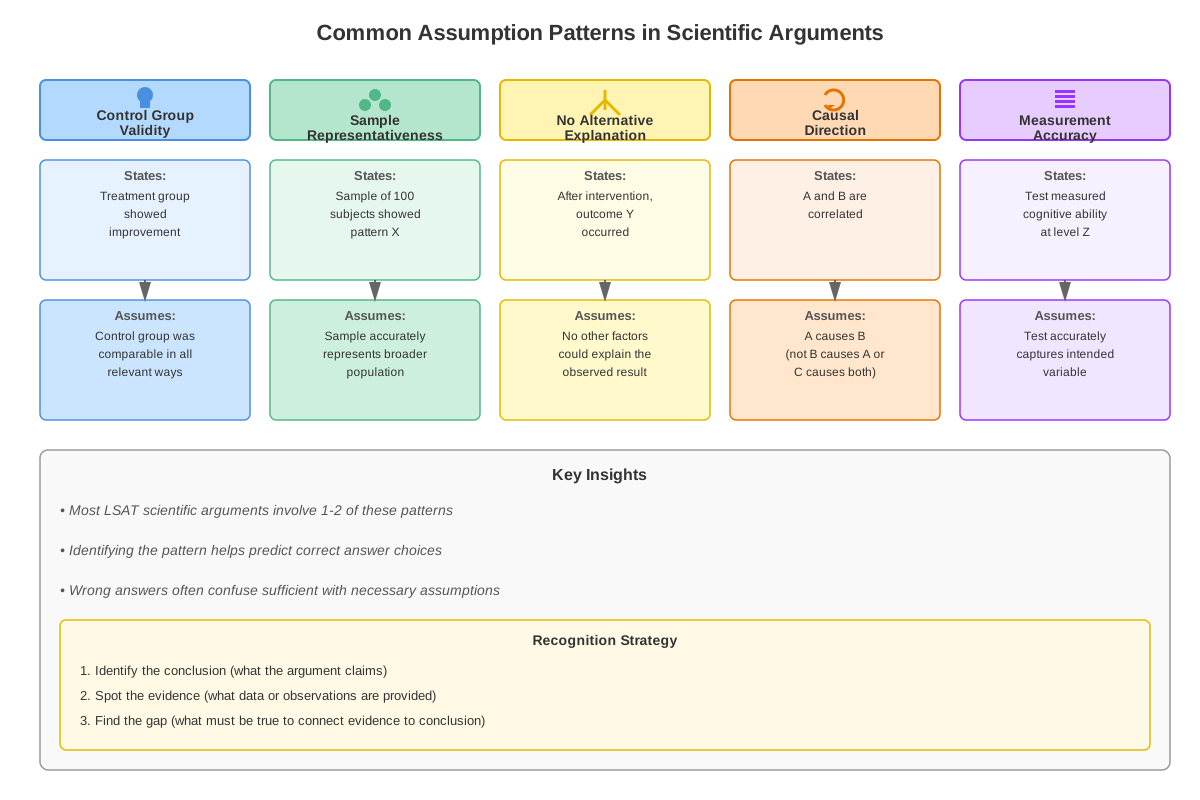
- [ ] Recognize common assumption patterns involving control groups, sample representativeness, and alternative explanations
- [ ] Evaluate whether a proposed assumption is necessary versus merely sufficient for a scientific argument's validity
Prerequisites
- Basic understanding of necessary versus sufficient assumptions: Scientific arguments require recognizing which unstated premises must be true for conclusions to follow logically
- Familiarity with causal reasoning patterns: Many scientific arguments establish or assume causal relationships between variables
- Knowledge of argument structure (premise-conclusion identification): Students must identify what evidence supports which claims before finding assumptions
- Understanding of conditional logic: Scientific hypotheses often involve if-then relationships that depend on unstated conditions
Why This Topic Matters
Scientific reasoning pervades modern discourse, from public health policy to environmental regulations to technological innovation. The LSAT tests scientific argument analysis because legal practice frequently requires evaluating expert testimony, understanding empirical evidence, and assessing the logical validity of research-based claims. Attorneys must identify weaknesses in scientific arguments presented in court, recognize when conclusions overreach available data, and understand what assumptions underlie expert opinions.
On the LSAT, scientific arguments appear in approximately 3-5 questions per test across both Logical Reasoning sections. These questions most commonly take the form of Necessary Assumption questions (asking what must be assumed), Sufficient Assumption questions (asking what would guarantee the conclusion), and Strengthen/Weaken questions (testing understanding of what the argument depends upon). Scientific passages also appear in Reading Comprehension sections, making this reasoning pattern valuable across multiple question types.
Scientific arguments typically appear in passages discussing research studies, experimental results, evolutionary biology, medical findings, psychological studies, or theoretical explanations in natural sciences. Common formats include: researcher conclusions based on experimental data, explanations for observed phenomena, predictions based on scientific theories, and critiques of previous research methodologies. The LSAT favors arguments where the gap between evidence and conclusion involves methodological concerns, alternative explanations, or interpretive leaps.
Core Concepts
The Nature of Scientific Assumptions
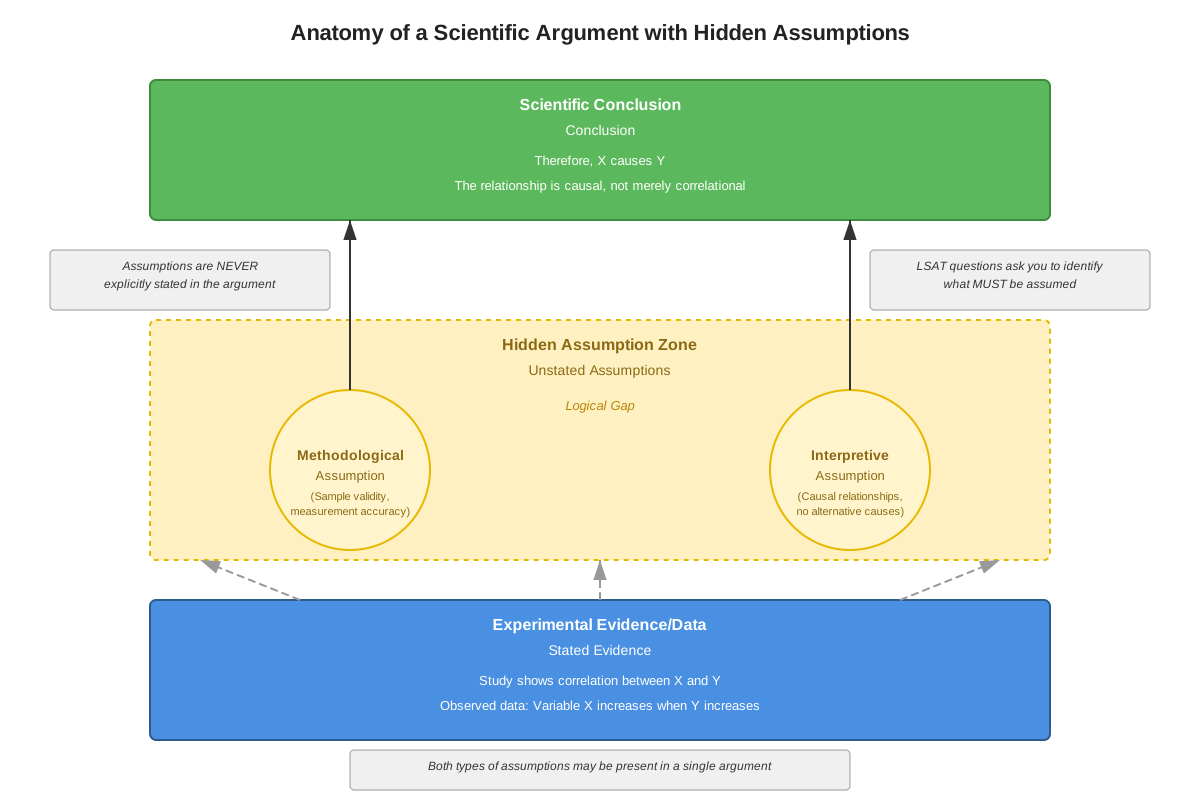
Assumptions in scientific arguments are unstated premises that bridge the gap between empirical observations and theoretical conclusions. Unlike everyday arguments, scientific reasoning involves specialized methodologies that introduce unique assumption categories. Every scientific argument on the LSAT contains at least one logical gap where the arguer takes something for granted without explicitly stating it.
Scientific assumptions typically fall into three categories: methodological assumptions (concerning how research was conducted), interpretive assumptions (concerning how data should be understood), and theoretical assumptions (concerning background scientific principles). Methodological assumptions involve claims about experimental design, sample selection, measurement accuracy, and control conditions. Interpretive assumptions concern whether observed correlations indicate causation, whether results generalize beyond the study sample, and whether alternative explanations have been ruled out. Theoretical assumptions invoke broader scientific principles or background knowledge.
Common Assumption Patterns in Scientific Arguments
Pattern 1: Representative Sample Assumptions
When researchers draw conclusions about a population based on a sample, they assume the sample accurately represents the larger group. LSAT questions exploit this by presenting studies where sample characteristics might differ systematically from the target population.
Structure: Study observes X in sample → Conclusion: X is true of population → Assumption: Sample represents population in relevant ways
Example: "A study of hospital patients found that 60% experienced side effects from Drug A. Therefore, most people who take Drug A will experience side effects." This assumes hospitalized patients respond to medications similarly to the general population—an assumption that could be false if hospitalized patients are systematically different (older, sicker, taking multiple medications).
Pattern 2: Control Group and Alternative Explanation Assumptions
Scientific experiments assume that control groups differ from experimental groups only in the variable being tested. Arguments also assume that no alternative explanation better accounts for observed results.
Structure: Group A (with treatment) differs from Group B (without treatment) → Conclusion: Treatment caused the difference → Assumption: No other relevant differences between groups; no alternative causes
Example: "Participants who exercised daily showed improved memory compared to those who didn't exercise. Therefore, exercise improves memory." This assumes the exercise group didn't differ in other relevant ways (diet, sleep, baseline health) and that no confounding variable (like increased social interaction during group exercise) actually caused the improvement.
Pattern 3: Measurement Validity Assumptions
Scientific arguments assume that measurement tools accurately capture the phenomenon being studied and that operational definitions align with theoretical concepts.
Structure: Measurement M indicates phenomenon P → Conclusion about P → Assumption: M validly measures P
Example: "Subjects who scored higher on the happiness questionnaire reported fewer health problems. Therefore, happiness promotes health." This assumes the questionnaire accurately measures happiness (not just temporary mood or social desirability bias) and that self-reported health problems reflect actual health status.
Pattern 4: Causal Direction and Mechanism Assumptions
When arguments claim one variable causes another based on correlation, they assume the causal direction is correct and that a plausible mechanism exists.
Structure: X correlates with Y → Conclusion: X causes Y → Assumption: Y doesn't cause X; no third factor causes both; causal mechanism exists
Example: "Countries with higher chocolate consumption have more Nobel Prize winners per capita. Therefore, chocolate consumption enhances cognitive abilities leading to scientific achievement." This assumes chocolate causes achievement rather than wealth causing both chocolate consumption and educational opportunities.
Pattern 5: Generalization and Scope Assumptions
Scientific conclusions often generalize from specific conditions to broader contexts, assuming relevant conditions remain constant.
Structure: Finding under conditions C → Conclusion applies to conditions D → Assumption: Relevant factors are similar between C and D
Example: "Laboratory mice on high-fat diets developed diabetes. Therefore, high-fat diets cause diabetes in humans." This assumes mouse metabolism sufficiently resembles human metabolism regarding fat processing and diabetes development.
The Negation Test for Scientific Assumptions
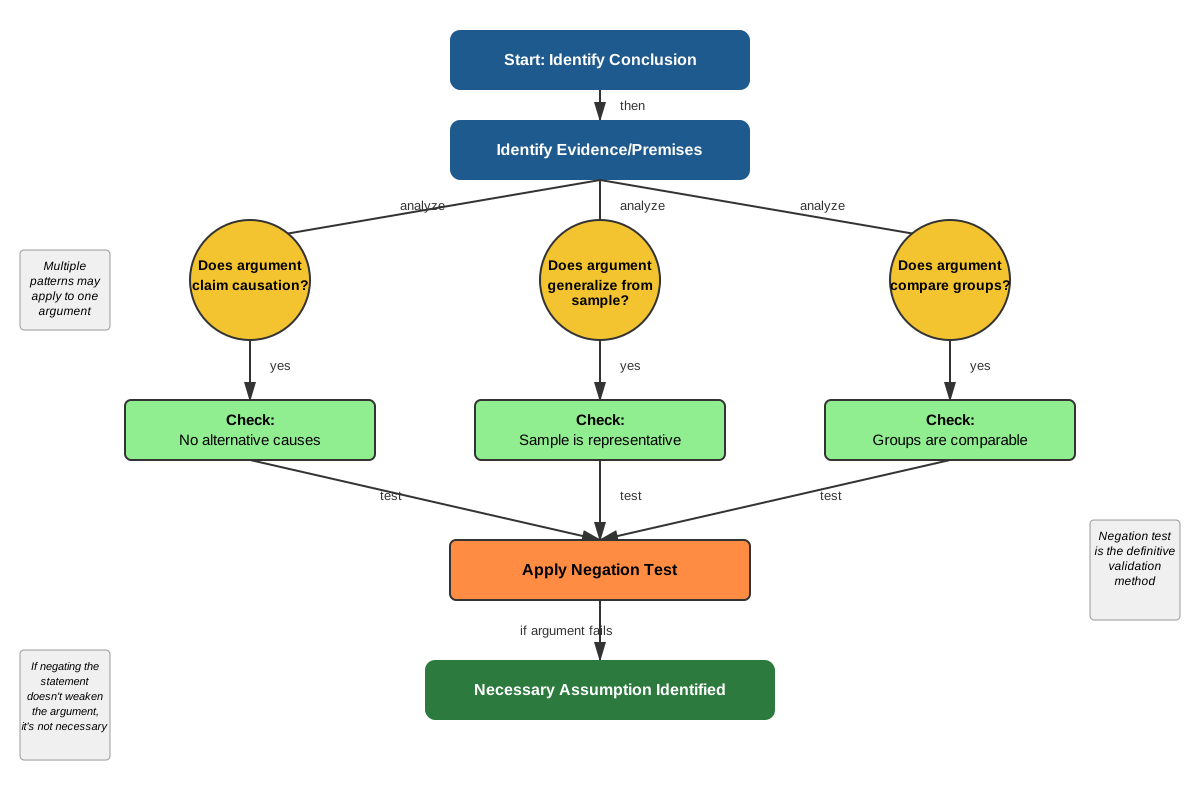
The negation test proves especially valuable for scientific arguments. If negating a statement would make the argument's conclusion illogical or unsupported, that statement is a necessary assumption. For scientific arguments, negating methodological assumptions typically reveals that the evidence no longer supports the conclusion.
Application process:
- Identify the conclusion and evidence
- Locate the logical gap
- Formulate a potential assumption
- Negate that assumption
- Determine whether the negated version destroys the argument
Example: "Patients given Medication X recovered faster than those given a placebo. Therefore, Medication X is effective." Potential assumption: "The faster recovery wasn't due to differences in patient expectations." Negation: "The faster recovery WAS due to differences in patient expectations." If true, this negation would mean the medication itself wasn't responsible, destroying the argument—confirming this is a necessary assumption.
Scientific Terminology and Assumption Triggers
Certain scientific terms signal specific assumption patterns:
| Term/Phrase | Typical Assumption Pattern |
|---|---|
| "The study shows..." | Sample represents population; measurements are valid |
| "This explains why..." | No better alternative explanation exists |
| "Therefore, X causes Y" | Correlation indicates causation; causal direction is correct |
| "The experiment demonstrates..." | Control conditions were adequate; no confounding variables |
| "Researchers concluded..." | Data interpretation is correct; no measurement errors |
| "This suggests..." | Observed pattern is not coincidental; mechanism exists |
Concept Relationships
The concepts within scientific assumption analysis form an interconnected system. Methodological assumptions (about how research was conducted) directly influence interpretive assumptions (about what results mean). For example, if a study lacks proper controls (methodological issue), then assuming the treatment caused observed effects (interpretive assumption) becomes problematic.
Representative sample assumptions connect to generalization assumptions—if the sample doesn't represent the population, then generalizing findings becomes invalid. Similarly, measurement validity assumptions underlie causal mechanism assumptions—if measurements don't capture the intended phenomenon, causal claims become unsupported.
The relationship map flows as follows:
Experimental Design → determines → Data Quality → constrains → Valid Interpretations → support → Theoretical Conclusions
Each arrow represents an assumption-rich transition. Arguments can fail at any stage: poor design undermines data quality, flawed data prevents valid interpretation, and interpretive leaps produce unsupported conclusions.
These scientific assumption patterns connect to prerequisite knowledge of causal reasoning (understanding how cause-effect claims require assumptions about alternative explanations) and necessary versus sufficient conditions (distinguishing what must be true from what would guarantee truth). They also relate to Strengthen/Weaken questions (where understanding assumptions reveals what would support or undermine arguments) and Flaw questions (where unwarranted assumptions constitute logical errors).
High-Yield Facts
⭐ Scientific arguments on the LSAT almost always contain assumptions about whether observed correlations indicate causation rather than mere association
⭐ When a study compares two groups, the argument assumes no relevant differences exist between groups except the variable being tested
⭐ Conclusions generalizing from samples to populations assume the sample represents the population in all relevant characteristics
⭐ Arguments claiming one variable causes another assume the causal direction is correct (X causes Y, not Y causes X or Z causes both)
⭐ Scientific conclusions assume measurement tools validly capture the phenomena they purport to measure
- Arguments explaining observed phenomena assume no better alternative explanation exists
- Studies involving self-reported data assume participants accurately report their experiences and behaviors
- Experimental conclusions assume that control conditions adequately isolated the variable of interest
- Longitudinal studies assume that observed changes over time result from the studied variable rather than maturation, historical events, or measurement changes
- Meta-analyses and literature reviews assume that included studies used comparable methodologies and measured similar constructs
- Arguments about mechanisms assume that proposed causal pathways are biologically, physically, or logically plausible
Quick check — test yourself on Assumption in scientific arguments so far.
Try Flashcards →Common Misconceptions
Misconception: If a study uses a large sample size, no assumptions about representativeness are necessary → Correction: Sample size addresses statistical power and random error but doesn't eliminate systematic bias. A study of 10,000 college students still cannot generalize to all adults without assuming college students represent the broader population in relevant ways.
Misconception: Scientific arguments with control groups make no assumptions about alternative explanations → Correction: Control groups address some confounding variables but cannot eliminate all alternatives. Arguments still assume that unmeasured variables don't account for observed differences and that the control condition truly isolates the variable of interest.
Misconception: Correlation never implies causation, so any causal claim from correlational data is automatically flawed → Correction: While correlation alone is insufficient for causation, correlational evidence combined with proper assumptions (temporal precedence, no plausible alternatives, theoretical mechanism) can support causal claims. The LSAT tests whether necessary assumptions are present, not whether correlation categorically proves causation.
Misconception: Statistical significance means a finding is practically important or that the measured effect is large → Correction: Statistical significance indicates that results are unlikely due to chance but says nothing about effect size or practical importance. Arguments assuming significant findings matter practically make an additional assumption beyond statistical inference.
Misconception: If researchers are experts, their interpretations require no assumptions → Correction: Expert conclusions still depend on assumptions about methodology, measurement, and interpretation. The LSAT frequently presents expert conclusions that rest on questionable assumptions, testing whether students can identify logical gaps regardless of source credibility.
Misconception: Necessary assumptions must be explicitly stated somewhere in the passage → Correction: By definition, assumptions are unstated premises. The LSAT tests the ability to identify what must be true for an argument to work, even when the passage never mentions these premises.
Worked Examples
Example 1: Representative Sample and Generalization
Passage: "A recent study examined 500 adults who regularly visit fitness centers and found that 80% reported sleeping at least 7 hours per night. The researchers concluded that most adults get adequate sleep."
Question: Which of the following is an assumption required by the researchers' argument?
Analysis:
Step 1 - Identify the conclusion: Most adults get adequate sleep (at least 7 hours)
Step 2 - Identify the evidence: 80% of 500 fitness center visitors sleep at least 7 hours nightly
Step 3 - Locate the logical gap: The evidence concerns fitness center visitors, but the conclusion concerns all adults. The argument leaps from a specific sample to a general population.
Step 4 - Identify the assumption pattern: This is a representative sample assumption. The argument assumes fitness center visitors represent adults generally regarding sleep patterns.
Step 5 - Apply the negation test: If fitness center visitors do NOT represent adults generally in sleep patterns—perhaps they're more health-conscious and sleep better than typical adults—then the evidence wouldn't support the conclusion about most adults.
Required Assumption: Adults who regularly visit fitness centers are representative of adults generally with respect to sleep patterns.
Alternative formulations the LSAT might use:
- "Adults who don't visit fitness centers have sleep patterns similar to those who do"
- "The sample studied was not biased toward adults with better-than-average sleep habits"
- "Fitness center visitors are not systematically different from other adults regarding sleep"
Connection to learning objectives: This example demonstrates how scientific arguments appear in LSAT questions (presenting research conclusions), explains the reasoning pattern (sample-to-population generalization), and shows how to apply assumption analysis to solve problems accurately.
Example 2: Alternative Explanation and Causal Direction
Passage: "Researchers found that children who read frequently score higher on vocabulary tests than children who read infrequently. The researchers concluded that reading causes vocabulary growth. They recommend that parents encourage children to read more to improve their vocabulary."
Question: The researchers' argument depends on assuming which of the following?
Analysis:
Step 1 - Identify the conclusion: Reading causes vocabulary growth (implied by the recommendation that reading will improve vocabulary)
Step 2 - Identify the evidence: Correlation between reading frequency and vocabulary test scores
Step 3 - Locate the logical gap: The evidence shows correlation, but the conclusion claims causation. Multiple assumption gaps exist: causal direction, alternative explanations, and mechanism.
Step 4 - Identify assumption patterns:
- Causal direction assumption: Reading causes vocabulary rather than existing vocabulary causing more reading (children with better vocabularies might enjoy reading more)
- Alternative explanation assumption: No third factor causes both (perhaps parental education level causes both more reading and better vocabulary)
- Mechanism assumption: Reading provides vocabulary exposure that translates to test performance
Step 5 - Apply the negation test: If children with larger vocabularies are simply more likely to enjoy reading (reverse causation), then increasing reading wouldn't necessarily improve vocabulary—the conclusion would fail.
Required Assumptions (any of these could be correct answers):
- "Having a larger vocabulary does not make children more likely to read frequently"
- "There is no factor other than reading that accounts for both reading frequency and vocabulary scores"
- "The vocabulary children encounter while reading contributes to their performance on vocabulary tests"
Why wrong answers fail:
- "All children have equal access to books" - Not necessary; the argument works even if access varies, as long as reading causes vocabulary growth
- "Vocabulary tests accurately measure all aspects of language ability" - Too broad; the argument only requires that tests measure vocabulary, not all language ability
- "Children who read frequently read more challenging material" - Not necessary; even if all children read similar material, reading frequency could still cause vocabulary differences
Connection to learning objectives: This example shows the causal reasoning pattern common in scientific arguments and demonstrates how to distinguish necessary from unnecessary assumptions.
Exam Strategy
Approaching Scientific Assumption Questions
Step 1 - Identify the argument type: Recognize scientific contexts through trigger words: "study," "research," "experiment," "scientists," "data," "findings," "concluded." These signal that specialized assumption patterns likely apply.
Step 2 - Map the evidence-to-conclusion structure: Scientific arguments typically follow this pattern: [Empirical observation/data] → [Interpretation/explanation] → [Broader conclusion/recommendation]. The gaps between these stages contain assumptions.
Step 3 - Anticipate assumption categories: Before reading answer choices, predict which assumption pattern applies:
- Sample study → Population conclusion = Representative sample assumption
- Correlation observed → Causation claimed = Causal direction/alternative explanation assumption
- Measurement reported → Phenomenon concluded = Measurement validity assumption
- Experimental difference → Treatment effect = Control group/confounding variable assumption
Step 4 - Use the negation test strategically: For Necessary Assumption questions, negate answer choices. The correct answer, when negated, will destroy the argument. For Sufficient Assumption questions, the correct answer will guarantee the conclusion when added to the premises.
Trigger Words and Phrases
High-priority triggers indicating assumption gaps:
- "Therefore" / "Thus" / "Hence" - Marks the conclusion; check what evidence actually supports it
- "Shows that" / "Demonstrates that" / "Proves that" - Strong claims requiring strong assumptions
- "Explains why" - Assumes no better alternative explanation exists
- "Suggests" / "Indicates" - Weaker claims but still require assumptions about data interpretation
- "Most" / "Many" / "Generally" - Quantitative claims requiring representative sample assumptions
Methodological red flags:
- Any mention of sample size without discussion of sample composition
- Comparison groups without explicit statement of how groups were matched
- Self-reported data without acknowledgment of reporting accuracy
- Single study conclusions without mention of replication
- Correlation language ("associated with," "related to") followed by causal conclusions
Process of Elimination Tips
Eliminate answers that:
- Go beyond necessity: If the argument works without assuming something, it's not necessary. Test: "Could the conclusion follow even if this weren't true?"
- Reverse the logic: Some wrong answers state the conclusion or evidence rather than an assumption bridging them.
- Address irrelevant factors: Scientific arguments have specific scopes. Assumptions about factors outside that scope are typically incorrect.
- Are too extreme: Necessary assumptions are usually modest. Answers with "all," "every," "never," or "only" are often too strong unless the conclusion itself is that extreme.
- Confuse sufficient with necessary: For Necessary Assumption questions, eliminate answers that would strengthen the argument but aren't required for it to work.
Time Allocation
Scientific assumption questions typically require 1:15-1:45 minutes. Allocate time as follows:
- 20-30 seconds: Read and understand the passage
- 15-20 seconds: Identify conclusion and evidence, predict assumption type
- 30-45 seconds: Evaluate answer choices using negation test or logical analysis
- 10-15 seconds: Verify the selected answer and move on
Exam Tip: If stuck between two answers on a scientific assumption question, check which one addresses a more fundamental gap. Methodological assumptions (about how the study was conducted) are typically more fundamental than interpretive assumptions (about what results mean).
Memory Techniques
SCREAM Acronym for Scientific Assumption Categories:
- Sample representativeness
- Control groups and confounding variables
- Reverse causation (causal direction)
- Explanation alternatives
- Accuracy of measurement
- Mechanism plausibility
Visualization Strategy: Picture a bridge with gaps. The evidence is one side, the conclusion is the other. Assumptions are the missing planks. Ask: "What plank must be in place for someone to cross from evidence to conclusion?" This metaphor helps identify necessary versus merely helpful assumptions.
The "What If Not?" Technique: For any potential assumption, immediately ask "What if this weren't true?" If the argument would collapse, you've found a necessary assumption. Practice this reflexively until it becomes automatic.
Causal Assumption Checklist (memorize this sequence):
- Does X actually cause Y? (not just correlate)
- Does Y cause X instead? (reverse causation)
- Does Z cause both X and Y? (common cause)
- Is there a plausible mechanism? (how could X cause Y?)
- Are there alternative explanations? (other ways to account for observations)
Sample Assumption Mnemonic - "REPS":
- Representative of population
- Enough subjects (adequate sample size)
- Proper selection (not biased sampling)
- Similar in relevant ways (to target population)
Summary
Assumption in scientific arguments represents a high-yield LSAT topic requiring students to identify unstated premises connecting empirical evidence to theoretical conclusions. Scientific arguments introduce specialized assumption patterns involving methodological concerns (sample representativeness, control groups, measurement validity), interpretive issues (causal direction, alternative explanations), and theoretical claims (mechanism plausibility, generalization scope). Success requires recognizing common patterns: representative sample assumptions when studies generalize from samples to populations, control group assumptions when experiments compare treatment and non-treatment groups, causal direction assumptions when arguments claim one variable causes another based on correlation, measurement validity assumptions when operational definitions stand in for theoretical constructs, and alternative explanation assumptions when arguments explain observed phenomena. The negation test proves especially valuable—if negating a statement destroys the argument, that statement is a necessary assumption. Students must distinguish necessary assumptions (what must be true) from sufficient assumptions (what would guarantee the conclusion) and recognize that scientific expertise doesn't eliminate logical gaps. Mastering this topic requires understanding both general logical principles and domain-specific scientific reasoning patterns.
Key Takeaways
- Scientific arguments on the LSAT contain predictable assumption patterns involving samples, controls, causation, measurement, and alternative explanations
- Representative sample assumptions bridge the gap between study samples and population conclusions—the sample must represent the population in relevant characteristics
- Causal claims from correlational evidence require assumptions about causal direction, alternative explanations, and plausible mechanisms
- The negation test reliably identifies necessary assumptions: if negating a statement destroys the argument, that statement is necessary
- Control groups and experimental designs assume no confounding variables and no relevant differences between groups except the studied variable
- Measurement validity assumptions underlie all empirical claims—instruments must actually capture the phenomena they purport to measure
- Scientific authority doesn't eliminate assumption gaps; expert conclusions still depend on unstated premises about methodology and interpretation
Related Topics
Strengthen and Weaken Questions with Scientific Arguments: Understanding assumptions enables prediction of what would strengthen (confirming assumptions) or weaken (undermining assumptions) scientific arguments. Mastering assumption identification directly improves performance on these related question types.
Flaw Questions in Scientific Reasoning: Many flaws in LSAT arguments involve unwarranted assumptions. Scientific arguments commonly commit the correlation-causation flaw, sampling bias flaw, and alternative explanation flaw—all rooted in missing assumptions.
Method of Reasoning Questions: These questions ask how arguments proceed, often describing assumption-dependent reasoning patterns like "generalizes from a sample to a population" or "infers a causal relationship from a correlation."
Parallel Reasoning with Scientific Arguments: Recognizing assumption patterns helps identify structurally similar arguments, even across different content domains.
Principle Questions: Scientific methodology principles (like "correlation doesn't prove causation" or "samples must represent populations") appear in Principle questions, requiring understanding of the assumptions underlying these principles.
Practice CTA
Now that you understand how assumptions function in scientific arguments, you're ready to apply these concepts to actual LSAT questions. The practice questions and flashcards will reinforce the assumption patterns covered in this guide and help you develop the rapid pattern recognition essential for test day success. Focus especially on using the negation test and identifying which assumption category each question tests. Remember: every scientific argument on the LSAT contains at least one significant assumption gap—your job is to find it quickly and accurately. With deliberate practice, these patterns will become second nature, allowing you to approach scientific reasoning questions with confidence and precision.
Sign up free to keep reading
Create a free AnvayaPrep account to finish this LSAT guide on Assumption in scientific arguments — plus flashcards and practice questions.