Overview
Assumption in statistical arguments represents one of the most frequently tested and challenging question types within LSAT Logical Reasoning sections. Statistical arguments present numerical data, percentages, surveys, or studies to support a conclusion, but these arguments invariably rest on unstated premises about how the data was collected, what it represents, and how it applies to the conclusion being drawn. The LSAT tests whether students can identify these hidden assumptions—the logical gaps between statistical evidence and the conclusions drawn from that evidence.
Understanding assumptions in statistical arguments is essential for LSAT success because these questions appear in multiple forms across both Logical Reasoning sections. Test-makers favor statistical arguments because they mirror real-world reasoning patterns found in legal, business, and policy contexts where attorneys must evaluate evidence, identify weaknesses in opposing arguments, and construct sound reasoning from data. A single LSAT administration typically includes 3-5 questions directly involving statistical reasoning, making this a high-yield topic that can significantly impact overall scores.
This topic builds upon fundamental assumption question skills while adding layers of complexity specific to numerical and survey-based reasoning. Students must not only identify logical gaps but also recognize common statistical fallacies such as sampling bias, representativeness issues, temporal changes, and causation-correlation confusion. Mastering assumption questions involving statistics provides a foundation for tackling strengthen, weaken, and flaw questions that similarly involve numerical evidence, creating a multiplier effect on overall Logical Reasoning performance.
Learning Objectives
- [ ] Identify how Assumption in statistical arguments appears in LSAT questions
- [ ] Explain the reasoning pattern behind Assumption in statistical arguments
- [ ] Apply Assumption in statistical arguments to solve LSAT-style problems accurately
- [ ] Distinguish between necessary and sufficient assumptions in statistical contexts
- [ ] Recognize the five most common statistical assumption patterns tested on the LSAT
- [ ] Evaluate answer choices using the negation technique for statistical assumptions
- [ ] Predict likely assumptions before reviewing answer choices in statistical arguments
Prerequisites
- Basic Assumption Question Structure: Understanding what assumptions are (unstated premises that must be true for an argument to work) is fundamental because statistical assumptions follow the same logical framework with added numerical complexity.
- Argument Components (Premise, Conclusion, Evidence): Recognizing how arguments are constructed allows students to identify where statistical evidence ends and where inferential leaps begin, which is where assumptions hide.
- Conditional Reasoning Basics: Many statistical assumptions involve conditional relationships (if X represents Y, then conclusions about Y are valid), making conditional logic skills directly applicable.
- Causation vs. Correlation: Statistical arguments frequently confuse these concepts, and recognizing this distinction helps identify assumption gaps.
Why This Topic Matters
Statistical reasoning permeates legal practice, from evaluating expert testimony and survey evidence in litigation to analyzing policy data and market research in corporate law. Attorneys must constantly assess whether numerical evidence actually supports the conclusions drawn from it, making this skill directly relevant to legal education and practice. The LSAT tests this competency because it predicts success in law school case analysis and legal writing.
On the LSAT, statistical arguments appear in approximately 15-20% of all Logical Reasoning questions across both sections. These questions manifest as:
- Necessary Assumption questions asking what must be true for statistical evidence to support a conclusion
- Sufficient Assumption questions requiring identification of what would guarantee a statistical argument's validity
- Flaw questions where the error involves misuse of statistical data
- Strengthen/Weaken questions targeting the reliability or applicability of statistical evidence
Statistical arguments are particularly high-yield because they follow predictable patterns. Once students internalize the common assumption types—sampling representativeness, temporal stability, definitional consistency, response accuracy, and causal mechanisms—they can quickly identify gaps and eliminate wrong answers. Test-makers favor these questions because they efficiently separate students who think critically about evidence from those who accept numerical data at face value.
Core Concepts
The Nature of Statistical Assumptions
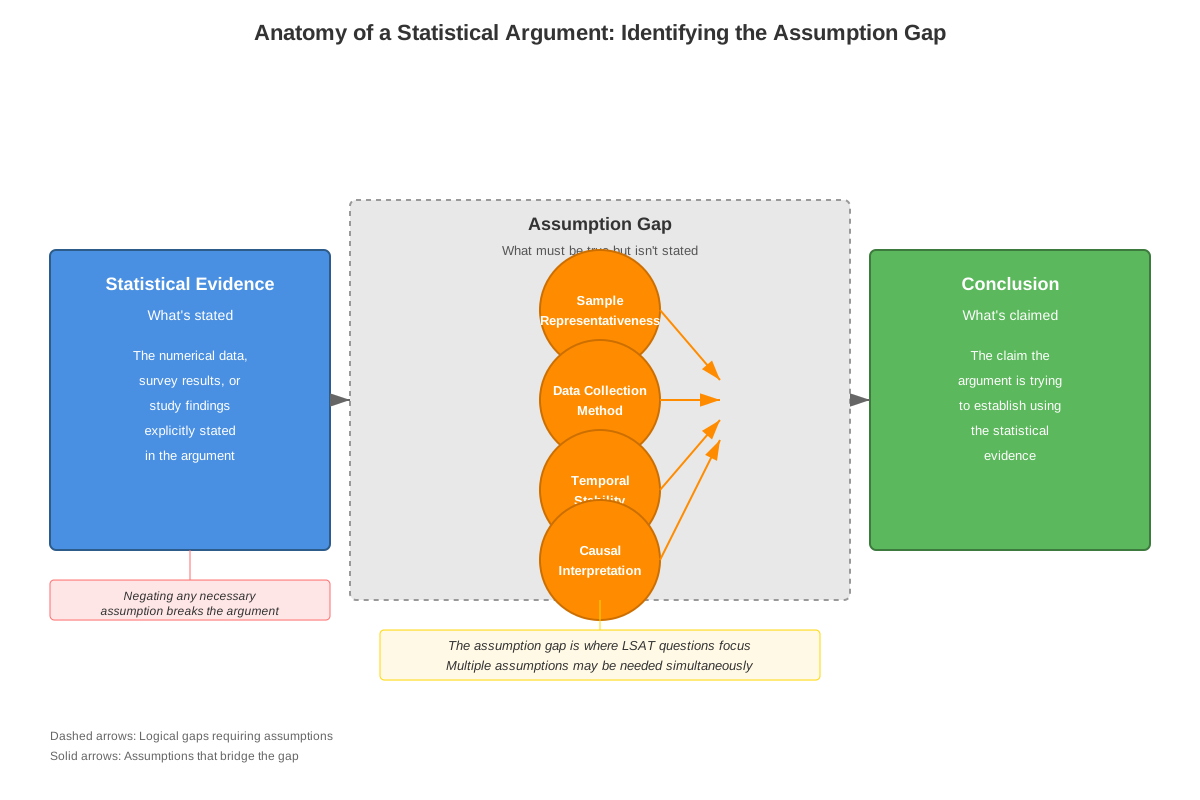
An assumption in statistical arguments is an unstated premise that bridges the gap between numerical data and the conclusion drawn from that data. Unlike assumptions in purely logical arguments, statistical assumptions typically concern the quality, representativeness, or applicability of the data itself. Every statistical argument on the LSAT contains at least one—and often multiple—unstated premises about how the data was gathered, what it represents, or how it connects to the conclusion.
The fundamental pattern follows this structure:
- Statistical Evidence: A study, survey, percentage, or numerical comparison is presented
- Conclusion: A claim is made based on this evidence
- Assumption Gap: Unstated premises about data quality, representativeness, or applicability must be true for the conclusion to follow
For example, if an argument states "70% of surveyed doctors recommend Brand X, therefore Brand X is the best choice for most patients," the assumption gap includes premises about whether surveyed doctors represent all doctors, whether "recommend" means "best," and whether what's true for doctors' recommendations translates to what's best for patients.
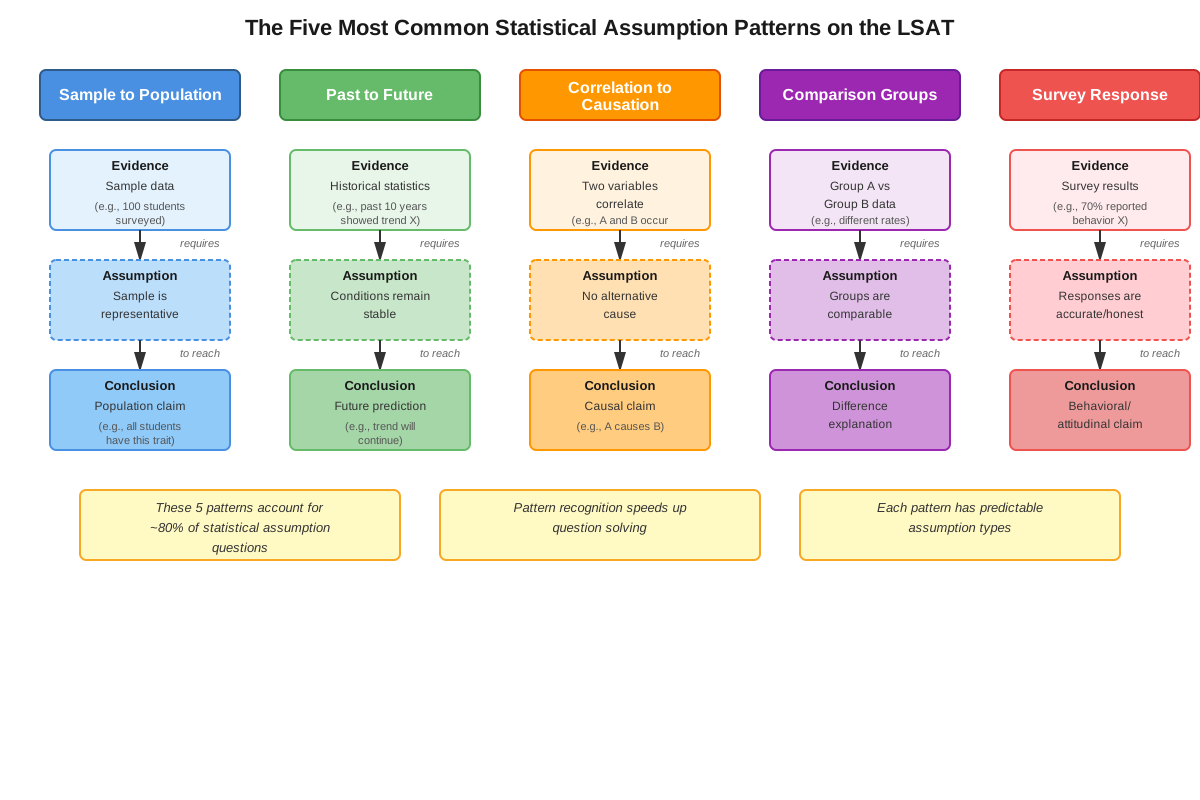
Five Core Statistical Assumption Patterns
1. Sampling Representativeness
The most frequently tested assumption pattern involves whether a sample accurately represents the population about which conclusions are drawn. Arguments present data from a subset (sample) and draw conclusions about a larger group (population), assuming without stating that the sample mirrors the population's relevant characteristics.
Key assumption structure: The sample studied has the same relevant characteristics as the population to which the conclusion applies.
Example indicators:
- "A survey of 500 residents found..."
- "In a study of college students..."
- "Among participants who volunteered..."
The assumption gap typically involves:
- Whether the sample was randomly selected
- Whether the sample size is adequate
- Whether the sample demographics match the target population
- Whether self-selection bias affects results
2. Temporal Stability
Statistical arguments often assume that data collected at one time remains valid at another time. When an argument uses past data to draw conclusions about the present or future, it assumes no relevant changes have occurred in the interim.
Key assumption structure: Conditions that existed when data was collected remain substantially unchanged at the time of the conclusion.
Example indicators:
- "A 2015 study showed..."
- "Historical data indicates..."
- "Previous surveys found..."
The assumption gap typically involves:
- Whether market conditions have changed
- Whether technology has evolved
- Whether population characteristics have shifted
- Whether regulations or policies have been modified
3. Definitional and Measurement Consistency
Arguments assume that terms, categories, and measurements mean the same thing across different contexts or time periods. When comparing statistics or applying data to conclusions, the argument presumes consistent definitions and measurement methods.
Key assumption structure: The way terms are defined and measured in the data matches how they're used in the conclusion.
Example indicators:
- Comparing statistics from different sources
- Using technical terms without definition
- Applying data to differently worded conclusions
The assumption gap typically involves:
- Whether "success" means the same thing in study and conclusion
- Whether categories (e.g., "small business") use consistent criteria
- Whether measurement methods remained constant
- Whether rating scales are comparable
4. Response Accuracy and Honesty
When arguments rely on self-reported data, surveys, or interviews, they assume respondents provided accurate, honest, and complete information. This assumption becomes critical when conclusions depend on the truthfulness of reported behaviors, preferences, or beliefs.
Key assumption structure: Survey respondents accurately reported their true behaviors, beliefs, or characteristics.
Example indicators:
- "Participants reported that..."
- "Survey respondents indicated..."
- "When asked, consumers stated..."
The assumption gap typically involves:
- Whether respondents had incentive to misrepresent
- Whether respondents accurately remembered past events
- Whether social desirability bias affected responses
- Whether respondents understood questions correctly
5. Causal Mechanism and Alternative Explanations
Statistical correlations or associations assume a particular causal relationship exists, ruling out alternative explanations for observed patterns. When data shows two things occurring together, arguments often assume one causes the other without stating this explicitly.
Key assumption structure: The observed statistical relationship reflects the causal mechanism claimed in the conclusion, not alternative explanations.
Example indicators:
- "After implementing policy X, outcome Y increased..."
- "Companies that do X have higher rates of Y..."
- "Regions with more X show greater Y..."
The assumption gap typically involves:
- Whether correlation implies causation
- Whether a third factor explains both variables
- Whether reverse causation might apply
- Whether the relationship is coincidental
Statistical Assumption Question Stems
Recognizing question stems helps identify when statistical assumption skills apply:
- "Which one of the following is an assumption required by the argument?"
- "The argument depends on assuming which one of the following?"
- "The argument relies on which one of the following?"
- "Which one of the following, if assumed, allows the conclusion to be properly drawn?"
When these stems accompany arguments containing numerical data, percentages, studies, or surveys, statistical assumption patterns almost certainly apply.
The Negation Technique for Statistical Assumptions
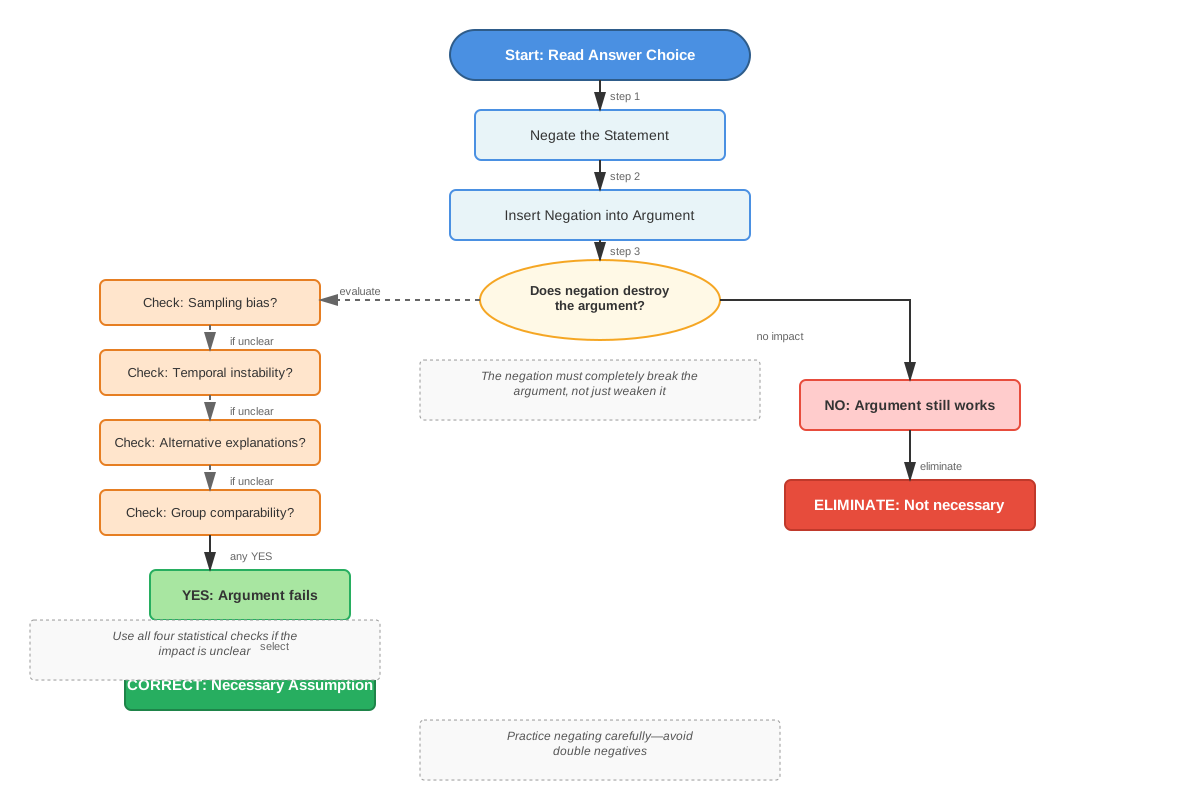
The negation technique proves especially powerful for statistical assumptions. To test whether an answer choice states a necessary assumption:
- Negate the answer choice (make it false)
- If negating it destroys the argument, it's a necessary assumption
- If the argument still works when negated, it's not necessary
For statistical arguments, negation often reveals hidden dependencies on data quality or applicability. For example, if an answer choice states "The sample was representative of the general population," negating it to "The sample was NOT representative" would destroy any argument drawing population-level conclusions from sample data.
Concept Relationships
The five core statistical assumption patterns interconnect and often appear together in single arguments. Sampling representativeness forms the foundation—if a sample doesn't represent the population, other assumptions become irrelevant. Temporal stability builds on representativeness by adding a time dimension: even if a sample was representative when studied, it must remain representative when conclusions are applied. Definitional consistency ensures that what was measured in the sample matches what the conclusion discusses. Response accuracy addresses data quality within the sample itself. Causal mechanisms represent the final inferential leap from correlation to causation.
These concepts connect to broader logical reasoning principles. Statistical assumptions are specialized applications of general assumption identification skills, requiring the same gap-finding approach but with added attention to numerical evidence quality. They relate closely to strengthen and weaken questions because assumptions represent vulnerabilities—points where additional evidence could support or undermine the argument.
The relationship map flows as follows:
General Assumption Skills → Statistical Context → Five Pattern Recognition → Answer Choice Evaluation → Negation Testing → Correct Answer Selection
Each statistical assumption also connects to common logical fallacies: sampling issues relate to hasty generalization, temporal issues to false analogy, definitional problems to equivocation, response accuracy to appeal to unreliable authority, and causal assumptions to post hoc reasoning.
High-Yield Facts
⭐ Statistical arguments on the LSAT almost always contain unstated assumptions about sample representativeness, making this the first assumption pattern to consider.
⭐ When an argument compares statistics from different time periods, assume temporal stability is the key assumption gap.
⭐ Self-reported survey data requires assuming respondents answered honestly and accurately, especially regarding socially sensitive topics.
⭐ The negation technique works exceptionally well for statistical assumptions—negating the correct answer will destroy the argument's validity.
⭐ Correlation presented as evidence for causation always requires assuming no alternative explanations exist for the observed relationship.
- Arguments using volunteer samples assume volunteers don't differ from non-volunteers in relevant ways.
- When statistics use technical or undefined terms, the argument assumes readers interpret terms as intended.
- Percentage increases or decreases assume the baseline measurements use consistent methodology.
- Comparative statistics assume the groups being compared are similar in all relevant respects except the variable being studied.
- Arguments projecting future trends from past data assume underlying conditions will remain stable.
- Sample size adequacy is rarely the primary assumption—LSAT focuses more on sample composition than size.
- When arguments cite "studies show" without details, they assume the studies were methodologically sound.
- Statistical arguments about effectiveness assume the measured outcomes reflect the intended goals.
- Arguments using average or median statistics assume these measures appropriately represent the distribution.
- Cross-cultural or cross-regional statistical comparisons assume relevant similarities between populations.
Quick check — test yourself on Assumption in statistical arguments so far.
Try Flashcards →Common Misconceptions
Misconception: Statistical arguments always assume the sample size was large enough.
Correction: While sample size matters in real statistics, the LSAT rarely tests this. Instead, focus on sample composition, representativeness, and whether the sample matches the population about which conclusions are drawn. A large but biased sample is more problematic than a small representative one.
Misconception: Every statistical argument requires assuming causation from correlation.
Correction: Only arguments that explicitly or implicitly claim a causal relationship require this assumption. Many statistical arguments simply describe associations or make predictions without claiming one variable causes another. Read carefully to determine whether causation is actually claimed.
Misconception: The correct answer will always mention statistics, numbers, or data explicitly.
Correction: Correct assumptions often address underlying logical relationships without using statistical terminology. An assumption might discuss "similarity between groups" without mentioning samples or populations, or address "consistency over time" without referencing specific dates.
Misconception: If an answer choice is true, it must be a necessary assumption.
Correction: Necessary assumptions must be true for the argument to work, but not everything true about the argument is necessary. Use the negation technique: only if negating the statement destroys the argument is it truly necessary.
Misconception: Statistical assumptions are always about methodology or data collection.
Correction: While many statistical assumptions concern data quality, others address how data applies to conclusions, what terms mean, or whether alternative explanations exist. The assumption gap might be in the inferential leap from data to conclusion rather than in the data itself.
Misconception: More complex or technical-sounding answer choices are more likely correct.
Correction: The LSAT often makes incorrect answers sound sophisticated while correct answers state simple, fundamental assumptions. Don't be seduced by statistical jargon—focus on what the argument actually needs to be true.
Misconception: All five statistical assumption patterns appear in every statistical argument.
Correction: Most arguments have one or two primary assumption gaps. Trying to find all five patterns wastes time. Identify the main inferential leap from evidence to conclusion, then determine which assumption pattern(s) bridge that specific gap.
Worked Examples
Example 1: Sampling Representativeness
Argument: "A recent survey of 1,000 smartphone users found that 65% prefer larger screens over smaller ones. Therefore, smartphone manufacturers should prioritize producing phones with larger screens to meet consumer demand."
Question: Which one of the following is an assumption required by the argument?
Analysis:
Step 1: Identify the statistical evidence and conclusion
- Evidence: Survey of 1,000 smartphone users showing 65% prefer larger screens
- Conclusion: Manufacturers should prioritize larger screens to meet consumer demand
Step 2: Locate the assumption gap
The argument moves from "surveyed users prefer X" to "manufacturers should produce X for consumers." This requires assuming the surveyed users represent the broader consumer market.
Step 3: Predict the assumption
The survey respondents must be representative of the general smartphone-buying population. If they're not representative (e.g., if only tech enthusiasts were surveyed), the conclusion doesn't follow.
Step 4: Evaluate answer choices (hypothetical)
(A) "Larger screens do not significantly increase manufacturing costs."
- This addresses feasibility, not whether the data supports the conclusion. Negating it (larger screens DO increase costs) doesn't destroy the logical connection between survey data and consumer demand—it just adds a practical consideration. NOT NECESSARY.
(B) "The preferences of the surveyed smartphone users reflect the preferences of smartphone consumers generally."
- This directly addresses representativeness. Negating it: "The surveyed users do NOT reflect general consumers." If true, the survey tells us nothing about what manufacturers should produce for the broader market. The argument collapses. NECESSARY ASSUMPTION.
(C) "Screen size is the most important factor in smartphone purchasing decisions."
- The argument only claims manufacturers should prioritize larger screens, not that screen size is THE most important factor. This overstates what's needed. NOT NECESSARY.
(D) "All smartphone users who prefer larger screens will purchase phones with larger screens."
- The argument doesn't require universal behavior, only that preferences indicate what manufacturers should prioritize. NOT NECESSARY.
(E) "Technology for producing larger screens has improved in recent years."
- This is irrelevant to whether survey data supports the conclusion about consumer demand. NOT NECESSARY.
Correct Answer: (B)
Connection to Learning Objectives: This example demonstrates identifying statistical assumptions (sampling representativeness), explaining the reasoning pattern (sample-to-population inference), and applying the negation technique to solve accurately.
Example 2: Temporal Stability and Causal Mechanism
Argument: "Five years ago, City X implemented a new traffic management system. Traffic data shows that average commute times decreased by 15% in the year following implementation. City Y, which faces similar traffic problems, should implement the same system to reduce its commute times."
Question: The argument depends on assuming which one of the following?
Analysis:
Step 1: Identify the statistical evidence and conclusion
- Evidence: City X's commute times decreased 15% after implementing a system (five years ago)
- Conclusion: City Y should implement the same system to achieve similar results
Step 2: Locate assumption gaps
Multiple gaps exist:
- Temporal: Assumes conditions haven't changed since five years ago
- Causal: Assumes the system caused the decrease (not other factors)
- Similarity: Assumes City Y is relevantly similar to City X
Step 3: Predict likely assumptions
The argument needs: (1) the system still works as it did five years ago, (2) the system actually caused the improvement, and (3) what worked in City X will work in City Y.
Step 4: Evaluate answer choices (hypothetical)
(A) "City X and City Y have similar population sizes."
- While similarity matters, population size might not be the relevant similarity. This is too specific and might not be necessary. POSSIBLY, but check others.
(B) "No other significant changes that would affect traffic occurred in City X during the year following implementation."
- This addresses the causal assumption. If other changes occurred (new subway line, major employer relocated, etc.), we can't attribute the improvement to the traffic system. Negating this destroys the causal inference. STRONG CANDIDATE.
(C) "The traffic management system is more cost-effective than alternative solutions."
- The argument recommends implementation but doesn't claim it's the most cost-effective option. NOT NECESSARY.
(D) "Average commute times are the best measure of traffic management success."
- The argument uses this measure but doesn't need to assume it's the "best" measure—only that it's a valid indicator. NOT NECESSARY.
(E) "City X's traffic problems were more severe than City Y's before implementation."
- The argument claims similar problems, and relative severity doesn't affect whether the system would help City Y. NOT NECESSARY.
Correct Answer: (B)
Connection to Learning Objectives: This example shows how multiple assumption patterns can appear in one argument (temporal, causal, similarity) and demonstrates prioritizing the most critical gap—here, the causal mechanism assumption that rules out alternative explanations for the observed improvement.
Exam Strategy
Systematic Approach to Statistical Assumption Questions
Step 1: Identify the statistical evidence (5-10 seconds)
Quickly note what numerical data, survey results, or study findings the argument presents. Circle or mentally flag percentages, sample descriptions, and time references.
Step 2: Identify the conclusion (5-10 seconds)
Determine what claim the argument makes based on the statistical evidence. Often this involves applying sample data to a broader population or using past data to predict future outcomes.
Step 3: Locate the assumption gap (10-15 seconds)
Ask: "What must be true about this data for the conclusion to follow?" Consider:
- Does a sample represent a population? (representativeness)
- Does past data apply to present/future? (temporal stability)
- Do terms mean the same thing? (definitional consistency)
- Are self-reports accurate? (response accuracy)
- Does correlation imply the claimed causation? (causal mechanism)
Step 4: Predict the assumption (5-10 seconds)
Before reading answer choices, articulate in your own words what the argument assumes. This prevents wrong answers from seeming attractive.
Step 5: Evaluate answer choices using negation (20-30 seconds)
For each choice, ask: "If this were false, would the argument fall apart?" Only the necessary assumption will destroy the argument when negated.
Trigger Words and Phrases
Watch for these indicators that statistical assumptions are being tested:
Sample-to-population inferences:
- "A survey of [group] found..."
- "Among [sample], X% reported..."
- "Participants in the study..."
- "Respondents indicated..."
Temporal applications:
- "A [year] study showed..."
- "Historical data indicates..."
- "After implementing X, Y occurred..."
- "Previously, statistics showed..."
Causal claims:
- "As a result of..."
- "Led to..."
- "Caused..."
- "Because of X, Y happened..."
Comparative statistics:
- "Compared to..."
- "Higher/lower rates of..."
- "More/less likely to..."
- "Increased/decreased by..."
Process of Elimination Tips
Eliminate answer choices that:
- Address practical considerations (cost, feasibility) rather than logical gaps
- State facts that might be true but aren't necessary for the argument
- Overstate what the argument needs (using "most," "all," "only," "best")
- Introduce completely new concepts not connected to the evidence-conclusion gap
- Focus on irrelevant details rather than the core inferential leap
Keep answer choices that:
- Directly address the relationship between the statistical evidence and conclusion
- Bridge the gap between sample and population, past and present, or correlation and causation
- When negated, make the conclusion completely unsupported by the evidence
- Use simple, clear language to state fundamental assumptions
Time Allocation
For statistical assumption questions:
- First pass (45-60 seconds): Read argument, identify evidence/conclusion, locate gap, predict assumption
- Answer evaluation (30-45 seconds): Test choices using negation, eliminate wrong answers
- Verification (10-15 seconds): Confirm the selected answer is necessary by negating it one final time
If stuck between two answers, negate both and choose the one whose negation more completely destroys the argument. Statistical assumptions typically feel "obvious" once identified—if an answer seems overly complex or introduces new concepts, it's likely wrong.
Memory Techniques
The SMART Acronym for Statistical Assumptions
Sample representativeness - Does the sample match the population?
Measurement consistency - Are definitions and methods consistent?
Accuracy of responses - Did respondents report truthfully?
Relevant time period - Does past data apply to present/future?
True causation - Does correlation reflect the claimed causal relationship?
When encountering a statistical argument, mentally run through SMART to identify which assumption pattern(s) apply.
The Negation Test Mantra
"If this were FALSE, would the argument FALL?"
Repeat this when evaluating answer choices. The rhythm helps maintain focus on necessity rather than mere truth.
Visual Pattern Recognition
Imagine statistical arguments as bridges:
[Statistical Evidence] -------- ? -------- [Conclusion]
     (Island A)         (Gap)        (Island B)
The assumption is the missing bridge section. Ask: "What structural support (assumption) must exist for someone to cross from the evidence to the conclusion?"
The Three-Question Drill
For any statistical argument, automatically ask:
- Who/what was studied? → Leads to representativeness assumptions
- When was it studied? → Leads to temporal assumptions
- What does it mean? → Leads to definitional and causal assumptions
Rhyme for Response Accuracy
"When surveys say what people claim,
Assume their answers are the same
As truth—but watch for reasons why
Respondents might distort or lie."
This reminds you that self-reported data requires assuming honesty and accuracy.
Summary
Assumption in statistical arguments represents a high-yield LSAT topic requiring students to identify unstated premises that bridge gaps between numerical evidence and conclusions. The five core patterns—sampling representativeness, temporal stability, definitional consistency, response accuracy, and causal mechanisms—account for virtually all statistical assumptions tested. Successful students recognize that statistical arguments on the LSAT rarely have methodological flaws in data collection itself; instead, the assumptions concern whether data applies to the conclusion being drawn. The negation technique proves especially powerful: necessary assumptions, when negated, destroy the argument's validity. By systematically identifying statistical evidence, locating the conclusion, determining which assumption pattern applies, predicting the assumption before reading choices, and using negation to evaluate answers, students can efficiently and accurately solve these questions. Statistical assumptions connect to broader logical reasoning skills while adding layers specific to numerical evidence, making them both challenging and predictable once the underlying patterns are mastered.
Key Takeaways
- Statistical arguments always contain assumptions about data quality, applicability, or interpretation—the question is which type of assumption is being tested.
- Sampling representativeness is the most frequently tested pattern—whenever a sample is mentioned, immediately consider whether it represents the population about which conclusions are drawn.
- The negation technique is your most powerful tool—if negating an answer choice doesn't destroy the argument, it's not a necessary assumption.
- Predict the assumption before reading answer choices—this prevents attractive wrong answers from misleading you and saves time.
- Focus on the inferential leap from evidence to conclusion—the assumption fills the specific gap between what the statistics show and what the argument claims.
- Don't confuse "true" with "necessary"—many answer choices state facts about the argument that aren't required for it to work.
- Statistical assumptions often sound obvious once identified—if an answer seems overly complex or introduces new concepts, it's likely wrong.
Related Topics
Strengthen and Weaken Questions with Statistical Evidence: Once you understand statistical assumptions, you can identify what additional evidence would support or undermine arguments involving numerical data. Strengthening questions often provide evidence that confirms assumptions, while weakening questions show assumptions are false.
Flaw Questions Involving Statistical Reasoning: Many flaw questions identify the same gaps that assumption questions leave unstated. Understanding statistical assumptions helps you recognize when arguments commit sampling errors, temporal fallacies, or causation-correlation confusion.
Method of Reasoning Questions: Some questions ask you to describe how statistical evidence functions in an argument. Understanding assumptions helps you articulate the logical structure and identify what role data plays.
Parallel Reasoning with Statistics: These questions require matching the logical structure of statistical arguments, including their assumption patterns. Mastering statistical assumptions makes parallel reasoning questions more manageable.
Sufficient Assumption Questions: While necessary assumptions must be true for arguments to work, sufficient assumptions guarantee conclusions follow. Statistical sufficient assumptions often involve strengthening the connection between sample and population or establishing causal relationships definitively.
Practice CTA
Now that you've mastered the core concepts of assumptions in statistical arguments, it's time to apply this knowledge to actual LSAT questions. The practice questions and flashcards will reinforce the five key patterns—sampling representativeness, temporal stability, definitional consistency, response accuracy, and causal mechanisms—and help you develop the automatic pattern recognition that separates high scorers from average performers. Remember: statistical assumption questions are highly predictable once you understand the underlying patterns. Each practice question you complete strengthens your ability to quickly identify assumption gaps and confidently select correct answers. You've built the foundation—now build the speed and accuracy that will maximize your LSAT score.
Sign up free to keep reading
Create a free AnvayaPrep account to finish this LSAT guide on Assumption in statistical arguments — plus flashcards and practice questions.