Overview
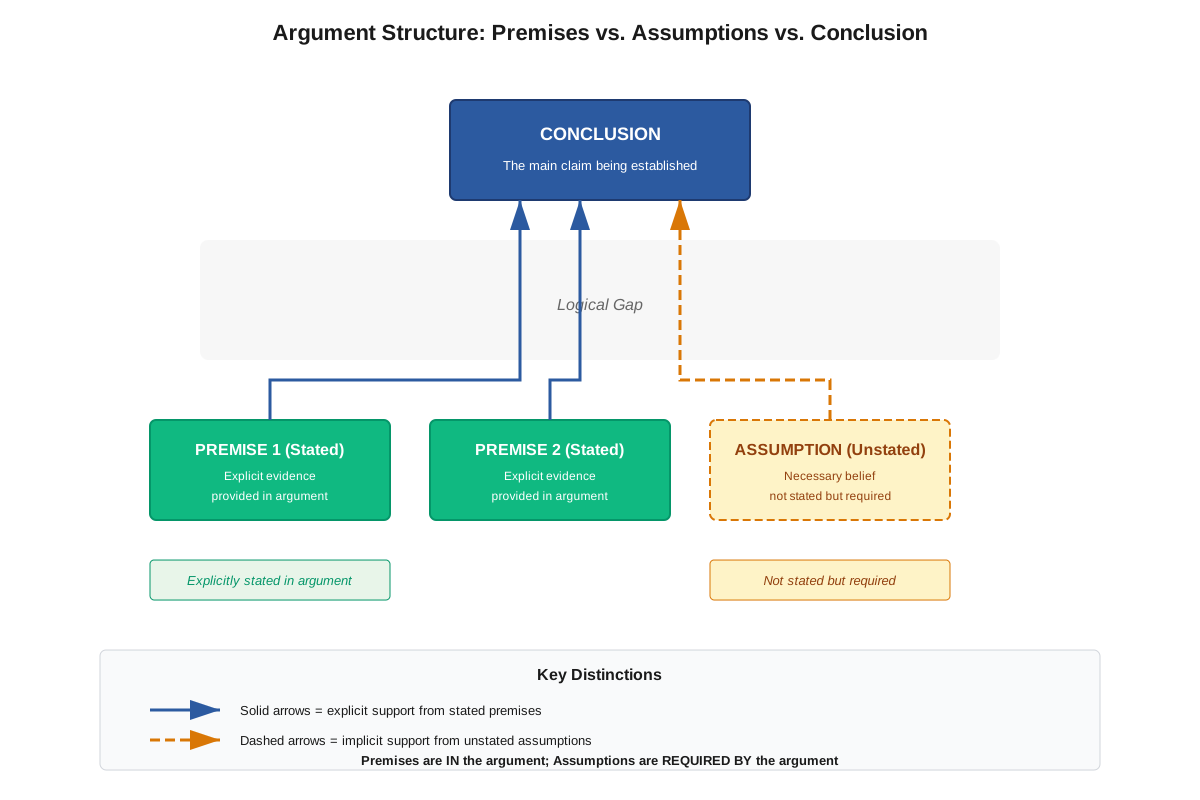
Understanding the distinction between assumptions and premises is fundamental to mastering Logical Reasoning on the LSAT. While both elements play critical roles in arguments, they function differently and require distinct analytical approaches. A premise is an explicitly stated piece of evidence or reason that the author provides to support a conclusion. An assumption, by contrast, is an unstated but necessary piece of information that must be true for the argument to hold together logically. The ability to distinguish between what an argument explicitly states (premises) and what it implicitly requires (assumptions) is essential for success on assumption questions and many other Logical Reasoning question types.
This distinction matters profoundly on the LSAT because approximately 20-25% of Logical Reasoning questions directly test your ability to identify assumptions, and many other question types—including Strengthen, Weaken, and Flaw questions—require you to recognize the gap between stated premises and unstated assumptions. The LSAT tests whether you can read critically, identifying not just what an argument says, but what it must believe to be true without saying it. Students who master assumption versus premise develop a crucial skill: the ability to see the invisible architecture of arguments.
Within the broader landscape of LSAT Logical Reasoning, this topic serves as a bridge between basic argument structure (identifying conclusions and premises) and advanced critical reasoning skills (evaluating argument quality, identifying logical flaws, and predicting how arguments can be strengthened or weakened). Once you can reliably distinguish assumptions from premises, you unlock the ability to analyze arguments at a deeper level, making connections between what's said and what's left unsaid—precisely the skill the LSAT rewards most generously.
Learning Objectives
- [ ] Identify how assumption versus premise appears in LSAT questions
- [ ] Explain the reasoning pattern behind assumption versus premise
- [ ] Apply assumption versus premise to solve LSAT-style problems accurately
- [ ] Distinguish between stated premises and unstated assumptions in complex arguments
- [ ] Recognize the logical gap that assumptions fill between premises and conclusions
- [ ] Evaluate whether a given statement is necessary for an argument's validity
- [ ] Predict common assumption types based on argument structure and content
Prerequisites
- Basic argument structure: Understanding what constitutes a conclusion and supporting evidence is essential because assumptions bridge the gap between these elements
- Conditional reasoning fundamentals: Recognizing if-then relationships helps identify when arguments assume connections between concepts
- Causal reasoning basics: Many assumptions involve unstated causal links, so understanding cause-and-effect relationships is necessary
- Reading comprehension skills: The ability to parse complex sentences and identify main ideas enables recognition of what is and isn't explicitly stated
Why This Topic Matters
The assumption versus premise distinction appears in real-world contexts constantly. Lawyers must identify unstated assumptions in opposing counsel's arguments to expose weaknesses. Business leaders must recognize assumptions underlying strategic proposals to assess risk. Scientists must articulate the assumptions behind experimental designs to ensure valid conclusions. The LSAT tests this skill because it's fundamental to legal reasoning—attorneys must constantly evaluate whether arguments rest on solid ground or depend on questionable unstated beliefs.
On the LSAT, assumption-related questions appear with remarkable frequency. Approximately 4-6 questions per Logical Reasoning section directly ask you to identify necessary assumptions, making this one of the most common question types. Additionally, Strengthen questions (3-4 per section) often require you to identify assumptions that, when supported, make arguments more convincing. Weaken questions (4-5 per section) frequently target unstated assumptions. Flaw questions (3-4 per section) often describe arguments that fail because they rely on unwarranted assumptions. Cumulatively, understanding assumptions impacts your performance on 14-19 questions per section—more than half of all Logical Reasoning questions.
This topic appears in LSAT passages through several common patterns: arguments that jump from evidence about one group to conclusions about another group (requiring an assumption that the groups are comparable), arguments that move from correlation to causation (requiring an assumption that no alternative explanations exist), and arguments that propose solutions to problems (requiring assumptions that the solutions will work and won't create worse problems). Recognizing these patterns allows you to anticipate what assumptions arguments will require.
Core Concepts
Defining Premises
A premise is any piece of information explicitly stated in an argument to support its conclusion. Premises are the building blocks that authors provide—the facts, evidence, observations, or reasons they present as justification for their claims. On the LSAT, premises are always visible in the text; you never need to infer or assume them. They typically follow indicator words like "because," "since," "given that," "for," or "as evidenced by," though these indicators aren't always present.
Consider this simple argument: "All mammals are warm-blooded. Whales are mammals. Therefore, whales are warm-blooded." Both "All mammals are warm-blooded" and "Whales are mammals" are premises—they're explicitly stated pieces of information supporting the conclusion that whales are warm-blooded. You don't need to read between the lines or make any logical leaps to identify these premises; they're right there in the text.
Defining Assumptions
An assumption is an unstated piece of information that must be true for an argument to work logically. Assumptions are the invisible glue connecting premises to conclusions. They represent what the author believes but doesn't say—the gaps in reasoning that must be filled for the argument to hold together. On the LSAT, assumptions are never explicitly stated; if something appears in the text, it's not an assumption, it's a premise.
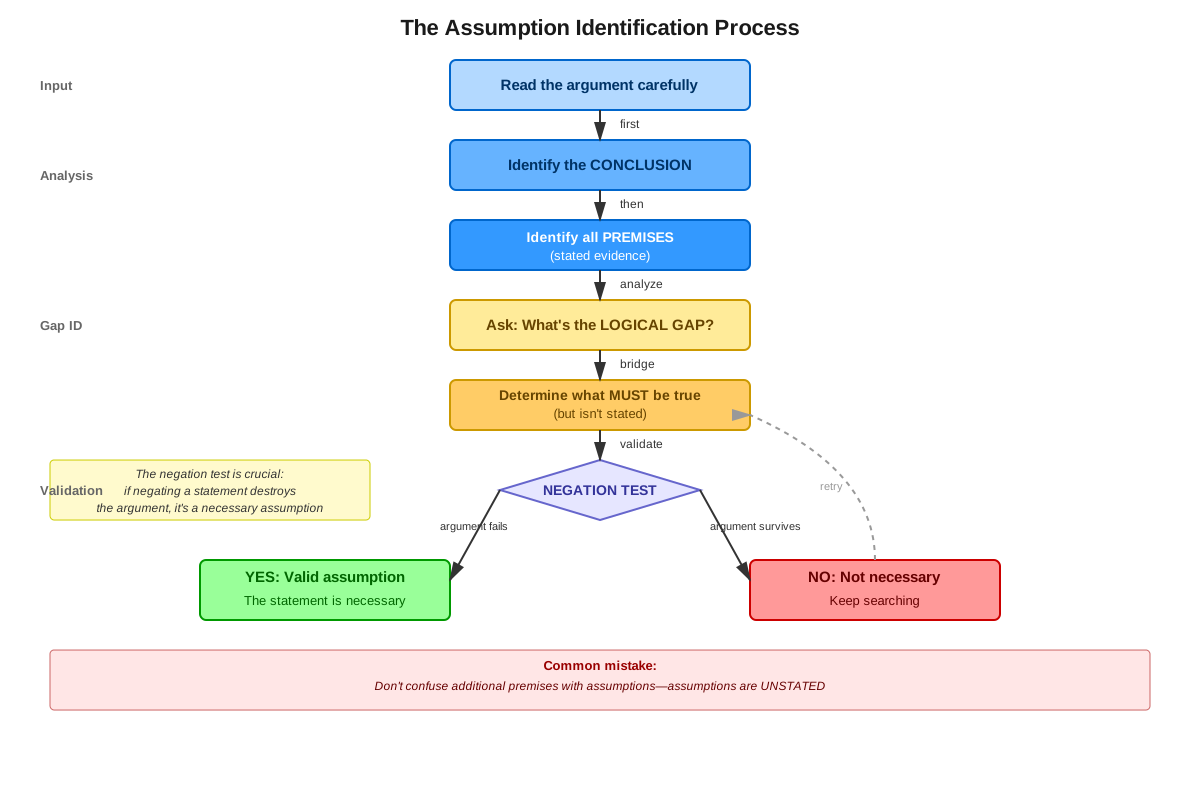
The critical test for identifying assumptions is the Negation Test: if you negate (reverse) a statement and the argument falls apart, that statement is a necessary assumption. If the argument still works when you negate the statement, it's not a necessary assumption. This test is extraordinarily powerful for assumption questions because it provides a definitive way to evaluate answer choices.
The Logical Gap
Every argument that relies on assumptions contains a logical gap—a space between what's stated (premises) and what's concluded. This gap represents the conceptual distance the argument must cross to reach its conclusion. Assumptions fill this gap. Understanding where gaps appear and what type of assumptions might fill them is crucial for LSAT success.
Consider this argument: "Sales of electric vehicles increased 30% last year. Therefore, concern about climate change is growing." The premise tells us about electric vehicle sales. The conclusion tells us about climate change concern. There's a gap: the argument jumps from one topic (vehicle sales) to another (environmental concern). The assumption filling this gap might be: "Increased electric vehicle sales reflect growing climate change concern" or "People buy electric vehicles primarily because of climate change concerns." Without such an assumption, the premise doesn't support the conclusion.
Types of Assumptions
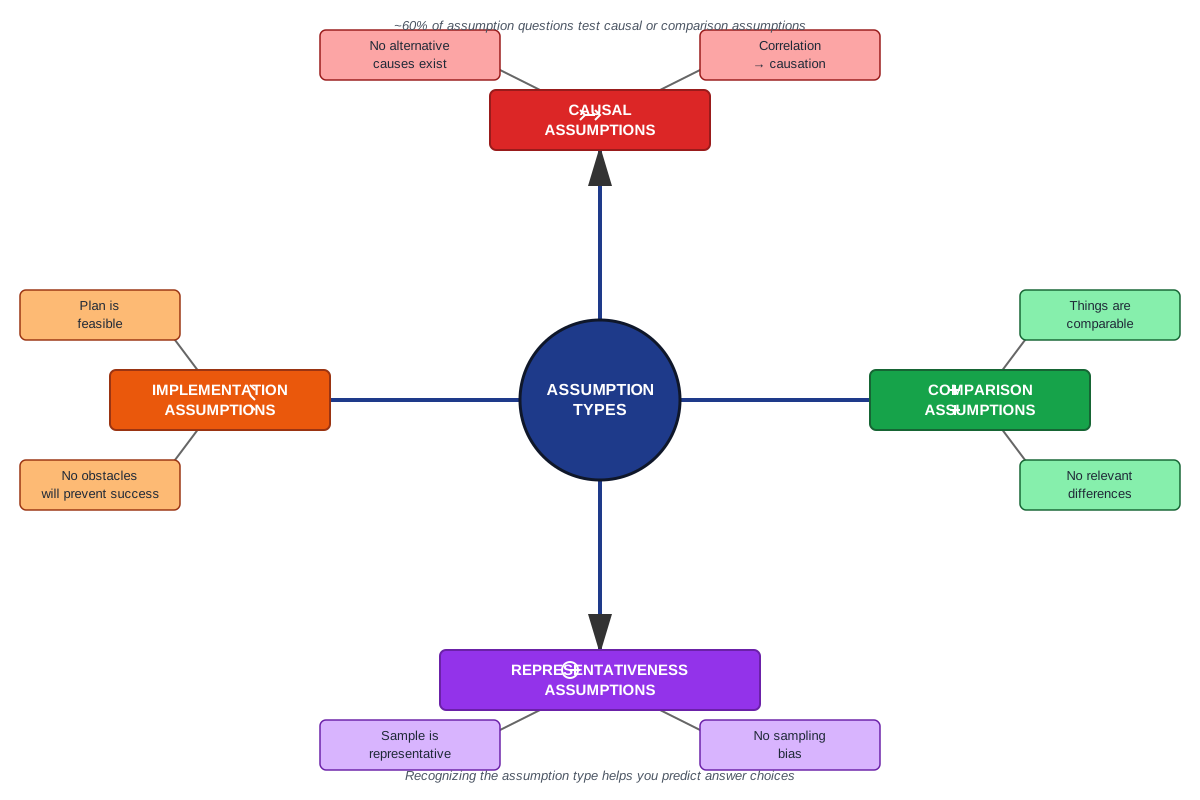
LSAT arguments commonly rely on several assumption categories:
Representativeness Assumptions: When arguments generalize from a sample to a population, they assume the sample is representative. If an argument concludes that "most voters support the policy" based on a survey, it assumes the survey respondents represent the broader voting population.
Causal Assumptions: When arguments claim one thing causes another, they assume no alternative explanations exist and that the causal relationship works as described. An argument claiming "The new training program caused productivity increases" assumes other factors (economic conditions, seasonal variations, new equipment) didn't cause the increase.
Comparison Assumptions: When arguments compare two things, they assume the comparison is valid—that relevant similarities exist and relevant differences don't undermine the comparison. An argument claiming "This medication worked in rats, so it will work in humans" assumes rats and humans are similar enough in relevant ways.
Implementation Assumptions: When arguments propose solutions, they assume the solutions are feasible, won't create worse problems, and will achieve their intended effects. An argument advocating "Increasing police patrols will reduce crime" assumes criminals won't simply move to unpatrolled areas and that resources exist for increased patrols.
The Relationship Between Premises and Assumptions
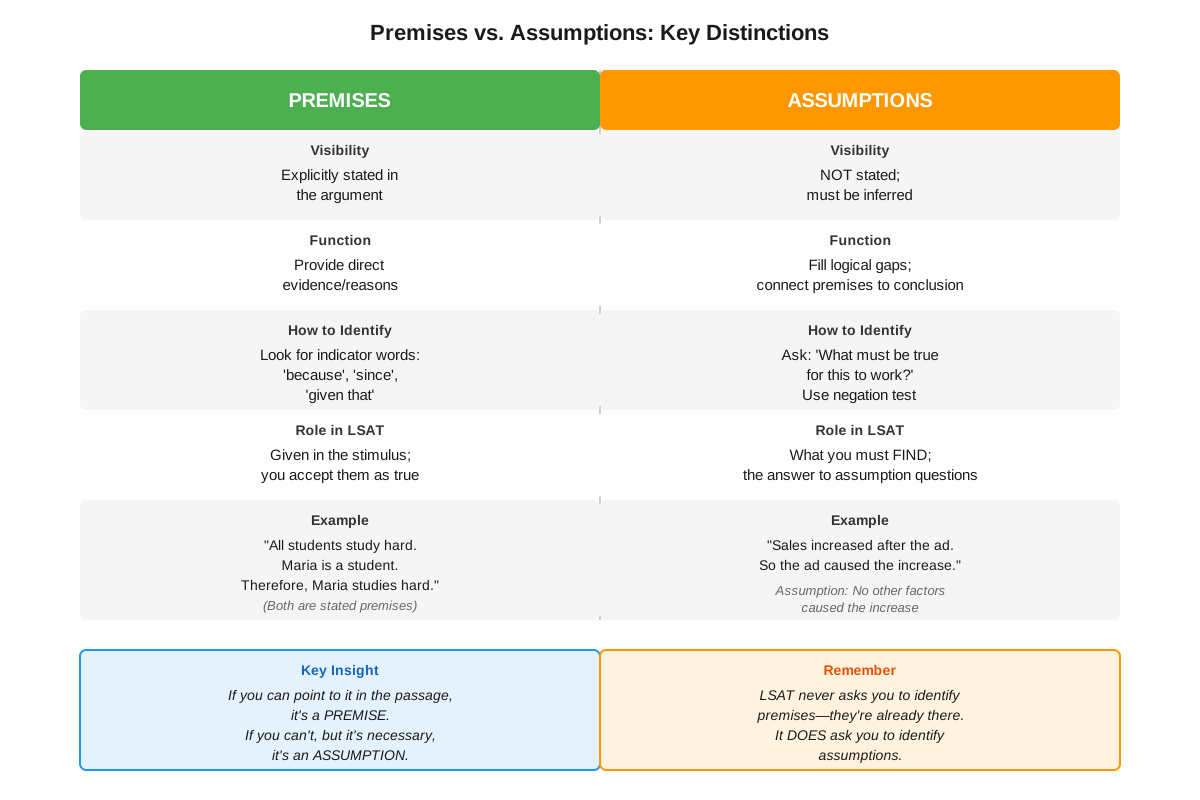
| Feature | Premise | Assumption |
|---|---|---|
| Visibility | Explicitly stated in the text | Unstated; must be inferred |
| Function | Provides direct support for conclusion | Bridges gap between premises and conclusion |
| Identification | Look for stated evidence and reasons | Look for unstated beliefs necessary for argument |
| Negation Effect | Removing a premise weakens argument | Negating an assumption destroys argument |
| LSAT Testing | "The argument's premises include..." | "The argument assumes which of the following?" |
Necessary versus Sufficient Assumptions
While this guide focuses on necessary assumptions (what must be true), understanding the distinction from sufficient assumptions aids comprehension. A necessary assumption is required for the argument to work—without it, the argument fails. A sufficient assumption, by contrast, is enough to make the argument work but isn't required; other assumptions might work equally well.
For LSAT purposes, assumption questions almost always ask for necessary assumptions. The Negation Test works perfectly for necessary assumptions: negate the assumption, and the argument collapses. Sufficient assumptions, when negated, might weaken the argument but won't necessarily destroy it because alternative assumptions could still support the conclusion.
Recognizing Assumption Indicators
While assumptions themselves aren't stated, certain argument structures signal that assumptions are present:
- Scope shifts: When the conclusion discusses something not mentioned in the premises (or vice versa), an assumption connects the different concepts
- Strong conclusions from limited evidence: When a conclusion makes a definitive claim based on narrow evidence, assumptions fill the gap
- Causal claims: When arguments assert causation, they assume alternative explanations don't apply
- Recommendations and predictions: When arguments advocate actions or predict outcomes, they assume the actions will work as intended and no obstacles will prevent success
Concept Relationships
The assumption versus premise distinction forms the foundation for understanding argument structure. Premises (stated evidence) combine with assumptions (unstated beliefs) to support conclusions. This relationship can be mapped as:
Premises + Assumptions → Conclusion
Without both elements, arguments fail. Strong premises with faulty assumptions produce weak arguments, just as solid assumptions can't rescue arguments with irrelevant premises.
This topic connects directly to conditional reasoning because many assumptions take conditional form: "If X (premise is true), then Y (conclusion follows)" requires the assumption that the conditional relationship holds. It also connects to causal reasoning because causal arguments inherently assume that correlation indicates causation and that alternative explanations don't apply.
The relationship extends to other question types: Strengthen questions ask you to identify information that supports an argument's assumptions. Weaken questions ask you to identify information that undermines assumptions. Flaw questions often describe arguments that fail because they rely on unwarranted assumptions. Inference questions require you to distinguish what must be true based on stated premises from what the argument merely assumes. Mastering assumption versus premise thus unlocks success across multiple question types.
The progression flows: Basic argument structure → Assumption versus premise → Assumption question strategies → Advanced argument evaluation. Each level builds on the previous, with assumption versus premise serving as the critical middle step.
High-Yield Facts
⭐ A premise is explicitly stated in the argument text; an assumption is never stated but must be true for the argument to work
⭐ The Negation Test definitively identifies necessary assumptions: negate the statement, and if the argument falls apart, it's a necessary assumption
⭐ Every argument with a logical gap between premises and conclusion relies on at least one assumption to bridge that gap
⭐ Scope shifts between premises and conclusions always indicate assumptions connecting the different concepts
⭐ Causal arguments assume no alternative explanations exist for the observed effect
- Arguments that generalize from samples assume the samples are representative of the broader population
- Comparison arguments assume the things being compared are similar in relevant ways
- Arguments proposing solutions assume those solutions are feasible and will work as intended
- If a statement appears in the argument text, it cannot be an assumption—it's a premise by definition
- Assumptions can be conditional statements connecting premise concepts to conclusion concepts
- Multiple assumptions may support a single argument, but LSAT questions typically ask for the most critical one
- Recognizing common assumption types (representativeness, causal, comparison, implementation) speeds up question analysis
Quick check — test yourself on Assumption versus premise so far.
Try Flashcards →Common Misconceptions
Misconception: Assumptions are the same as inferences or conclusions. → Correction: Assumptions are unstated beliefs that support arguments, while inferences are new conclusions drawn from stated information. Assumptions fill gaps in reasoning; inferences extend reasoning to new claims. The conclusion is what the argument tries to prove; assumptions are what the argument must believe (without stating) to make that proof work.
Misconception: If something seems likely to be true, it's an assumption of the argument. → Correction: An assumption must be necessary for the argument to work, not merely likely or reasonable. Many plausible statements aren't assumptions because the argument doesn't depend on them. Use the Negation Test: only if negating the statement destroys the argument is it a necessary assumption.
Misconception: Premises and assumptions are interchangeable terms for evidence. → Correction: Premises are stated evidence; assumptions are unstated beliefs. This distinction is fundamental. If you can point to where something appears in the text, it's a premise. If it's not in the text but must be true for the argument to work, it's an assumption.
Misconception: Every argument has only one assumption. → Correction: Most arguments rely on multiple assumptions. However, LSAT questions typically ask you to identify the most important or most vulnerable assumption—the one that, if false, would most severely damage the argument.
Misconception: Assumptions are always about topics not mentioned in the premises. → Correction: While scope-shift assumptions connect different concepts, many assumptions involve the same topics as the premises. For example, a premise might state "Sales increased after the advertising campaign," and the argument might assume "The advertising campaign caused the sales increase"—both involve the same topics (sales, advertising) but the causal connection is assumed, not stated.
Misconception: Background information or context provided in the stimulus is always a premise. → Correction: Not all stated information functions as a premise. Some statements provide context or background without directly supporting the conclusion. Premises specifically support the conclusion; other stated information might simply set the stage or provide definitions.
Worked Examples
Example 1: Identifying the Assumption
Argument: "The city's new recycling program has been in place for six months, and the amount of waste sent to landfills has decreased by 15%. Therefore, the recycling program is successfully diverting waste from landfills."
Analysis:
Step 1 - Identify the conclusion: "The recycling program is successfully diverting waste from landfills." This is what the argument tries to prove.
Step 2 - Identify the premises:
- The recycling program has been in place for six months (stated)
- Waste sent to landfills decreased by 15% (stated)
Step 3 - Identify the logical gap: The premises tell us about timing (six months) and an outcome (15% decrease). The conclusion attributes this decrease to the recycling program. But the premises don't explicitly connect the program to the decrease—that's the gap.
Step 4 - Determine what assumption fills the gap: The argument assumes that the recycling program caused the decrease, not some other factor. More specifically, it assumes: "No other factor besides the recycling program caused the 15% decrease in landfill waste."
Step 5 - Apply the Negation Test: If we negate this assumption—"Some other factor besides the recycling program caused the 15% decrease"—the argument falls apart. We could no longer conclude that the recycling program successfully diverted waste because something else might have caused the decrease. This confirms it's a necessary assumption.
Connection to learning objectives: This example demonstrates how to identify assumptions by recognizing the gap between stated premises (timing and outcome) and the conclusion (causal attribution), illustrating the reasoning pattern behind assumption versus premise.
Example 2: Distinguishing Premises from Assumptions
Argument: "Studies show that students who eat breakfast perform better on standardized tests than students who skip breakfast. Therefore, schools should provide free breakfast to all students to improve test scores."
Analysis:
Stated Premises (what's explicitly in the text):
- Studies show a correlation between eating breakfast and better test performance
- The correlation involves standardized tests specifically
Unstated Assumptions (what must be true but isn't stated):
- Causal assumption: Eating breakfast causes better test performance (not just correlation)
- Representativeness assumption: The students in the studies are similar to the students at these schools
- Implementation assumption: Students will actually eat the free breakfast if provided
- Implementation assumption: The cost of providing free breakfast won't create problems that outweigh the benefits
- Scope assumption: What works for test performance generally will work for these specific schools
Why these are assumptions, not premises:
The argument never states that breakfast causes better performance—it only states a correlation. The causal connection is assumed. The argument never states that students will eat the provided breakfast—that's assumed. The argument never addresses costs or logistics—it assumes these won't be prohibitive.
Applying the Negation Test:
If we negate assumption #1 ("Eating breakfast does NOT cause better test performance; some other factor explains the correlation"), the argument collapses. We'd have no reason to think providing breakfast would improve scores.
If we negate assumption #3 ("Students will NOT eat the free breakfast"), the argument fails. Providing breakfast that students don't eat won't improve test scores.
Connection to learning objectives: This example shows how to systematically distinguish what's stated (premises) from what's required but unstated (assumptions), and demonstrates how to apply the Negation Test to verify assumptions—key skills for solving LSAT assumption questions accurately.
Exam Strategy
Approaching Assumption Questions
When you encounter an assumption question (typically worded "The argument assumes which of the following?" or "Which of the following is an assumption required by the argument?"), follow this systematic approach:
Step 1 - Read the question stem first to confirm it's asking for an assumption. This primes your brain to look for gaps while reading the argument.
Step 2 - Identify the conclusion by asking "What is this argument trying to prove?" Circle or mentally note the conclusion.
Step 3 - Identify the premises by asking "What evidence does the argument provide?" Note what's explicitly stated.
Step 4 - Spot the gap by asking "What's the logical distance between the premises and conclusion? What concepts appear in the conclusion but not the premises, or vice versa?"
Step 5 - Predict the assumption before looking at answer choices. Ask "What must be true to connect these premises to this conclusion?"
Step 6 - Evaluate answer choices using the Negation Test. For each choice, negate it and ask "Does the argument fall apart?" If yes, it's likely the correct answer. If the argument still works or is only slightly weakened, eliminate that choice.
Trigger Words and Phrases
Question stem triggers that indicate assumption questions:
- "assumes," "assumption," "presupposes," "presupposition"
- "depends on assuming," "requires the assumption"
- "takes for granted," "relies on which of the following"
Argument triggers that signal assumptions are present:
- Causal language without proven causation: "caused," "led to," "resulted in," "because of"
- Recommendations: "should," "must," "ought to," "needs to"
- Predictions: "will," "is likely to," "probably"
- Comparisons: "similarly," "likewise," "just as," "analogous to"
- Generalizations: "all," "most," "typically," "generally"
Process of Elimination Tips
Eliminate answers that:
- Restate premises (if it's already stated, it's not an assumption)
- Are irrelevant to the argument's reasoning (even if true, they don't connect premises to conclusion)
- Go beyond what's necessary (sufficient but not necessary assumptions)
- Weaken rather than support the argument
- Pass the Negation Test (if negating them doesn't hurt the argument, they're not necessary)
Keep answers that:
- Fill the identified gap between premises and conclusion
- Fail the Negation Test (negating them destroys the argument)
- Address scope shifts or conceptual jumps in the reasoning
- Rule out alternative explanations (for causal arguments)
- Establish necessary conditions for the conclusion to follow
Time Allocation
Spend approximately 1:15-1:30 on assumption questions. They're worth the time investment because they're common and, with systematic approach, highly predictable. Allocate:
- 20-25 seconds reading and analyzing the argument
- 10-15 seconds predicting the assumption
- 40-50 seconds evaluating answer choices with the Negation Test
If you're stuck between two answers, apply the Negation Test rigorously to both—the correct answer will clearly destroy the argument when negated.
Memory Techniques
The SPAN Mnemonic for Assumption Types
Scope shifts - Assumptions connect different concepts in premises and conclusions
Prevention - Assumptions rule out alternative explanations and obstacles
Applicability - Assumptions establish that evidence applies to the conclusion's context
Necessity - Assumptions provide necessary conditions for the conclusion to follow
The GAP Visualization
Think of arguments as bridges: Given premises on one side, Assumed connections in the middle, Proven conclusion on the other side. Assumptions are the invisible middle span. When you read an argument, visualize the gap and ask "What invisible support must exist for this bridge to hold?"
The Negation Test Acronym: SNAP
State the assumption clearly
Negate it (reverse it)
Analyze the argument with the negation
Pass or fail: Does the argument collapse? If yes, it's necessary; if no, eliminate it
The "In the Text?" Test
Create a mental habit: whenever you're considering whether something is an assumption, ask "Can I point to where this appears in the text?" If yes → premise. If no → potential assumption (verify with Negation Test).
Summary
The distinction between assumptions and premises is foundational to LSAT Logical Reasoning success. Premises are explicitly stated pieces of evidence supporting a conclusion; assumptions are unstated beliefs that must be true for the argument to work. Every argument with a logical gap between its premises and conclusion relies on assumptions to bridge that gap. The Negation Test provides a definitive method for identifying necessary assumptions: negate the statement, and if the argument collapses, it's a necessary assumption. Common assumption types include representativeness assumptions (samples represent populations), causal assumptions (no alternative explanations exist), comparison assumptions (compared things are relevantly similar), and implementation assumptions (proposed solutions will work). Mastering this distinction enables success not only on assumption questions but also on Strengthen, Weaken, and Flaw questions, which collectively comprise more than half of all Logical Reasoning questions. The key skill is recognizing what arguments say explicitly versus what they must believe implicitly—reading between the lines to see the invisible architecture supporting every argument's reasoning.
Key Takeaways
- Premises are stated; assumptions are unstated but necessary—this is the fundamental distinction that underlies all assumption questions
- The Negation Test is your most powerful tool: negate a statement, and if the argument falls apart, you've identified a necessary assumption
- Every logical gap between premises and conclusions requires assumptions to bridge it—look for scope shifts, causal claims, and conceptual jumps
- Common assumption types (representativeness, causal, comparison, implementation) appear repeatedly on the LSAT—recognizing these patterns accelerates analysis
- If you can point to where something appears in the text, it's a premise, not an assumption—assumptions are always invisible in the argument itself
- Assumption mastery unlocks success across multiple question types—Strengthen, Weaken, Flaw, and Necessary Assumption questions all require understanding what arguments assume
- Systematic approach beats intuition—follow the steps (identify conclusion, identify premises, spot the gap, predict the assumption, apply Negation Test) rather than relying on what "feels right"
Related Topics
Sufficient Assumption Questions: While this guide focuses on necessary assumptions, sufficient assumption questions ask what, if true, would guarantee the conclusion follows. Mastering necessary assumptions provides the foundation for understanding sufficient assumptions.
Strengthen and Weaken Questions: These question types require identifying assumptions and then determining what information would support or undermine them. Your ability to spot assumptions directly determines your success on these common question types.
Flaw Questions: Many logical flaws involve unwarranted assumptions—arguments that assume causation without proof, assume representativeness without justification, or assume solutions will work without considering obstacles. Understanding assumptions enables you to identify and articulate these flaws.
Conditional Reasoning: Many assumptions take conditional form, connecting premise concepts to conclusion concepts through if-then relationships. Deepening your conditional reasoning skills enhances your ability to identify and evaluate assumptions.
Argument Structure and Diagramming: Advanced argument analysis involves mapping the relationships between premises, assumptions, and conclusions visually. This skill builds directly on your ability to distinguish assumptions from premises.
Practice CTA
Now that you understand the critical distinction between assumptions and premises, it's time to put this knowledge into practice. Work through the practice questions designed for this topic, applying the Negation Test systematically to each answer choice. Use the flashcards to reinforce your recognition of common assumption types and trigger words. Remember: assumption questions are among the most predictable on the LSAT—with systematic practice, they become reliable point-scorers. Every assumption question you master brings you closer to your target score. The invisible architecture of arguments is now visible to you—use that insight to your advantage!
Sign up free to keep reading
Create a free AnvayaPrep account to finish this LSAT guide on Assumption versus premise — plus flashcards and practice questions.