Overview
Assumption versus strengthen represents one of the most critical distinctions students must master in LSAT logical reasoning. Both question types ask test-takers to identify statements that support an argument, but they differ fundamentally in their relationship to the argument's validity. Assumption questions require identifying statements that are necessary for the argument to work—without which the argument completely falls apart. Strengthen questions, by contrast, ask for statements that make the argument better or more convincing, but aren't absolutely required for the argument's basic logical structure.
Understanding this distinction is essential because the LSAT frequently tests whether students can differentiate between what an argument needs to be valid versus what merely makes it more persuasive. Many test-takers struggle with this topic because both question types appear similar on the surface: both involve finding supporting information, both require careful analysis of argument structure, and both demand attention to logical gaps. However, the threshold for correctness differs dramatically. An assumption must be something the author must believe for their conclusion to follow from their premises, while a strengthener simply needs to increase the probability that the conclusion is true.
This topic sits at the heart of assumption questions and connects directly to broader logical reasoning skills including identifying argument structure, recognizing logical gaps, and evaluating evidence. Mastering the assumption versus strengthen distinction enables students to approach roughly 20-25% of all Logical Reasoning questions with confidence and precision, making it one of the highest-yield topics in LSAT preparation.
Learning Objectives
- [ ] Identify how assumption versus strengthen appears in LSAT questions
- [ ] Explain the reasoning pattern behind assumption versus strengthen
- [ ] Apply assumption versus strengthen to solve LSAT-style problems accurately
- [ ] Distinguish between necessary and sufficient conditions in argument support
- [ ] Apply the negation test to verify assumption answer choices
- [ ] Recognize the different degrees of support required by each question type
- [ ] Evaluate answer choices using the "required versus helpful" framework
Prerequisites
- Basic argument structure: Understanding premises, conclusions, and how they connect is essential because both assumption and strengthen questions require identifying what's missing or what could improve the logical connection between evidence and conclusion.
- Conditional reasoning fundamentals: Recognizing necessary versus sufficient conditions helps distinguish what must be true (assumptions) from what could help (strengtheners).
- Identifying conclusion indicators: Both question types require quickly locating the argument's main claim to determine what needs support.
- Understanding logical gaps: Recognizing unstated connections between premises and conclusions is the foundation for identifying both assumptions and strengtheners.
Why This Topic Matters
The distinction between assumption and strengthen questions appears with remarkable frequency on the LSAT. Assumption questions alone constitute approximately 12-15% of all Logical Reasoning questions, while strengthen questions account for another 8-10%. Combined, these question types represent nearly a quarter of the Logical Reasoning section, which itself comprises 50% of the total LSAT score. Students who master this distinction gain a significant competitive advantage.
Beyond test performance, this skill develops critical thinking abilities applicable to legal reasoning, contract analysis, and evaluating arguments in professional contexts. Lawyers must constantly distinguish between what a case requires to succeed versus what merely makes it stronger—precisely the skill tested by these question types.
On the LSAT, these questions typically appear in several formats. Assumption questions may ask: "Which one of the following is an assumption required by the argument?" or "The argument depends on assuming which one of the following?" Strengthen questions use language like: "Which one of the following, if true, most strengthens the argument?" or "Which one of the following provides the most support for the conclusion?" The subtle wording differences signal fundamentally different logical tasks, and recognizing these signals is crucial for efficient test-taking.
Common scenarios include arguments with scope shifts (where the premises discuss one group but the conclusion addresses another), causal reasoning (where the author assumes no alternative explanations exist), and analogical reasoning (where the author assumes relevant similarities between compared items). Both question types exploit these same logical structures, but demand different levels of support.
Core Concepts
The Fundamental Distinction: Necessary versus Helpful
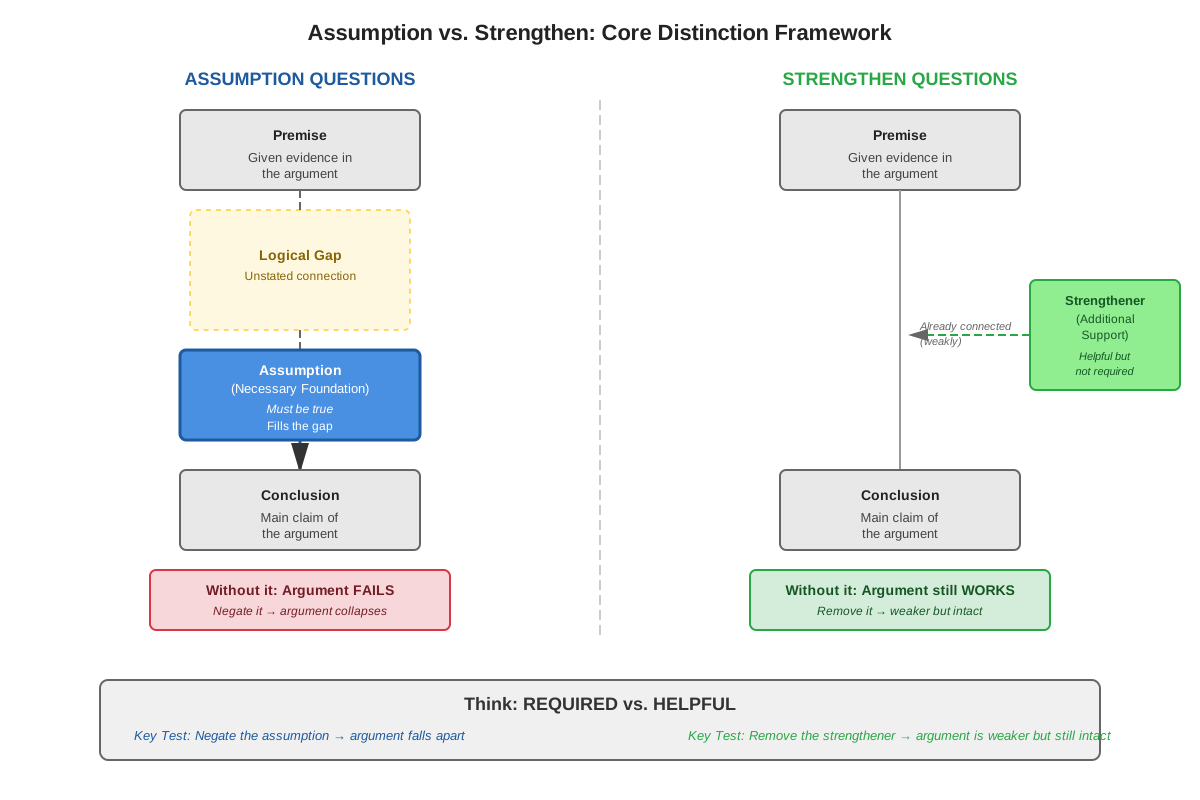
The core difference between assumption and strengthen questions lies in the relationship between the answer choice and the argument's validity. An assumption is a statement that must be true for the argument to work. It's a necessary condition—without it, the argument collapses entirely. A strengthener, however, is a statement that makes the argument more likely to be true but isn't absolutely required. The argument could still function (though perhaps weakly) without a strengthener.
Consider this analogy: If an argument is a bridge connecting premises to a conclusion, an assumption is a support beam without which the bridge falls down. A strengthener is additional reinforcement that makes the bridge sturdier but isn't structurally necessary. The bridge might be shaky without the strengthener, but it still stands. Without the assumption, there's no bridge at all.
The Negation Test for Assumptions
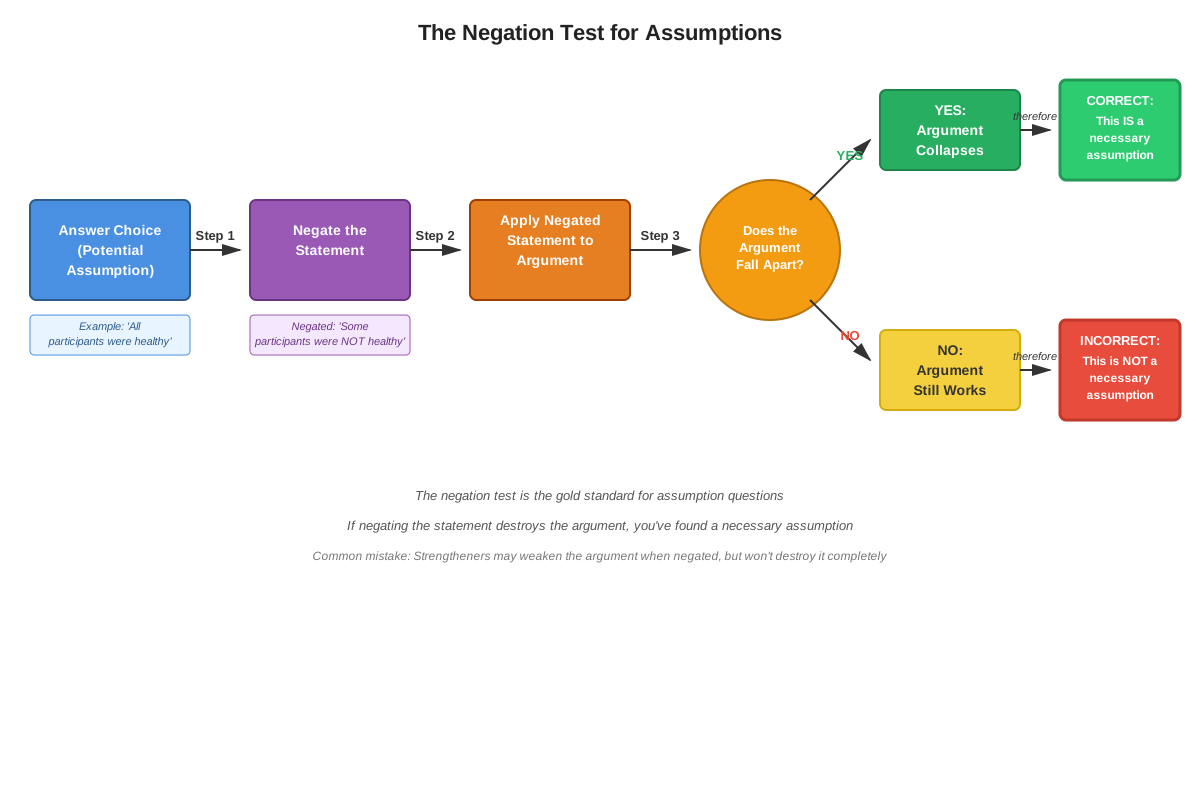
The most powerful tool for identifying assumptions is the negation test. This technique involves negating an answer choice and asking: "If this statement were false, would the argument fall apart?" If the answer is yes, you've found an assumption. If the argument still works (even if weakened), the statement isn't a necessary assumption.
Here's how to apply the negation test systematically:
- Read the answer choice carefully
- Negate it (turn "all" into "not all," "some" into "none," positive statements into negative ones)
- Ask whether the negated statement destroys the argument
- If yes, it's an assumption; if the argument merely becomes weaker, it's not necessary
For example, if an argument concludes that "electric cars will reduce pollution" based on the premise that "electric cars produce no tailpipe emissions," a necessary assumption might be "the electricity used to power electric cars doesn't create more pollution than gasoline cars would." Negate this: "the electricity used DOES create more pollution than gasoline cars would." This negation destroys the argument, confirming it's a necessary assumption.
Degrees of Support in Strengthen Questions
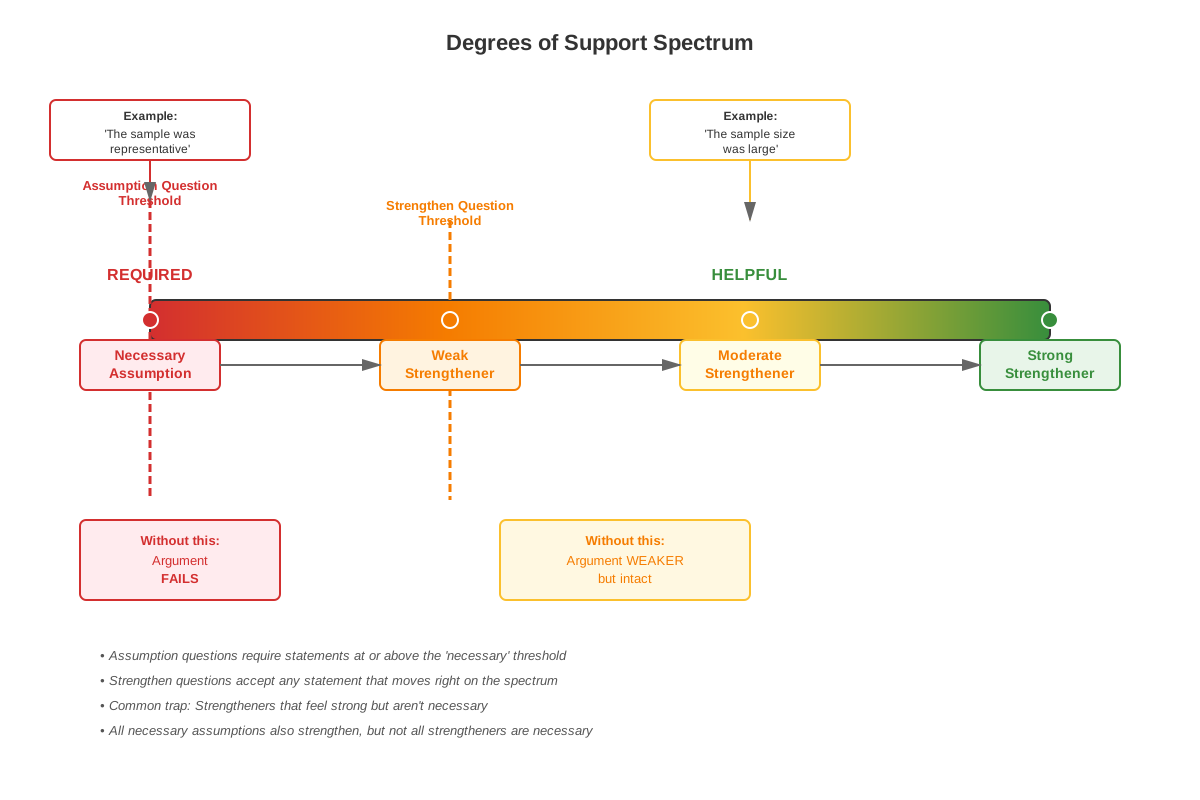
Unlike assumptions, which operate on a binary (necessary or not necessary) basis, strengthen questions involve degrees of support. Some answer choices strengthen arguments dramatically, while others provide minimal support. The LSAT typically asks for the answer that "most strengthens" the argument, requiring comparison between multiple supportive statements.
Strengtheners work through several mechanisms:
- Eliminating alternative explanations: Ruling out competing causes or interpretations
- Providing additional evidence: Adding new data that supports the conclusion
- Establishing relevant connections: Showing that compared items are actually similar in relevant ways
- Addressing potential objections: Countering reasons to doubt the conclusion
- Increasing sample size or representativeness: Making evidence more reliable
The strongest strengtheners typically address the argument's most significant weakness or logical gap. Weaker strengtheners might support the conclusion but fail to address the central vulnerability in the reasoning.
Common Logical Gaps Exploited by Both Question Types
Both assumption and strengthen questions frequently target the same types of logical gaps, though they require different responses:
| Logical Gap Type | Assumption Response | Strengthen Response |
|---|---|---|
| Scope shift | Must assume the shift is valid | Evidence that the shift is reasonable |
| Causal claim | Must assume no alternative causes | Evidence against alternative causes |
| Representativeness | Must assume sample represents population | Evidence that sample is representative |
| Comparison/Analogy | Must assume relevant similarity | Evidence of relevant similarity |
| Prediction | Must assume future resembles past | Evidence supporting the prediction |
Recognizing Question Stems
Accurate identification of question type is the first step toward correct answers. Assumption question stems include:
- "Which one of the following is an assumption required by the argument?"
- "The argument depends on assuming which one of the following?"
- "Which one of the following is an assumption on which the argument relies?"
- "The argument presupposes which one of the following?"
Strengthen question stems include:
- "Which one of the following, if true, most strengthens the argument?"
- "Which one of the following, if true, provides the most support for the conclusion?"
- "Which one of the following, if true, most helps to justify the reasoning above?"
- "Which one of the following, if true, would most strengthen the argument?"
The key distinguishing features are: assumption questions ask what the argument "requires," "depends on," or "presupposes," while strengthen questions include "if true" and ask what "strengthens," "supports," or "justifies."
The "Required versus Helpful" Framework
When evaluating answer choices, apply this decision framework:
For Assumption Questions:
- Ask: "Must the author believe this for the conclusion to follow?"
- Apply the negation test
- Eliminate answers that are merely helpful but not required
- The correct answer will be something the argument cannot function without
For Strengthen Questions:
- Ask: "Does this make the conclusion more likely to be true?"
- Compare the degree of support among answer choices
- Don't eliminate answers just because they're not necessary
- The correct answer provides the most additional support, even if not required
This framework prevents the common error of selecting strengtheners on assumption questions (choosing answers that help but aren't necessary) and the opposite error of being too restrictive on strengthen questions (eliminating good strengtheners because they're not absolutely required).
Concept Relationships
The assumption versus strengthen distinction builds directly on understanding argument structure. Before identifying what an argument needs or what would help it, students must first identify the conclusion and premises. This foundational skill enables recognition of logical gaps—the unstated connections between evidence and conclusion.
Logical gaps serve as the bridge concept connecting assumptions and strengtheners. Both question types exploit the same gaps, but assumptions fill gaps that must be filled for the argument to work, while strengtheners fill gaps in ways that make the argument more convincing without being strictly necessary.
The relationship flows as follows:
Argument Structure → Identify Conclusion and Premises → Recognize Logical Gap → Determine Question Type → Apply Appropriate Standard (necessary for assumptions, helpful for strengtheners) → Evaluate Answer Choices
The negation test connects specifically to assumption questions and derives from understanding necessary conditions in conditional logic. If X is necessary for Y, then "not X" means "not Y." This conditional relationship underlies why negating an assumption destroys the argument.
Strengthen questions connect forward to weaken questions (their logical opposites) and to evaluate questions (which ask what information would be most useful in assessing an argument). Understanding what strengthens an argument automatically reveals what would weaken it—information suggesting the opposite.
Both question types also relate to sufficient assumption questions, which ask for statements that, if true, would guarantee the conclusion follows. Sufficient assumptions are stronger than necessary assumptions and represent a special category of strengthener that provides complete logical support.
High-Yield Facts
⭐ Assumptions are necessary conditions—the argument cannot work without them; strengtheners are helpful but not required.
⭐ The negation test is the definitive method for verifying assumptions: negate the answer choice and check if the argument falls apart.
⭐ Assumption questions never include "if true" in the stem; strengthen questions almost always do.
⭐ The correct assumption is often something that seems obvious or goes without saying—that's why it's unstated.
⭐ Strengthen questions ask for the answer that "most" strengthens, requiring comparison of degrees of support.
- Assumptions connect gaps between premises and conclusions by providing missing logical links.
- Strengtheners can work by eliminating alternative explanations, providing additional evidence, or addressing potential objections.
- An answer choice can strengthen an argument without being an assumption (helpful but not necessary).
- Every assumption, if added to the argument, would strengthen it—but not every strengthener is an assumption.
- Scope shifts between premises and conclusions are among the most common sources of both assumption and strengthen questions.
- Causal arguments typically assume no alternative causes exist—this is a frequent assumption tested on the LSAT.
- The correct assumption is the minimum necessary statement, not the strongest possible support.
- Strengthen questions may have multiple answers that provide some support; choose the one providing the most.
- Assumptions are always things the author must believe, even if unstated; they're not new information.
- Wrong answers on assumption questions often strengthen the argument without being necessary.
Quick check — test yourself on Assumption versus strengthen so far.
Try Flashcards →Common Misconceptions
Misconception: Any answer that strengthens an argument is also an assumption.
Correction: Strengthening is a broader category than assuming. All assumptions strengthen arguments (if added explicitly), but many strengtheners are not assumptions because they're not necessary. An assumption must be something without which the argument fails; a strengthener merely makes it better.
Misconception: Assumptions must be explicitly provable from the passage.
Correction: Assumptions are unstated premises that the author must believe for the argument to work. They're not stated in the passage—that's why they're assumptions. The passage should not contradict them, but it won't prove them either.
Misconception: The correct assumption is the strongest statement that supports the conclusion.
Correction: The correct assumption is the minimum necessary statement. LSAT assumption questions often include trap answers that provide very strong support but go beyond what's strictly necessary. The negation test helps identify the necessary minimum rather than the strongest support.
Misconception: On strengthen questions, the correct answer must make the argument completely valid.
Correction: Strengthen questions ask what makes the argument better, not perfect. The correct answer might leave the argument still somewhat vulnerable but provide more support than other options. Don't eliminate answers because they don't guarantee the conclusion.
Misconception: If an answer choice introduces new information, it can't be an assumption.
Correction: Assumptions often involve new concepts not explicitly mentioned in the premises, particularly when they bridge scope shifts. For example, if premises discuss "students" and the conclusion discusses "young people," an assumption might connect these terms. The key is whether the connection is necessary, not whether it's new.
Misconception: Strengthen questions always require eliminating alternative explanations.
Correction: While eliminating alternatives is one powerful way to strengthen arguments (especially causal ones), strengtheners can also work by providing additional supporting evidence, establishing relevant similarities, or addressing potential objections. Multiple mechanisms can strengthen arguments.
Misconception: The negation test means choosing the opposite extreme.
Correction: Negation means logical negation, not the opposite extreme. "All X are Y" negates to "Not all X are Y" (meaning at least one X is not Y), not "No X are Y." Proper negation is crucial for the negation test to work correctly.
Worked Examples
Example 1: Distinguishing Assumption from Strengthen
Argument: "The new traffic light at Main Street has reduced accidents by 40% in the past year. Therefore, installing similar traffic lights at other dangerous intersections throughout the city will significantly reduce accidents citywide."
Question A (Assumption): "The argument depends on assuming which of the following?"
Question B (Strengthen): "Which of the following, if true, most strengthens the argument?"
Analysis:
For the assumption question, we need something the argument requires to work. The argument moves from evidence about one intersection to a conclusion about other intersections. This scope shift creates a logical gap: the author must assume the other intersections are relevantly similar to Main Street.
Let's consider potential answers:
(A) "The Main Street intersection was among the most dangerous in the city before the traffic light was installed."
Apply the negation test: "Main Street was NOT among the most dangerous." Does this destroy the argument? No—even if Main Street was moderately dangerous, the 40% reduction could still indicate that similar lights would work elsewhere. This strengthens but isn't necessary.
(B) "The factors that made Main Street dangerous are present at other dangerous intersections in the city."
Apply the negation test: "The factors that made Main Street dangerous are NOT present at other intersections." This destroys the argument—if the other intersections are dangerous for completely different reasons, there's no basis for thinking the same solution will work. This is a necessary assumption.
For the strengthen question, both answers would provide support, but we need the one that provides more support. Answer (B) provides stronger support because it directly establishes that the solution is relevant to the problem at other locations. Answer (A) provides some support by suggesting the test case was significant, but doesn't address whether the solution will transfer.
Key Insight: Notice that answer (B) works for both questions—it's both necessary (an assumption) and provides strong support (a strengthener). This illustrates that all assumptions strengthen arguments, but answer (A) shows that not all strengtheners are assumptions.
Example 2: Applying the Negation Test
Argument: "Studies show that people who drink green tea daily have lower rates of heart disease than those who don't. Therefore, drinking green tea prevents heart disease."
Question: "The argument relies on which of the following assumptions?"
Answer Choices:
(A) "Green tea contains antioxidants that are beneficial to heart health."
(B) "People who drink green tea daily don't have other health habits that reduce heart disease risk."
(C) "Heart disease is one of the leading causes of death."
(D) "Green tea is widely available and affordable."
(E) "The studies were conducted over a sufficient period to detect differences in heart disease rates."
Analysis:
Let's apply the negation test to each:
(A) Negated: "Green tea does NOT contain beneficial antioxidants."
Does this destroy the argument? Not necessarily—green tea could prevent heart disease through other mechanisms. This explains how green tea might work but isn't necessary for the argument. The argument just claims green tea prevents heart disease based on correlation; it doesn't require a specific mechanism. Not necessary.
(B) Negated: "People who drink green tea daily DO have other health habits that reduce heart disease risk."
Does this destroy the argument? Yes! If green tea drinkers also exercise more, eat better, and don't smoke, the lower heart disease rates could be due to these other factors rather than the tea itself. The argument assumes green tea is the cause, which requires assuming no confounding variables. This is necessary.
(C) Negated: "Heart disease is NOT one of the leading causes of death."
Does this destroy the argument? No—the argument is about whether green tea prevents heart disease, not about how common heart disease is. Not necessary.
(D) Negated: "Green tea is NOT widely available and affordable."
Does this destroy the argument? No—the argument is about whether green tea prevents heart disease, not about practical considerations of access. Not necessary.
(E) Negated: "The studies were NOT conducted over a sufficient period."
Does this destroy the argument? This is tempting, but the argument already tells us the studies "show" a difference. We're told to accept the study results as given. The argument might be weak if the studies were flawed, but the author isn't assuming anything about study duration—they're just citing the results. Not necessary.
Correct Answer: (B)
Key Insight: This example demonstrates how the negation test eliminates answers that seem relevant or that strengthen the argument without being necessary. Answer (A) provides a mechanism and would strengthen the argument, but isn't required. Answer (E) relates to the evidence's quality but isn't an assumption the author makes—the author simply accepts the study results.
Exam Strategy
Approaching Assumption Questions
- Read the question stem first to identify the question type before reading the argument
- Identify the conclusion using conclusion indicators (therefore, thus, so, consequently)
- Identify the premises and note what evidence supports the conclusion
- Spot the logical gap—what's missing between premises and conclusion?
- Predict the assumption before looking at answers (even a rough prediction helps)
- Apply the negation test to promising answer choices
- Eliminate answers that strengthen without being necessary—this is the most common trap
Approaching Strengthen Questions
- Identify the argument's biggest weakness or most vulnerable logical gap
- Predict what type of information would help—additional evidence? Eliminating alternatives? Establishing similarity?
- Evaluate each answer for degree of support—don't just look for any support, compare strength
- Don't eliminate answers because they're not necessary—helpful is sufficient
- Choose the answer that addresses the central weakness, not peripheral issues
Trigger Words and Phrases
Assumption Question Triggers:
- "requires," "depends on," "relies on," "presupposes"
- "assumption," "assumes"
- Never includes "if true"
Strengthen Question Triggers:
- "if true" (almost always present)
- "strengthens," "supports," "justifies"
- "most helps," "provides support for"
- "most strongly supports"
Process of Elimination Tips
For Assumption Questions, eliminate:
- Answers that are irrelevant to the logical gap
- Answers that strengthen but aren't necessary (use negation test)
- Answers that go beyond the scope of the conclusion
- Answers that are already stated or clearly implied in the premises
- Answers that, when negated, leave the argument intact
For Strengthen Questions, eliminate:
- Answers that are completely irrelevant
- Answers that weaken the argument
- Answers that address minor points rather than central weaknesses
- Answers that are too weak compared to other options
Time Allocation
- Spend 1:15-1:30 per question on average
- For assumption questions, invest time in the negation test—it's worth 10-15 extra seconds to be certain
- For strengthen questions, if torn between two answers, ask which addresses the bigger logical gap
- Don't get stuck on difficult questions; mark and return if needed
Exam Tip: If you're unsure whether a question asks for an assumption or a strengthener, look for "if true" in the stem. Its presence almost always indicates a strengthen question. Assumption questions ask what the argument "requires" or "depends on."
Memory Techniques
The NEGATE Acronym for Assumption Questions
Negate the answer choice
Evaluate the argument with the negation
Goes the argument fall apart?
Assumption confirmed if yes
Test another answer if no
Eliminate non-necessary choices
The BRIDGE Visualization
Think of assumptions as bridge supports connecting premise island to conclusion island. If you remove a support (negate it), does the bridge collapse? If yes, it's necessary. Strengtheners are like adding extra cables—they make the bridge sturdier but aren't structural requirements.
The "Must Believe" Test
For assumptions, ask: "Must the author believe this for their argument to make sense?" If you can imagine the author saying, "No, I don't believe that, but my argument still works," it's not an assumption.
Degrees of Support Spectrum
Visualize a spectrum from left to right:
Irrelevant → Slightly Helpful → Moderately Strengthening → Strongly Strengthening → Sufficient (Guarantees Conclusion)
Assumptions fall at the "necessary minimum" point. Strengthen answers can fall anywhere from "slightly helpful" rightward, with the correct answer typically being the furthest right.
The "If True" Flag
Create a mental flag that pops up when you see "if true"—this signals you're looking for what would help if it were true, not what must be true. This flag prevents applying assumption-level standards to strengthen questions.
Summary
The distinction between assumption and strengthen questions represents a critical skill for LSAT success, testing whether students understand the difference between necessary and helpful support for arguments. Assumptions are statements that must be true for an argument to work—without them, the logical connection between premises and conclusion breaks down entirely. Strengtheners make arguments more convincing but aren't strictly required for the argument's basic logical structure. The negation test provides a reliable method for identifying assumptions: negate the answer choice and determine whether the argument collapses. For strengthen questions, students must compare degrees of support and select the answer that most effectively addresses the argument's central weakness. Both question types exploit the same logical gaps—scope shifts, causal claims, representativeness issues, and analogical reasoning—but demand different levels of support. Mastering this distinction requires recognizing question stem language, understanding the "required versus helpful" framework, and avoiding the common trap of selecting strengtheners on assumption questions or being too restrictive on strengthen questions.
Key Takeaways
- Assumptions are necessary; strengtheners are helpful—this fundamental distinction drives all strategy for these question types
- The negation test definitively identifies assumptions: negate the answer and check if the argument falls apart
- Question stems reveal the task: "requires/depends on" signals assumption; "if true, strengthens" signals strengthen
- All assumptions strengthen arguments, but not all strengtheners are assumptions—this asymmetric relationship explains many trap answers
- Apply appropriate standards: don't demand necessity on strengthen questions or accept mere helpfulness on assumption questions
- Logical gaps are the same; required support differs—both question types exploit scope shifts, causal reasoning, and analogies
- The correct assumption often seems obvious—it's what goes without saying but must be true for the argument to work
Related Topics
Sufficient Assumption Questions: These ask for statements that, if true, would guarantee the conclusion follows logically. They represent the strongest form of assumption and connect to formal logic. Mastering necessary assumptions prepares students for sufficient assumptions.
Weaken Questions: The logical opposite of strengthen questions, these ask what would make an argument less convincing. Understanding what strengthens arguments automatically reveals what weakens them.
Flaw Questions: These identify logical errors in arguments, often pointing to missing assumptions. Recognizing what an argument assumes helps identify when those assumptions are problematic.
Evaluate Questions: These ask what information would be most useful in assessing an argument's strength. They combine elements of both strengthen and weaken questions, requiring understanding of what would help or hurt the argument.
Conditional Logic: Understanding necessary versus sufficient conditions provides the logical foundation for distinguishing assumptions (necessary) from strengtheners (which may be sufficient but aren't necessary).
Practice CTA
Now that you understand the critical distinction between assumption and strengthen questions, it's time to apply these concepts to actual LSAT questions. The practice questions and flashcards will help solidify your ability to identify question types, apply the negation test, and evaluate degrees of support. Remember: this distinction appears in roughly 20-25% of all Logical Reasoning questions, making it one of the highest-yield topics you can master. Each practice question you complete builds the pattern recognition and analytical skills that will serve you throughout the LSAT. Start practicing now to transform this conceptual understanding into test-day performance!
Sign up free to keep reading
Create a free AnvayaPrep account to finish this LSAT guide on Assumption versus strengthen — plus flashcards and practice questions.