Overview
Comparison assumptions represent one of the most frequently tested reasoning patterns in LSAT Logical Reasoning sections. These assumptions appear when an argument draws a conclusion by comparing two or more entities, time periods, groups, or situations, but fails to explicitly state that the comparison is valid or appropriate. The argument implicitly assumes that the items being compared are sufficiently similar in relevant ways, or that differences between them don't undermine the conclusion.
Understanding comparison assumptions is critical for LSAT success because they appear across multiple question types, including Necessary Assumption, Sufficient Assumption, Strengthen, Weaken, and Flaw questions. When test-makers construct arguments involving comparisons, they deliberately omit key information about whether the compared items are truly comparable. Students who can identify these gaps in reasoning gain a significant advantage, as comparison-based questions appear in approximately 15-20% of all Logical Reasoning questions on any given LSAT.
Within the broader landscape of assumption questions, comparison assumptions form a distinct category alongside causal assumptions, representativeness assumptions, and term-shift assumptions. While all assumptions involve unstated premises necessary for an argument's validity, comparison assumptions specifically address the logical leap that occurs when an arguer treats two different things as equivalent without justification. Mastering this topic builds directly on understanding basic argument structure and prepares students for more complex reasoning patterns involving analogies, statistical comparisons, and temporal shifts.
Learning Objectives
- [ ] Identify how Comparison assumptions appears in LSAT questions
- [ ] Explain the reasoning pattern behind Comparison assumptions
- [ ] Apply Comparison assumptions to solve LSAT-style problems accurately
- [ ] Distinguish comparison assumptions from other assumption types (causal, representativeness, term-shift)
- [ ] Recognize the specific language patterns and trigger words that signal comparison-based reasoning
- [ ] Evaluate whether a given statement properly addresses a comparison assumption gap
- [ ] Construct valid comparison assumptions that would make flawed comparative arguments logically sound
Prerequisites
- Basic argument structure: Understanding premises, conclusions, and how they connect is essential because comparison assumptions fill gaps between comparative premises and conclusions
- Assumption question fundamentals: Familiarity with what makes something a necessary versus sufficient assumption provides the foundation for identifying what comparison assumptions accomplish
- Conditional reasoning basics: Many comparison assumptions involve implicit conditional statements about when comparisons are valid
- Evidence evaluation: Recognizing what counts as relevant evidence helps determine whether compared items share pertinent characteristics
Why This Topic Matters
Comparison assumptions appear throughout legal reasoning, policy debates, scientific arguments, and everyday decision-making. Attorneys constantly argue by analogy, comparing current cases to precedents while assuming relevant similarities. Policy makers compare different jurisdictions, time periods, or demographic groups, often overlooking crucial differences. Scientists compare experimental conditions, control groups, and data sets. The ability to identify unstated assumptions in comparative reasoning is fundamental to critical thinking in law school and legal practice.
On the LSAT specifically, comparison assumptions appear in approximately 3-5 questions per Logical Reasoning section, making them one of the highest-yield patterns to master. They appear most frequently in:
- Necessary Assumption questions (40% of comparison assumption questions)
- Flaw questions (25% of comparison assumption questions)
- Strengthen/Weaken questions (20% of comparison assumption questions)
- Sufficient Assumption questions (15% of comparison assumption questions)
Test-makers favor comparison assumptions because they test multiple skills simultaneously: reading comprehension, logical analysis, and the ability to identify what's missing from an argument. These questions often separate high scorers from average performers because they require recognizing not just what the argument says, but what it fails to say about the validity of its comparison.
Core Concepts
The Basic Structure of Comparison Assumptions
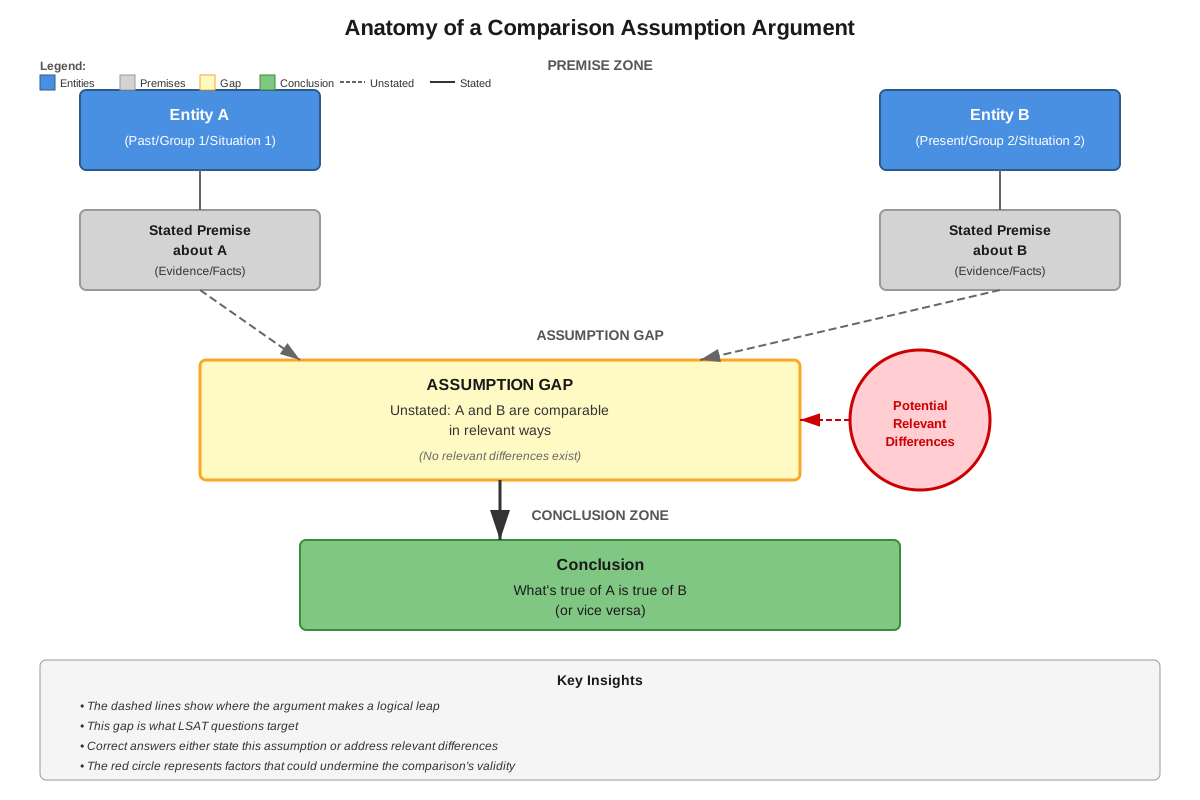
A comparison assumption is an unstated premise that bridges the gap between comparative evidence and a conclusion drawn from that comparison. The fundamental pattern follows this structure:
Premise: X has characteristic A
Premise: Y has characteristic B
Conclusion: Therefore, what's true of X is also true of Y (or vice versa)
Unstated Assumption: X and Y are sufficiently similar in relevant ways to make this comparison valid
The argument assumes that no relevant differences exist between the compared items that would undermine the conclusion. This assumption is necessary because the mere fact that two things can be compared doesn't mean they should be compared for the argument's purpose.
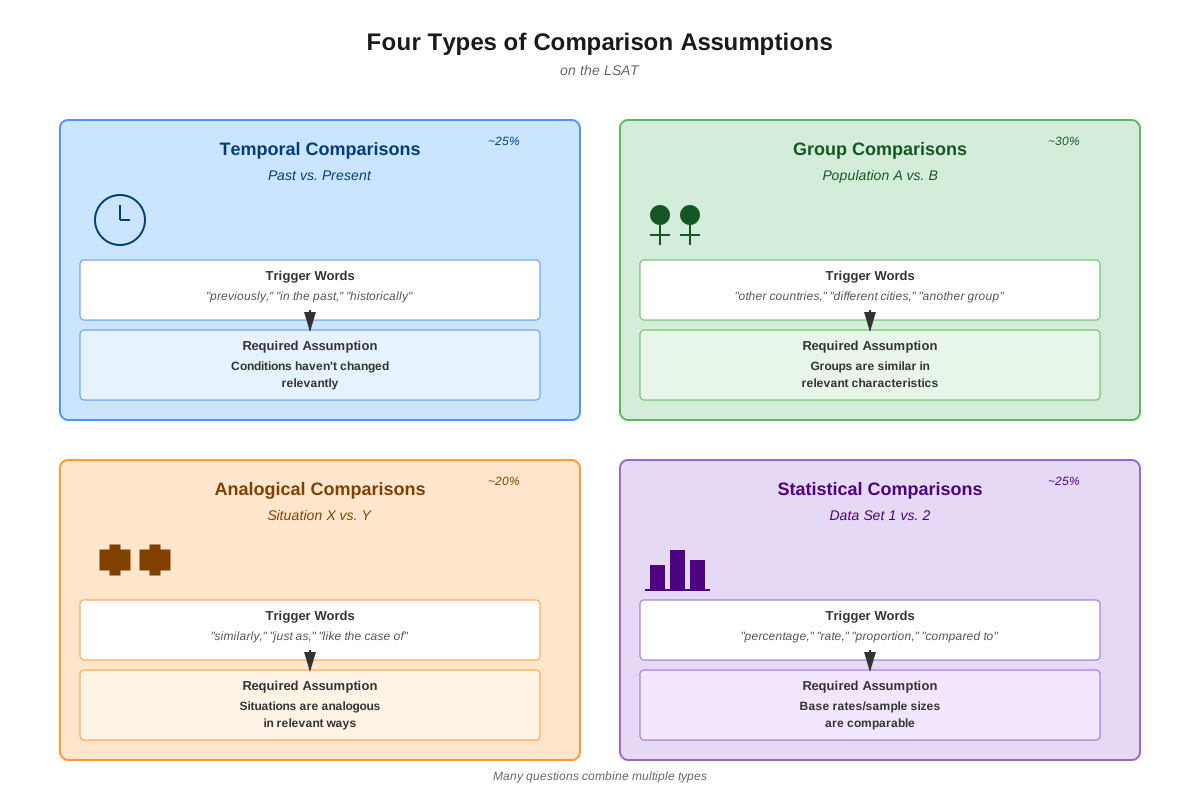
Types of Comparisons in LSAT Arguments
Temporal Comparisons
Arguments frequently compare different time periods, assuming conditions remain constant across time. For example:
"Sales increased 20% after implementing the new marketing strategy. Therefore, the strategy was effective."
Hidden assumption: No other relevant factors changed between the two time periods that could account for the sales increase.
Group-to-Group Comparisons
These arguments compare different populations, locations, or categories:
"City A reduced crime by implementing policy X. City B should implement the same policy to reduce its crime rate."
Hidden assumption: City A and City B are sufficiently similar in relevant ways (demographics, existing crime patterns, resources, etc.) for the policy to have similar effects.
Individual-to-Group Comparisons
Arguments sometimes generalize from one case to many or vice versa:
"This patient responded well to the treatment. Therefore, other patients with the same diagnosis should receive this treatment."
Hidden assumption: The individual patient is representative of the broader group in ways relevant to treatment response.
Analogical Comparisons
These involve comparing situations, scenarios, or cases:
"Just as requiring licenses for drivers improved road safety, requiring licenses for gun owners would improve public safety."
Hidden assumption: The situations are analogous in relevant ways—that factors making licensing effective for driving also apply to gun ownership.
The Comparison Assumption Gap
The logical gap in comparison-based arguments exists because similarity in one respect doesn't guarantee similarity in all relevant respects. Consider this structure:
| What the Argument States | What the Argument Assumes |
|---|---|
| X and Y share some characteristics | X and Y share ALL relevant characteristics |
| Something was true at Time 1 | Conditions haven't changed by Time 2 |
| Policy worked in Location A | Location B has similar relevant conditions |
| Sample group showed result R | Sample is representative of target population |
The LSAT exploits this gap by presenting arguments where the comparison seems plausible but rests on unstated assumptions about comparability. Test-takers must identify what would need to be true for the comparison to support the conclusion.
Necessary vs. Sufficient Comparison Assumptions
Necessary comparison assumptions identify minimum requirements for the argument to work. They state what must be true about the similarity or comparability of the items being compared. These assumptions, if false, would destroy the argument.
Example: "Because the drug worked in mice, it will work in humans."
Necessary assumption: Mice and humans aren't so different in relevant biological ways that the drug's mechanism couldn't function similarly.
Sufficient comparison assumptions provide enough information to guarantee the conclusion follows. They often explicitly state that the compared items are similar in all relevant ways or that no relevant differences exist.
Example sufficient assumption: "Mice and humans have identical relevant biological mechanisms for this drug's action, and no other factors affect the drug's efficacy."
Identifying Comparison Assumption Questions
LSAT comparison assumptions manifest through specific language patterns in stimulus arguments:
- Explicit comparison words: "similarly," "likewise," "in the same way," "just as," "compared to"
- Temporal indicators: "previously," "in the past," "historically," "will continue to"
- Analogical reasoning: "like," "analogous to," "parallel to"
- Implicit comparisons through contrasting data points or time periods
The conclusion typically projects findings from one context onto another or predicts future outcomes based on past patterns.
Concept Relationships
Comparison assumptions connect to other assumption types through shared logical structures. They represent a specific application of the broader principle that arguments require unstated premises to connect evidence to conclusions.
Relationship map:
- Basic Argument Structure → provides framework → Assumption Questions → specialized into → Comparison Assumptions
- Comparison Assumptions ↔ overlaps with → Causal Assumptions (when comparing cause-effect relationships across contexts)
- Comparison Assumptions → requires understanding of → Relevant vs. Irrelevant Differences → determines → Validity of Comparison
- Temporal Comparisons → special case of → Comparison Assumptions → assumes → Stability of Conditions Over Time
- Comparison Assumptions → tested through → Necessary Assumption Questions, Flaw Questions, Strengthen/Weaken Questions
Within the topic itself, the concepts build hierarchically:
- Basic comparison structure (comparing two items)
- Types of comparisons (temporal, group-to-group, analogical)
- The assumption gap (what's missing)
- How to identify and articulate the assumption
- How to evaluate answer choices that address the assumption
Understanding causal assumptions helps with comparison assumptions because many comparative arguments involve implicit causal claims (e.g., "What caused X in Situation 1 will cause X in Situation 2"). Similarly, representativeness assumptions overlap with individual-to-group comparisons, where the argument assumes a sample represents a larger population.
High-Yield Facts
⭐ Comparison assumptions bridge the gap between evidence about one entity/time/group and conclusions about another entity/time/group
⭐ The most common comparison assumption is that no relevant differences exist between the compared items that would undermine the conclusion
⭐ Temporal comparisons assume conditions haven't changed between time periods in ways that affect the conclusion
⭐ Arguments comparing different groups assume the groups are similar in ways relevant to the conclusion
⭐ The correct answer to a comparison assumption question often explicitly states that the compared items are similar in a specific relevant way
- Comparison assumptions appear in approximately 15-20% of all Logical Reasoning questions
- Flaw questions about comparisons typically identify that the argument "overlooks relevant differences" or "assumes without justification that the situations are comparable"
- Strengthen questions addressing comparison assumptions provide evidence that the compared items are indeed similar in relevant ways
- Weaken questions exploit comparison assumptions by highlighting relevant differences between compared items
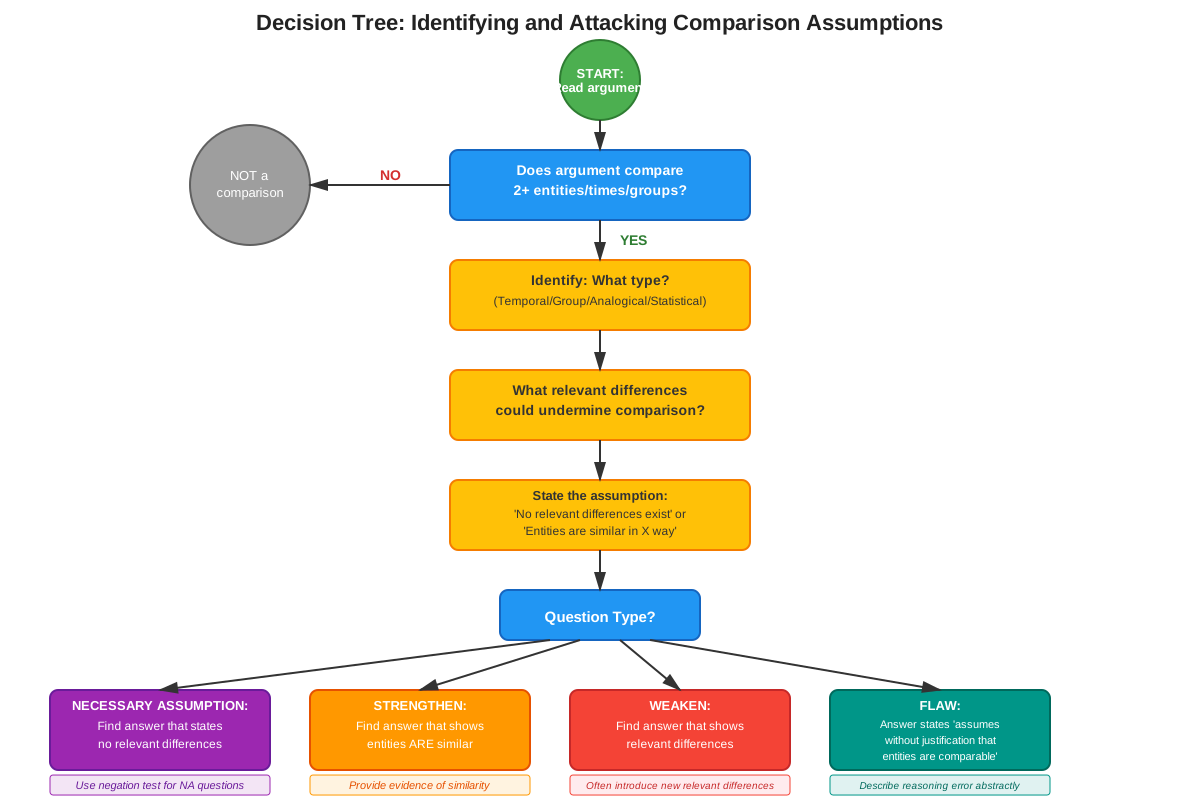
- Necessary assumption questions about comparisons can be tested using the negation technique: if the items ARE relevantly different, does the argument fall apart?
- Sufficient assumption questions require answer choices that explicitly guarantee the comparison is valid, often using strong language like "all relevant factors" or "in every pertinent respect"
- Comparison assumptions differ from causal assumptions: comparison assumptions address whether items are similar enough to compare, while causal assumptions address whether one thing causes another
- The LSAT rarely tests comparisons where the items are obviously incomparable; instead, the comparisons seem plausible but rest on unstated assumptions
- Answer choices that are too broad (claiming complete similarity in all ways) are usually incorrect for necessary assumption questions but may be correct for sufficient assumption questions
Quick check — test yourself on Comparison assumptions so far.
Try Flashcards →Common Misconceptions
Misconception: Any argument that mentions two different things involves a comparison assumption.
Correction: Comparison assumptions only arise when the argument's conclusion depends on the two things being similar or comparable. If an argument simply mentions two separate items without drawing conclusions based on their similarity, no comparison assumption exists.
Misconception: The comparison assumption is always that the two things are identical or exactly the same.
Correction: Comparison assumptions only require similarity in relevant respects. The compared items can differ in many ways; what matters is whether they differ in ways that affect the conclusion. The assumption is about relevant similarity, not complete identity.
Misconception: Temporal comparisons (comparing past to present/future) are fundamentally different from other comparison types.
Correction: Temporal comparisons follow the same logical structure as other comparisons—they assume no relevant differences exist between the time periods being compared. They're a specific application of the general comparison assumption pattern.
Misconception: If an argument explicitly states that two things are being compared, it doesn't have a comparison assumption.
Correction: Explicitly stating that a comparison is being made doesn't eliminate the assumption gap. The argument still assumes the comparison is valid and that the items are similar in relevant ways. Acknowledging a comparison doesn't justify it.
Misconception: The correct answer to a comparison assumption question will always use the word "similar" or "comparable."
Correction: While these words often appear, correct answers may instead specify particular ways the items don't differ, describe shared characteristics, or rule out specific relevant differences. Focus on the logical function, not specific vocabulary.
Misconception: Comparison assumptions only appear in Necessary Assumption questions.
Correction: Comparison assumptions appear across multiple question types: Necessary Assumption, Sufficient Assumption, Flaw, Strengthen, Weaken, and even some Inference questions. The same logical gap manifests differently depending on what the question asks.
Misconception: If the argument provides some evidence that the compared items are similar, there's no comparison assumption.
Correction: Providing some evidence of similarity doesn't eliminate the assumption that they're similar in ALL relevant ways. The argument may still assume additional similarities beyond what's explicitly stated.
Worked Examples
Example 1: Temporal Comparison
Stimulus: "Five years ago, Acme Corporation increased employee productivity by 15% after implementing flexible work schedules. Acme should implement flexible schedules again to boost current productivity levels."
Question: Which of the following is an assumption required by the argument?
Analysis:
- Identify the comparison: The argument compares Acme five years ago to Acme today
- Identify the conclusion: Implementing flexible schedules now will boost productivity
- Identify the evidence: Flexible schedules boosted productivity five years ago
- Identify the gap: The argument assumes conditions at Acme haven't changed in ways that would make flexible schedules less effective now
Step-by-step reasoning:
- The argument uses past success to predict future success
- This temporal comparison assumes relevant similarity between past and present
- What could have changed? Employee composition, company size, nature of work, technology, management structure, etc.
- The assumption must be that no such changes have occurred that would undermine the policy's effectiveness
Correct answer type: "Acme's current workforce and operations are not so different from those of five years ago that flexible schedules would be less effective now."
Why this works: This answer directly addresses the temporal comparison assumption by stating that relevant conditions haven't changed. If this were false (if conditions HAD changed significantly), the argument would fail.
Connection to learning objectives: This example demonstrates how to identify comparison assumptions in temporal contexts and explains the reasoning pattern (past success doesn't guarantee future success without assuming stability of relevant conditions).
Example 2: Group-to-Group Comparison
Stimulus: "Country X reduced traffic fatalities by 30% after implementing mandatory helmet laws for motorcyclists. Country Y, which has similar traffic fatality rates, should implement the same law to achieve similar results."
Question: The argument's reasoning is most vulnerable to criticism on the grounds that it:
Analysis:
- Identify the comparison: Country X's experience is compared to Country Y's expected experience
- Identify the conclusion: Country Y will achieve similar results
- Identify the evidence: Country X achieved 30% reduction; both countries have similar fatality rates
- Identify the gap: The argument assumes that having similar fatality rates means the countries are similar in OTHER relevant ways
Step-by-step reasoning:
- The argument provides one similarity (fatality rates) but assumes this is sufficient
- Many other factors could differ: motorcycle usage rates, enforcement capabilities, road infrastructure, cultural attitudes toward helmet use, climate, etc.
- The flaw is assuming that similarity in one respect (fatality rates) guarantees similarity in all relevant respects
- The argument overlooks that relevant differences might exist despite the stated similarity
Correct answer type: "overlooks the possibility that Country X and Country Y differ in ways relevant to the effectiveness of helmet laws"
Why this works: This identifies the comparison assumption gap—the argument fails to establish that the countries are similar in ways that matter for the policy's effectiveness. Sharing similar fatality rates doesn't guarantee sharing similar conditions for policy implementation.
Connection to learning objectives: This example shows how to identify comparison assumptions in group-to-group contexts and demonstrates how to articulate the reasoning flaw when an argument makes unjustified comparisons.
Exam Strategy
Recognition Strategy
When reading LSAT stimuli, immediately flag arguments that:
- Reference different time periods ("previously," "in the past," "historically," "will continue")
- Compare different groups, locations, or populations
- Use analogical language ("similarly," "likewise," "just as," "in the same way")
- Draw conclusions about one thing based on evidence about another thing
Exam Tip: The moment you see comparative language or evidence from one context applied to another, mentally ask: "What would need to be true for this comparison to be valid?"
Question Stem Triggers
Different question types test comparison assumptions differently:
Necessary Assumption questions: Look for answers stating that no relevant differences exist or that the items are similar in specific ways. Use the negation test—if the items ARE relevantly different, the argument should fall apart.
Flaw questions: Correct answers typically state the argument "fails to establish that the situations are comparable," "overlooks relevant differences," or "assumes without justification that the comparison is appropriate."
Strengthen questions: Correct answers provide evidence that the compared items are indeed similar in relevant ways or that suspected differences don't actually exist.
Weaken questions: Correct answers highlight specific relevant differences between the compared items that undermine the conclusion.
Process of Elimination
Eliminate answers that:
- Address the wrong type of assumption (causal when the argument involves comparison)
- Focus on irrelevant differences (differences that don't affect the conclusion)
- Are too extreme for necessary assumption questions (claiming complete identity rather than relevant similarity)
- Are too weak for sufficient assumption questions (not guaranteeing the conclusion follows)
Keep answers that:
- Directly address whether the compared items are similar in ways that matter for the conclusion
- Rule out specific relevant differences
- Establish that conditions haven't changed (for temporal comparisons)
- Connect the comparison to the specific conclusion being drawn
Time Allocation
Comparison assumption questions typically require 60-90 seconds:
- 20-30 seconds: Read and understand the argument, identify the comparison
- 15-20 seconds: Articulate the assumption gap to yourself
- 25-40 seconds: Evaluate answer choices against your prediction
Don't rush the initial analysis. Clearly identifying what's being compared and what the argument assumes about that comparison makes answer choice evaluation much faster and more accurate.
Pre-Phrasing Strategy
Before looking at answer choices, complete this sentence: "This argument assumes that [Item A] and [Item B] are similar in that..." or "This argument assumes that no relevant differences exist regarding..."
Having a clear pre-phrase dramatically improves accuracy and speed on comparison assumption questions.
Memory Techniques
The COMPARE Acronym
Context shift (different times, places, or groups)
Overlooks differences (what the argument fails to consider)
Must be similar (what the assumption requires)
Past to present (common temporal comparison)
Analogical reasoning (comparing situations)
Relevant factors (focus on what matters for the conclusion)
Evidence from elsewhere (applying evidence from one context to another)
Visualization Strategy
Picture two circles representing the compared items. The argument shows they overlap in one area (the stated similarity) but assumes they overlap in all relevant areas. The assumption fills in the unstated overlapping regions.
The "Time Travel" Mnemonic
For temporal comparisons, imagine time traveling between periods. Ask: "What could have changed during the journey that would make the comparison invalid?" This helps identify the assumption that relevant conditions remain stable.
The "Spot the Difference" Game
Treat comparison arguments like a "spot the difference" puzzle. The argument assumes there are no relevant differences, but your job is to identify what differences COULD exist that would matter for the conclusion.
Summary
Comparison assumptions represent a critical reasoning pattern on the LSAT, appearing in 15-20% of Logical Reasoning questions across multiple question types. These assumptions arise when arguments draw conclusions by comparing different entities, time periods, groups, or situations without explicitly establishing that the comparison is valid. The fundamental assumption is that the compared items are sufficiently similar in ways relevant to the conclusion, or that no relevant differences exist that would undermine the reasoning. Comparison assumptions manifest in temporal comparisons (assuming conditions haven't changed), group-to-group comparisons (assuming different populations share relevant characteristics), and analogical reasoning (assuming situations are comparable). Success with these questions requires recognizing when an argument shifts context, identifying what the argument assumes about the validity of that shift, and evaluating whether answer choices properly address the assumption gap. The key insight is that similarity in one respect doesn't guarantee similarity in all relevant respects—arguments must assume additional similarities beyond what they explicitly state.
Key Takeaways
- Comparison assumptions bridge gaps between evidence about one context and conclusions about another context
- The core assumption is always about relevant similarity—not complete identity, but similarity in ways that matter for the conclusion
- Temporal comparisons assume stability of conditions; group comparisons assume shared relevant characteristics
- Different question types test the same comparison assumption gap in different ways (necessary vs. sufficient, flaw vs. strengthen/weaken)
- Focus on relevant differences—what could differ between the compared items that would affect the conclusion?
- Pre-phrase the assumption before looking at answer choices: "This assumes X and Y are similar in that..."
- Use the negation test for necessary assumptions: if the items ARE relevantly different, the argument should collapse
Related Topics
Causal Assumptions: Many comparison arguments involve implicit causal reasoning (e.g., "What caused X in Situation 1 will cause X in Situation 2"). Understanding causal assumptions helps identify when comparison arguments also make causal claims.
Representativeness Assumptions: These overlap with individual-to-group comparisons, where arguments assume a sample represents a larger population. Mastering comparison assumptions provides foundation for understanding sampling and generalization issues.
Sufficient vs. Necessary Assumptions: The distinction between what's minimally required (necessary) versus what guarantees the conclusion (sufficient) applies directly to comparison assumptions and affects how to evaluate answer choices.
Flaw Question Types: Understanding comparison assumptions enables recognition of multiple flaw types, including "false analogy," "overlooking relevant differences," and "unwarranted generalization."
Strengthen/Weaken Questions: Comparison assumptions provide the foundation for understanding how to strengthen arguments (by establishing similarity) or weaken them (by highlighting differences).
Practice CTA
Now that you understand the reasoning patterns behind comparison assumptions, you're ready to apply this knowledge to actual LSAT questions. The practice questions and flashcards will help solidify your ability to quickly recognize comparison-based reasoning, identify assumption gaps, and select correct answers with confidence. Remember: comparison assumptions are highly testable and appear across multiple question types, making them one of the highest-yield patterns to master. Each practice question you complete strengthens your pattern recognition and builds the automaticity you need for test day success. Start practicing now to transform this conceptual understanding into point-scoring performance!
Sign up free to keep reading
Create a free AnvayaPrep account to finish this LSAT guide on Comparison assumptions — plus flashcards and practice questions.