Overview
Representativeness assumptions form a critical category of reasoning patterns tested extensively on the LSAT's Logical Reasoning sections. These assumptions appear when an argument draws conclusions about a larger group, population, or category based on evidence from a sample or subset of that group. The core vulnerability in such arguments lies in the unstated assumption that the sample accurately represents the whole—that the characteristics observed in the smaller group reliably reflect the characteristics of the entire population.
Understanding representativeness assumptions is essential for LSAT success because they appear in approximately 10-15% of all assumption questions and related question types. These questions test whether students can identify the gap between evidence (what we know about a sample) and conclusion (what we claim about the whole). The LSAT frequently constructs arguments where researchers, pollsters, or analysts make broad generalizations based on limited observations, and test-takers must recognize the hidden assumption that the sample mirrors the population in relevant ways.
Within the broader landscape of Logical Reasoning, representativeness assumptions connect to fundamental concepts of inductive reasoning, sampling methodology, and the distinction between necessary and sufficient conditions. They share conceptual territory with causal reasoning (where samples might not represent causal relationships accurately) and with strengthen/weaken questions (where answer choices often exploit or repair representativeness flaws). Mastering this topic provides a foundation for recognizing flawed generalizations across multiple question types, making it a high-yield area for score improvement.
Learning Objectives
- [ ] Identify how Representativeness assumptions appears in LSAT questions
- [ ] Explain the reasoning pattern behind Representativeness assumptions
- [ ] Apply Representativeness assumptions to solve LSAT-style problems accurately
- [ ] Distinguish representativeness assumptions from other assumption types (causal, conditional, etc.)
- [ ] Evaluate answer choices that either state or violate representativeness assumptions
- [ ] Recognize common sampling flaws that create representativeness gaps in arguments
Prerequisites
- Basic understanding of argument structure: Recognizing premises and conclusions is essential because representativeness assumptions bridge the gap between sample-based evidence (premise) and population-level conclusions
- Familiarity with assumption question stems: Knowing how the LSAT phrases assumption questions ("assumes," "depends on," "required") helps identify when to look for representativeness gaps
- Concept of sufficient vs. necessary conditions: Understanding what an argument needs (necessary) versus what would guarantee it (sufficient) clarifies why representativeness is required, not just helpful
- General knowledge of inductive reasoning: Recognizing that arguments move from specific observations to general conclusions provides the framework for understanding when samples must represent populations
Why This Topic Matters
Representativeness assumptions appear in real-world contexts constantly: political polling, medical research, consumer surveys, scientific studies, and policy decisions all rely on the principle that samples can tell us about larger populations. When news reports claim "Americans believe X" based on a survey of 1,000 people, or when a study concludes "the medication is effective" based on clinical trial participants, representativeness assumptions underlie these claims. The LSAT tests this reasoning pattern because lawyers must evaluate evidence, assess the strength of generalizations, and identify when conclusions overreach their evidentiary support.
On the LSAT, representativeness assumptions appear in multiple question types with significant frequency. Assumption questions directly test whether students can identify the representativeness gap as a necessary assumption. Strengthen questions often present answer choices that confirm the sample is representative, while Weaken questions frequently introduce information showing the sample is biased or atypical. Flaw questions may ask students to describe the error in reasoning when an argument treats an unrepresentative sample as representative. Across all Logical Reasoning sections, students can expect to encounter 3-5 questions per test that either directly or indirectly test representativeness reasoning.
The most common manifestations include: arguments about survey results and polling data; scientific studies with specific participant groups; observations about a subset of a category used to conclude something about the entire category; historical examples used to predict future patterns; and geographic or demographic samples used to make universal claims. The LSAT particularly favors scenarios where the sample has obvious potential biases—voluntary response surveys, convenience samples, or groups selected for specific characteristics that might make them atypical.
Core Concepts
The Basic Structure of Representativeness Arguments
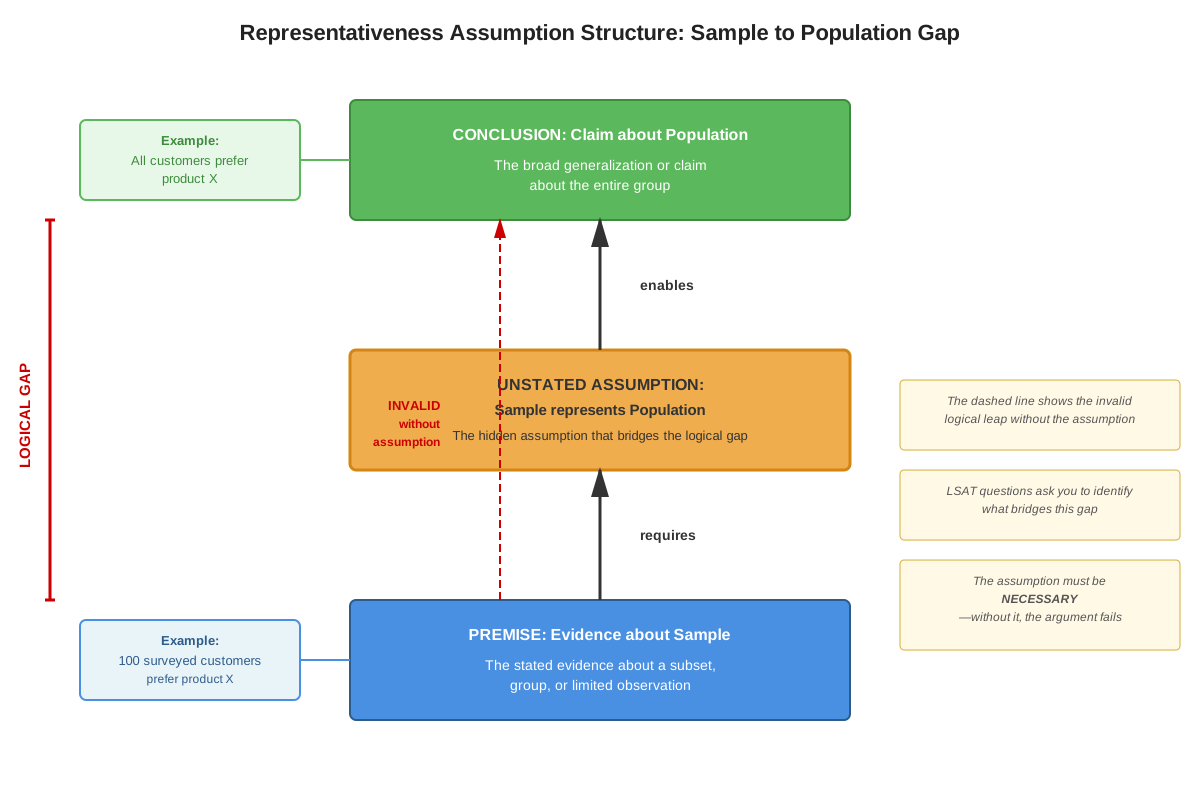
LSAT representativeness assumptions follow a predictable logical structure. The argument presents evidence about a sample (a subset, group, or limited set of observations) and draws a conclusion about a population (the larger group, category, or universal set). The assumption is that the sample accurately reflects the population in all relevant respects—that whatever is true of the sample is also true of the whole.
The formal structure appears as:
- Premise: Sample S has characteristic X
- Conclusion: Population P has characteristic X
- Assumption: Sample S is representative of Population P (with respect to characteristic X)
This pattern appears in various forms. Sometimes the argument moves from a specific time period to a general pattern, from one location to all locations, from volunteers to everyone, or from test subjects to the general population. The key vulnerability remains constant: if the sample differs from the population in ways that affect the characteristic being measured, the conclusion fails.
Types of Representativeness Flaws
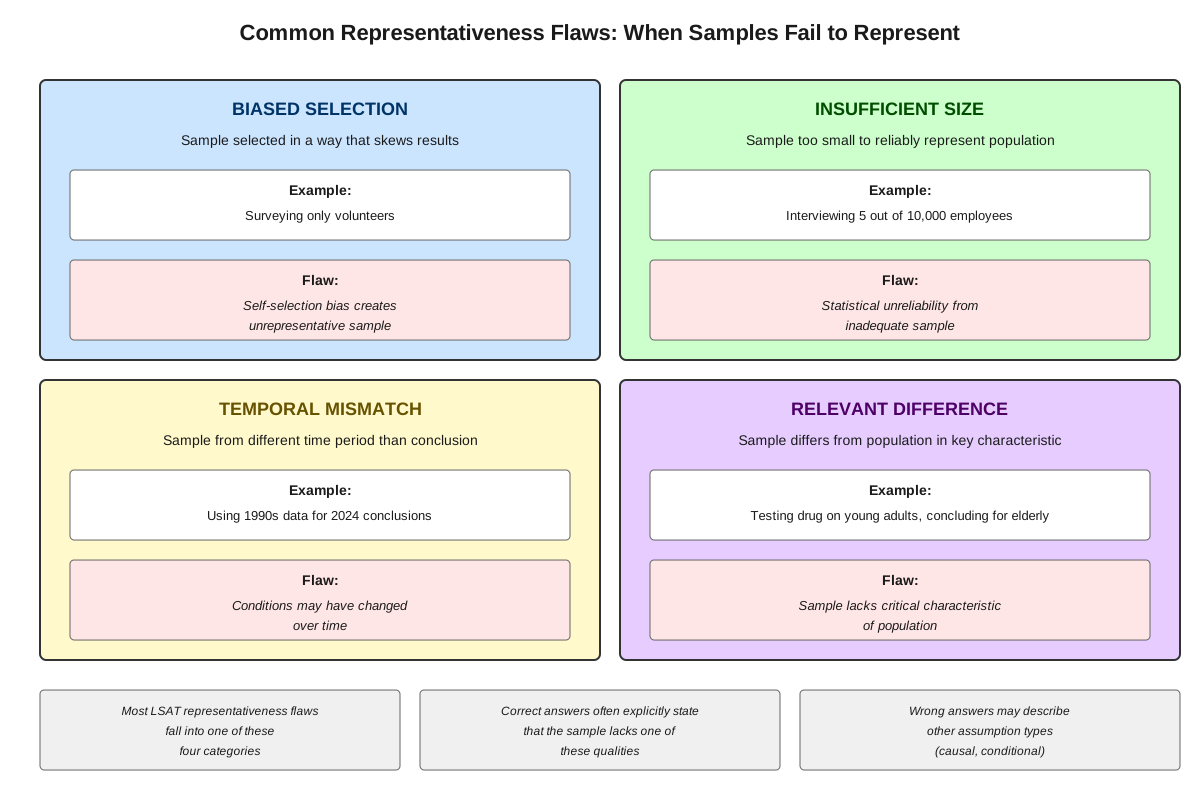
Several specific flaws commonly appear in logical reasoning questions involving representativeness:
Selection Bias: The sample is chosen in a way that systematically excludes or overrepresents certain groups. For example, surveying only people who visit a website about a topic will oversample those with strong interest in that topic.
Voluntary Response Bias: When participation is optional, those who choose to respond often differ systematically from non-respondents. People with extreme opinions or strong feelings are more likely to participate in voluntary surveys.
Temporal Bias: Using data from one time period to draw conclusions about other time periods assumes conditions remain constant. Historical examples may not represent current or future situations if relevant circumstances have changed.
Geographic Bias: Samples from one location may not represent other locations if regional differences affect the characteristic being studied.
Demographic Bias: When a sample overrepresents or underrepresents certain demographic groups (age, income, education, etc.), conclusions about the general population may be unwarranted.
The Assumption vs. The Flaw
Understanding the relationship between the assumption and the flaw is crucial for different question types. The representativeness assumption is what the argument needs to be true—it's the unstated premise that the sample represents the population. The flaw is the error in reasoning—treating the sample as representative without justification.
| Question Type | What You're Looking For |
|---|---|
| Assumption | The statement that the sample IS representative (fills the gap) |
| Flaw | The description that the argument TREATS an unrepresentative sample as representative |
| Strengthen | Evidence that the sample IS representative or was properly selected |
| Weaken | Evidence that the sample IS NOT representative or has specific biases |
Necessary vs. Sufficient Representativeness
The LSAT tests understanding of what representativeness claims are necessary (required for the argument to work) versus sufficient (would guarantee the conclusion). The assumption that a sample is representative is necessary—without it, the argument completely fails. However, representativeness alone may not be sufficient to prove the conclusion, as other assumptions might also be required.
For example, if an argument concludes that "most citizens support the policy" based on a survey, the representativeness of the survey sample is necessary. But the argument might also assume that respondents answered honestly, understood the questions correctly, or that "support" in the survey means the same thing as "support" in the conclusion.
Scope Matching in Representativeness
A subtle but frequently tested aspect involves matching the scope of the sample to the scope of the conclusion. The sample must be representative of the specific population mentioned in the conclusion. If the conclusion is about "all employees," the sample must represent all employees, not just one department. If the conclusion is about "voters in the upcoming election," the sample must represent likely voters, not all citizens.
Common scope mismatches include:
- Sample of current users → Conclusion about potential users
- Sample of one species → Conclusion about related species
- Sample from one industry → Conclusion about all industries
- Sample of extreme cases → Conclusion about typical cases
Concept Relationships
Representativeness assumptions connect to broader assumption questions methodology through the fundamental principle that assumptions bridge gaps between evidence and conclusions. While causal assumptions bridge gaps between correlation and causation, and conditional assumptions bridge gaps in logical chains, representativeness assumptions bridge gaps between samples and populations.
The relationship flows as follows: Inductive Reasoning → Generalization from Samples → Representativeness Assumptions → Specific Sampling Flaws. Understanding that arguments move from specific to general (inductive reasoning) helps identify when generalization occurs, which triggers the need to evaluate whether the sample represents the population, which then requires examining specific ways the sample might be biased.
Representativeness assumptions also connect to strengthen and weaken questions because the same logical gap appears across question types. An assumption question asks what must be true (the sample is representative), a strengthen question asks what would make the argument better (evidence of representativeness), and a weaken question asks what would undermine the argument (evidence of non-representativeness). Mastering the core concept enables success across all three question types.
Within the topic itself, the concepts build hierarchically: Basic Structure → Types of Flaws → Assumption vs. Flaw Distinction → Scope Matching. Each level adds sophistication to the analysis, allowing students to handle increasingly complex LSAT questions.
High-Yield Facts
⭐ Representativeness assumptions appear when an argument draws conclusions about a population based on evidence from a sample
⭐ The core assumption is that the sample accurately reflects the population in all relevant respects
⭐ Voluntary response samples are almost always biased toward those with stronger opinions or greater interest
⭐ Temporal representativeness requires that conditions remain constant across time periods being compared
⭐ The sample must represent the specific population mentioned in the conclusion, not a broader or narrower group
- Selection bias occurs when the sampling method systematically excludes or overrepresents certain groups
- Geographic samples may not represent other locations if regional differences affect the measured characteristic
- Demographic representativeness requires that the sample's composition matches the population's composition for relevant characteristics
- A representative sample is necessary but may not be sufficient for the argument's conclusion
- Scope mismatches between sample and population are common wrong answer traps in assumption questions
- Convenience samples (easily accessible groups) typically fail to represent broader populations
- Historical examples used to predict future outcomes assume relevant conditions haven't changed
- Expert opinions based on limited experience assume that experience represents the broader field
- The size of the sample is less important than how the sample was selected for representativeness purposes
- Answer choices stating "the sample is typical" or "the group is representative" often correctly identify the assumption
Quick check — test yourself on Representativeness assumptions so far.
Try Flashcards →Common Misconceptions
Misconception: Larger samples are always more representative than smaller samples.
Correction: Sample size affects statistical precision, but representativeness depends on selection method. A large biased sample is less representative than a small properly randomized sample. The LSAT tests whether the sample was selected appropriately, not whether it's large enough.
Misconception: If the argument doesn't explicitly mention "sample" or "survey," representativeness assumptions don't apply.
Correction: Representativeness assumptions appear whenever an argument generalizes from specific instances to broader conclusions, regardless of terminology. Phrases like "based on these examples," "in this study," "these cases show," or "this group demonstrates" all signal potential representativeness issues.
Misconception: The correct answer to an assumption question will introduce new information about how the sample was selected.
Correction: Assumption answers typically state that the sample IS representative or that no relevant differences exist between sample and population. They don't usually describe specific sampling methods. The assumption is about the outcome (representativeness), not the process (how sampling occurred).
Misconception: Representativeness assumptions only appear in arguments about surveys and polls.
Correction: These assumptions appear in any argument that generalizes from observed cases to broader patterns: scientific experiments, historical examples, case studies, observations of specific instances, expert experiences, and anecdotal evidence all involve representativeness reasoning.
Misconception: If the argument acknowledges the sample is limited, no representativeness assumption exists.
Correction: Acknowledging a limitation doesn't eliminate the assumption. If the argument still draws a conclusion about the broader population despite noting the limited sample, it still assumes the sample is representative enough to support that conclusion.
Misconception: Representativeness assumptions are the same as causal assumptions.
Correction: These are distinct assumption types. Representativeness concerns whether a sample reflects a population. Causal assumptions concern whether a correlation indicates causation. An argument can have both types of assumptions, but they address different logical gaps.
Worked Examples
Example 1: Survey-Based Argument
Argument: "A recent survey of subscribers to Gourmet Cooking Magazine found that 78% prepare meals at home at least five times per week. Therefore, most people who enjoy cooking prepare meals at home at least five times per week."
Analysis:
- Premise: 78% of Gourmet Cooking Magazine subscribers prepare meals at home 5+ times weekly
- Conclusion: Most people who enjoy cooking prepare meals at home 5+ times weekly
- Sample: Subscribers to Gourmet Cooking Magazine
- Population: People who enjoy cooking
Identifying the Gap: The argument moves from a specific group (magazine subscribers) to a broader category (all people who enjoy cooking). The logical gap is whether magazine subscribers represent all people who enjoy cooking.
The Assumption: Subscribers to Gourmet Cooking Magazine are representative of people who enjoy cooking with respect to meal preparation frequency. Alternatively stated: People who subscribe to cooking magazines don't differ in relevant ways from other people who enjoy cooking.
Why This Matters: Magazine subscribers might be more dedicated, have more time, or be more interested in cooking than the average person who enjoys cooking. They're a self-selected group who care enough about cooking to pay for a magazine subscription. This selection bias means they might not represent all cooking enthusiasts.
Correct Answer Choice Would State: "People who subscribe to cooking magazines prepare home meals with similar frequency to other people who enjoy cooking" or "Subscribers to Gourmet Cooking Magazine are typical of people who enjoy cooking in their meal preparation habits."
Wrong Answer Trap: "Most people who enjoy cooking subscribe to cooking magazines." This reverses the relationship and isn't necessary for the argument. The argument doesn't need most cooking enthusiasts to be subscribers; it needs subscribers to represent cooking enthusiasts.
Example 2: Historical Precedent Argument
Argument: "The last three times the Federal Reserve raised interest rates during economic expansion, a recession followed within 18 months. The Federal Reserve has just raised interest rates during the current economic expansion. Therefore, a recession will likely occur within 18 months."
Analysis:
- Premise: In three previous instances, rate increases during expansion preceded recessions
- Conclusion: The current rate increase will precede a recession
- Sample: Three previous instances
- Population: All instances of rate increases during expansion (including the current one)
Identifying the Gap: The argument uses historical examples to predict a future outcome. The gap is whether past instances represent the current situation—whether conditions that led to previous recessions still apply.
The Assumption: The current economic conditions are similar to those in the three previous instances in ways relevant to whether rate increases lead to recession. Alternatively: No relevant economic factors have changed that would make the current situation different from previous instances.
Why This Matters: Economic conditions change over time. Factors like global trade patterns, technological changes, regulatory environments, debt levels, or monetary policy tools might differ between past instances and the current situation. If relevant conditions have changed, past examples might not represent the current case.
Correct Answer Choice Would State: "Current economic conditions are similar to those in the previous three instances in ways relevant to recession risk" or "No significant economic factors have changed that would affect whether rate increases lead to recession."
Strengthen/Weaken Connection: A strengthen answer might state that economists have verified the current situation matches previous instances in all relevant respects. A weaken answer might introduce a significant difference, such as "Unlike previous instances, the current economy has substantially lower consumer debt levels, which economists agree affects recession risk."
Exam Strategy
Recognizing Representativeness Questions
Watch for these trigger phrases in argument stems that signal representativeness assumptions:
- "Based on a survey/study/poll..."
- "These examples/cases/instances show..."
- "In this experiment/trial/test..."
- "Historically/Previously/In the past..."
- "Researchers observed/found/discovered..."
- "Among those who [specific group]..."
When you see conclusions using words like "most," "generally," "typically," "people," or "usually" based on evidence about a specific group, immediately consider representativeness.
The Three-Step Analysis Process
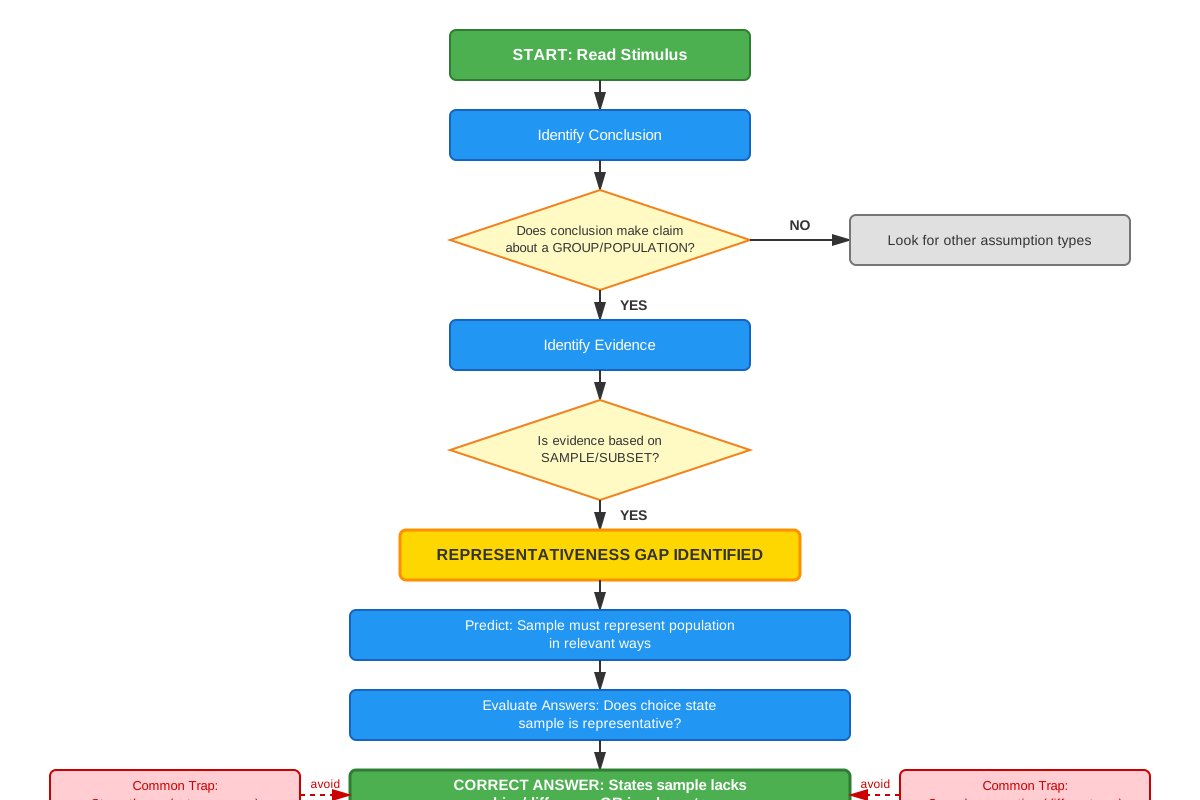
- Identify the sample and population: Ask "What specific group provided the evidence?" and "What broader group is the conclusion about?" Write these down if necessary.
- Spot the potential bias: Ask "How might this sample differ from the population?" Consider selection method, voluntary participation, time period, location, or demographic factors.
- Articulate the assumption: State in your own words: "The argument assumes [sample] represents [population] with respect to [characteristic]."
Process of Elimination Strategy
For Assumption Questions:
- Eliminate answers that introduce new topics not connecting sample to population
- Eliminate answers about sample size rather than sample selection
- Eliminate answers that would strengthen but aren't necessary (use the negation test)
- Keep answers stating the sample is "typical," "representative," or "similar to" the population
For Strengthen Questions:
- Eliminate answers that address different assumptions (causal, conditional)
- Keep answers providing evidence the sample was randomly selected or properly chosen
- Keep answers showing the sample matches the population in relevant characteristics
- Keep answers ruling out specific biases
For Weaken Questions:
- Keep answers showing the sample was self-selected or biased
- Keep answers introducing relevant differences between sample and population
- Keep answers showing conditions have changed (for temporal representativeness)
- Eliminate answers about sample size alone without addressing selection bias
Time Management
Representativeness questions typically require 1:15-1:30 to complete. Spend:
- 20-30 seconds reading and identifying the argument structure
- 15-20 seconds identifying sample and population
- 30-40 seconds evaluating answer choices
If you quickly identify the representativeness gap, these questions can be faster than complex conditional logic questions. Don't overthink—the assumption is usually straightforward once you've identified the sample-to-population move.
Exam Tip: When stuck between two answers, ask "Does this answer directly connect the sample to the population?" The correct answer will explicitly bridge that gap, not discuss tangential issues.
Memory Techniques
The SAMPLE Acronym
Use SAMPLE to remember common representativeness flaws:
- Selection bias (how was the sample chosen?)
- Attitude differences (do volunteers differ from non-volunteers?)
- Method of participation (voluntary vs. required?)
- Place/location (geographic representativeness?)
- Length of time (temporal representativeness?)
- Exclusions (who's missing from the sample?)
The Bridge Visualization
Picture the argument as a bridge: the sample is one side, the population is the other side, and the assumption is the bridge connecting them. If the bridge is weak (sample isn't representative), the argument collapses. This visualization helps remember that assumption answers must explicitly connect sample to population.
The "Typical Test"
For assumption questions, mentally insert the word "typical" or "representative" into potential answers. If an answer can be restated as "the sample is typical of the population," it's likely correct. This quick test helps identify representativeness assumptions even when they're worded differently.
The Time-Travel Check
For arguments using historical examples, imagine time-traveling between the past and present. Ask: "What might have changed?" This helps identify temporal representativeness assumptions quickly.
Summary
Representativeness assumptions form a critical reasoning pattern on the LSAT, appearing when arguments generalize from samples to populations. The core logical structure involves evidence about a specific group (sample) supporting a conclusion about a broader category (population), with the unstated assumption that the sample accurately reflects the population in relevant respects. Common flaws include selection bias, voluntary response bias, temporal bias, geographic bias, and demographic bias—all representing ways samples might systematically differ from populations. Success on these questions requires identifying the sample-to-population move, recognizing potential biases, and selecting answers that explicitly bridge the gap between sample and population. This reasoning pattern appears across multiple question types (assumption, strengthen, weaken, flaw), making it a high-yield topic for score improvement. The key insight is that representativeness is about selection method and relevant similarities, not merely sample size, and that the LSAT tests whether students can identify when conclusions overreach their evidentiary support by treating potentially biased samples as representative of broader populations.
Key Takeaways
- Representativeness assumptions bridge the gap between sample evidence and population conclusions—whenever an argument generalizes from specific instances to broader claims, evaluate whether the sample represents the whole
- The assumption is about outcome (representativeness), not process (sampling method)—correct answers state that the sample IS representative, not how it was selected
- Voluntary participation almost always creates bias—self-selected samples systematically differ from populations because participation correlates with interest, opinion strength, or other relevant factors
- Scope matching is essential—the sample must represent the specific population in the conclusion, not a broader or narrower group
- Temporal representativeness requires constant conditions—historical examples assume relevant circumstances haven't changed between past and present
- Selection method matters more than sample size—a small properly randomized sample is more representative than a large biased sample
- The same logical gap appears across question types—mastering representativeness enables success on assumption, strengthen, weaken, and flaw questions involving sampling and generalization
Related Topics
Causal Reasoning and Assumptions: While representativeness concerns whether samples reflect populations, causal reasoning concerns whether correlations indicate causation. Many arguments combine both assumption types, requiring students to identify multiple gaps. Mastering representativeness provides a foundation for distinguishing these assumption categories.
Strengthen and Weaken Questions: The same representativeness concepts apply when questions ask what would make arguments stronger or weaker. Evidence of proper sampling strengthens; evidence of bias weakens. Understanding representativeness assumptions enables efficient analysis of these related question types.
Flaw Questions: Arguments with representativeness flaws commit the error of treating unrepresentative samples as representative. Flaw questions require describing this error rather than identifying the assumption, but the underlying logical analysis remains identical.
Survey and Study Analysis: A specialized application of representativeness reasoning involves evaluating scientific studies, polls, and surveys. This advanced topic builds on representativeness foundations by adding considerations of statistical significance, control groups, and experimental design.
Scope and Precision in Arguments: Understanding how sample scope must match conclusion scope connects to broader skills in identifying scope shifts, overgeneralizations, and precision errors throughout Logical Reasoning sections.
Practice CTA
Now that you've mastered the core concepts of representativeness assumptions, it's time to apply this knowledge to actual LSAT questions. The practice questions and flashcards will reinforce your ability to quickly identify sample-to-population moves, recognize common biases, and select correct answers across multiple question types. Remember: representativeness questions are highly predictable once you've trained yourself to spot the pattern. Each practice question you complete strengthens your pattern recognition and builds the confidence needed for test day success. Start with the practice questions to test your understanding, then use the flashcards to cement the high-yield facts and common flaws in your memory. You've built a strong foundation—now make it automatic through deliberate practice.
Sign up free to keep reading
Create a free AnvayaPrep account to finish this LSAT guide on Representativeness assumptions — plus flashcards and practice questions.