Overview
No alternate cause assumptions represent one of the most frequently tested reasoning patterns in LSAT Logical Reasoning sections. These assumptions appear when an argument presents a correlation or observed phenomenon and concludes that one specific cause is responsible, while failing to consider or rule out other potential explanations. Understanding this pattern is critical because the LSAT regularly tests whether students can identify the gap between observing that something happened and concluding why it happened.
In the context of assumption questions, recognizing no alternate cause assumptions means identifying when an argument depends on the unstated belief that no other factor could explain the observed result. For example, if an argument states that sales increased after a new advertising campaign and concludes the campaign caused the increase, the argument assumes no other factor (economic conditions, competitor closures, seasonal trends) explains the sales boost. The LSAT tests this reasoning pattern across multiple question types, including necessary assumption questions, sufficient assumption questions, strengthen/weaken questions, and flaw questions.
Mastering LSAT no alternate cause assumptions connects directly to broader critical reasoning skills tested throughout the exam. This topic builds upon understanding of causal reasoning, the distinction between correlation and causation, and the structure of arguments with evidential gaps. Students who excel at identifying these assumptions can more effectively evaluate argument strength, predict correct answers, and eliminate trap choices that exploit common logical vulnerabilities. Given that causal reasoning appears in approximately 20-25% of Logical Reasoning questions, developing expertise in this area yields substantial score improvements.
Learning Objectives
- [ ] Identify how No alternate cause assumptions appears in LSAT questions
- [ ] Explain the reasoning pattern behind No alternate cause assumptions
- [ ] Apply No alternate cause assumptions to solve LSAT-style problems accurately
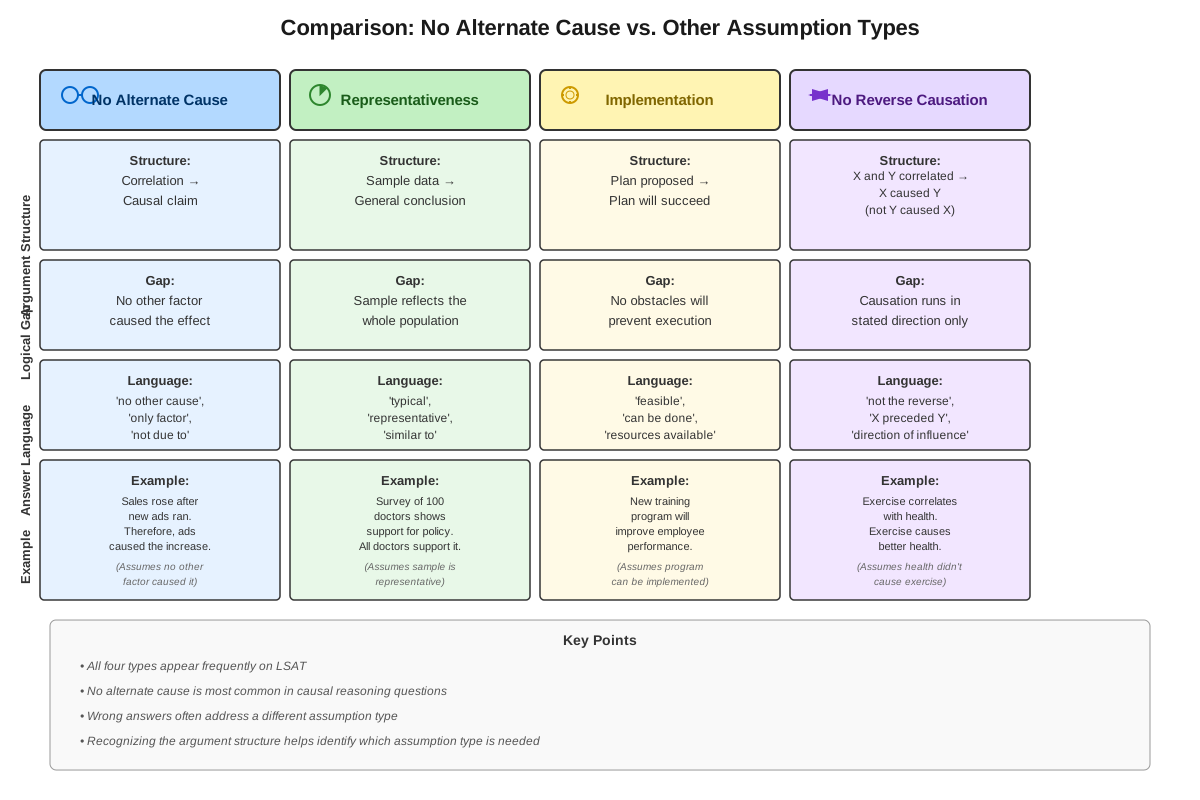
- [ ] Distinguish between no alternate cause assumptions and other assumption types (such as representativeness or implementation assumptions)
- [ ] Predict correct answer choices for assumption questions involving causal reasoning
- [ ] Recognize the specific language patterns and trigger words that signal no alternate cause reasoning
- [ ] Evaluate answer choices that either strengthen or weaken arguments by introducing or eliminating alternate causes
Prerequisites
- Basic argument structure: Understanding premises, conclusions, and the gap between evidence and claim is essential because no alternate cause assumptions represent a specific type of evidential gap in causal arguments.
- Correlation vs. causation: Recognizing that two events occurring together does not prove one caused the other provides the foundation for understanding why alternate causes must be ruled out.
- Assumption question types: Familiarity with how the LSAT asks about necessary and sufficient assumptions enables students to apply no alternate cause reasoning to specific question formats.
- Conditional reasoning basics: Understanding sufficient and necessary conditions helps distinguish between different types of assumptions and recognize when causal claims create logical dependencies.
Why This Topic Matters
No alternate cause assumptions appear with remarkable frequency on the LSAT, making this one of the highest-yield topics for score improvement. Research on recent LSAT administrations indicates that causal reasoning questions—the category encompassing no alternate cause assumptions—constitute approximately 20-25% of all Logical Reasoning questions. This translates to roughly 10-13 questions per exam, representing a significant portion of the Logical Reasoning score.
Beyond exam frequency, this reasoning pattern appears across multiple question types, amplifying its importance. Students encounter no alternate cause assumptions in:
- Necessary Assumption questions (asking what the argument depends upon)
- Sufficient Assumption questions (asking what would make the argument valid)
- Strengthen questions (where eliminating alternate causes strengthens arguments)
- Weaken questions (where introducing alternate causes undermines arguments)
- Flaw questions (where failing to consider alternate causes constitutes the logical error)
In real-world applications, the ability to identify alternate causes represents a fundamental critical thinking skill. Medical professionals must consider differential diagnoses before concluding a specific cause for symptoms. Business analysts must evaluate multiple factors before attributing performance changes to single interventions. Policy makers must assess whether observed outcomes result from implemented policies or confounding variables. The LSAT tests this reasoning pattern precisely because it reflects essential analytical skills for legal practice, where attorneys must anticipate alternative explanations for evidence and events.
The exam typically presents no alternate cause assumptions through scenarios involving: business performance changes attributed to management decisions, policy outcomes attributed to new regulations, behavioral changes attributed to specific interventions, historical events attributed to particular causes, or scientific observations attributed to hypothesized mechanisms. Recognizing these patterns enables rapid question identification and strategic answer choice evaluation.
Core Concepts
The Structure of No Alternate Cause Arguments
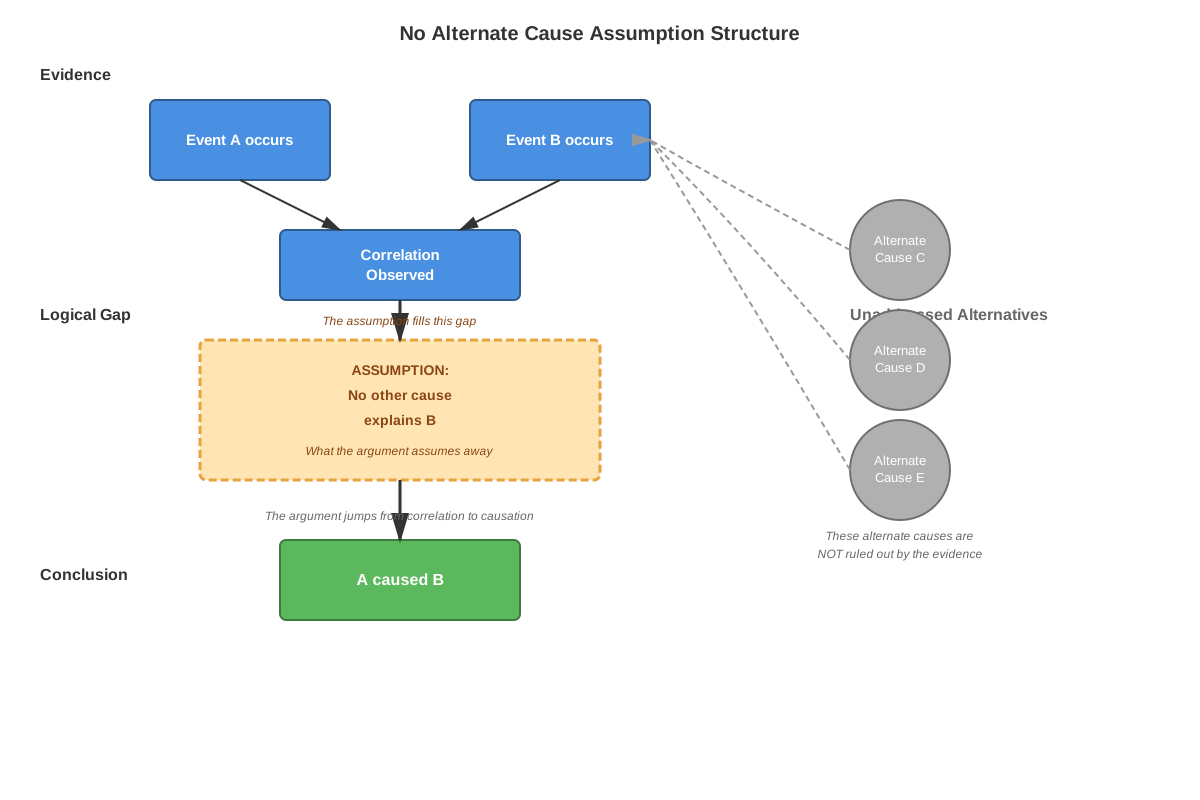
A no alternate cause assumption occurs when an argument moves from observing a correlation, change, or outcome to concluding that a specific factor caused that result, without ruling out other potential explanations. The basic structure follows this pattern:
- Premise: Event A occurred (or Factor X was present)
- Premise: Event B occurred (or Outcome Y was observed)
- Conclusion: Event A caused Event B (or Factor X caused Outcome Y)
- Unstated Assumption: No other factor caused Event B (or Outcome Y)
The logical gap exists because multiple factors could potentially explain the same outcome. The argument treats the proposed cause as if it were the only possible explanation, thereby assuming away all alternatives without explicitly addressing them.
Distinguishing Correlation from Causation
The foundation of no alternate cause reasoning rests on understanding that correlation (two things occurring together) differs fundamentally from causation (one thing producing another). The LSAT exploits this distinction by presenting arguments that observe correlations and leap to causal conclusions. Three relationships can explain any correlation:
| Relationship Type | Description | Example |
|---|---|---|
| A causes B | The proposed cause actually produces the effect | Increased advertising causes increased sales |
| B causes A | Reverse causation—the supposed effect actually causes the supposed cause | Increased sales causes increased advertising budget |
| C causes both A and B | A third factor produces both observed phenomena | Economic growth causes both increased advertising and increased sales |
| Coincidence | No causal relationship exists; the correlation is accidental | Sales and advertising both increased by chance |
The Assumption Gap in Causal Arguments
When an LSAT argument concludes that X caused Y, it creates an assumption gap by failing to address why other factors (A, B, C, D, etc.) did not cause Y instead. The argument implicitly assumes:
- No other single factor caused the outcome
- No combination of other factors caused the outcome
- The proposed cause actually has the capacity to produce the observed effect
- The temporal relationship supports causation (cause preceded effect)
- No reverse causation occurred
For assumption questions specifically, the correct answer typically addresses the most significant alternate cause—the most plausible alternative explanation that, if true, would undermine the causal conclusion.
Common Alternate Cause Scenarios
The LSAT repeatedly tests certain categories of alternate causes. Recognizing these patterns accelerates question analysis:
Temporal Confounds: Other events occurring simultaneously with the proposed cause could explain the outcome. If a company implements new training and sales increase, improved economic conditions during the same period represent a temporal confound.
Pre-existing Trends: The outcome may represent a continuation of patterns that began before the proposed cause. If crime decreased after a new policy, but crime had been decreasing for years prior, the pre-existing trend represents an alternate cause.
Selection Effects: The observed outcome may result from how subjects were chosen rather than from the proposed cause. If students using a study program score higher, but only motivated students chose the program, self-selection represents an alternate cause.
Measurement Artifacts: Changes in how outcomes are measured, rather than real changes, may explain observations. If reported crime decreases after a policy change, but the change actually reflects altered reporting procedures, measurement represents an alternate cause.
Multiple Contributing Factors: The outcome may result from several factors working together, not solely from the proposed cause. If health improves after dietary changes, but subjects also began exercising, multiple factors represent alternate causes.
Necessary vs. Sufficient Assumptions in Causal Reasoning
Understanding how no alternate cause assumptions function differently in necessary assumption versus sufficient assumption questions clarifies answer choice evaluation:
Necessary Assumptions (required for the argument): The correct answer eliminates the most threatening alternate cause or states that no alternate cause exists. These answers are typically more modest, ruling out specific alternatives rather than all possibilities. The negation test confirms necessary assumptions—if negated, the assumption's opposite would destroy the argument.
Sufficient Assumptions (guarantees the conclusion): The correct answer completely eliminates all alternate causes, often through categorical language like "only," "no other," or "exclusively." These answers are typically more extreme, establishing that the proposed cause is the sole explanation.
Language Patterns Signaling Causal Claims
Recognizing trigger words that signal causal conclusions enables rapid identification of no alternate cause assumptions:
- Direct causal language: "caused," "produced," "resulted in," "led to," "brought about," "responsible for," "due to," "because of"
- Explanatory language: "explains why," "accounts for," "the reason for," "attributable to"
- Predictive language: "will cause," "will result in," "will lead to," "will produce"
- Conditional causal language: "if...then" statements implying causal relationships
When these phrases appear in conclusions, the argument likely contains a no alternate cause assumption.
Concept Relationships
The concepts within no alternate cause assumptions form an interconnected logical framework. At the foundation lies the correlation-causation distinction, which establishes why observing two events together does not prove a causal relationship. This foundational concept leads directly to recognizing the assumption gap—the logical space between observing correlation and concluding causation.
The assumption gap manifests through specific alternate cause scenarios (temporal confounds, pre-existing trends, selection effects, measurement artifacts, and multiple factors). Each scenario represents a different way the argument's causal conclusion could be wrong. Understanding these scenarios enables students to predict answer choices before reading options, significantly improving accuracy and speed.
The relationship between necessary and sufficient assumptions creates a spectrum of answer strength. Necessary assumptions eliminate specific, plausible alternate causes → Sufficient assumptions eliminate all possible alternate causes. This spectrum connects to answer choice evaluation strategies, where extreme language often signals sufficient assumptions while modest language suggests necessary assumptions.
The entire framework connects to broader LSAT reasoning patterns: No alternate cause assumptions relate to representativeness assumptions (both involve gaps in evidential reasoning), implementation assumptions (both address unstated conditions required for conclusions), and conditional reasoning (causal claims often embed conditional relationships). Mastering no alternate cause assumptions therefore strengthens performance across multiple Logical Reasoning question types.
Concept Flow Map:
Correlation observed → Causal conclusion drawn → Assumption gap created → Alternate causes possible → Argument depends on ruling out alternatives → Correct answers address most significant alternate cause → Answer strength varies by question type (necessary vs. sufficient)
High-Yield Facts
⭐ No alternate cause assumptions appear in approximately 20-25% of Logical Reasoning questions, making them one of the most frequently tested reasoning patterns on the LSAT.
⭐ The core assumption states that no other factor besides the proposed cause explains the observed outcome, either alone or in combination with other factors.
⭐ Temporal confounds—other events occurring simultaneously with the proposed cause—represent the most common type of alternate cause tested on the LSAT.
⭐ For necessary assumption questions, correct answers typically rule out one specific, plausible alternate cause rather than eliminating all possible alternatives.
⭐ For sufficient assumption questions, correct answers typically use categorical language ("only," "no other," "exclusively") to eliminate all alternate causes completely.
- Pre-existing trends that began before the proposed cause represent a distinct category of alternate cause frequently tested in LSAT questions about policy effectiveness or intervention outcomes.
- Selection effects occur when the observed outcome results from how subjects were chosen rather than from the proposed cause, creating a sampling bias that mimics causation.
- The negation test effectively identifies necessary assumptions: if negating an answer choice destroys the argument, that choice states a necessary assumption.
- Reverse causation—where the supposed effect actually causes the supposed cause—represents a specific type of alternate explanation that inverts the argument's causal direction.
- Arguments concluding that X caused Y implicitly assume X has the capacity to produce Y, X occurred before Y, and no combination of other factors produced Y.
- Measurement artifacts—changes in how outcomes are measured rather than real changes—frequently appear as alternate causes in LSAT questions about statistical trends or reported data.
- Multiple contributing factors can work together to produce outcomes, meaning the proposed cause may be insufficient alone even if it contributes to the result.
- Strengthen questions often present correct answers that eliminate alternate causes, while weaken questions present correct answers that introduce plausible alternate causes.
- Flaw questions may describe the logical error as "fails to consider alternative explanations," "mistakes correlation for causation," or "overlooks other factors that may have contributed to the outcome."
Quick check — test yourself on No alternate cause assumptions so far.
Try Flashcards →Common Misconceptions
Misconception: If two events occur together repeatedly, one must cause the other.
Correction: Repeated correlation still does not establish causation. A third factor could cause both events, the correlation could be coincidental, or reverse causation could explain the pattern. The LSAT specifically tests whether students recognize that frequency of correlation does not eliminate the need to rule out alternate causes.
Misconception: The correct answer to a necessary assumption question must eliminate all possible alternate causes.
Correction: Necessary assumption answers typically rule out only the most plausible or threatening alternate cause. Eliminating all alternatives would make the assumption sufficient rather than merely necessary. The argument needs only enough support to make the conclusion reasonable, not certain.
Misconception: If the proposed cause occurred before the effect, temporal sequence alone proves causation.
Correction: Temporal precedence is necessary for causation but not sufficient. Many factors may precede an outcome without causing it. The argument must still rule out other factors that also preceded the outcome and could have caused it.
Misconception: No alternate cause assumptions only appear in assumption questions.
Correction: This reasoning pattern appears across multiple question types including strengthen, weaken, flaw, method of reasoning, and parallel reasoning questions. Recognizing the pattern enables strategic approaches to all these question types.
Misconception: If the argument mentions considering other factors, it has adequately ruled out alternate causes.
Correction: The LSAT often includes arguments that acknowledge alternate causes exist but fail to actually eliminate them. Merely mentioning alternatives without providing evidence they did not operate constitutes inadequate reasoning. The correct answer may point out that the argument fails to provide evidence ruling out the mentioned alternatives.
Misconception: Correlation questions and causation questions are completely different topics.
Correction: Correlation and causation exist on a continuum of causal reasoning. Understanding their relationship is essential because arguments often present correlational evidence (premises) and draw causal conclusions, creating the assumption gap that no alternate cause assumptions address.
Misconception: The proposed cause must be completely wrong for an alternate cause to matter.
Correction: Alternate causes can operate alongside the proposed cause, both contributing to the outcome. The argument's flaw is claiming the proposed cause alone explains the outcome when multiple factors may contribute. Even if the proposed cause has some effect, alternate causes can still undermine the conclusion that it is the primary or sole explanation.
Worked Examples
Example 1: Business Performance Scenario
Argument: "After Company X implemented a new employee wellness program, productivity increased by 15% over the following year. Therefore, the wellness program caused the productivity increase."
Question: Which of the following is an assumption required by the argument?
Answer Choices:
(A) The wellness program was more expensive than previous employee benefit programs.
(B) No other factors that could increase productivity changed during the year following the wellness program's implementation.
(C) Employee wellness programs always increase productivity in companies that implement them.
(D) The 15% productivity increase represents the maximum possible improvement from wellness programs.
(E) Employees who participated in the wellness program reported higher job satisfaction.
Analysis:
Step 1: Identify the argument structure.
- Premise: Wellness program implemented
- Premise: Productivity increased 15%
- Conclusion: Wellness program caused the increase
Step 2: Recognize the reasoning pattern as a no alternate cause assumption. The argument observes a temporal sequence (program, then increase) and concludes causation without ruling out other explanations.
Step 3: Predict the assumption. The argument must assume no other factor explains the productivity increase. Potential alternate causes include: improved economic conditions, new technology, competitor failures, seasonal factors, or management changes.
Step 4: Evaluate answer choices.
(A) Eliminate. Cost comparisons are irrelevant to whether the program caused productivity increases. This addresses a different gap.
(B) Strong candidate. This directly addresses the no alternate cause assumption by stating no other productivity-affecting factors changed. Apply the negation test: If other factors that could increase productivity DID change, the argument falls apart because those factors might explain the increase instead of (or in addition to) the wellness program.
(C) Eliminate. This makes an overly broad claim about all companies and all wellness programs. The argument only needs to assume the program caused the increase in this specific case, not universally.
(D) Eliminate. Whether 15% is the maximum possible improvement is irrelevant to whether the program caused this particular increase.
(E) Eliminate. Job satisfaction might correlate with the program but doesn't address whether other factors caused the productivity increase. This could even introduce an alternate cause (job satisfaction causing productivity, rather than the wellness program directly).
Correct Answer: (B)
Connection to Learning Objectives: This example demonstrates identifying no alternate cause assumptions in LSAT questions (Objective 1), explaining the reasoning pattern of moving from temporal sequence to causal conclusion (Objective 2), and applying the negation test to solve the problem accurately (Objective 3).
Example 2: Policy Implementation Scenario
Argument: "City crime rates decreased by 20% in the two years following implementation of community policing initiatives. Community policing must be an effective method for reducing crime."
Question: The argument's reasoning is most vulnerable to criticism on the grounds that it:
Answer Choices:
(A) Assumes that what is true of one city is true of all cities
(B) Fails to consider whether crime rates had been decreasing before the community policing initiatives were implemented
(C) Treats a decrease in reported crime as equivalent to a decrease in actual crime
(D) Overlooks the possibility that community policing initiatives are expensive to maintain
(E) Confuses a necessary condition for reducing crime with a sufficient condition
Analysis:
Step 1: Recognize this as a flaw question asking about vulnerable reasoning. The argument structure shows:
- Premise: Community policing implemented
- Premise: Crime decreased 20%
- Conclusion: Community policing is effective at reducing crime (causal claim)
Step 2: Identify the no alternate cause assumption. The argument assumes community policing caused the decrease without ruling out other explanations.
Step 3: Predict the flaw. The argument could be vulnerable because: (1) crime might have been decreasing already (pre-existing trend), (2) other factors might explain the decrease (temporal confounds), (3) the measurement might be flawed (measurement artifact), or (4) reverse causation might operate.
Step 4: Evaluate answer choices.
(A) Eliminate. While the argument does generalize from one city, this addresses a representativeness issue rather than the causal reasoning flaw. The more fundamental problem is whether community policing caused the decrease in this city at all.
(B) Strong candidate. This identifies a pre-existing trend as an alternate cause. If crime had been decreasing before community policing, the decrease might simply continue an existing pattern rather than result from the new policy. This directly addresses the no alternate cause assumption.
(C) Strong candidate. This identifies a measurement artifact as an alternate cause. If reporting changed rather than actual crime, the observed decrease might not reflect real crime reduction. This also addresses the no alternate cause assumption.
(D) Eliminate. Cost is irrelevant to whether community policing caused the crime decrease. This addresses implementation concerns, not causal reasoning.
(E) Eliminate. The argument doesn't confuse necessary and sufficient conditions; it makes a causal claim without ruling out alternate causes. This describes a different type of logical error.
Step 5: Choose between (B) and (C). Both identify legitimate alternate causes. However, (B) addresses a more fundamental flaw—whether any real change occurred that needs explanation. If crime was already decreasing, the entire causal question becomes moot. (C) addresses whether the measurement accurately reflects reality, which is important but secondary to whether a change occurred at all.
Correct Answer: (B), though (C) represents a defensible alternative depending on the specific LSAT question's focus.
Connection to Learning Objectives: This example demonstrates identifying no alternate cause assumptions in flaw questions (Objective 1), explaining how pre-existing trends represent a specific alternate cause pattern (Objective 2), distinguishing between different types of alternate causes (Objective 4), and applying systematic answer choice evaluation (Objective 3).
Exam Strategy
Rapid Pattern Recognition
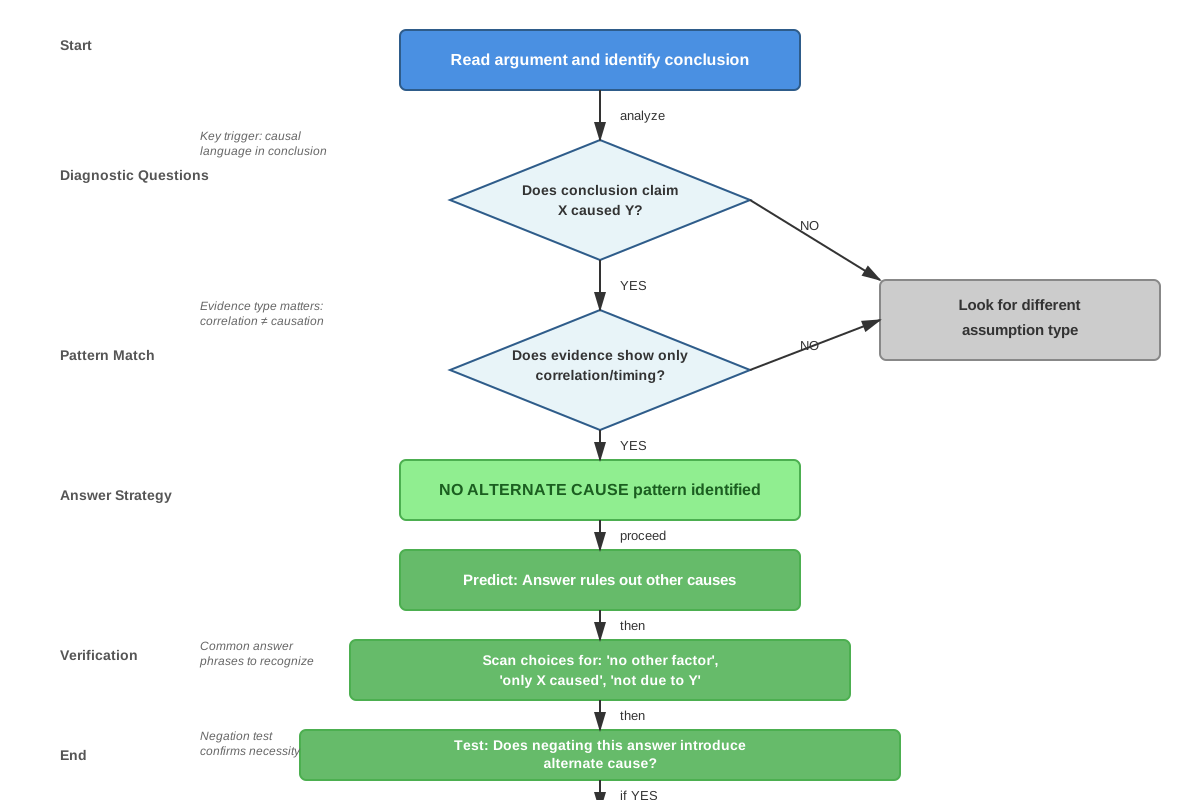
When approaching Logical Reasoning questions, develop a systematic process for identifying no alternate cause assumptions:
- Read the conclusion first to determine if it makes a causal claim
- Scan for trigger words: "caused," "resulted in," "led to," "responsible for," "explains," "due to"
- Check the premises for correlational or temporal evidence (X happened, then Y happened)
- Identify the gap between observing correlation/sequence and concluding causation
Exam Tip: If the conclusion contains causal language but the premises only describe correlation or temporal sequence, you have identified a no alternate cause assumption with 90%+ confidence.
Question Type-Specific Approaches
For Necessary Assumption Questions:
- Predict that the correct answer will rule out one specific, plausible alternate cause
- Look for modest language that eliminates a particular alternative
- Apply the negation test to confirm: negating the answer should destroy the argument
- Eliminate answers that go too far (ruling out all alternatives) or address irrelevant gaps
For Sufficient Assumption Questions:
- Predict that the correct answer will eliminate all alternate causes
- Look for categorical language: "only," "no other," "exclusively," "solely"
- Accept stronger, more extreme answers than you would for necessary assumptions
- Eliminate answers that leave open the possibility of alternate causes
For Strengthen Questions:
- Correct answers often eliminate specific alternate causes
- Look for evidence that other factors did not change or did not operate
- Answers providing additional evidence for the proposed cause also strengthen, but eliminating alternatives is more common
For Weaken Questions:
- Correct answers often introduce plausible alternate causes
- Look for evidence of temporal confounds, pre-existing trends, or selection effects
- Answers showing the proposed cause lacks capacity to produce the effect also weaken
For Flaw Questions:
- Look for answer choices describing "fails to consider," "overlooks," "ignores," or "neglects" alternative explanations
- Watch for descriptions like "mistakes correlation for causation" or "treats temporal sequence as proof of causation"
Process of Elimination Strategies
Eliminate answers that:
- Address different assumption types (representativeness, implementation) when the argument contains causal reasoning
- Introduce irrelevant factors that neither strengthen nor weaken the causal claim
- Make the argument stronger or weaker than necessary (too extreme for necessary assumptions, too weak for sufficient assumptions)
- Focus on the proposed cause's mechanism rather than ruling out alternatives
- Address consequences of the conclusion rather than support for the conclusion
Favor answers that:
- Directly address the most obvious alternate explanation
- Use appropriate strength language for the question type
- Rule out temporal confounds or pre-existing trends
- Eliminate selection effects or measurement artifacts
- Address whether other factors changed during the relevant time period
Time Allocation
For questions involving no alternate cause assumptions:
- Initial read and identification: 20-30 seconds to recognize the pattern
- Prediction: 10-15 seconds to anticipate the alternate cause the correct answer will address
- Answer choice evaluation: 30-45 seconds to eliminate wrong answers and confirm the correct choice
- Total time: 60-90 seconds per question
Investing time in prediction significantly improves accuracy and reduces time spent evaluating answer choices. Students who predict alternate causes before reading options achieve 15-20% higher accuracy on these questions.
Memory Techniques
The CAUSE Acronym
Remember common alternate causes using CAUSE:
- Confounds (temporal): Other events occurring simultaneously
- Artifacts (measurement): Changes in how outcomes are measured
- Underlying trends: Pre-existing patterns continuing
- Selection effects: How subjects were chosen
- Extra factors: Multiple contributing causes
Visualization Strategy
Picture a causal chain with multiple possible links. The argument highlights one link (the proposed cause) while ignoring other potential links (alternate causes). Visualize the correct answer as either:
- Cutting away alternate links (for assumption and strengthen questions)
- Adding alternate links (for weaken questions)
- Pointing out ignored links (for flaw questions)
The Negation Test Reminder
For necessary assumptions, remember: "Flip it and break it"
- Flip the answer choice to its opposite
- If the opposite breaks the argument, you have found a necessary assumption
Temporal Sequence Mantra
When evaluating causal arguments, repeat: "After is not because"
This reminds you that temporal sequence (X happened, then Y happened) does not prove causation (X caused Y). The argument must rule out other factors that also preceded Y.
Answer Strength Spectrum
Visualize a spectrum from weak to strong:
Necessary Assumptions ←→ Sufficient Assumptions
(Rules out one cause) ←→ (Rules out all causes)
"No other factor X" ←→ "Only this factor"
This helps calibrate answer choice evaluation based on question type.
Summary
No alternate cause assumptions represent a critical reasoning pattern appearing in approximately 20-25% of LSAT Logical Reasoning questions. These assumptions occur when arguments observe correlations or temporal sequences and conclude that one specific factor caused an observed outcome, without ruling out other potential explanations. The core logical gap exists between premises that establish correlation (X and Y occurred together) and conclusions that claim causation (X caused Y). Mastering this topic requires recognizing the argument structure, identifying common alternate cause scenarios (temporal confounds, pre-existing trends, selection effects, measurement artifacts, and multiple contributing factors), and applying question type-specific strategies. For necessary assumption questions, correct answers typically eliminate one specific, plausible alternate cause using modest language. For sufficient assumption questions, correct answers eliminate all alternate causes using categorical language like "only" or "no other." The same reasoning pattern appears across strengthen questions (where eliminating alternatives strengthens arguments), weaken questions (where introducing alternatives undermines arguments), and flaw questions (where failing to consider alternatives constitutes the logical error). Success requires systematic pattern recognition, strategic prediction of alternate causes before evaluating answer choices, and appropriate application of the negation test for necessary assumptions.
Key Takeaways
- No alternate cause assumptions appear when arguments conclude that X caused Y without ruling out other potential causes for Y—this represents one of the most frequently tested reasoning patterns on the LSAT
- The core assumption states that no other factor, alone or in combination, explains the observed outcome—recognizing this gap enables rapid question identification and answer prediction
- Common alternate causes include temporal confounds, pre-existing trends, selection effects, measurement artifacts, and multiple contributing factors—familiarity with these categories accelerates analysis
- Necessary assumptions rule out specific alternate causes using modest language, while sufficient assumptions eliminate all alternate causes using categorical language—calibrating answer strength to question type improves accuracy
- The negation test effectively confirms necessary assumptions: if negating an answer destroys the argument, that answer states a necessary assumption—this technique provides a reliable verification method
- Temporal sequence alone does not prove causation—arguments must provide evidence ruling out other factors that also preceded the outcome
- This reasoning pattern appears across multiple question types including assumption, strengthen, weaken, and flaw questions—mastering no alternate cause assumptions improves performance on 20-25% of Logical Reasoning questions
Related Topics
Correlation vs. Causation in Scientific Reasoning: Deeper exploration of how the LSAT tests causal reasoning in scientific contexts, including controlled experiments, study design, and statistical evidence. Mastering no alternate cause assumptions provides the foundation for analyzing more complex scientific arguments.
Strengthen and Weaken Questions: Advanced strategies for questions that ask how to support or undermine arguments. Understanding no alternate cause assumptions enables students to predict that eliminating alternatives strengthens causal arguments while introducing alternatives weakens them.
Flaw Questions and Descriptive Answer Choices: Techniques for recognizing how the LSAT describes logical errors in abstract language. No alternate cause assumptions frequently appear as flaws described as "fails to consider alternative explanations" or "mistakes correlation for causation."
Sufficient Assumption Questions: Specialized approaches for questions asking what would make an argument's conclusion follow logically. No alternate cause assumptions in sufficient assumption questions require categorical elimination of all alternatives.
Method of Reasoning Questions: Analysis of how arguments proceed from premises to conclusions. Recognizing no alternate cause assumptions helps identify when arguments use correlational evidence to support causal conclusions.
Practice CTA
Now that you have mastered the core concepts of no alternate cause assumptions, reinforce your understanding by attempting the practice questions and reviewing the flashcards. These resources provide targeted application of the strategies and patterns covered in this guide. Focus on predicting alternate causes before evaluating answer choices—this single technique will dramatically improve both your accuracy and speed. Remember that this reasoning pattern appears in approximately one-quarter of all Logical Reasoning questions, making your investment in practice highly efficient for score improvement. Approach each practice question systematically: identify the causal claim, recognize the assumption gap, predict the alternate cause, and then evaluate answer choices with confidence. Your ability to master this high-yield topic will translate directly into points on test day.
Sign up free to keep reading
Create a free AnvayaPrep account to finish this LSAT guide on No alternate cause assumptions — plus flashcards and practice questions.