Overview
Quantifier assumptions represent one of the most frequently tested reasoning patterns on the LSAT Logical Reasoning section. These assumptions involve shifts in the scope or degree of claims—moving from "some" to "all," from "most" to "every," or from a qualified statement to an absolute one. Understanding quantifier assumptions is essential because arguments on the LSAT often contain subtle logical gaps where the author assumes a broader or narrower claim than the evidence actually supports.
The LSAT tests quantifier assumptions because they reveal critical thinking skills that law schools value: the ability to identify when someone has overgeneralized from limited evidence, when they've assumed universality without justification, or when they've treated a partial truth as a complete one. These reasoning errors appear constantly in legal arguments, policy debates, and everyday discourse. A lawyer must recognize when opposing counsel claims "all contracts of this type are unenforceable" based on evidence about only "some contracts," or when a witness testifies that "everyone saw the defendant" when only "several people" actually did.
Within the broader landscape of assumption questions in Logical Reasoning, quantifier assumptions occupy a middle ground between sufficient assumptions (which guarantee the conclusion) and necessary assumptions (which are required for the argument to work). They connect closely to conditional reasoning, scope shifts, and representativeness issues. Mastering quantifier assumptions provides a foundation for understanding how arguments can fail through overgeneralization, undergeneralization, or mismatched quantification between premises and conclusions.
Learning Objectives
- [ ] Identify how quantifier assumptions appear in LSAT questions
- [ ] Explain the reasoning pattern behind quantifier assumptions
- [ ] Apply quantifier assumptions to solve LSAT-style problems accurately
- [ ] Distinguish between different types of quantifier shifts (some→all, most→all, none→some)
- [ ] Recognize quantifier assumptions in both explicit and implicit forms
- [ ] Evaluate answer choices by testing whether they bridge quantifier gaps
- [ ] Predict the quantifier assumption before reviewing answer choices
Prerequisites
- Basic formal logic terminology: Understanding terms like "all," "some," "most," "none," and "many" is essential because quantifier assumptions involve shifts between these terms.
- Argument structure identification: Recognizing premises and conclusions allows students to spot where quantifier mismatches occur between evidence and claim.
- Necessary vs. sufficient assumptions: This distinction helps students understand that quantifier assumptions are typically necessary assumptions that must be true for the argument to hold.
- Scope concepts: Understanding how arguments can shift in scope prepares students to recognize when quantifiers change the breadth of a claim.
Why This Topic Matters
Quantifier assumptions appear in approximately 15-20% of all Logical Reasoning questions on the LSAT, making them one of the highest-yield patterns to master. They surface most commonly in Necessary Assumption questions, Sufficient Assumption questions, Flaw questions, and Strengthen/Weaken questions. The ability to spot quantifier shifts quickly and accurately can add 3-5 points to a student's Logical Reasoning score.
In legal practice, quantifier precision matters enormously. The difference between "some defendants" and "all defendants," or between "most contracts" and "every contract," can determine case outcomes, shape precedents, and affect millions of dollars in settlements. Law schools use the LSAT to identify students who can think with this level of precision.
On the exam, quantifier assumptions typically appear in arguments about:
- Scientific studies and their generalizability ("This study of 100 patients shows..." → "Therefore, this treatment works for all patients")
- Policy recommendations ("Most cities that implemented this policy saw benefits" → "Therefore, our city should implement it")
- Causal claims ("Some instances of X were followed by Y" → "Therefore, X causes Y")
- Categorical statements ("No observed cases of A have property B" → "Therefore, A never has property B")
Core Concepts
Understanding Quantifiers in Logical Reasoning
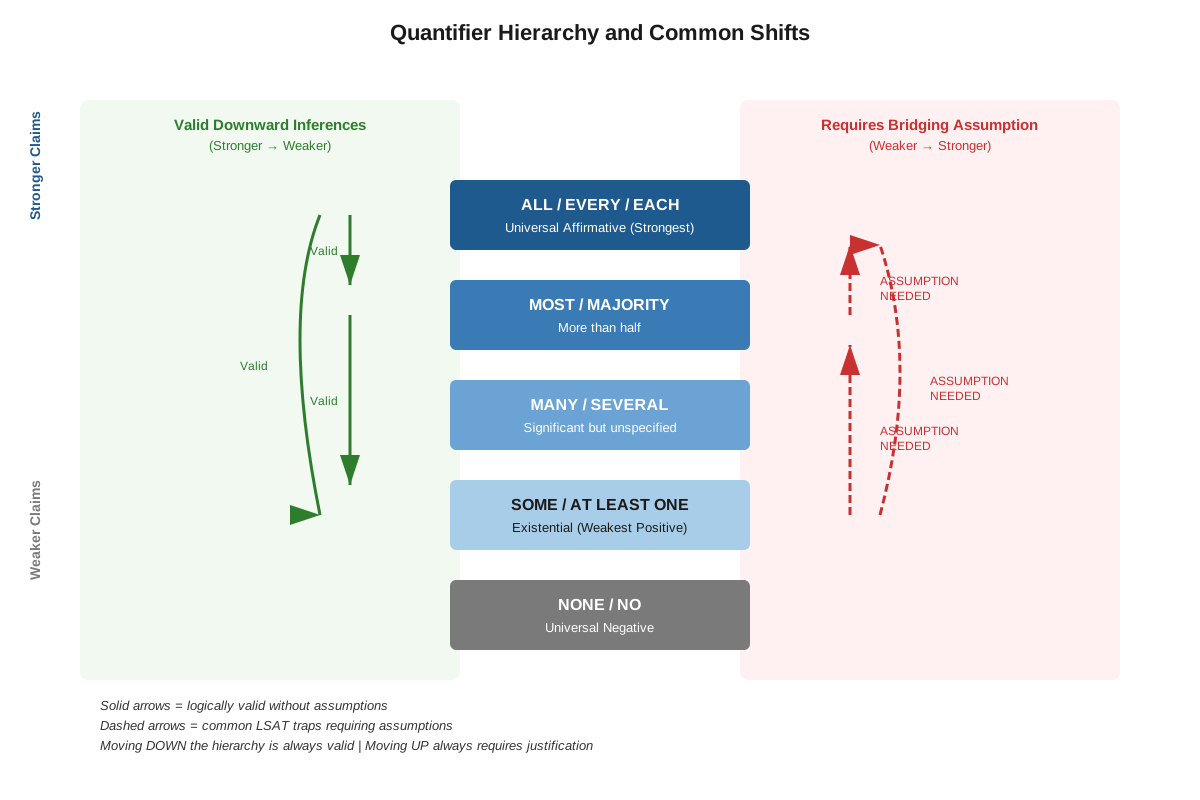
Quantifiers are words or phrases that specify the quantity or scope of a claim. The most common quantifiers on the LSAT form a hierarchy from weakest to strongest:
- Some: At least one, possibly more (weakest claim)
- Many/Several: More than a few, but not necessarily most
- Most: More than half
- All/Every/Each: 100% without exception (strongest claim)
- None/No: 0% (absolute negative)
The LSAT also uses implicit quantifiers through words like "the," "typically," "generally," "often," and "usually." Understanding this hierarchy is crucial because lsat quantifier assumptions involve moving up or down this ladder without justification.
The Basic Pattern of Quantifier Assumptions
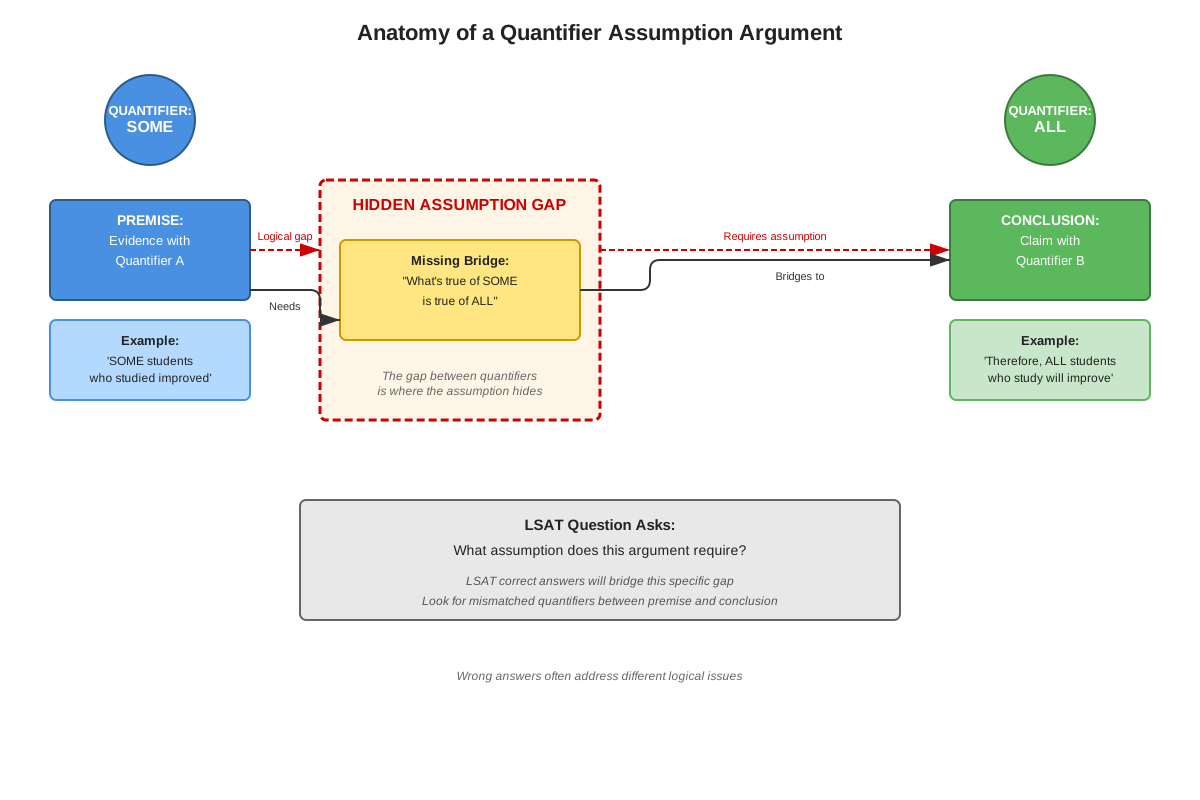
A quantifier assumption occurs when an argument's conclusion uses a different quantifier than its premises support. The classic pattern follows this structure:
Premise: [Quantifier A] of X have property Y
Conclusion: [Quantifier B] of X have property Y
Assumption: The shift from Quantifier A to Quantifier B is justified
For example:
- Premise: Some politicians who supported the bill were reelected
- Conclusion: Politicians who support the bill will be reelected
- Hidden Assumption: What's true of some politicians is true of all politicians (or at least this particular politician)
The argument contains a logical gap because the evidence (some) doesn't support the conclusion (implied all). The assumption bridges this gap by asserting that the pattern observed in some cases applies universally.
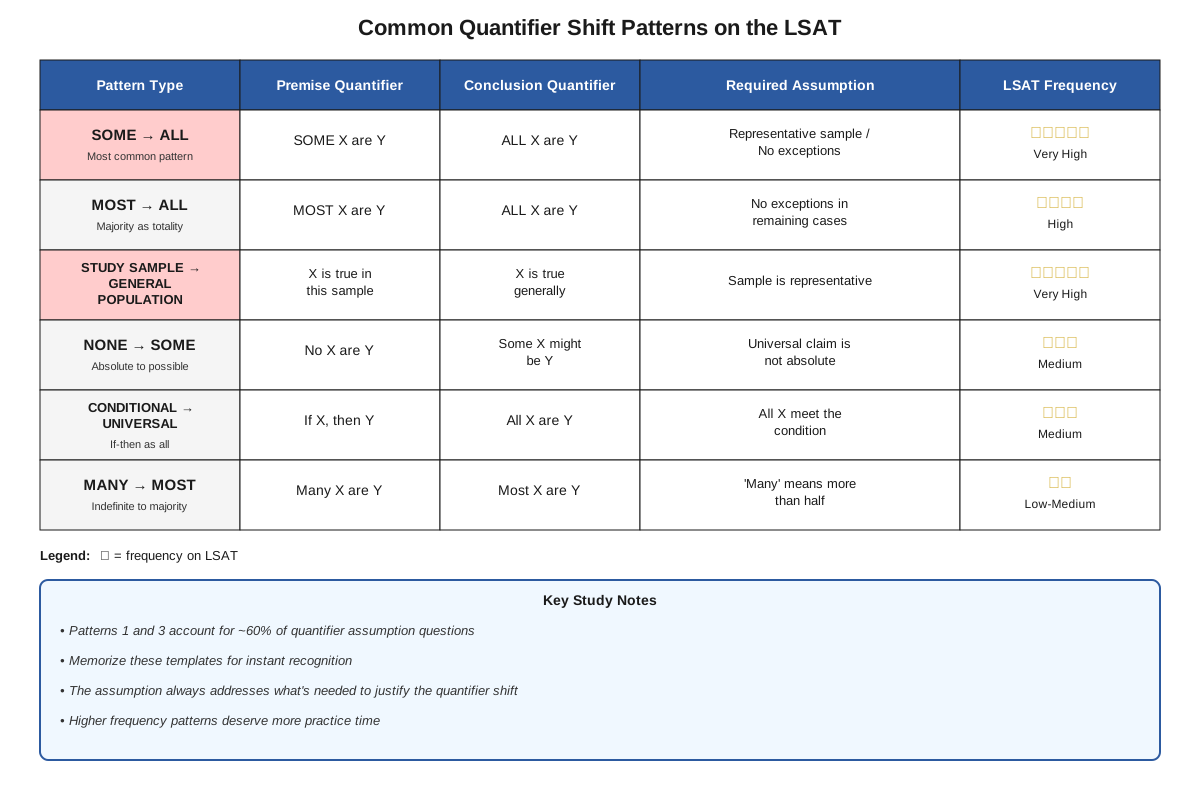
Types of Quantifier Shifts
Some → All Shifts
This is the most common quantifier assumption on the LSAT. The argument observes a pattern in some instances and concludes it applies to all instances.
Example Structure:
- Premise: Some students who used this study method improved their scores
- Conclusion: This study method will improve your score
- Assumption: What worked for some students will work for all students (or at least for you specifically)
Most → All Shifts
Arguments sometimes move from "most" to "all" or "every," assuming that what's true of the majority is true of every member.
Example Structure:
- Premise: Most companies that adopted this technology increased profits
- Conclusion: Every company should adopt this technology
- Assumption: What benefits most companies will benefit all companies
None → Some Shifts (Reverse Direction)
Less common but still tested, these arguments assume that because something hasn't been observed, it doesn't exist.
Example Structure:
- Premise: No study has shown harmful effects from this substance
- Conclusion: This substance is safe
- Assumption: The absence of evidence of harm is evidence of absence of harm
Implicit vs. Explicit Quantifiers
Many LSAT arguments use implicit quantifiers that students must recognize:
| Explicit Quantifier | Implicit Equivalent |
|---|---|
| All doctors | Doctors (with "the") |
| Some evidence | Evidence exists |
| Most experts | Experts generally agree |
| No cases | It never happens |
The word "the" often implies "all" (e.g., "the voters want change" suggests "all voters"). Recognizing these implicit quantifiers is essential for identifying quantifier assumptions.
Conditional Statements and Quantifiers
Conditional statements (if-then) contain implicit universal quantifiers. "If X, then Y" means "For all cases where X is true, Y is true." Arguments often shift between conditional statements and non-universal claims:
- Premise: If a company invests in training, productivity increases
- Conclusion: Companies that invested in training saw productivity increases
- Assumption: The conditional applies to all actual cases (no exceptions exist)
Representativeness and Sample Size
Quantifier assumptions often involve questions of representativeness. An argument might observe a pattern in a sample and conclude it applies to the whole population:
- Premise: In a survey of 100 urban residents, most supported the policy
- Conclusion: The policy has broad public support
- Assumption: Urban residents are representative of the general public; 100 people represent the broader population
Concept Relationships
Quantifier assumptions connect to multiple other Logical Reasoning concepts in a web of relationships:
Quantifier Assumptions → Scope Shifts: Quantifier assumptions are a specific type of scope shift where the breadth of a claim changes. Understanding scope helps identify when an argument has moved from a narrow claim to a broad one.
Conditional Reasoning → Quantifier Assumptions: Conditional statements contain implicit universal quantifiers ("all cases where..."). Misapplying conditionals often involves quantifier assumptions.
Sampling/Representativeness → Quantifier Assumptions: When arguments generalize from samples to populations, they make quantifier assumptions about whether the sample represents the whole.
Causal Reasoning → Quantifier Assumptions: Causal arguments often assume that because X caused Y in some cases, X causes Y in all cases (or this case specifically).
Necessary Assumptions → Quantifier Assumptions: Most quantifier assumptions are necessary assumptions—the argument requires them to be valid, but they alone don't guarantee the conclusion.
The relationship map flows as follows:
Observe pattern in limited cases → Assume pattern applies more broadly → Conclude universal or broader claim → Requires assumption that sample is representative and pattern holds across all cases
High-Yield Facts
⭐ Most quantifier assumptions involve moving from a weaker quantifier (some, many) to a stronger one (all, every) without justification.
⭐ The word "the" often functions as a universal quantifier, implying "all members of the category."
⭐ When an argument concludes with an unqualified statement after presenting qualified evidence, suspect a quantifier assumption.
⭐ "Some" in formal logic means "at least one, possibly all"—it's the weakest positive claim possible.
⭐ "Most" means "more than half" but does not mean "all" or even "almost all."
- Arguments that move from observed cases to unobserved cases typically contain quantifier assumptions.
- Conditional statements (if-then) contain implicit universal quantifiers that apply to all cases meeting the condition.
- The absence of a quantifier in a conclusion often implies "all" or "generally," creating potential quantifier gaps.
- Quantifier assumptions can work in reverse: assuming that because something is true of all, it's true of each specific instance.
- Survey and study-based arguments almost always involve quantifier assumptions about representativeness and generalizability.
Quick check — test yourself on Quantifier assumptions so far.
Try Flashcards →Common Misconceptions
Misconception: "Most" and "all" are close enough that arguments can move between them without assumptions.
Correction: "Most" means "more than 50%" while "all" means "100%"—this is a significant logical gap. An argument that concludes "all X are Y" based on "most X are Y" makes a substantial unjustified leap that requires an assumption.
Misconception: If no counterexamples have been observed, we can conclude none exist.
Correction: The absence of observed counterexamples doesn't prove their non-existence. Moving from "no observed cases" to "no cases exist" requires the assumption that our observations are complete and representative.
Misconception: Quantifier assumptions only involve the words "all," "some," "most," and "none."
Correction: Quantifiers can be implicit in articles ("the"), adverbs ("typically," "generally"), and context. An argument saying "doctors recommend this treatment" implies "all doctors" or "doctors generally," which may not be supported by evidence about "some doctors."
Misconception: If an argument says "some X are Y," it's claiming that "only some" or "not all" X are Y.
Correction: In formal logic, "some" means "at least one, possibly all." It's compatible with "all." Saying "some birds fly" doesn't exclude the possibility that all birds fly; it simply doesn't commit to that stronger claim.
Misconception: Quantifier assumptions are always wrong or fallacious.
Correction: Quantifier assumptions aren't inherently fallacious—they're gaps that need to be filled. On Necessary Assumption questions, identifying the quantifier assumption is finding what the argument needs. On Strengthen questions, providing the quantifier assumption strengthens the argument legitimately.
Misconception: The correct answer to a quantifier assumption question will always contain explicit quantifier words.
Correction: Correct answers often express quantifier assumptions through other language: "is representative of," "applies in this case," "holds true generally," or "no exceptions exist." Students must recognize the logical function, not just the vocabulary.
Worked Examples
Example 1: Classic Some → All Shift
Argument: "Several companies that implemented flexible work schedules reported increased employee satisfaction. Therefore, implementing flexible work schedules will increase employee satisfaction at our company."
Analysis:
Step 1 - Identify the conclusion: "Implementing flexible work schedules will increase employee satisfaction at our company."
Step 2 - Identify the premise: "Several companies that implemented flexible work schedules reported increased employee satisfaction."
Step 3 - Spot the quantifier shift: The premise discusses "several companies" (some), while the conclusion makes a claim about "our company" (a specific instance, implying the pattern holds universally or at least in this case).
Step 4 - Articulate the gap: The argument assumes that what was true for several companies will be true for this particular company. It assumes no relevant differences exist between the companies in the premise and "our company."
Step 5 - Predict the assumption: The argument requires assuming that our company is similar to the companies mentioned in relevant ways, or that the pattern observed in several companies applies to all companies (or at least ours).
Correct answer would say something like: "Our company is similar in relevant respects to the companies that reported increased satisfaction" or "The factors that led to increased satisfaction at those companies are present at our company."
Connection to learning objectives: This example demonstrates how to identify quantifier assumptions (moving from "several" to a specific application), explain the reasoning pattern (generalization from limited cases), and apply the concept to solve the problem.
Example 2: Most → All with Conditional Reasoning
Argument: "Most students who take practice tests before the LSAT improve their scores. Since practice tests help students improve, everyone preparing for the LSAT should take practice tests."
Analysis:
Step 1 - Identify the conclusion: "Everyone preparing for the LSAT should take practice tests."
Step 2 - Identify the premises: (1) "Most students who take practice tests improve their scores" and (2) "Practice tests help students improve" (intermediate conclusion).
Step 3 - Spot the quantifier shifts:
- First shift: "Most students" improve → "practice tests help students" (implies generally or universally)
- Second shift: "Practice tests help" → "everyone should take them"
Step 4 - Articulate the gaps:
- The argument moves from "most" to an unqualified general claim
- It then moves from a general benefit to a universal recommendation
- It assumes that what benefits most students will benefit all students
Step 5 - Predict the assumptions:
- What's true of most students is true of all students (or at least the relevant students)
- No students exist for whom practice tests would be harmful or unhelpful
- The benefit observed in most cases justifies a universal recommendation
Correct answer would say something like: "No students are harmed by taking practice tests" or "The students who didn't improve from practice tests would still benefit from taking them" or "What benefits most test-takers is advisable for all test-takers."
Connection to learning objectives: This example shows a more complex quantifier assumption involving multiple shifts and demonstrates how to work through layered reasoning to identify the core assumption.
Exam Strategy
Recognition Triggers
Watch for these phrases that signal potential quantifier assumptions:
- Conclusion indicators with universal implications: "will," "must," "should," "is," "are" (without qualifiers)
- Premise indicators with limited scope: "some," "several," "many," "a study showed," "in one case," "most"
- Generalization language: "this shows that," "therefore," "thus," "it follows that"
- Sample-to-population moves: "in a survey," "researchers found," "evidence suggests"
Systematic Approach
- Identify quantifiers in premises: Circle or note every quantifier word (explicit or implicit)
- Identify quantifiers in conclusion: Note what scope the conclusion claims
- Compare: Does the conclusion claim more than the premises support?
- Articulate the gap: State in your own words what assumption bridges the gap
- Predict before looking at answers: Write down what the assumption must say
- Eliminate wrong answers: Remove choices that don't address the quantifier gap
Process of Elimination Tips
Eliminate answers that:
- Address a different gap (causal, conditional, etc.) rather than the quantifier gap
- Go in the wrong direction (weaken rather than provide the assumption)
- Are too extreme or too weak for the specific gap
- Introduce new concepts not present in the argument
- State the conclusion or premise rather than the assumption
Keep answers that:
- Bridge the specific quantifier gap you identified
- Use language like "representative," "similar," "applies to," "no exceptions," "in this case"
- Make the conclusion follow logically from the premises when added
- Pass the negation test (if negated, the argument falls apart)
Time Management
- Spend 15-20 seconds identifying the quantifier gap before looking at answers
- If you can't spot the gap immediately, look for the most obvious quantifier words in premises and conclusion
- Don't get stuck trying to find a perfect prediction—a general sense of the gap is sufficient
- On Necessary Assumption questions, use the negation test only on your top 1-2 contenders to save time
Exam Tip: If you see "some" or "most" in the premise and an unqualified statement in the conclusion, you've almost certainly found a quantifier assumption. This pattern appears in 60-70% of quantifier assumption questions.
Memory Techniques
The Quantifier Ladder Mnemonic: "SNMA"
Remember the strength hierarchy with "Some Need More Assurance":
- Some (weakest)
- None/Many (middle)
- Most (stronger)
- All (strongest)
Moving up the ladder requires assumptions; moving down is logically safe.
The Bridge Visualization
Picture quantifier assumptions as bridges over gaps:
- Left bank: What the evidence actually shows (narrow, limited)
- Gap: The logical space between evidence and conclusion
- Right bank: What the conclusion claims (broader, more universal)
- Bridge: The assumption that connects them
When you spot different quantifiers, visualize building a bridge from the limited evidence to the broader claim.
The "Prove It" Test
When reading an argument, mentally challenge the conclusion with "Prove it!" If the premises don't fully prove the conclusion because they're about "some" but the conclusion is about "all," you've found your quantifier assumption.
The Article Alert: "THE = ALL"
Remember: "THE" = "ALL" in most LSAT contexts. When you see "the voters," "the companies," or "the students," treat it as "all voters," "all companies," or "all students" until proven otherwise.
Summary
Quantifier assumptions represent critical logical gaps where arguments shift between different levels of generality—from some to all, from most to every, or from observed to unobserved cases. These assumptions appear in 15-20% of Logical Reasoning questions and are essential for achieving high scores. The core pattern involves premises that support a claim about a limited set (some, many, most) and a conclusion that makes a broader claim (all, generally, this specific case). Identifying these assumptions requires careful attention to both explicit quantifier words (some, most, all, none) and implicit quantifiers (the, typically, generally). Students must recognize that moving up the quantifier hierarchy (from weaker to stronger claims) always requires justification through assumptions, while moving down is logically safe. Mastering quantifier assumptions involves spotting the gap, articulating what assumption would bridge it, and selecting answers that specifically address the quantifier mismatch rather than other logical issues. This skill connects to broader concepts of scope, generalization, representativeness, and the distinction between necessary and sufficient conditions.
Key Takeaways
- Quantifier assumptions occur when conclusions claim more than premises support, typically moving from "some/most" to "all" or from observed to unobserved cases
- The quantifier hierarchy flows from weakest to strongest: some → many → most → all, and moving up requires assumptions
- Implicit quantifiers matter as much as explicit ones: "the" often means "all," and unqualified statements imply universal claims
- Recognition triggers include: qualified premises (some, several, most) paired with unqualified conclusions, or sample-based evidence supporting general claims
- The systematic approach: identify premise quantifiers → identify conclusion quantifiers → spot the gap → predict the assumption → eliminate wrong answers
- Use the negation test on Necessary Assumption questions: if negating the answer choice destroys the argument, you've found the necessary assumption
- Quantifier assumptions connect to representativeness, sampling, and generalization—arguments moving from studies or examples to broad claims almost always contain them
Related Topics
Scope Shifts in Arguments: Quantifier assumptions are a specific type of scope shift. Mastering quantifier assumptions prepares students to recognize other scope issues, such as shifts between different categories or concepts.
Conditional Logic and Sufficient Assumptions: Understanding how universal quantifiers relate to conditional statements (if-then) helps students tackle sufficient assumption questions, which often require adding a conditional that makes the argument valid.
Flaw Questions: Many flaw questions involve identifying quantifier assumptions as errors in reasoning. Students who master quantifier assumptions can quickly spot "overgeneralization" and "unrepresentative sample" flaws.
Strengthen and Weaken Questions: Providing or undermining quantifier assumptions is a common way to strengthen or weaken arguments. This topic enables progression to more advanced question types.
Statistical Reasoning: Quantifier assumptions underlie many statistical reasoning questions, particularly those involving surveys, studies, and data interpretation.
Practice CTA
Now that you understand quantifier assumptions—one of the highest-yield patterns on the LSAT—it's time to cement your mastery through practice. Work through the practice questions to apply these concepts to real LSAT-style problems, and use the flashcards to reinforce the key distinctions between quantifier types and common assumption patterns. Remember: recognizing quantifier assumptions quickly and accurately can add several points to your Logical Reasoning score. Every practice question you complete builds the pattern recognition that will make these assumptions obvious on test day. You've learned the framework—now make it automatic through deliberate practice!
Sign up free to keep reading
Create a free AnvayaPrep account to finish this LSAT guide on Quantifier assumptions — plus flashcards and practice questions.