Overview
Sampling assumptions represent a critical category of reasoning patterns tested extensively on the LSAT Logical Reasoning section. These assumptions appear when an argument draws a conclusion about a larger group (a population) based on evidence gathered from a smaller subset (a sample) of that group. The fundamental logical leap occurs when the argument assumes that the sample accurately represents the characteristics of the entire population without explicitly stating why this representation is valid.
Understanding sampling assumptions is essential for LSAT success because they appear in approximately 10-15% of all assumption questions across Logical Reasoning sections. These questions test whether students can identify the unstated premise that bridges the gap between sample evidence and population-level conclusions. The LSAT frequently disguises sampling assumptions within arguments about surveys, studies, polls, experiments, and observational data—making them appear in various question types including Necessary Assumption, Sufficient Assumption, Strengthen, Weaken, and Flaw questions.
Within the broader landscape of logical reasoning, sampling assumptions connect intimately to other assumption patterns, particularly causal assumptions and representativeness issues. While causal assumptions address whether one phenomenon causes another, sampling assumptions address whether observed data from a subset can legitimately support claims about the whole. Mastering this topic requires developing the ability to spot when an argument makes an inferential leap from "some" to "all" or from "this group" to "that group," and recognizing what must be true for such reasoning to hold. This skill forms a cornerstone of critical thinking tested throughout the LSAT and proves invaluable for law school case analysis.
Learning Objectives
- [ ] Identify how sampling assumptions appears in LSAT questions
- [ ] Explain the reasoning pattern behind sampling assumptions
- [ ] Apply sampling assumptions to solve LSAT-style problems accurately
- [ ] Distinguish between representative and unrepresentative samples in argument structures
- [ ] Recognize trigger language that signals sampling assumption vulnerabilities
- [ ] Evaluate whether a given assumption is necessary or sufficient for a sampling-based argument
- [ ] Predict common ways the LSAT will test sampling assumption recognition in various question formats
Prerequisites
- Basic argument structure: Understanding premises, conclusions, and the gap between them is essential because sampling assumptions fill the gap between sample-based evidence and population-based conclusions.
- Assumption question fundamentals: Familiarity with what makes an assumption "necessary" versus "sufficient" enables proper evaluation of sampling assumptions in different question contexts.
- Conditional reasoning basics: Understanding how to work with "if-then" relationships helps recognize when sample characteristics must transfer to population characteristics.
- Quantifier logic: Recognizing the difference between "some," "most," "all," and other quantifiers is crucial for identifying when arguments overgeneralize from samples.
Why This Topic Matters
Sampling assumptions appear with remarkable frequency on the LSAT, making them one of the highest-yield topics for focused study. Research on recent LSAT administrations indicates that sampling-related reasoning appears in 3-5 questions per test, distributed across both Logical Reasoning sections. These questions appear not only as pure Assumption questions but also as Strengthen/Weaken questions (where answer choices make samples more or less representative), Flaw questions (identifying sampling errors), and Method of Reasoning questions (describing how arguments use sample data).
In real-world legal practice, attorneys constantly evaluate whether evidence from specific cases, witnesses, or documents can support broader claims about patterns, practices, or policies. A lawyer arguing employment discrimination must demonstrate that specific instances represent systematic behavior rather than isolated incidents. Prosecutors and defense attorneys evaluate whether forensic samples, witness testimony, or documentary evidence accurately represents the full picture of events. Understanding sampling assumptions develops the critical thinking skills essential for evaluating evidentiary sufficiency—a core competency in legal reasoning.
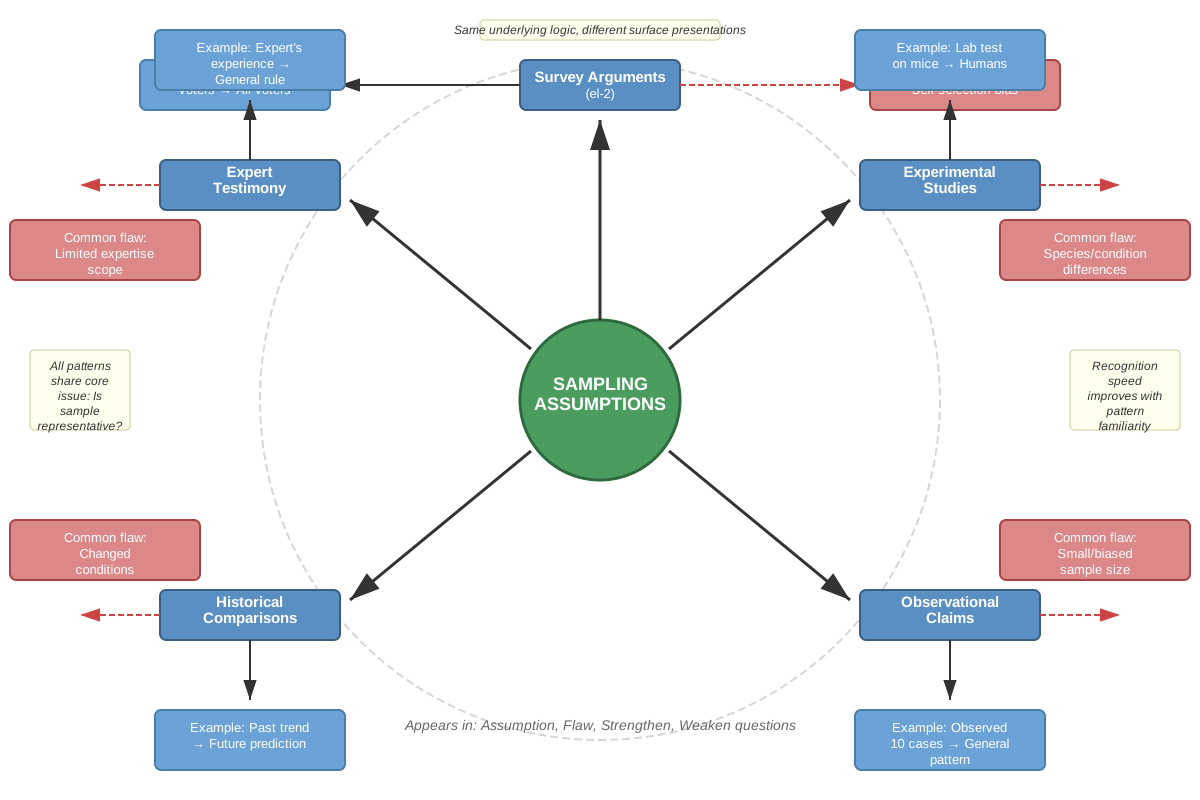
On the LSAT specifically, sampling assumptions typically appear in arguments involving: surveys and polls (claiming survey results represent broader public opinion), scientific studies (generalizing from experimental subjects to larger populations), observational claims (inferring patterns from limited observations), historical arguments (drawing lessons from past events), and comparative reasoning (assuming one group's characteristics apply to another). The test writers deliberately craft these arguments to contain subtle sampling flaws, testing whether students can identify what must be assumed for the reasoning to work.
Core Concepts
The Basic Structure of Sampling Arguments
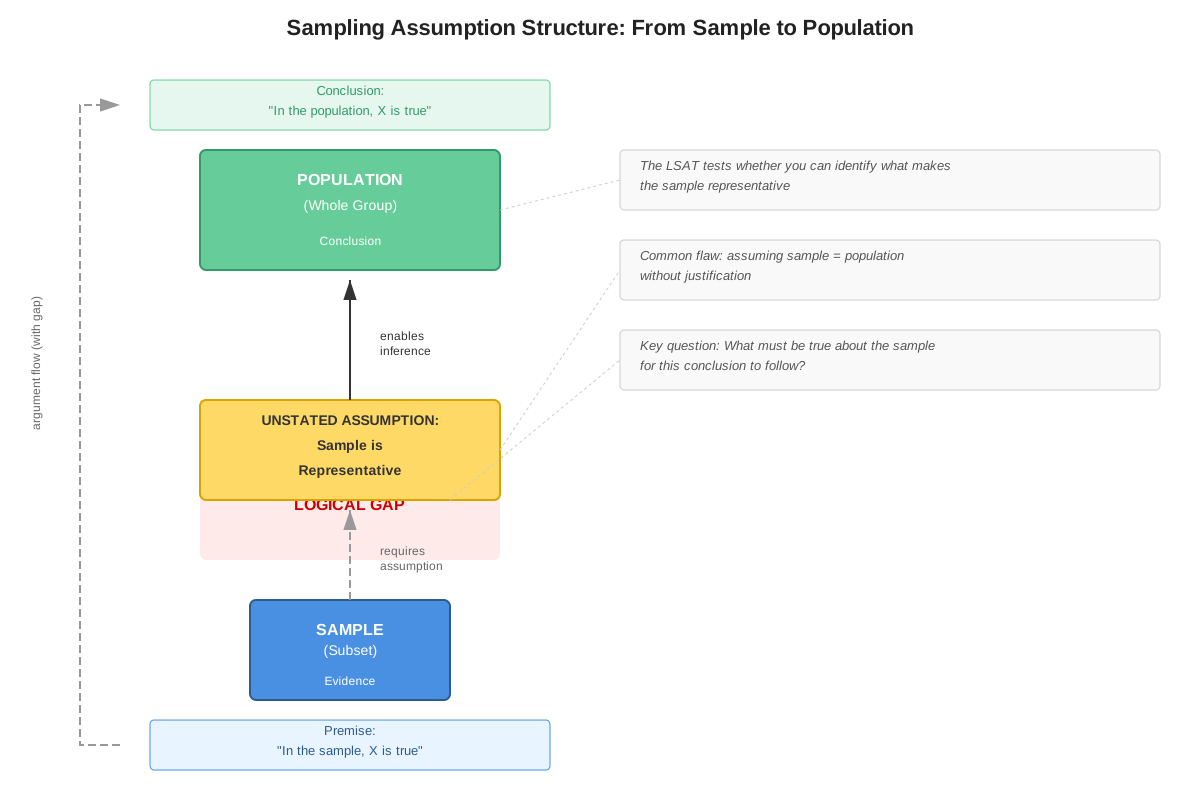
A sampling assumption emerges whenever an argument follows this fundamental pattern: Evidence is gathered from a subset of a population, and a conclusion is drawn about the entire population or a different group. The logical structure contains three key elements:
- The Sample: The specific group, cases, or instances actually observed or studied
- The Population: The larger group about which the conclusion is drawn
- The Inferential Leap: The unstated assumption that the sample adequately represents the population
Consider this simple example: "In a survey of 100 students at University X, 80% supported the new cafeteria policy. Therefore, the majority of all students at University X support the policy." The sample is the 100 surveyed students; the population is all students at University X; the assumption is that these 100 students are representative of the entire student body.
Representativeness: The Core Assumption
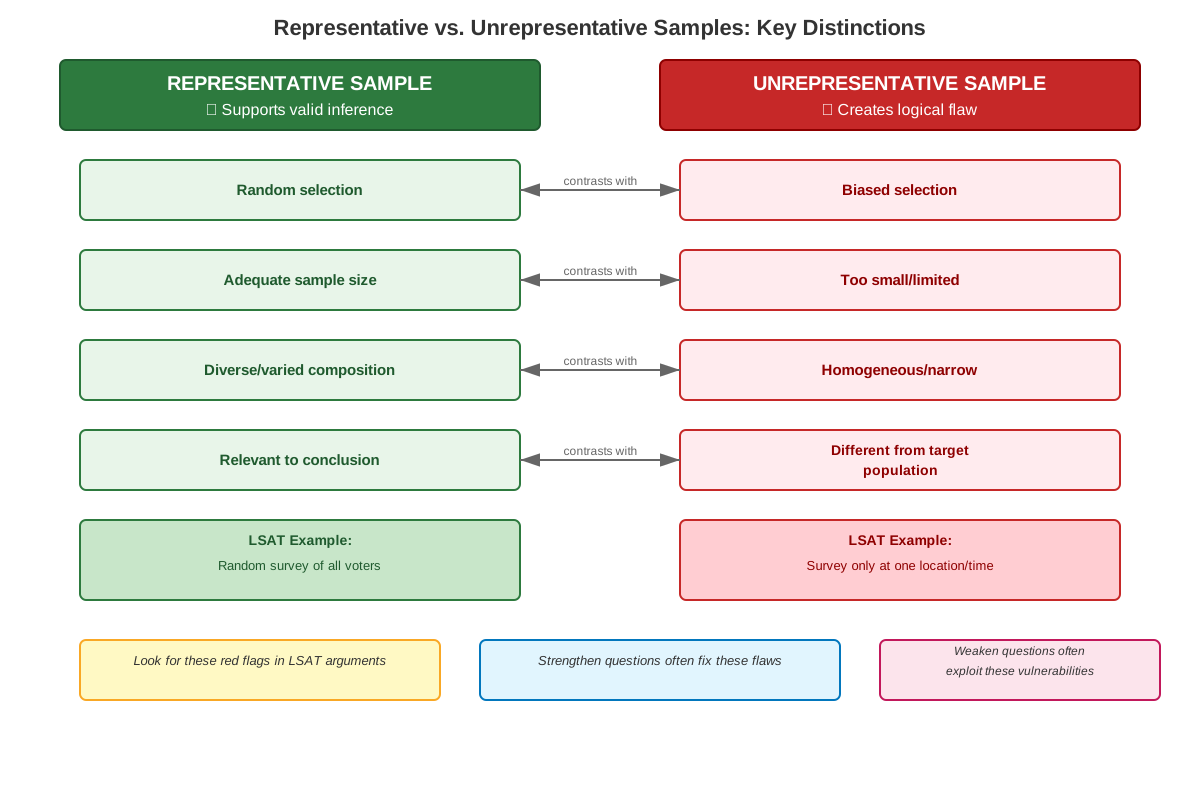
The central assumption in sampling arguments is representativeness—the idea that the sample shares relevant characteristics with the population in proportions that justify the inference. For a sample to be representative, it must:
- Include members selected without systematic bias toward or against particular characteristics
- Be sufficiently large relative to population diversity
- Reflect the population's relevant characteristics in appropriate proportions
- Not be skewed by selection methods that exclude important subgroups
The LSAT tests representativeness by presenting arguments where samples might be biased, too small, self-selected, or otherwise unrepresentative. The key insight is that not all characteristics need to match—only those relevant to the conclusion. If an argument concludes about voting preferences, the sample must represent relevant political characteristics, but demographic factors like height or eye color may be irrelevant.
Types of Sampling Problems
LSAT sampling assumptions manifest in several distinct patterns:
| Sampling Problem Type | Description | Example Signal |
|---|---|---|
| Biased Selection | Sample selected in a way that systematically excludes or overrepresents certain groups | "Surveyed people who called the radio show..." |
| Self-Selection Bias | Sample consists only of volunteers or those who chose to participate | "Respondents who returned the questionnaire..." |
| Insufficient Sample Size | Sample too small to reliably represent population diversity | "Based on interviews with three employees..." |
| Temporal Mismatch | Sample from one time period used to conclude about a different time | "A 1950s study shows that today's consumers..." |
| Geographic Mismatch | Sample from one location used to conclude about different locations | "Data from coastal cities suggests that nationwide..." |
| Demographic Mismatch | Sample from one demographic group used to conclude about others | "College students' preferences indicate that all adults..." |
The Assumption Question Framework
When assumption questions involve sampling, they typically ask students to identify what must be true for the argument to work. The correct answer will address the gap between sample and population by:
- Ruling out alternative explanations for why the sample might differ from the population
- Establishing relevant similarity between sample and population characteristics
- Excluding systematic bias in how the sample was selected or composed
- Confirming adequate sample scope to support the breadth of the conclusion
For example, if an argument concludes that "most citizens oppose the tax increase" based on "a survey of 1,000 randomly selected voters," the assumption might be that "the voters surveyed do not differ significantly from citizens generally in their views on taxation." This assumption is necessary because if voters systematically differ from non-voters on tax issues, the inference fails.
Recognizing Sample-to-Population Shifts
A critical skill is identifying when an argument shifts from discussing a sample to making claims about a population. Watch for these linguistic markers:
Sample indicators: "the study participants," "those surveyed," "the observed cases," "in this experiment," "the sample group," "respondents"
Population indicators: "in general," "most people," "typically," "the average person," "consumers," "voters," "all members," "the species"
The shift from sample language to population language signals where the sampling assumption operates. The argument assumes the transition is valid without stating why.
Necessary vs. Sufficient Sampling Assumptions
Understanding whether a sampling assumption is necessary (required for the argument to work) or sufficient (enough to make the argument work) is crucial:
Necessary assumptions for sampling arguments typically state that the sample is NOT unrepresentative in some specific way. They use language like "not all," "not significantly different," or "not exclusively." For example: "The surveyed employees are not all from a single department" might be necessary if the argument concludes about all employees.
Sufficient assumptions for sampling arguments typically state that the sample IS representative in a strong, positive way. They use language like "perfectly represents," "is identical to," or "includes all types." For example: "The surveyed employees perfectly represent the demographic composition of the entire workforce" would be sufficient (though not necessary) to support a conclusion about all employees.
Concept Relationships
The concepts within sampling assumptions form an interconnected logical framework. Representativeness serves as the foundational concept upon which all sampling reasoning depends. When representativeness fails due to biased selection, self-selection bias, or demographic mismatch, the argument's sampling assumption becomes vulnerable. These specific types of sampling problems represent different ways that representativeness can break down.
The relationship flows as follows: Basic sampling structure → Representativeness requirement → Specific threats to representativeness → Assumption identification strategies → Application to different question types.
Sampling assumptions connect to prerequisite knowledge of argument structure because identifying the sample-to-population leap requires first recognizing the argument's premises and conclusion. They connect to assumption question fundamentals because the techniques for finding necessary assumptions (negation test, gap analysis) apply specifically to sampling contexts. The relationship to conditional reasoning emerges when arguments implicitly claim "if true of the sample, then true of the population"—a conditional that requires the representativeness assumption to hold.
Within the broader Logical Reasoning curriculum, sampling assumptions relate closely to:
- Causal reasoning: Studies often use samples to establish causal claims, combining both assumption types
- Generalization flaws: Overgeneralizing from samples represents a specific type of generalization error
- Analogy reasoning: Analogies assume one case represents another, similar to sampling logic
- Statistical reasoning: Interpreting percentages and proportions requires understanding sample validity
High-Yield Facts
⭐ Sampling assumptions appear when arguments draw conclusions about a population based on evidence from a sample subset.
⭐ The core assumption is always representativeness—that the sample adequately reflects relevant characteristics of the population.
⭐ Self-selected samples (volunteers, respondents who chose to participate) are inherently suspect and frequently tested on the LSAT.
⭐ Not all characteristics need to match between sample and population—only those relevant to the specific conclusion being drawn.
⭐ Temporal mismatches (old data applied to current situations) represent a common sampling flaw on the LSAT.
- Sample size alone doesn't guarantee representativeness; a large biased sample is still unrepresentative.
- Geographic and demographic mismatches are high-yield sampling problems that appear in 2-3 questions per test.
- The LSAT often presents sampling arguments in the context of surveys, studies, experiments, and historical comparisons.
- Necessary assumptions about sampling typically state what is NOT true (the sample is NOT biased in a particular way).
- Sufficient assumptions about sampling typically state strong positive claims (the sample DOES perfectly represent the population).
⭐ Random selection is not always mentioned; arguments may assume randomness without stating it explicitly.
- Answer choices that introduce irrelevant characteristics (unrelated to the conclusion) are common trap answers in sampling assumption questions.
- Strengthen questions often present answer choices that make samples more representative; Weaken questions present factors that make samples less representative.
- The negation test for necessary assumptions works powerfully with sampling: if negating an answer choice destroys the argument, it's necessary.
- Sampling assumptions can combine with other assumption types (especially causal assumptions) in complex arguments.
Quick check — test yourself on Sampling assumptions so far.
Try Flashcards →Common Misconceptions
Misconception: A large sample size automatically makes the sample representative.
Correction: Sample size matters, but selection method is more critical. A sample of 10,000 people all from the same city, age group, or demographic may be less representative than a properly randomized sample of 500 people. The LSAT frequently tests this by presenting large but biased samples.
Misconception: All characteristics of the sample must match the population for the argument to work.
Correction: Only characteristics relevant to the conclusion need to match. If an argument concludes about movie preferences, the sample's average height or eye color is irrelevant. The LSAT includes trap answers that mention irrelevant characteristics to test this understanding.
Misconception: If an argument mentions "random selection," no sampling assumption exists.
Correction: Even with random selection, assumptions remain about response rates, temporal relevance, and whether the sampling frame (the group from which the sample was drawn) matches the target population. Random selection reduces but doesn't eliminate sampling assumptions.
Misconception: Sampling assumptions only appear in Assumption questions.
Correction: Sampling reasoning appears across question types: Strengthen/Weaken (making samples more/less representative), Flaw (identifying sampling errors), Method of Reasoning (describing how arguments use samples), and even some Main Point questions where the conclusion involves a sample-to-population inference.
Misconception: The correct answer to a sampling assumption question will always explicitly mention "representative" or "sample."
Correction: Correct answers often describe specific ways the sample might be biased or specific characteristics that do or don't match, without using the words "sample" or "representative." For example: "The employees interviewed were not all from the marketing department" addresses representativeness without using those terms.
Misconception: If a study is described as "scientific" or "rigorous," sampling assumptions don't apply.
Correction: The LSAT tests logical structure, not real-world credibility. Even arguments citing scientific studies contain sampling assumptions about whether the study participants represent the broader population. The test requires identifying these logical gaps regardless of how authoritative the source sounds.
Misconception: Sampling assumptions are the same as hasty generalizations.
Correction: While related, these are distinct. Hasty generalization is a broader category of reasoning errors involving insufficient evidence for a general claim. Sampling assumptions specifically involve the sample-to-population inference structure. All sampling assumption problems involve generalization, but not all hasty generalizations involve sampling.
Worked Examples
Example 1: Survey-Based Argument
Argument: "A recent survey asked 500 subscribers to Fitness Monthly magazine about their exercise habits. The survey found that 85% exercise at least four times per week. This demonstrates that most people in the general population maintain a regular exercise routine."
Question: Which of the following is an assumption required by the argument?
Answer Choices:
(A) People who subscribe to Fitness Monthly are representative of the general population with respect to exercise habits.
(B) The survey methodology was scientifically rigorous and properly conducted.
(C) Exercise habits have remained constant over the past decade.
(D) People who responded to the survey answered honestly about their exercise frequency.
(E) Regular exercise provides significant health benefits to most people.
Analysis:
Step 1: Identify the sample and population.
- Sample: 500 subscribers to Fitness Monthly magazine
- Population: The general population
- Conclusion: Most people in the general population maintain regular exercise routines
Step 2: Identify the inferential leap.
The argument jumps from data about magazine subscribers to a claim about the general population. This is a classic sample-to-population shift.
Step 3: Determine what must be assumed.
For this inference to work, the magazine subscribers must represent the general population regarding exercise habits. If subscribers differ systematically (which seems likely—people interested in fitness enough to subscribe to a fitness magazine probably exercise more than average), the inference fails.
Step 4: Evaluate answer choices.
(A) CORRECT: This directly addresses the representativeness assumption. Apply the negation test: "People who subscribe to Fitness Monthly are NOT representative of the general population with respect to exercise habits." If true, this destroys the argument because the sample data wouldn't support the population conclusion.
(B) Incorrect: While methodology matters for the survey's internal validity, this doesn't address whether subscribers represent the general population. Even a perfectly conducted survey of an unrepresentative sample doesn't support the conclusion.
(C) Incorrect: The argument makes no temporal comparison, so constancy over time isn't assumed.
(D) Incorrect: Honesty affects whether the 85% figure accurately reflects even the subscribers' habits, but doesn't address whether subscribers represent the general population. This is a different assumption.
(E) Incorrect: The argument's conclusion is about exercise frequency, not benefits. This is irrelevant to the sample-to-population inference.
Key Takeaway: This example demonstrates the core sampling assumption pattern. The correct answer directly addresses whether the sample (magazine subscribers) represents the population (general public) regarding the relevant characteristic (exercise habits).
Example 2: Historical Comparison Argument
Argument: "Archaeological evidence from three ancient settlements in the northern region shows that pottery styles changed dramatically around 500 BCE. Historians conclude that a major cultural shift affected all ancient settlements in the region during this period."
Question: The historians' conclusion depends on assuming which of the following?
Answer Choices:
(A) The three settlements studied were typical of settlements throughout the region with respect to cultural influences.
(B) Pottery styles are the most reliable indicator of cultural change in ancient societies.
(C) The archaeological evidence from these settlements has been accurately dated.
(D) Cultural shifts in ancient times typically affected entire regions rather than individual settlements.
(E) No other evidence contradicts the conclusion about regional cultural change.
Analysis:
Step 1: Identify the sample and population.
- Sample: Three ancient settlements in the northern region
- Population: All ancient settlements in the region
- Conclusion: A major cultural shift affected all settlements
Step 2: Recognize the sampling structure.
This is a geographic sampling issue—evidence from three locations is used to conclude about the entire region.
Step 3: Apply the representativeness test.
(A) CORRECT: This addresses whether the three settlements represent all settlements in the region regarding cultural influences. Negation test: "The three settlements studied were NOT typical of settlements throughout the region with respect to cultural influences." If true, this destroys the argument—the three settlements might have experienced unique changes not shared by others.
(B) Incorrect: This addresses whether pottery is a good indicator of cultural change, but doesn't address whether these three settlements represent all settlements. Even if pottery perfectly indicates cultural change, the sampling assumption remains.
(C) Incorrect: Accurate dating is necessary for the evidence to show change around 500 BCE, but doesn't address whether these three settlements represent the entire region.
(D) Incorrect: This reverses the logic. The argument uses sample evidence to conclude about regional patterns; it doesn't assume that regional patterns exist and then apply them. This is a tempting trap answer.
(E) Incorrect: The absence of contradictory evidence isn't assumed. Arguments can be valid even if contradictory evidence exists elsewhere; the question is whether the given evidence supports the conclusion.
Key Takeaway: This example shows how sampling assumptions appear in non-survey contexts. The same representativeness logic applies whether the sample consists of survey respondents, study participants, or archaeological sites. The correct answer addresses whether the observed cases represent the broader group about which the conclusion is drawn.
Exam Strategy
Identifying Sampling Assumption Questions
Watch for these trigger phrases that signal sampling reasoning:
In the stimulus:
- "A survey/study/poll found..."
- "Based on observations of..."
- "Research on [specific group] shows..."
- "In experiments with..."
- "Historical evidence from [specific cases]..."
- "Analysis of [sample] indicates..."
In the question stem:
- "The argument assumes that..."
- "Which of the following is an assumption required..."
- "The argument depends on assuming..."
- "The reasoning is vulnerable to criticism because it fails to consider..."
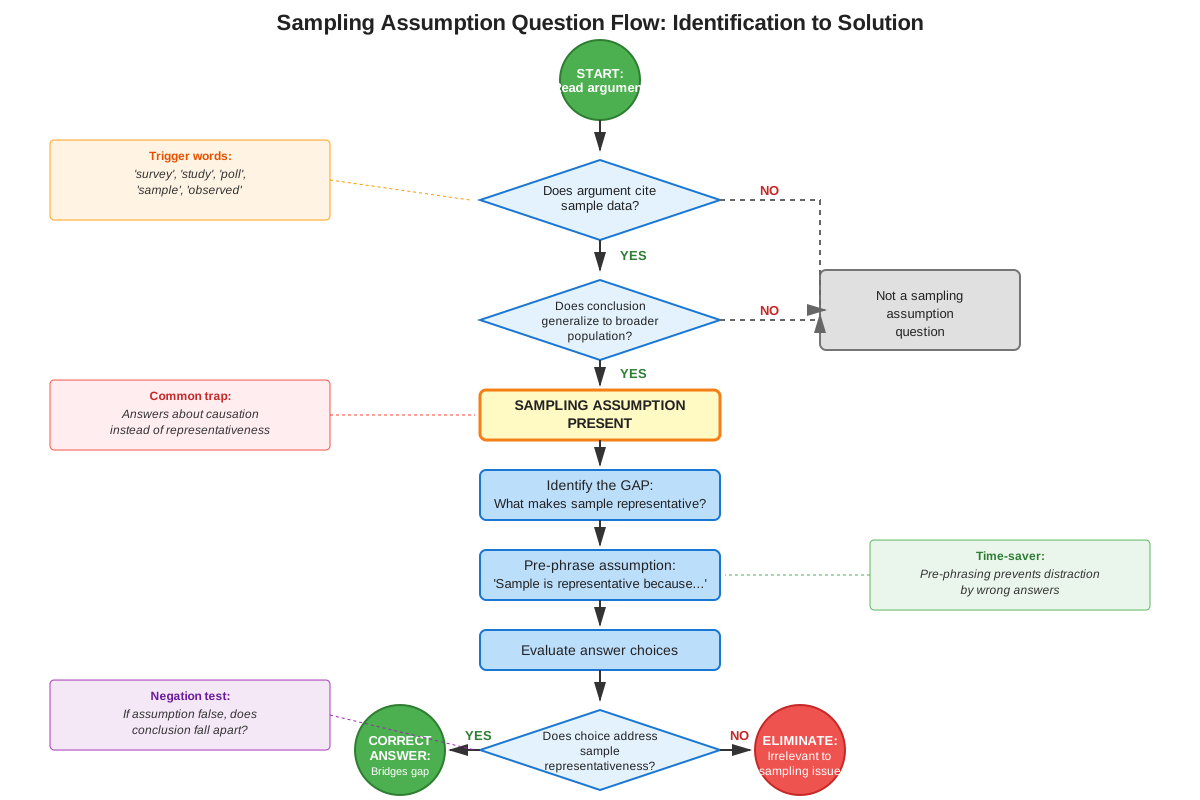
The Three-Step Approach
Step 1: Identify Sample and Population (15 seconds)
- Underline or mentally note what group was actually studied/observed (sample)
- Circle or note what group the conclusion discusses (population)
- If these differ, a sampling assumption likely exists
Step 2: Articulate the Gap (10 seconds)
- Ask: "Why might the sample NOT represent the population?"
- Consider: selection bias, demographic differences, temporal issues, geographic differences
- Predict: "The argument assumes the sample is representative regarding [relevant characteristic]"
Step 3: Evaluate Answer Choices (45 seconds)
- Eliminate answers about irrelevant characteristics
- Eliminate answers that address different assumption types (causal, etc.)
- Apply negation test to remaining choices
- Select the answer that, when negated, most directly destroys the sample-to-population inference
Process of Elimination Tips
Eliminate answers that:
- Discuss characteristics clearly irrelevant to the conclusion
- Address methodology or measurement accuracy without addressing representativeness
- Make the argument stronger than necessary (sufficient but not necessary assumptions)
- Introduce new topics not connected to the sample-population gap
- State obvious facts that don't bridge the logical gap
Keep answers that:
- Directly address whether sample represents population
- Rule out specific ways the sample might be biased
- Connect sample characteristics to population characteristics
- Use language like "not all," "not exclusively," "not significantly different" (for necessary assumptions)
Time Management
Allocate approximately 1 minute 10 seconds for sampling assumption questions:
- 20 seconds: Read and understand the argument
- 15 seconds: Identify sample, population, and gap
- 35 seconds: Evaluate answer choices
If stuck between two answers, apply the negation test to both and select the one whose negation more completely destroys the argument.
Common Trap Patterns
The Irrelevant Characteristic Trap: Answer choice mentions a characteristic that doesn't matter for the conclusion. Example: If the conclusion is about political views, an answer about age distribution is likely wrong unless age clearly relates to political views in context.
The Methodology Trap: Answer choice discusses how the study was conducted rather than whether the sample represents the population. Example: "The survey questions were clearly worded" addresses measurement but not representativeness.
The Sufficient-Not-Necessary Trap: Answer choice makes a stronger claim than required. Example: "The sample perfectly represents the population in all respects" is sufficient but not necessary; the argument only needs representation regarding relevant characteristics.
The Reversed Logic Trap: Answer choice assumes the conclusion is true and works backward. Example: "Cultural shifts typically affect entire regions" assumes what the argument tries to prove.
Memory Techniques
The SAMPLE Acronym
Use SAMPLE to remember key questions for evaluating sampling assumptions:
- Selection method: How was the sample chosen? Any bias?
- Adequacy: Is the sample size sufficient for the conclusion's scope?
- Match: Do sample characteristics match population characteristics?
- Period: Is there a temporal mismatch between sample and population?
- Location: Is there a geographic mismatch?
- Exclusions: Were any relevant subgroups systematically excluded?
The Representativeness Checklist Visualization
Visualize a bridge between two islands:
- Left island: The sample (small, specific group)
- Right island: The population (large, general group)
- Bridge: The assumption of representativeness
- Gap below: All the ways the sample might differ from the population
When evaluating an argument, picture whether the bridge is sturdy (sample is representative) or has gaps (sample is biased, too small, or otherwise unrepresentative). The correct answer either strengthens the bridge or identifies a gap.
The "NOT All" Pattern
For necessary assumptions in sampling questions, remember that correct answers often include "NOT all" or "NOT exclusively" language:
- "The surveyed employees were NOT all from the same department"
- "The participants were NOT exclusively volunteers"
- "The observed cases do NOT all come from a single time period"
This pattern helps distinguish necessary assumptions (which rule out specific problems) from sufficient assumptions (which make strong positive claims).
Summary
Sampling assumptions constitute a high-yield category of LSAT Logical Reasoning questions that test whether students can identify unstated premises connecting sample evidence to population conclusions. The fundamental pattern involves an argument that observes or studies a subset of a group and then draws conclusions about the entire group or a different group. The core assumption is always representativeness—that the sample adequately reflects the population's relevant characteristics. Common sampling problems include biased selection, self-selection bias, insufficient sample size, and temporal or geographic mismatches. Success requires identifying when arguments shift from discussing samples to making population claims, recognizing what characteristics must match between sample and population, and distinguishing necessary assumptions (ruling out specific biases) from sufficient assumptions (establishing perfect representation). The LSAT tests sampling assumptions across multiple question types, including Assumption, Strengthen, Weaken, and Flaw questions, making this topic essential for achieving a competitive score. Mastery involves developing pattern recognition for sample-to-population shifts, applying the negation test to evaluate whether assumptions are necessary, and avoiding common traps involving irrelevant characteristics or methodology issues.
Key Takeaways
- Sampling assumptions appear whenever arguments use evidence from a subset to conclude about a larger group or different group—watch for shifts from specific samples to general populations in argument structure.
- Representativeness is the central concept—the sample must reflect the population's characteristics relevant to the conclusion, though not necessarily all characteristics.
- Self-selected samples and biased selection methods are the most frequently tested sampling problems on the LSAT, appearing in surveys, studies, and observational arguments.
- Apply the negation test to identify necessary assumptions—if negating an answer choice destroys the sample-to-population inference, it's necessary for the argument.
- Distinguish between relevant and irrelevant characteristics—only characteristics that matter for the specific conclusion need to match between sample and population.
- Sampling assumptions appear across multiple question types, not just Assumption questions, including Strengthen, Weaken, Flaw, and Method of Reasoning questions.
- Use the SAMPLE acronym (Selection, Adequacy, Match, Period, Location, Exclusions) to systematically evaluate sampling arguments and predict correct answers.
Related Topics
Causal Assumptions: Many arguments combine sampling and causal reasoning, using sample data to establish causal claims. Understanding how these assumption types interact enables analysis of complex arguments that both generalize from samples and infer causal relationships.
Generalization Flaws: Sampling assumptions represent a specific type of generalization error. Studying broader generalization patterns helps recognize when arguments overgeneralize from limited evidence, whether or not formal sampling is involved.
Statistical Reasoning: Interpreting percentages, proportions, and statistical claims requires understanding whether the underlying sample supports the statistical inference. This topic builds directly on sampling assumption foundations.
Survey and Study Analysis: A specialized application of sampling assumptions focusing specifically on how to evaluate research-based arguments, including understanding response rates, control groups, and experimental design issues.
Strengthen and Weaken Questions: These question types frequently test sampling assumptions by presenting answer choices that make samples more or less representative. Mastering sampling assumptions enables more effective analysis of these questions.
Practice CTA
Now that you've mastered the core concepts of sampling assumptions, it's time to apply this knowledge to actual LSAT questions. Work through the practice questions and flashcards to reinforce your understanding of how to identify sample-to-population shifts, evaluate representativeness, and select correct answers efficiently. Remember that sampling assumptions appear in 3-5 questions per test—making this one of the highest-yield topics for your study time. Each practice question you complete strengthens your pattern recognition and builds the confidence needed to tackle these questions quickly and accurately on test day. You've built the foundation; now develop the speed and precision that will maximize your score!
Sign up free to keep reading
Create a free AnvayaPrep account to finish this LSAT guide on Sampling assumptions — plus flashcards and practice questions.