Overview
Strong answer traps represent one of the most sophisticated and frequently encountered obstacles in LSAT Logical Reasoning, particularly within assumption questions. These traps are deliberately crafted answer choices that appear compelling, even correct, because they make statements that are true, relevant, or logically sound—yet they fail to satisfy the specific task required by the question stem. On assumption questions specifically, strong answer traps typically present statements that would strengthen the argument or provide additional support, but they go beyond what is strictly necessary for the argument to hold. Understanding this distinction between "helpful" and "necessary" is crucial for LSAT success.
The LSAT test makers design these traps with precision, exploiting common reasoning patterns and the natural tendency to select answers that "feel right" or seem to improve an argument. A strong answer trap might introduce a new consideration that makes the conclusion more likely to be true, or it might address a potential objection to the argument. However, if the argument could still function without that statement—if the premises could still lead to the conclusion even when the answer choice is negated—then it is not a necessary assumption, regardless of how attractive it appears. This subtle distinction separates high scorers from average performers.
Mastering the identification and avoidance of strong answer traps connects directly to broader LSAT strong answer traps awareness across all Logical Reasoning question types. The skills developed here—careful reading, precise logical analysis, and disciplined answer choice evaluation—transfer to strengthen questions, weaken questions, and inference questions. Strong answer traps in assumption questions specifically test whether students understand the minimal logical requirements for an argument versus the broader universe of statements that might support it.
Learning Objectives
- [ ] Identify how Strong answer traps appears in LSAT questions
- [ ] Explain the reasoning pattern behind Strong answer traps
- [ ] Apply Strong answer traps to solve LSAT-style problems accurately
- [ ] Distinguish between necessary assumptions and sufficient strengtheners in answer choices
- [ ] Execute the negation test effectively to eliminate strong answer traps
- [ ] Recognize the linguistic markers and structural patterns that signal strong answer traps
- [ ] Develop systematic approaches to avoid selecting overly strong answers under time pressure
Prerequisites
- Basic argument structure: Understanding premises, conclusions, and the logical relationship between them is essential because assumption questions require identifying what's missing from the explicit argument structure.
- Necessary vs. sufficient conditions: Distinguishing between what must be true for a conclusion to follow versus what would guarantee it helps differentiate assumptions from strengtheners.
- Assumption question fundamentals: Familiarity with what assumptions are (unstated premises that must be true) provides the foundation for recognizing when an answer goes beyond this requirement.
- The negation technique: Knowledge of how to negate answer choices and test whether negation destroys the argument is the primary tool for identifying correct assumptions and eliminating traps.
Why This Topic Matters
Strong answer traps appear in approximately 60-70% of assumption questions on the LSAT, making them one of the most consistent obstacles to achieving a high Logical Reasoning score. Since assumption questions themselves constitute roughly 15-20% of all Logical Reasoning questions (typically 4-6 questions per test), and Logical Reasoning comprises half of the scored LSAT, mastering this topic directly impacts overall performance. Students who cannot reliably identify and avoid strong answer traps often plateau in the 155-160 score range, while those who master this skill frequently break into the 165+ range.
In real-world applications, the ability to distinguish between necessary conditions and merely helpful support translates to critical thinking skills valued in legal practice and beyond. Lawyers must identify the minimal elements required to prove a case, not simply gather all potentially supportive evidence. They must recognize when opposing counsel presents compelling but ultimately irrelevant information, and they must construct arguments that rest on solid logical foundations rather than persuasive but unnecessary elaboration.
On the LSAT, strong answer traps most commonly appear in assumption questions (both necessary and sufficient), but the same principle manifests in strengthen questions where one answer strengthens more than others, and in flaw questions where attractive wrong answers describe problems that don't actually exist in the argument. The test makers consistently exploit the gap between "this would help the argument" and "this is required for the argument," making this distinction one of the highest-yield concepts across the entire Logical Reasoning section.
Core Concepts
The Nature of Strong Answer Traps
Strong answer traps are incorrect answer choices that present statements which would strengthen, support, or improve an argument, but which are not necessary for the argument's logical validity. These traps are "strong" in two senses: they make strong (definitive, broad) claims, and they exert a strong psychological pull on test-takers. The fundamental error they exploit is the conflation of "helpful" with "required."
In assumption questions, the correct answer must identify something the argument depends upon—a logical gap that must be bridged for the premises to support the conclusion. A strong answer trap, by contrast, provides additional support that goes beyond filling the minimal gap. It might eliminate an alternative explanation, address a potential counterargument, or provide corroborating evidence, but the argument could still function without it.
The Necessary vs. Sufficient Distinction
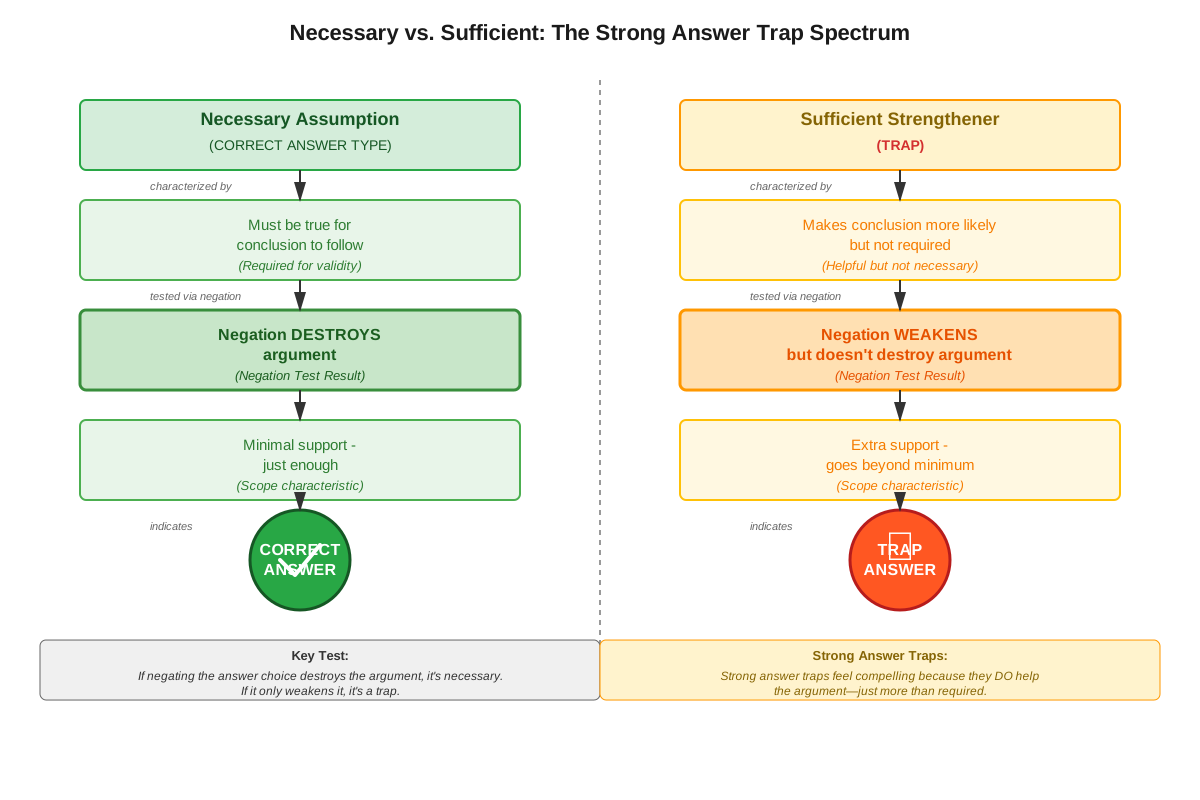
Understanding the difference between necessary and sufficient conditions is crucial for avoiding strong answer traps:
| Necessary Assumption | Sufficient Strengthener (Trap) |
|---|---|
| Must be true for the argument to work | Would guarantee or strongly support the conclusion |
| Minimal requirement | Goes beyond what's required |
| If negated, argument falls apart | If negated, argument is weakened but may survive |
| Fills a logical gap | Adds additional support |
| Often modest in scope | Often broad or definitive |
A necessary assumption is the minimum required; a sufficient strengthener provides more than enough. Strong answer traps typically fall into the sufficient category—they would certainly help the argument, but the argument doesn't strictly need them.
The Negation Test
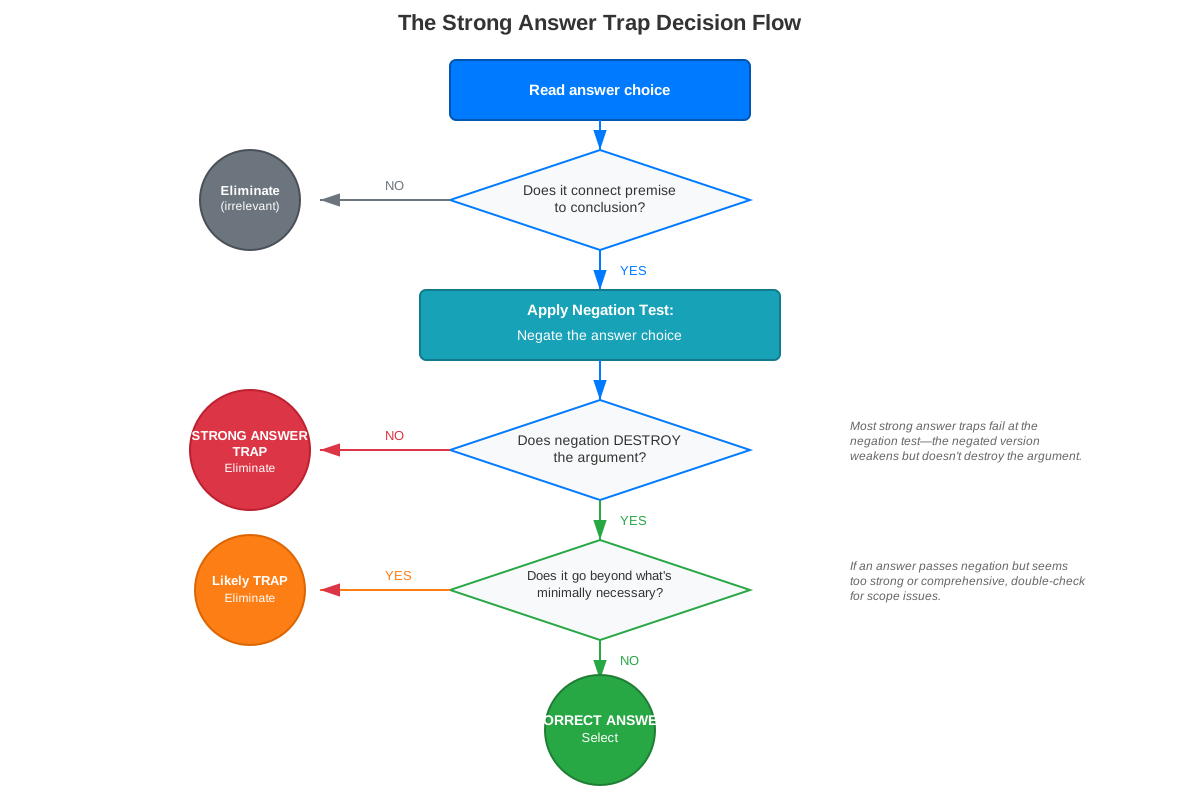
The negation test is the most reliable tool for identifying strong answer traps. To apply it:
- Negate the answer choice (make it say the opposite)
- Ask whether the negated statement destroys the argument
- If the argument survives the negation, the answer is not necessary (likely a trap)
- If the argument collapses, the answer is necessary (potentially correct)
For strong answer traps, negation typically weakens the argument but doesn't destroy it. For example, if an answer says "No other factors contributed to the result," negating it to "Other factors may have contributed" would weaken the argument but wouldn't necessarily make the conclusion impossible—suggesting this is a trap rather than a necessary assumption.
Common Patterns of Strong Answer Traps
Pattern 1: Eliminating Alternative Explanations
Strong answer traps often rule out other possible causes or explanations. While this strengthens the argument by making the stated cause more likely, it's usually not necessary because the argument can work even if alternatives exist—they just need to be less significant than the stated cause.
Example structure: "No factors other than X contributed to Y." This is almost always too strong to be necessary.
Pattern 2: Absolute or Universal Claims
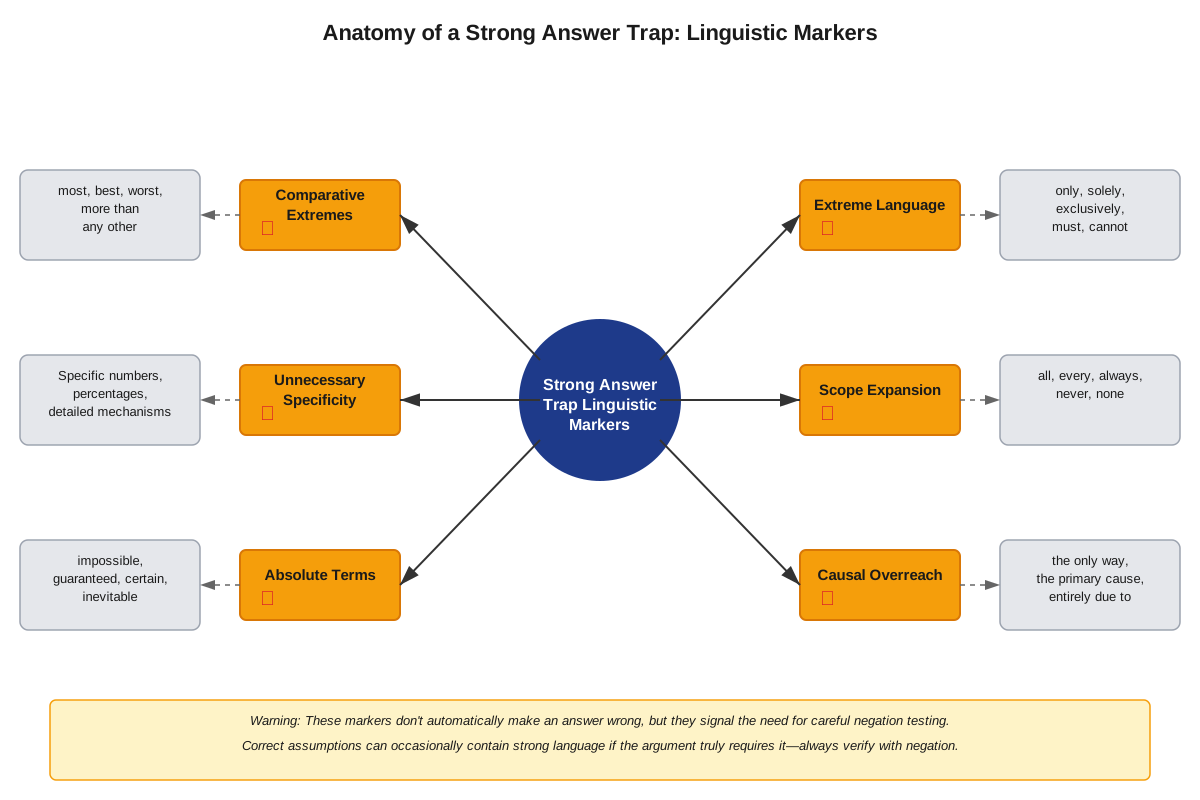
Traps frequently use extreme language: "all," "every," "only," "never," "always," "must," "cannot." While necessary assumptions can occasionally be absolute, strong answer traps abuse this by making claims broader than the argument requires.
Example: If an argument concludes that "this policy will reduce crime," a trap might say "this policy is the only way to reduce crime"—far stronger than necessary.
Pattern 3: Addressing Unstated Objections
These traps anticipate and refute counterarguments that aren't actually relevant to the logical structure of the argument. They make the argument more persuasive but aren't required for the basic logical connection.
Example: An argument about a new teaching method might have a trap that says "students will not resist the new method"—this addresses a practical concern but isn't necessary for the logical claim about effectiveness.
Pattern 4: Providing Additional Support
Some traps offer extra evidence or corroboration for the conclusion. This additional support is helpful but not necessary—the argument already has its own premises.
Example: If an argument uses survey data to conclude something about public opinion, a trap might say "the survey methodology was flawless"—this would strengthen the argument but isn't assumed by it.
Psychological Appeal of Strong Answer Traps
Strong answer traps succeed because they trigger several cognitive biases:
- Confirmation bias: They align with what would make the argument better, so they "feel right"
- Scope insensitivity: Test-takers fail to notice that the answer is broader than necessary
- Defensive reasoning: Students want to protect the argument from all possible objections, not just fill the minimal gap
- Authority deference: Strong, confident statements seem more correct than modest ones
Recognizing these psychological factors helps students maintain the discipline to apply the negation test even when an answer seems obviously correct.
The Scope Principle
Strong answer traps typically violate the scope principle: the correct assumption should match the scope of the argument in terms of breadth, strength, and subject matter. If an argument makes a limited claim about "some" members of a group, an assumption about "all" members is likely a trap. If an argument discusses correlation, an assumption about causation may be too strong.
Scope mismatches manifest in several ways:
- Quantitative scope: "all" vs. "some," "every" vs. "many"
- Temporal scope: "always" vs. "in this case," "never" vs. "not now"
- Categorical scope: broader categories than the argument discusses
- Strength scope: certainty vs. probability, "must" vs. "likely"
Concept Relationships
The concept of strong answer traps connects directly to the fundamental nature of assumptions in logical reasoning. An assumption is an unstated premise that must be true for an argument to be valid → this definition requires understanding necessary conditions → which contrasts with sufficient conditions that would guarantee the conclusion → leading to the recognition that strong answer traps provide sufficient but not necessary support.
Within the topic itself, the relationships flow as follows:
Necessary vs. Sufficient Distinction → forms the theoretical foundation → which is tested practically through → The Negation Test → which reveals → Common Patterns of Strong Answer Traps → all of which are made more challenging by → Psychological Appeal → but can be managed through → The Scope Principle
This topic also connects to prerequisite knowledge: understanding basic argument structure enables recognition of what's explicitly stated versus what's assumed → which allows application of necessary vs. sufficient conditions → which is tested through the negation technique → all of which come together in identifying strong answer traps.
Looking forward, mastering strong answer traps in assumption questions prepares students for related challenges: recognizing when strengthen question answers strengthen too much to be the best answer, identifying when weaken question answers are irrelevant despite seeming problematic, and distinguishing between what must be true versus what could be true in inference questions.
High-Yield Facts
⭐ Strong answer traps provide sufficient support for an argument but are not necessary for its logical validity.
⭐ The negation test is the most reliable method for identifying strong answer traps: if negating an answer weakens but doesn't destroy the argument, it's likely a trap.
⭐ Strong answer traps typically use extreme language (all, every, only, never, always) that exceeds the scope of the argument.
⭐ Answers that eliminate alternative explanations are common strong answer traps because arguments rarely require that no other factors exist.
⭐ The correct assumption in assumption questions should match the scope of the conclusion in breadth, strength, and subject matter.
- Strong answer traps often address potential objections or concerns that aren't logically necessary for the argument to work.
- Psychological appeal is a key feature of strong answer traps—they "feel right" because they would genuinely improve the argument.
- Approximately 60-70% of assumption questions include at least one strong answer trap among the wrong answers.
- Strong answer traps can appear in both necessary assumption questions and sufficient assumption questions, though they manifest differently in each type.
- The distinction between "this helps the argument" and "the argument requires this" is the core skill for avoiding strong answer traps.
- Time pressure increases susceptibility to strong answer traps because they require careful analysis rather than intuitive selection.
- Strong answer traps often introduce new information or considerations not mentioned in the stimulus, going beyond the argument's scope.
Quick check — test yourself on Strong answer traps so far.
Try Flashcards →Common Misconceptions
Misconception: If an answer choice would strengthen the argument, it must be a necessary assumption.
Correction: Strengthening and assuming are different logical relationships. Many statements would strengthen an argument without being necessary for it. The correct assumption is the minimal requirement, not the maximal support.
Misconception: Stronger, more definitive statements are more likely to be correct because they show confidence.
Correction: On assumption questions, stronger statements are more likely to be traps. The LSAT rewards precision, not confidence. An answer that says "all" when the argument only requires "some" is wrong, regardless of how authoritative it sounds.
Misconception: If an answer eliminates an alternative explanation, it must be assumed by the argument.
Correction: Arguments can work even when alternative explanations exist—they just need their stated explanation to be sufficient. Unless the argument explicitly relies on excluding alternatives, such answers are typically traps.
Misconception: The negation test means simply adding "not" to the beginning of the answer choice.
Correction: Proper negation requires understanding logical opposites. The negation of "all" is "not all" (which means "some are not"), not "none." The negation of "only X causes Y" is "something other than X might cause Y," not "X never causes Y."
Misconception: If an answer addresses a potential weakness in the argument, it must be assumed.
Correction: Arguments can have multiple weaknesses, and the correct assumption only addresses the primary logical gap. An answer that addresses a secondary concern or practical objection, while helpful, is not necessary if the core logical structure doesn't depend on it.
Misconception: Correct assumptions always introduce completely new concepts not mentioned in the stimulus.
Correction: While assumptions are unstated, they typically connect concepts already present in the argument. Strong answer traps often introduce entirely new considerations that, while relevant, go beyond what the argument actually requires.
Worked Examples
Example 1: Medical Research Argument
Stimulus: "A recent study found that patients who took vitamin D supplements had fewer respiratory infections than those who did not. Therefore, vitamin D supplementation prevents respiratory infections."
Question: Which of the following is an assumption required by the argument?
Answer Choices:
(A) Vitamin D supplementation has no negative side effects.
(B) The patients who took vitamin D supplements did not differ from those who did not in other ways that might affect respiratory infection rates.
(C) Respiratory infections are caused solely by vitamin D deficiency.
(D) All patients should take vitamin D supplements.
(E) Vitamin D supplementation is the most effective way to prevent respiratory infections.
Analysis:
Let's apply the negation test to each answer:
(A) Strong Answer Trap: This addresses a practical concern about safety, but the argument is about whether vitamin D prevents infections, not whether it's safe. Negation: "Vitamin D has some negative side effects." Does this destroy the argument? No—it could still prevent infections even with side effects. This is a trap because it would make the recommendation more appealing but isn't necessary for the causal claim.
(B) Correct Answer: This addresses the core logical gap—the possibility of confounding variables. Negation: "The patients who took vitamin D differed in other ways that might affect infection rates." Does this destroy the argument? Yes—if the groups differed in other relevant ways (age, health status, behavior), we couldn't conclude that vitamin D caused the difference in infection rates. This is necessary.
(C) Strong Answer Trap: This is far too strong. The argument only needs vitamin D to be a preventive factor, not the only cause of infections. Negation: "Respiratory infections have causes other than vitamin D deficiency." Does this destroy the argument? No—vitamin D could still prevent infections even if other factors also matter. This eliminates alternative explanations beyond what's necessary.
(D) Strong Answer Trap: This is a recommendation that goes beyond the argument's conclusion. The argument concludes that vitamin D prevents infections, not that everyone should take it. This confuses a factual claim with a normative one.
(E) Strong Answer Trap: This claims vitamin D is the most effective method, which is much stronger than necessary. The argument only needs vitamin D to be effective, not superior to all alternatives. Negation: "Other methods might be more effective." Does this destroy the argument? No—vitamin D could still prevent infections even if something else works better.
Key Lesson: Notice how answers (A), (C), (D), and (E) all make claims that would strengthen or support the argument in various ways—addressing safety, ruling out alternatives, making recommendations, claiming superiority—but none is necessary for the basic logical move from "correlation in a study" to "causation."
Example 2: Business Decision Argument
Stimulus: "The Acme Corporation's profits increased by 15% in the quarter after it implemented a new employee training program. The CEO concluded that the training program caused the increase in profits."
Question: The CEO's conclusion depends on which of the following assumptions?
Answer Choices:
(A) No other factors that could have increased profits changed during that quarter.
(B) The training program did not cost more than the profit increase it generated.
(C) Employee performance is the only factor that affects corporate profits.
(D) The increase in profits was not primarily due to factors unrelated to the training program.
(E) All employees participated in the training program.
Analysis:
(A) Strong Answer Trap: This is the classic "eliminate all alternatives" trap. It's too strong because it requires that literally nothing else changed—no market conditions, no competitor actions, no seasonal factors. Negation: "Other factors that could have increased profits also changed." Does this destroy the argument? Not necessarily—the training could still be the primary cause even if other factors existed. This goes beyond what's necessary.
(B) Strong Answer Trap: This addresses whether the decision was financially wise, but the argument is about causation, not cost-effectiveness. The CEO's conclusion is that the training caused the increase, not that it was worth the investment. This introduces a new consideration beyond the argument's scope.
(C) Strong Answer Trap: This is absurdly strong—claiming employee performance is the only profit factor. The argument doesn't require this extreme position. Negation: "Other factors besides employee performance affect profits." Obviously true, and the argument can survive this. This is a trap because it's far broader than necessary.
(D) Correct Answer: This is more modest than (A) and precisely targets the logical gap. The argument moves from correlation (training program, then profit increase) to causation (training caused increase). This requires assuming the increase wasn't primarily due to other factors—not that no other factors existed, but that they weren't the main cause. Negation: "The increase was primarily due to factors unrelated to the training program." This destroys the causal conclusion. This is necessary and sufficient.
(E) Strong Answer Trap: This seems relevant but is too strong. The argument could work even if only some employees participated, as long as their improved performance drove the profit increase. This adds a detail that would strengthen the argument but isn't required for the basic causal claim.
Key Lesson: Notice the difference between (A) and (D). Both address alternative explanations, but (A) requires eliminating all alternatives completely (too strong), while (D) only requires that alternatives not be the primary cause (appropriately scoped). This subtle distinction is exactly what the LSAT tests.
Exam Strategy
Approaching Assumption Questions with Strong Answer Traps
Step 1: Identify the Conclusion and Premises
Before looking at answers, clearly identify what the argument concludes and what evidence it provides. This prevents being swayed by attractive but irrelevant answer choices.
Step 2: Predict the Gap
Ask yourself: "What's missing? What must be true for these premises to support this conclusion?" Having a prediction helps you recognize when answers go beyond filling the gap.
Step 3: Screen for Scope Mismatches
As you read each answer, immediately check whether its scope matches the argument. Look for:
- Extreme language (all, every, only, never, always)
- Broader categories than the argument discusses
- Stronger claims than the conclusion makes
Step 4: Apply the Negation Test Systematically
For answers that survive the scope screen, negate them properly and ask whether the argument collapses. Don't skip this step even when an answer seems obviously correct—that's when traps are most dangerous.
Trigger Words and Phrases
Red Flags for Strong Answer Traps:
- "only," "solely," "exclusively" (eliminates all alternatives)
- "all," "every," "any," "each" (universal quantifiers)
- "never," "always," "must," "cannot" (absolute modifiers)
- "the most," "the best," "the only way" (superlatives and exclusivity)
- Phrases introducing entirely new concepts not mentioned in the stimulus
Green Flags for Correct Assumptions:
- "not primarily," "not mainly" (modest scope)
- Language that matches the conclusion's strength
- Concepts that bridge terms from premises to conclusion
- Statements that, when negated, make the argument impossible
Process of Elimination Tips
- Eliminate answers that address practical concerns rather than logical gaps: Safety, cost-effectiveness, implementation details, and side considerations are usually traps.
- Eliminate answers that are broader than the conclusion: If the conclusion is about "some," eliminate answers about "all." If it's about "this case," eliminate answers about "always."
- Eliminate answers that rule out all alternatives: Unless the argument explicitly requires exclusivity, answers that say "no other factors" or "only this cause" are traps.
- Keep answers that connect premise terms to conclusion terms: The correct assumption often bridges concepts that appear separately in the argument.
- When stuck between two answers, negate both: The one whose negation more completely destroys the argument is correct.
Time Allocation
- Spend 15-20 seconds identifying the argument structure
- Spend 5-10 seconds predicting the gap
- Spend 30-40 seconds evaluating answer choices
- Reserve 10-15 seconds for the negation test on your top choice
- Total: 60-85 seconds per assumption question
Don't rush the negation test to save time—this is where strong answer traps are caught, and skipping it often leads to wrong answers that cost more time than they save.
Memory Techniques
The SNAP Acronym for Avoiding Strong Answer Traps
Scope: Does the answer match the argument's scope in breadth and strength?
Negation: Does negating the answer destroy the argument?
Alternatives: Does the answer eliminate alternatives unnecessarily?
Practical: Does the answer address practical concerns rather than logical gaps?
Visualization Strategy
Picture the argument as a bridge with a gap. The correct assumption is the single missing plank needed to cross. Strong answer traps are:
- Extra planks that would make the bridge sturdier but aren't necessary
- Railings that would make crossing safer but aren't required to cross
- Signs that would make the bridge more appealing but don't affect its function
- Entire additional bridges that would provide alternative routes
The "Minimum Requirement" Mantra
When evaluating answers, repeatedly ask: "Is this the minimum required, or is this more than enough?" Strong answer traps provide more than enough; correct assumptions provide the minimum.
The Extreme Language Alert
Create a mental alarm for extreme words. When you see "all," "only," "never," "always," "must," or "cannot," immediately think: "This might be too strong—check carefully."
Summary
Strong answer traps represent one of the most consistent and challenging obstacles in LSAT assumption questions, appearing in the majority of such questions and exploiting the natural tendency to select answers that strengthen arguments rather than identify minimal logical requirements. These traps succeed by presenting statements that would genuinely improve or support the argument—eliminating alternative explanations, addressing potential objections, or providing additional evidence—while failing to identify what the argument actually depends upon. The key distinction is between sufficient support (what would guarantee or strongly support the conclusion) and necessary assumptions (what must be true for the argument to work at all). Mastering this topic requires understanding the necessary versus sufficient distinction, applying the negation test systematically, recognizing common patterns like extreme language and alternative-elimination, and maintaining awareness of scope matching between answers and arguments. Success depends not on intuition but on disciplined application of these analytical tools, particularly the negation test, which reveals whether an argument collapses without a given statement or merely becomes weaker.
Key Takeaways
- Strong answer traps provide sufficient but not necessary support—they would help the argument but aren't required for it to work
- The negation test is the most reliable tool: negate the answer and see if the argument collapses (necessary) or just weakens (trap)
- Extreme language (all, only, never, always) and alternative-elimination statements are common markers of strong answer traps
- Correct assumptions match the scope of the argument in breadth, strength, and subject matter—no broader, no stronger
- Strong answer traps often address practical concerns, secondary objections, or unstated counterarguments rather than core logical gaps
- Psychological appeal is a feature, not a bug—traps are designed to "feel right" because they genuinely would strengthen the argument
- Systematic application of screening techniques (scope check, negation test) is essential because intuition often fails on these questions
Related Topics
Sufficient Assumption Questions: While necessary assumption questions ask for the minimum required, sufficient assumption questions ask for what would guarantee the conclusion. Understanding strong answer traps in necessary assumptions helps recognize when sufficient assumption answers provide more than enough versus exactly enough to make the argument valid.
Strengthen Questions: The same principle applies—some answers strengthen more than others, and the correct answer must strengthen in a way that's relevant to the argument's core reasoning. Strong answer traps in assumption questions prepare students to evaluate degrees of support.
Weaken Questions: The inverse skill—recognizing when attractive answers don't actually damage the argument's logic, even though they seem problematic. Understanding what's necessary for an argument helps identify what would genuinely undermine it.
Flaw Questions: Many strong answer traps in assumption questions describe flaws that don't actually exist in the argument. Mastering assumptions helps students recognize the difference between actual logical gaps and imagined problems.
Practice CTA
Now that you understand the mechanics and patterns of strong answer traps, it's time to put this knowledge into practice. The difference between understanding these concepts intellectually and applying them under timed conditions is significant—practice is where mastery develops. Attempt the practice questions for this topic, focusing on applying the negation test systematically and catching yourself when you feel drawn to strong, confident-sounding answers. Use the flashcards to reinforce the key distinctions and patterns until recognizing strong answer traps becomes automatic. Remember: every strong answer trap you correctly identify in practice is one you won't fall for on test day, and this skill alone can add several points to your LSAT score. You've got this!
Sign up free to keep reading
Create a free AnvayaPrep account to finish this LSAT guide on Strong answer traps — plus flashcards and practice questions.