Overview
Sufficient assumption stems represent one of the most critical question types within LSAT Logical Reasoning sections. These questions ask test-takers to identify an answer choice that, when added to the argument's premises, guarantees the conclusion follows with absolute certainty. Unlike necessary assumptions (which identify what must be true for an argument to work), sufficient assumptions provide information that is enough to make the argument logically airtight—even if that information goes beyond what is strictly required.
Mastering sufficient assumption questions is essential for LSAT success because they appear regularly throughout both Logical Reasoning sections, typically comprising 2-4 questions per test. These questions test a student's ability to recognize logical gaps in arguments and identify precisely what additional information would bridge those gaps completely. The skill of identifying sufficient assumptions directly translates to understanding formal logical relationships, conditional reasoning, and the structure of deductive arguments—all foundational competencies for legal reasoning and law school success.
Within the broader landscape of assumption questions, sufficient assumptions occupy a unique position. They require more aggressive gap-filling than necessary assumptions and often involve formal logical structures like conditional statements, categorical relationships, or principle applications. Understanding sufficient assumption stems builds directly upon knowledge of argument structure, premise-conclusion relationships, and logical validity, while also preparing students for related question types including strengthen questions, principle questions, and parallel reasoning questions.
Learning Objectives
- [ ] Identify how sufficient assumption stems appears in LSAT questions
- [ ] Explain the reasoning pattern behind sufficient assumption stems
- [ ] Apply sufficient assumption stems to solve LSAT-style problems accurately
- [ ] Distinguish between sufficient and necessary assumptions in question stems
- [ ] Recognize common logical gaps that sufficient assumptions fill
- [ ] Evaluate answer choices using the "negation test" and "sufficiency test"
- [ ] Predict sufficient assumptions before reviewing answer choices
Prerequisites
- Argument structure identification: Understanding premises, conclusions, and intermediate conclusions is essential because sufficient assumptions bridge gaps between these components
- Basic formal logic: Familiarity with conditional statements (if-then relationships) and their contrapositives enables recognition of the logical structures most commonly tested in sufficient assumption questions
- Necessary vs. sufficient conditions: Distinguishing between what must be true versus what would be enough to guarantee truth underlies the entire concept of sufficient assumptions
- Argument evaluation fundamentals: Recognizing that arguments can have logical gaps prepares students to identify what information would close those gaps
Why This Topic Matters
Sufficient assumption questions test the core analytical skill that law schools value most: the ability to identify what additional information would make an argument logically complete. This mirrors the legal reasoning process where attorneys must determine what facts or precedents would definitively establish their case. In legal practice, recognizing sufficient conditions for establishing liability, proving intent, or satisfying statutory requirements represents daily work.
On the LSAT, sufficient assumption questions typically appear 2-4 times per test across both Logical Reasoning sections, making them high-yield material that directly impacts scores. These questions carry the same weight as any other Logical Reasoning question (approximately 1 point each), but they often prove challenging because they require precise logical thinking rather than general reasoning skills. Students who master sufficient assumptions typically see score improvements of 2-4 points overall because the skills transfer to other question types.
Sufficient assumption questions most commonly appear in arguments involving: conditional reasoning chains with missing links, categorical statements requiring bridging terms, causal arguments needing additional support, and principle-application scenarios. The LSAT frequently tests whether students can identify the precise logical connection that would make an argument's reasoning valid, even if that connection seems overly strong or goes beyond common sense. This tests pure logical form rather than content knowledge, making it a fair and reliable measure of analytical reasoning ability.
Core Concepts
Understanding Sufficient Assumptions
A sufficient assumption is a piece of information that, when added to an argument's existing premises, absolutely guarantees the conclusion must follow. The term "sufficient" means "enough"—the assumption provides enough logical support to make the argument's reasoning completely valid, with no remaining gaps. Importantly, a sufficient assumption may provide more information than strictly necessary; it simply needs to be strong enough to ensure the conclusion is true given the premises.
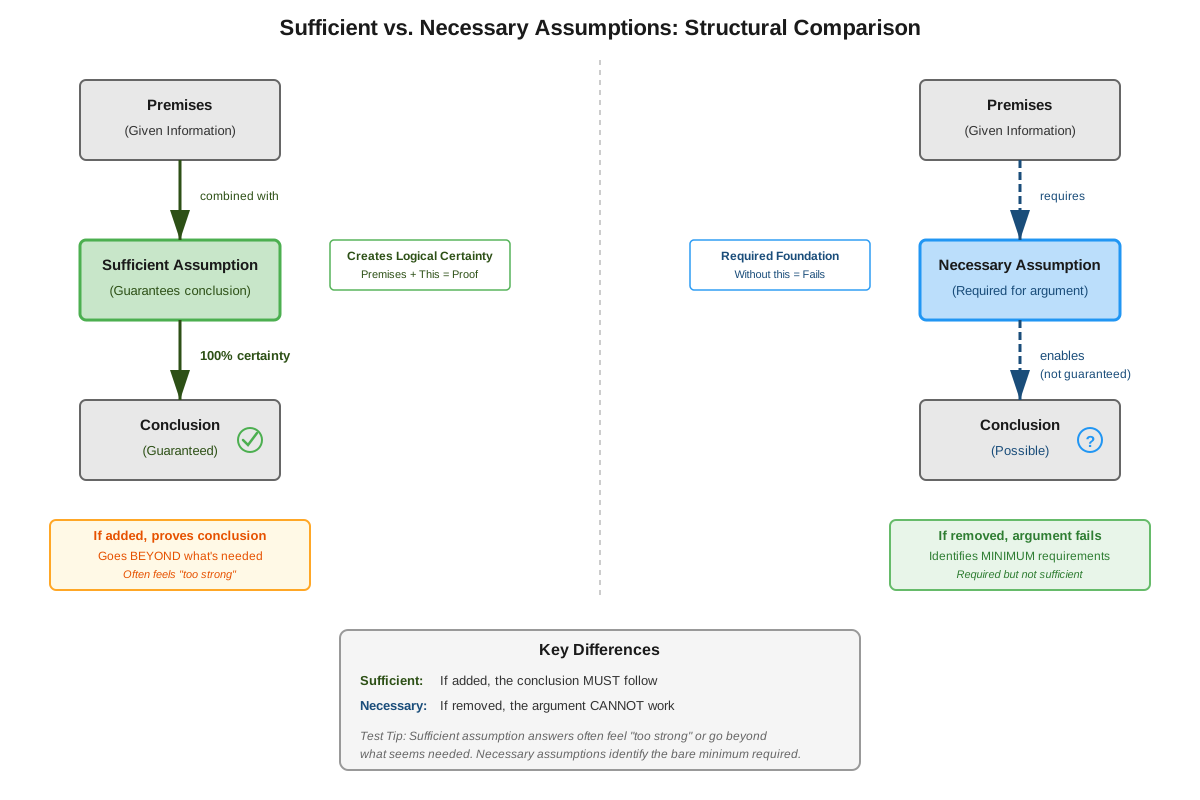
The key distinction lies in understanding logical sufficiency versus necessity. While a necessary assumption identifies something that must be true for the argument to work (without which the argument falls apart), a sufficient assumption identifies something that would be enough to make the argument work perfectly. A sufficient assumption can be "overkill"—stronger than needed—whereas a necessary assumption must be precisely calibrated to what the argument requires at minimum.
Recognizing Sufficient Assumption Question Stems
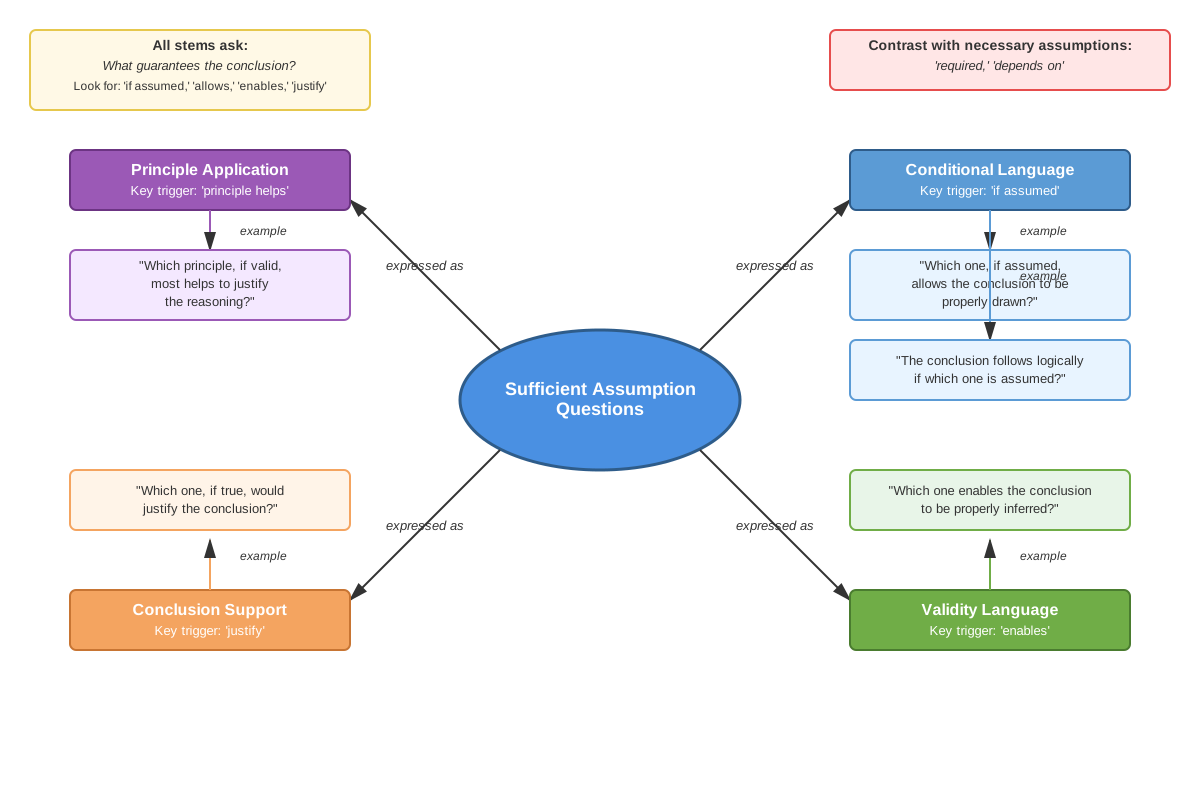
LSAT sufficient assumption stems follow predictable patterns that signal the question type. Common formulations include:
- "Which one of the following, if assumed, allows the conclusion to be properly drawn?"
- "The conclusion follows logically if which one of the following is assumed?"
- "Which one of the following principles, if valid, most helps to justify the reasoning?"
- "The argument's conclusion can be properly inferred if which one of the following is assumed?"
- "Which one of the following, if true, enables the conclusion to be properly drawn?"
The critical trigger words include: "if assumed," "allows/enables the conclusion," "properly drawn/inferred," "follows logically," and "justifies the reasoning." These phrases indicate that the correct answer will provide information sufficient to make the argument logically valid. The word "properly" is particularly important—it signals that the question asks for formal logical validity, not merely strengthening or making the conclusion more likely.
The Logical Gap in Sufficient Assumption Questions
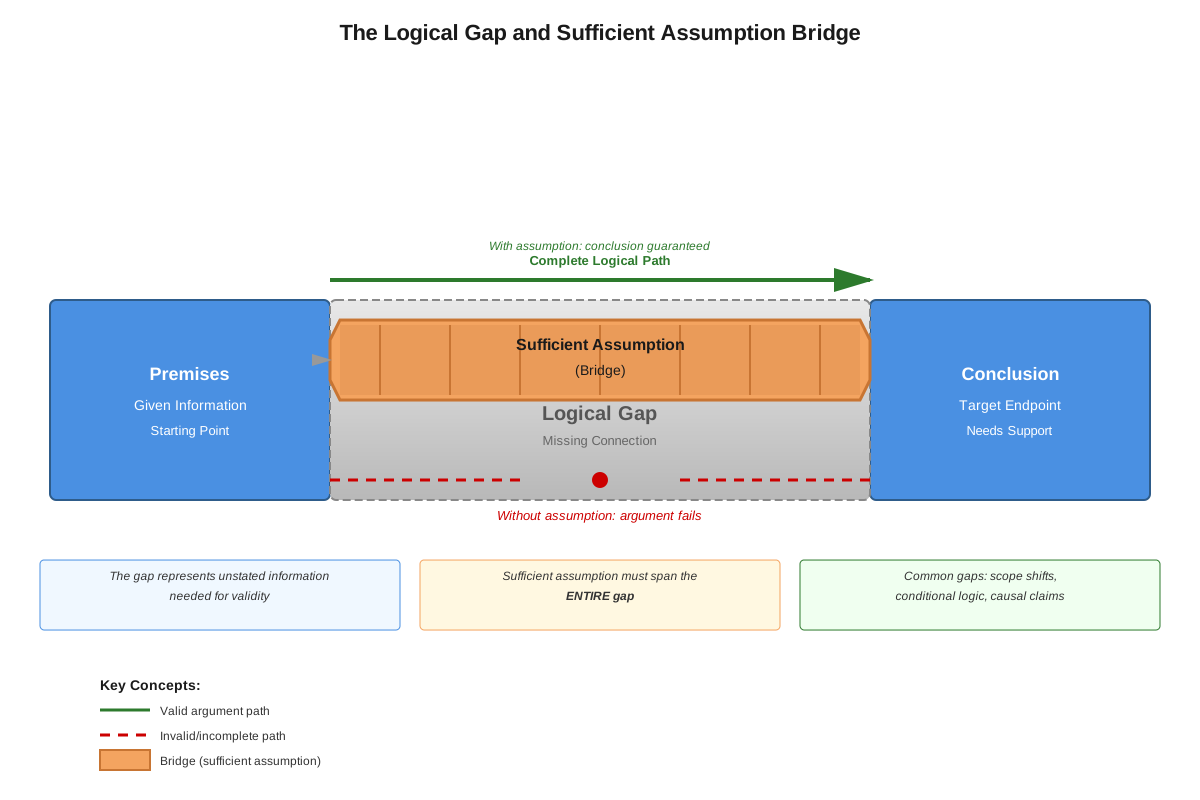
Every sufficient assumption question presents an argument with a logical gap—a disconnect between the premises and conclusion where additional information is needed to make the reasoning complete. Identifying this gap is the crucial first step in solving these questions efficiently.
Common types of logical gaps include:
- Term shifts: The premises discuss concept X, but the conclusion discusses concept Y, with no explicit connection established
- Conditional reasoning gaps: A chain of if-then statements has a missing link
- Categorical reasoning gaps: The premises establish membership in one category, but the conclusion requires membership in a different category
- Scope shifts: The premises address a narrow scope, but the conclusion makes a broader claim
- Causal gaps: The premises establish correlation or temporal sequence, but the conclusion claims causation
The Sufficiency Test
To verify whether an answer choice is a sufficient assumption, apply the sufficiency test: Add the answer choice to the argument's premises and determine whether the conclusion now must be true. If the conclusion becomes guaranteed—not merely more likely, but absolutely certain given the new information—then the answer choice is sufficient.
This test differs fundamentally from the negation test used for necessary assumptions. With sufficient assumptions, the question is not "What happens if we remove this?" but rather "What happens if we add this?" The correct answer, when added, creates an airtight logical connection.
Common Logical Structures in Sufficient Assumption Questions
Conditional reasoning chains represent the most frequently tested structure. These arguments present a series of conditional statements with a missing link:
Premise: If A → B
Premise: If C → D
Conclusion: If A → D
The sufficient assumption would be: If B → C (completing the chain).
Categorical syllogisms also appear regularly, requiring a middle term connection:
Premise: All X are Y
Conclusion: All X are Z
The sufficient assumption would be: All Y are Z (connecting the categories).
Principle application questions ask for a general rule that, when applied to the specific facts in the premises, yields the conclusion. These sufficient assumptions often take the form of conditional statements or universal principles.
Sufficient vs. Necessary Assumptions Comparison
| Feature | Sufficient Assumption | Necessary Assumption |
|---|---|---|
| Logical role | Guarantees conclusion | Required for argument |
| Strength | Can be stronger than needed | Must be minimal requirement |
| Test method | Add it and check if conclusion must follow | Negate it and check if argument fails |
| Question language | "Allows conclusion to be properly drawn" | "Assumption on which argument depends/relies" |
| Answer characteristics | Often formal, sometimes extreme | Usually moderate, defensible |
| Relationship to argument | Sufficient but not necessary | Necessary but not sufficient |
Concept Relationships
The concepts within sufficient assumption questions form a hierarchical relationship: Argument structure identification → Logical gap recognition → Sufficient assumption prediction → Answer evaluation using sufficiency test. Each step builds upon the previous one, creating a systematic approach to these questions.
Sufficient assumptions connect to prerequisite knowledge of formal logic through their reliance on conditional reasoning and valid argument forms. The ability to recognize valid deductive structures (modus ponens, modus tollens, hypothetical syllogism) directly enables identification of what information would complete an incomplete logical chain.
The relationship between sufficient and necessary assumptions is complementary rather than oppositional. Both question types test assumption identification, but from different angles: necessary assumptions ask "What must this argument assume?" while sufficient assumptions ask "What would guarantee this argument works?" Understanding this distinction prevents confusion when encountering similar-looking question stems.
Sufficient assumption skills transfer directly to strengthen questions (where the correct answer makes the conclusion more likely but doesn't guarantee it), principle questions (where a general rule must be applied to specific facts), and parallel reasoning questions (where recognizing the logical structure enables matching). Mastering sufficient assumptions thus provides a foundation for multiple question types.
High-Yield Facts
⭐ Sufficient assumption question stems always ask what would allow the conclusion to be "properly drawn," "properly inferred," or "logically follow"—this language signals the need for logical validity, not mere strengthening
⭐ The correct answer to a sufficient assumption question, when added to the premises, makes the conclusion 100% certain—not just more likely
⭐ Sufficient assumptions often connect two terms or concepts that appear disconnected in the original argument (bridging the gap between premises and conclusion)
⭐ The sufficiency test is the primary evaluation method: add the answer choice to the argument and verify whether the conclusion must now be true
⭐ Sufficient assumptions can be stronger than necessary—they may provide more information than the minimum required, which is acceptable
- Conditional reasoning chains with missing links represent the most common logical structure in sufficient assumption questions
- Term shifts between premises and conclusion create the most frequent type of logical gap requiring a sufficient assumption
- The correct answer often appears formal or extreme because it must guarantee the conclusion without qualification
- Principle-based sufficient assumption questions require identifying a general rule that, when applied to the specific facts, yields the conclusion
- Sufficient assumptions differ from necessary assumptions in both question stem language and the logical role the answer plays
Quick check — test yourself on Sufficient assumption stems so far.
Try Flashcards →Common Misconceptions
Misconception: Sufficient assumptions must be realistic or likely to be true in the real world → Correction: Sufficient assumptions only need to be logically adequate to guarantee the conclusion; they can be unrealistic, extreme, or even absurd as long as they create logical validity. The LSAT tests formal logic, not plausibility.
Misconception: The correct answer to a sufficient assumption question should be the minimum information needed → Correction: Sufficient assumptions can provide more than the minimum; they can be "overkill." Unlike necessary assumptions, which must be precisely calibrated, sufficient assumptions simply need to be strong enough to guarantee the conclusion.
Misconception: If an answer choice strengthens the argument, it must be the sufficient assumption → Correction: Strengthening is not the same as guaranteeing. Many wrong answers strengthen the argument by making the conclusion more likely, but only the correct answer makes the conclusion absolutely certain when added to the premises.
Misconception: The negation test works for sufficient assumption questions → Correction: The negation test is designed for necessary assumptions. For sufficient assumptions, use the sufficiency test: add the answer choice and verify whether the conclusion must follow.
Misconception: Sufficient assumption questions and necessary assumption questions are asking for the same thing with different wording → Correction: These are fundamentally different question types testing different logical relationships. Sufficient assumptions guarantee the conclusion; necessary assumptions identify what the argument requires. The same statement is rarely both sufficient and necessary for a given argument.
Worked Examples
Example 1: Conditional Reasoning Chain
Argument: "All students who study diligently pass the bar exam. Maria will study diligently. Therefore, Maria will become a successful lawyer."
Question: Which one of the following, if assumed, allows the conclusion to be properly drawn?
Analysis:
- Identify the premises and conclusion:
- Premise 1: All students who study diligently → pass bar exam
- Premise 2: Maria will study diligently
- Conclusion: Maria will become a successful lawyer
- Identify the logical gap: The premises establish that Maria will pass the bar exam (following the conditional chain), but the conclusion jumps to "successful lawyer." There's a term shift from "pass bar exam" to "successful lawyer" with no connection established.
- Predict the sufficient assumption: We need something that connects "passing the bar exam" to "becoming a successful lawyer." A sufficient assumption would be: "All who pass the bar exam become successful lawyers" or "If Maria passes the bar exam, she will become a successful lawyer."
- Apply the sufficiency test: If we add "All who pass the bar exam become successful lawyers" to the premises:
- Maria studies diligently → Maria passes bar exam (from premises)
- Maria passes bar exam → Maria becomes successful lawyer (from our assumption)
- Therefore, Maria becomes successful lawyer (conclusion now guaranteed)
Correct Answer: "Everyone who passes the bar exam becomes a successful lawyer"
This answer bridges the gap by connecting the intermediate conclusion (Maria will pass the bar exam) to the final conclusion (Maria will become a successful lawyer), making the reasoning valid.
Example 2: Categorical Reasoning
Argument: "The new policy will reduce costs. Any measure that reduces costs should be implemented. Therefore, the new policy will improve company performance."
Question: The conclusion follows logically if which one of the following is assumed?
Analysis:
- Identify the structure:
- Premise 1: New policy reduces costs
- Premise 2: Measures that reduce costs should be implemented
- Conclusion: New policy will improve company performance
- Identify the logical gap: The premises establish that the policy should be implemented (because it reduces costs), but the conclusion claims it will improve performance. There's a disconnect between "should be implemented" and "will improve performance."
- Predict the sufficient assumption: We need a connection between implementation (or cost reduction) and improved performance. Something like: "Any policy that should be implemented will improve company performance" or "All cost-reducing measures improve company performance."
- Apply the sufficiency test: If we add "All measures that should be implemented will improve company performance":
- New policy reduces costs (premise)
- Measures that reduce costs should be implemented (premise)
- Therefore, new policy should be implemented (intermediate conclusion)
- All measures that should be implemented improve performance (our assumption)
- Therefore, new policy will improve performance (conclusion now guaranteed)
Correct Answer: "Any measure that should be implemented will improve company performance"
This creates a valid logical chain from the premises to the conclusion by bridging the gap between "should be implemented" and "will improve performance."
Exam Strategy
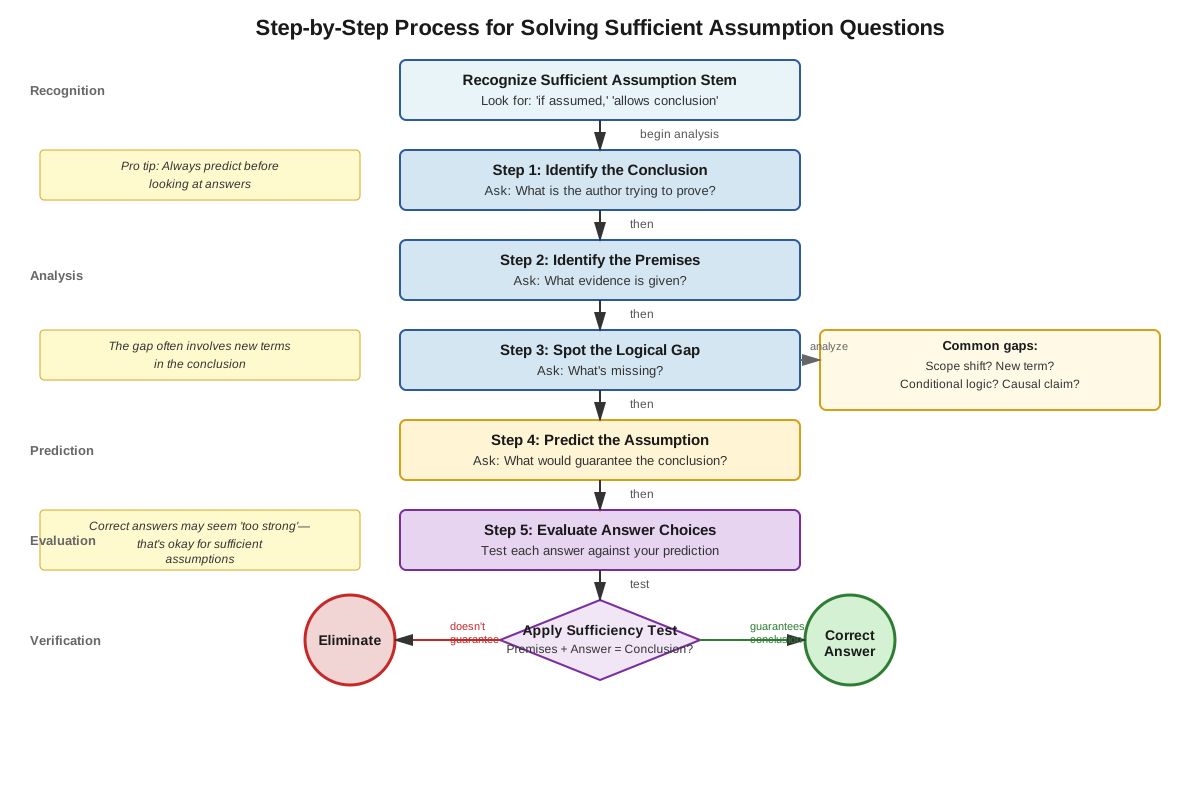
Step 1: Identify the question type immediately. Look for trigger phrases like "if assumed, allows the conclusion to be properly drawn" or "conclusion follows logically if." These signal a sufficient assumption question, which requires a different approach than necessary assumptions or strengthen questions.
Step 2: Deconstruct the argument carefully. Identify the conclusion first (often signaled by words like "therefore," "thus," or "consequently"), then identify each premise. Pay special attention to any intermediate conclusions—steps in reasoning between premises and final conclusion.
Step 3: Identify the logical gap. Ask yourself: "What's missing between these premises and this conclusion?" Look for term shifts (new concepts in the conclusion not mentioned in premises), scope shifts (broader or narrower claims), or missing links in conditional chains. Articulate the gap in your own words before looking at answer choices.
Step 4: Predict the sufficient assumption. Based on the gap you've identified, formulate what information would bridge it. Your prediction doesn't need to match the correct answer word-for-word, but it should capture the logical relationship needed. This prediction serves as your guide when evaluating answers.
Step 5: Evaluate answer choices using the sufficiency test. For each answer choice, mentally add it to the argument and ask: "Does the conclusion now must follow with certainty?" Eliminate answers that merely strengthen or that address irrelevant issues. The correct answer will make the conclusion absolutely guaranteed.
Exam Tip: Watch for wrong answers that are necessary but not sufficient. These answers identify something the argument assumes, but don't go far enough to guarantee the conclusion. They're tempting because they're relevant to the argument, but they fail the sufficiency test.
Time allocation: Spend 1:15-1:30 on sufficient assumption questions. They require careful analysis but shouldn't consume excessive time. If you're stuck after evaluating all five choices, use the sufficiency test more rigorously on your top two contenders rather than re-reading the stimulus repeatedly.
Process of elimination tips:
- Eliminate answers that introduce completely new concepts unrelated to the gap
- Eliminate answers that go in the wrong direction (connecting terms in reverse order)
- Eliminate answers that are too weak (using words like "some," "might," or "could")
- Keep answers that bridge the specific gap you identified, even if they seem strong or extreme
Memory Techniques
BRIDGE - Remember that sufficient assumptions build a logical bridge:
- Bridge the gap between premises and conclusion
- Requires adding information that guarantees the conclusion
- Identify term shifts and missing links
- Different from necessary assumptions (which identify requirements)
- Guarantees validity when added to premises
- Evaluate using the sufficiency test
"Add and Guarantee" - For sufficient assumptions, you ADD the answer choice and check if it GUARANTEES the conclusion. This contrasts with necessary assumptions where you NEGATE and check if the argument FAILS. The mnemonic "Add and Guarantee" helps remember the sufficiency test.
Visualization strategy: Picture the argument as a bridge with a missing section. The premises are on one side, the conclusion on the other, and there's a gap in the middle. The sufficient assumption is the piece that completes the bridge, allowing you to walk from premises to conclusion without any leaps.
The "100% Rule": Remember that sufficient assumptions must make the conclusion 100% certain, not 90% or even 99%. If there's any scenario where the premises plus the answer choice could be true but the conclusion false, it's not sufficient. This bright-line rule helps eliminate tempting wrong answers.
Summary
Sufficient assumption questions test the ability to identify information that, when added to an argument's premises, guarantees the conclusion follows with logical certainty. These questions appear 2-4 times per LSAT and are identifiable through stems asking what "allows the conclusion to be properly drawn" or makes the conclusion "follow logically." The key skill is recognizing the logical gap between premises and conclusion—typically a term shift, missing conditional link, or categorical disconnect—and identifying what information would bridge that gap completely. Unlike necessary assumptions, sufficient assumptions can provide more than the minimum required; they simply must be strong enough to make the argument valid. The sufficiency test (adding the answer choice and verifying the conclusion must follow) is the primary evaluation method. Mastering sufficient assumptions requires understanding formal logical structures, particularly conditional reasoning chains and categorical relationships, and distinguishing between making an argument valid versus merely making it stronger. Success on these questions translates to improved performance across multiple Logical Reasoning question types.
Key Takeaways
- Sufficient assumption question stems ask what would allow the conclusion to be "properly drawn" or "logically follow"—language indicating the need for guaranteed validity
- The sufficiency test is the primary tool: add the answer choice to the premises and verify whether the conclusion must now be true with 100% certainty
- Logical gaps typically involve term shifts, missing conditional links, or categorical disconnects between premises and conclusion
- Sufficient assumptions differ fundamentally from necessary assumptions in both the question stem language and the logical role the answer plays
- The correct answer often appears strong or extreme because it must guarantee the conclusion without qualification—this is acceptable and often correct
- Predicting the sufficient assumption before reviewing answer choices dramatically improves accuracy and efficiency
- Sufficient assumption skills transfer directly to strengthen questions, principle questions, and parallel reasoning questions
Related Topics
Necessary Assumption Questions: Understanding what an argument requires (rather than what would guarantee it) represents the complementary skill to sufficient assumptions. Mastering both types enables complete command of assumption questions.
Strengthen and Weaken Questions: These question types test similar analytical skills but require making arguments more or less likely rather than guaranteeing validity. Sufficient assumption mastery provides a foundation for understanding degrees of support.
Formal Logic and Conditional Reasoning: Deep understanding of if-then statements, contrapositives, and valid argument forms enables rapid identification of missing links in conditional chains—the most common sufficient assumption structure.
Principle Questions: Many principle questions are essentially sufficient assumption questions in disguise, asking for a general rule that, when applied, justifies the reasoning. The same analytical approach applies.
Parallel Reasoning Questions: Recognizing the logical structure of arguments (the skill developed through sufficient assumption practice) is essential for identifying arguments with matching structures.
Practice CTA
Now that you understand the mechanics and strategy behind sufficient assumption questions, it's time to apply these concepts to actual LSAT questions. The practice questions and flashcards will reinforce your ability to identify logical gaps, predict sufficient assumptions, and apply the sufficiency test efficiently. Remember: sufficient assumption questions reward systematic analysis and precise logical thinking. Each practice question you complete strengthens your pattern recognition and builds the confidence needed to tackle these high-yield questions on test day. Start practicing now to transform this knowledge into points on your LSAT score!
Sign up free to keep reading
Create a free AnvayaPrep account to finish this LSAT guide on Sufficient assumption stems — plus flashcards and practice questions.