Overview
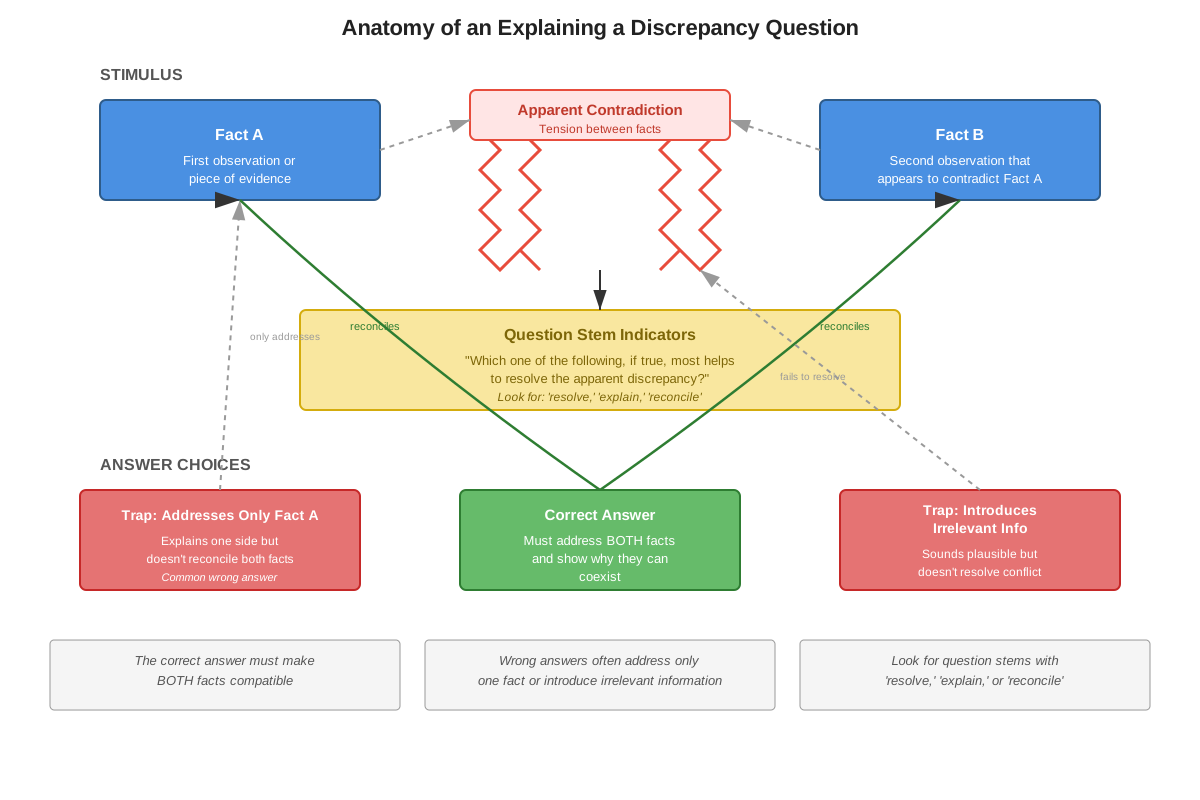
Explaining a discrepancy is one of the most frequently tested question types in LSAT Logical Reasoning sections, appearing in approximately 10-15% of all Logical Reasoning questions. These questions present two seemingly contradictory facts, observations, or trends and ask test-takers to identify which answer choice best resolves, explains, or reconciles the apparent conflict. Mastering this question type is essential for achieving a competitive LSAT score, as it tests the ability to think critically about complex information and identify the underlying factors that make seemingly incompatible statements both true.
The fundamental challenge in explaining a discrepancy questions lies in recognizing that both pieces of information presented are factually accurate—the task is not to disprove one statement or the other, but rather to find the missing piece of information that makes both statements logically compatible. This requires understanding the relationship between causation and explanation, as the correct answer typically introduces a causal factor, distinguishing characteristic, or contextual detail that was not initially apparent. Students must resist the temptation to choose answers that merely address one side of the discrepancy or that introduce irrelevant information, no matter how interesting or plausible it may seem.
Within the broader landscape of Logical Reasoning, explaining a discrepancy questions bridge several critical skills: understanding causal relationships, recognizing relevant versus irrelevant information, and applying logical principles to real-world scenarios. These questions often overlap with other question types such as strengthen/weaken questions and assumption questions, as they all require careful analysis of argument structure and the relationships between premises and conclusions. The ability to explain discrepancies is not merely an isolated test-taking skill but a fundamental component of legal reasoning that law schools value highly.
Learning Objectives
- [ ] Identify how Explaining a discrepancy appears in LSAT questions
- [ ] Explain the reasoning pattern behind Explaining a discrepancy
- [ ] Apply Explaining a discrepancy to solve LSAT-style problems accurately
- [ ] Distinguish between answer choices that resolve both sides of a discrepancy versus those that address only one side
- [ ] Recognize common trap answers that introduce irrelevant information or false dichotomies
- [ ] Evaluate the logical sufficiency of proposed explanations for apparent contradictions
Prerequisites
- Basic argument structure: Understanding premises, conclusions, and how claims relate to one another is essential for identifying what appears contradictory and what would resolve the conflict
- Causal reasoning fundamentals: Recognizing cause-and-effect relationships enables students to identify explanations that introduce relevant causal factors
- Reading comprehension skills: The ability to parse complex stimulus passages and identify the precise nature of the discrepancy is foundational to selecting correct answers
- Logical operators and conditional reasoning: Understanding how different conditions interact helps in evaluating whether proposed explanations actually resolve the apparent contradiction
Why This Topic Matters
Explaining a discrepancy questions appear with remarkable consistency across LSAT administrations, making them one of the highest-yield question types for focused study. Test-takers can expect to encounter 3-5 such questions per test, distributed across both Logical Reasoning sections. These questions typically appear at medium difficulty levels, though they can range from relatively straightforward to highly challenging depending on the complexity of the discrepancy and the subtlety of the correct answer.
In real-world legal practice, attorneys constantly encounter situations where evidence appears contradictory or where client accounts seem inconsistent with documented facts. The ability to identify explanations that reconcile apparent conflicts is fundamental to case analysis, witness examination, and legal argumentation. Judges and lawyers must regularly evaluate competing narratives and determine which explanations best account for all available evidence—precisely the skill tested by these questions.
On the LSAT, explaining a discrepancy questions most commonly appear with question stems such as "Which one of the following, if true, most helps to resolve the apparent discrepancy described above?" or "Which one of the following, if true, most helps to explain the surprising finding?" These questions may also be phrased as asking what "reconciles" the information, what "accounts for" the observations, or what "explains" the paradox. The stimulus typically presents statistical data, research findings, survey results, or observational evidence that contains an unexpected or seemingly contradictory element.
Core Concepts
The Nature of Discrepancies
A discrepancy in LSAT Logical Reasoning refers to an apparent contradiction, paradox, or surprising relationship between two or more facts, observations, or trends. The key word here is "apparent"—the discrepancy is not an actual logical impossibility but rather a situation where the facts seem incompatible based on common expectations or typical patterns. The stimulus presents information that makes the reader think, "That's strange" or "How can both of those things be true?"
Discrepancies typically fall into several categories:
- Statistical anomalies: Data that contradicts expected trends or patterns
- Behavioral paradoxes: Actions that seem contrary to stated preferences or rational self-interest
- Outcome contradictions: Results that differ from what the described causes would typically produce
- Comparative inconsistencies: Differences between similar groups or situations that lack obvious explanation
The fundamental principle underlying all explaining a discrepancy questions is that both parts of the discrepancy are factually true. The correct answer does not dispute either fact but instead provides additional information that makes their coexistence logical and expected rather than surprising.
The Resolution Mechanism
When approaching these questions, understanding the resolution mechanism is crucial. A proper explanation must address both sides of the discrepancy simultaneously—it cannot simply elaborate on one fact while ignoring the other. The correct answer introduces a new piece of information that:
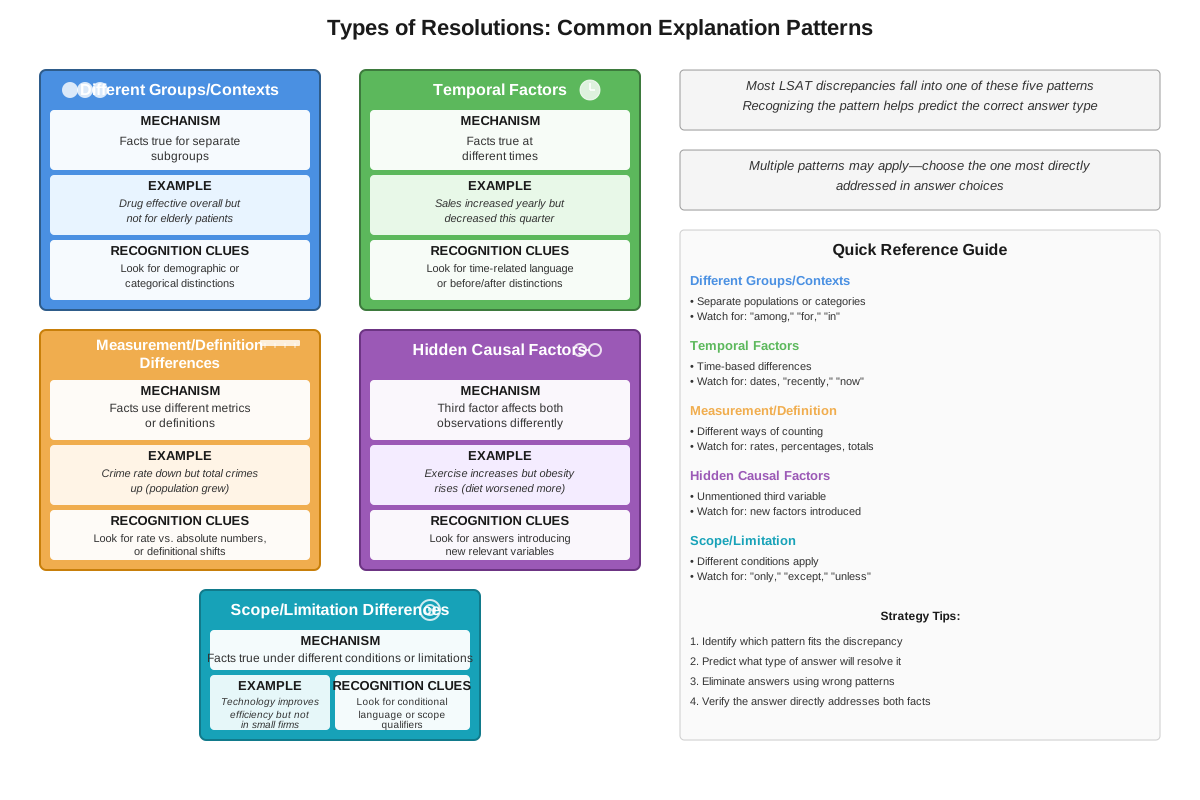
- Identifies a relevant difference between compared groups or situations
- Reveals a hidden factor that affects the outcome
- Clarifies a measurement or definitional issue that created the apparent conflict
- Establishes a causal relationship that was not initially obvious
- Distinguishes between correlation and causation in a way that resolves the paradox
Consider this structure: If Fact A suggests X should happen, but Fact B shows Y happened instead, the explanation must show why, given the complete picture, Y is actually the expected outcome despite Fact A. This often involves introducing Fact C, which interacts with Fact A in a way that produces Y.
Common Discrepancy Patterns
| Pattern Type | Structure | Example Framework |
|---|---|---|
| Expected vs. Actual | Theory predicts X, but observation shows Y | Economic theory suggests prices should fall, but they rose |
| Comparative Anomaly | Group A and Group B are similar, but outcomes differ | Two cities have similar populations, but different crime rates |
| Temporal Inconsistency | Situation at Time 1 differs unexpectedly from Time 2 | Sales increased despite reduced advertising |
| Inverse Relationship | More of X correlates with less of Y (counterintuitively) | Higher education spending correlates with lower test scores |
| Self-Contradictory Behavior | Actions contradict stated preferences or logic | People say they want X but consistently choose Y |
Identifying the Precise Discrepancy
Before evaluating answer choices, students must precisely identify what makes the situation surprising or contradictory. This requires asking: "What would I normally expect given the first piece of information, and how does the second piece of information violate that expectation?" Many students struggle with these questions because they fail to articulate the exact nature of the discrepancy before looking at answers.
The discrepancy often hinges on an unstated assumption about how things typically work. For example, if a stimulus states that "Restaurant A raised prices significantly, yet saw an increase in customers," the discrepancy relies on the common assumption that higher prices typically reduce demand. The correct explanation might reveal that Restaurant A's competitors raised prices even more, or that the price increase signaled higher quality to consumers, or that the restaurant simultaneously expanded its menu in ways that attracted new customer segments.
Evaluating Answer Choices
When evaluating potential explanations, apply these criteria:
- Relevance: Does the answer address the specific facts presented in the discrepancy?
- Completeness: Does it account for both sides of the apparent contradiction?
- Sufficiency: Does it make the outcome logical rather than surprising?
- Scope: Does it match the scope of the discrepancy (not too broad or too narrow)?
Wrong answers typically fall into predictable categories: they address only one side of the discrepancy, they introduce irrelevant information, they actually deepen the paradox rather than resolve it, or they make unsupported assumptions that don't necessarily follow from the stimulus.
The Role of Background Assumptions
Many discrepancies exist only because of implicit background assumptions that readers bring to the passage. Recognizing these assumptions is crucial for both identifying the discrepancy and evaluating explanations. For instance, if a passage states that "City X implemented strict pollution controls, yet air quality worsened," the discrepancy exists only if we assume pollution controls should improve air quality. The explanation might reveal that neighboring cities without controls saw massive industrial growth, or that the measurement methodology changed, or that natural factors like weather patterns overwhelmed the impact of the controls.
Concept Relationships
The skill of explaining a discrepancy builds directly on understanding causation and explanation within Logical Reasoning. When a discrepancy exists, it typically involves a causal relationship that is either misunderstood, incomplete, or more complex than initially apparent. The explanation introduces additional causal factors that complete the picture.
This topic connects closely to strengthen and weaken questions because an explanation that resolves a discrepancy essentially strengthens the coherence of the overall narrative. If someone were arguing that both facts are true and compatible, the correct answer to an explaining a discrepancy question would strengthen that argument. Conversely, information that deepens the paradox would weaken such an argument.
The relationship to assumption questions is also significant. Often, the discrepancy exists because of an unstated assumption, and the correct explanation either validates that assumption while introducing a countervailing factor, or reveals why the assumption doesn't apply in this particular case.
Concept flow: Identify discrepancy → Recognize unstated assumptions → Evaluate which additional information makes both facts compatible → Select answer that addresses both sides → Verify that the explanation is sufficient and relevant
Understanding necessary versus sufficient conditions also aids in evaluating explanations. A correct explanation must be sufficient to resolve the discrepancy, though it need not be the only possible explanation. Students sometimes reject correct answers because they can imagine alternative explanations, but the question asks only for an answer that resolves the discrepancy, not the only possible resolution.
High-Yield Facts
⭐ Both parts of the discrepancy are factually true; the correct answer does not dispute either fact but explains how they coexist
⭐ The correct answer must address both sides of the discrepancy, not just elaborate on one side
⭐ Explaining a discrepancy questions appear 3-5 times per LSAT test, making them high-yield for focused study
⭐ Common wrong answers introduce irrelevant information, address only one side, or actually deepen the paradox
⭐ The discrepancy typically relies on an unstated assumption about how things normally work
- Question stems typically include words like "resolve," "explain," "reconcile," or "account for"
- The correct explanation often introduces a relevant difference between compared groups or a hidden causal factor
- Temporal discrepancies (changes over time) often involve external factors that changed during the same period
- Comparative discrepancies (differences between similar groups) often involve a relevant difference that wasn't initially mentioned
- Statistical discrepancies frequently involve issues of measurement, sample selection, or confounding variables
- The correct answer makes the outcome expected rather than surprising given the complete information
- Wrong answers often sound plausible but fail to address the specific discrepancy presented
- Some discrepancies involve distinguishing between absolute numbers and percentages or rates
- The explanation need not be the only possible resolution, just one that sufficiently resolves the conflict
- Reading carefully for scope is essential—answers that are too broad or too narrow typically fail to resolve the specific discrepancy
Quick check — test yourself on Explaining a discrepancy so far.
Try Flashcards →Common Misconceptions
Misconception: The correct answer must prove that both facts are true → Correction: Both facts are already established as true in the stimulus; the answer must explain how they can both be true simultaneously, not prove their truth
Misconception: Any answer that relates to the topic of the discrepancy is potentially correct → Correction: The answer must specifically address the relationship between the two conflicting facts, not merely discuss related topics; relevance to the discrepancy itself is essential
Misconception: The correct answer should resolve the discrepancy completely and be the only possible explanation → Correction: The correct answer need only provide a sufficient explanation that makes the facts compatible; alternative explanations may exist, but the question asks for an answer that resolves the discrepancy, not the unique explanation
Misconception: If an answer addresses one side of the discrepancy well, it's likely correct → Correction: The correct answer must address both sides simultaneously; answers that elaborate on only one fact without connecting it to the other fail to resolve the apparent contradiction
Misconception: The explanation should align with common sense or typical patterns → Correction: The correct explanation often reveals why this situation deviates from typical patterns; it may introduce unusual circumstances or factors that make the counterintuitive outcome logical
Misconception: Longer, more detailed answers are more likely to be correct → Correction: Answer length is irrelevant to correctness; some correct answers are concise while some wrong answers are verbose; focus on whether the answer logically resolves both sides of the discrepancy
Misconception: The discrepancy must involve a direct logical contradiction → Correction: Most discrepancies involve surprising or unexpected relationships rather than logical impossibilities; they contradict expectations or typical patterns, not logical laws
Worked Examples
Example 1: Consumer Behavior Discrepancy
Stimulus: A recent survey found that consumers consistently rate Brand X coffee as inferior in taste to Brand Y coffee in blind taste tests. However, Brand X outsells Brand Y by a significant margin in the same markets where the taste tests were conducted.
Question: Which of the following, if true, most helps to explain the discrepancy described above?
Answer Choices:
(A) Brand X coffee is less expensive than Brand Y coffee
(B) Brand X has been available in stores longer than Brand Y
(C) Some consumers prefer stronger coffee, while others prefer milder coffee
(D) The taste tests were conducted with small sample sizes
(E) Brand Y coffee is also rated highly in taste tests
Analysis:
First, identify the precise discrepancy: Brand X tastes worse (according to blind tests) but sells better. This is surprising because we typically expect better-tasting products to sell better, especially when the taste difference is established through blind testing.
Both facts are true: Brand X genuinely tastes worse in blind tests AND sells better. We need an explanation that makes this combination logical.
(A) Brand X coffee is less expensive than Brand Y coffee - This is the correct answer. It introduces a relevant factor (price) that wasn't mentioned in the stimulus. Lower price provides a compelling reason why consumers might purchase Brand X despite its inferior taste. This resolves both sides: it acknowledges the taste difference while explaining the sales difference. Price is a major factor in purchasing decisions, and many consumers accept lower quality for lower cost.
(B) Brand X has been available in stores longer than Brand Y - This addresses only the sales side and doesn't explain why consumers would continue buying an inferior-tasting product. Longevity might explain initial market share, but not sustained higher sales when consumers have had time to try both products.
(C) Some consumers prefer stronger coffee, while others prefer milder coffee - This is irrelevant because the blind taste tests already account for consumer preferences. If Brand X consistently rates as inferior, this suggests it's not simply a matter of different preferences but of quality differences.
(D) The taste tests were conducted with small sample sizes - This attempts to undermine the validity of the taste test results rather than explain how both facts can be true. The question assumes both facts are accurate.
(E) Brand Y coffee is also rated highly in taste tests - This merely restates information already implied in the stimulus and doesn't explain the sales discrepancy.
Key Takeaway: The correct answer introduced a new, relevant factor (price) that makes the counterintuitive outcome (worse taste but better sales) completely logical.
Example 2: Educational Outcome Discrepancy
Stimulus: School District A spends significantly more per student on education than School District B and has newer facilities, better-paid teachers, and smaller class sizes. Surprisingly, students in District B consistently score higher on standardized tests than students in District A.
Question: Which of the following, if true, most helps to resolve the apparent paradox?
Answer Choices:
(A) District A has implemented several innovative teaching methods in recent years
(B) District B's students come from families with significantly higher average income and parental education levels than District A's students
(C) Standardized tests do not measure all important educational outcomes
(D) District A has more students enrolled than District B
(E) Teachers in District B report higher job satisfaction than teachers in District A
Analysis:
The discrepancy: District A has better resources (more spending, newer facilities, better-paid teachers, smaller classes) but worse outcomes (lower test scores). This contradicts the expectation that better resources produce better outcomes.
(B) District B's students come from families with significantly higher average income and parental education levels than District A's students - This is the correct answer. It introduces a powerful confounding variable that explains why District B outperforms District A despite having fewer educational resources. Parental income and education are among the strongest predictors of student academic achievement. This explanation makes both facts compatible: District A has better school resources, but District B has students who start with significant advantages that outweigh the resource differences.
(A) District A has implemented several innovative teaching methods in recent years - This actually deepens the paradox rather than resolving it. If District A has innovative methods in addition to better resources, the performance gap becomes even more surprising.
(C) Standardized tests do not measure all important educational outcomes - This is irrelevant to explaining the specific discrepancy about test scores. It might be true, but it doesn't explain why District B scores higher on the tests that are being measured.
(D) District A has more students enrolled than District B - Enrollment size doesn't clearly explain the performance difference, especially since District A already has smaller class sizes, which should mitigate any negative effects of larger overall enrollment.
(E) Teachers in District B report higher job satisfaction than teachers in District A - While teacher satisfaction might correlate with student outcomes, this doesn't explain why District B teachers would be more satisfied despite having lower pay and presumably fewer resources. This answer doesn't resolve the discrepancy.
Key Takeaway: The correct answer identified a relevant difference between the compared groups (student background characteristics) that was not mentioned in the original comparison but that powerfully affects the outcome being measured.
Exam Strategy
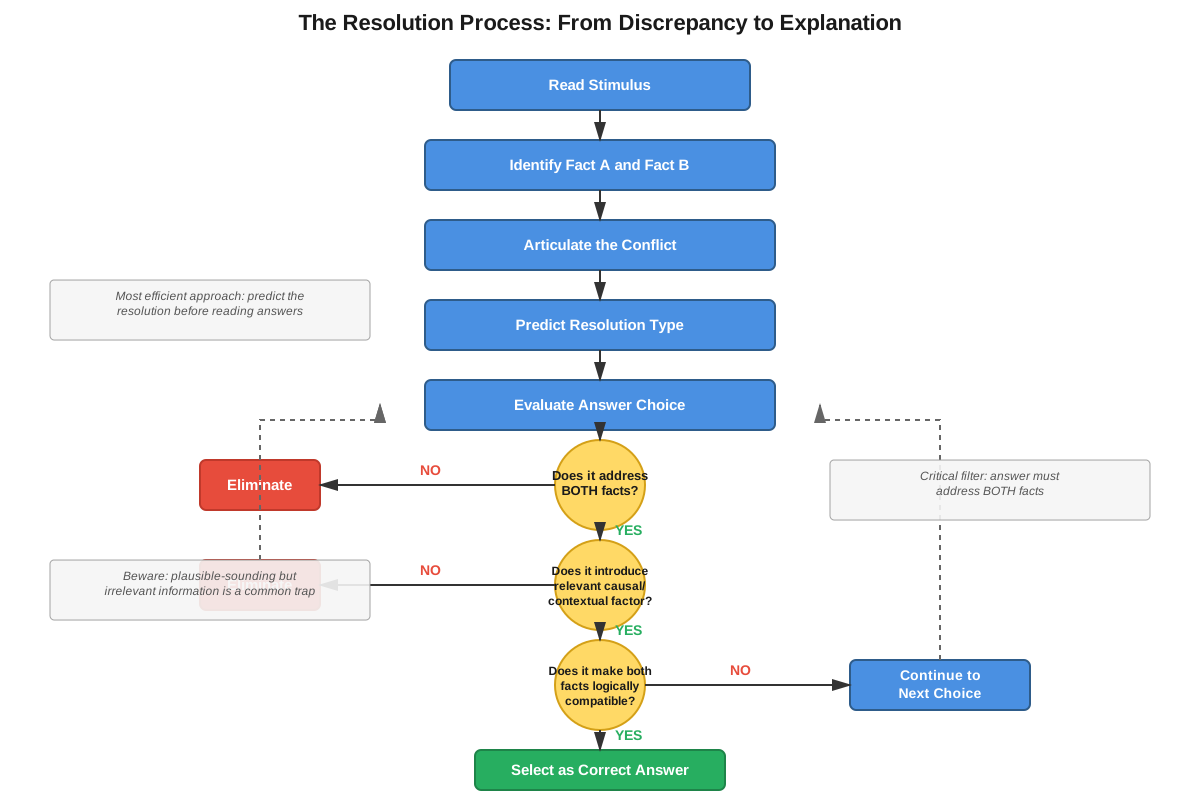
When approaching explaining a discrepancy questions on the LSAT, follow this systematic process:
Step 1: Identify the Question Type - Look for trigger words in the question stem: "resolve," "explain," "reconcile," "account for," "paradox," or "apparent discrepancy." These signal that you're dealing with this question type.
Step 2: Read the Stimulus Carefully - Before looking at answers, articulate the discrepancy in your own words. Ask yourself: "What would I normally expect, and how does this situation violate that expectation?" Write down or mentally note both sides of the discrepancy.
Step 3: Identify Unstated Assumptions - Determine what background assumption makes the situation seem contradictory. Often, the correct answer will address this assumption.
Step 4: Predict the Type of Answer - Before reading choices, consider what kind of information would resolve the discrepancy. Are you looking for a relevant difference between groups? A hidden causal factor? A measurement issue?
Step 5: Evaluate Each Answer Systematically - For each choice, ask:
- Does it address both sides of the discrepancy?
- Does it make the outcome expected rather than surprising?
- Is it relevant to the specific facts presented?
- Does it introduce new information rather than just restating the stimulus?
Exam Tip: Wrong answers often address only one side of the discrepancy. If an answer choice makes you think "Yes, but that doesn't explain the other part," eliminate it immediately.
Time Management: These questions typically require 1-1.5 minutes. Spend 20-30 seconds understanding the discrepancy before looking at answers. If you find yourself spending more than 2 minutes, flag the question and return to it if time permits.
Process of Elimination Strategies:
- Eliminate answers that restate information already in the stimulus
- Eliminate answers that address only one side of the discrepancy
- Eliminate answers that deepen the paradox rather than resolve it
- Eliminate answers that are too broad or too narrow in scope
- Eliminate answers that require additional unsupported assumptions
Common Trap Patterns:
- The "Interesting but Irrelevant" trap: An answer that sounds related to the topic but doesn't address the specific discrepancy
- The "One-Sided" trap: An answer that elaborates on one fact without connecting to the other
- The "Assumption Required" trap: An answer that would work only if you make additional assumptions not supported by the stimulus
- The "Opposite Effect" trap: An answer that would actually make the discrepancy more surprising
Memory Techniques
BOTH Mnemonic for evaluating answers:
- Both sides addressed
- Outcome becomes expected
- Ties facts together logically
- Has sufficient explanatory power
The Bridge Visualization: Picture the two conflicting facts as two islands. The correct answer is a bridge that connects them, allowing you to walk from one fact to the other logically. Wrong answers are either boats that go to only one island, bridges to different islands entirely, or broken bridges that don't quite reach both sides.
RED FLAG Acronym for wrong answers:
- Restates stimulus without adding new information
- Elaborates on only one side
- Deepens the paradox
- Fails relevance test
- Lacks sufficient explanatory power
- Assumptions required beyond stimulus
- Goes beyond appropriate scope
The "Surprise Test": After reading a potential explanation, ask yourself: "If I had known this information from the beginning, would the situation still be surprising?" If yes, the answer doesn't resolve the discrepancy. If no, it's likely correct.
Summary
Explaining a discrepancy questions test the ability to identify information that reconciles apparently contradictory or surprising facts. These high-frequency LSAT questions require recognizing that both parts of the discrepancy are true and finding the answer that makes their coexistence logical rather than paradoxical. The correct answer must address both sides of the discrepancy simultaneously, typically by introducing a relevant difference, hidden factor, or causal relationship not initially apparent. Success requires precisely identifying the nature of the discrepancy, recognizing unstated assumptions that create the appearance of contradiction, and systematically evaluating whether each answer choice provides sufficient explanation for the surprising relationship. Common wrong answers address only one side of the discrepancy, introduce irrelevant information, or require unsupported additional assumptions. Mastering this question type involves understanding that the goal is not to prove the facts true but to explain how they can both be true together, making the counterintuitive outcome expected given complete information.
Key Takeaways
- Explaining a discrepancy questions appear 3-5 times per LSAT and are high-yield for focused preparation
- Both facts in the discrepancy are true; the task is explaining their compatibility, not disputing either fact
- The correct answer must address both sides of the discrepancy simultaneously and make the outcome expected rather than surprising
- Common wrong answers elaborate on only one side, introduce irrelevant information, or deepen the paradox
- Identifying the precise nature of the discrepancy and the unstated assumptions behind it is essential before evaluating answers
- The correct explanation often introduces a relevant difference between compared groups or a hidden causal factor
- Systematic evaluation using the "both sides" test eliminates most wrong answers quickly and efficiently
Related Topics
Strengthen and Weaken Questions: Understanding how to explain discrepancies directly supports the ability to strengthen arguments by resolving potential objections or weaknesses. The same analytical skills apply to identifying information that would make an argument more or less convincing.
Assumption Questions: Many discrepancies exist because of unstated assumptions. Mastering assumption identification enhances the ability to recognize what makes situations seem contradictory and what information would resolve the contradiction.
Causal Reasoning: Explaining discrepancies often involves identifying complex causal relationships, including confounding variables, multiple causation, and the distinction between correlation and causation. Deeper study of causal reasoning patterns strengthens discrepancy resolution skills.
Formal Logic and Conditional Reasoning: Understanding how different conditions interact and how to evaluate whether explanations are sufficient helps in determining whether proposed resolutions actually resolve discrepancies or merely address related issues.
Flaw Questions: Recognizing flawed reasoning patterns helps identify when arguments fail to account for discrepancies or when they draw conclusions despite unresolved contradictions in the evidence.
Practice CTA
Now that you understand the core principles of explaining a discrepancy questions, it's time to apply these concepts to actual LSAT-style problems. The practice questions and flashcards will reinforce your ability to quickly identify discrepancies, evaluate answer choices systematically, and select explanations that resolve both sides of apparent contradictions. Consistent practice with these question types will build the pattern recognition and analytical skills necessary to handle even the most complex discrepancy questions confidently and accurately. Remember: every practice question you work through strengthens your ability to think like the test-makers and recognize the logical structures that appear repeatedly on the LSAT. Your investment in mastering this high-yield question type will pay dividends on test day!
Sign up free to keep reading
Create a free AnvayaPrep account to finish this LSAT guide on Explaining a discrepancy — plus flashcards and practice questions.