Overview
Resolve the paradox questions represent a critical question type within the LSAT's Logical Reasoning sections, appearing with consistent frequency on every administration of the exam. These questions present students with an apparent contradiction, discrepancy, or surprising result within a stimulus, then ask them to identify the answer choice that best explains how both seemingly incompatible facts can be true simultaneously. Unlike strengthen or weaken questions that ask students to affect an argument's validity, resolve the paradox questions focus on causation and explanation—requiring test-takers to understand the underlying mechanisms that reconcile seemingly contradictory observations.
Mastering this question type is essential for LSAT success because it tests a fundamental skill that pervades legal reasoning: the ability to synthesize conflicting information and identify explanatory frameworks that accommodate multiple facts. These questions typically account for 2-4 questions per Logical Reasoning section, making them a high-yield investment of study time. The cognitive skills developed through practicing resolve the paradox questions—identifying implicit assumptions, recognizing causal relationships, and evaluating explanatory power—transfer directly to other question types including assumption, strengthen/weaken, and inference questions.
Within the broader landscape of LSAT Logical Reasoning, resolve the paradox questions occupy a unique position. While argument-based questions ask students to evaluate reasoning from premises to conclusion, paradox questions present descriptive scenarios without explicit arguments. This distinction requires a different analytical approach: rather than identifying logical gaps or assessing evidential support, students must construct explanatory bridges between facts. This skill connects directly to the causation and explanation unit because resolving paradoxes almost always involves identifying causal mechanisms, distinguishing correlation from causation, or recognizing alternative explanations for observed phenomena.
Learning Objectives
- [ ] Identify how Resolve the paradox questions appears in LSAT questions
- [ ] Explain the reasoning pattern behind Resolve the paradox questions
- [ ] Apply Resolve the paradox questions to solve LSAT-style problems accurately
- [ ] Distinguish between answer choices that genuinely resolve a paradox versus those that address only one side of the discrepancy
- [ ] Recognize common wrong answer patterns in resolve the paradox questions, including irrelevant information and partial explanations
- [ ] Evaluate the sufficiency of explanations by testing whether they account for all elements of the presented paradox
Prerequisites
- Basic argument structure recognition: Understanding premises, conclusions, and evidence is necessary because paradox questions require identifying which facts appear contradictory
- Causal reasoning fundamentals: Familiarity with cause-and-effect relationships enables recognition of how explanatory mechanisms work to reconcile discrepancies
- Reading comprehension skills: The ability to parse complex stimulus text accurately ensures correct identification of the paradox's two components
- Conditional reasoning basics: Understanding sufficient and necessary conditions helps evaluate whether proposed explanations adequately account for observed phenomena
Why This Topic Matters
Resolve the paradox questions test a reasoning skill that extends far beyond standardized testing into professional legal practice. Attorneys regularly encounter situations where evidence appears contradictory, witness testimony conflicts, or case outcomes seem inconsistent with established precedent. The ability to identify explanatory frameworks that reconcile apparent contradictions is fundamental to legal analysis, case strategy, and persuasive argumentation. This question type directly simulates the analytical thinking required in law school case analysis and professional legal reasoning.
On the LSAT itself, resolve the paradox questions appear with remarkable consistency. Test-takers can expect to encounter 2-4 of these questions across the two scored Logical Reasoning sections on any given exam administration, representing approximately 4-8% of all Logical Reasoning questions. This frequency, combined with the question type's moderate difficulty level, makes it a high-value target for focused preparation. Students who master this question type can reliably secure these points, contributing meaningfully to overall score improvement.
These questions typically appear in several recognizable formats. The most common presentation involves statistical or empirical observations that seem contradictory (e.g., "Sales increased but revenue decreased"). Another frequent pattern presents behavioral paradoxes where individuals or groups act contrary to apparent self-interest or logical expectations. A third common format involves temporal discrepancies where conditions change in unexpected ways over time. Recognizing these patterns helps students quickly identify the question type and activate appropriate analytical strategies.
Core Concepts
The Anatomy of a Paradox
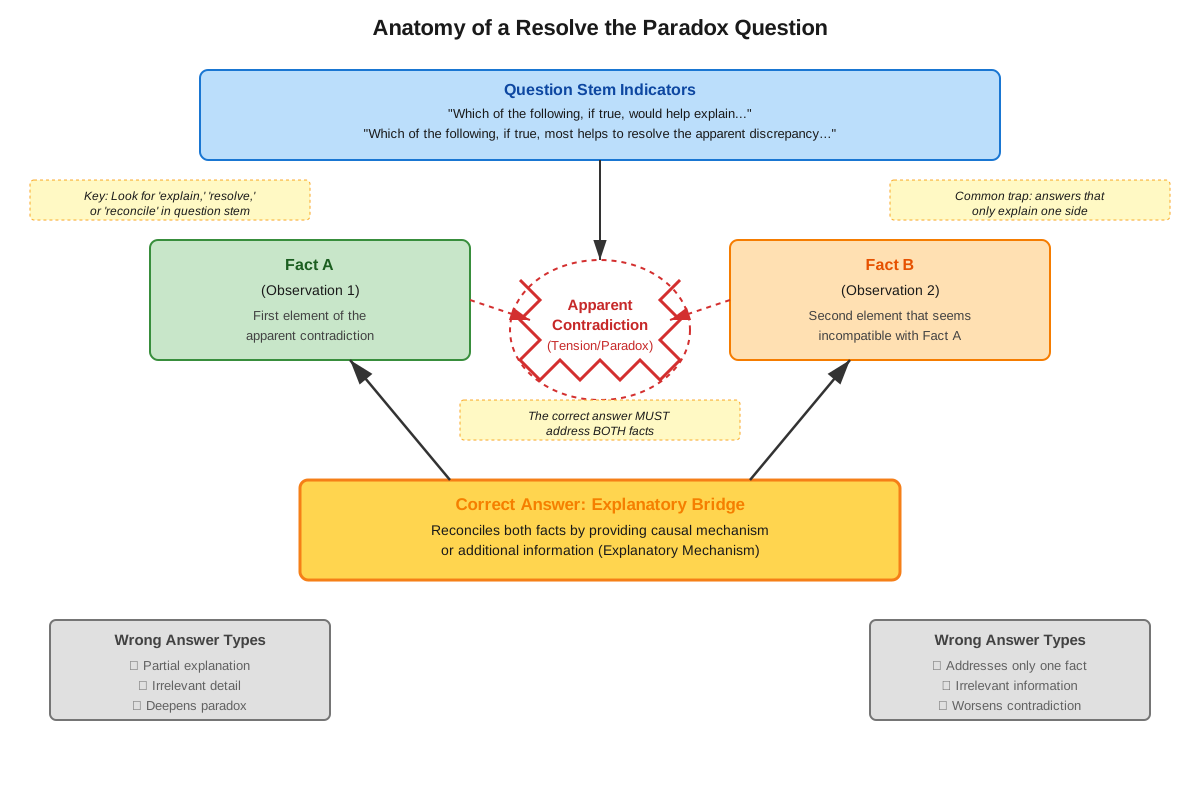
A paradox in LSAT terms is not a true logical impossibility but rather an apparent contradiction—two facts or observations that seem incompatible on their surface but can coexist when properly explained. Every resolve the paradox question contains two essential components: the surprising fact and the baseline expectation. The surprising fact represents an observation or outcome that defies normal expectations, while the baseline expectation reflects what one would typically anticipate given the circumstances.
For example, a stimulus might state: "Restaurant X raised its prices by 20%, yet customer traffic increased by 15%." The baseline expectation (implicit) is that higher prices typically reduce demand. The surprising fact is that traffic increased despite the price increase. The paradox exists in the tension between these two elements. Understanding this structure is crucial because the correct answer must address both components—explaining why the surprising outcome occurred despite the baseline expectation.
Question Stem Identification
LSAT resolve the paradox questions announce themselves through distinctive question stem language. Common phrasings include:
- "Which one of the following, if true, most helps to resolve the apparent paradox?"
- "Which one of the following, if true, most helps to explain the discrepancy described above?"
- "Which one of the following, if true, most helps to reconcile the seemingly contradictory findings?"
- "Which one of the following, if true, contributes most to an explanation of the puzzling facts described above?"
The key linguistic markers include words like "resolve," "explain," "reconcile," "account for," and references to "paradox," "discrepancy," "puzzle," or "surprising" results. Recognizing these stems immediately signals that the task is explanatory rather than evaluative—students should not assess argument strength but rather identify information that makes both facts comprehensible together.
The Mechanism of Resolution
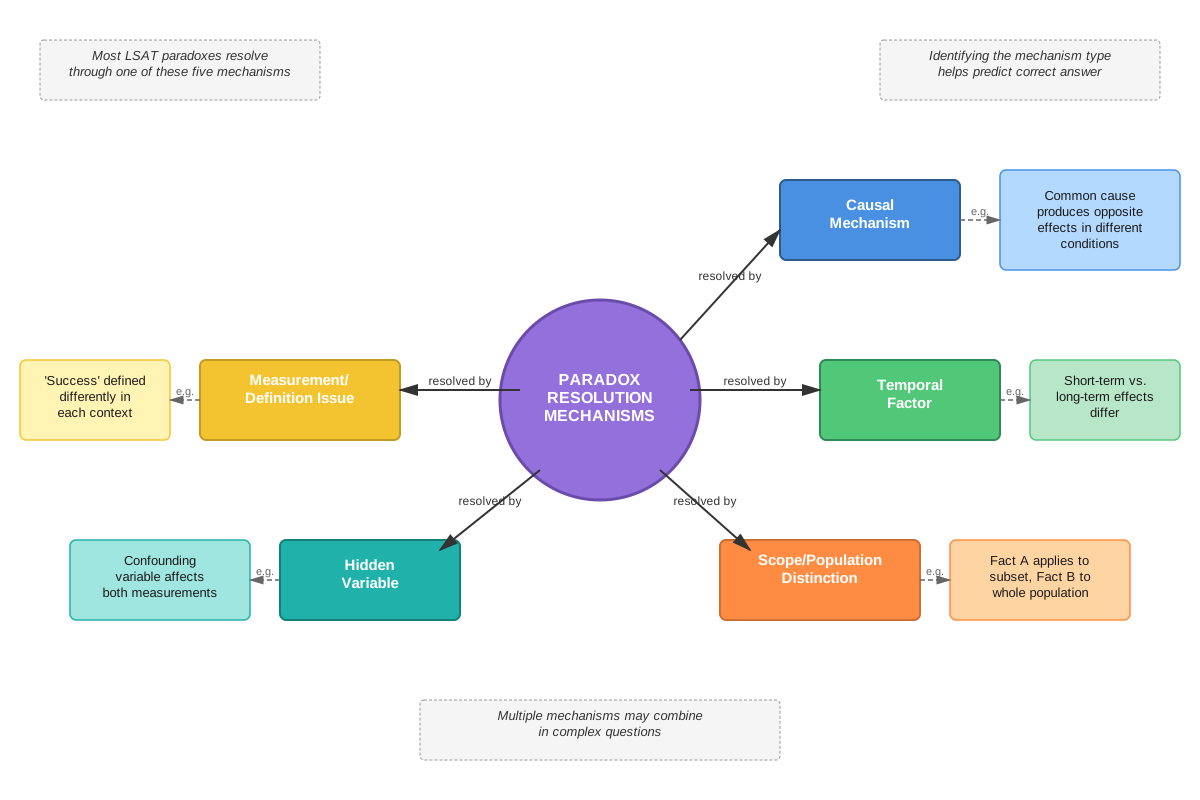
A correct answer to a resolve the paradox question works by introducing new information that provides a causal or contextual framework explaining how both facts can be true. This new information typically operates through one of several mechanisms:
- Distinction-making: Identifying a relevant difference between groups, time periods, or conditions that explains the divergent outcomes
- Hidden variable introduction: Revealing a third factor that influences the relationship between the two observed facts
- Scope clarification: Specifying that the facts apply to different domains, populations, or contexts
- Temporal sequencing: Explaining that the facts occur at different times or that intervening events changed conditions
- Definitional precision: Clarifying that terms are being used in specific ways that eliminate the apparent contradiction
Consider this example: "Company profits increased while employee wages decreased." A resolution might introduce the information that "The company shifted from full-time to contract workers, reducing wage expenses while increasing operational efficiency." This works by introducing a hidden variable (employment structure change) that explains both observations simultaneously.
What Makes an Answer Wrong
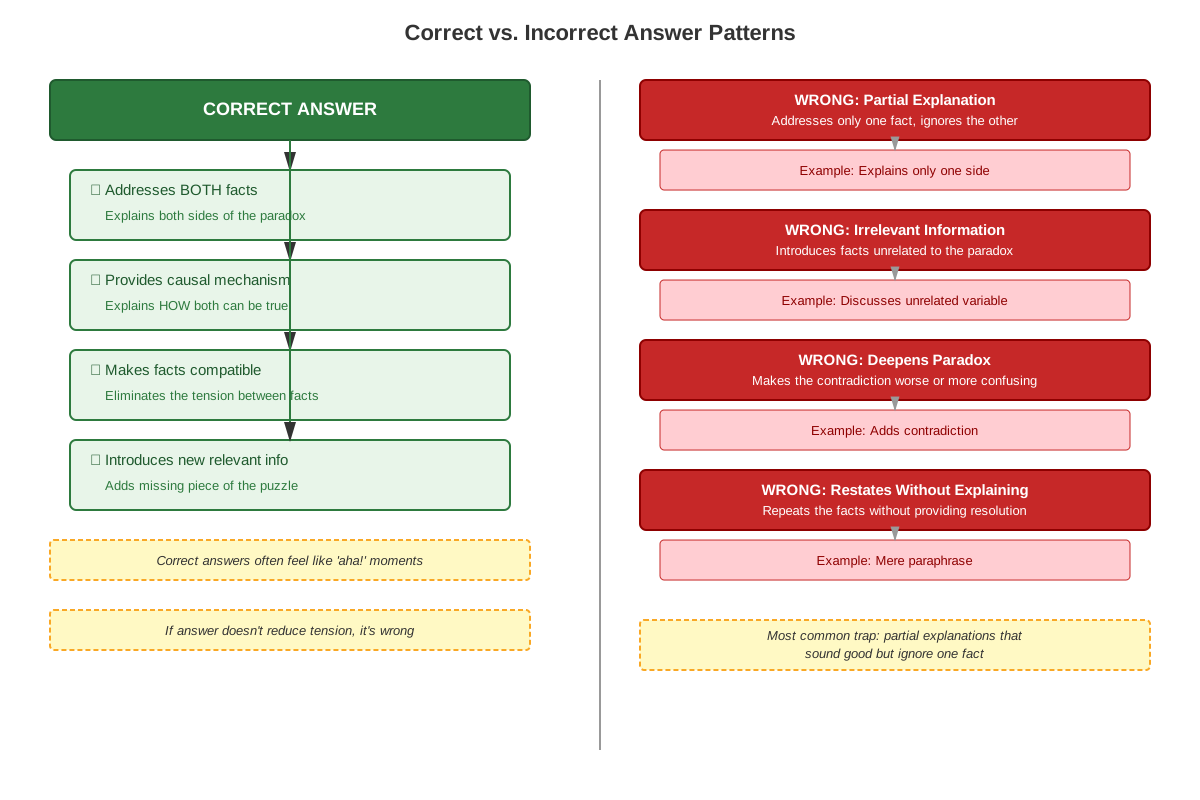
Understanding incorrect answer patterns is as important as recognizing correct ones. Wrong answers in resolve the paradox questions typically fall into these categories:
| Wrong Answer Type | Description | Why It Fails |
|---|---|---|
| One-sided explanation | Addresses only one fact in the paradox | Leaves the contradiction unresolved |
| Irrelevant information | Introduces facts unrelated to the discrepancy | Doesn't bridge the gap between observations |
| Deepens the paradox | Makes the contradiction more puzzling | Moves in the wrong direction |
| Insufficient scope | Explains only a small portion of the phenomenon | Doesn't account for the full magnitude described |
| Temporal mismatch | Refers to wrong time period | Doesn't apply to the facts as presented |
The most common trap is the one-sided explanation. For instance, if the paradox involves "increased exercise but weight gain," an answer stating "The person's exercise routine was very intense" only addresses the exercise component without explaining the weight gain, thus failing to resolve the paradox.
The "Both Facts True" Principle
A fundamental principle underlying all resolve the paradox questions is that both facts presented in the stimulus must be accepted as true. Students should never select an answer that disputes, contradicts, or undermines either component of the paradox. The correct answer assumes both observations are accurate and provides a framework where both can coexist logically.
This principle distinguishes resolve questions from weaken questions. In a weaken question, the goal is to cast doubt on a conclusion or argument. In a resolve question, the goal is to explain how seemingly contradictory facts are actually compatible. This difference in purpose requires a fundamentally different analytical approach and answer evaluation strategy.
Causal Complexity in Explanations
Many resolve the paradox questions involve causation and explanation at their core, requiring students to understand that multiple causal factors can operate simultaneously, that correlation doesn't imply causation, and that causal relationships can be more complex than simple linear models suggest. A robust explanation often reveals that:
- The two facts are caused by a common underlying factor
- One fact is caused by something other than what initially appears responsible
- The relationship between factors is more nuanced than a simple direct correlation
- Intervening variables mediate the relationship between observed phenomena
For example, a paradox stating "Countries with higher chocolate consumption have more Nobel Prize winners" might be resolved by explaining that both factors correlate with national wealth and education investment—a common cause explanation that doesn't require chocolate to cause Nobel Prizes.
Concept Relationships
The concepts within resolve the paradox questions form an interconnected analytical framework. Question stem identification serves as the entry point, triggering activation of the appropriate reasoning mode. This leads directly to paradox anatomy analysis, where students identify the surprising fact and baseline expectation. Understanding these components enables evaluation of answer choices through the mechanism of resolution framework, which itself relies on the "both facts true" principle to guide answer selection. Throughout this process, awareness of wrong answer patterns helps eliminate incorrect options efficiently, while understanding causal complexity enables recognition of sophisticated explanations.
These concepts connect to prerequisite knowledge in important ways. Basic argument structure provides the foundation for identifying the facts that constitute the paradox, even though paradox stimuli don't contain explicit arguments. Causal reasoning fundamentals directly enable understanding of resolution mechanisms, particularly when explanations involve hidden variables or common causes. Conditional reasoning helps evaluate whether proposed explanations are sufficient to account for the observations.
Resolve the paradox questions also connect forward to other Logical Reasoning question types. The skill of identifying hidden assumptions developed through paradox questions transfers directly to assumption questions. The ability to evaluate explanatory power relates closely to strengthen questions, where adding information that explains an argument's reasoning strengthens it. The analytical framework of considering multiple factors simultaneously applies to complex inference questions where multiple facts must be synthesized.
Relationship map: Question Stem Recognition → Paradox Component Identification → Baseline Expectation vs. Surprising Fact → Evaluation of Resolution Mechanisms → Application of "Both Facts True" Principle → Elimination of Wrong Answer Patterns → Selection of Sufficient Explanation
High-Yield Facts
⭐ Resolve the paradox questions require accepting both facts in the stimulus as true; never select an answer that contradicts either component
⭐ The correct answer must address BOTH sides of the paradox, not just explain one fact in isolation
⭐ Common question stem language includes "resolve," "explain," "reconcile," "account for," and references to "paradox," "discrepancy," or "surprising" results
⭐ Wrong answers frequently explain only one side of the discrepancy, leaving the contradiction unresolved
⭐ The correct answer introduces NEW information not present in the stimulus that bridges the gap between contradictory facts
- Resolve the paradox questions typically appear 2-4 times per LSAT administration across both Logical Reasoning sections
- The paradox always consists of a surprising fact that contradicts a baseline expectation (which may be implicit)
- Resolution mechanisms include distinction-making, hidden variable introduction, scope clarification, temporal sequencing, and definitional precision
- Answers that deepen or intensify the paradox are always incorrect
- The correct answer doesn't need to completely eliminate all mystery, only make both facts reasonably compatible
- Causal explanations are the most common resolution mechanism, often involving common causes or intervening variables
- Time pressure makes wrong answer elimination particularly valuable for this question type
- The stimulus never contains an explicit argument with a conclusion to evaluate
- Quantitative paradoxes (involving statistics or numbers) are among the most common formats
- The correct answer must have sufficient scope to explain the magnitude of the phenomenon described
Quick check — test yourself on Resolve the paradox questions so far.
Try Flashcards →Common Misconceptions
Misconception: Resolve the paradox questions ask you to identify which fact is incorrect or mistaken.
Correction: Both facts must be accepted as true. The task is to explain how they can coexist, not to dispute either one. The LSAT explicitly states "if true" in question stems, signaling that all stimulus information should be treated as accurate.
Misconception: An answer that explains the surprising fact is sufficient to resolve the paradox.
Correction: The correct answer must account for both the surprising fact AND why it occurred despite the baseline expectation. One-sided explanations are the most common wrong answer type because they address only half of the discrepancy.
Misconception: The correct answer must completely eliminate all sense of surprise or mystery.
Correction: The correct answer only needs to make both facts reasonably compatible—to show how they can both be true. Some element of the unexpected may remain; the answer doesn't need to make the situation seem completely ordinary or predictable.
Misconception: Resolve the paradox questions are the same as strengthen questions because both add supporting information.
Correction: Strengthen questions add evidence supporting an argument's conclusion, while resolve questions explain how seemingly contradictory facts can coexist. Resolve questions don't contain arguments to strengthen; they present descriptive scenarios to explain.
Misconception: The correct answer will always involve a causal explanation.
Correction: While causal mechanisms are common, correct answers can also work through scope distinctions (the facts apply to different groups), temporal clarifications (the facts occur at different times), or definitional precision (terms are used in specific ways). Not all resolutions require identifying a cause.
Misconception: If an answer choice makes sense and seems relevant, it must be correct.
Correction: An answer must specifically bridge the gap between the two contradictory facts. Many wrong answers introduce plausible-sounding information that's tangentially related but doesn't actually resolve the specific discrepancy presented. Always test whether the answer makes BOTH facts comprehensible together.
Worked Examples
Example 1: The Restaurant Paradox
Stimulus: "A restaurant in a tourist district raised its menu prices by 25% last year. Despite this significant price increase, the restaurant's total revenue from food sales decreased by 10% over the same period. The restaurant's seating capacity remained unchanged, and it maintained the same operating hours."
Question: Which one of the following, if true, most helps to explain the apparent discrepancy?
Answer Choices:
(A) The restaurant's competitors also raised their prices during the same period
(B) Tourist traffic to the district decreased by 40% due to new travel restrictions
(C) The restaurant's food quality remained consistent throughout the year
(D) Menu prices at similar restaurants in other districts remained stable
(E) The restaurant spent more on advertising than in previous years
Analysis:
First, identify the paradox components:
- Surprising fact: Revenue decreased despite price increase
- Baseline expectation: Higher prices should increase revenue (assuming similar sales volume)
- The paradox: How can revenue fall when prices rise?
The correct answer must explain why higher prices didn't translate to higher revenue—specifically, it must account for a decrease in sales volume sufficient to offset the price increase.
Evaluating each choice:
(A) Competitors' prices: This doesn't explain why THIS restaurant lost revenue. If anything, competitors raising prices might make this restaurant more competitive. This is irrelevant information. ❌
(B) Tourist traffic decreased 40%: This directly explains the paradox. If customer traffic dropped by 40%, the restaurant would serve far fewer meals. Even with 25% higher prices per meal, serving 40% fewer customers would result in decreased total revenue. This makes both facts compatible: prices rose (fact 1) but revenue fell because customer volume dropped dramatically (fact 2). ✓
(C) Food quality consistent: This doesn't explain the revenue decrease. Consistent quality wouldn't cause customers to stop coming or revenue to fall. This addresses neither side of the paradox. ❌
(D) Other districts' prices stable: This might explain why customers chose other areas, but it's too indirect and doesn't specifically account for the magnitude of revenue loss described. It's a weak, one-sided explanation. ❌
(E) More advertising spending: Advertising expenses would affect profit, not revenue from food sales. This confuses revenue with profit and doesn't resolve the paradox. ❌
Correct Answer: (B)
This example demonstrates the importance of finding an answer that addresses both components. Choice (B) works because it explains why revenue fell (fewer customers) despite prices rising (the 40% traffic decrease more than offset the 25% price increase). It introduces a new variable (travel restrictions affecting tourist traffic) that makes both facts comprehensible together.
Example 2: The Exercise Paradox
Stimulus: "A study found that people who reported exercising more than five hours per week had higher average body mass index (BMI) measurements than people who reported exercising less than two hours per week. This finding surprised researchers, who expected that increased exercise would correlate with lower BMI."
Question: Which one of the following, if true, most helps to resolve the apparent paradox?
Answer Choices:
(A) BMI is calculated using height and weight measurements
(B) People with higher initial BMI are more likely to begin intensive exercise programs to lose weight
(C) Exercise increases muscle mass, which weighs more than fat
(D) The study participants self-reported their exercise hours without verification
(E) Some forms of exercise burn more calories than others
Analysis:
Identify the paradox:
- Surprising fact: Higher exercise correlates with higher BMI
- Baseline expectation: More exercise should correlate with lower BMI
- The paradox: Why do people who exercise more have higher BMI?
The correct answer must explain this inverse relationship—why the expected negative correlation doesn't appear in the data.
Evaluating each choice:
(A) BMI calculation method: This is definitional information that doesn't explain the unexpected correlation. It's true but irrelevant to resolving why exercise correlates with higher rather than lower BMI. ❌
(B) Higher initial BMI motivates exercise: This resolves the paradox through reverse causation. People don't have higher BMI because they exercise; rather, they exercise because they have higher BMI. The causal arrow points the opposite direction from what was expected. This explains why the high-exercise group has higher BMI—they started with higher BMI, which motivated their exercise. Even if exercise helps, they may still have higher BMI than people who never needed to exercise. ✓
(C) Muscle weighs more than fat: This seems relevant but doesn't fully resolve the paradox. While muscle mass might slightly increase BMI, it wouldn't explain why exercisers have HIGHER BMI than sedentary people—the muscle gain from exercise wouldn't typically exceed the fat loss enough to increase overall BMI beyond sedentary individuals. This is a partial explanation at best. ❌
(D) Self-reporting without verification: This suggests data quality issues but doesn't explain the specific pattern observed. Even if reporting is inaccurate, why would inaccuracy create this particular correlation? This doesn't resolve the paradox. ❌
(E) Different calorie burn rates: This is true but doesn't explain why MORE exercise correlates with HIGHER BMI. If anything, this would suggest variation within exercise groups, not explain the overall pattern. ❌
Correct Answer: (B)
This example illustrates how resolve the paradox questions often involve clarifying causal direction. The expected relationship assumed exercise causes lower BMI, but the correct answer reveals that higher BMI causes more exercise (reverse causation). This makes both facts compatible: people exercise more (fact 1) AND have higher BMI (fact 2) because their higher BMI motivated the exercise behavior. The answer introduces new information about motivation and initial conditions that wasn't in the stimulus but makes the surprising finding comprehensible.
Exam Strategy
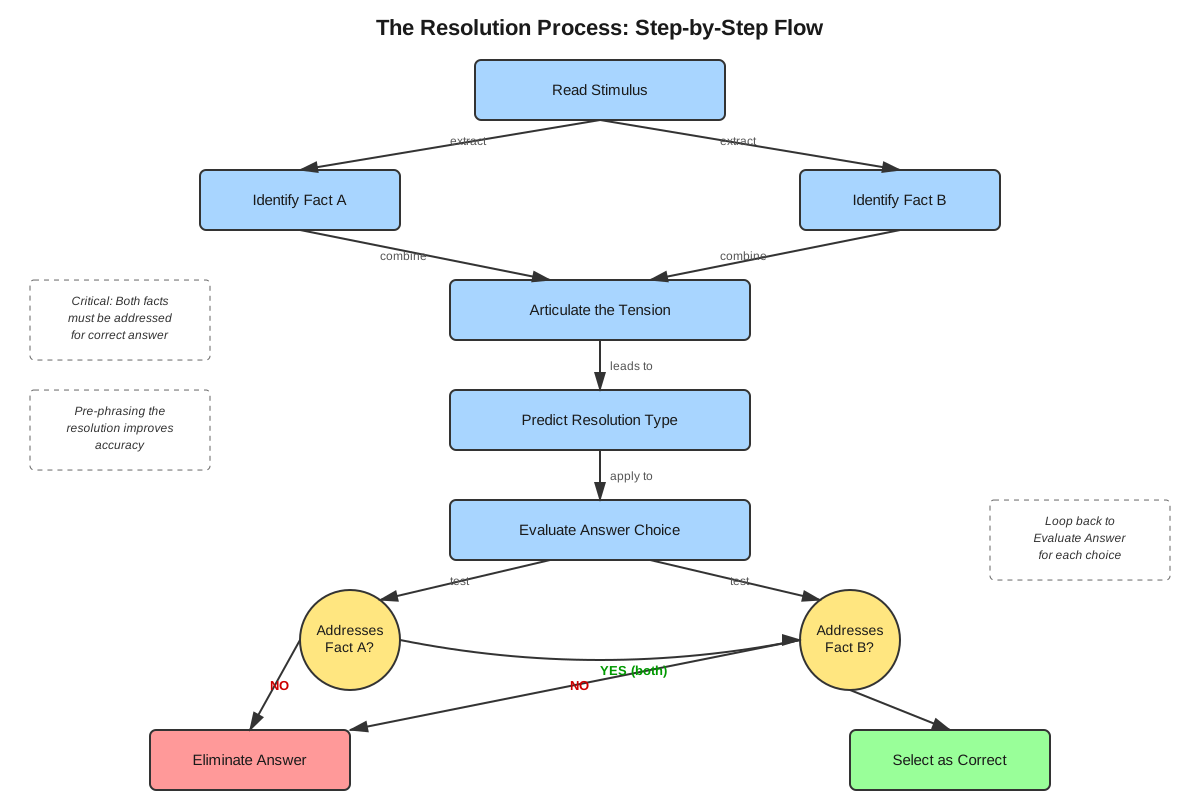
When approaching lsat resolve the paradox questions, employ this systematic process:
Step 1: Identify the question type (5-10 seconds)
Read the question stem first. Look for trigger words: "resolve," "explain," "reconcile," "account for," "paradox," "discrepancy," "surprising." This immediately activates the correct analytical framework.
Step 2: Read the stimulus actively (30-40 seconds)
Identify the two facts that seem contradictory. Often one is explicit and surprising while the other is an implicit baseline expectation. Articulate the paradox to yourself: "How can X be true when Y is also true?" This mental formulation clarifies what needs explaining.
Step 3: Predict the resolution mechanism (10-15 seconds)
Before looking at answers, consider what TYPE of information would resolve this paradox. Does it need a distinction between groups? A hidden variable? A temporal explanation? This prediction helps you recognize the correct answer more quickly.
Step 4: Evaluate answer choices systematically (40-60 seconds)
For each choice, ask: "If this were true, would it make both facts comprehensible together?" Eliminate answers that:
- Address only one side of the paradox
- Introduce irrelevant information
- Contradict either stated fact
- Deepen rather than resolve the contradiction
Step 5: Verify the correct answer (10-15 seconds)
Before selecting, confirm that your chosen answer introduces new information that bridges the gap between both facts. Test it by explaining to yourself how it resolves the specific discrepancy.
Exam Tip: If you're stuck between two answers, identify which one addresses BOTH components of the paradox. The answer that explains only the surprising fact while ignoring the baseline expectation is wrong.
Time allocation: Aim to complete resolve the paradox questions in 1:15-1:30 (75-90 seconds). These questions are typically more straightforward than complex argument-based questions, so spending excessive time suggests you're overthinking. If you exceed 90 seconds, make your best selection and move on.
Trigger phrases to watch for in answer choices:
- "Actually" or "In fact" (often signals a correction or clarification)
- "However" or "But" (may indicate a distinction or exception)
- "Because" or "Due to" (introduces causal explanations)
- "Only" or "Primarily" (scope limitations that may create distinctions)
- Temporal markers like "initially," "previously," "subsequently" (timing explanations)
Process of elimination strategy:
Wrong answers often cluster into types. If you identify one answer as a "one-sided explanation," check whether other answers make the same error. Recognizing patterns accelerates elimination. Similarly, if one answer seems irrelevant, others may share that flaw. Use pattern recognition to eliminate multiple answers quickly.
Memory Techniques
BRIDGE Acronym for what correct answers do:
- Both facts addressed
- Reconciles the discrepancy
- Introduces new information
- Doesn't contradict stimulus
- Genuinely explains the relationship
- Eliminates the contradiction
The "Two-Sided Test": Visualize the paradox as two puzzle pieces that don't seem to fit. The correct answer is the connecting piece that makes them join together. If an answer only touches one piece, it fails the test.
Question Stem Memory Device: "REAP the paradox"
- Resolve
- Explain
- Account for
- Paradox/Puzzle
These four words appear in virtually all resolve the paradox question stems. Seeing any of them should trigger your paradox-resolution analytical mode.
Wrong Answer Mnemonic - "DIOS":
- Deepens the paradox
- Irrelevant information
- One-sided explanation
- Scope insufficient
Visualization Strategy: Picture a seesaw with the two contradictory facts on opposite ends, unbalanced. The correct answer is the fulcrum point that brings them into balance. This image reinforces that both sides must be addressed for resolution to occur.
Summary
Resolve the paradox questions constitute a high-yield question type on the LSAT Logical Reasoning sections, requiring students to identify explanations that reconcile apparently contradictory facts. These questions test the ability to synthesize conflicting information through explanatory frameworks—a core skill in legal reasoning. Success requires recognizing the question type through distinctive stem language, identifying both components of the paradox (the surprising fact and baseline expectation), and selecting answers that introduce new information making both facts comprehensible together. The most common error is selecting one-sided explanations that address only part of the discrepancy. Correct answers typically work through mechanisms including distinction-making, hidden variable introduction, scope clarification, temporal sequencing, or definitional precision. Mastery involves understanding that both stimulus facts must be accepted as true, recognizing wrong answer patterns, and systematically evaluating whether proposed explanations have sufficient scope to account for the observed phenomenon. With consistent practice applying the BRIDGE framework and two-sided test, students can reliably secure points on these questions.
Key Takeaways
- Resolve the paradox questions require explanations that make both contradictory facts compatible, not arguments that dispute either fact
- The correct answer always introduces NEW information not present in the stimulus that bridges the gap between observations
- One-sided explanations—addressing only the surprising fact or only the baseline expectation—are the most common wrong answer type
- Question stems containing "resolve," "explain," "reconcile," or "account for" signal this question type and require explanatory rather than evaluative reasoning
- Both facts in the stimulus must be accepted as true; never select an answer that contradicts either component
- Common resolution mechanisms include hidden variables, distinctions between groups, temporal explanations, and reverse causation
- Systematic evaluation using the "two-sided test" (Does this answer address BOTH facts?) efficiently eliminates wrong answers
Related Topics
Strengthen and Weaken Questions: These question types share the skill of evaluating how new information affects relationships between facts, but differ in purpose—strengthen/weaken questions affect argument validity while resolve questions explain compatibility. Mastering paradox resolution builds the foundation for understanding how additional information changes logical relationships.
Assumption Questions: Identifying assumptions requires recognizing gaps between premises and conclusions, similar to identifying what information would bridge the gap in a paradox. The analytical skill of determining what's missing transfers directly between these question types.
Causal Reasoning Questions: Many paradox resolutions involve clarifying causal relationships, distinguishing correlation from causation, or identifying alternative causes. Deep understanding of causation enhances performance on both question types.
Inference Questions: Complex inference questions often require synthesizing multiple facts that may seem unrelated. The skill of finding connections between disparate information developed through paradox questions applies directly to drawing valid inferences.
Method of Reasoning Questions: Understanding how explanations work—the logical structure of resolution mechanisms—builds analytical skills applicable to identifying and describing reasoning methods in arguments.
Practice CTA
Now that you've mastered the conceptual framework for resolve the paradox questions, it's time to apply these strategies to actual LSAT-style problems. The practice questions and flashcards will reinforce your ability to quickly identify question types, systematically analyze paradoxes, and confidently select correct answers. Remember: these questions are highly learnable through deliberate practice. Each question you work through strengthens your pattern recognition and sharpens your analytical instincts. Approach practice with the same systematic process outlined in the exam strategy section, and you'll see consistent improvement. You've built the foundation—now construct mastery through application!
Sign up free to keep reading
Create a free AnvayaPrep account to finish this LSAT guide on Resolve the paradox questions — plus flashcards and practice questions.