Overview
Conditional statements with only represent one of the most frequently tested patterns in LSAT conditional logic. The word "only" functions as a powerful logical indicator that establishes a necessary condition, and misinterpreting its logical force is one of the most common errors test-takers make on the Logical Reasoning section. Understanding how "only" operates within conditional relationships is essential for correctly diagramming arguments, identifying valid inferences, and eliminating incorrect answer choices across multiple question types including Must Be True, Sufficient Assumption, and Flaw questions.
The challenge with "only" statements lies in their counterintuitive structure. While everyday language might suggest that "only" introduces what comes first or what seems most important, formal logic requires recognizing that "only" always introduces the necessary condition—the consequence that must follow. This reversal from natural language patterns makes "only" statements particularly high-yield for LSAT preparation, as the test consistently exploits this gap between intuitive reading and logical precision.
Within the broader framework of conditional logic, mastering "only" statements builds directly upon understanding basic sufficient and necessary conditions while preparing students for more complex logical structures involving multiple conditional relationships, contrapositive reasoning, and formal logic games. The ability to quickly and accurately translate "only" statements into proper conditional form serves as a foundational skill that supports performance across all three LSAT sections, though it appears most prominently in Logical Reasoning questions.
Learning Objectives
- [ ] Identify how conditional statements with only appears in LSAT questions
- [ ] Explain the reasoning pattern behind conditional statements with only
- [ ] Apply conditional statements with only to solve LSAT-style problems accurately
- [ ] Translate "only" statements into proper conditional notation (sufficient → necessary)
- [ ] Distinguish between "only," "only if," and "the only" constructions
- [ ] Form valid contrapositives of conditional statements containing "only"
- [ ] Recognize and avoid common logical fallacies involving "only" statements
Prerequisites
- Basic conditional logic structure: Understanding the fundamental relationship between sufficient and necessary conditions is essential because "only" statements are a specific type of conditional relationship
- Conditional notation systems: Familiarity with arrow notation (→) or other symbolic representations enables efficient diagramming of "only" statements during timed exam conditions
- Contrapositive formation: Knowledge of how to form valid contrapositives is necessary because "only" statements frequently require contrapositive reasoning to identify correct inferences
- Logical indicators: Recognition of other conditional indicators (if, then, when, unless) provides context for understanding how "only" differs from and relates to other conditional triggers
Why This Topic Matters
In real-world contexts, conditional statements with "only" appear constantly in legal reasoning, policy analysis, and formal argumentation—precisely the skills the LSAT measures for law school readiness. Legal statutes frequently use "only" to establish necessary conditions for rights, obligations, or procedures (e.g., "A contract is valid only if all parties have capacity to consent"). Understanding these logical structures is fundamental to legal interpretation and analysis.
On the LSAT itself, conditional statements with "only" appear with remarkable frequency. Research on recent LSAT administrations suggests that approximately 15-20% of Logical Reasoning questions involve conditional logic, and "only" statements appear in roughly 30-40% of those conditional logic questions. This translates to approximately 3-5 questions per test that directly test understanding of "only" statements, with many additional questions where this knowledge provides strategic advantage.
The topic appears across multiple question types. Must Be True questions frequently present arguments with "only" statements and ask what necessarily follows. Sufficient Assumption questions may require identifying an "only" statement that completes an argument. Flaw questions often hinge on recognizing when an argument illegitimately reverses or confuses the logic of an "only" statement. Parallel Reasoning questions may test whether students can recognize equivalent logical structures across different "only" formulations. Even in Reading Comprehension, authors' arguments may depend on conditional relationships marked by "only," making this knowledge valuable across all LSAT sections.
Core Concepts
The Logical Function of "Only"
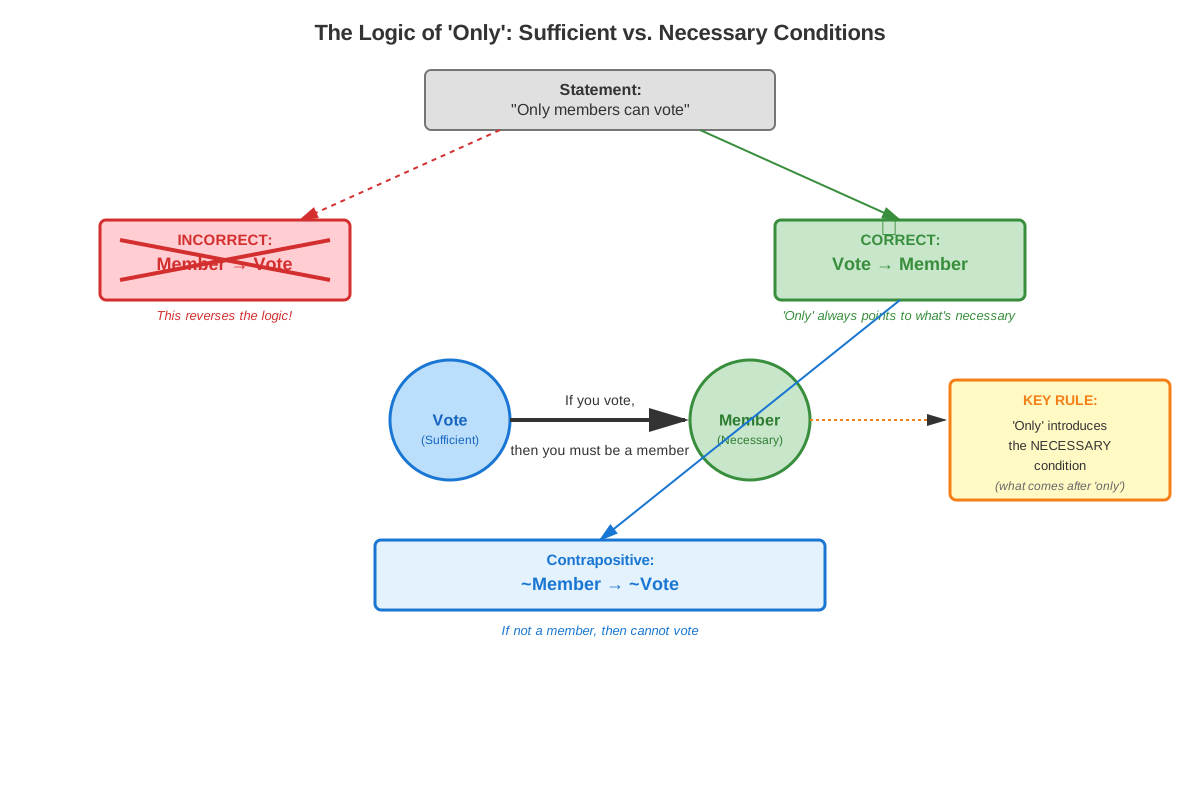
Conditional statements with only establish necessary conditions in logical relationships. The fundamental rule is straightforward but counterintuitive: only introduces the necessary condition, never the sufficient condition. When a statement takes the form "Only A are B" or "A only if B," the element introduced by "only" (or following "only if") is the necessary condition—the consequence that must be true whenever the sufficient condition is met.
Consider the statement: "Only members can vote." This means that being a member is necessary for voting. In conditional notation: Vote → Member. The sufficient condition (voting) guarantees the necessary condition (membership). The contrapositive is equally valid: Not a Member → Not Vote. If someone is not a member, they definitely cannot vote.
The counterintuitive aspect emerges because "only" appears before "members," which might suggest members are the starting point. However, logically, voting is the sufficient condition that triggers the necessary requirement of membership. This reversal from surface grammar to logical structure is precisely what the LSAT tests repeatedly.
Distinguishing "Only" from "Only If"
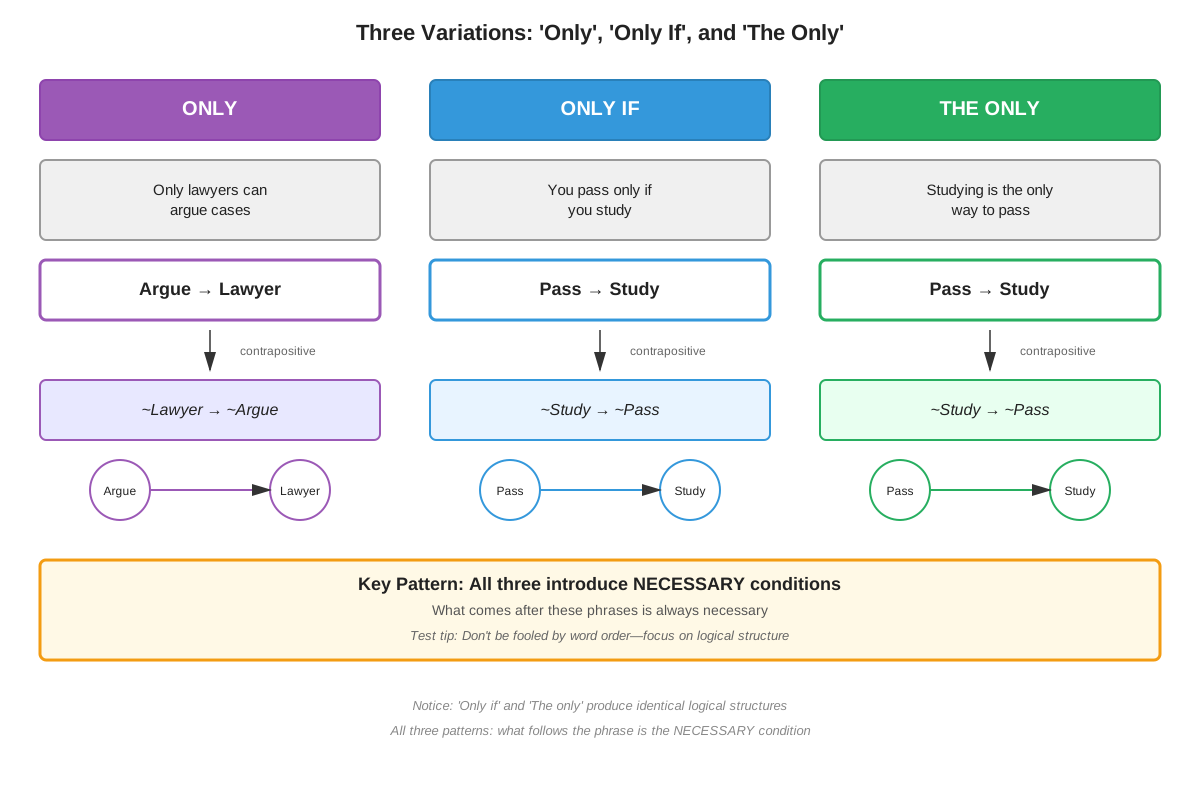
While both "only" and "only if" introduce necessary conditions, their grammatical positions differ, which affects how statements are diagrammed:
| Construction | Example | Sufficient Condition | Necessary Condition | Diagram |
|---|---|---|---|---|
| Only X | Only students attended | Attended | Student | Attended → Student |
| X only if Y | Students attended only if invited | Student attended | Invited | Student attended → Invited |
| The only X | The only way to win is to practice | Win | Practice | Win → Practice |
All three constructions establish the same logical relationship—they identify necessary conditions—but the grammatical structure varies. "Only" typically precedes the necessary condition directly. "Only if" follows the sufficient condition and precedes the necessary condition. "The only" emphasizes exclusivity while still marking a necessary condition.
The "Only" Translation Process
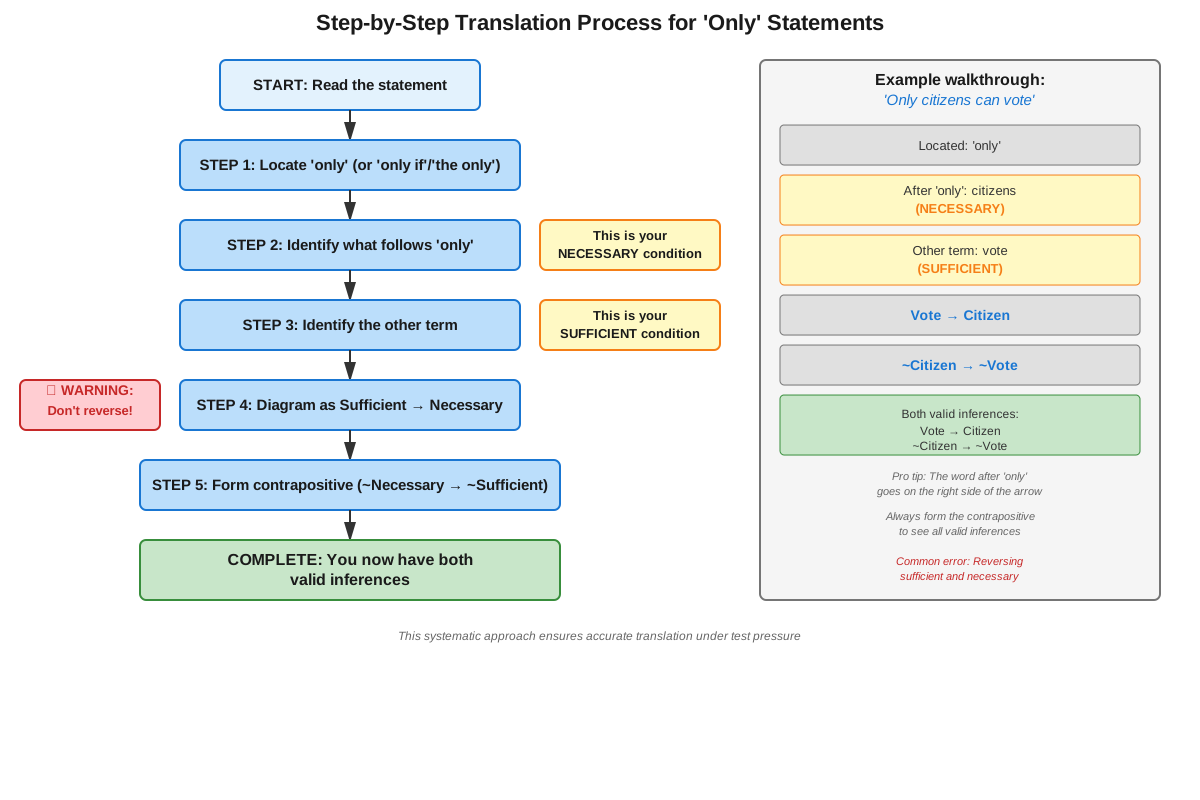
Translating lsat conditional statements with only requires a systematic approach:
- Identify the "only" indicator: Locate "only," "only if," or "the only" in the statement
- Determine what "only" modifies: The term immediately following "only" (or "only if") is the necessary condition
- Identify the other term: The remaining element is the sufficient condition
- Diagram with arrow notation: Place the sufficient condition before the arrow and the necessary condition after it
- Verify with the necessity test: Ask "Is [necessary condition] required for [sufficient condition]?" The answer should be yes
Example: "The museum admits only patrons with tickets."
- Step 1: "Only" is the indicator
- Step 2: "Only" modifies "patrons with tickets" (necessary condition)
- Step 3: "The museum admits" refers to being admitted (sufficient condition)
- Step 4: Admitted → Has Ticket
- Step 5: Is having a ticket required for being admitted? Yes, this confirms the diagram
Multiple "Only" Statements and Chains
Arguments frequently contain multiple conditional statements with "only," creating conditional chains. When properly diagrammed, these chains allow for extended inferences:
Example argument:
- "Only registered voters can serve on juries."
- "Only citizens can register to vote."
Diagram:
- Serve on Jury → Registered Voter
- Registered Voter → Citizen
Chain: Serve on Jury → Registered Voter → Citizen
Valid inference: Serve on Jury → Citizen (If someone serves on a jury, they must be a citizen)
Valid contrapositive: Not Citizen → Not Serve on Jury
Invalid inference: Citizen → Serve on Jury (being a citizen is necessary but not sufficient for jury service)
Common "Only" Variations and Equivalents
The LSAT presents "only" logic through various linguistic formulations, all establishing necessary conditions:
- "None but": "None but experts should attempt this" = Only experts should attempt this = Attempt → Expert
- "No one except": "No one except managers has access" = Only managers have access = Access → Manager
- "No...unless": "No refund unless defective" = Refund only if defective = Refund → Defective
- "Exclusively": "Available exclusively to members" = Only members can access = Access → Member
Recognizing these variations prevents the LSAT from disguising "only" logic through synonym substitution.
The Contrapositive of "Only" Statements
Every conditional statement has a logically equivalent contrapositive formed by negating both conditions and reversing their order. For "only" statements:
Original: Only A are B (B → A)
Contrapositive: Not A → Not B
Example: "Only seniors can take the seminar"
- Original: Take Seminar → Senior
- Contrapositive: Not Senior → Not Take Seminar
The contrapositive is crucial because LSAT questions frequently ask what must be true, and the contrapositive provides an alternative valid inference. Many correct answers rephrase the contrapositive rather than the original statement.
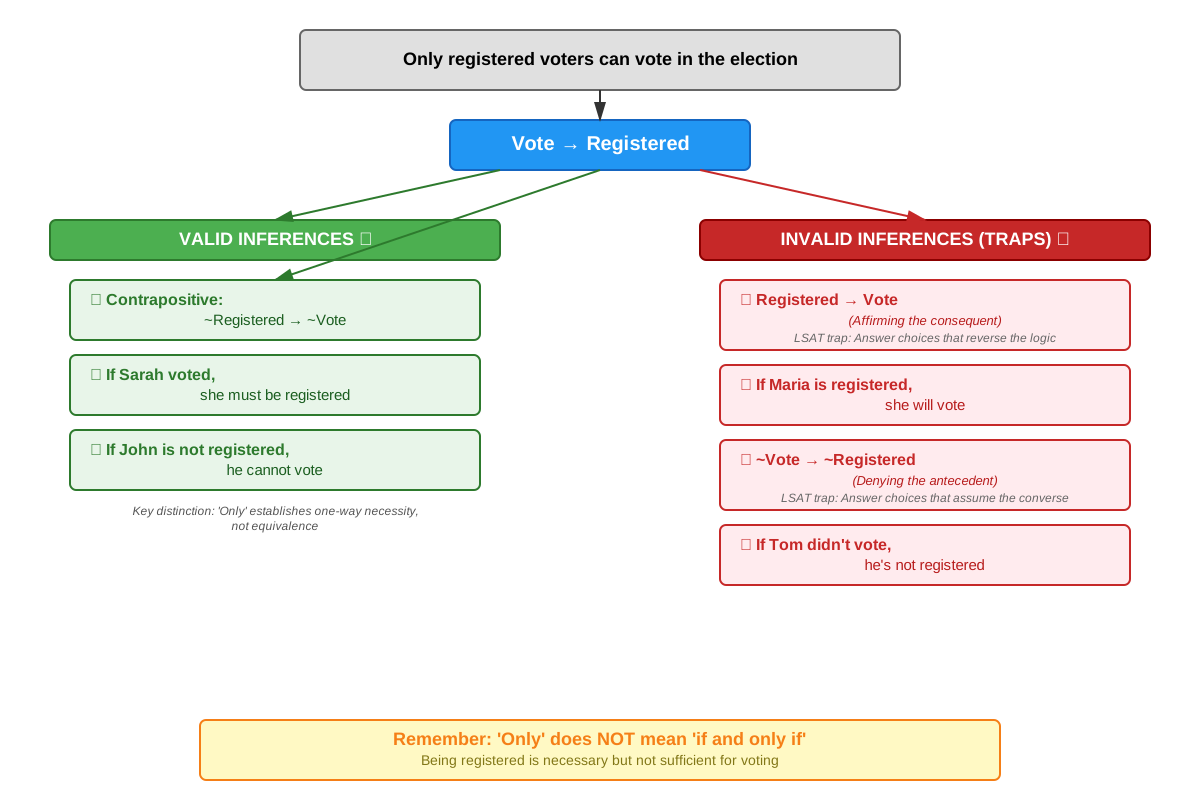
Invalid Inferences from "Only" Statements
Understanding what does NOT follow from "only" statements is as important as understanding what does:
Illegal reversal: From "Only A are B" (B → A), one cannot conclude "Only B are A" (A → B)
Example: "Only mammals nurse their young" (Nurse → Mammal) does NOT mean "Only nursing distinguishes mammals" or "Mammals only nurse" (Mammal → Nurse)
Illegal negation: From "Only A are B" (B → A), one cannot conclude "Only not-A are not-B" (Not B → Not A)
These invalid inference patterns appear frequently in incorrect answer choices, making recognition of these errors essential for process of elimination.
Concept Relationships
The logical structure of "only" statements connects directly to the foundational concept of necessary versus sufficient conditions. Understanding that "only" always marks necessity enables proper diagramming, which in turn enables valid contrapositive formation. The contrapositive relationship creates a bidirectional connection: every "only" statement generates a logically equivalent contrapositive that may be easier to apply in specific contexts.
Within conditional logic more broadly, "only" statements often combine with other conditional indicators to form complex argument structures. An argument might begin with an "if...then" statement establishing one conditional relationship, then add an "only" statement that creates a chain, requiring students to track multiple conditional connections simultaneously.
The relationship map for this topic:
Basic Conditional Logic (Sufficient/Necessary) → "Only" as Necessity Marker → Proper Diagramming → Contrapositive Formation → Valid Inferences → Application to LSAT Questions
Additionally, "only" statements connect to formal logic concepts tested in Logic Games, where rules frequently use "only" to establish necessary conditions for variable placement. The same logical principles apply across sections, making this knowledge transferable and high-yield.
High-Yield Facts
⭐ "Only" always introduces the necessary condition, never the sufficient condition
⭐ "Only if" also introduces the necessary condition: "A only if B" means A → B
⭐ The contrapositive of any "only" statement is always valid and logically equivalent
⭐ "Only A are B" diagrams as B → A (the element after "are" is sufficient)
⭐ Reversing an "only" statement (illegal reversal) is one of the most common logical flaws on the LSAT
- "The only" functions identically to "only" in establishing necessary conditions
- "None but," "no one except," and "exclusively" are logical equivalents of "only"
- Multiple "only" statements can chain together to create extended conditional relationships
- From "Only A are B," you cannot conclude that all A are B (A → B is invalid)
- "Only" statements appear in approximately 30-40% of conditional logic questions on the LSAT
- Recognizing "only" quickly during timed conditions saves valuable seconds per question
- The necessity test ("Is X required for Y?") confirms correct diagramming of "only" statements
Quick check — test yourself on Conditional statements with only so far.
Try Flashcards →Common Misconceptions
Misconception: "Only" introduces the sufficient condition because it comes first in the sentence.
Correction: "Only" always introduces the necessary condition regardless of word order. In "Only members can vote," membership is necessary for voting, so the diagram is Vote → Member, not Member → Vote.
Misconception: "Only A are B" means the same thing as "All A are B."
Correction: These statements have opposite logical structures. "Only A are B" means B → A (if something is B, it must be A). "All A are B" means A → B (if something is A, it must be B). For example, "Only mammals nurse" (Nurse → Mammal) is completely different from "All mammals nurse" (Mammal → Nurse).
Misconception: If "Only A are B" is true, then "Only B are A" must also be true.
Correction: This is the illegal reversal fallacy. The original statement establishes one directional relationship (B → A), but reversing it (A → B) requires separate justification. From "Only citizens can vote" (Vote → Citizen), we cannot conclude "Only voting distinguishes citizens" (Citizen → Vote).
Misconception: "Only if" means the same thing as "if."
Correction: These are opposite logical indicators. "If A then B" means A → B (A is sufficient for B). "A only if B" means A → B (B is necessary for A). While they happen to produce the same diagram, they do so for opposite reasons, and recognizing this distinction prevents confusion in complex statements.
Misconception: The contrapositive of an "only" statement is less reliable than the original statement.
Correction: The contrapositive is logically equivalent to the original statement—it has exactly the same truth value and logical force. If "Only members can vote" (Vote → Member) is true, then "Non-members cannot vote" (Not Member → Not Vote) is equally and necessarily true.
Misconception: "Only" statements tell you what is sufficient for something to occur.
Correction: "Only" statements tell you what is necessary, not what is sufficient. "Only practice leads to improvement" (Improve → Practice) means practice is required for improvement, but it doesn't mean practice alone is enough (sufficient) to guarantee improvement—other factors might also be necessary.
Worked Examples
Example 1: Basic "Only" Statement Analysis
Question: Consider the following statement: "The company hires only candidates with advanced degrees." Which of the following must be true?
(A) All candidates with advanced degrees are hired by the company
(B) If someone is hired by the company, they have an advanced degree
(C) Having an advanced degree is sufficient to be hired by the company
(D) The company does not value work experience
(E) Some people with advanced degrees are not hired by the company
Solution:
Step 1: Identify the conditional structure. "Only" introduces the necessary condition.
Step 2: Diagram the statement. "The company hires only candidates with advanced degrees" means:
- Hired by Company → Has Advanced Degree
Step 3: Form the contrapositive:
- Not Have Advanced Degree → Not Hired by Company
Step 4: Evaluate each answer choice:
(A) "All candidates with advanced degrees are hired" would diagram as: Advanced Degree → Hired. This is the illegal reversal of our statement. The original tells us that having an advanced degree is necessary for being hired, not that it's sufficient. Incorrect.
(B) "If someone is hired by the company, they have an advanced degree" diagrams as: Hired → Advanced Degree. This is exactly what our original statement says. Correct.
(C) "Having an advanced degree is sufficient to be hired" means Advanced Degree → Hired. This is the illegal reversal again. Incorrect.
(D) The statement tells us nothing about what the company values, only about a necessary condition for hiring. Incorrect.
(E) This might be true in reality, but it doesn't must be true based on the statement. The statement doesn't tell us whether all, some, or no people with advanced degrees are hired—only that everyone hired has one. Incorrect.
Answer: (B)
This example demonstrates the core learning objective of applying "only" statements to solve LSAT-style problems by correctly identifying the necessary condition and avoiding the illegal reversal trap.
Example 2: Complex "Only" Chain with Contrapositive
Question: An argument states:
- "Only certified instructors can teach advanced courses."
- "Only those who pass the examination become certified instructors."
- "Maria teaches an advanced course."
Which of the following can be properly concluded?
(A) Maria passed the examination
(B) Everyone who passes the examination teaches advanced courses
(C) Some certified instructors do not teach advanced courses
(D) Maria is the only person who passed the examination
(E) Passing the examination is sufficient to teach advanced courses
Solution:
Step 1: Diagram each statement.
Statement 1: "Only certified instructors can teach advanced courses"
- Teach Advanced → Certified Instructor
Statement 2: "Only those who pass the examination become certified instructors"
- Certified Instructor → Passed Exam
Statement 3: "Maria teaches an advanced course"
- Maria: Teach Advanced (this is a fact, not a conditional)
Step 2: Create the conditional chain.
- Teach Advanced → Certified Instructor → Passed Exam
Step 3: Apply the chain to Maria.
Since Maria teaches an advanced course, and we have the chain Teach Advanced → Certified Instructor → Passed Exam, we can conclude:
- Maria → Certified Instructor (from statement 1)
- Maria → Passed Exam (from the complete chain)
Step 4: Evaluate answer choices.
(A) "Maria passed the examination" follows directly from our chain reasoning. Since Maria teaches an advanced course, and teaching advanced courses requires being a certified instructor, and being a certified instructor requires passing the examination, Maria must have passed the examination. Correct.
(B) This reverses statement 2. Passing the exam is necessary for certification, not sufficient for teaching. Incorrect.
(C) This might be true, but nothing in the statements tells us about certified instructors who don't teach. Incorrect.
(D) Nothing suggests Maria is the only person who passed. Incorrect.
(E) This confuses necessary and sufficient conditions. Passing is necessary (required) but not stated to be sufficient (enough by itself). Incorrect.
Answer: (A)
This example demonstrates how multiple "only" statements chain together and how applying the chain to a specific case (Maria) allows for valid inferences through the entire conditional sequence.
Exam Strategy
When approaching LSAT questions involving conditional statements with only, implement this systematic strategy:
Recognition Phase: Scan the stimulus for "only," "only if," "the only," and equivalent terms ("none but," "exclusively," "no one except"). These are high-priority words that should trigger immediate attention and careful diagramming. Underline or circle these indicators during your first read-through.
Diagramming Phase: Immediately translate "only" statements into conditional notation. Use consistent notation throughout your practice (whether arrows, letters, or other symbols) to build automaticity. Write the diagram in the margin next to the relevant sentence. For "Only A are B," remember the formula: the term after "are/is/can" goes before the arrow (B → A).
Contrapositive Formation: Automatically form the contrapositive of every "only" statement you diagram. Write it directly below the original diagram. Many correct answers rephrase the contrapositive rather than the original statement, so having both versions visible saves time and prevents errors.
Chain Recognition: When multiple conditional statements appear, look for opportunities to chain them. If you have A → B and B → C, immediately note that A → C. These extended inferences are frequently the basis for correct answers in Must Be True questions.
Elimination Strategy: In answer choices, immediately eliminate any option that commits the illegal reversal (reversing the arrow) or illegal negation. These are the most common wrong answer patterns for "only" questions. If the stimulus says "Only A are B" (B → A), any answer suggesting "Only B are A" (A → B) is automatically wrong.
Trigger Phrases in Answer Choices: Watch for answer choices that use different conditional language to express the same relationship. A correct answer might rephrase "Only members can vote" (Vote → Member) as "All voters are members" (Vote → Member) or "No non-members can vote" (Not Member → Not Vote). These are logically equivalent formulations.
Time Management: Conditional logic questions, including those with "only," typically require 60-90 seconds for careful diagramming and analysis. Don't rush the diagramming phase—accurate diagrams make answer choice evaluation much faster. If you diagram correctly, you should be able to eliminate wrong answers in 5-10 seconds each.
Exam Tip: If you're uncertain about your diagram, test it with a concrete example. For "Only seniors can take the seminar," imagine a junior trying to take it—they can't, confirming that Take Seminar → Senior is correct.
Memory Techniques
The "ONLY = NECESSARY" Mnemonic: Create a strong mental association between the word "only" and "necessary condition." Some students find it helpful to mentally replace "only" with "necessarily" when reading. "Only members can vote" becomes "Voters are necessarily members."
The Arrow Flip Visualization: When you see "Only A are B," visualize the sentence structure flipping: the term after "are" (B) jumps to the front of the arrow. Imagine the words physically moving: "Only [A] are [B]" → "[B] → [A]". This kinesthetic visualization helps cement the counterintuitive reversal.
The "COIN" Acronym for Common Errors:
- Contrapositive is valid
- Only marks necessity
- Illegal reversal is wrong
- Negation (illegal) is wrong
The Necessity Test Phrase: Memorize this question format: "Is [term after only] required for [other term]?" If the answer is yes, your diagram is correct. This provides a quick verification method during timed conditions.
The "Only If = Necessary If" Substitution: When you see "only if," mentally substitute "necessary if" to remind yourself of the logical function. "A only if B" becomes "A necessary if B," reinforcing that B is the necessary condition.
Spatial Memory Technique: Always write "only" statements in the same location on your scratch paper (e.g., top left corner) and always write contrapositives directly below originals. This spatial consistency builds automatic pattern recognition and reduces cognitive load during the exam.
Summary
Conditional statements with only represent a critical pattern in LSAT logical reasoning that tests the distinction between necessary and sufficient conditions. The fundamental principle is that "only" always introduces the necessary condition, creating a conditional relationship where the other element serves as the sufficient condition. Proper translation requires recognizing that "Only A are B" diagrams as B → A, with the element following "are" serving as the sufficient condition. This counterintuitive structure—where surface grammar suggests one direction but logical structure requires the reverse—is precisely what makes "only" statements high-yield for LSAT preparation. Mastery requires automatic recognition of "only" and its equivalents ("only if," "the only," "none but"), systematic diagramming, contrapositive formation, and vigilant avoidance of illegal reversals and negations. Success on "only" questions depends on understanding that these statements establish what is required (necessary) rather than what is sufficient, and that the contrapositive provides an equally valid alternative formulation for drawing inferences.
Key Takeaways
- "Only" always marks the necessary condition, never the sufficient condition, regardless of word order in the sentence
- "Only A are B" translates to B → A, with the term after "are/is/can" serving as the sufficient condition
- The contrapositive of every "only" statement is logically equivalent and often appears in correct answer choices
- Illegal reversal (flipping the arrow) is the most common error pattern in wrong answers for "only" questions
- "Only if" functions identically to "only" in establishing necessary conditions: "A only if B" means A → B
- Multiple "only" statements can chain together to create extended conditional relationships that enable distant inferences
- Recognition speed matters: identifying "only" and its equivalents quickly enables efficient diagramming and time management
Related Topics
Sufficient Condition Indicators ("If," "When," "All"): Understanding how sufficient condition indicators contrast with "only" deepens comprehension of conditional logic structure and enables recognition of complex statements combining both types of indicators.
Unless Statements: "Unless" creates conditional relationships similar to "only" but with built-in negation, making it a natural next topic after mastering "only" statements.
Formal Logic in Logic Games: The conditional reasoning skills developed through "only" statements transfer directly to Logic Games rules, where "only" frequently establishes constraints on variable placement.
Necessary vs. Sufficient Assumptions: Question types that ask for necessary or sufficient assumptions build directly on understanding the distinction that "only" statements exemplify, making this topic foundational for assumption question mastery.
Conditional Chains and Complex Arguments: After mastering individual "only" statements, students can progress to arguments involving multiple conditional relationships that require tracking extended chains of inference.
Practice CTA
Now that you've mastered the logical structure of conditional statements with only, it's time to cement your understanding through active practice. Attempt the practice questions associated with this topic, focusing on applying the systematic diagramming process and avoiding illegal reversals. Use the flashcards to build automatic recognition of "only" and its equivalent formulations. Remember that conditional logic skills improve dramatically with deliberate practice—each question you work through strengthens your pattern recognition and increases your speed for test day. The investment you make in mastering "only" statements will pay dividends across multiple question types and sections of the LSAT. You've built the foundation; now apply it with confidence!
Sign up free to keep reading
Create a free AnvayaPrep account to finish this LSAT guide on Conditional statements with only — plus flashcards and practice questions.