Overview
Conclusion completion questions represent one of the most strategic question types in LSAT logical reasoning sections. These questions present an argument with a missing final statement, requiring test-takers to identify which answer choice most logically completes the reasoning pattern established in the premises. Unlike other question types that ask students to critique or strengthen existing arguments, conclusion completion questions demand that students actively construct the logical endpoint of a chain of reasoning.
Mastering conclusion completion is essential for LSAT success because these questions test the fundamental skill of recognizing logical relationships between premises and conclusions—the bedrock of all logical reasoning. These questions typically appear 2-4 times per LSAT administration, making them a high-yield investment of study time. More importantly, the analytical skills developed through practicing conclusion completion transfer directly to other question types, including inference questions, assumption questions, and argument structure questions.
Within the broader framework of evaluate and complete the argument questions, conclusion completion occupies a unique position. While evaluation questions ask students to assess the strength or validity of complete arguments, conclusion completion requires students to understand argument structure so thoroughly that they can predict and identify the precise conclusion that follows from given premises. This skill bridges deductive and inductive reasoning, requiring students to recognize both what must be true and what is most strongly supported by the evidence provided.
Learning Objectives
- [ ] Identify how conclusion completion appears in LSAT questions
- [ ] Explain the reasoning pattern behind conclusion completion
- [ ] Apply conclusion completion to solve LSAT-style problems accurately
- [ ] Distinguish between conclusions that must be true versus conclusions that are strongly supported
- [ ] Recognize common structural patterns in conclusion completion arguments
- [ ] Eliminate answer choices that introduce new information not supported by premises
- [ ] Identify the scope and degree of certainty appropriate for completed conclusions
Prerequisites
- Basic argument structure: Understanding the distinction between premises (evidence) and conclusions (claims supported by evidence) is fundamental, as conclusion completion requires identifying which statement logically follows from given premises.
- Conditional reasoning: Familiarity with "if-then" statements and their logical implications helps recognize when conclusions must follow necessarily from conditional premises.
- Inference skills: The ability to determine what can be validly concluded from given information underlies all conclusion completion questions.
- Scope recognition: Understanding the boundaries of what an argument addresses prevents selecting conclusions that overreach or introduce irrelevant information.
Why This Topic Matters
In legal practice, attorneys must constantly construct logical arguments from evidence, determining what conclusions can legitimately be drawn from available facts. Law school itself demands this skill daily, as students analyze cases and construct arguments from precedents and principles. LSAT conclusion completion questions directly assess this real-world legal reasoning ability, making them among the most practically relevant question types on the exam.
From an exam perspective, conclusion completion questions appear with notable frequency—typically 2-4 questions per Logical Reasoning section, translating to 4-8 questions across a full LSAT administration. These questions carry the same weight as all other Logical Reasoning questions, making them worth approximately 15-20% of the total Logical Reasoning score. Given their predictable structure and teachable patterns, conclusion completion questions offer excellent return on study investment.
These questions commonly appear in several formats: arguments about causal relationships requiring causal conclusions, comparative arguments requiring comparative conclusions, conditional chains requiring conclusions about what must or might be true, and evidence-based arguments requiring conclusions about what is most strongly supported. The LSAT frequently tests whether students can match the logical force of premises (distinguishing "must be true" from "likely" or "possible") and maintain consistent scope between premises and conclusion.
Core Concepts
The Structure of Conclusion Completion Questions
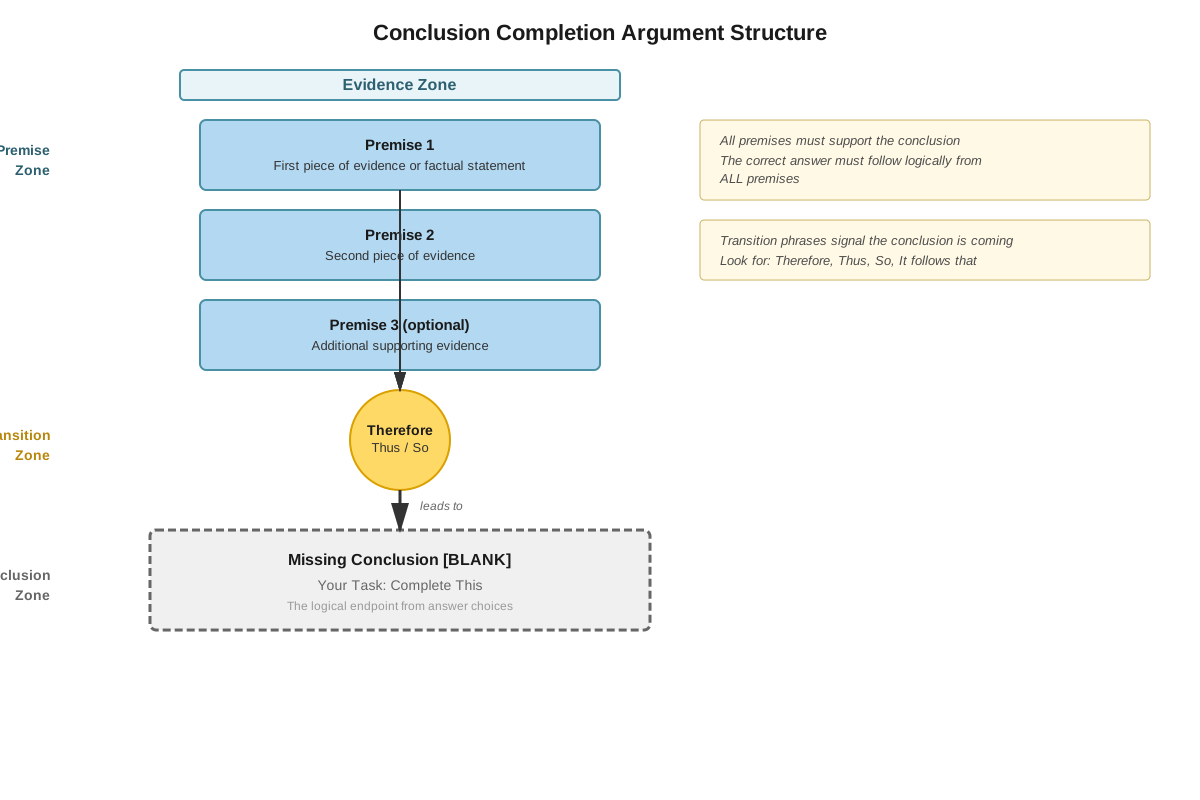
Conclusion completion questions present an incomplete argument followed by a question stem that explicitly indicates the missing element is the conclusion. Common question stems include: "Which one of the following most logically completes the argument?" or "The argument's conclusion is most strongly supported if which one of the following completes the passage?" The argument itself typically contains 2-5 premises establishing facts, relationships, or principles, followed by a conclusion indicator word (therefore, thus, so, consequently) and a blank or incomplete final statement.
The key structural feature distinguishing these questions is that the premises are complete and the conclusion is missing, creating a forward-moving logical task. Students must project forward from evidence to conclusion, rather than working backward from conclusion to support (as in assumption questions) or sideways to evaluate (as in strengthen/weaken questions).
Logical Force and Scope Matching
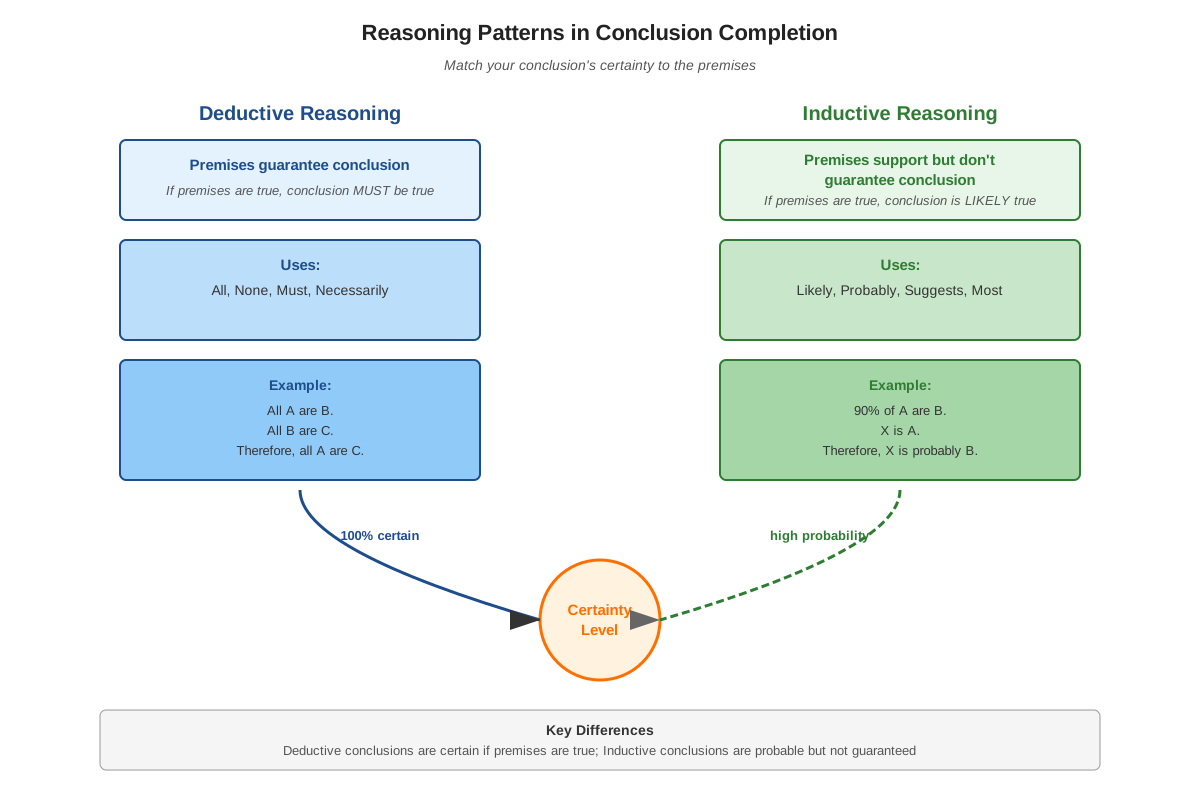
The most critical concept in conclusion completion is matching the logical force of the conclusion to the premises. Logical force refers to the degree of certainty or strength with which a conclusion follows from premises. This operates on a spectrum:
| Logical Force Level | Indicator Words | When Appropriate |
|---|---|---|
| Necessary certainty | must, cannot, definitely, always | Premises establish deductive relationships or universal rules |
| Strong probability | probably, likely, most, generally | Premises provide strong inductive evidence |
| Possibility | may, might, could, possibly | Premises suggest but don't firmly establish |
| Comparison | more/less than, -er than | Premises compare two or more things |
A common error is selecting a conclusion with stronger logical force than the premises support. If premises state "Most lawyers enjoy research" and "Sarah is a lawyer," the conclusion "Sarah enjoys research" is too strong—it should be "Sarah probably enjoys research" or "Sarah is likely to enjoy research."
Scope matching is equally crucial. The conclusion's scope must align with the premises' scope. If premises discuss "some European countries," the conclusion cannot legitimately address "all countries" or "Europe as a whole." Scope dimensions include:
- Quantitative scope: all, most, some, few, none
- Temporal scope: always, usually, sometimes, never; past, present, future
- Subject scope: the specific entities, categories, or concepts discussed
- Conditional scope: what happens under specified conditions versus generally
Common Reasoning Patterns
Certain reasoning patterns appear repeatedly in LSAT conclusion completion questions:
Causal Reasoning Pattern: Premises establish that X causes Y or that X and Y are correlated, leading to conclusions about causal relationships, predictions, or explanations. Example structure: "Studies show increased exercise correlates with improved mood. Regular exercise increases endorphin production. Therefore, _____." The conclusion should connect exercise, endorphins, and mood causally.
Conditional Chain Pattern: Premises present conditional statements (if-then relationships) that can be chained together, leading to conclusions about what must, might, or cannot be true. Example: "If the law passes, taxes will increase. If taxes increase, consumer spending will decrease. Therefore, _____." The conclusion should complete the chain: if the law passes, consumer spending will decrease.
Comparative Pattern: Premises compare two or more things on various dimensions, leading to conclusions about relative rankings, superiority, or relationships. Example: "Product A costs more than Product B. Product B has more features than Product A. Therefore, _____." The conclusion should address the relationship between cost and features.
Evidence-to-Explanation Pattern: Premises present observations or data requiring explanation, leading to conclusions that provide the most logical explanation. Example: "Sales increased after the advertising campaign. No other marketing changes occurred. Therefore, _____." The conclusion should attribute sales increase to advertising.
The Role of Intermediate Conclusions
Some conclusion completion arguments contain intermediate conclusions—statements that function as both conclusions (supported by some premises) and premises (supporting the final conclusion). Recognizing these is crucial because the final conclusion must follow from both the basic premises and any intermediate conclusions. The logical chain might look like: Premise 1 + Premise 2 → Intermediate Conclusion + Premise 3 → Final Conclusion.
Necessary versus Sufficient Conclusions
Understanding the distinction between necessary and sufficient conditions helps identify appropriate conclusions. A necessary condition must be present for something to occur (but doesn't guarantee it will occur). A sufficient condition guarantees something will occur (but isn't required for it to occur). Premises about necessary conditions support conclusions about what's required; premises about sufficient conditions support conclusions about what's guaranteed.
Concept Relationships
The concepts within conclusion completion form an integrated logical framework. Logical force matching and scope matching work together as dual constraints on valid conclusions—both must be satisfied simultaneously. A conclusion might have appropriate scope but excessive logical force (or vice versa), making it incorrect.
Reasoning patterns (causal, conditional, comparative, explanatory) determine which type of scope and logical force are appropriate. Conditional reasoning patterns typically support conclusions with necessary certainty ("must be true"), while causal patterns typically support conclusions with strong probability ("likely" or "probably"). Comparative patterns require conclusions that maintain the comparative relationship established in premises.
Intermediate conclusions connect to the concept of argument structure from prerequisite knowledge. Recognizing intermediate conclusions requires understanding that arguments can have multiple layers, with some statements serving dual roles. This connects forward to more complex argument structure questions.
The relationship map flows as follows:
Premises → Determine reasoning pattern → Pattern constrains appropriate logical force → Scope of premises constrains scope of conclusion → Logical force + Scope matching → Correct conclusion
This framework connects backward to prerequisite topics like basic argument structure (understanding premises and conclusions) and conditional reasoning (recognizing if-then relationships). It connects forward to related topics like inference questions (which also require determining what follows from premises) and assumption questions (which require understanding what's needed to complete an argument's logic).
High-Yield Facts
⭐ Conclusion completion questions always provide complete premises and require identifying the missing conclusion, not missing premises or assumptions.
⭐ The correct answer must match both the logical force (degree of certainty) and scope (breadth of subject matter) of the premises.
⭐ Answer choices that introduce entirely new concepts not mentioned or implied in the premises are almost always incorrect.
⭐ Conditional reasoning premises (if-then statements) typically support conclusions with necessary certainty (must/cannot), while causal or correlational premises support probabilistic conclusions (likely/probably).
⭐ The conclusion must follow from the premises as written; students should not add outside knowledge or assumptions.
- Conclusion indicator words (therefore, thus, so, consequently, hence) signal where the missing conclusion belongs in the argument structure.
- Comparative premises require comparative conclusions that maintain the same relationship structure (if A > B and B > C, then A > C).
- Quantifier matching is crucial: "all" in premises can support "all" in conclusions, but "some" in premises cannot support "all" in conclusions.
- Temporal consistency matters: premises about the past cannot directly support conclusions about the future without additional bridging logic.
- The correct answer often paraphrases or combines elements from multiple premises rather than simply restating one premise.
- Extreme language in answer choices (always, never, only, all, none) requires extremely strong premises to be justified.
- When premises establish a problem or puzzle, the conclusion often provides the explanation or solution.
- Intermediate conclusions within the argument must be incorporated into the logical chain leading to the final conclusion.
Quick check — test yourself on Conclusion completion so far.
Try Flashcards →Common Misconceptions
Misconception: Any statement that could be true based on the premises is a valid conclusion.
Correction: The conclusion must be the statement most strongly supported by or most logically following from the premises. Many statements might be possibly true without being the logical endpoint of the argument's reasoning.
Misconception: The longest or most complex answer choice is usually correct because it seems more sophisticated.
Correction: Correct conclusions are often straightforward and directly follow from premises. Complexity or length doesn't indicate correctness; logical connection does. Overly complex answers often introduce unsupported new information.
Misconception: If an answer choice is factually true in the real world, it's the correct conclusion.
Correction: Conclusion completion tests logical reasoning, not outside knowledge. The correct answer must follow from the given premises, regardless of real-world truth. Students must ignore outside knowledge and work only with provided information.
Misconception: The conclusion should always be stronger or more definitive than the premises.
Correction: The conclusion's strength must match the premises' strength. If premises are tentative or probabilistic, the conclusion should be similarly qualified. Overreaching beyond premise strength is a common trap.
Misconception: All premises must be used in reaching the conclusion.
Correction: While typically all premises contribute to the conclusion, some arguments include background information or context that doesn't directly support the conclusion. The conclusion must be supported by the premises, but not every premise must be essential.
Misconception: Conclusion completion questions are just like inference questions.
Correction: While both require determining what follows from premises, conclusion completion questions specifically ask for the endpoint of a particular argument's reasoning chain, often signaled by conclusion indicators. Inference questions ask what can be concluded generally, without necessarily completing a specific argument structure.
Misconception: The correct answer will always use the same terminology as the premises.
Correction: Correct conclusions often paraphrase or synthesize premise concepts using different but equivalent language. Exact terminology matching can actually be a trap, as incorrect answers sometimes repeat premise language without logical connection.
Worked Examples
Example 1: Causal Reasoning Pattern
Argument: "Recent studies have shown that cities with more green spaces have lower rates of respiratory illness among residents. City planners in Riverside have proposed converting several vacant lots into parks and community gardens. Air quality measurements in Riverside currently show elevated levels of particulate matter. Therefore, _____."
Analysis Process:
Step 1 - Identify the reasoning pattern: This is a causal/correlational pattern. The premises establish a relationship between green spaces and respiratory health, then present Riverside's situation.
Step 2 - Map the premises:
- Premise 1: More green spaces → lower respiratory illness (correlation/causal)
- Premise 2: Riverside plans to add green spaces (parks/gardens)
- Premise 3: Riverside has poor air quality (context suggesting respiratory illness risk)
Step 3 - Determine appropriate logical force: The first premise shows correlation, not proven causation ("studies have shown"), so the conclusion should be probabilistic (likely/probably), not certain (must/will definitely).
Step 4 - Determine appropriate scope: The conclusion should address Riverside specifically (not cities generally) and respiratory health (the outcome mentioned in the correlation).
Step 5 - Predict the conclusion: "The park conversion will likely reduce respiratory illness rates in Riverside" or "Riverside residents will probably experience improved respiratory health."
Step 6 - Evaluate answer choices:
- (A) "Riverside will have the lowest respiratory illness rates in the region" - TOO STRONG (nothing compares Riverside to other cities) and WRONG SCOPE
- (B) "The proposed parks will likely improve respiratory health among Riverside residents" - CORRECT (matches logical force and scope)
- (C) "All cities should convert vacant lots to green spaces" - WRONG SCOPE (too broad, introduces "all cities")
- (D) "Green spaces directly cause reduced respiratory illness" - TOO STRONG (premises show correlation, not proven causation)
- (E) "Air quality in Riverside must improve" - TOO STRONG (uses "must" when "likely" is appropriate)
Correct Answer: (B) - It maintains probabilistic logical force ("likely"), appropriate scope (Riverside residents, respiratory health), and follows logically from the causal pattern established.
Example 2: Conditional Chain Pattern
Argument: "If the proposed legislation passes, all manufacturers will be required to reduce emissions by 30%. If manufacturers reduce emissions by 30%, they will need to invest in new filtration technology. Companies that invest in new filtration technology typically pass costs to consumers through price increases. Therefore, _____."
Analysis Process:
Step 1 - Identify the reasoning pattern: This is a conditional chain pattern with clear if-then relationships.
Step 2 - Map the conditional chain:
- If legislation passes → manufacturers must reduce emissions 30%
- If reduce emissions 30% → must invest in filtration technology
- If invest in filtration technology → typically pass costs to consumers
Step 3 - Chain the conditionals: If legislation passes → manufacturers reduce emissions → invest in technology → pass costs to consumers
Step 4 - Determine appropriate logical force: The first two conditionals use "will" and "need to" (strong necessity), but the third uses "typically" (high probability, not certainty). The conclusion's strength is limited by the weakest link, so it should be probabilistic.
Step 5 - Determine appropriate scope: The conclusion should address what happens if the legislation passes (the initial condition) and should end with the final consequence (consumer prices).
Step 6 - Predict the conclusion: "If the legislation passes, consumer prices will likely increase" or "The legislation will probably result in higher consumer prices."
Step 7 - Evaluate answer choices:
- (A) "The legislation should not pass" - WRONG TYPE (normative judgment, not logical conclusion from descriptive premises)
- (B) "If the legislation passes, consumer prices will likely increase" - CORRECT (completes the conditional chain with appropriate logical force)
- (C) "Manufacturers will definitely raise prices" - TOO STRONG (ignores "typically" qualifier in third premise)
- (D) "New filtration technology is expensive" - UNSUPPORTED (not stated or implied in premises)
- (E) "All companies pass costs to consumers" - TOO STRONG and WRONG SCOPE (premises say "typically," not "all")
Correct Answer: (B) - It correctly completes the conditional chain from initial condition to final consequence while maintaining the probabilistic force required by "typically."
Exam Strategy
When approaching LSAT conclusion completion questions, follow this systematic process:
Step 1 - Identify the question type: Look for stems containing "most logically completes," "conclusion is most strongly supported if which one of the following completes," or similar language. Note where the blank or incomplete statement appears.
Step 2 - Read actively for structure: As you read the argument, identify:
- Each distinct premise
- The reasoning pattern (causal, conditional, comparative, explanatory)
- Conclusion indicator words (therefore, thus, so, hence)
- The scope and logical force of each premise
Step 3 - Predict before looking at answers: Based on the premises and reasoning pattern, formulate your own conclusion. This prediction doesn't need to be perfectly worded, but should capture the logical endpoint. Ask yourself: "What must or probably follows from these premises?"
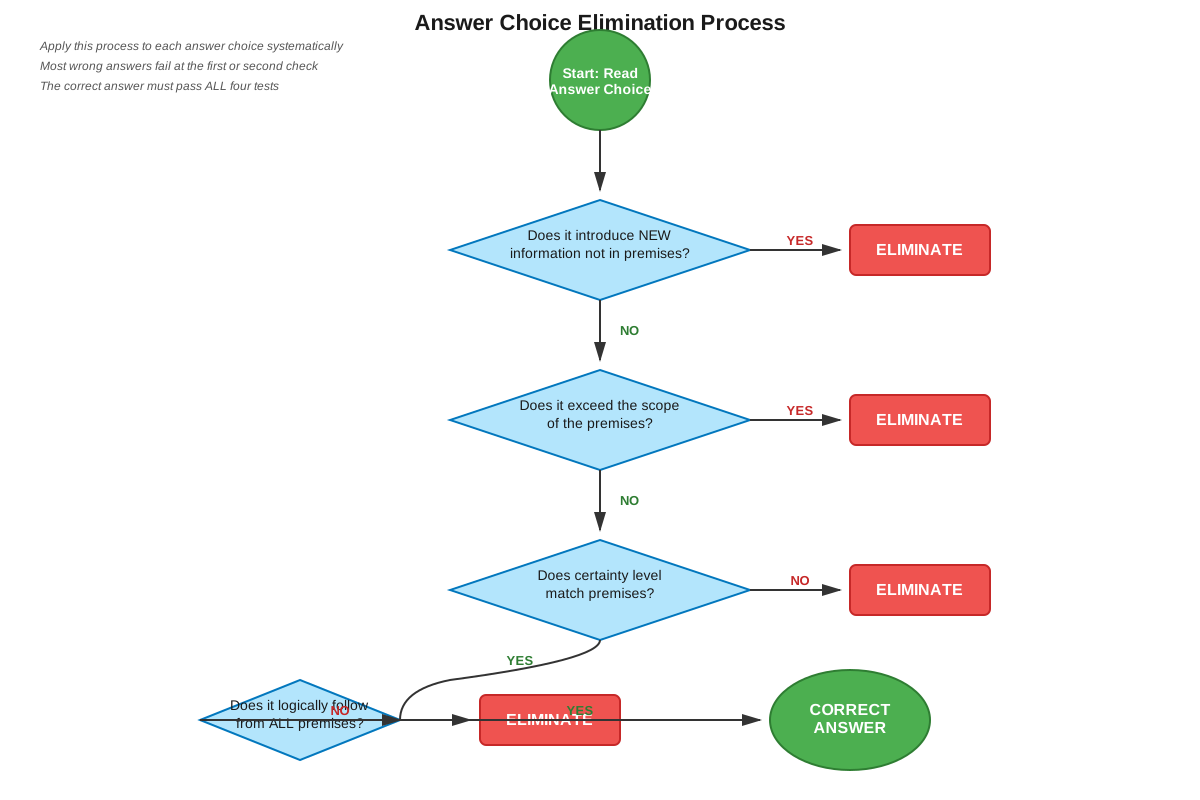
Step 4 - Match logical force and scope: Before evaluating specific content, eliminate answers that:
- Use stronger certainty than premises support (must/will when should be likely/probably)
- Use weaker certainty than premises support (might/could when premises establish must/will)
- Expand scope beyond premises (all when premises say some; future when premises address present)
- Narrow scope inappropriately
Step 5 - Check for new information: Eliminate answers introducing concepts not mentioned or clearly implied in premises. Every term in the conclusion should connect to premise content.
Step 6 - Verify logical connection: The correct answer should feel like the natural endpoint of the argument's reasoning. If you have to add assumptions or make logical leaps, the answer is likely wrong.
Exam Tip: Trigger words to watch for include conclusion indicators (therefore, thus, so, consequently, hence, accordingly) and logical force qualifiers (must, likely, probably, might, could, always, never, typically, generally).
Time allocation: Spend approximately 1:15-1:30 on conclusion completion questions. They typically require less time than assumption or flaw questions because the logical task is more straightforward—you're building forward from complete premises rather than analyzing complex argument weaknesses.
Process of elimination strategy:
- First pass: Eliminate answers with scope problems or inappropriate logical force (often 2-3 answers)
- Second pass: Eliminate answers introducing unsupported new information (often 1-2 more answers)
- Final evaluation: Choose between remaining answers based on which most directly and completely follows from premises
Memory Techniques
FORCE mnemonic for checking logical force:
- Full certainty (must, cannot, always) - requires deductive or universal premises
- Ordinary probability (likely, probably) - requires strong inductive evidence
- Reasonable possibility (might, could) - requires suggestive but not conclusive evidence
- Comparative relationships (more than, less than) - requires comparative premises
- Exact matching - conclusion force must match premise force
SCOPE acronym for checking scope:
- Subject matter - same topics as premises
- Category breadth - all/most/some must match
- Outside information - none allowed
- Premise connection - every conclusion term links to premises
- Expansion check - no broadening beyond premise boundaries
Visualization technique: Picture the argument as a bridge. The premises are the foundation and support structure (complete and solid). The conclusion is the final span that must connect logically to the supports. If the conclusion "span" doesn't align with the "supports" (premises), the bridge fails. This helps visualize whether a conclusion logically follows.
The "Therefore Test": When evaluating answer choices, insert "therefore" before each option and read the complete argument aloud (mentally). The correct answer should sound like a natural, logical continuation. Awkward or forced-sounding completions are likely incorrect.
Summary
Conclusion completion questions test the fundamental logical reasoning skill of determining what follows from given premises. Success requires matching both the logical force (degree of certainty) and scope (breadth of subject matter) of the conclusion to the premises provided. The correct answer must follow logically from the premises without introducing unsupported new information or requiring outside knowledge. Common reasoning patterns include causal relationships, conditional chains, comparative structures, and evidence-to-explanation arguments, each requiring different types of conclusions. Students should identify the reasoning pattern, map the logical relationships between premises, predict an appropriate conclusion, and then systematically eliminate answer choices that mismatch force or scope, introduce new concepts, or fail to complete the argument's logical chain. These questions appear regularly on the LSAT (2-4 per section) and offer excellent return on study investment because their structure is predictable and their skills transfer to other question types.
Key Takeaways
- Conclusion completion requires forward-moving logic from complete premises to missing conclusion, distinguishing it from assumption or evaluation questions
- The correct answer must match both logical force (certainty level) and scope (subject breadth) to the premises
- Common reasoning patterns (causal, conditional, comparative, explanatory) determine what type of conclusion is appropriate
- Answer choices introducing concepts not mentioned or implied in premises are almost always incorrect
- Conditional premises typically support necessary conclusions (must/cannot), while causal premises support probabilistic conclusions (likely/probably)
- Predicting the conclusion before reviewing answer choices significantly improves accuracy and efficiency
- Systematic elimination based on force, scope, and new information typically narrows choices to one or two viable options
Related Topics
Inference Questions: While conclusion completion asks for the endpoint of a specific argument, inference questions ask what can be concluded from a set of statements without necessarily completing a structured argument. Mastering conclusion completion provides the logical foundation for inference questions.
Assumption Questions: These require identifying unstated premises needed for a conclusion to follow. Understanding conclusion completion helps recognize what makes conclusions follow logically, which illuminates what's missing when they don't.
Argument Structure Questions: These ask about the role statements play in arguments. Recognizing how premises support conclusions in completion questions builds the structural awareness needed for these questions.
Parallel Reasoning Questions: These require matching argument structures. Understanding reasoning patterns in conclusion completion (causal, conditional, comparative) directly transfers to identifying parallel structures.
Strengthen and Weaken Questions: These require understanding what would make conclusions more or less likely to follow from premises. Mastering what makes conclusions follow logically (through completion questions) provides the foundation for manipulating argument strength.
Practice CTA
Now that you've mastered the core concepts of conclusion completion, it's time to apply these skills to actual LSAT-style questions. The practice questions and flashcards will reinforce your ability to identify reasoning patterns, match logical force and scope, and systematically eliminate incorrect answers. Remember: conclusion completion questions offer some of the highest return on practice investment because their patterns are predictable and learnable. Each practice question you complete strengthens your logical reasoning foundation for the entire LSAT. Approach practice strategically, reviewing not just which answer is correct but why the incorrect answers fail—this builds the elimination skills that save time on test day. You've got this!
Sign up free to keep reading
Create a free AnvayaPrep account to finish this LSAT guide on Conclusion completion — plus flashcards and practice questions.