Overview
Evaluating causal arguments represents one of the most frequently tested reasoning patterns on the LSAT Logical Reasoning section. This topic requires students to analyze arguments that claim one event or factor causes another, then determine what additional information would help assess the strength of that causal claim. Unlike questions that ask students to strengthen or weaken an argument directly, evaluation questions demand identification of the precise information gap that, once filled, would allow proper judgment of the argument's validity.
The LSAT tests causal reasoning extensively because legal thinking constantly involves assessing cause-and-effect relationships: Did the defendant's actions cause the plaintiff's injury? Did a policy change cause crime rates to shift? Lawyers must identify what evidence would be most relevant to establishing or refuting causal connections. On the exam, these questions typically present a correlation or observed pattern, conclude that one factor caused another, and then ask what information would be most useful in evaluating whether that causal conclusion is justified.
Within the broader Logical Reasoning framework, lsat evaluating causal arguments connects directly to assumption identification, strengthening/weakening questions, and flaw recognition. All these question types require understanding how causal claims can go wrong—through alternative explanations, reversed causation, or mere coincidence. Mastering the evaluate and complete the argument question type for causal reasoning builds the analytical foundation needed for multiple question formats, making this a high-leverage topic for score improvement.
Learning Objectives
- [ ] Identify how Evaluating causal arguments appears in LSAT questions
- [ ] Explain the reasoning pattern behind Evaluating causal arguments
- [ ] Apply Evaluating causal arguments to solve LSAT-style problems accurately
- [ ] Distinguish between causal claims and mere correlations in argument structures
- [ ] Generate the most relevant evaluative questions for any given causal argument
- [ ] Recognize the five major causal reasoning flaws that evaluation questions target
- [ ] Predict answer choices by identifying information gaps in causal reasoning
Prerequisites
- Basic argument structure: Understanding premises, conclusions, and how evidence supports claims is essential because causal arguments follow standard argument patterns with specific vulnerabilities.
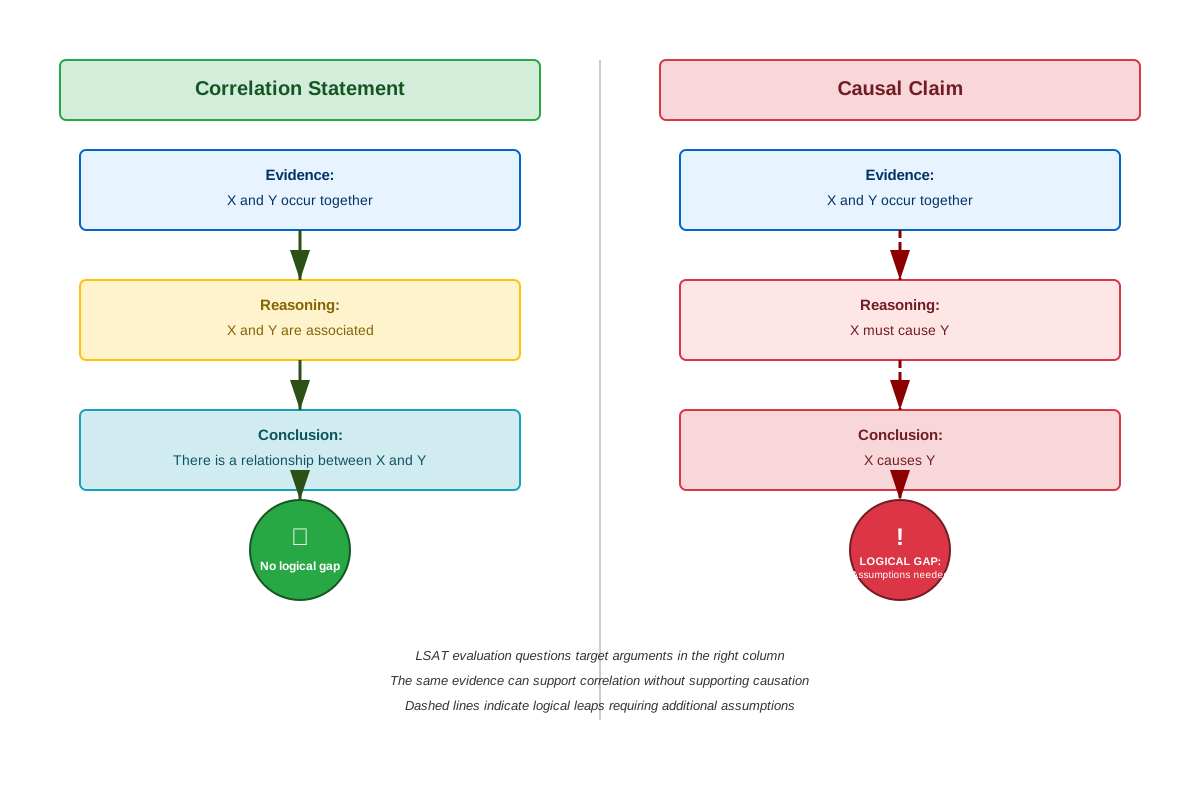
- Correlation versus causation: Recognizing that two events occurring together doesn't prove one caused the other provides the foundation for identifying what additional information matters.
- Necessary and sufficient conditions: Causal claims often confuse these logical relationships, so distinguishing them helps identify evaluation criteria.
- Alternative explanations: The ability to generate competing hypotheses for observed phenomena directly informs what questions would help evaluate causal claims.
Why This Topic Matters
In legal practice, establishing causation determines liability, damages, and policy effectiveness. Attorneys must constantly evaluate whether sufficient evidence exists to prove causal connections or whether alternative explanations remain viable. This real-world application makes causal reasoning central to legal education and LSAT testing.
On the LSAT, evaluation questions appear in approximately 10-15% of Logical Reasoning questions, with causal arguments representing roughly 40% of those evaluation questions. This translates to 2-4 questions per exam specifically testing the ability to evaluate causal claims. Additionally, understanding causal reasoning strengthens performance on strengthen/weaken questions (another 25% of Logical Reasoning), assumption questions (20%), and flaw questions (15%), making this topic's impact far broader than its direct question count suggests.
These questions typically appear in several formats: "Which of the following would be most useful to know in evaluating the argument?", "The answer to which of the following questions would be most relevant to assessing the conclusion?", or "Which of the following would it be most important to investigate?" The arguments present observed correlations in contexts ranging from business decisions to scientific studies to policy analyses, then conclude causal relationships that require evaluation.
Core Concepts
The Structure of Causal Arguments
A causal argument claims that one phenomenon (the cause) produces, brings about, or is responsible for another phenomenon (the effect). On the LSAT, these arguments typically follow a predictable structure:
- Observation of correlation: Two events or factors occur together or in sequence
- Causal conclusion: The argument asserts that one caused the other
- Implicit assumption: No alternative explanation better accounts for the correlation
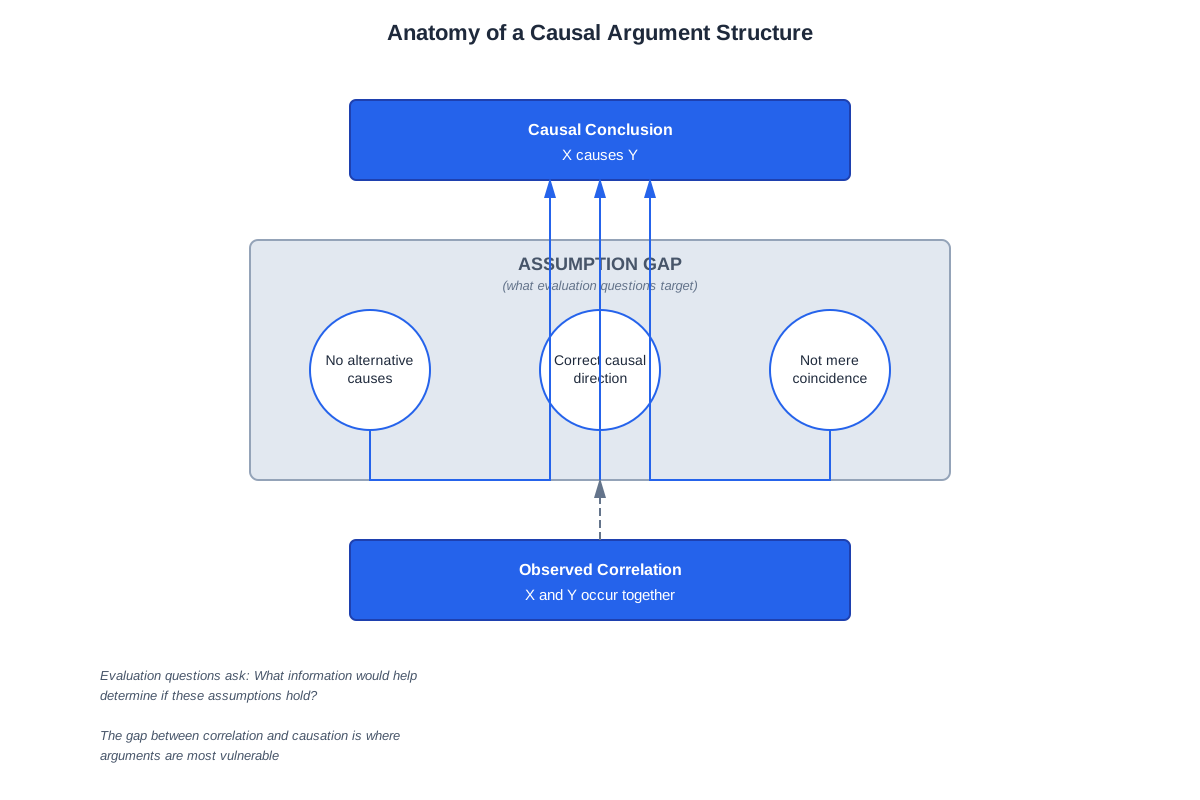
The fundamental vulnerability in causal reasoning stems from the logical gap between observing that X and Y occur together and concluding that X causes Y. Multiple alternative relationships could explain the correlation: Y might cause X (reverse causation), Z might cause both X and Y (common cause), or the correlation might be coincidental.
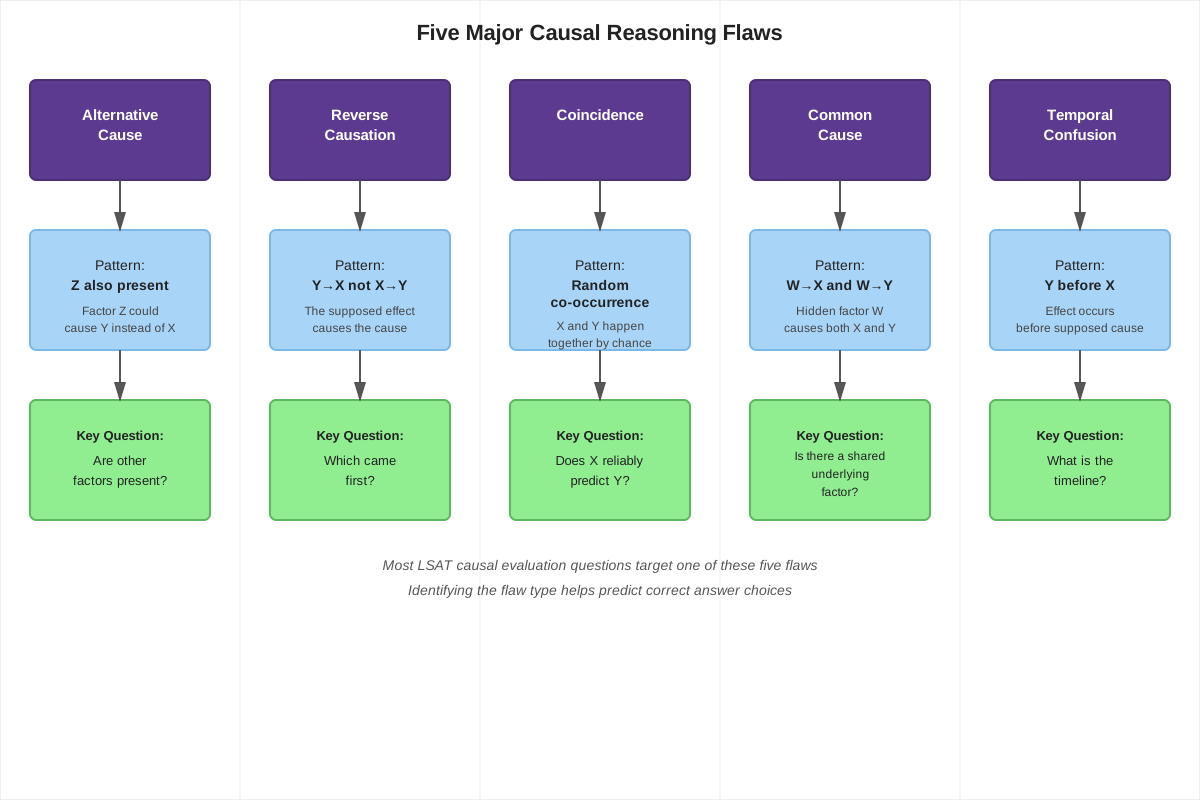
The Five Major Causal Reasoning Flaws
Understanding these five categories helps predict what information would be most valuable for evaluation:
| Flaw Type | Description | Evaluation Focus |
|---|---|---|
| Reverse Causation | Assumes X causes Y when Y actually causes X | Does the effect actually precede the cause? |
| Common Cause | Overlooks a third factor causing both observed phenomena | Could another factor explain both observations? |
| Coincidence | Mistakes random correlation for causal connection | Is the correlation statistically significant and consistent? |
| Confounding Variables | Fails to control for other factors that might explain the effect | Are other relevant factors held constant? |
| Insufficient Sample | Generalizes from unrepresentative or limited observations | Is the sample size adequate and representative? |
Identifying Information Gaps
When evaluating causal arguments, the most useful information directly addresses whether alternative explanations remain viable. The correct answer to an evaluation question will be information that, depending on whether the answer is "yes" or "no," would significantly strengthen or weaken the causal claim.
This creates a practical test: For any answer choice, ask "If the answer to this question were YES, would it affect the argument's strength? If the answer were NO, would it affect the argument differently?" If both answers impact the argument's validity in opposite directions, that information is relevant to evaluation.
The Temporal Sequence Requirement
Causes must precede effects. Many LSAT causal arguments present correlations without establishing temporal order. Information about timing—whether the alleged cause actually occurred before the alleged effect—becomes crucial for evaluation. Arguments that observe simultaneous phenomena are particularly vulnerable to reverse causation concerns.
The Alternative Explanation Test
The strongest causal arguments eliminate plausible alternative explanations. Evaluation questions often test whether students recognize what alternatives remain unaddressed. When analyzing a causal argument, systematically consider:
- Could the effect cause the supposed cause instead?
- Could both be effects of an unmentioned common cause?
- Are there other factors present that might produce the observed effect?
- Has the arguer confused correlation with causation?
Control and Comparison Groups
Scientific and policy arguments often claim causation based on observed changes. Strong causal reasoning requires appropriate comparison: What would have happened without the alleged cause? Information about control groups, baseline conditions, or comparison populations helps evaluate whether the observed effect genuinely resulted from the proposed cause or would have occurred anyway.
Mechanism and Plausibility
While not always necessary for causal claims, information about the mechanism through which X causes Y can be relevant to evaluation. If no plausible mechanism exists, or if the proposed mechanism is contradicted by other evidence, the causal claim weakens. Conversely, evidence of a clear causal pathway strengthens the argument.
Concept Relationships
The core concepts in evaluating causal arguments form an interconnected diagnostic framework. The structure of causal arguments provides the foundation, revealing the logical gap between correlation and causation. This gap creates vulnerability to the five major causal reasoning flaws, each representing a different way the causal inference might fail.
Identifying information gaps applies these flaw categories to specific arguments, determining which vulnerability is most relevant to the particular causal claim being made. This process depends on the temporal sequence requirement (ruling out reverse causation), the alternative explanation test (addressing common causes and confounding variables), and consideration of control and comparison groups (eliminating coincidence and establishing the effect's dependence on the cause).
The relationship flows: Argument Structure → Flaw Categories → Information Gap Identification → Evaluation Criteria
This framework connects to prerequisite knowledge of correlation versus causation (which explains why the gap exists) and alternative explanations (which populate the flaw categories). It also connects forward to strengthen/weaken questions (which provide specific information rather than asking what information would be useful) and assumption questions (which identify what must be true for the causal reasoning to work).
High-Yield Facts
⭐ Correlation does not establish causation—the most fundamental principle underlying all causal evaluation questions.
⭐ The correct answer to an evaluation question must matter regardless of whether the answer is "yes" or "no"—both possible answers should impact the argument's strength in opposite directions.
⭐ Temporal precedence is necessary for causation—causes must occur before their effects, making timing information highly relevant.
⭐ Alternative explanations are the primary threat to causal arguments—information that rules out or confirms alternatives is typically most valuable.
⭐ Reverse causation is one of the most common causal reasoning flaws on the LSAT—always consider whether the alleged effect might actually cause the alleged cause.
- Information about sample size and representativeness helps evaluate whether observed correlations are reliable or coincidental.
- Control groups and baseline comparisons are essential for determining whether an observed change resulted from the proposed cause.
- Common cause scenarios (where factor Z causes both X and Y) explain correlations without direct causal connections between X and Y.
- The strength of a causal argument depends on how thoroughly it eliminates alternative explanations, not just on the strength of the correlation.
- Confounding variables—factors that correlate with both the proposed cause and the observed effect—can create spurious causal appearances.
- Mechanism information (how X causes Y) is relevant when its presence or absence affects the plausibility of the causal claim.
- Statistical significance differs from practical significance; even strong correlations might not indicate meaningful causal relationships.
Quick check — test yourself on Evaluating causal arguments so far.
Try Flashcards →Common Misconceptions
Misconception: Strong correlation proves causation if the correlation is consistent and statistically significant.
Correction: Even perfect correlation doesn't establish causation. Two variables might correlate perfectly because both are caused by a third factor, or because one is calculated from the other, without any direct causal relationship. Evaluation requires information about alternative explanations, not just correlation strength.
Misconception: The correct answer to an evaluation question will always weaken the argument.
Correction: Evaluation questions ask what information would be most useful to know, not what would weaken the argument. The correct answer identifies information that could strengthen OR weaken the argument depending on what that information reveals. Both "yes" and "no" answers to the evaluation question should matter.
Misconception: If the cause occurred before the effect, the temporal sequence proves causation.
Correction: Temporal precedence is necessary but not sufficient for causation. Many events precede other events without causing them. Evaluation still requires information about whether alternative explanations exist, whether the correlation is consistent, and whether appropriate controls were used.
Misconception: Information about the mechanism of causation is always relevant to evaluating causal arguments.
Correction: Mechanism information is only relevant when its presence or absence affects the argument's plausibility. Many causal relationships are well-established without complete understanding of mechanisms. The LSAT tests whether students can identify the most relevant information gap, which often concerns alternative explanations rather than mechanisms.
Misconception: Evaluation questions are just weaken questions phrased differently.
Correction: Weaken questions provide information and ask whether it weakens the argument. Evaluation questions ask what information would be most useful to obtain. The correct answer to an evaluation question identifies a genuine information gap whose resolution matters to the argument's validity, while weaken question answers provide specific information that undermines the conclusion.
Misconception: Larger sample sizes automatically make causal arguments stronger.
Correction: Sample size matters for reliability, but unrepresentative samples remain problematic regardless of size. Information about sample representativeness and whether appropriate controls were used is often more relevant than sample size alone. A small, well-controlled study can provide better causal evidence than a large, confounded observational study.
Worked Examples
Example 1: Business Decision Causal Argument
Argument: "Sales of Product X increased by 30% in the month following the launch of our new advertising campaign. Therefore, the advertising campaign caused the increase in sales."
Question: Which of the following would be most useful to know in evaluating the argument?
Analysis Process:
- Identify the causal claim: The argument concludes that the advertising campaign caused the sales increase.
- Identify the evidence: Sales increased after the campaign launched (temporal correlation).
- Identify potential flaws:
- Alternative causes: Could something else have caused increased sales?
- Coincidence: Would sales have increased anyway?
- Confounding variables: Were other factors present?
- Generate evaluation questions:
- Did competitors' products become unavailable during this period?
- Did Product X's price decrease when the campaign launched?
- What were Product X's sales trends in previous months?
- Did similar products without advertising campaigns also see sales increases?
- Apply the "yes/no" test: The most useful information would significantly impact the argument regardless of the answer.
Best evaluation question: "Whether sales of similar products that were not advertised also increased by similar amounts during the same period."
Why this is correct: If YES (other products also increased), this suggests a common cause (perhaps seasonal demand, economic conditions, or industry trends) rather than the advertising campaign specifically causing Product X's increase. If NO (other products didn't increase), this strengthens the claim that the advertising campaign specifically caused Product X's sales increase. Both answers matter significantly.
Why other options fail:
- "Whether the advertising campaign was expensive" → Cost doesn't affect whether it caused sales increases
- "Whether customers liked the advertisements" → Liking ads doesn't establish they caused purchases
- "Whether Product X is high quality" → Quality doesn't explain the timing of the increase
Example 2: Policy Evaluation Argument
Argument: "After the city implemented a new traffic light timing system, average commute times decreased by 15%. The new timing system must have caused the reduction in commute times."
Question: The answer to which of the following questions would be most relevant to assessing the conclusion?
Analysis Process:
- Identify the causal structure: New timing system (cause) → reduced commute times (effect)
- Check temporal sequence: The timing system was implemented before commute times decreased (sequence is correct)
- Consider alternative explanations:
- Common cause: Did something else change that affected both timing and commutes?
- Confounding variables: What else changed when the timing system was implemented?
- Coincidence: Would commute times have decreased anyway?
- Reverse causation: Less applicable here (reduced commutes couldn't cause timing changes)
- Identify the information gap: The argument assumes no other factors explain the reduction.
- Evaluate answer choices using the bidirectional impact test:
Best evaluation question: "Whether the city's population decreased significantly during the same period."
Why this is correct: If YES (population decreased), this provides an alternative explanation for reduced commute times—fewer drivers rather than better timing. If NO (population remained stable or increased), this eliminates a major alternative explanation and strengthens the causal claim. The information matters crucially in both directions.
Connection to learning objectives: This example demonstrates how to identify information gaps (Objective 5), recognize alternative explanation flaws (Objective 6), and apply evaluation reasoning to LSAT-style problems (Objective 3).
Exam Strategy
Approaching Evaluation Questions
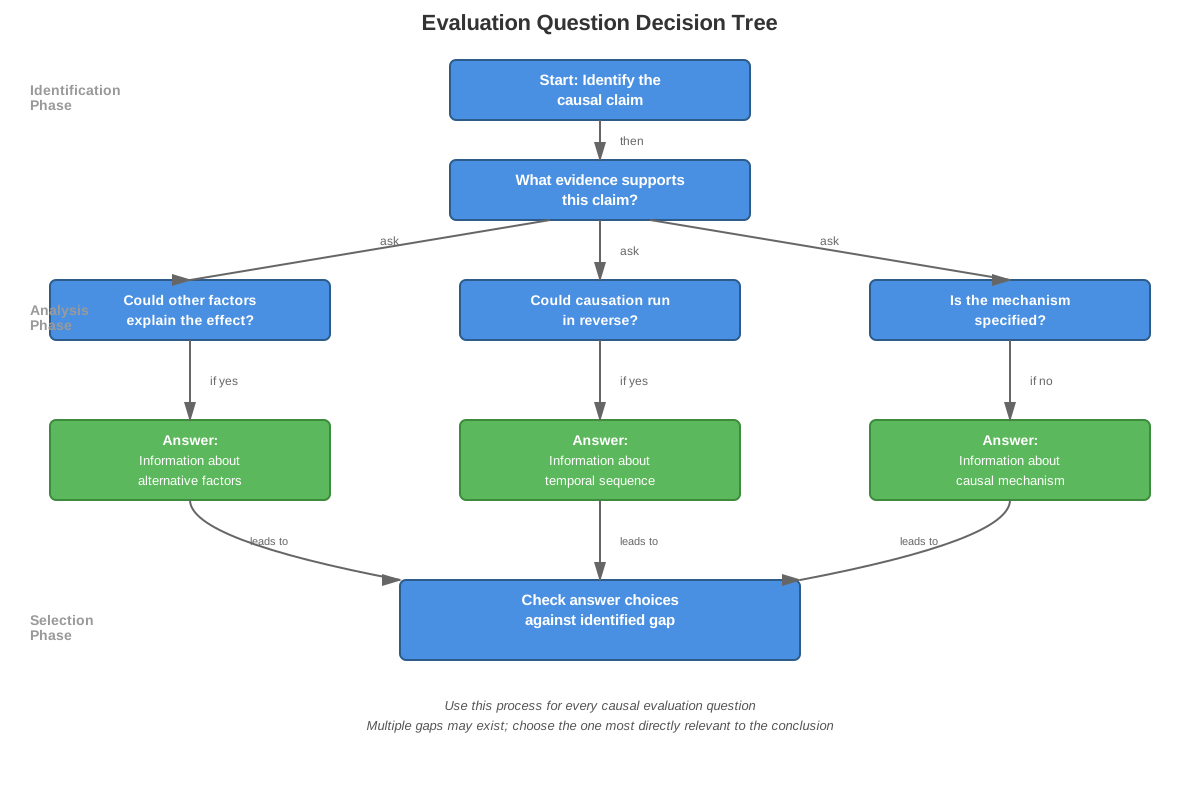
When encountering an evaluation question on the LSAT, follow this systematic process:
- Identify the conclusion: What causal claim is being made?
- Identify the evidence: What correlation or observation supports the claim?
- Spot the gap: What alternative explanations remain unaddressed?
- Predict the answer: What information would help determine if alternatives are viable?
- Test answer choices: Apply the "yes/no" test to each option
Trigger Words and Phrases
Watch for these indicators of causal arguments:
- "caused by," "resulted from," "led to," "brought about"
- "because of," "due to," "as a result of"
- "responsible for," "produced," "created"
- "explains why," "accounts for," "is the reason that"
Evaluation questions use these phrasings:
- "most useful to know in evaluating"
- "most relevant to assessing"
- "most important to investigate"
- "would be most helpful to determine"
Exam Tip: If you can't immediately identify the causal claim, look for the conclusion indicator words ("therefore," "thus," "so," "consequently") and check if the conclusion asserts that one thing caused another.
Process of Elimination Strategy
Eliminate answer choices that:
- Only matter in one direction: If knowing "yes" matters but knowing "no" doesn't (or vice versa), it's not an evaluation answer
- Are irrelevant to causation: Information about whether something is good, expensive, popular, or ethical usually doesn't address whether it caused the observed effect
- Address the wrong gap: If the argument's main vulnerability is alternative causes, eliminate answers about mechanisms or sample size
- Provide information rather than asking for it: Evaluation questions ask what to investigate, not what conclusion to draw
Time Allocation
Evaluation questions typically require 60-90 seconds:
- 15-20 seconds: Read and identify the causal claim
- 20-30 seconds: Identify the primary vulnerability
- 20-30 seconds: Evaluate answer choices
- 10-15 seconds: Confirm with the "yes/no" test
If you're spending more than 90 seconds, you may be overthinking. Trust your identification of the information gap and move forward.
Memory Techniques
The RACE Acronym for Causal Flaws
Reverse causation: Does the effect actually cause the supposed cause?
Alternative explanations: Could something else explain the correlation?
Coincidence: Is this just random correlation without causal connection?
Evidence quality: Is the sample adequate, representative, and controlled?
The "Both Directions" Rule
Visualize a balance scale: The correct answer to an evaluation question tips the scale toward "stronger argument" if answered one way and toward "weaker argument" if answered the other way. If the scale only moves in one direction, it's not an evaluation answer.
The "Third Factor" Visualization
When you see a correlation between X and Y, visualize a triangle with X and Y at the base corners and a question mark at the top vertex. That question mark represents the potential common cause (Z) that might explain both X and Y without either causing the other. Evaluation questions often ask about that third factor.
The Temporal Timeline
Draw a mental timeline: [Alleged Cause] → [Time Gap] → [Alleged Effect]. Ask: "What else happened during the time gap?" This helps identify confounding variables and alternative explanations.
Summary
Evaluating causal arguments on the LSAT requires systematic analysis of the logical gap between correlation and causation. These questions present arguments that observe two phenomena occurring together and conclude that one caused the other, then ask what information would be most useful in assessing that causal claim. The correct answer identifies information that, depending on whether the answer is "yes" or "no," would significantly strengthen or weaken the argument. The five major vulnerabilities in causal reasoning—reverse causation, common cause, coincidence, confounding variables, and insufficient evidence—provide a framework for identifying what information matters most. Success requires recognizing that strong correlation alone never proves causation, that temporal precedence is necessary but insufficient, and that eliminating alternative explanations is essential for establishing causal relationships. The most effective approach involves identifying the argument's primary vulnerability, predicting what information would address that vulnerability, and confirming that both possible answers to the evaluation question would impact the argument's validity in opposite directions.
Key Takeaways
- Correlation never proves causation—evaluation questions test whether students recognize what additional information is needed to bridge this gap
- The correct answer to an evaluation question must matter in both directions: both "yes" and "no" answers should significantly impact the argument's strength
- The five major causal flaws (reverse causation, common cause, coincidence, confounding variables, insufficient evidence) provide a systematic framework for identifying information gaps
- Temporal precedence is necessary but not sufficient for causation—causes must precede effects, but not everything that precedes an effect causes it
- Alternative explanations are the primary threat to causal arguments, making information that rules out or confirms alternatives typically most valuable
- Evaluation questions differ from strengthen/weaken questions by asking what information would be useful rather than providing specific information
- The systematic approach—identify the causal claim, spot the gap, predict the answer, test with the "yes/no" rule—maximizes accuracy and efficiency
Related Topics
Strengthening and Weakening Causal Arguments: After mastering evaluation, students should study how specific information strengthens or weakens causal claims. This builds on evaluation skills by providing the actual information rather than asking what information would be useful.
Assumption Questions with Causal Reasoning: Many assumption questions involve causal arguments, requiring identification of what must be true for the causal inference to be valid. Understanding evaluation helps identify these necessary assumptions.
Flaw Questions and Causal Reasoning: Recognizing causal reasoning flaws directly applies evaluation skills. Instead of asking what information would help, flaw questions ask students to identify what error the argument commits.
Necessary and Sufficient Conditions in Causal Claims: Advanced causal reasoning involves understanding when causes are necessary (required for the effect), sufficient (enough to produce the effect), or both. This deepens causal analysis skills.
Statistical Reasoning and Causation: Many LSAT arguments present statistical evidence for causal claims. Understanding how statistics can support or fail to support causation builds on evaluation fundamentals.
Practice CTA
Now that you understand the framework for evaluating causal arguments, apply these concepts to practice questions. Focus on identifying the causal claim, spotting the primary vulnerability, and predicting what information would matter most before looking at answer choices. The systematic approach outlined here becomes automatic with practice, transforming evaluation questions from challenging to routine. Each practice question strengthens your ability to recognize causal reasoning patterns and identify information gaps—skills that will serve you throughout the Logical Reasoning section. Challenge yourself to complete practice questions efficiently while maintaining accuracy, and review any mistakes to understand which step in the evaluation process needs refinement.
Sign up free to keep reading
Create a free AnvayaPrep account to finish this LSAT guide on Evaluating causal arguments — plus flashcards and practice questions.