Overview
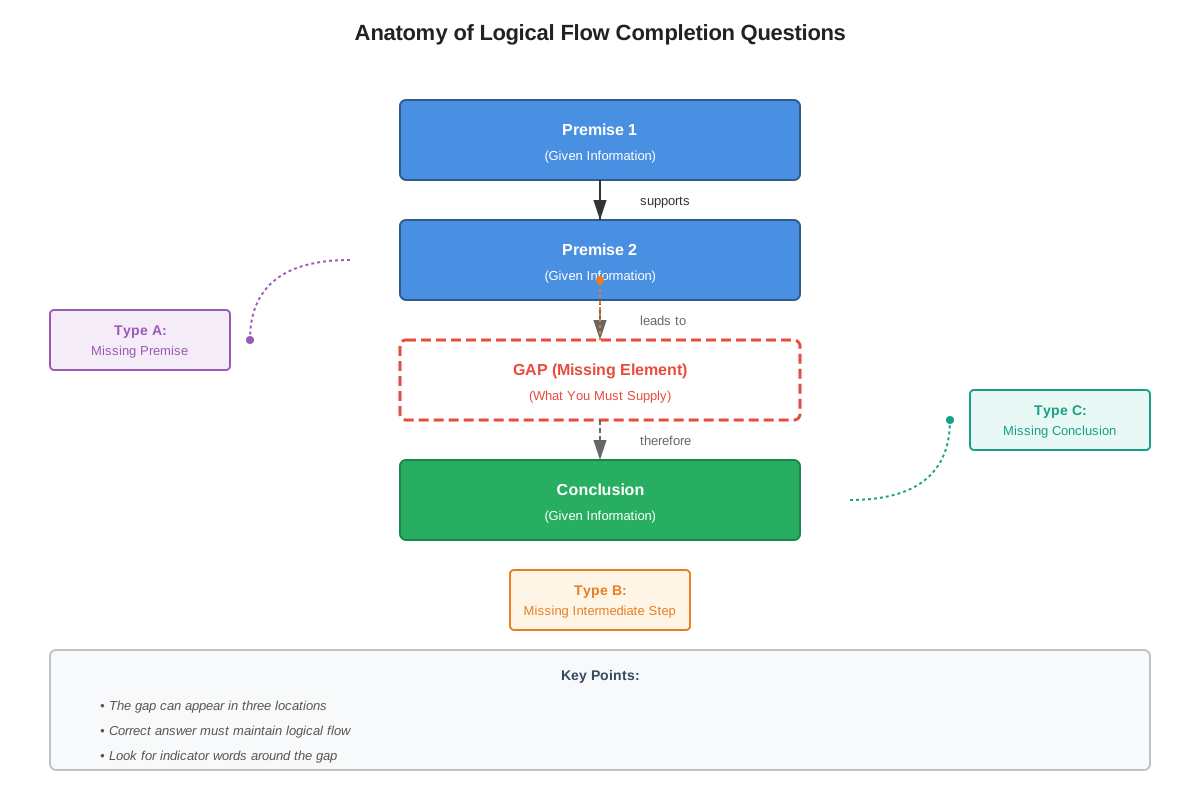
Logical flow completion questions represent a distinctive and frequently tested question type within the LSAT Logical Reasoning sections. These questions present an argument with a missing piece—typically a conclusion, premise, or intermediate step—and ask test-takers to identify which answer choice best completes the logical structure. Unlike assumption questions that ask what must be true for an argument to work, or strengthen/weaken questions that ask for additional evidence, logical flow completion questions require identifying the statement that most naturally and logically fits into the existing argumentative structure. Mastering this question type demands both analytical precision and an intuitive grasp of how arguments develop from premises to conclusions.
The importance of lsat logical flow completion questions cannot be overstated for exam success. These questions test the fundamental skill of recognizing how ideas connect within an argument—a core competency that underlies virtually all logical reasoning tasks on the LSAT. When facing these questions, test-takers must understand not only what the argument says but also how it moves from point to point, what role each statement plays, and what kind of statement would best bridge any gaps in reasoning. This requires synthesizing multiple skills: identifying argument structure, recognizing reasoning patterns, understanding logical relationships, and predicting what logically follows from given information.
Within the broader landscape of LSAT Logical Reasoning, logical flow completion questions occupy a central position in the "Evaluate and Complete the Argument" family of question types. They share DNA with assumption questions (both involve identifying missing elements), inference questions (both require understanding what follows logically), and even parallel reasoning questions (both demand recognition of argument structure). However, logical flow completion questions are unique in their explicit presentation of a gap and their requirement that test-takers select the precise statement that fills that gap most effectively. Success with these questions builds foundational skills that transfer directly to virtually every other Logical Reasoning question type, making them high-yield targets for focused study.
Learning Objectives
By the end of this study guide, students should be able to:
- [ ] Identify how Logical flow completion appears in LSAT questions
- [ ] Explain the reasoning pattern behind Logical flow completion
- [ ] Apply Logical flow completion to solve LSAT-style problems accurately
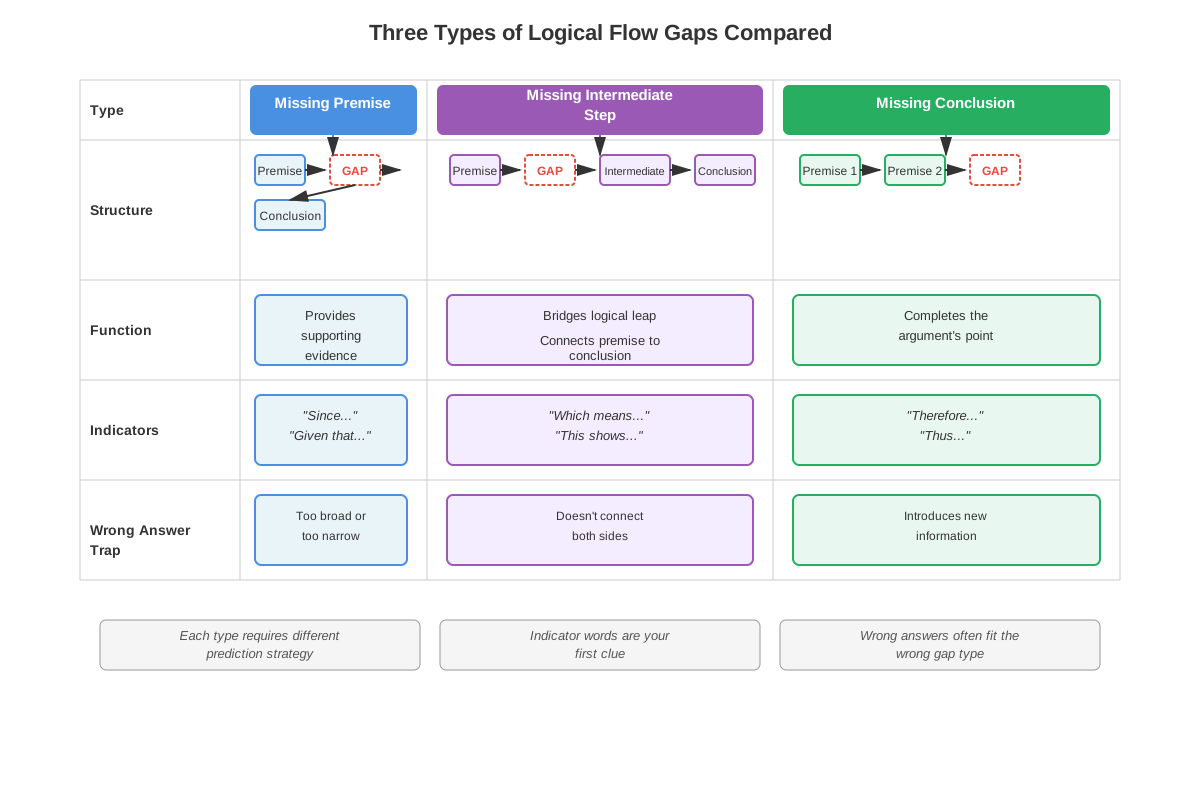
- [ ] Distinguish between different types of logical flow completion questions (missing premise, missing conclusion, missing intermediate step)
- [ ] Predict the content and function of missing statements before reviewing answer choices
- [ ] Evaluate answer choices based on their logical fit within the argument's structure
- [ ] Recognize common wrong answer patterns in logical flow completion questions
Prerequisites
Students should have foundational knowledge in the following areas:
- Argument structure identification: Understanding the difference between premises, conclusions, and intermediate claims is essential because logical flow completion requires recognizing where the gap exists within the argument's architecture
- Indicator words and phrases: Familiarity with conclusion indicators (therefore, thus, so) and premise indicators (because, since, for) helps identify the function of existing statements and predict what type of statement is missing
- Basic logical relationships: Understanding concepts like sufficient and necessary conditions, causation, and correlation provides the foundation for recognizing how statements connect logically
- Conditional reasoning fundamentals: Many logical flow completion questions involve conditional statements, so comfort with if-then logic is necessary for success
Why This Topic Matters
Logical flow completion questions appear with remarkable consistency on the LSAT, typically comprising 2-4 questions per Logical Reasoning section, which translates to approximately 4-8 questions per complete exam. This frequency, combined with their medium difficulty level, makes them high-value targets for score improvement. Unlike some question types that require extensive background knowledge or complex logical manipulations, logical flow completion questions reward systematic analysis and pattern recognition—skills that improve rapidly with focused practice.
Beyond exam performance, the skills developed through mastering logical flow completion have profound real-world applications. Legal reasoning constantly requires identifying gaps in arguments, determining what evidence or reasoning would complete a case, and recognizing when an argument's structure is sound versus when it contains logical leaps. Attorneys must regularly construct complete, coherent arguments from disparate pieces of information, anticipate opposing counsel's reasoning, and identify exactly what's missing from an adversary's case. These are precisely the skills that logical flow completion questions develop.
On the LSAT, these questions typically appear with stems such as "Which one of the following most logically completes the argument?" or "The conclusion of the argument is most strongly supported if which one of the following is assumed?" or "Which one of the following, if true, would most reasonably complete the passage?" The passages themselves vary widely in content—from scientific reasoning to political arguments to everyday scenarios—but the underlying task remains constant: identify the statement that best fits the logical structure. Questions may present the gap at the beginning (missing premise), middle (missing intermediate step), or end (missing conclusion) of the argument, with conclusion-completion questions being the most common variant.
Core Concepts
Understanding Logical Flow
Logical flow refers to the progression of reasoning within an argument, the way ideas connect and build upon each other to reach a conclusion. In a well-constructed argument, each statement serves a specific function: premises provide evidence or reasons, intermediate steps connect premises to conclusions, and conclusions represent the argument's ultimate claim. The flow should be smooth and inevitable—each statement should follow naturally from what precedes it and lead logically to what follows.
When the LSAT presents a logical flow completion question, it deliberately removes one piece of this progression, creating a gap that disrupts the natural flow. The test-taker's task is to identify which statement, when inserted into the gap, restores the argument's logical coherence. This requires understanding not just what the argument says, but how it works—the mechanism by which it attempts to establish its conclusion.
Types of Logical Flow Completion Questions
Missing Conclusion Questions
The most common variant presents all premises and asks test-takers to identify the conclusion that these premises best support. These questions test the ability to recognize what logically follows from given information. The correct answer will be a statement that:
- Is directly supported by the premises without requiring additional assumptions
- Represents an appropriate scope (not too broad or too narrow relative to the premises)
- Follows the logical direction established by the premises
- Matches the tone and strength of the premises (definitive premises support definitive conclusions; qualified premises support qualified conclusions)
Missing Premise Questions
These questions present a conclusion and some supporting premises, but one crucial premise is missing. The gap creates a logical leap—the existing premises don't quite get to the conclusion without additional support. The correct answer will:
- Bridge the gap between existing premises and the conclusion
- Provide information that makes the conclusion follow logically
- Address the specific weakness or gap in the reasoning
- Connect concepts that appear in the conclusion but not in the premises
Missing Intermediate Step Questions
Less common but particularly challenging, these questions present premises and a conclusion but remove a middle step in the reasoning chain. The argument may have multiple stages of reasoning, and the missing piece connects one stage to another. The correct answer will:
- Link earlier premises to later reasoning
- Maintain logical consistency with both what comes before and after
- Serve as both a conclusion (from earlier premises) and a premise (for the final conclusion)
- Preserve the argument's overall logical structure
Analyzing Argument Structure
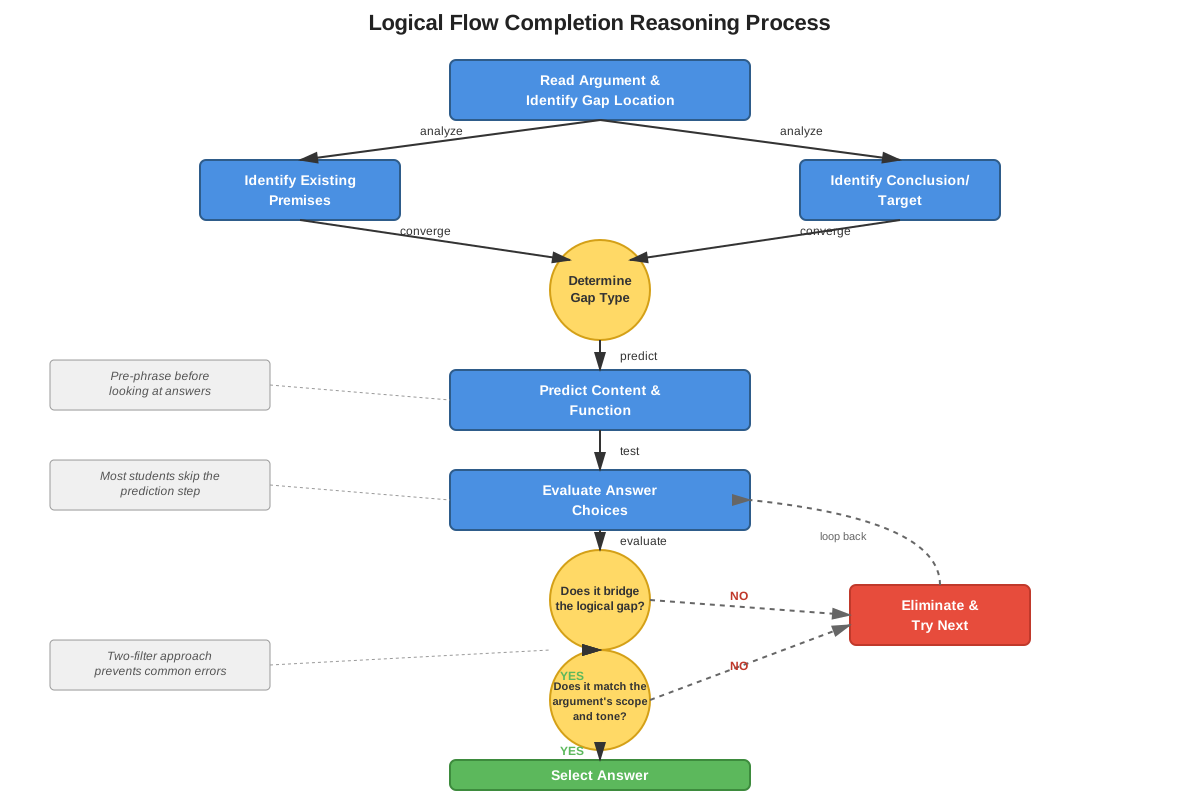
Success with logical flow completion requires systematic structural analysis. The recommended approach involves:
- Identify existing components: Mark premises, conclusions, and any intermediate steps clearly
- Locate the gap: Determine precisely where the missing statement belongs in the argument's structure
- Determine the gap's function: Decide whether the missing piece is a premise, conclusion, or intermediate step
- Predict content: Before reviewing answer choices, articulate what kind of information would fill the gap
- Evaluate fit: Test each answer choice by inserting it into the gap and assessing whether it creates smooth logical flow
Logical Connectors and Transitions
Understanding how statements connect is crucial for logical flow completion. Arguments use various mechanisms to link ideas:
| Connection Type | Function | Example Indicators |
|---|---|---|
| Causal | Shows one thing causes another | "because," "leads to," "results in" |
| Conditional | Establishes if-then relationships | "if," "only if," "provided that" |
| Contrastive | Highlights differences or opposing ideas | "however," "but," "although" |
| Supportive | Provides additional evidence | "furthermore," "additionally," "also" |
| Conclusive | Signals the argument's endpoint | "therefore," "thus," "consequently" |
The missing statement must maintain consistency with these logical connectors. If the argument uses causal language, the missing piece likely involves a causal relationship. If conditional language dominates, the missing statement probably involves conditional reasoning.
Scope Matching
One of the most reliable techniques for eliminating wrong answers involves scope matching. The missing statement must match the scope of surrounding statements in several dimensions:
- Breadth: If premises discuss "some politicians," the conclusion shouldn't claim "all politicians"
- Certainty: If premises use qualified language ("may," "could," "suggests"), the conclusion shouldn't be absolute
- Subject matter: The missing statement should address the same concepts and entities as surrounding statements
- Temporal scope: If premises discuss current conditions, conclusions about historical or future conditions require additional support
Logical Necessity vs. Logical Sufficiency
Understanding the difference between what's logically necessary and what's logically sufficient is crucial. The correct answer to a logical flow completion question must be:
- Sufficient to complete the argument's logical flow (it actually fills the gap)
- Necessary in the sense that the argument doesn't work as well without it
- Appropriate in strength (not claiming more than the premises support)
Many wrong answers fail because they're either insufficient (they don't fully complete the argument) or excessive (they claim more than needed or supported).
Concept Relationships
The concepts within logical flow completion form an interconnected system. Understanding argument structure enables identification of where gaps exist, which determines whether the question asks for a missing premise, conclusion, or intermediate step. This classification then guides the prediction process—what kind of statement would fill this particular gap? The prediction is refined through scope matching and attention to logical connectors, ensuring the predicted statement maintains consistency with surrounding elements. Finally, logical necessity and sufficiency provide the criteria for evaluating whether an answer choice actually completes the argument effectively.
These concepts connect to prerequisite knowledge in essential ways. Conditional reasoning frequently appears in logical flow completion questions, particularly when the missing statement involves an if-then relationship. Indicator words help identify the function of existing statements and predict what type of statement is missing. Basic logical relationships provide the foundation for understanding how premises support conclusions and what kind of support is adequate.
Logical flow completion also connects forward to more advanced Logical Reasoning topics. Mastering these questions builds skills directly applicable to assumption questions (which ask for unstated premises), inference questions (which ask what must be true given the premises), and strengthen/weaken questions (which require understanding argument structure to identify what would support or undermine it). The structural analysis skills developed here transfer to virtually every Logical Reasoning question type.
Relationship Map:
Argument Structure Analysis → Gap Identification → Gap Classification (Premise/Conclusion/Intermediate) → Content Prediction → Scope Matching & Connector Analysis → Answer Evaluation → Logical Necessity/Sufficiency Check → Correct Answer Selection
High-Yield Facts
⭐ Logical flow completion questions typically appear 4-8 times per LSAT exam, making them one of the most frequently tested question types in Logical Reasoning.
⭐ The correct answer to a missing conclusion question must be fully supported by the premises without requiring additional assumptions beyond common sense.
⭐ Scope mismatches are the most common reason wrong answers fail—if premises discuss "some," the conclusion cannot claim "all" without additional support.
⭐ Missing premise questions always involve a logical gap between existing premises and the stated conclusion; the correct answer bridges this specific gap.
⭐ Predicting the content and function of the missing statement before reviewing answer choices dramatically improves accuracy and speed.
- The missing statement must maintain logical consistency with both what precedes and follows it in the argument.
- Extreme language in answer choices (always, never, all, none) is often incorrect unless the premises use equally extreme language.
- The correct answer will use concepts and terminology that appear elsewhere in the argument, creating thematic coherence.
- Wrong answers often introduce new information that, while potentially relevant, doesn't specifically complete the logical flow.
- Conditional statements in the argument often signal that the missing piece involves completing or applying a conditional relationship.
- The tone and certainty level of the correct answer should match the tone and certainty level of the surrounding statements.
- If the argument contains a contrast or objection, the missing statement often resolves or addresses this contrast.
- Causal arguments frequently have missing premises that establish the causal connection or rule out alternative causes.
- The correct answer should make the argument feel complete and natural, not forced or awkward.
- Time-efficient test-takers read the argument first, predict the missing content, then scan answer choices for matches rather than evaluating each answer in detail.
Quick check — test yourself on Logical flow completion so far.
Try Flashcards →Common Misconceptions
Misconception: The correct answer must introduce new, surprising information to complete the argument.
Correction: The correct answer typically uses concepts already present in the argument and makes explicit what was implicit. Introducing entirely new concepts usually indicates a wrong answer that goes beyond the argument's scope.
Misconception: Any answer that's true and relevant will work for logical flow completion questions.
Correction: The correct answer must specifically complete the logical flow—it must fit precisely into the gap and make the argument work. Many wrong answers are true and relevant but don't perform the specific function needed to complete this particular argument's structure.
Misconception: Missing conclusion questions ask for what could possibly follow from the premises.
Correction: Missing conclusion questions ask for what most logically or most strongly follows from the premises. The correct answer isn't just possible; it's the best-supported conclusion given the specific premises provided.
Misconception: The longest or most detailed answer choice is usually correct because it provides the most complete reasoning.
Correction: Length is irrelevant to correctness. The correct answer is the one that best fits the logical structure, which may be quite concise. Longer answers often introduce unnecessary information that actually makes them incorrect.
Misconception: If an answer choice strengthens the argument, it's correct for a logical flow completion question.
Correction: Strengthening an argument and completing its logical flow are different tasks. An answer might strengthen an argument by providing additional evidence while not actually fitting into the specific gap in the argument's structure. The correct answer must fit the gap precisely, not just support the conclusion generally.
Misconception: Logical flow completion questions are essentially the same as assumption questions.
Correction: While related, these question types differ significantly. Assumption questions ask for unstated premises that must be true for the argument to work (necessary assumptions) or that would make the argument work (sufficient assumptions). Logical flow completion questions present an explicit gap and ask for the statement that best fills it. The correct answer to a flow completion question is stated explicitly, while assumptions remain unstated.
Worked Examples
Example 1: Missing Conclusion
Argument: "Recent studies have shown that employees who work in offices with natural lighting report higher job satisfaction than those who work in offices with only artificial lighting. Additionally, employees in naturally lit offices take fewer sick days and demonstrate higher productivity levels. Companies that have renovated their office spaces to include more windows and skylights have seen measurable improvements in employee retention rates."
Question: Which one of the following most logically completes the argument?
Answer Choices:
A) Therefore, all companies should immediately renovate their offices to include natural lighting.
B) Therefore, natural lighting in office spaces appears to contribute to better employee outcomes.
C) Therefore, artificial lighting causes health problems in office workers.
D) Therefore, employee satisfaction is the most important factor in workplace productivity.
E) Therefore, companies that don't provide natural lighting will fail.
Analysis:
First, identify the argument structure. The passage presents three related pieces of evidence:
- Natural lighting correlates with higher job satisfaction
- Natural lighting correlates with fewer sick days and higher productivity
- Companies adding natural lighting see improved retention
The argument presents evidence about correlations between natural lighting and positive outcomes. The missing conclusion should summarize what this evidence supports.
Prediction: The conclusion should state that natural lighting appears to have positive effects on employee outcomes. It should match the scope (correlation, not causation) and certainty level (evidence suggests, not proves) of the premises.
Evaluating choices:
- Choice A: Too extreme ("all companies should immediately"). The premises show correlation but don't prove this is the best solution for every company. Scope mismatch.
- Choice B: ✓ Matches scope perfectly. Uses "appears to contribute" (appropriately qualified language), addresses the specific relationship discussed (natural lighting and employee outcomes), and summarizes what the premises support without overreaching.
- Choice C: Too strong and introduces causation ("causes") when premises only show correlation. Also focuses narrowly on health problems when premises discuss broader outcomes.
- Choice D: Scope shift. The argument is about natural lighting's effects, not about what's "most important" for productivity. Introduces a comparison not supported by the premises.
- Choice E: Extreme and unsupported. "Will fail" is far too strong given the evidence, which shows positive effects of natural lighting but doesn't prove companies without it will fail.
Correct Answer: B
Key Lesson: The correct answer matches the scope, certainty level, and subject matter of the premises. It makes explicit what the evidence supports without claiming more than the premises justify.
Example 2: Missing Premise
Argument: "The city council argues that installing speed cameras at major intersections will reduce traffic accidents. However, this policy should be rejected. __________ Therefore, the speed camera policy will not achieve its stated goal of reducing accidents."
Question: Which one of the following most logically completes the argument?
Answer Choices:
A) Speed cameras have been shown to reduce accidents in other cities.
B) Traffic accidents are a serious problem that requires immediate attention.
C) Studies show that speed cameras primarily reduce speeding but that most accidents at these intersections are caused by distracted driving, not speeding.
D) The city council has proposed several other traffic safety measures this year.
E) Installing speed cameras is expensive and may strain the city budget.
Analysis:
First, identify the structure. The argument presents:
- Context: City council claims speed cameras will reduce accidents
- Position: The policy should be rejected
- Gap: Missing premise
- Conclusion: The policy won't achieve its goal
The conclusion claims the policy won't reduce accidents. For this conclusion to follow logically, the missing premise must explain why speed cameras won't reduce accidents at these specific intersections.
Prediction: The missing premise should provide a reason why speed cameras specifically won't reduce accidents in this situation. It needs to connect "speed cameras" to "won't reduce accidents" by explaining why the mechanism won't work here.
Evaluating choices:
- Choice A: Contradicts the argument's conclusion. If speed cameras reduced accidents elsewhere, this would support the policy, not argue against it.
- Choice B: Irrelevant to whether speed cameras will work. This might support doing something about accidents but doesn't explain why speed cameras specifically won't help.
- Choice C: ✓ Perfect fit. This explains precisely why speed cameras won't achieve the goal: they address speeding, but speeding isn't the main cause of accidents at these intersections. This bridges the gap between the premises and conclusion by showing why the proposed solution doesn't match the actual problem.
- Choice D: Irrelevant to whether this specific policy will work. Other proposals don't explain why speed cameras won't reduce accidents.
- Choice E: Addresses cost, not effectiveness. Even if true, this doesn't support the conclusion that the policy "will not achieve its stated goal." An expensive policy could still be effective.
Correct Answer: C
Key Lesson: Missing premise questions require identifying the specific gap between existing premises and the conclusion. The correct answer must bridge this exact gap, not just provide related information or general support for the conclusion.
Exam Strategy
Systematic Approach
When encountering logical flow completion questions, follow this proven process:
- Read the question stem first to know you're dealing with a completion question and to identify where the gap appears (beginning, middle, or end)
- Read the argument carefully, marking premises and conclusions, and noting the location and function of the gap
- Predict before looking at answers: Articulate in your own words what kind of statement would complete the argument. Consider:
- What function does the missing piece serve?
- What concepts need to be connected?
- What scope and certainty level is appropriate?
- Scan answer choices for matches to your prediction rather than evaluating each answer in isolation
- Test the best candidate by mentally inserting it into the gap and reading the complete argument to ensure smooth logical flow
- Eliminate systematically using scope, relevance, and logical fit as criteria
Trigger Words and Phrases
Watch for these question stem indicators:
- "Which one of the following most logically completes the argument?"
- "The conclusion of the argument is most strongly supported if which one of the following is assumed?"
- "Which one of the following, if true, would most reasonably complete the passage?"
- "The argument's conclusion follows logically if which one of the following is assumed?"
Within arguments, these phrases often signal the location of gaps:
- Blank lines or explicit gaps in the text
- Sudden logical leaps between statements
- Conclusions that seem unsupported by preceding premises
- Premises that don't clearly lead anywhere
Process of Elimination Tips
Eliminate answers that:
- Introduce entirely new concepts not mentioned elsewhere in the argument
- Use extreme language (all, none, always, never) when the argument uses qualified language
- Are too narrow or too broad relative to the argument's scope
- Contradict information stated in the argument
- Would be true but don't specifically complete this argument's logical flow
- Make the argument feel awkward or forced when inserted into the gap
Favor answers that:
- Use terminology and concepts from the argument
- Match the certainty level of surrounding statements
- Create smooth, natural-sounding logical flow when inserted
- Address the specific gap without introducing unnecessary information
- Connect concepts that appear separated in the argument
Time Allocation
Logical flow completion questions should take approximately 1:00-1:30 minutes each. Allocate time as follows:
- 0:00-0:20: Read and analyze the argument, identify the gap
- 0:20-0:30: Predict the missing content
- 0:30-0:50: Scan and evaluate answer choices
- 0:50-1:00: Verify the best answer and move on
If you find yourself spending more than 1:30 on a question, mark it and return if time permits. The prediction step is crucial—spending an extra 10 seconds on a quality prediction saves 30+ seconds on answer evaluation.
Exam Tip: If you're stuck between two answers, insert each into the gap and read the complete argument aloud (mentally). The correct answer will create noticeably smoother, more natural logical flow.
Memory Techniques
The SCOPE Acronym
Use SCOPE to remember key evaluation criteria:
- Subject matter must match (same concepts and entities)
- Certainty level must align (qualified premises → qualified conclusion)
- Outcome must fit the gap (actually completes the specific logical flow)
- Premises must support it (or it must support the conclusion)
- Extreme language usually signals wrong answers
The Flow Test Visualization
Visualize arguments as rivers flowing from premises to conclusions. The missing statement is a bridge across a gap in the river. The correct answer:
- Connects both banks (links what comes before and after)
- Matches the river's width (appropriate scope)
- Maintains the current's strength (consistent certainty level)
- Allows smooth passage (natural logical flow)
Wrong answers either don't reach both banks, are too narrow or wide, or create turbulence in the flow.
The Three Ps for Prediction
Remember Predict, Predict, Predict:
- Predict the function: Is it a premise, conclusion, or intermediate step?
- Predict the content: What concepts need to be connected?
- Predict the scope: How broad and certain should it be?
Making these three predictions before reviewing answers dramatically improves accuracy.
The Insertion Test
Remember: "If it fits, it sits." The correct answer should fit so naturally into the gap that the completed argument feels like it was written as a single, coherent piece. If inserting an answer makes the argument feel awkward or disjointed, it's wrong.
Summary
Logical flow completion questions test the fundamental skill of recognizing and completing argument structures—a core competency for LSAT success and legal reasoning generally. These questions present arguments with deliberate gaps and ask test-takers to identify which statement best completes the logical flow. Success requires systematic structural analysis: identifying existing components, locating and classifying the gap, predicting what would fill it, and evaluating answer choices based on logical fit rather than mere truth or relevance. The correct answer must match the scope, certainty level, and subject matter of surrounding statements while creating smooth, natural logical flow. Common pitfalls include selecting answers that are true but don't specifically complete the argument, choosing answers with scope mismatches, and failing to predict before evaluating choices. The most effective approach involves careful prediction of the missing content's function and substance before reviewing answer choices, then systematically eliminating options that introduce new concepts, use inappropriate language strength, or create awkward logical connections. Mastering these questions builds foundational skills that transfer to virtually all other Logical Reasoning question types.
Key Takeaways
- Logical flow completion questions appear 4-8 times per LSAT and test the ability to recognize and complete argument structures by identifying which statement best fills a deliberate gap
- Always predict the missing statement's function, content, and scope before reviewing answer choices—this dramatically improves both accuracy and speed
- The correct answer must match the scope and certainty level of surrounding statements; extreme language (all, none, always, never) typically signals wrong answers unless the premises use equally extreme language
- Scope mismatches are the most common reason answers fail—if premises discuss "some," conclusions cannot claim "all" without additional support
- The correct answer creates smooth, natural logical flow when inserted into the gap, using concepts and terminology from elsewhere in the argument rather than introducing entirely new ideas
- Missing conclusion questions ask for what most logically follows from the premises; missing premise questions ask for what bridges the gap between existing premises and the stated conclusion
- Test answer choices by mentally inserting them into the gap and reading the complete argument—the correct answer will make the argument feel coherent and complete
Related Topics
Assumption Questions: These questions ask for unstated premises that the argument requires to work. Mastering logical flow completion provides the structural analysis skills needed to identify what's missing from arguments, which directly applies to recognizing necessary and sufficient assumptions.
Inference Questions: Also called "must be true" questions, these ask what logically follows from given information. The prediction skills developed through logical flow completion—determining what logically follows from premises—transfer directly to inference questions.
Strengthen and Weaken Questions: These require understanding argument structure to identify what would support or undermine the reasoning. The structural analysis skills from logical flow completion enable quick identification of an argument's vulnerable points and what would affect them.
Parallel Reasoning Questions: These ask test-takers to identify arguments with similar logical structures. The deep structural analysis required for logical flow completion builds the pattern recognition skills essential for parallel reasoning questions.
Flaw Questions: These ask test-takers to identify errors in reasoning. Understanding how arguments should flow logically (from logical flow completion) makes it easier to recognize when they don't flow properly (flaws).
Practice CTA
Now that you've mastered the core concepts of logical flow completion, it's time to put your knowledge into practice. Attempt the practice questions to apply these strategies to real LSAT-style problems, and use the flashcards to reinforce the high-yield facts and common patterns. Remember: prediction is the key to success with these questions. The more you practice predicting missing content before reviewing answer choices, the faster and more accurate you'll become. Each practice question is an opportunity to refine your structural analysis skills and build the intuition that separates good test-takers from great ones. You've got this!
Sign up free to keep reading
Create a free AnvayaPrep account to finish this LSAT guide on Logical flow completion — plus flashcards and practice questions.