Overview
Testing answer impact is a critical analytical skill within LSAT Logical Reasoning that requires students to evaluate how different answer choices would affect an argument's strength, validity, or completeness. This technique appears most prominently in "Evaluate the Argument" questions and "Complete the Argument" questions, where test-takers must determine which piece of information would most significantly strengthen, weaken, or properly conclude a given argument. Unlike simpler question types that ask students to identify flaws or assumptions, testing answer impact demands active manipulation of the argument structure—students must mentally insert each answer choice into the argument and assess the resulting logical consequences.
The skill of lsat testing answer impact represents a sophisticated level of logical reasoning that goes beyond passive comprehension. Students must develop the ability to project hypothetical scenarios: "If this answer choice were true, what would happen to the argument?" This forward-thinking analytical approach mirrors real-world legal reasoning, where attorneys must anticipate how different pieces of evidence or legal precedents will affect their cases. On the LSAT, this skill separates high scorers from average performers because it requires both understanding the argument's logical structure and predicting how modifications to that structure will cascade through the reasoning chain.
Within the broader context of Logical Reasoning, testing answer impact serves as a bridge between foundational skills (identifying conclusions, recognizing assumptions) and advanced application skills (constructing valid arguments, identifying sufficient and necessary conditions). The evaluate and complete the argument question types that rely on this skill typically appear 3-5 times per Logical Reasoning section, making them high-yield targets for focused study. Mastering this topic enhances performance across multiple question types, as the underlying analytical framework applies to strengthen/weaken questions, assumption questions, and even some parallel reasoning questions.
Learning Objectives
- [ ] Identify how Testing answer impact appears in LSAT questions
- [ ] Explain the reasoning pattern behind Testing answer impact
- [ ] Apply Testing answer impact to solve LSAT-style problems accurately
- [ ] Distinguish between answer choices that have major versus minor impact on argument strength
- [ ] Construct mental models that predict how new information affects logical relationships
- [ ] Evaluate multiple answer choices systematically using a consistent testing framework
- [ ] Recognize the specific language patterns that signal high-impact versus low-impact information
Prerequisites
- Argument structure identification: Understanding premises, conclusions, and how they connect is essential because testing answer impact requires knowing where new information would fit within the argument framework.
- Assumption recognition: Identifying unstated assumptions allows students to recognize which answer choices address critical gaps in reasoning versus peripheral issues.
- Strengthen and weaken question mechanics: Familiarity with how evidence affects argument strength provides the foundation for predicting impact in evaluate/complete questions.
- Conditional reasoning basics: Understanding sufficient and necessary conditions helps predict how new information will interact with existing logical relationships.
- Scope analysis: Recognizing what an argument does and doesn't address prevents students from selecting answer choices that introduce irrelevant information.
Why This Topic Matters
Testing answer impact represents one of the most practical applications of logical reasoning skills beyond the LSAT itself. In legal practice, attorneys constantly evaluate how different pieces of evidence, witness testimony, or legal arguments will affect their cases. In business, executives assess how various strategic decisions will impact organizational outcomes. In academic research, scholars determine which additional data would most significantly strengthen or challenge their hypotheses. The cognitive skill of projecting consequences and evaluating relative impact transfers directly to these professional contexts.
On the LSAT specifically, questions requiring answer impact testing appear with remarkable consistency. Evaluate the Argument questions typically appear 2-3 times per Logical Reasoning section, while Complete the Argument questions (particularly those requiring students to select proper conclusions) appear 1-2 times per section. Combined, these question types represent approximately 15-20% of each Logical Reasoning section's content. Given that Logical Reasoning comprises two sections of the LSAT, mastering this skill can directly improve performance on 6-10 questions per test—a significant score differential.
These questions appear in several distinct formats. The most common is the explicit "evaluate" question that asks "Which of the following would be most useful to know in evaluating the argument?" Another frequent format presents an incomplete argument and asks students to select the conclusion that "most logically completes the argument." A third variation asks which piece of information would "most strengthen" or "most weaken" the argument, requiring students to compare the relative impact of different answer choices. Understanding how to systematically test each answer's impact provides a unified approach to all these question variations.
Core Concepts
The Testing Framework
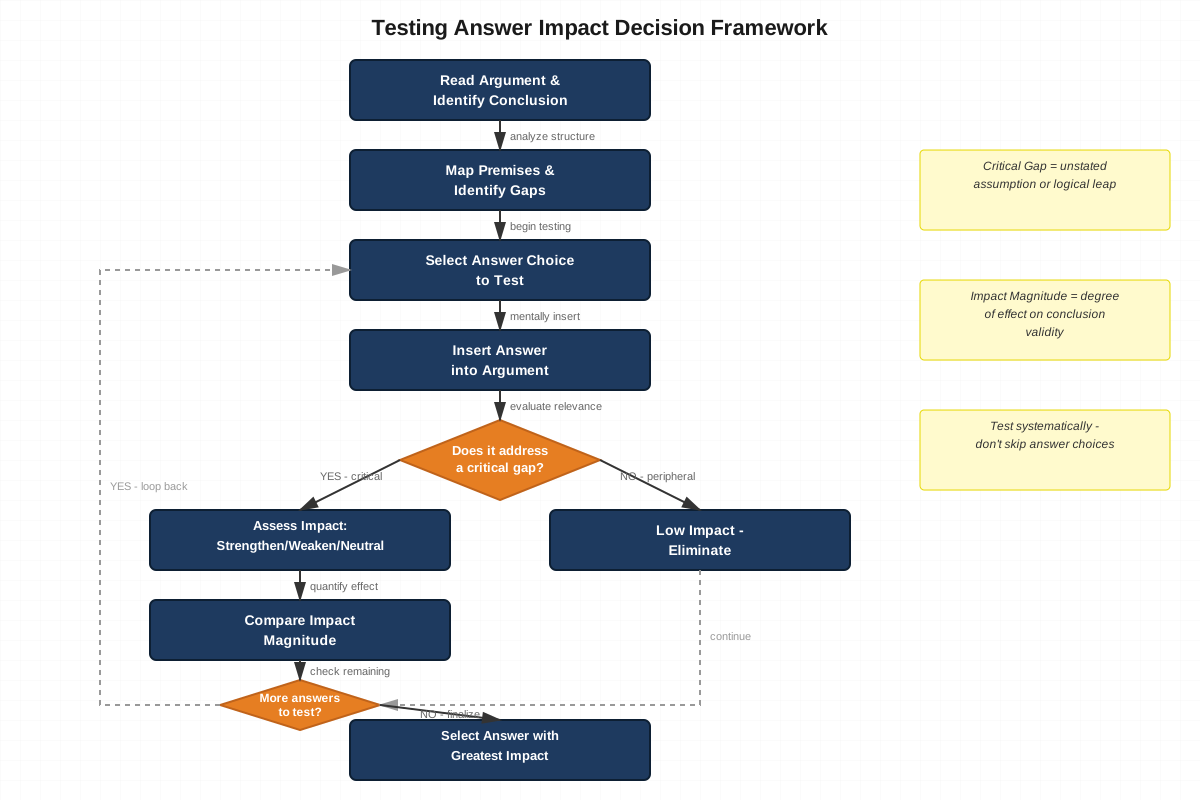
Testing answer impact involves a systematic process of mentally inserting each answer choice into the argument and observing the logical consequences. The fundamental framework consists of four steps: (1) identify the argument's conclusion and supporting premises, (2) recognize the logical gap or assumption connecting premises to conclusion, (3) consider each answer choice as potentially true, and (4) determine whether that truth would strengthen, weaken, or have no effect on the argument's validity.
The key insight is that high-impact answers directly address the argument's central assumption or logical gap, while low-impact answers address peripheral issues or introduce irrelevant information. For example, if an argument concludes that "increasing police patrols will reduce crime" based on the premise that "visible police presence deters criminal activity," the central assumption is that increased patrols will actually increase visible presence in areas where crimes occur. An answer choice addressing whether criminals notice police presence would have high impact, while an answer choice about police officer training would have minimal impact on this specific argument.
The Variance Test
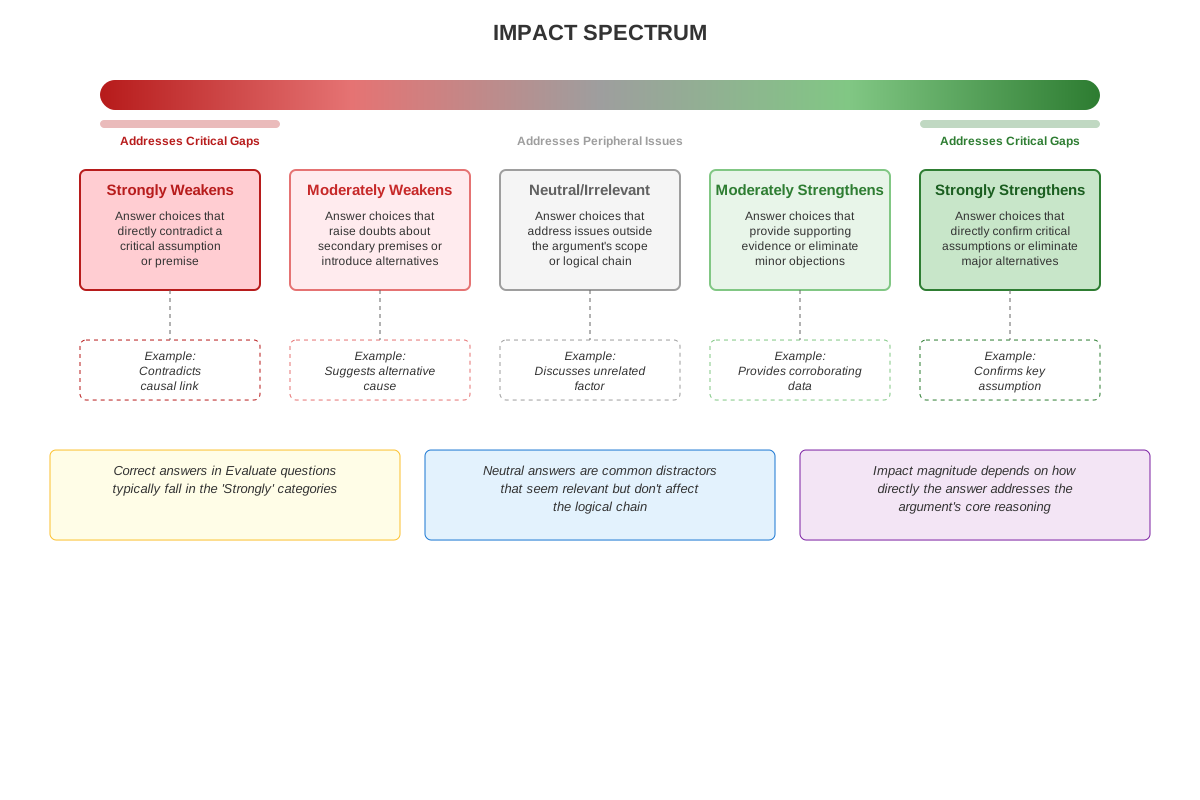
A powerful technique for testing answer impact is the variance test: consider what happens to the argument if the answer choice is true versus if it's false. High-impact information creates significant variance—the argument becomes much stronger or much weaker depending on the answer. Low-impact information creates minimal variance—the argument's strength remains relatively constant regardless of whether the information is true or false.
Consider this example: An argument claims that "Company X will increase profits next year because it's launching a new product." Testing the impact of "The new product addresses an unmet market need" reveals high variance: if true, the argument strengthens considerably; if false, the argument weakens substantially. By contrast, testing "Company X has been in business for 20 years" reveals low variance: whether true or false, this information doesn't significantly affect whether the new product will increase profits.
Direct versus Indirect Impact
Answer choices can affect arguments through direct impact (immediately affecting a premise or conclusion) or indirect impact (affecting background conditions that influence the argument). Direct impact answers typically score higher on the LSAT because they create clearer, more predictable effects on argument strength.
| Impact Type | Characteristics | Example |
|---|---|---|
| Direct Impact | Addresses explicit premises or conclusions | Information about whether a stated cause actually produces the stated effect |
| Indirect Impact | Addresses background conditions or context | Information about general industry trends when argument concerns specific company |
| No Impact | Introduces irrelevant scope or tangential issues | Historical information when argument concerns future predictions |
The Assumption Bridge
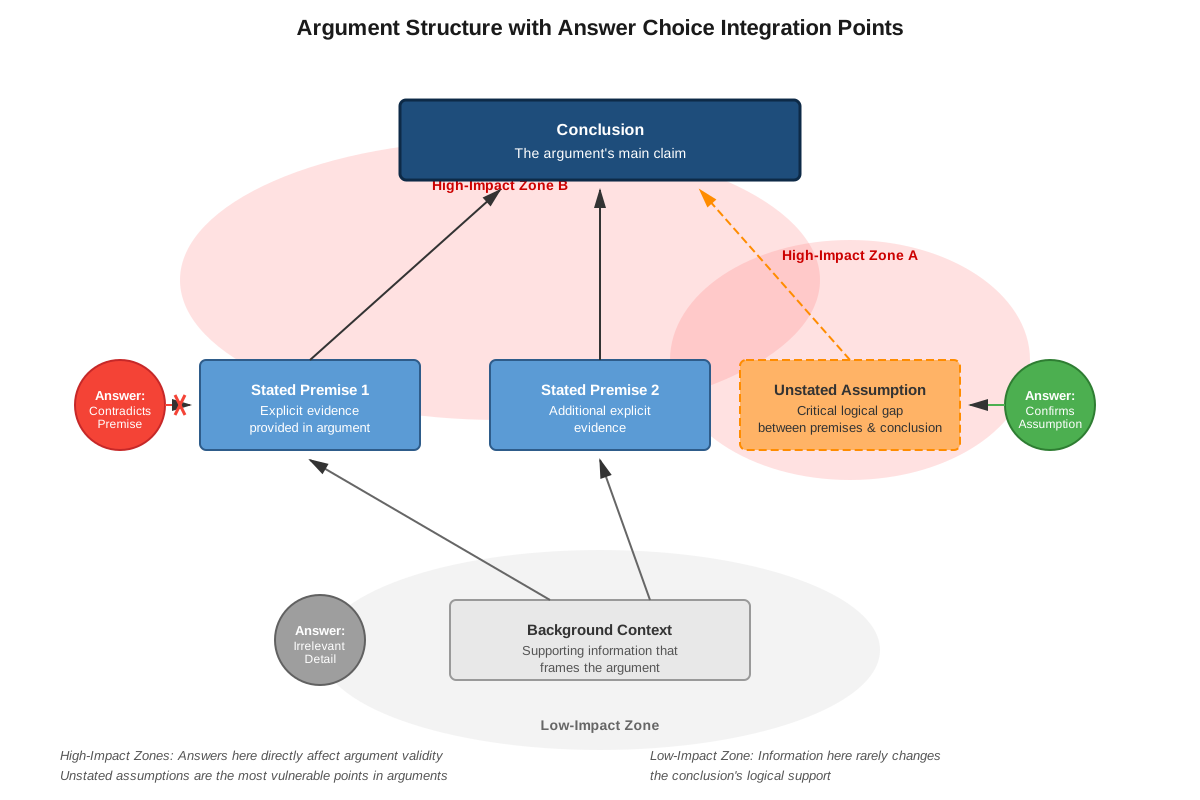
Many high-impact answers directly address the assumption bridge—the unstated logical connection between premises and conclusion. When evaluating answer impact, students should first identify this bridge, then assess which answer choices would strengthen or weaken it. The assumption bridge represents the argument's most vulnerable point, so information addressing it typically has maximum impact.
For instance, if an argument states "Archaeological evidence shows ancient civilization X had advanced mathematics, so they must have had formal educational institutions," the assumption bridge is that advanced mathematics requires formal educational institutions. An answer choice stating "Advanced mathematical knowledge can be transmitted through apprenticeship systems without formal institutions" would have high impact because it directly challenges this bridge.
Scope Matching
Scope matching is crucial for testing answer impact. High-impact answers match the argument's scope in terms of time frame, subject matter, degree of certainty, and population discussed. Answers that shift scope—even if logically related—typically have lower impact because they don't directly address the argument's specific claims.
An argument about "most voters in the upcoming election" is not significantly affected by information about "all citizens" (population mismatch) or "voters in past elections" (time frame mismatch). Students must train themselves to recognize these scope shifts and downgrade the predicted impact accordingly.
The Completion Test for "Complete the Argument" Questions
For questions asking students to complete an argument, the testing process involves determining which answer choice creates the most logical, well-supported conclusion given the premises. The correct answer will: (1) follow logically from the stated premises without requiring additional assumptions, (2) match the scope and tone of the premises, and (3) address the specific issue raised in the argument rather than introducing new topics.
The completion test requires asking: "Do the premises actually support this conclusion?" and "Does this conclusion require me to assume additional information not provided?" High-impact completions flow naturally from the premises; low-impact completions require logical leaps or introduce unsupported elements.
Comparative Impact Analysis
When multiple answer choices seem relevant, comparative impact analysis becomes essential. Students must rank answers not by whether they affect the argument, but by how much they affect it. The LSAT frequently includes trap answers that have some impact but less than the credited response. Developing the ability to distinguish "significant impact" from "maximum impact" is crucial for consistent high performance.
This analysis requires considering: (1) how directly the answer addresses the argument's core reasoning, (2) how much variance the answer creates in argument strength, (3) whether the answer addresses necessary versus sufficient conditions, and (4) whether the answer affects the argument's conclusion or merely a supporting premise.
Concept Relationships
The concepts within testing answer impact form an interconnected analytical system. The testing framework provides the overall structure, while the variance test offers a specific technique for implementing that framework. Scope matching acts as a filter that determines which answers merit detailed variance testing—answers with scope mismatches can be quickly eliminated. The assumption bridge concept identifies where to focus attention when applying the variance test, since information affecting the bridge typically creates maximum variance.
These concepts connect directly to prerequisite knowledge: argument structure identification enables the testing framework by revealing where new information would fit; assumption recognition reveals the assumption bridge that high-impact answers address; strengthen/weaken mechanics provide the foundation for understanding what "impact" means in terms of argument strength.
The relationship map flows as follows: Argument Structure Analysis → Assumption Bridge Identification → Scope Matching Filter → Variance Test Application → Comparative Impact Analysis → Answer Selection. Each step depends on the previous one, creating a systematic approach that reduces the cognitive load of evaluating multiple answer choices under time pressure.
High-Yield Facts
⭐ High-impact answers directly address the argument's central assumption or logical gap, not peripheral issues.
⭐ The variance test (comparing argument strength if answer is true vs. false) reliably identifies high-impact information.
⭐ Scope mismatches (time, population, subject matter, degree) typically indicate low-impact answers.
⭐ Information about necessary conditions generally has higher impact than information about sufficient conditions.
⭐ Answers that introduce entirely new concepts usually have lower impact than answers addressing concepts already in the argument.
- Direct impact answers affect explicit premises or conclusions; indirect impact answers affect background conditions.
- The assumption bridge represents the argument's most vulnerable point and the highest-impact target.
- Comparative impact analysis requires ranking answers by degree of impact, not just presence/absence of impact.
- Complete-the-argument questions require conclusions that follow logically without additional assumptions.
- Trap answers often have some impact but less than the credited response—"good" is the enemy of "best."
- Temporal scope matters: information about past events typically has less impact on future predictions than information about current conditions.
- Statistical versus anecdotal evidence: arguments based on statistics are most affected by information about sample size, methodology, and representativeness.
- Causal arguments are most affected by information about alternative causes, correlation versus causation, and whether the cause actually produces the stated effect.
Quick check — test yourself on Testing answer impact so far.
Try Flashcards →Common Misconceptions
Misconception: Any answer choice that relates to the argument's topic has significant impact. → Correction: Topical relevance doesn't guarantee logical impact. An answer must address the specific logical connection between premises and conclusion, not just discuss related subjects. An argument about whether electric cars will reduce pollution is not significantly impacted by information about electric car manufacturing costs unless cost affects adoption rates, which affects pollution reduction.
Misconception: Longer, more detailed answer choices have greater impact than shorter ones. → Correction: Impact depends on logical relevance, not length or complexity. The LSAT frequently uses verbose answer choices as traps, packing them with impressive-sounding but ultimately irrelevant information. A concise answer addressing the core assumption has more impact than a lengthy answer discussing tangential issues.
Misconception: Information that strengthens one premise automatically strengthens the entire argument. → Correction: Arguments can have multiple premises, and strengthening a premise that's already well-supported has less impact than addressing a weak or questionable premise. If an argument has one solid premise and one questionable premise, information supporting the already-solid premise adds minimal value.
Misconception: In "evaluate the argument" questions, the correct answer must be information that would definitely strengthen or weaken the argument. → Correction: The correct answer is information that would be most useful to know—it could strengthen or weaken depending on what the answer turns out to be. The key is that knowing this information would significantly affect the evaluation, creating high variance in the argument's strength.
Misconception: Background information or context always has low impact. → Correction: While background information often has lower impact than information directly addressing the argument's logic, context that affects the interpretation of key terms or the applicability of premises can have high impact. If an argument assumes a term has one meaning, information revealing it has a different meaning in this context would significantly impact the argument.
Misconception: The correct answer in complete-the-argument questions should be the most dramatic or surprising conclusion. → Correction: The correct completion should be the most logical and well-supported conclusion given the premises, which is often moderate rather than dramatic. The LSAT rewards careful logical reasoning, not creative or unexpected thinking.
Worked Examples
Example 1: Evaluate the Argument Question
Argument: "City Council should approve the new downtown development project. The developer has successfully completed similar projects in other cities, and the project will create 500 new jobs. Therefore, the project will benefit the city's economy."
Question: Which of the following would be most useful to know in evaluating the argument?
Answer Choices:
(A) Whether the developer has experience working specifically in this city
(B) Whether the 500 jobs will go to current city residents or attract workers from elsewhere
(C) What the developer's profit margin will be on the project
(D) Whether other cities have approved similar development projects
(E) How many total jobs currently exist in the city
Solution Process:
First, identify the argument structure:
- Premises: Developer has successful track record; project creates 500 jobs
- Conclusion: Project will benefit city's economy
- Assumption Bridge: The 500 jobs will actually benefit the city's economy (not just create employment in general)
Now apply the variance test to each answer:
(A) Developer's experience in this specific city: Low variance. The premise already establishes general competence through success in other cities. Specific local experience might matter for project success, but doesn't significantly affect whether job creation benefits the economy.
(B) Whether jobs go to residents or attract outside workers: High variance. If jobs go to current residents, the economic benefit stays in the city (strengthens argument). If jobs attract workers from elsewhere, benefits might leave the city or be offset by increased demand on city services (weakens argument). This directly addresses the assumption bridge.
(C) Developer's profit margin: Low variance. The argument concerns the city's economic benefit, not the developer's profits. This introduces a scope shift to the developer's finances rather than the city's economy.
(D) Whether other cities approved similar projects: Low variance. Other cities' approval decisions don't affect whether this project will benefit this city's economy. This is a scope shift from economic impact to political decisions.
(E) Total existing jobs in city: Low variance. While this provides context, knowing the total doesn't significantly affect whether adding 500 jobs benefits the economy. 500 jobs could benefit the economy whether the city has 10,000 or 100,000 total jobs.
Correct Answer: (B)
This answer creates maximum variance because it directly addresses whether the job creation actually translates to economic benefit for the city—the core assumption of the argument. The variance test reveals that the argument's strength changes dramatically depending on the answer to this question.
Example 2: Complete the Argument Question
Argument: "Paleontologists have discovered that the fossil record shows several periods of rapid species diversification followed by long periods of relative stability. These patterns cannot be explained by the gradual evolutionary processes that Darwin proposed. Additionally, geological evidence indicates that the periods of rapid diversification coincide with major environmental changes such as volcanic eruptions or asteroid impacts. Therefore, ___________."
Answer Choices:
(A) Darwin's theory of evolution is entirely incorrect
(B) environmental catastrophes are the primary driver of evolutionary change
(C) gradual evolutionary processes play little role in species development
(D) sudden environmental changes may play a more significant role in species diversification than gradual processes alone would suggest
(E) the fossil record provides complete information about evolutionary history
Solution Process:
Identify what the premises support:
- Premise 1: Fossil record shows rapid diversification periods + stability periods
- Premise 2: Pattern inconsistent with gradual processes alone
- Premise 3: Rapid diversification coincides with environmental changes
- Logical implications: Environmental changes are associated with diversification; gradual processes don't fully explain the pattern
Test each completion:
(A) Darwin's theory is entirely incorrect: Too extreme. The premises say gradual processes "cannot explain" certain patterns, not that they're entirely wrong. This requires assuming gradual processes explain nothing, which isn't supported. Scope and degree mismatch.
(B) Environmental catastrophes are the primary driver: Too strong. The premises show correlation between catastrophes and diversification but don't establish that catastrophes are "primary" or rule out other factors. This requires additional assumptions about causation and relative importance. Unsupported degree of certainty.
(C) Gradual processes play little role: Too extreme. The premises say gradual processes don't explain certain patterns, not that they play little role overall. The argument is about what explains rapid diversification, not about evolution in general. Scope shift and unsupported degree.
(D) Sudden environmental changes may play a more significant role in species diversification than gradual processes alone would suggest: Properly supported. This conclusion: (1) acknowledges the correlation between environmental changes and diversification, (2) recognizes that gradual processes alone don't explain the pattern, (3) uses appropriately cautious language ("may play"), and (4) doesn't overstate by claiming environmental changes are the only or primary factor. Matches scope and follows logically.
(E) Fossil record provides complete information: Introduces a new topic (completeness of fossil record) not addressed in the premises. Scope shift to different issue.
Correct Answer: (D)
This completion follows logically from the premises without requiring additional assumptions, maintains appropriate scope (focusing on species diversification specifically), and uses language that matches the strength of evidence provided (suggesting a role rather than proving causation or primacy).
Exam Strategy
When approaching questions requiring answer impact testing, implement this systematic process:
Step 1: Identify the question type by reading the question stem carefully. Look for trigger phrases: "most useful to know in evaluating," "most logically completes," "most strengthens," "most weakens." These phrases signal that comparative impact analysis is required.
Step 2: Analyze the argument structure before looking at answer choices. Identify the conclusion, premises, and—most importantly—the assumption bridge. Write down or mentally note the logical gap. This preparation makes answer evaluation much faster because you know what to look for.
Step 3: Predict the type of information that would have high impact. Ask yourself: "What would I need to know to determine if this argument is strong or weak?" This prediction helps you recognize the correct answer more quickly and avoid trap answers.
Step 4: Apply scope matching as a first filter. Quickly eliminate answers with obvious scope mismatches (wrong time frame, wrong population, wrong subject matter). This typically eliminates 1-2 answers immediately, reducing your workload.
Step 5: Use the variance test on remaining answers. For each answer, mentally consider: "If this were true, how would the argument change? If this were false, how would the argument change?" The answer creating the most variance is typically correct.
Step 6: Watch for trap patterns. The LSAT frequently includes answers that: (1) are topically related but logically irrelevant, (2) strengthen an already-strong premise rather than addressing a weak point, (3) introduce new concepts rather than addressing existing ones, or (4) have some impact but less than the credited response.
Exam Tip: In "evaluate the argument" questions, the correct answer often addresses whether a key term or concept in the argument actually applies in the way the argument assumes. Look for answers that question the applicability or interpretation of crucial concepts.
Time allocation: Spend 15-20 seconds on argument analysis before looking at answers. This upfront investment saves time by making answer evaluation more efficient. Allocate 10-15 seconds per answer choice for variance testing, focusing more time on answers that survive the scope-matching filter.
Trigger words to watch for: "most useful to know," "most helpful in evaluating," "properly completes," "most logically completes," "most strengthens," "most seriously weakens." The word "most" signals that multiple answers may have some impact—your job is finding maximum impact.
Process of elimination tip: In comparative impact questions, don't eliminate an answer just because it seems to have some impact. Instead, keep it as a contender and compare it directly to other answers that also have impact. The question is always "which has MORE impact," not "which has ANY impact."
Memory Techniques
VASE - Remember the key components of testing answer impact:
- Variance: Does the answer create significant variance in argument strength?
- Assumption: Does the answer address the argument's central assumption?
- Scope: Does the answer match the argument's scope?
- Effect: What is the answer's effect on the conclusion specifically?
The Bridge Visualization: Picture the argument as two islands (premises and conclusion) connected by a bridge (the assumption). High-impact information either strengthens or weakens the bridge itself, not the islands. This mental image helps you focus on the logical connection rather than the individual components.
The Dial Test: Imagine each answer choice as a dial you can turn from "definitely false" to "definitely true." As you turn the dial, does the argument's strength meter move significantly? If the strength meter barely moves, the answer has low impact. If it swings dramatically, the answer has high impact.
SCOPE Acronym for scope matching:
- Subject matter: Same topic?
- Certainty: Same degree of certainty?
- Outcome: Addresses the same result/conclusion?
- Population: Same group of people/things?
- Era: Same time frame?
The "So What?" Test: After reading an answer choice, ask "So what? How does this affect whether the conclusion follows from the premises?" If you can't articulate a clear connection, the answer likely has low impact.
Summary
Testing answer impact is a systematic analytical skill that requires students to evaluate how different pieces of information would affect an argument's logical strength. The core technique involves identifying the argument's structure and assumption bridge, then applying the variance test to determine which answer choice creates the most significant change in argument strength depending on whether it's true or false. High-impact answers directly address the logical gap between premises and conclusion, match the argument's scope precisely, and create substantial variance in the argument's validity. Students must distinguish between answers that are topically relevant versus logically impactful, recognizing that the LSAT frequently includes trap answers that discuss related issues without actually affecting the argument's core reasoning. Mastery requires practicing comparative impact analysis—ranking answers by degree of impact rather than simply identifying whether they have any impact at all. The skill applies across multiple question types including evaluate-the-argument questions, complete-the-argument questions, and strengthen/weaken questions, making it a high-yield investment for LSAT preparation.
Key Takeaways
- Testing answer impact requires active mental simulation: insert each answer into the argument and observe the logical consequences on argument strength
- The variance test is the most reliable technique: high-impact answers create significant variance in argument strength depending on whether they're true or false
- Scope matching serves as an efficient first filter: answers with scope mismatches (time, population, subject, degree) typically have lower impact
- The assumption bridge is the highest-impact target: information directly addressing the unstated connection between premises and conclusion typically has maximum impact
- Comparative analysis is essential: the LSAT asks for "most" impact, requiring you to rank answers rather than simply identify relevant ones
- Topical relevance doesn't guarantee logical impact: answers can discuss related subjects without affecting the argument's logical validity
- Complete-the-argument questions reward logical flow over creativity: the correct completion should follow naturally from premises without requiring additional assumptions
Related Topics
Necessary and Sufficient Assumptions: Understanding the difference between necessary assumptions (required for the argument to work) and sufficient assumptions (enough to make the argument work) deepens your ability to test answer impact, as information about necessary conditions typically has higher impact than information about sufficient conditions.
Causal Reasoning: Many arguments requiring impact testing involve causal claims. Mastering how to evaluate causal relationships—including alternative causes, correlation versus causation, and causal mechanisms—enhances your ability to identify high-impact information in causal arguments.
Formal Logic and Conditional Reasoning: Advanced understanding of conditional statements (if-then relationships) allows you to more precisely predict how new information will interact with existing logical structures, particularly in arguments involving rules, requirements, or conditional predictions.
Argument Mapping and Diagramming: Developing skills in visually representing argument structures makes the assumption bridge more visible and helps you quickly identify where new information would have maximum impact within the logical framework.
Practice CTA
Now that you understand the systematic approach to testing answer impact, it's time to apply these techniques to actual LSAT questions. The practice questions and flashcards will help you internalize the variance test, sharpen your scope-matching skills, and develop the comparative analysis abilities that distinguish top scorers. Remember: this skill improves dramatically with deliberate practice. Each question you work through strengthens your ability to quickly identify high-impact information and avoid trap answers. Approach the practice materials with the systematic framework you've learned, and you'll see consistent improvement in your accuracy and speed on these high-yield question types.
Sign up free to keep reading
Create a free AnvayaPrep account to finish this LSAT guide on Testing answer impact — plus flashcards and practice questions.