Overview
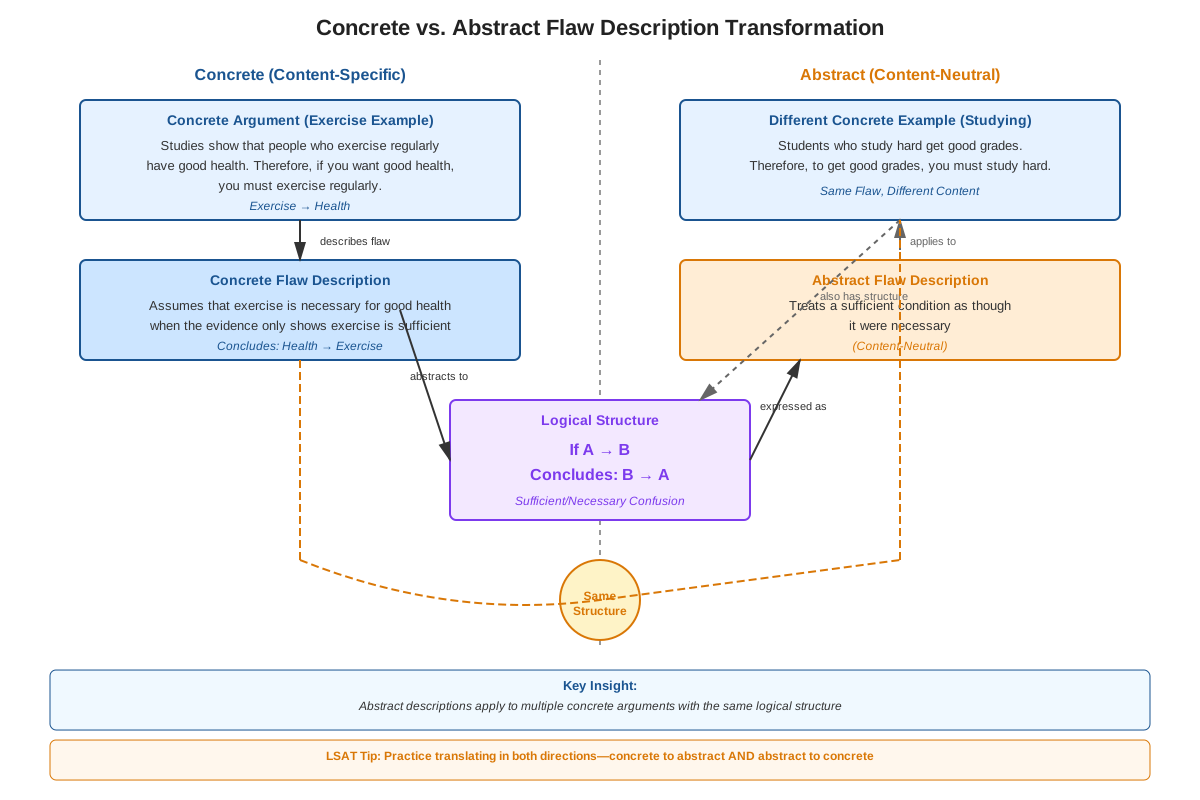
Abstract flaw descriptions represent one of the most challenging and frequently tested components of LSAT Logical Reasoning sections. Unlike concrete flaw descriptions that reference specific content from an argument (such as "the argument fails to consider that the survey respondents might have been biased"), abstract flaw descriptions characterize logical errors using general, content-neutral language (such as "the argument treats a condition sufficient for bringing about a result as though it were necessary for doing so"). These descriptions strip away the specific subject matter and focus purely on the logical structure of the reasoning error.
Mastering abstract flaw descriptions is essential for LSAT success because they appear not only in flaw questions but also in parallel reasoning questions, method of reasoning questions, and even some strengthen/weaken questions. The LSAT frequently uses abstract language in answer choices to test whether students truly understand logical structures or merely recognize surface-level content. Students who can translate between concrete arguments and abstract logical patterns demonstrate the sophisticated analytical skills that law schools seek. This skill separates high scorers from average performers, as it requires deep comprehension of logical relationships rather than superficial pattern matching.
The relationship between abstract flaw descriptions and other Logical Reasoning concepts is fundamental and bidirectional. Understanding formal logic, conditional reasoning, causal reasoning, and argument structure provides the foundation for recognizing abstract flaws. Conversely, mastering abstract flaw descriptions enhances performance across all question types by developing the ability to see through content to underlying logical form. This metacognitive skill—thinking about thinking patterns—represents the pinnacle of LSAT Logical Reasoning mastery and directly translates to the analytical demands of legal reasoning.
Learning Objectives
- [ ] Identify how abstract flaw descriptions appear in LSAT questions
- [ ] Explain the reasoning pattern behind abstract flaw descriptions
- [ ] Apply abstract flaw descriptions to solve LSAT-style problems accurately
- [ ] Translate concrete arguments into abstract logical structures
- [ ] Distinguish between structurally similar but logically distinct flaw types
- [ ] Recognize the same abstract flaw across different content domains
- [ ] Evaluate answer choices by matching abstract descriptions to argument structures
Prerequisites
- Basic argument structure: Understanding premises, conclusions, and assumptions is necessary because abstract flaw descriptions characterize errors in how premises relate to conclusions
- Conditional logic fundamentals: Familiarity with sufficient and necessary conditions enables recognition of the most common abstract flaws involving conditional reasoning errors
- Common concrete flaws: Prior exposure to flaws described in concrete terms provides the foundation for abstracting these patterns into general logical forms
- Formal logic notation: Basic ability to symbolize arguments helps visualize the structural patterns that abstract descriptions reference
Why This Topic Matters
Abstract flaw descriptions matter because they test the deepest level of logical comprehension required for legal reasoning. Lawyers must identify structural weaknesses in arguments regardless of subject matter—whether analyzing contract law, constitutional issues, or tort claims. The ability to recognize that two arguments commit the same logical error despite discussing entirely different topics demonstrates the transferable analytical skills essential for legal practice.
On the LSAT, abstract flaw descriptions appear with remarkable frequency. Approximately 60-70% of flaw question answer choices use at least partially abstract language, and 30-40% use fully abstract descriptions. These questions typically appear 4-6 times per Logical Reasoning section, making them among the highest-yield topics for score improvement. Beyond dedicated flaw questions, abstract reasoning patterns appear in parallel flaw questions (which require matching logical structures), method of reasoning questions (which ask students to describe argumentative techniques abstractly), and even in some principle questions.
The LSAT presents abstract flaw descriptions in several characteristic ways. Answer choices might describe conditional reasoning errors ("mistakes a sufficient condition for a necessary condition"), sampling problems ("generalizes from an unrepresentative sample"), causal reasoning flaws ("confuses correlation with causation" or "fails to consider alternative explanations"), circular reasoning ("presumes what it seeks to establish"), part-whole confusion ("attributes a characteristic of the parts to the whole"), and quantifier errors ("treats evidence that most members have a property as establishing that all members have that property"). Recognizing these patterns across diverse content areas represents a crucial LSAT skill.
Core Concepts
What Makes a Flaw Description Abstract
An abstract flaw description characterizes a logical error using general, content-neutral terminology that applies to the structure of reasoning rather than its specific subject matter. The key distinguishing feature is that abstract descriptions could theoretically apply to arguments about any topic—politics, science, economics, or everyday life—because they reference only the logical relationships between claims, not the claims themselves.
Consider the difference between these two descriptions of the same flaw:
- Concrete: "The argument fails to consider that factors other than the new traffic light might have caused the reduction in accidents"
- Abstract: "The argument fails to consider alternative explanations for the observed phenomenon"
The abstract version removes all specific content (traffic lights, accidents) and describes only the logical structure (failing to rule out alternatives when inferring causation). This abstraction requires students to recognize the underlying reasoning pattern independent of subject matter.
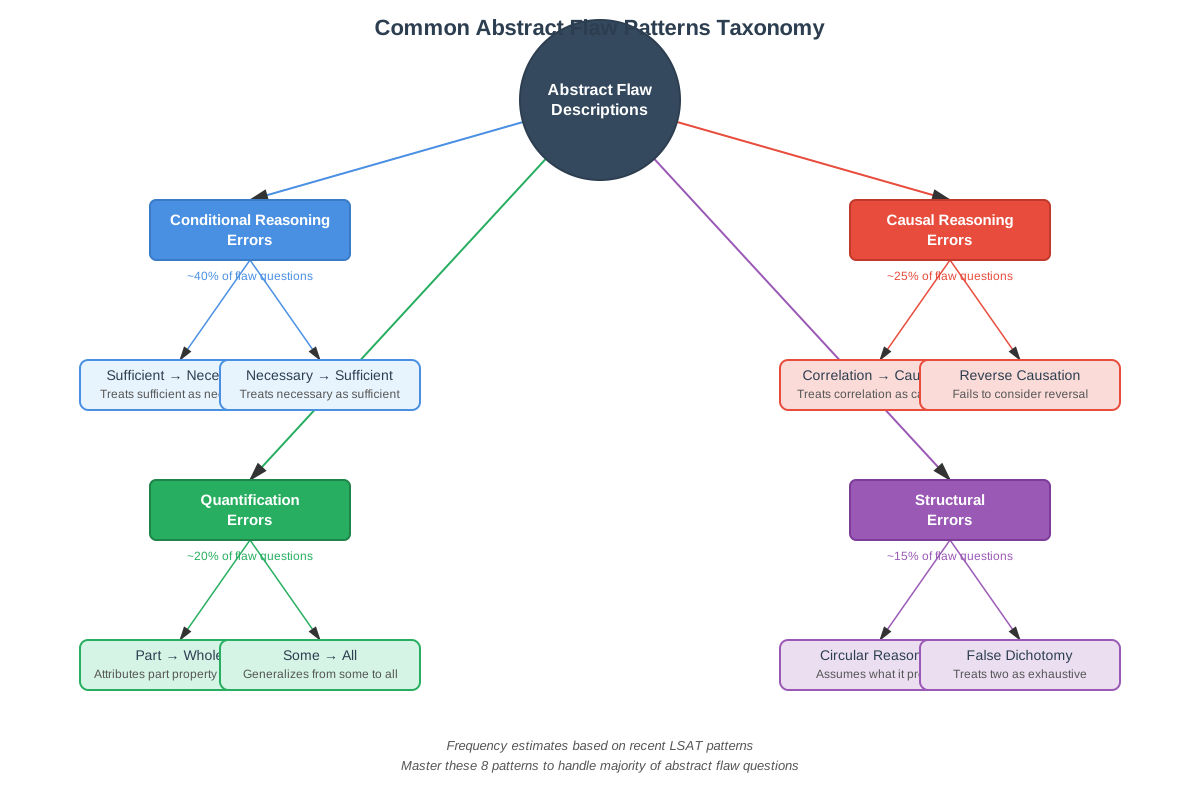
Categories of Abstract Flaw Descriptions
Conditional Reasoning Flaws
The most frequently tested abstract flaws involve errors in conditional logic. These include:
Sufficient/Necessary Confusion: The argument treats a condition that is sufficient for a result as though it were necessary, or vice versa. For example, an argument might establish that having a law degree is sufficient for understanding contract law, then conclude that someone without a law degree cannot understand contract law (treating the sufficient condition as necessary).
Contrapositive Errors: The argument mistakes the inverse or converse of a conditional statement for its logically equivalent contrapositive. If the premises establish "If A, then B," the argument might invalidly conclude "If not A, then not B" (inverse) or "If B, then A" (converse).
Conditional Chaining Errors: The argument fails to properly connect conditional statements or reverses the direction of implication when chaining multiple conditionals together.
| Flaw Type | Abstract Description | Logical Form |
|---|---|---|
| Affirming the Consequent | Treats evidence for the truth of a claim as though it established the claim's necessity | If A→B, B is true, therefore A must be true |
| Denying the Antecedent | Concludes that because a sufficient condition is absent, the result cannot occur | If A→B, A is false, therefore B must be false |
| Necessity/Sufficiency Swap | Mistakes what is required for what is adequate | Treats "only if B" as "if B" |
Causal Reasoning Flaws
Correlation-Causation Confusion: The argument treats a correlation or temporal sequence as sufficient evidence for a causal relationship. This abstract description applies whenever an argument observes that two phenomena occur together and concludes that one causes the other without ruling out alternative explanations.
Reverse Causation: The argument assumes a particular causal direction without considering that the effect might actually be the cause. Abstractly, this means treating the relationship between two correlated events as unidirectional when it might be reversed.
Common Cause Neglect: The argument fails to consider that both observed phenomena might result from a third, unmentioned factor. The abstract pattern involves inferring direct causation between A and B without considering that C might cause both.
Sampling and Generalization Flaws
Unrepresentative Sample: The argument generalizes from a sample to a population without establishing that the sample accurately represents the population. This abstract description applies regardless of what is being sampled—people, events, time periods, or locations.
Hasty Generalization: The argument draws a universal or broad conclusion from insufficient evidence. The abstract pattern involves moving from "some" or "a few observed cases" to "all" or "most" without adequate justification.
Composition/Division Fallacies: The argument attributes characteristics of parts to the whole (composition) or characteristics of the whole to all parts (division). Abstractly, this involves confusing properties that apply at one level of analysis with properties at another level.
Circular Reasoning and Question-Begging
Presumes What It Seeks to Establish: The argument includes its conclusion as a premise, either explicitly or implicitly. This abstract description identifies arguments where the reasoning is circular—the conclusion is assumed in order to prove the conclusion.
Definitional Circularity: The argument uses a definition or characterization that already assumes the truth of what needs to be proven. The abstract pattern involves embedding the conclusion within the meaning of terms used in the premises.
Quantifier and Scope Errors
Universal-Particular Confusion: The argument treats evidence about some members of a group as though it applied to all members, or vice versa. Abstractly, this involves confusing "some," "most," and "all" in ways that make the reasoning invalid.
Scope Shift: The argument shifts between different populations, time periods, or contexts without justification. The abstract description identifies reasoning that applies evidence from one domain to draw conclusions about a different domain.
Recognizing Abstract Patterns Across Content
The crucial skill in mastering abstract flaw descriptions involves recognizing the same logical structure across radically different content. Consider these three arguments that commit the same abstract flaw:
- Medical: "Patients who take vitamin C recover from colds faster. Therefore, vitamin C must cause faster recovery."
- Economic: "Countries that reduced interest rates experienced economic growth. Therefore, reducing interest rates must cause economic growth."
- Educational: "Students who attend review sessions score higher on exams. Therefore, attending review sessions must cause higher scores."
All three commit the abstract flaw of "treating correlation as sufficient evidence for causation" or "failing to consider alternative explanations for the observed correlation." The content differs entirely, but the logical structure remains identical. Mastering abstract flaw descriptions means seeing through the surface content to recognize this underlying pattern.
Translating Between Concrete and Abstract
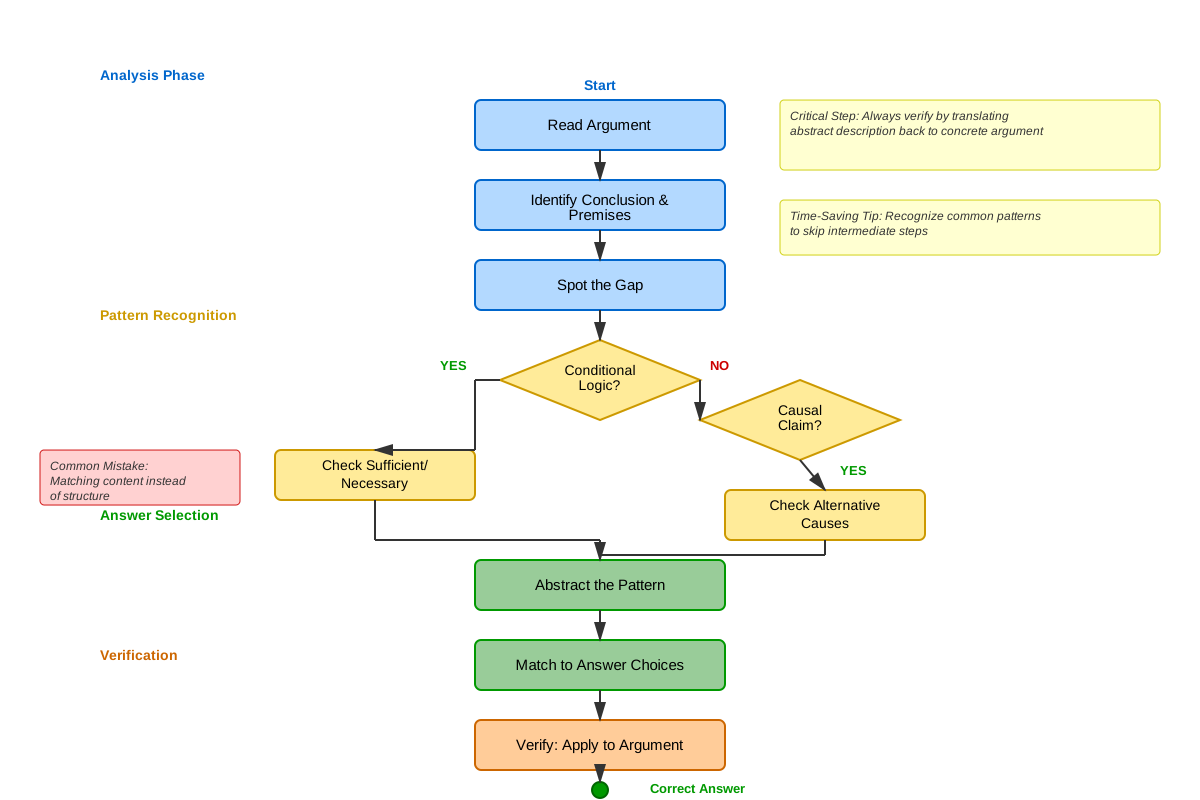
Effective LSAT performance requires bidirectional translation: moving from concrete arguments to abstract descriptions (when answering flaw questions) and from abstract descriptions to concrete arguments (when eliminating wrong answers). This translation process involves several steps:
- Identify the argument's conclusion and premises: Determine what the argument is trying to prove and what evidence it offers
- Analyze the logical relationship: How do the premises supposedly support the conclusion? What logical moves does the argument make?
- Spot the gap or error: Where does the reasoning break down? What assumption is unwarranted?
- Characterize the error structurally: Describe the flaw without reference to the specific content
- Match to abstract descriptions: Find the answer choice that captures this structural error
Concept Relationships
Abstract flaw descriptions connect to virtually every other Logical Reasoning concept because they represent the meta-level understanding of how arguments can go wrong. The relationship flows as follows:
Argument Structure → Flaw Recognition → Abstract Description: Understanding how premises and conclusions relate enables identification of where reasoning breaks down, which then allows characterization of that breakdown in abstract terms.
Formal Logic → Conditional Flaws → Abstract Conditional Descriptions: Mastery of conditional logic (sufficient/necessary conditions, contrapositives) directly enables recognition of conditional reasoning flaws, which are then described abstractly in answer choices.
Causal Reasoning → Causal Flaws → Abstract Causal Descriptions: Understanding how causal arguments work (and what they require) allows identification of causal reasoning errors, which appear in abstract form as "correlation-causation confusion" or "failure to consider alternative explanations."
Assumption Questions ↔ Flaw Questions: These question types are inverse operations. Assumption questions ask what must be true for an argument to work; flaw questions identify why an argument doesn't work. Abstract flaw descriptions often point to missing assumptions.
Parallel Reasoning → Abstract Pattern Matching: Parallel reasoning questions require matching abstract logical structures across different content domains, making abstract flaw description skills directly transferable.
The progression of mastery follows this path: Concrete Flaw Recognition → Pattern Identification → Abstraction → Cross-Domain Application → Rapid Abstract Matching. Students typically begin by recognizing flaws described concretely, then learn to identify patterns across similar arguments, develop the ability to describe these patterns abstractly, apply this understanding across different content areas, and finally achieve rapid recognition of abstract descriptions in answer choices.
High-Yield Facts
⭐ Abstract flaw descriptions characterize logical errors using content-neutral language that focuses on reasoning structure rather than specific subject matter
⭐ The most frequently tested abstract flaws involve conditional reasoning errors, particularly sufficient/necessary condition confusion
⭐ "Treats correlation as sufficient evidence for causation" and "fails to consider alternative explanations" are among the most common abstract causal flaw descriptions
⭐ Abstract descriptions can apply to arguments about any topic because they reference only logical relationships, not content
⭐ Circular reasoning is abstractly described as "presumes what it seeks to establish" or "takes for granted the very claim it sets out to prove"
- Composition fallacies are abstractly described as "attributes a characteristic of the parts to the whole"
- Division fallacies are abstractly described as "attributes a characteristic of the whole to each individual part"
- Unrepresentative sampling flaws appear as "generalizes from a sample that is not representative of the population"
- Scope shifts are described as "applies evidence from one context to draw conclusions about a different context"
- Quantifier confusion appears as "treats evidence that most members have a property as establishing that all members have that property"
- Ad hominem reasoning is abstractly described as "rejects a claim based on the source rather than the merits of the claim itself"
- False dichotomy appears as "treats two alternatives as exhaustive when others exist"
- Equivocation is described as "relies on an ambiguous term being used in different senses"
Quick check — test yourself on Abstract flaw descriptions so far.
Try Flashcards →Common Misconceptions
Misconception: Abstract flaw descriptions are just more complicated ways of saying the same thing as concrete descriptions, so understanding one means understanding the other.
Correction: Abstract descriptions require a fundamentally different cognitive skill—recognizing logical structure independent of content. Many students can identify flaws when described concretely but struggle when the same flaw is described abstractly because they haven't developed the ability to see through content to structure. This is why the LSAT uses abstract language: it tests deeper comprehension.
Misconception: If an answer choice uses abstract language, it must be correct because the LSAT prefers abstract descriptions.
Correction: While the LSAT frequently uses abstract language, not all abstract descriptions are correct. Wrong answers often use abstract language that sounds sophisticated but doesn't actually match the argument's logical structure. Students must verify that the abstract description accurately characterizes the specific reasoning error in the argument.
Misconception: Abstract flaw descriptions are memorizable templates that can be mechanically matched to arguments.
Correction: While certain abstract descriptions appear frequently, successful application requires genuine understanding of logical structures, not mere memorization. The LSAT creates variations and combinations of flaws that prevent purely mechanical matching. Students must understand what each abstract description means logically to apply it correctly.
Misconception: The same abstract flaw description always indicates the same type of error.
Correction: Some abstract language can describe multiple distinct logical errors depending on context. For example, "fails to establish" could refer to insufficient evidence, a sampling problem, a causal reasoning gap, or other issues. Students must consider how the abstract description applies to the specific argument structure.
Misconception: If an argument has multiple flaws, the correct answer must describe all of them.
Correction: LSAT flaw questions ask for "a flaw" or "the flaw in the reasoning," not necessarily every flaw. The correct answer needs to accurately describe one significant flaw, even if others exist. Students should focus on finding an answer that correctly characterizes a clear logical error rather than seeking a description that captures every weakness.
Worked Examples
Example 1: Conditional Reasoning Flaw
Argument: "Every successful entrepreneur has demonstrated creativity in solving business problems. Jamal has demonstrated exceptional creativity in solving business problems. Therefore, Jamal will certainly become a successful entrepreneur."
Analysis Process:
Step 1 - Identify Structure:
- Premise: All successful entrepreneurs have creativity (SE → C)
- Premise: Jamal has creativity (J → C)
- Conclusion: Jamal will be a successful entrepreneur (J → SE)
Step 2 - Identify the Logical Error: The argument establishes that creativity is necessary for entrepreneurial success (you can't be a successful entrepreneur without it), but then treats creativity as sufficient for success (having it means you will succeed). This is a classic sufficient/necessary confusion.
Step 3 - Abstract Description: The argument "treats a condition necessary for a result as though it were sufficient for that result" or "mistakes a necessary condition for a sufficient condition."
Step 4 - Eliminate Wrong Answers:
- ❌ "Assumes without justification that creativity is the only factor in entrepreneurial success" - Too concrete and doesn't capture the conditional logic error
- ❌ "Generalizes from a single case to all entrepreneurs" - Mischaracterizes the reasoning; the argument doesn't generalize from Jamal to others
- ✅ "Treats a characteristic necessary for a particular outcome as though it were sufficient for that outcome" - Correctly identifies the conditional reasoning flaw abstractly
- ❌ "Fails to consider that Jamal might lack other qualities" - Too concrete; doesn't describe the structural error
- ❌ "Confuses correlation with causation" - Wrong flaw type entirely
Connection to Learning Objectives: This example demonstrates how to identify abstract flaw descriptions in answer choices, explain the reasoning pattern (necessary/sufficient confusion), and apply this understanding to eliminate wrong answers and select the correct one.
Example 2: Causal Reasoning Flaw
Argument: "A recent study found that cities with higher rates of ice cream consumption also have higher rates of drowning. Clearly, increased ice cream consumption leads to more drowning incidents. Therefore, cities should consider restricting ice cream sales to reduce drowning deaths."
Analysis Process:
Step 1 - Identify Structure:
- Premise: Correlation exists between ice cream consumption and drowning rates
- Conclusion: Ice cream consumption causes drowning
- Further conclusion: Restricting ice cream will reduce drowning
Step 2 - Identify the Logical Error: The argument observes a correlation and immediately concludes causation without considering alternative explanations. The obvious alternative is that both ice cream consumption and swimming (which leads to drowning) increase during hot weather—a common cause for both phenomena.
Step 3 - Abstract Description: The argument "treats a correlation between two phenomena as sufficient evidence that one causes the other" or "fails to consider that both phenomena might result from a common underlying cause."
Step 4 - Evaluate Abstract Answer Choices:
- ❌ "Assumes that correlation implies causation in all cases" - Too strong; the flaw is about this specific case, not a universal claim
- ❌ "Fails to provide statistical evidence for the correlation" - Misses the point; the correlation is granted, the problem is inferring causation
- ✅ "Takes a correlation between two phenomena as sufficient grounds for concluding that one causes the other" - Precisely captures the causal reasoning flaw abstractly
- ❌ "Generalizes from cities to individuals" - Wrong flaw type; no such generalization occurs
- ❌ "Treats a sufficient condition as necessary" - Wrong category; this is a causal flaw, not a conditional logic flaw
Alternative Correct Abstract Description: "Fails to consider that an observed correlation might be explained by a factor that causally contributes to both correlated phenomena"
Connection to Learning Objectives: This example shows how the same logical error (correlation-causation confusion) can be described using different abstract formulations, all of which focus on the structural reasoning error rather than the specific content about ice cream and drowning.
Exam Strategy
Approaching Abstract Flaw Questions
When encountering a flaw question with abstract answer choices, follow this systematic approach:
- Read the argument carefully and identify the conclusion first: Understanding what the argument is trying to prove provides the anchor for analyzing how the reasoning fails.
- Articulate the flaw in your own words before looking at answers: Predict what's wrong with the reasoning. Even a rough, concrete description helps prevent being swayed by sophisticated-sounding but incorrect abstract language.
- Translate your concrete understanding into structural terms: Ask yourself, "What type of logical move is this argument making? Is it a conditional claim? A causal inference? A generalization?" This helps bridge from concrete to abstract.
- Use process of elimination aggressively: Abstract language can be confusing, so eliminating clearly wrong answers often proves more efficient than seeking the perfect match immediately.
Trigger Words and Phrases
Certain words in answer choices signal specific types of abstract flaws:
Conditional Reasoning Triggers:
- "sufficient," "necessary," "required," "adequate"
- "only if," "unless," "without"
- "condition," "prerequisite," "guarantee"
Causal Reasoning Triggers:
- "cause," "effect," "result," "lead to," "bring about"
- "correlation," "association," "coincidence"
- "explanation," "account for," "responsible for"
Quantifier Triggers:
- "all," "some," "most," "none," "every," "any"
- "universal," "particular," "general"
- "each," "individual," "whole," "part"
Circular Reasoning Triggers:
- "presumes," "assumes," "takes for granted"
- "what it seeks to establish," "what it attempts to prove"
- "begs the question" (in its technical sense)
Process of Elimination Tips
Eliminate answers that:
- Describe flaws that simply don't occur in the argument (e.g., an ad hominem description when no one's character is attacked)
- Use abstract language from the wrong category (e.g., conditional language for a causal argument)
- Are too specific and reference content rather than structure
- Describe the argument's reasoning accurately rather than identifying a flaw
- Confuse the direction of reasoning (e.g., saying the argument goes from specific to general when it does the opposite)
Keep answers that:
- Match the logical structure you identified
- Use appropriate category language (conditional for conditional flaws, causal for causal flaws)
- Could theoretically apply to arguments about completely different topics
- Identify a genuine gap between premises and conclusion
Time Allocation
Abstract flaw questions typically require 1:30-2:00 minutes because the abstract language demands careful analysis. However, strong preparation can reduce this time:
- Spend 30-40 seconds on the argument itself, ensuring you understand the reasoning structure
- Spend 10-15 seconds articulating the flaw to yourself
- Spend 40-60 seconds evaluating answer choices, using elimination
- Spend 10-15 seconds confirming your selection by checking it against the argument
If you find yourself spending more than 2 minutes, you may be overthinking. Trust your structural analysis and move forward rather than second-guessing abstract language interpretations.
Memory Techniques
The SCAN Acronym for Flaw Categories
Sufficient/Necessary (conditional reasoning flaws)
Causation (correlation-causation, alternative explanations, reverse causation)
Assumption (circular reasoning, question-begging)
Numbers (quantifier errors, sampling flaws, part-whole confusion)
When reading an argument, SCAN through these categories to quickly identify which type of flaw might be present.
The "Content Eraser" Visualization
Imagine taking a highlighter and erasing all specific content words (nouns, specific verbs) from an argument, leaving only logical structure words (if, then, all, some, because, therefore, causes, correlates). What remains is the abstract skeleton. Practice this mental exercise to develop the ability to see through content to structure.
The "Different Topic Test"
When evaluating whether an answer choice is truly abstract, ask: "Could this exact description apply to an argument about a completely different topic?" If yes, it's genuinely abstract. If no, it's too content-specific.
Common Abstract Flaw Phrases to Memorize
Create flashcards for these high-frequency abstract descriptions:
- "Treats a necessary condition as sufficient"
- "Mistakes correlation for causation"
- "Generalizes from an unrepresentative sample"
- "Presumes what it seeks to establish"
- "Attributes a property of the parts to the whole"
- "Fails to consider alternative explanations"
- "Treats absence of evidence as evidence of absence"
- "Confuses a claim's source with its validity"
The Parallel Argument Technique
For each abstract flaw description you learn, create three parallel arguments with completely different content that all commit the same flaw. This reinforces that the abstract description captures structure, not content, and helps you recognize the pattern across diverse contexts.
Summary
Abstract flaw descriptions represent the LSAT's method of testing whether students understand logical structures independent of content. These descriptions characterize reasoning errors using general, content-neutral language that focuses on the relationships between claims rather than the claims themselves. Mastering this skill requires developing the ability to see through surface content to underlying logical patterns—recognizing that arguments about medicine, economics, and education might all commit the identical structural error despite discussing entirely different subjects.
The most frequently tested abstract flaws fall into four main categories: conditional reasoning errors (particularly sufficient/necessary confusion), causal reasoning flaws (especially correlation-causation confusion and failure to consider alternatives), sampling and generalization problems (unrepresentative samples and hasty generalizations), and circular reasoning (presuming what one seeks to establish). Success requires bidirectional translation skills—moving from concrete arguments to abstract descriptions when answering questions, and from abstract descriptions to concrete examples when eliminating wrong answers. Students must learn to articulate flaws structurally, recognize trigger words that signal different flaw types, and systematically eliminate answers that don't match the argument's logical structure. This meta-level understanding of reasoning patterns represents the pinnacle of LSAT Logical Reasoning mastery and directly translates to the analytical demands of legal education and practice.
Key Takeaways
- Abstract flaw descriptions characterize logical errors using content-neutral language that applies to reasoning structure rather than specific subject matter
- The four main categories of abstract flaws are conditional reasoning errors, causal reasoning flaws, sampling/generalization problems, and circular reasoning
- Successful application requires translating between concrete arguments and abstract logical structures in both directions
- The most tested abstract descriptions involve sufficient/necessary confusion, correlation-causation errors, and failure to consider alternative explanations
- Trigger words in answer choices (sufficient, necessary, cause, correlation, all, some) signal specific types of abstract flaws
- Process of elimination is crucial because abstract language can be confusing; eliminate answers that describe flaws that don't occur or use the wrong category of logical language
- Developing the ability to recognize the same logical structure across different content domains is essential for LSAT success and legal reasoning
Related Topics
Parallel Reasoning Questions: These questions require matching abstract logical structures across different arguments, making abstract pattern recognition skills directly applicable. Mastering abstract flaw descriptions provides the foundation for identifying structurally identical arguments.
Method of Reasoning Questions: These questions ask students to describe argumentative techniques abstractly, using similar content-neutral language. The skills developed for abstract flaw descriptions transfer directly to characterizing valid reasoning methods.
Principle Questions: Some principle questions require abstracting specific arguments into general rules or applying abstract principles to concrete situations, utilizing the same translation skills developed for abstract flaw descriptions.
Formal Logic and Conditional Reasoning: Deeper study of formal logic systems and advanced conditional reasoning provides the theoretical foundation for understanding why certain abstract descriptions accurately characterize logical errors.
Argument Structure and Diagramming: Advanced techniques for visually representing argument structures help develop the ability to see logical patterns independent of content, reinforcing abstract reasoning skills.
Practice CTA
Now that you understand abstract flaw descriptions conceptually, the crucial next step is application. Attempt the practice questions to test your ability to recognize abstract patterns in real LSAT-style arguments. Focus on translating between concrete reasoning and abstract descriptions, and pay special attention to questions where you're tempted by wrong answers—these reveal gaps in your structural understanding. Use the flashcards to reinforce recognition of common abstract flaw phrases until you can instantly match them to logical patterns. Remember: abstract reasoning is a skill that improves dramatically with deliberate practice. Each question you work through strengthens your ability to see through content to structure, bringing you closer to LSAT mastery and the analytical excellence required for legal reasoning.
Sign up free to keep reading
Create a free AnvayaPrep account to finish this LSAT guide on Abstract flaw descriptions — plus flashcards and practice questions.