Overview
The appeal to authority flaw represents one of the most frequently tested reasoning errors on the LSAT Logical Reasoning section. This flaw occurs when an argument relies on the testimony or opinion of an authority figure to support its conclusion, but the authority's expertise is questionable, irrelevant to the topic at hand, or insufficient to justify the conclusion. Understanding this flaw is critical because it appears in multiple question types, including Flaw questions, Weaken questions, and Strengthen questions, making it a high-yield topic for test preparation.
On the LSAT, recognizing an appeal to authority flaw requires students to evaluate whether the cited authority possesses genuine expertise in the relevant domain, whether that expertise is current and applicable, and whether expert testimony alone can adequately support the argument's conclusion. The test makers frequently craft arguments that cite impressive-sounding credentials or authoritative sources while subtly introducing gaps between the authority's area of expertise and the argument's subject matter. Mastering this concept enables students to quickly identify flawed reasoning patterns and eliminate incorrect answer choices with confidence.
This topic connects fundamentally to broader logical reasoning principles, particularly the evaluation of evidence quality and the assessment of argument structure. The appeal to authority flaw intersects with other common LSAT flaws such as hasty generalizations, unrepresentative samples, and circular reasoning. By understanding how authority-based reasoning can go wrong, students develop sharper critical thinking skills that apply across the entire Logical Reasoning section, enhancing their ability to analyze arguments systematically and identify subtle logical weaknesses that distinguish correct answers from attractive distractors.
Learning Objectives
- [ ] Identify how Appeal to authority flaw appears in LSAT questions
- [ ] Explain the reasoning pattern behind Appeal to authority flaw
- [ ] Apply Appeal to authority flaw to solve LSAT-style problems accurately
- [ ] Distinguish between legitimate appeals to authority and fallacious ones
- [ ] Recognize the specific conditions that make an authority citation problematic
- [ ] Evaluate whether an authority's expertise is relevant to the argument's conclusion
- [ ] Predict answer choice patterns in questions featuring appeal to authority flaws
Prerequisites
- Basic argument structure: Understanding premises, conclusions, and how they connect is essential for identifying where authority-based reasoning appears in an argument's logical chain.
- Evidence evaluation: Recognizing different types of evidence (empirical, testimonial, statistical) helps distinguish when authority testimony is appropriate versus when it's insufficient.
- Flaw question format: Familiarity with how the LSAT asks students to identify reasoning errors provides the framework for recognizing appeal to authority flaws in context.
- Scope and degree concepts: Understanding how arguments can exceed their evidential support helps identify when authority citations are stretched beyond their legitimate application.
Why This Topic Matters
The lsat appeal to authority flaw appears with remarkable frequency across LSAT administrations, making it one of the highest-yield topics for focused study. Research on LSAT question patterns indicates that authority-based reasoning appears in approximately 8-12% of Logical Reasoning questions, either as the primary flaw or as a component of the argument structure. This frequency means that mastering this single flaw type can directly impact performance on 3-5 questions per test, representing a significant score improvement opportunity.
Beyond test performance, understanding appeal to authority flaws develops critical thinking skills essential for legal reasoning and professional practice. Attorneys must constantly evaluate expert testimony, assess the credibility of sources, and determine when authority citations strengthen or weaken arguments. The LSAT tests this skill because it directly predicts success in law school case analysis, where students must distinguish between binding precedent, persuasive authority, and irrelevant citations.
On the exam, appeal to authority flaws appear most commonly in flaw questions (where students must identify the reasoning error), Weaken questions (where students must undermine authority-based reasoning), and Strengthen questions (where students must bolster questionable authority citations). The flaw also appears in Method of Reasoning questions, where students must describe how an argument uses authority testimony. Recognizing the various manifestations of this flaw across question types enables strategic, efficient problem-solving and reduces the cognitive load during timed test conditions.
Core Concepts
Definition of Appeal to Authority Flaw
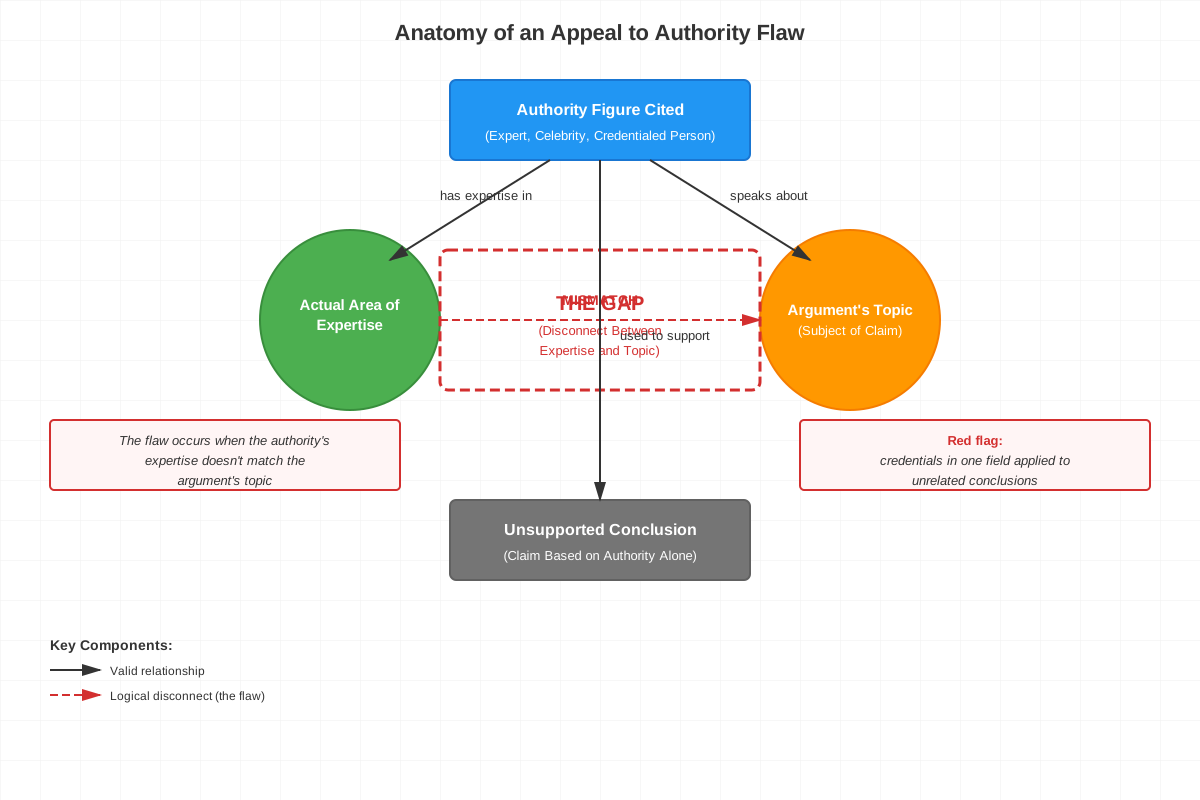
An appeal to authority flaw occurs when an argument treats the opinion or testimony of an authority figure as sufficient justification for a conclusion, despite problems with the authority's expertise, relevance, or the appropriateness of relying solely on testimony. Not all appeals to authority are fallacious—citing genuine experts within their domain of expertise represents legitimate reasoning. The flaw emerges when specific conditions undermine the authority's credibility or applicability.
The fundamental reasoning pattern follows this structure: "Authority X claims Y; therefore, Y is true." This becomes problematic when the argument fails to establish that Authority X possesses relevant expertise, that the expertise applies to the specific claim, or that expert opinion alone suffices for the conclusion. The LSAT tests whether students can identify the gap between "an authority said it" and "it is therefore true."
Conditions That Create the Flaw
Several specific conditions transform a legitimate authority citation into a logical flaw:
Irrelevant Expertise: The authority possesses genuine credentials but in an unrelated field. For example, citing a Nobel Prize-winning physicist's opinion on economic policy represents irrelevant expertise. The authority's accomplishments don't transfer across domains.
Outdated Expertise: The authority once possessed relevant knowledge, but the field has evolved. A doctor who practiced 40 years ago may lack current medical knowledge, making their testimony unreliable for contemporary medical conclusions.
Insufficient Expertise: The authority has some knowledge but lacks the depth required for the specific claim. A general practitioner's opinion on a rare neurological condition may be insufficient compared to a specialist's expertise.
Biased Authority: The authority has conflicts of interest or motivations that compromise objectivity. A pharmaceutical company executive testifying about their own drug's safety presents obvious bias concerns.
Consensus Matters: The argument cites one authority when expert consensus differs. In fields where experts disagree, citing a single authority ignores the broader professional debate.
Legitimate vs. Fallacious Authority Appeals
Understanding when authority citations are appropriate helps identify the flaw by contrast:
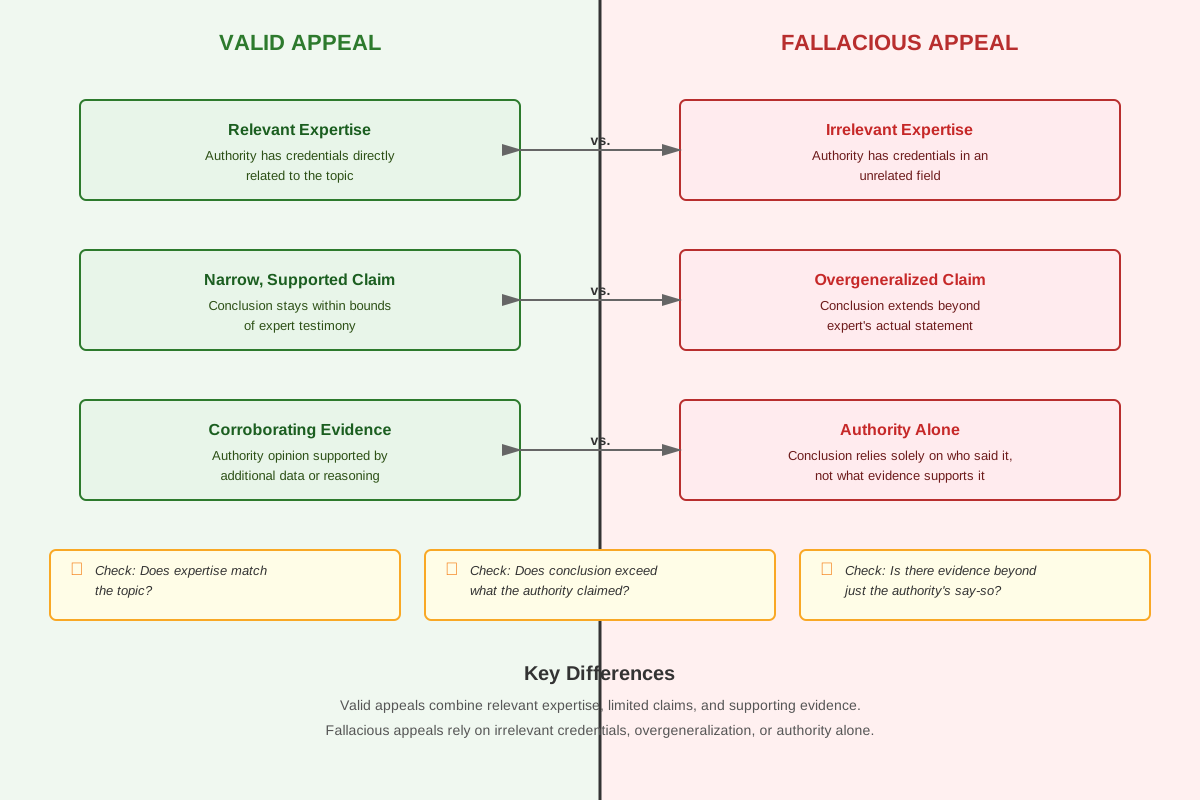
| Legitimate Appeal | Fallacious Appeal |
|---|---|
| Expert has relevant credentials in the specific field | Expert's credentials are in an unrelated area |
| Expert's knowledge is current and applicable | Expert's knowledge is outdated or theoretical |
| Expert consensus supports the claim | Single expert contradicts broader consensus |
| Expert has no apparent conflicts of interest | Expert has financial or personal stakes in the outcome |
| Expert testimony supplements other evidence | Expert testimony is the sole evidence provided |
| The claim falls within the expert's domain | The claim extends beyond any expert's capacity to verify |
The Reasoning Gap
The core logical problem in appeal to authority flaws involves an evidential gap: the argument assumes that authority testimony automatically translates to truth without establishing the necessary connections. Even genuine experts can be wrong, disagree with each other, or speak beyond their expertise. The flaw lies in treating authority as a shortcut that bypasses the need for substantive evidence or reasoning.
LSAT arguments featuring this flaw typically present impressive credentials, institutional affiliations, or experience to create an aura of credibility. The test makers expect students to look past these surface-level indicators and evaluate whether the authority's expertise genuinely supports the specific conclusion. This requires distinguishing between "this person is generally knowledgeable" and "this person's knowledge makes this particular conclusion reliable."
Variations in LSAT Presentations
The LSAT presents appeal to authority flaws through several distinct patterns:
- Direct Citation: "Dr. Smith, a leading researcher, claims X; therefore, X is true."
- Institutional Authority: "The prestigious University conducted a study showing X; therefore, X is true."
- Experience-Based Authority: "Having worked in the field for 30 years, Jones believes X; therefore, X is true."
- Consensus Claim: "Most experts agree that X; therefore, X is true" (when the consensus is unverified or irrelevant).
- Self-Proclaimed Expertise: "As an expert in this area, I can confirm X; therefore, X is true."
Each variation requires students to identify the specific weakness: Is the expertise relevant? Is the authority qualified? Does testimony alone suffice? Is there potential bias? These questions guide the analysis of authority-based reasoning.
Why This Flaw Is Tempting
The appeal to authority flaw succeeds as a distractor because humans naturally defer to expertise in daily life. We trust doctors for medical advice, mechanics for car repairs, and lawyers for legal guidance. This practical reliance on expertise makes it psychologically difficult to question authority citations in arguments. The LSAT exploits this cognitive tendency by presenting arguments where authority seems reasonable on the surface but contains subtle logical gaps upon closer examination.
Concept Relationships
The appeal to authority flaw connects to several other logical reasoning concepts, forming a network of related ideas. Understanding these connections deepens comprehension and enables more sophisticated analysis.
Appeal to Authority → Evidence Evaluation: The authority flaw is fundamentally an evidence quality problem. It connects directly to broader principles of assessing whether evidence adequately supports conclusions. When students evaluate authority citations, they're applying general evidence evaluation skills to a specific evidence type.
Appeal to Authority → Scope Problems: Many authority-based flaws involve scope mismatches—the authority's expertise covers one domain while the conclusion addresses another. This connects to the general LSAT concept of scope, where arguments make claims that exceed their evidential foundation.
Appeal to Authority ↔ Ad Hominem Reasoning: These flaws represent opposite errors. Appeal to authority accepts claims based on who makes them (positive credibility transfer), while ad hominem rejects claims based on who makes them (negative credibility transfer). Both commit the error of focusing on the source rather than the substance of reasoning.
Appeal to Authority → Hasty Generalization: When an argument cites one expert's opinion to support a broad conclusion, it may combine appeal to authority with hasty generalization. The single expert's view becomes an insufficient sample for the general claim.
Appeal to Authority → Circular Reasoning: Some arguments use authority to establish premises that then support conclusions about that same authority's credibility, creating circular logic. For example: "Dr. Jones is reliable because she's an expert, and we know she's an expert because reliable sources say so."
The relationship map flows: Basic Argument Structure → Evidence Types → Authority as Evidence → Conditions for Valid Authority → Identifying When Conditions Fail → Recognizing the Flaw → Selecting Correct Answer Choices.
High-Yield Facts
⭐ The appeal to authority flaw occurs when an argument relies on authority testimony without establishing that the authority has relevant, current expertise in the specific domain of the conclusion.
⭐ Not all appeals to authority are fallacious—citing appropriate experts within their area of expertise represents legitimate reasoning.
⭐ The most common version on the LSAT involves citing an authority whose credentials are impressive but irrelevant to the argument's specific subject matter.
⭐ Even genuine experts can be wrong, so treating expert opinion as automatically true represents flawed reasoning.
⭐ When experts disagree in a field, citing one expert's opinion without acknowledging the controversy commits the appeal to authority flaw.
- Authority-based flaws appear in approximately 8-12% of Logical Reasoning questions across various question types.
- The flaw can appear in Flaw questions, Weaken questions, Strengthen questions, and Method of Reasoning questions.
- Bias or conflict of interest in an authority undermines the reliability of their testimony, even if they possess relevant expertise.
- Outdated expertise is a common LSAT variation—an authority who was once qualified but whose knowledge is no longer current.
- The argument must establish both that the authority is qualified AND that their expertise applies to the specific claim being made.
- Institutional prestige (citing a famous university or organization) doesn't automatically make the authority's claim reliable if other conditions aren't met.
- The LSAT often presents authority citations with impressive-sounding credentials to test whether students can look past surface credibility.
- Answer choices describing this flaw typically use language like "relies on testimony from a source whose expertise is questionable" or "treats the opinion of an authority as sufficient to establish the conclusion."
Quick check — test yourself on Appeal to authority flaw so far.
Try Flashcards →Common Misconceptions
Misconception: Any argument that cites an expert commits the appeal to authority flaw.
Correction: Citing appropriate experts within their domain of expertise is legitimate reasoning. The flaw only occurs when specific conditions undermine the authority's credibility or relevance. Students must distinguish between proper and improper uses of authority.
Misconception: If someone has a PhD or impressive credentials, their opinion on any topic is reliable.
Correction: Expertise is domain-specific. A PhD in chemistry doesn't confer expertise in economics, education policy, or literary criticism. The LSAT frequently tests whether students recognize that credentials must match the subject matter.
Misconception: The appeal to authority flaw means the authority's claim is definitely wrong.
Correction: The flaw is about the logical structure of the argument, not the truth of the conclusion. An authority might happen to be correct, but the argument still commits a flaw if it treats their testimony as sufficient justification without proper foundation. The flaw concerns reasoning quality, not factual accuracy.
Misconception: If multiple experts agree, the argument automatically avoids the appeal to authority flaw.
Correction: Consensus among experts strengthens authority-based reasoning but doesn't eliminate all potential problems. If all the experts cited have conflicts of interest, lack relevant expertise, or are working with outdated information, the consensus doesn't resolve the flaw. Additionally, the argument must actually establish that consensus exists rather than merely asserting it.
Misconception: Experience in a field automatically makes someone a reliable authority.
Correction: Experience is one factor in expertise, but it's not sufficient alone. Someone might have 30 years of experience using outdated methods, or experience in a related but distinct area. The LSAT tests whether students recognize that experience must be relevant, current, and combined with actual expertise to support authority-based reasoning.
Misconception: The appeal to authority flaw only appears in Flaw questions.
Correction: This reasoning pattern appears across multiple question types. In Weaken questions, students might need to identify that an authority lacks relevant credentials. In Strengthen questions, they might need to establish an authority's qualifications. In Method of Reasoning questions, they might need to describe how an argument uses authority testimony. Recognizing the flaw across contexts is essential for comprehensive mastery.
Worked Examples
Example 1: Classic Irrelevant Expertise
Argument: "Dr. Martinez, a renowned physicist who won the Nobel Prize for her work on quantum mechanics, recently stated that the new education reform bill will significantly improve student outcomes in public schools. Therefore, the education reform bill will indeed improve student outcomes."
Analysis:
Step 1: Identify the conclusion: The education reform bill will improve student outcomes.
Step 2: Identify the evidence: Dr. Martinez, a Nobel Prize-winning physicist, stated this claim.
Step 3: Evaluate the authority's credentials: Dr. Martinez has impressive credentials in physics, specifically quantum mechanics.
Step 4: Assess relevance: Physics expertise doesn't transfer to education policy. Understanding quantum mechanics doesn't provide special insight into educational outcomes, pedagogical methods, or policy implementation.
Step 5: Identify the flaw: The argument commits an appeal to authority flaw by relying on testimony from an authority whose expertise is irrelevant to the conclusion's subject matter.
Step 6: Predict answer choice language: Look for choices mentioning "relies on an authority whose expertise is in an unrelated field" or "treats testimony from a source as reliable without establishing relevant qualifications."
Connection to Learning Objectives: This example demonstrates how to identify the appeal to authority flaw (Objective 1), explains the reasoning pattern of citing irrelevant expertise (Objective 2), and shows the analytical process for solving LSAT-style problems (Objective 3).
Example 2: Outdated Expertise with Bias
Argument: "Johnson, who practiced as a nutritionist in the 1970s and now works as a consultant for a major sugar industry trade association, argues that recent studies linking sugar consumption to health problems are overblown. We can therefore conclude that sugar consumption does not pose significant health risks."
Analysis:
Step 1: Identify the conclusion: Sugar consumption does not pose significant health risks.
Step 2: Identify the evidence: Johnson, a former nutritionist, argues against studies linking sugar to health problems.
Step 3: Evaluate multiple authority problems:
- Outdated expertise: Johnson practiced in the 1970s, meaning his knowledge is 50+ years old in a field where research has advanced significantly.
- Conflict of interest: Johnson works for a sugar industry trade association, creating obvious bias regarding sugar's health effects.
- Insufficient current credentials: The argument doesn't establish that Johnson has maintained current expertise in nutrition science.
Step 4: Identify the compound flaw: This argument commits the appeal to authority flaw in multiple ways—the authority's expertise is outdated AND the authority has a clear conflict of interest that compromises objectivity.
Step 5: Predict answer choice language: Look for choices mentioning "relies on testimony from a source with a vested interest in the conclusion" or "treats outdated expertise as sufficient to reject current research."
Step 6: Consider question type variations: In a Weaken question, the correct answer might establish that nutrition science has fundamentally changed since the 1970s. In a Strengthen question, the correct answer might establish that Johnson has maintained current expertise and has no financial ties to the sugar industry.
Connection to Learning Objectives: This example shows how appeal to authority flaws can involve multiple problems simultaneously (Objective 4), demonstrates evaluation of authority relevance (Objective 6), and illustrates how the same flaw appears across different question types (Objective 7).
Exam Strategy
Recognition Triggers
When reading LSAT arguments, watch for these trigger phrases that signal potential appeal to authority flaws:
- "According to [expert name/title]..."
- "A leading researcher claims..."
- "Studies conducted by [institution] show..."
- "Having worked in the field for [X] years..."
- "As an expert in this area..."
- "The prestigious [organization] concluded..."
- "Most experts agree that..."
These phrases don't automatically indicate a flaw, but they signal that the argument relies on authority-based reasoning, requiring careful evaluation of the authority's credentials and relevance.
Systematic Evaluation Process
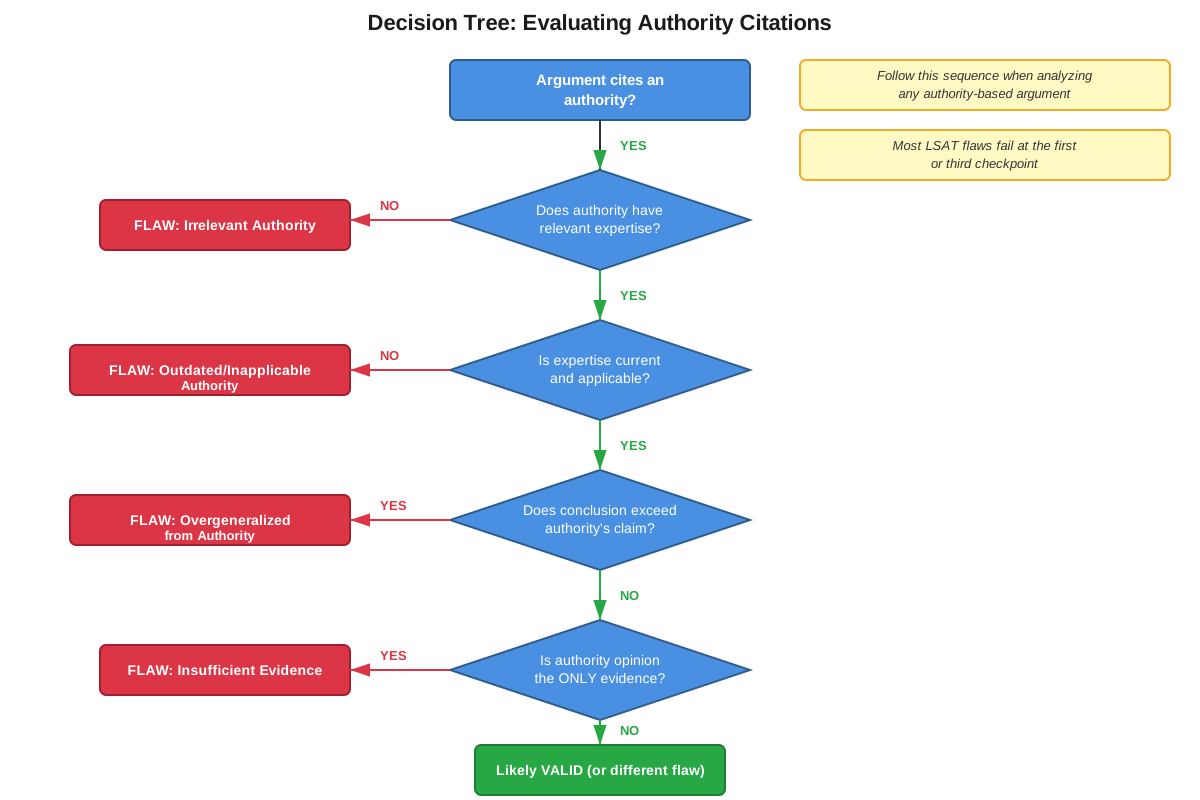
When you identify authority-based reasoning, apply this systematic evaluation:
- Identify the authority: Who is being cited? What are their credentials?
- Identify the claim: What specific conclusion does the authority support?
- Check relevance: Does the authority's expertise match the claim's subject matter?
- Check currency: Is the expertise current, or might it be outdated?
- Check bias: Does the authority have conflicts of interest or motivations that compromise objectivity?
- Check sufficiency: Even if the authority is qualified, does testimony alone suffice, or does the claim require additional evidence?
Answer Choice Patterns
In Flaw questions, correct answers describing appeal to authority typically use this language:
- "takes for granted that [authority] has relevant expertise"
- "relies on the testimony of a source whose credibility is questionable"
- "treats the opinion of an authority as sufficient to establish the conclusion"
- "fails to establish that [authority] is qualified to make claims about [subject]"
- "presumes, without justification, that [authority's] expertise extends to [subject]"
Incorrect answer choices often describe flaws that aren't present or mischaracterize the reasoning. Eliminate choices that:
- Describe circular reasoning when the argument doesn't circle back
- Mention sampling problems when no sample is discussed
- Reference causal reasoning when the argument doesn't make causal claims
- Describe ad hominem attacks when the argument doesn't attack anyone
Time Management
Appeal to authority flaws are typically quick to identify once you recognize the pattern. Spend approximately:
- 15-20 seconds reading and identifying the argument structure
- 10-15 seconds evaluating the authority's credentials and relevance
- 20-25 seconds reviewing answer choices and eliminating incorrect options
- Total: 45-60 seconds per question
If you quickly identify the authority-based reasoning and the specific problem (irrelevant expertise, bias, etc.), you can confidently select the correct answer and move forward. Don't second-guess yourself when the flaw is clear.
Process of Elimination Tips
When eliminating answer choices:
- Eliminate choices describing flaws that aren't present: If the argument doesn't make a causal claim, eliminate choices about causal reasoning.
- Eliminate choices that are too narrow or too broad: The correct answer must match the specific problem with the authority citation.
- Eliminate choices that describe the argument's content rather than its reasoning: Flaw questions ask about logical structure, not factual accuracy.
- Keep choices that identify the gap between the authority's credentials and the conclusion's subject matter: This is the core of most appeal to authority flaws on the LSAT.
Memory Techniques
The CRAB Mnemonic
Use CRAB to remember the four main conditions that create appeal to authority flaws:
- Credentials: Does the authority have appropriate credentials?
- Relevance: Is the expertise relevant to the specific claim?
- Actuality: Is the expertise current and applicable?
- Bias: Does the authority have conflicts of interest?
When you see authority-based reasoning, mentally run through CRAB to identify potential problems.
The "Transfer Test" Visualization
Visualize expertise as a spotlight that illuminates a specific area. When an argument cites an authority, imagine their expertise spotlight shining on their domain (physics, medicine, economics, etc.). Then visualize the argument's conclusion as a separate area. Ask: Does the spotlight reach the conclusion's area? If there's a gap between where the expertise spotlight shines and where the conclusion sits, you've identified an appeal to authority flaw.
The "So What?" Question
When an argument cites an authority, immediately ask: "So what?" This question forces you to evaluate whether the authority's credentials actually matter for the conclusion. "Dr. Smith is a physicist—so what? How does that make her qualified to discuss education policy?" This mental habit quickly reveals relevance gaps.
The Authority Checklist Acronym: EXPERT
- Expertise exists: Does the person actually have expertise?
- X-domain match: Does the expertise match the conclusion's domain?
- Present knowledge: Is the expertise current?
- Evidence sufficiency: Is testimony alone enough?
- Relevant application: Does the expertise apply to this specific claim?
- Trustworthiness: Is the authority unbiased?
Summary
The appeal to authority flaw represents a critical reasoning error where arguments treat expert testimony as sufficient justification for conclusions without establishing that the authority possesses relevant, current, unbiased expertise in the specific domain of the claim. This flaw appears frequently on the LSAT across multiple question types, making it essential for test success. Not all authority citations are fallacious—legitimate appeals to appropriate experts within their domain represent sound reasoning. The flaw emerges when specific conditions undermine the authority's credibility: irrelevant expertise, outdated knowledge, conflicts of interest, or insufficient qualifications. Mastering this concept requires students to systematically evaluate whether cited authorities genuinely support the conclusions they're meant to justify, looking past impressive credentials to assess actual relevance and applicability. Success on LSAT questions featuring this flaw depends on recognizing the reasoning pattern, identifying the specific problem with the authority citation, and selecting answer choices that accurately describe the logical gap between the authority's credentials and the argument's conclusion.
Key Takeaways
- The appeal to authority flaw occurs when arguments rely on authority testimony without establishing relevant, current expertise in the specific domain of the conclusion.
- Not all appeals to authority are fallacious—citing appropriate experts within their area of expertise represents legitimate reasoning; the flaw requires specific problematic conditions.
- The most common LSAT variations involve irrelevant expertise (credentials in an unrelated field), outdated expertise (knowledge that's no longer current), and biased authorities (conflicts of interest).
- Use the CRAB mnemonic (Credentials, Relevance, Actuality, Bias) to systematically evaluate authority-based reasoning and identify potential flaws.
- This flaw appears in approximately 8-12% of Logical Reasoning questions across Flaw, Weaken, Strengthen, and Method of Reasoning question types.
- Answer choices describing this flaw typically use language about "questionable expertise," "insufficient qualifications," or "treating authority opinion as sufficient to establish the conclusion."
- Even genuine experts can be wrong, so treating expert testimony as automatically true represents flawed reasoning—the argument must establish why this particular expert's opinion reliably supports this specific conclusion.
Related Topics
Ad Hominem Reasoning: The opposite error of appeal to authority—rejecting claims based on the source's characteristics rather than the argument's merits. Understanding both flaws together clarifies how arguments can improperly focus on sources rather than substance.
Hasty Generalization: Often combines with appeal to authority when arguments cite one expert's opinion to support broad conclusions. Mastering both flaws enables recognition of compound reasoning errors.
Sampling Flaws: Related to authority flaws when arguments treat one expert's view as representative of expert consensus. Understanding sampling principles helps evaluate whether authority citations reflect broader professional agreement.
Causal Reasoning Flaws: Authority citations often appear in causal arguments, where experts claim one thing causes another. Combining knowledge of both topics enables sophisticated analysis of complex arguments.
Strengthen and Weaken Questions: These question types frequently test appeal to authority by asking students to identify what would make authority-based reasoning more or less reliable. Mastering the flaw enables strategic approach to these questions.
Practice CTA
Now that you've mastered the appeal to authority flaw, it's time to apply this knowledge to actual LSAT questions. Work through the practice questions and flashcards to reinforce your understanding and build the pattern recognition skills essential for test day success. Focus on identifying the specific condition that makes each authority citation problematic—is it irrelevant expertise, outdated knowledge, bias, or insufficient qualifications? The more you practice, the faster you'll recognize these patterns under timed conditions. Remember: this single flaw type can impact 3-5 questions per test, making your focused practice here a high-yield investment in your LSAT score. You've built the foundation—now strengthen it through deliberate practice!
Sign up free to keep reading
Create a free AnvayaPrep account to finish this LSAT guide on Appeal to authority flaw — plus flashcards and practice questions.