Overview
Common flaws represent recurring patterns of faulty reasoning that appear consistently throughout LSAT Logical Reasoning sections. These predictable errors in argumentation form the foundation of flaw questions, which ask test-takers to identify the specific reasoning mistake an author makes. Mastering common flaws is not merely about memorizing a list—it requires developing the analytical skill to recognize how seemingly persuasive arguments contain subtle but critical logical gaps.
The LSAT tests common flaws extensively because they mirror the types of reasoning errors that appear in legal arguments, judicial opinions, and everyday discourse. Understanding these flaws enables students to think critically about the structure of arguments rather than being swayed by content alone. Each flaw represents a violation of sound logical principles, whether through improper causal reasoning, inadequate sampling, unwarranted assumptions, or faulty comparisons. The ability to spot these patterns quickly and accurately separates high-scoring test-takers from those who struggle with Logical Reasoning sections.
Within the broader landscape of LSAT common flaws and Logical Reasoning, flaw identification serves as a cornerstone skill that enhances performance across multiple question types. The reasoning patterns behind common flaws appear not only in explicit flaw questions but also in strengthen/weaken questions, assumption questions, and parallel reasoning questions. By developing fluency with these patterns, students build a mental framework for analyzing any argument they encounter on test day, making this topic one of the highest-yield areas of LSAT preparation.
Learning Objectives
- [ ] Identify how Common flaws appears in LSAT questions
- [ ] Explain the reasoning pattern behind Common flaws
- [ ] Apply Common flaws to solve LSAT-style problems accurately
- [ ] Distinguish between similar but distinct flaw types in complex arguments
- [ ] Predict the most likely flaw category based on argument structure and content
- [ ] Evaluate answer choices by matching abstract flaw descriptions to concrete argument features
- [ ] Recognize when multiple minor flaws exist but only one represents the primary logical error
Prerequisites
- Basic argument structure: Understanding premises, conclusions, and how they connect is essential because flaws occur in the relationship between these components
- Conditional reasoning fundamentals: Many flaws involve misunderstanding necessary and sufficient conditions, making this foundational knowledge critical
- Causal reasoning basics: Since causal flaws represent a major category, students must understand what constitutes proper causal reasoning
- Distinction between facts and inferences: Recognizing the difference between what an argument states and what it assumes enables flaw identification
Why This Topic Matters
Common flaws appear in approximately 15-20% of all Logical Reasoning questions on the LSAT, making them one of the most frequently tested concepts. Beyond explicit flaw questions that ask "Which one of the following describes a flaw in the argument's reasoning?", these patterns appear in strengthen/weaken questions (where understanding the flaw helps identify what would fix or worsen it), assumption questions (where the flaw reveals what's missing), and even some parallel reasoning questions.
In legal practice, attorneys must identify weaknesses in opposing arguments, recognize gaps in reasoning, and construct airtight logical chains. The LSAT's emphasis on common flaws directly tests the analytical skills required for legal reading, writing, and advocacy. Judges evaluate the soundness of legal arguments daily, and law students must critique case law and statutory interpretation—all activities that require flaw recognition.
On the exam, flaw questions typically present arguments of 3-5 sentences followed by answer choices that describe reasoning errors in abstract terms. The challenge lies not in understanding the argument's content but in accurately characterizing its logical structure and identifying where that structure breaks down. Test-makers deliberately craft wrong answer choices that describe flaws the argument doesn't commit, making precision in flaw identification essential for success.
Core Concepts
Causal Reasoning Flaws
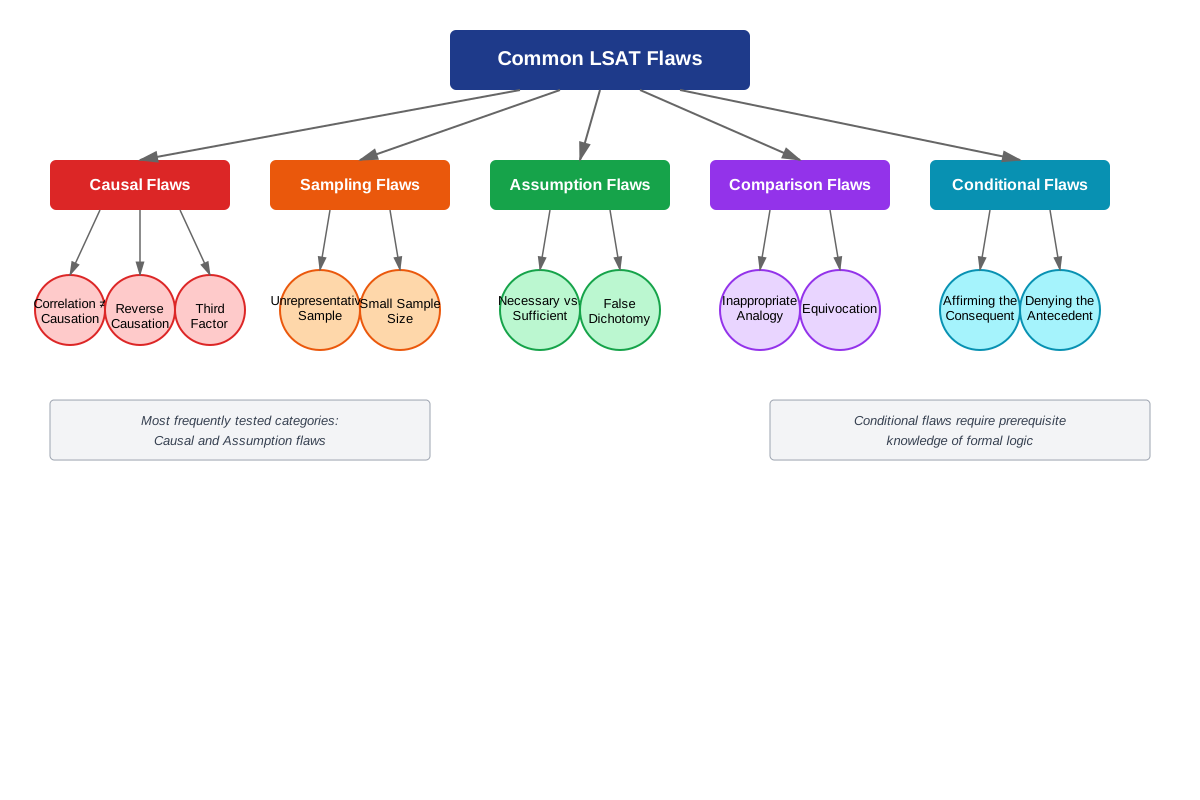
Causal reasoning flaws occur when an argument improperly establishes, assumes, or relies upon a cause-and-effect relationship. These represent the single most common category of flaws on the LSAT. The fundamental error involves concluding that one event causes another without adequately ruling out alternative explanations.
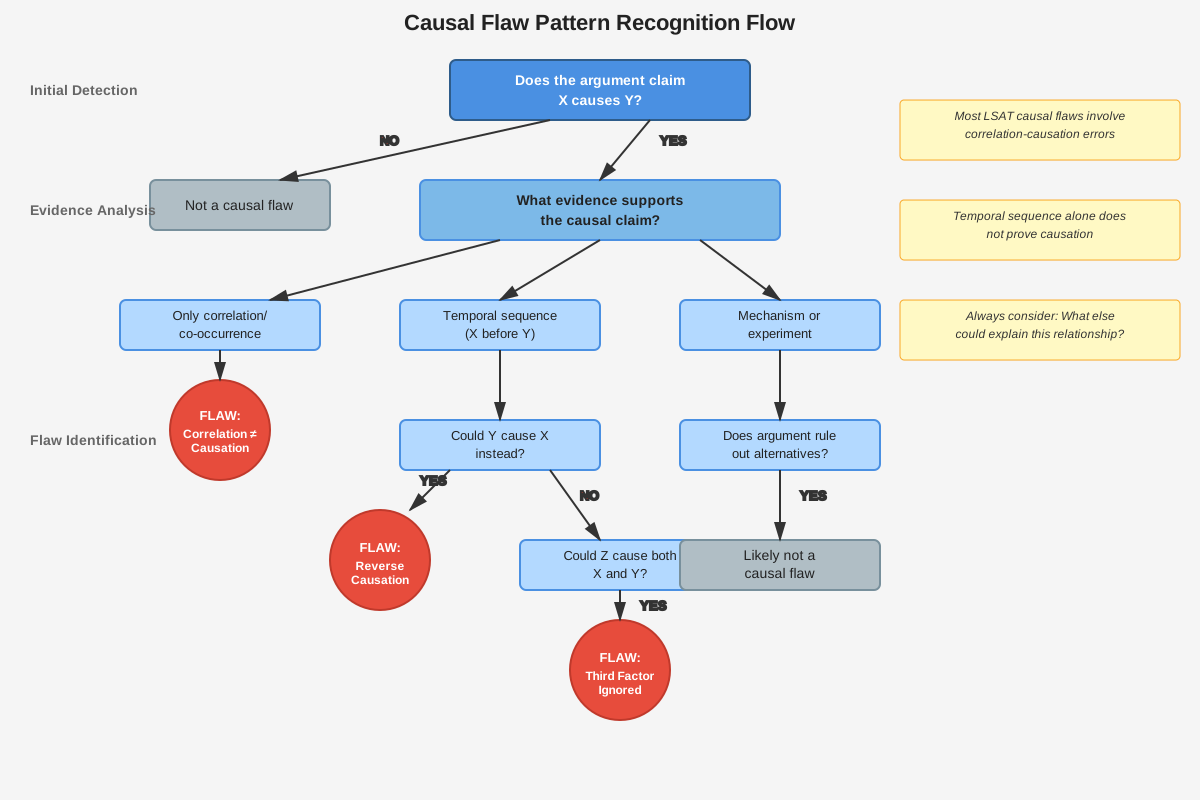
Correlation-causation confusion happens when an argument observes that two phenomena occur together and concludes one must cause the other. For example: "Countries with higher chocolate consumption have more Nobel Prize winners; therefore, eating chocolate improves cognitive function." This commits the classic error of treating correlation as causation without considering that both might be caused by a third factor (national wealth enabling both chocolate imports and research funding) or that the relationship might be coincidental.
Reverse causation occurs when an argument assumes A causes B when B might actually cause A. Consider: "Successful students spend more time in the library; therefore, spending time in the library causes academic success." The flaw lies in failing to consider that academic success (or the traits that produce it) might cause students to spend more time in the library, rather than library time causing success.
Common cause errors involve failing to consider that an observed correlation might result from both phenomena being effects of a shared underlying cause. The argument treats one observed phenomenon as the cause of another when both might stem from a third factor entirely.
Sampling and Generalization Flaws
Sampling flaws involve drawing conclusions about a population based on inadequate, unrepresentative, or biased samples. The LSAT frequently tests whether arguments properly support broad generalizations with their evidence.
Unrepresentative sample flaws occur when an argument generalizes from a sample that doesn't reflect the target population. For instance: "We surveyed students at elite universities and found 90% plan to pursue graduate education; therefore, most college students plan to attend graduate school." The sample (elite university students) systematically differs from the broader population (all college students) in ways directly relevant to the conclusion.
Small sample size flaws involve drawing sweeping conclusions from insufficient data points. While the LSAT rarely focuses purely on sample size (since determining adequate sample size requires statistical knowledge beyond the test's scope), arguments sometimes commit this error in combination with other problems.
Hasty generalization represents the broader category of reaching a universal or broad conclusion from limited evidence, whether due to sample size, representativeness, or both.
Conditional Logic Flaws
Conditional logic flaws involve misapplying the rules of necessary and sufficient conditions. These flaws exploit common reasoning errors people make when processing "if-then" statements.
Affirming the consequent occurs when an argument treats a necessary condition as sufficient. The structure: "If A, then B. B is true. Therefore, A is true." For example: "If it's raining, the streets are wet. The streets are wet. Therefore, it's raining." This fails because other factors (street cleaning, sprinklers) could produce wet streets.
Denying the antecedent happens when an argument treats a sufficient condition as necessary. The structure: "If A, then B. A is false. Therefore, B is false." For example: "If you study hard, you'll pass. You didn't study hard. Therefore, you won't pass." This fails because other factors might enable passing without hard study.
Confusing necessary and sufficient conditions more broadly includes any misunderstanding of conditional relationships, such as treating "only if" statements as "if" statements or reversing conditional relationships without proper contraposition.
Scope Shifts and Equivocation
Scope shifts occur when an argument's conclusion discusses a different group, time period, or concept than its premises support. The evidence might be perfectly sound but simply doesn't address what the conclusion claims.
Term shifts involve using the same word with different meanings in premises versus conclusion, creating an illusion of logical connection. For example: "Natural products are safe for the environment. This cleaning product is natural. Therefore, it's safe for the environment." The word "natural" might mean "derived from plants" in the premise but "non-toxic" in the conclusion.
Quantifier shifts happen when premises discuss "some" members of a group but the conclusion claims something about "all" members, or vice versa. This represents an unjustified expansion or contraction of scope.
Temporal scope shifts involve drawing conclusions about one time period based on evidence from another, without justification for assuming consistency across time.
Circular Reasoning
Circular reasoning (also called "begging the question") occurs when an argument's conclusion appears among its premises, either explicitly or in disguised form. The argument assumes what it purports to prove, providing no independent support for its conclusion.
The circularity might be obvious: "We should trust Senator Smith because she's trustworthy." More often, the LSAT presents subtle circularity where the premise restates the conclusion using different words: "The new policy will improve efficiency because it will enable us to accomplish more with the same resources." Here, "improve efficiency" and "accomplish more with the same resources" express the same idea.
Ad Hominem and Source Arguments
Ad hominem flaws attack the person making an argument rather than addressing the argument's merits. For example: "The scientist claims climate change is occurring, but she receives research funding from environmental organizations, so her conclusion is false." The funding source might raise questions about bias, but it doesn't logically demonstrate the conclusion is wrong.
Source-based reasoning errors more broadly include dismissing arguments based on their source's characteristics rather than logical merit, or accepting arguments solely because of source authority without examining the reasoning.
False Dichotomy
False dichotomy (or false dilemma) flaws occur when an argument presents two options as exhaustive when other possibilities exist. The structure: "Either A or B. Not A. Therefore, B." The flaw lies in failing to consider options C, D, or E.
For example: "Either we implement this expensive security system or we accept increased risk of theft. We cannot accept increased risk. Therefore, we must implement this system." This ignores alternatives like different security measures, insurance, or risk mitigation strategies.
Overlooking Alternatives and Possibilities
Beyond false dichotomies, arguments frequently fail by overlooking relevant alternatives—not presenting them as the only options, but simply failing to consider them when drawing conclusions. This includes:
- Failing to consider alternative explanations for observed phenomena
- Ignoring potential counterexamples to generalizations
- Not accounting for factors that might prevent a predicted outcome
- Overlooking ways a plan might fail or produce unintended consequences
Inappropriate Appeals
Appeal to authority flaws involve citing an authority figure whose expertise doesn't extend to the topic at hand. A Nobel Prize-winning physicist's opinion on economic policy doesn't carry special weight from their physics expertise.
Appeal to popularity (argumentum ad populum) treats widespread belief as evidence of truth: "Most people believe X; therefore, X is true." Popularity doesn't establish correctness.
Appeal to tradition argues something is correct or should continue because it's traditional or long-standing, without providing independent justification.
Composition and Division
Composition fallacies attribute properties of parts to the whole: "Each player on the team is excellent; therefore, the team is excellent." This fails because team success depends on coordination, chemistry, and complementary skills, not just individual excellence.
Division fallacies attribute properties of the whole to its parts: "This is a great university; therefore, every department is great." The whole's quality doesn't guarantee each component shares that quality.
Concept Relationships
The various common flaws interconnect through shared underlying logical principles. Causal reasoning flaws often overlap with sampling flaws—an argument might observe a correlation in an unrepresentative sample and conclude causation, committing both errors simultaneously. Similarly, scope shifts frequently accompany generalization flaws, as arguments extrapolate from limited evidence to broader populations or contexts.
Conditional logic flaws represent a distinct category based on formal logical rules, but they connect to overlooking alternatives because both involve failing to consider all possibilities. An argument that affirms the consequent essentially overlooks alternative explanations for the observed consequent.
Circular reasoning stands somewhat apart as a structural flaw in how premises relate to conclusions, rather than a flaw in the content of that relationship. However, it often appears alongside equivocation, where shifting word meanings disguise the circularity.
The relationship map flows as follows: Argument structure (premises + conclusion) → Logical connections (how premises supposedly support conclusion) → Flaw categories (ways those connections break down) → Specific flaw types (particular patterns of breakdown). Understanding this hierarchy helps students move from identifying that something is wrong to precisely characterizing what is wrong.
Quick check — test yourself on Common flaws so far.
Try Flashcards →High-Yield Facts
⭐ Causal reasoning flaws appear more frequently than any other flaw type on the LSAT, particularly correlation-causation confusion and failure to consider alternative causes.
⭐ Flaw questions ask students to identify the reasoning error, not whether the conclusion is true or false—an argument can reach a true conclusion through flawed reasoning.
⭐ Conditional logic flaws almost always involve treating necessary conditions as sufficient (affirming the consequent) or sufficient conditions as necessary (denying the antecedent).
⭐ Scope shifts between premises and conclusion represent one of the most commonly tested flaw patterns, requiring careful attention to what exactly the evidence addresses versus what the conclusion claims.
⭐ Unrepresentative samples constitute a flaw only when the sample's unrepresentative nature is relevant to the conclusion—a sample of doctors' opinions on medical matters isn't flawed merely because it doesn't include non-doctors.
- Circular reasoning appears less frequently than other flaws but is highly testable because it requires recognizing when premises and conclusions express the same idea in different words.
- False dichotomies on the LSAT typically involve overlooking moderate positions or alternative solutions, not just failing to consider a third option.
- Ad hominem flaws attack the arguer rather than the argument, but noting potential bias or conflict of interest isn't automatically ad hominem—the flaw occurs when the attack substitutes for logical rebuttal.
- Composition and division flaws appear infrequently but are easily identifiable once students learn to watch for part-whole relationships.
- Multiple flaws may exist in a single argument, but correct answers identify the primary or most significant logical error.
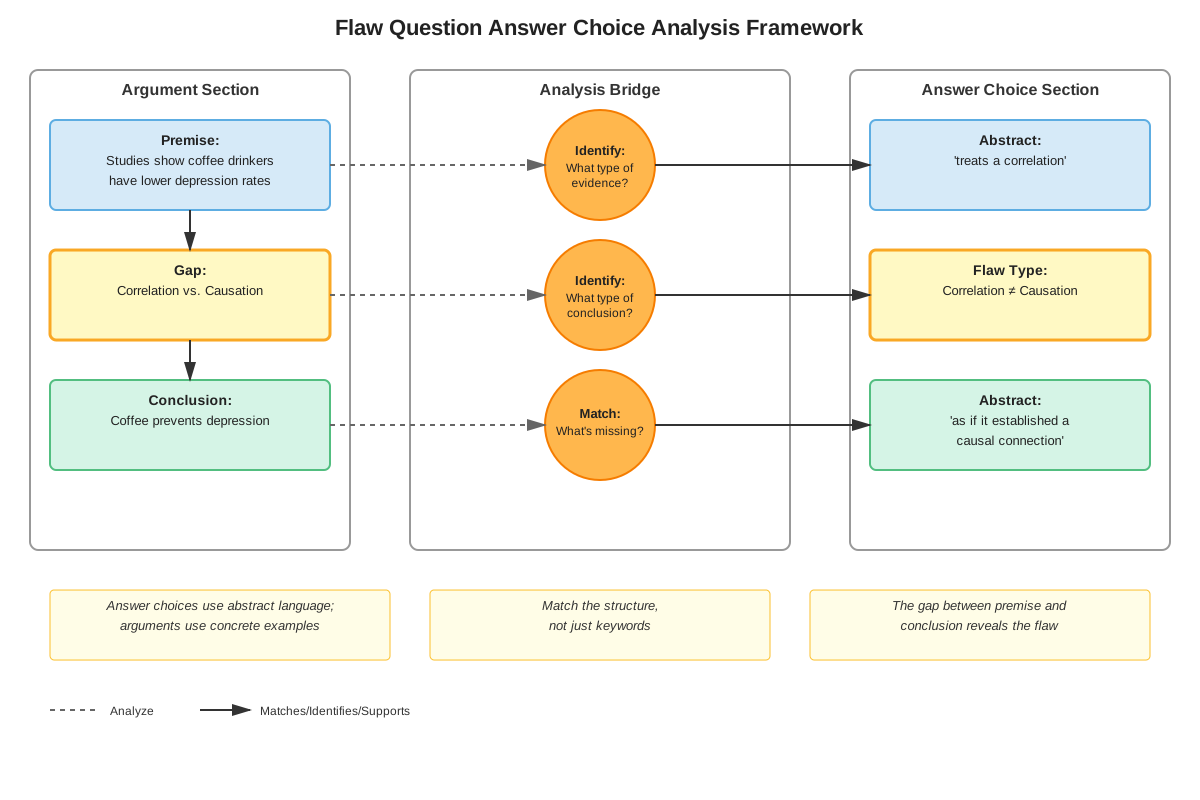
- Abstract answer choices describe flaws in general terms that apply to many arguments, requiring students to match the abstract description to the specific argument's structure.
Common Misconceptions
Misconception: If an argument's conclusion seems false or unreasonable, it must contain a logical flaw.
Correction: Flaw questions test logical structure, not truth. An argument can reach an implausible conclusion through valid reasoning from its premises, or reach a true conclusion through flawed reasoning. Focus on whether the premises, if true, would actually support the conclusion.
Misconception: Correlation-causation confusion means any argument mentioning correlation is flawed.
Correction: The flaw occurs when an argument concludes causation from mere correlation without additional support. Arguments can properly use correlation as one piece of evidence for causation if they also rule out alternative explanations, establish temporal priority, or provide mechanism evidence.
Misconception: Circular reasoning means the argument repeats itself or is redundant.
Correction: Circularity specifically means the conclusion appears among the premises (explicitly or disguised). Repetitive writing isn't necessarily circular reasoning. The test is whether the premises provide independent support for the conclusion or merely restate it.
Misconception: An unrepresentative sample is always a flaw.
Correction: A sample must be unrepresentative in a way that's relevant to the conclusion. Surveying only doctors about medical best practices isn't flawed—their expertise makes them the appropriate sample. The flaw occurs when the sample's characteristics systematically bias results in ways that matter for the conclusion.
Misconception: Attacking someone's credibility or noting their bias is always an ad hominem flaw.
Correction: Ad hominem occurs when an argument dismisses a claim solely because of who made it, without addressing the claim's merits. Noting relevant bias or lack of expertise can be legitimate when it affects the weight of testimony or authority-based claims. The flaw is substituting personal attack for logical rebuttal.
Misconception: If an argument doesn't consider every possible alternative, it commits a false dichotomy.
Correction: False dichotomy specifically involves presenting two options as exhaustive when they're not. Arguments aren't required to address every conceivable possibility—the flaw occurs when the argument's structure depends on only two options existing and that's demonstrably false.
Misconception: Conditional logic flaws are the most common flaw type.
Correction: While conditional logic flaws are important and frequently tested, causal reasoning flaws appear more often overall. Students sometimes over-identify conditional logic flaws because they're more formulaic and easier to spot once learned.
Worked Examples
Example 1: Causal Reasoning Flaw
Argument: "A recent study found that people who drink coffee daily have a 20% lower risk of depression than those who don't drink coffee. Therefore, drinking coffee prevents depression, and doctors should recommend daily coffee consumption to patients at risk for depression."
Analysis:
Step 1: Identify the conclusion: "Drinking coffee prevents depression" and doctors should recommend it.
Step 2: Identify the evidence: A correlation exists between coffee drinking and lower depression rates.
Step 3: Examine the logical connection: The argument observes a correlation (coffee drinking associated with less depression) and concludes causation (coffee prevents depression).
Step 4: Identify the flaw: This commits the classic correlation-causation error. The argument fails to consider alternative explanations:
- Reverse causation: Depression might cause people to avoid coffee (perhaps due to anxiety symptoms or medication interactions)
- Common cause: A third factor might cause both coffee drinking and lower depression (e.g., higher socioeconomic status enabling both coffee purchases and better mental health care)
- Confounding variables: Coffee drinkers might differ from non-drinkers in other health behaviors (exercise, diet, sleep) that affect depression risk
Step 5: Match to learning objectives: This demonstrates how causal flaws appear in LSAT questions (Objective 1), explains the reasoning pattern of treating correlation as causation (Objective 2), and shows how to identify this flaw type (Objective 3).
Correct answer choice would state: "The argument treats evidence that two phenomena are correlated as sufficient to establish that one causes the other" or "The argument fails to consider whether the correlation might be explained by factors other than a causal relationship."
Example 2: Scope Shift with Conditional Logic
Argument: "All successful entrepreneurs take calculated risks. Maria takes calculated risks in her business ventures. Therefore, Maria will certainly become a successful entrepreneur."
Analysis:
Step 1: Identify the conclusion: Maria will certainly become a successful entrepreneur.
Step 2: Identify the evidence: (1) All successful entrepreneurs take calculated risks, (2) Maria takes calculated risks.
Step 3: Map the conditional logic:
- Premise 1: Successful entrepreneur → Takes calculated risks
- Premise 2: Maria takes calculated risks
- Conclusion: Maria will be a successful entrepreneur
Step 4: Identify the flaw: This commits the conditional logic error of affirming the consequent. The argument treats a necessary condition (taking calculated risks is necessary for entrepreneurial success) as if it were sufficient (taking calculated risks is enough to guarantee success). The argument's structure is: "If A, then B. B is true. Therefore, A is true."
Step 5: Consider additional issues: The argument also contains a scope shift from "successful entrepreneurs" (a defined group) to "will become a successful entrepreneur" (a prediction about the future), and it uses absolute language ("certainly") unsupported by the premises.
Step 6: Identify the primary flaw: While multiple issues exist, the core logical error is the conditional logic flaw—treating a necessary condition as sufficient.
Correct answer choice would state: "The argument mistakes a condition necessary for entrepreneurial success for a condition sufficient to guarantee such success" or "The argument concludes that someone possesses a characteristic merely because that person shares one attribute with others who possess that characteristic."
Exam Strategy
When approaching flaw questions on the LSAT, begin by reading the question stem to confirm it's asking for a flaw (trigger phrases: "vulnerable to criticism," "reasoning is flawed," "questionable technique"). This primes your mind to read critically rather than persuasively.
As you read the argument, actively separate premises from conclusion. Identify the conclusion first (often signaled by "therefore," "thus," "consequently," "so"), then determine what evidence supposedly supports it. Ask yourself: "What logical gap exists between this evidence and this conclusion?"
Watch for trigger words and phrases that signal specific flaw types:
- Causal language ("causes," "leads to," "results in," "produces," "responsible for") → likely causal reasoning flaw
- Conditional indicators ("if," "only if," "unless," "all," "any") → possible conditional logic flaw
- Quantifiers ("some," "most," "all," "many") → potential scope shift or generalization flaw
- Comparison terms ("more," "less," "better," "worse") → possible inappropriate comparison
- Source references ("experts say," "studies show," "according to") → potential appeal to authority
Before looking at answer choices, try to articulate the flaw in your own words. This prevents answer choices from leading your thinking. Common self-prompts include:
- "Does the evidence actually prove what the conclusion claims?"
- "What alternative explanations hasn't the argument considered?"
- "Does the conclusion discuss the same thing the premises discuss?"
- "What assumption bridges the gap between premises and conclusion?"
When evaluating answer choices, eliminate those that:
- Describe flaws the argument doesn't commit (most common wrong answer type)
- Describe features that aren't actually flaws (e.g., "fails to provide statistical evidence" when anecdotal evidence might suffice)
- Accurately describe the argument but don't identify a flaw (e.g., "bases its conclusion on a sample" when sampling itself isn't problematic)
- Use extreme language that doesn't match the argument's actual error
Time allocation: Spend 1:00-1:15 reading and analyzing the argument, 0:15-0:30 predicting the flaw, and 0:30-0:45 evaluating answer choices. If you can't identify the flaw after initial reading, move to answer choices and test each against the argument, but this approach takes longer.
For difficult flaw questions where multiple answers seem plausible, return to the argument's exact wording. The correct answer must describe what the argument actually does, not what it should have done or what would strengthen it.
Memory Techniques
CAUSAL acronym for causal reasoning flaws:
- Correlation isn't causation
- Alternative causes overlooked
- Unidirectional assumption (might be reverse)
- Shared cause possibility
- Assumes mechanism without evidence
- Lacks temporal priority
"SCAN" for scope issues:
- Subject shift (premises discuss X, conclusion discusses Y)
- Context change (different time, place, or circumstances)
- Amount alteration (some → all, or all → some)
- Nuance in terminology (same word, different meaning)
Conditional logic visualization: Draw arrows to track logical flow. "If A then B" becomes A → B. If the argument goes backward (B → A) or reverses without contrapositive, you've found the flaw.
"Part ≠ Whole" reminder: When arguments discuss components and wholes, check for composition/division flaws. Visualize a sports team (great players ≠ great team) or a building (strong bricks ≠ strong building without proper construction).
Circular reasoning check: Cover the conclusion and ask, "Do the premises give me new information, or just repeat what I'm supposed to prove?" If covering the conclusion makes the premises meaningless, the reasoning is circular.
Summary
Common flaws represent predictable patterns of faulty reasoning that appear throughout LSAT Logical Reasoning sections, particularly in flaw questions that ask test-takers to identify specific reasoning errors. The most frequently tested categories include causal reasoning flaws (especially correlation-causation confusion), sampling and generalization errors, conditional logic mistakes (affirming the consequent and denying the antecedent), scope shifts between premises and conclusions, and circular reasoning. Success requires not merely memorizing flaw types but developing the analytical skill to recognize how abstract flaw descriptions match concrete argument structures. Students must distinguish between an argument's content (which might be true or false) and its logical structure (which might be valid or flawed), focusing exclusively on whether premises actually support conclusions as claimed. Mastering common flaws enhances performance across multiple Logical Reasoning question types and builds the critical thinking skills essential for legal reasoning.
Key Takeaways
- Causal reasoning flaws, particularly correlation-causation confusion, represent the single most common flaw category on the LSAT and deserve focused practice
- Flaw identification requires analyzing logical structure, not evaluating whether conclusions are true—arguments can reach true conclusions through flawed reasoning
- Conditional logic flaws follow predictable patterns of treating necessary conditions as sufficient or vice versa, making them highly recognizable once learned
- Scope shifts between what premises discuss and what conclusions claim appear frequently and require careful attention to precise wording
- Abstract answer choices describe flaws in general terms, requiring students to match those descriptions to the specific argument's structure rather than its content
- Multiple flaws may exist in a single argument, but correct answers identify the primary logical error that most undermines the reasoning
- Systematic approach—identifying conclusion, mapping evidence, finding logical gaps, predicting the flaw, then evaluating choices—produces more accurate and efficient performance than reading passively
Related Topics
Assumption Questions: Understanding common flaws directly enables identifying assumptions because assumptions fill the logical gaps that create flaws. An argument with a causal flaw assumes no alternative causes exist; recognizing the flaw reveals the assumption.
Strengthen and Weaken Questions: These question types test the same logical vulnerabilities as flaw questions but ask what would fix or worsen the reasoning. Mastering flaws makes strengthen/weaken questions more straightforward.
Parallel Reasoning Questions: These require matching argument structures, including flawed structures. Recognizing that two arguments commit the same flaw enables accurate parallel identification.
Sufficient Assumption Questions: These ask what would make an argument's reasoning valid, essentially asking what would eliminate its flaw. Understanding the flaw reveals what assumption would be sufficient to fix it.
Method of Reasoning Questions: While these don't always involve flaws, they require describing argument structure—the same analytical skill developed through flaw identification.
Practice CTA
Now that you've mastered the conceptual framework of common flaws, it's time to cement your understanding through active practice. Attempt the practice questions to apply these concepts to LSAT-style arguments, testing your ability to identify flaws quickly and accurately. Use the flashcards to reinforce your recognition of flaw patterns and their abstract descriptions. Remember: recognizing flaws in real LSAT arguments requires seeing these patterns repeatedly until they become automatic. Each practice question you complete strengthens your analytical instincts and builds the confidence you need to excel on test day. Your investment in deliberate practice now will pay dividends across every Logical Reasoning section you encounter.
Sign up free to keep reading
Create a free AnvayaPrep account to finish this LSAT guide on Common flaws — plus flashcards and practice questions.