Overview
Flaw answer language refers to the specific, standardized terminology that the LSAT uses in answer choices for flaw questions within the Logical Reasoning section. Understanding this specialized vocabulary is crucial because the LSAT consistently employs precise, technical language to describe logical errors in arguments. Students who master this language gain a significant advantage: they can quickly identify correct answers and eliminate distractors, even when the underlying logical error is complex or unfamiliar.
Flaw questions constitute approximately 15-20% of all Logical Reasoning questions on any given LSAT, making them one of the most frequently tested question types. These questions present an argument with a logical weakness and ask test-takers to identify the flaw. The challenge lies not only in recognizing the logical error but also in matching that recognition to the abstract, formal language used in the answer choices. The LSAT deliberately uses technical phrasing that may sound unfamiliar or convoluted to untrained test-takers, creating an additional layer of difficulty beyond simply understanding the argument itself.
Within the broader landscape of Logical Reasoning, LSAT flaw answer language serves as a bridge between argument analysis and answer selection. Students must first deconstruct the argument to identify its weakness, then translate their understanding into the formal terminology the test employs. This topic connects directly to assumption questions, strengthen/weaken questions, and parallel reasoning questions, as all require understanding how arguments can fail. Mastering flaw answer language provides a foundation for recognizing patterns across multiple question types and developing a sophisticated understanding of logical structure.
Learning Objectives
- [ ] Identify how Flaw answer language appears in LSAT questions
- [ ] Explain the reasoning pattern behind Flaw answer language
- [ ] Apply Flaw answer language to solve LSAT-style problems accurately
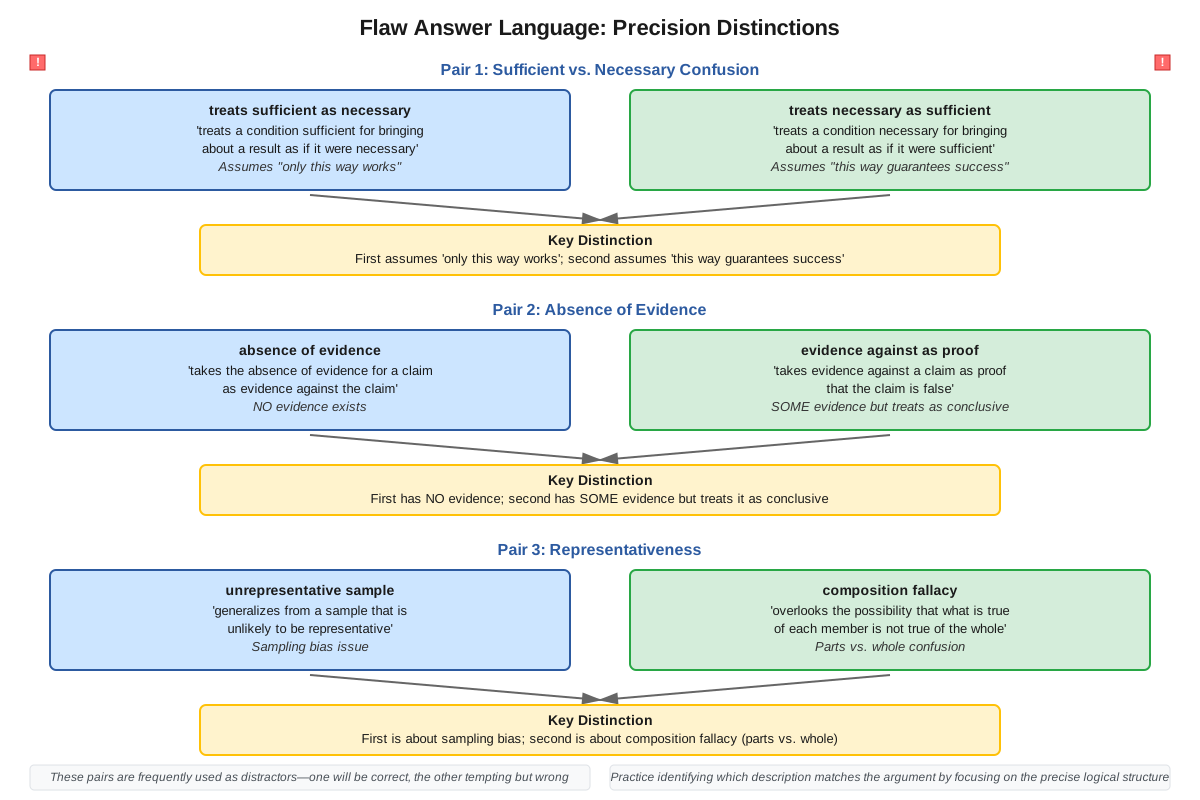
- [ ] Distinguish between similar-sounding flaw descriptions that describe different logical errors
- [ ] Translate informal descriptions of logical errors into formal LSAT terminology
- [ ] Recognize common distractor patterns in flaw question answer choices
- [ ] Evaluate whether a given flaw description accurately matches an argument's logical weakness
Prerequisites
- Basic argument structure: Understanding premises, conclusions, and how they relate is essential because flaw questions require identifying where the connection between premises and conclusion breaks down.
- Common logical fallacies: Familiarity with standard reasoning errors (ad hominem, false dichotomy, hasty generalization) provides the conceptual foundation for recognizing what the formal language describes.
- Conditional reasoning: Many flaws involve misunderstanding necessary and sufficient conditions, so comfort with "if-then" logic is required.
- Causal reasoning: Understanding the difference between correlation and causation is necessary because many flaw questions test whether arguments improperly establish causal relationships.
Why This Topic Matters
In professional contexts, the ability to identify flawed reasoning is fundamental to legal analysis, policy evaluation, and critical decision-making. Lawyers must recognize weaknesses in opposing arguments, judges must evaluate the logical soundness of legal reasoning, and policymakers must assess whether proposed solutions actually address identified problems. The LSAT tests this skill because it predicts success in law school, where students constantly analyze and critique arguments.
On the LSAT itself, flaw questions appear with remarkable consistency. Test-takers can expect 8-12 flaw questions across the two scored Logical Reasoning sections, representing roughly 16-20% of all Logical Reasoning questions. These questions appear throughout each section, not clustered in any particular location, and range from relatively straightforward to highly complex. The LSAT recycles certain flaw types repeatedly: circular reasoning, sampling flaws, causal errors, conditional logic mistakes, and equivocation appear on virtually every test.
The challenge intensifies because the LSAT presents these flaws using highly abstract language. An argument might commit a simple error—assuming that because most doctors recommend a treatment, the treatment must be effective—but the correct answer choice might read: "takes for granted that the opinion of a majority of experts in a field is sufficient to establish the truth of a claim within that field." Students who haven't mastered flaw answer language may recognize the error intuitively but fail to select the correct answer because they cannot match their understanding to the formal description. This disconnect between comprehension and answer selection costs students valuable points on one of the most predictable question types on the exam.
Core Concepts
Understanding Flaw Question Structure
Flaw questions ask test-takers to identify the logical weakness in an argument. The question stem typically includes phrases like "the reasoning in the argument is flawed in that it," "the argument is vulnerable to criticism on the grounds that it," or "which one of the following most accurately describes a flaw in the argument's reasoning?" The argument itself contains a clear logical error—the premises do not adequately support the conclusion, even if the premises are assumed to be true.
The answer choices employ standardized, technical language to describe potential flaws. Correct answers precisely identify the actual logical error, while incorrect answers either describe flaws that don't exist in the argument, describe the argument's reasoning accurately (making them not flaws), or use language that sounds similar to the correct answer but describes a different error entirely.
Common Flaw Types and Their Standard Descriptions
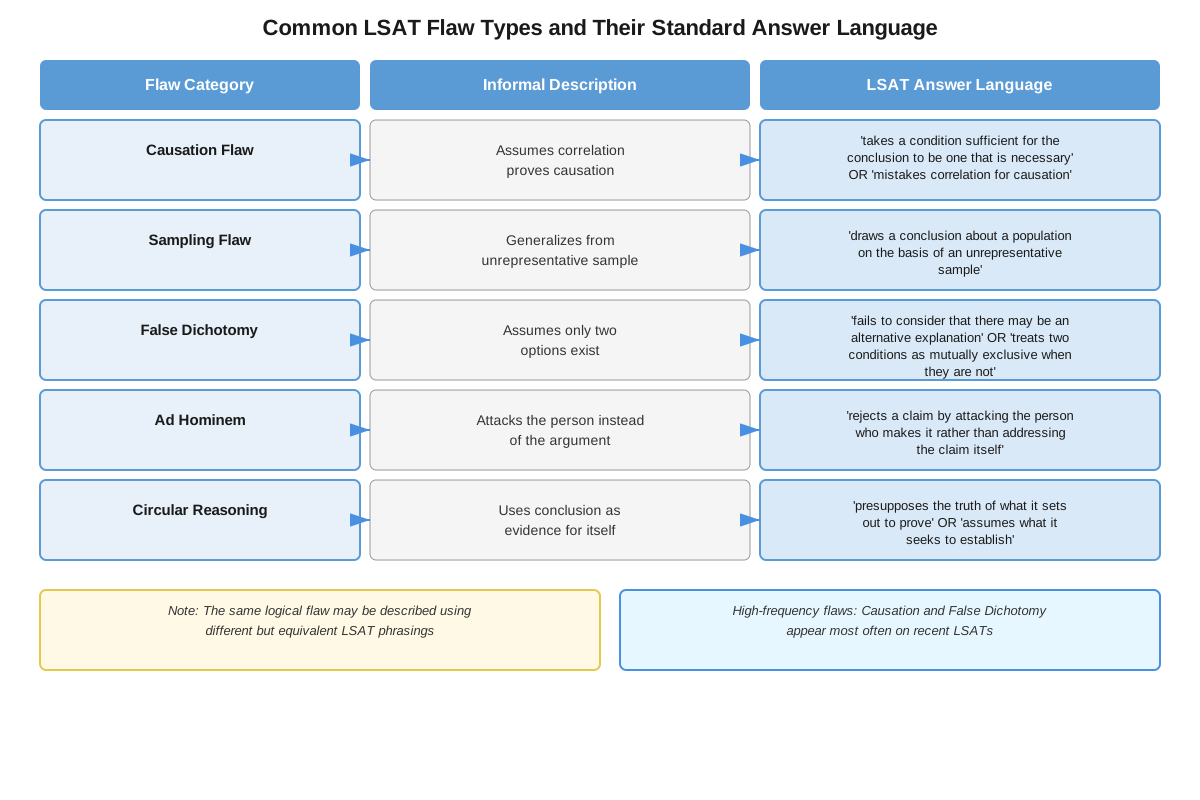
Circular Reasoning
Circular reasoning occurs when an argument's conclusion is used as support for itself, either explicitly or through rewording. The LSAT describes this flaw using several standard formulations:
- "presupposes the truth of what it sets out to establish"
- "takes for granted the very claim that it sets out to prove"
- "assumes what it seeks to demonstrate"
- "the argument's conclusion is used as a premise in support of that conclusion"
Example: "We should trust Senator Johnson because she is trustworthy." The conclusion (we should trust her) is supported only by restating the conclusion in different words (she is trustworthy).
Sampling and Generalization Flaws
Arguments frequently draw conclusions about a large group based on evidence about a small or unrepresentative sample. The LSAT describes these errors with phrases like:
- "bases a generalization on a sample that is likely to be unrepresentative"
- "draws a conclusion about a population based on a sample that may not be representative of that population"
- "generalizes from an atypical case"
- "overlooks the possibility that the sample is biased"
Example: "I surveyed students at the library on Friday night, and 90% said they study every weekend. Therefore, 90% of all students study every weekend." The sample (students at the library on Friday night) is clearly unrepresentative of all students.
Causal Reasoning Flaws
Causal flaws represent one of the most frequently tested categories. Arguments may confuse correlation with causation, reverse cause and effect, ignore alternative causes, or assume a causal relationship without adequate evidence. Standard LSAT descriptions include:
- "takes a condition necessary for a phenomenon to be a condition sufficient for that phenomenon" (or vice versa)
- "mistakes a correlation for a causal relationship"
- "fails to consider that the observed correlation might be explained by a common cause"
- "overlooks the possibility that the stated relationship is reversed"
- "fails to establish that the correlation is not coincidental"
| Flaw Type | What the Argument Does | Standard LSAT Language |
|---|---|---|
| Correlation ≠ Causation | Observes two things occur together and concludes one causes the other | "treats a correlation as sufficient to establish causation" |
| Reversed Causation | Gets the causal direction wrong | "fails to consider that the relationship might be reversed" |
| Alternative Cause | Ignores other possible explanations | "overlooks the possibility that the effect might have resulted from a different cause" |
| Common Cause | Doesn't consider that both effects might stem from a third factor | "fails to consider that both phenomena might be effects of a common cause" |
Conditional Logic Flaws
Many arguments misapply conditional reasoning, particularly by confusing necessary and sufficient conditions or by making invalid inferences. The LSAT uses precise language to describe these errors:
- "confuses a condition necessary for a phenomenon with a condition sufficient for that phenomenon"
- "mistakes being sufficient for an outcome with being required for that outcome"
- "concludes that something is necessary for a result merely because it is sufficient for that result"
- "treats the absence of a condition sufficient for an outcome as evidence that the outcome will not occur"
Example: "All successful lawyers are good communicators. Therefore, if you're a good communicator, you'll be a successful lawyer." This confuses a necessary condition (good communication) with a sufficient condition.
Equivocation and Ambiguity
Equivocation occurs when an argument uses a term with multiple meanings, shifting between those meanings without acknowledgment. The LSAT describes this as:
- "equivocates with respect to a central term"
- "relies on the ambiguity of a key term"
- "uses a term in different senses in different parts of the argument"
- "fails to recognize that a key term has multiple meanings"
Example: "Laws are meant to be broken—they're fragile rules. Therefore, we shouldn't worry about breaking traffic laws." The word "broken" shifts from meaning "fragile" to meaning "violated."
Ad Hominem and Source-Based Reasoning
Arguments sometimes attack the person making a claim rather than the claim itself, or they dismiss evidence based on its source rather than its merit. Standard descriptions include:
- "rejects a claim by attacking the person who makes it rather than addressing the claim itself"
- "dismisses a position merely on the grounds of its source"
- "concludes that a claim is false merely because the person making it has questionable motives"
- "takes the failure to prove a claim as evidence that the claim is false"
False Dichotomy and Overlooking Alternatives
Arguments may present two options as exhaustive when other possibilities exist. The LSAT describes this as:
- "treats two alternatives as mutually exclusive when they are not"
- "fails to consider that both alternatives might be true simultaneously"
- "overlooks the possibility that there are alternatives to the two options presented"
- "presumes, without justification, that the two options are the only options available"
Recognizing Formal vs. Informal Language
The LSAT consistently translates everyday descriptions of flaws into formal, abstract language. Understanding this translation is crucial:
- Informal: "The argument assumes its conclusion"
- Formal: "presupposes the truth of what it sets out to establish"
- Informal: "The argument attacks the person instead of the idea"
- Formal: "rejects a claim by criticizing the source of the claim rather than addressing the claim's content"
- Informal: "The argument says that because A causes B, B must cause A"
- Formal: "fails to consider that the stated causal relationship might be reversed"
Distractor Patterns in Flaw Questions
Incorrect answer choices follow predictable patterns:
- Accurate descriptions of the argument: These describe what the argument actually does, but not as a flaw
- Flaws that don't exist: These describe logical errors that simply aren't present in the argument
- Opposite flaws: These describe the reverse of the actual error (e.g., saying the argument is too narrow when it's actually too broad)
- Similar-sounding language: These use terminology that sounds like the correct answer but describes a different flaw
Concept Relationships
The concepts within flaw answer language form an interconnected system. Understanding circular reasoning requires recognizing when premises and conclusions are essentially identical, which connects to understanding argument structure from prerequisite knowledge. Sampling flaws relate directly to generalization errors, as both involve drawing conclusions about groups based on insufficient or biased evidence.
Causal reasoning flaws represent perhaps the most complex category, connecting to conditional logic (necessary vs. sufficient conditions), correlation analysis, and alternative explanation consideration. When an argument confuses correlation with causation, it often simultaneously commits a conditional logic error by treating a correlation (which might be necessary) as if it were sufficient to establish causation.
Equivocation connects to argument structure because it represents a breakdown in the logical chain: if a term means different things in the premise and conclusion, the premise cannot actually support the conclusion. This relates to scope shifts, where an argument's conclusion addresses a different scope than its premises support.
The relationship map flows as follows:
Argument Structure → enables recognition of → Premise-Conclusion Gaps → which manifest as → Specific Flaw Types (Circular Reasoning, Sampling Flaws, Causal Errors, etc.) → which are described using → Standardized LSAT Language → which must be matched to → Answer Choices → while avoiding → Distractor Patterns
Understanding flaw answer language also enables progression to related question types. Assumption questions ask what must be true for an argument to work—essentially, what would fix the flaw. Strengthen and weaken questions ask what would make the argument better or worse—what would reduce or exacerbate the flaw. Parallel reasoning questions require matching argument structures, including matching flawed structures to other flawed structures.
Quick check — test yourself on Flaw answer language so far.
Try Flashcards →High-Yield Facts
⭐ Circular reasoning is described as "presupposes the truth of what it sets out to establish" or "takes for granted the very claim it seeks to prove"
⭐ Sampling flaws are described as "bases a generalization on a sample that is likely to be unrepresentative"
⭐ Correlation-causation confusion is described as "mistakes a correlation for a causal relationship" or "treats a correlation as sufficient to establish causation"
⭐ Necessary-sufficient confusion is described as "confuses a condition necessary for a phenomenon with a condition sufficient for that phenomenon"
⭐ Ad hominem attacks are described as "rejects a claim by attacking the person who makes it rather than addressing the claim itself"
- Equivocation is described as "equivocates with respect to a central term" or "uses a term in different senses"
- False dichotomy is described as "overlooks the possibility that there are alternatives to the two options presented"
- Reversed causation is described as "fails to consider that the stated relationship might be reversed"
- Alternative causes are addressed with "overlooks the possibility that the effect might have resulted from a different cause"
- Absence of evidence fallacies are described as "takes the failure to prove a claim as evidence that the claim is false"
- The phrase "takes for granted" always indicates an assumption or presupposition, not something explicitly stated
- "Fails to consider" or "overlooks the possibility" indicates the argument ignores an alternative explanation or scenario
- "Treats X as Y" indicates the argument confuses two different concepts or conditions
Common Misconceptions
Misconception: If an answer choice accurately describes what the argument does, it must be correct.
Correction: Correct answers must describe what the argument does as a flaw. Many distractors accurately describe the argument's reasoning but frame it neutrally or positively rather than as an error.
Misconception: "Takes for granted" means the argument explicitly states something.
Correction: "Takes for granted" means the argument assumes something without stating or proving it. This phrase always indicates an unstated assumption, which is precisely what makes it a flaw.
Misconception: Circular reasoning only occurs when an argument repeats the exact same words in premise and conclusion.
Correction: Circular reasoning occurs whenever the conclusion is used to support itself, even if different words are used. "The movie is good because it's high quality" is circular even though "good" and "high quality" aren't identical.
Misconception: All arguments that mention correlation and causation commit the correlation-causation fallacy.
Correction: An argument only commits this fallacy if it treats correlation as sufficient to establish causation without providing additional evidence. Some arguments properly acknowledge that correlation requires additional support to establish causation.
Misconception: The longest or most complex answer choice is usually correct because flaw language is technical.
Correction: While flaw language is formal, correct answers are precise, not unnecessarily complex. The LSAT often includes verbose distractors that use technical-sounding language to describe flaws that don't exist in the argument.
Misconception: "Fails to consider" means the argument should have discussed something but didn't.
Correction: "Fails to consider" means the argument's reasoning is flawed because it doesn't account for a possibility that would undermine its conclusion. The argument isn't required to discuss everything—only to avoid reasoning that ignores crucial alternatives.
Misconception: If an argument mentions both necessary and sufficient conditions, it must confuse them.
Correction: Arguments can correctly discuss necessary and sufficient conditions. The flaw only occurs if the argument treats one type of condition as if it were the other type.
Worked Examples
Example 1: Identifying Circular Reasoning
Argument: "The new education policy will improve student outcomes because it is an effective approach to education. We know it's effective because it will lead to better results for students."
Question: The reasoning in the argument is flawed in that it
Answer Choices:
(A) relies on evidence from an unrepresentative sample
(B) presupposes the truth of what it sets out to establish
(C) mistakes a correlation for a causal relationship
(D) attacks the source of a claim rather than the claim itself
(E) overlooks the possibility that the policy might have unintended consequences
Analysis:
Step 1: Identify the conclusion: "The new education policy will improve student outcomes"
Step 2: Identify the premises: "because it is an effective approach" and "we know it's effective because it will lead to better results"
Step 3: Recognize the flaw: The argument claims the policy will improve outcomes because it's effective, but the only evidence that it's effective is that it will improve outcomes. This is circular—the conclusion supports itself.
Step 4: Match to answer language:
- (A) describes a sampling flaw—not present here
- (B) "presupposes the truth of what it sets out to establish"—this is the standard language for circular reasoning. CORRECT.
- (C) describes a causal flaw—no correlation is mentioned
- (D) describes ad hominem—no person is attacked
- (E) describes overlooking alternatives—while possibly true, this doesn't capture the circular nature of the reasoning
Answer: (B)
Connection to Learning Objectives: This example demonstrates how to identify flaw answer language (Objective 1), explains the reasoning pattern of circular reasoning (Objective 2), and applies that knowledge to select the correct answer (Objective 3).
Example 2: Distinguishing Similar Flaw Descriptions
Argument: "Studies show that countries with higher chocolate consumption have more Nobel Prize winners per capita. Therefore, eating chocolate improves cognitive function and leads to greater intellectual achievement."
Question: The argument is vulnerable to criticism on the grounds that it
Answer Choices:
(A) fails to establish that the correlation between chocolate consumption and Nobel Prizes is not coincidental
(B) confuses a condition necessary for winning a Nobel Prize with a condition sufficient for winning one
(C) bases a conclusion about all countries on evidence from only some countries
(D) presumes, without justification, that chocolate consumption is the only factor affecting intellectual achievement
(E) overlooks the possibility that greater wealth leads to both higher chocolate consumption and better education systems
Analysis:
Step 1: Identify the conclusion: "eating chocolate improves cognitive function and leads to greater intellectual achievement"
Step 2: Identify the premise: "countries with higher chocolate consumption have more Nobel Prize winners per capita"
Step 3: Recognize the flaw: The argument observes a correlation (chocolate consumption and Nobel Prizes occur together) and concludes causation (chocolate causes intellectual achievement). This is a classic causal reasoning flaw.
Step 4: Evaluate each answer:
- (A) "fails to establish that the correlation is not coincidental"—this describes the correlation-causation problem. This is a strong candidate.
- (B) describes necessary-sufficient confusion—the argument doesn't claim chocolate is necessary or sufficient for Nobel Prizes in those terms
- (C) describes a sampling flaw—but the argument doesn't claim to study all countries; it makes a causal claim
- (D) "presumes chocolate is the only factor"—the argument doesn't need to claim it's the only factor, just that it is a factor. This is too strong.
- (E) "overlooks the possibility that greater wealth leads to both"—this describes a common cause alternative. This is also a strong candidate.
Step 5: Distinguish between (A) and (E): Both identify problems with the causal reasoning. (A) describes the general problem (treating correlation as causation), while (E) describes a specific alternative explanation (common cause). On the LSAT, when both a general description and a specific alternative are present, the specific alternative is typically preferred because it more precisely identifies what the argument fails to consider. However, if the question asks for what the argument "most accurately describes," the general description might be preferred.
In this case, (E) is more precise because it identifies the specific type of alternative the argument overlooks—a common cause that could explain both phenomena. (A) is correct but more general.
Best Answer: (E), though (A) would also be defensible depending on the exact question wording.
Connection to Learning Objectives: This example demonstrates distinguishing between similar-sounding flaw descriptions (Objective 4), translating the informal understanding of "correlation isn't causation" into formal LSAT language (Objective 5), and recognizing that multiple answers might partially describe the flaw, requiring careful evaluation (Objective 6).
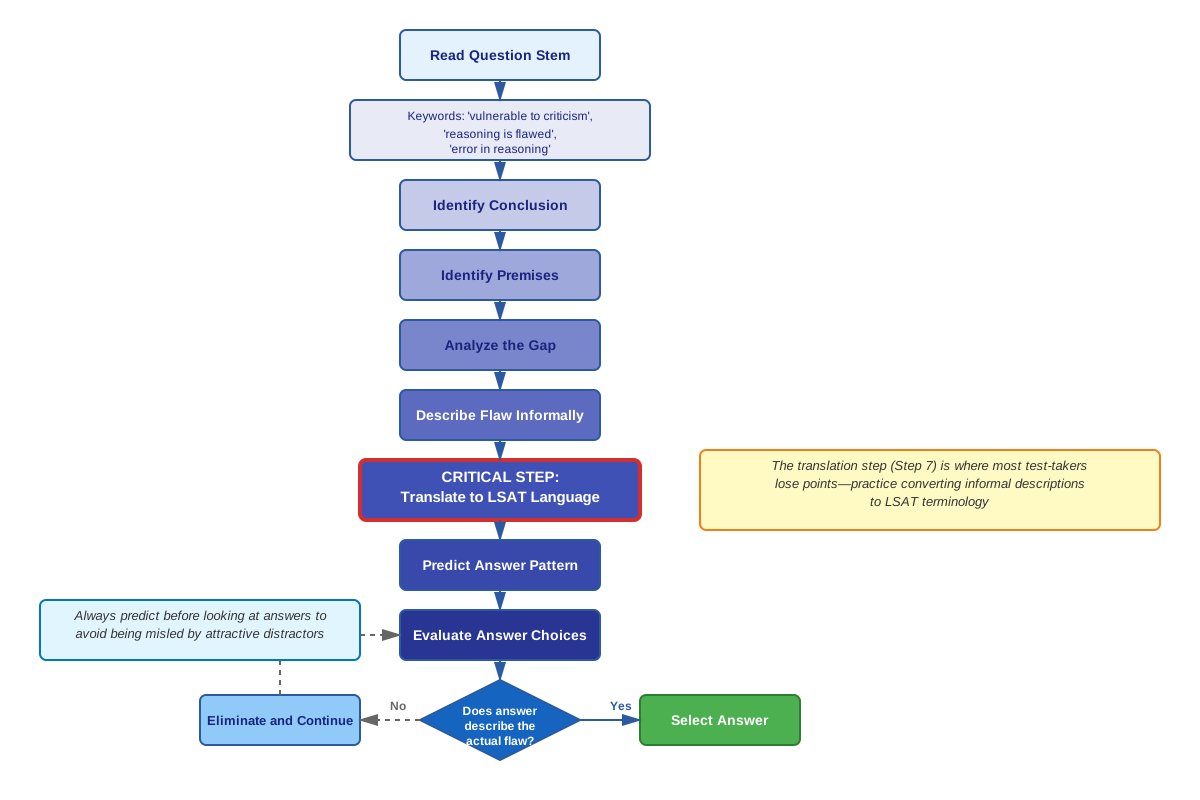
Exam Strategy
Approaching Flaw Questions Systematically
- Read the question stem first to confirm it's asking for a flaw
- Identify the conclusion before reading answer choices—underline or note it
- Identify the premises and note the gap between premises and conclusion
- Predict the flaw in your own words before looking at answers
- Match your prediction to the formal language in the answer choices
- Eliminate answers that describe flaws not present in the argument
Trigger Words and Phrases
In arguments, watch for:
- "Therefore," "thus," "consequently": Signal conclusions
- "Because," "since," "given that": Signal premises
- "Studies show," "research indicates": Often precede sampling or causal flaws
- "If...then": Signals conditional logic (watch for necessary-sufficient confusion)
- "Most," "many," "some": Watch for overgeneralization
- "Correlation," "associated with": Watch for causal claims
In answer choices, recognize:
- "Takes for granted," "presupposes," "assumes": Indicates unstated assumptions
- "Fails to consider," "overlooks," "ignores": Indicates missing alternatives
- "Treats X as Y," "mistakes X for Y," "confuses X with Y": Indicates conflation of concepts
- "Merely because," "solely on the grounds": Indicates insufficient evidence
- "Necessary" vs. "sufficient": Indicates conditional logic issues
Process of Elimination Strategy
Eliminate answers that:
- Describe the argument accurately but not as a flaw
- Use flaw language to describe something the argument doesn't do
- Describe the opposite of what the argument does
- Are too extreme (using "only," "solely," "exclusively" when the argument is more moderate)
- Describe flaws in the wrong category (e.g., sampling flaw when the issue is causal reasoning)
Keep answers that:
- Use standard LSAT flaw language you recognize
- Accurately describe a gap between premises and conclusion
- Match your pre-phrased prediction, even if worded differently
- Describe what the argument "fails to consider" or "takes for granted" in a way that would genuinely weaken the argument if true
Time Allocation
- Reading the argument: 20-30 seconds
- Identifying conclusion and premises: 10-15 seconds
- Predicting the flaw: 10-15 seconds
- Evaluating answer choices: 30-45 seconds
- Total per question: 70-105 seconds (1:10-1:45)
Exam Tip: If you can't predict the flaw in your own words, don't spend extra time trying. Move to the answer choices and evaluate each one systematically. Sometimes seeing the formal language helps clarify what the flaw is.
Exam Tip: The correct answer will describe something that, if true, would make the argument's reasoning problematic. If an answer describes something that wouldn't actually weaken the argument's logic, it's wrong—even if it uses technical-sounding language.
Memory Techniques
The CCASE Mnemonic for Common Flaws
Circular reasoning: "presupposes the truth of what it sets out to establish"
Correlation-causation: "mistakes a correlation for a causal relationship"
Ad hominem: "rejects a claim by attacking the person who makes it"
Sampling: "bases a generalization on a sample that is likely to be unrepresentative"
Equivocation: "equivocates with respect to a central term"
Visualization for Necessary vs. Sufficient
Picture necessary conditions as gates you must pass through (required) and sufficient conditions as keys that guarantee entry (enough). When an argument confuses them, it's like saying "because you passed through the gate, you must have had the key" or "because you have the key, you must have passed through the gate"—neither follows logically.
The "Takes for Granted" Rule
Whenever you see "takes for granted," mentally replace it with "assumes without stating." This helps clarify that the answer is describing an unstated assumption, not something the argument explicitly says.
The Reversal Test for Causal Flaws
When evaluating causal reasoning, ask: "Could the cause and effect be reversed?" If yes, look for answer choices containing "fails to consider that the relationship might be reversed" or "overlooks the possibility that [effect] might cause [cause]."
The Alternative Explanation Checklist
For any causal or correlational argument, mentally run through:
- Could the relationship be reversed?
- Could there be a common cause?
- Could it be coincidental?
- Could there be an alternative cause?
Match your answer to the language: "fails to consider," "overlooks the possibility," "ignores the fact that."
Summary
Mastering flaw answer language is essential for success on LSAT Logical Reasoning questions. The LSAT uses standardized, formal terminology to describe logical errors, and students must learn to recognize and match this language to the flaws they identify in arguments. The most frequently tested flaws include circular reasoning ("presupposes the truth of what it sets out to establish"), sampling errors ("bases a generalization on a sample that is likely to be unrepresentative"), causal reasoning mistakes ("mistakes a correlation for a causal relationship"), conditional logic confusion ("confuses a condition necessary for a phenomenon with a condition sufficient for that phenomenon"), and ad hominem attacks ("rejects a claim by attacking the person who makes it"). Success requires a systematic approach: identify the conclusion and premises, recognize the gap in reasoning, predict the flaw informally, then match that prediction to the formal language in answer choices. Understanding the standard phrases the LSAT employs—"takes for granted," "fails to consider," "overlooks the possibility," "treats X as Y"—enables quick recognition of correct answers and efficient elimination of distractors. With practice, students develop fluency in translating between informal understanding of logical errors and the precise, technical language the LSAT demands.
Key Takeaways
- Flaw answer language uses standardized, formal terminology that appears consistently across LSAT administrations
- The five most common flaw types are circular reasoning, sampling errors, causal reasoning mistakes, conditional logic confusion, and ad hominem attacks
- "Takes for granted" and "presupposes" always indicate unstated assumptions, not explicit statements
- "Fails to consider" and "overlooks the possibility" indicate the argument ignores alternatives that would undermine its conclusion
- Correct answers must describe what the argument does as a flaw, not merely describe what it does
- Pre-phrasing the flaw in your own words before reading answer choices improves accuracy and speed
- Distinguishing between similar-sounding flaw descriptions requires understanding the precise logical error each phrase describes
Related Topics
Assumption Questions: These ask what must be true for an argument to work—essentially, what unstated premise would fix the flaw. Mastering flaw answer language enables quick identification of assumptions because assumptions fill the gaps that create flaws.
Strengthen and Weaken Questions: These ask what would make an argument better or worse. Understanding flaws helps identify what would strengthen an argument (addressing the flaw) or weaken it (exacerbating the flaw).
Parallel Reasoning Questions: These require matching argument structures, including matching flawed arguments to other arguments with the same flaw. Recognizing flaw patterns enables quick matching of parallel structures.
Sufficient Assumption Questions: These ask what, if added to the argument, would make it logically valid. Understanding the flaw reveals what assumption would be sufficient to fix it.
Method of Reasoning Questions: These ask how an argument proceeds or what role a statement plays. Understanding flaw language helps recognize when an argument uses problematic reasoning methods.
Practice CTA
Now that you understand flaw answer language and the standardized terminology the LSAT employs, it's time to put this knowledge into practice. Work through the practice questions to reinforce your ability to recognize these patterns in real LSAT contexts. Use the flashcards to drill the standard phrases until you can instantly recognize what logical error each describes. Remember: every flaw question you encounter is an opportunity to apply this systematic approach and build confidence. The more you practice matching informal understanding to formal language, the more automatic this process becomes, freeing up mental energy for the most challenging questions. You've built a strong foundation—now strengthen it through deliberate practice.
Sign up free to keep reading
Create a free AnvayaPrep account to finish this LSAT guide on Flaw answer language — plus flashcards and practice questions.