Overview
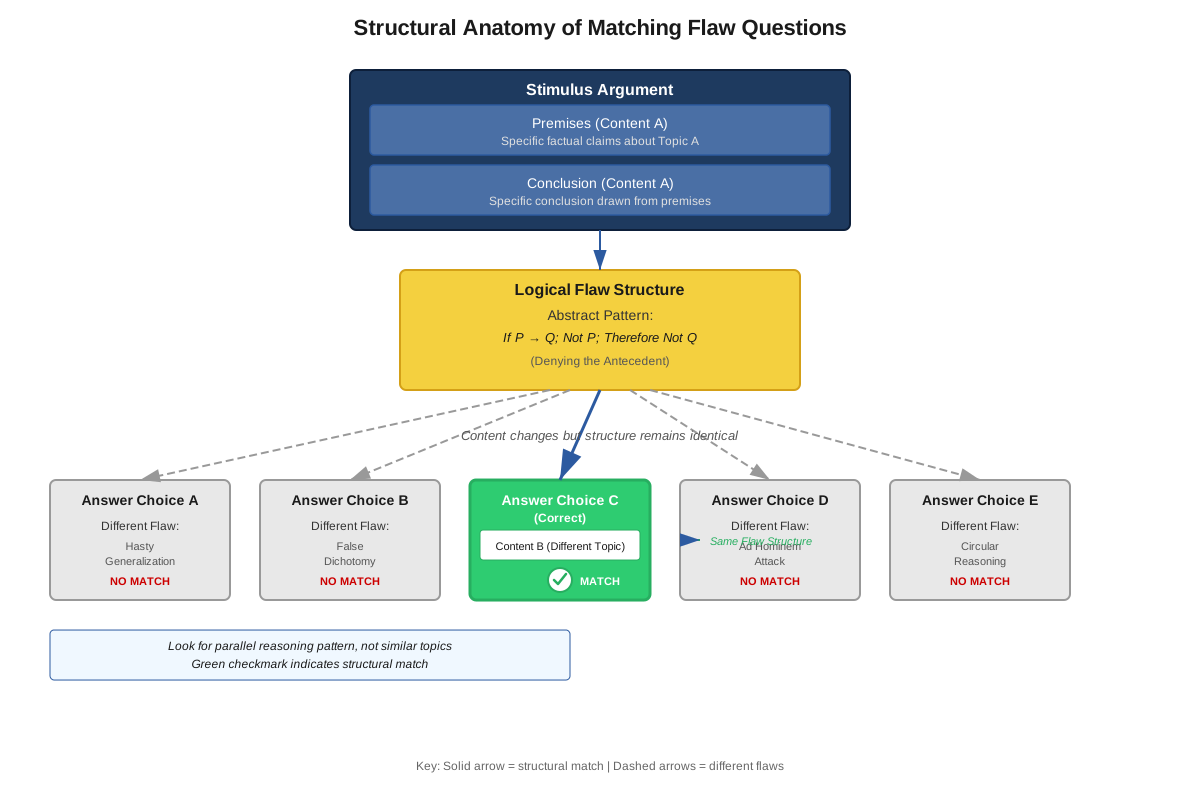
Matching flaw to stimulus is a critical skill within LSAT Logical Reasoning that requires test-takers to identify parallel reasoning errors across different arguments. Unlike standard flaw questions where students simply identify what's wrong with an argument, matching flaw questions demand a deeper level of analysis: recognizing the abstract structure of a flawed argument and finding another argument that commits the exact same logical error, even when the content is completely different.
This question type appears regularly on the LSAT and represents one of the more challenging variations of flaw identification. The difficulty stems from the need to abstract away from specific content—whether the argument discusses politics, science, or everyday scenarios—and focus purely on the logical structure of the reasoning error. Students must develop the ability to see past surface-level differences and recognize that an argument about restaurant quality and an argument about economic policy might share identical logical flaws.
Mastering matching flaw to stimulus questions builds upon foundational logical reasoning skills while developing advanced pattern recognition abilities essential for LSAT success. This skill connects directly to parallel reasoning questions, flaw identification, and formal logic, creating a comprehensive understanding of argument structure that benefits performance across all Logical Reasoning question types. The ability to match flaws demonstrates true mastery of logical principles rather than mere memorization of common error types.
Learning Objectives
- [ ] Identify how Matching flaw to stimulus appears in LSAT questions
- [ ] Explain the reasoning pattern behind Matching flaw to stimulus
- [ ] Apply Matching flaw to stimulus to solve LSAT-style problems accurately
- [ ] Abstract the logical structure of flawed arguments independent of content
- [ ] Distinguish between superficially similar arguments with different underlying flaws
- [ ] Systematically eliminate answer choices that commit different logical errors
- [ ] Recognize the most common flaw patterns that appear in matching questions
Prerequisites
- Basic flaw identification: Understanding common logical fallacies is essential because matching flaw questions require first identifying what's wrong with the stimulus argument before finding a parallel error.
- Argument structure analysis: The ability to break arguments into premises and conclusions enables students to see the skeleton of reasoning beneath the content.
- Conditional reasoning: Many matching flaw questions involve conditional logic errors, making familiarity with sufficient/necessary conditions crucial.
- Formal logic fundamentals: Understanding how to represent arguments symbolically helps abstract away from content to focus on structure.
Why This Topic Matters
Matching flaw to stimulus questions test one of the most sophisticated reasoning skills the LSAT measures: the ability to recognize abstract logical patterns. This skill extends far beyond test-taking into legal practice, where attorneys must identify analogous reasoning in case law, recognize when opposing counsel commits logical errors similar to those in precedent, and construct arguments that parallel successful reasoning from other contexts.
On the LSAT, matching flaw questions typically appear 2-4 times per test, representing approximately 5-10% of all Logical Reasoning questions. These questions carry significant weight because they're among the hardest to guess correctly—random selection among five structurally complex answer choices yields poor results. Students who master this question type gain a measurable competitive advantage, as these questions effectively separate high scorers from average performers.
These questions most commonly appear with question stems like "The flawed reasoning in which one of the following is most similar to that in the argument above?" or "Which one of the following arguments is most similar in its pattern of reasoning to the argument above?" The LSAT tests this skill because it requires the same type of analogical reasoning essential for legal analysis, where lawyers must determine whether the reasoning in one case applies to another despite different factual circumstances.
Core Concepts
The Structure of Matching Flaw Questions
Matching flaw to stimulus questions present a flawed argument in the stimulus, then ask test-takers to identify which answer choice contains an argument with the same logical error. The key challenge lies in recognizing that arguments with completely different content can share identical logical structures. For example, an argument that confuses correlation with causation about exercise and health commits the same flaw as an argument that confuses correlation with causation about studying and grades, despite discussing entirely different subjects.
These questions require a two-step process: first, identify the specific flaw in the stimulus argument; second, find the answer choice that replicates that exact flaw pattern. Both steps demand precision—misidentifying the stimulus flaw leads to selecting an answer with a different error, while correctly identifying the flaw but failing to match it accurately results in choosing an argument that seems similar but differs in crucial structural ways.
Abstracting Logical Structure
The core skill in matching flaw questions involves abstracting logical structure from specific content. This means mentally converting concrete arguments into their logical skeletons. Consider an argument: "Most doctors recommend exercise. Therefore, exercise must be beneficial." The abstract structure is: "Most members of expert group X recommend Y. Therefore, Y must have property Z." This abstraction allows recognition that "Most teachers assign homework. Therefore, homework must be educational" follows the same pattern, even though the content differs entirely.
Successful abstraction requires identifying:
- The type of premises (universal, particular, conditional, causal)
- The relationship between premises and conclusion
- Any logical gaps or unwarranted assumptions
- The specific nature of the reasoning error
Students should practice translating arguments into schematic form using variables (X, Y, Z) or generic placeholders to strip away distracting content and reveal underlying structure.
Common Flaw Patterns in Matching Questions
Certain logical flaws appear repeatedly in matching questions because they're easily paralleled across different contexts:
Confusing Sufficient and Necessary Conditions: The stimulus might argue "All A are B, therefore all B are A" (affirming the consequent), and the correct answer will follow the pattern "All X are Y, therefore all Y are X" with different content.
Correlation-Causation Confusion: Arguments that observe two phenomena occurring together and conclude one causes the other, without ruling out reverse causation, common causes, or coincidence.
Unrepresentative Sample: Drawing conclusions about a whole population based on an atypical subset, such as surveying only enthusiasts to determine general opinion.
Equivocation: Using a term with multiple meanings inconsistently within an argument, shifting between definitions to reach an invalid conclusion.
False Dichotomy: Presenting two options as exhaustive when other possibilities exist, then eliminating one to conclude the other must be true.
The Matching Process
Effective matching follows a systematic approach:
- Identify the stimulus flaw precisely: Don't just recognize something is wrong—articulate exactly what logical error occurs
- Predict the abstract pattern: Before reading answer choices, formulate what a parallel argument would look like
- Eliminate structurally different answers: Remove choices that commit different flaws, even if they're also flawed
- Compare remaining choices carefully: Distinguish between close matches and perfect parallels
- Verify the match: Ensure the selected answer replicates every structural element of the stimulus flaw
Distinguishing Content from Structure
The LSAT deliberately uses dramatically different content between stimulus and correct answer to test whether students truly understand logical structure. An argument about corporate mergers might parallel one about personal relationships, or a scientific argument might match a political one. This content diversity serves as a distractor—students who focus on subject matter similarity rather than structural identity will select incorrect answers.
The test also includes wrong answers that discuss similar topics to the stimulus but commit different logical errors. These "content trap" answers exploit the tendency to match based on subject matter rather than reasoning pattern. Recognizing this trap is essential: similarity in topic is irrelevant; only similarity in logical structure matters.
Degree of Precision Required
Matching flaw questions demand exact correspondence between stimulus and answer choice flaws. Near-misses don't count. If the stimulus confuses necessary conditions with sufficient conditions in a specific way, the correct answer must confuse them in precisely the same way—not merely commit some conditional reasoning error. This precision distinguishes matching flaw questions from general flaw identification, where recognizing the category of error suffices.
Consider these two arguments:
- Argument 1: "If it rains, the game is cancelled. The game was cancelled. Therefore, it rained."
- Argument 2: "If it rains, the game is cancelled. It didn't rain. Therefore, the game wasn't cancelled."
Both commit conditional reasoning errors, but they're different errors (affirming the consequent vs. denying the antecedent). A matching question would require distinguishing between these structurally distinct flaws.
Concept Relationships
The skill of matching flaw to stimulus builds directly upon basic flaw identification—students must first recognize what's wrong before they can match it. This foundational skill provides the vocabulary and conceptual framework for categorizing logical errors. From flaw identification, matching questions add the layer of structural abstraction, requiring students to see beyond content to pure logical form.
Matching flaw questions connect closely to parallel reasoning questions, which ask students to match valid argument structures rather than flawed ones. Both question types test the same core skill—recognizing logical patterns—but apply it to different contexts. Mastering one significantly aids performance on the other.
The relationship flows as follows: Basic Argument Structure → Flaw Identification → Flaw Categorization → Structural Abstraction → Pattern Matching → Matching Flaw to Stimulus. Each step builds upon the previous, with matching flaw questions representing an advanced synthesis of multiple logical reasoning skills.
Conditional reasoning serves as a prerequisite because many matching flaw questions involve conditional logic errors. Understanding sufficient and necessary conditions, contrapositive formation, and common conditional fallacies provides the foundation for recognizing and matching these specific flaw types.
The skill also connects forward to strengthen/weaken questions, as understanding how arguments fail helps identify what would fix or further damage them. Students who excel at matching flaws often find strengthen/weaken questions easier because they've developed sophisticated understanding of argument vulnerabilities.
High-Yield Facts
⭐ Matching flaw questions require exact structural correspondence—near-misses are incorrect even if they commit similar types of errors
⭐ Content similarity between stimulus and answer choice is irrelevant and often serves as a distractor
⭐ The correct answer will be flawed in precisely the same way as the stimulus, even if it's also flawed in additional ways
⭐ Abstracting the stimulus flaw before reading answer choices dramatically improves accuracy and speed
⭐ Common flaw patterns include sufficient/necessary confusion, correlation-causation errors, unrepresentative samples, and false dichotomies
- Wrong answers often commit different logical errors, making them flawed but not parallel to the stimulus
- The LSAT uses dramatically different content domains between stimulus and correct answer to test true structural understanding
- Conditional reasoning flaws (affirming consequent, denying antecedent) appear frequently in matching questions
- Some matching flaw questions involve multiple logical errors—the correct answer must match all of them
- Time pressure makes these questions particularly challenging; systematic elimination is more efficient than trying to match each answer directly
- The question stem will specify "most similar" because perfect parallels are sometimes impossible, but the correct answer will still be significantly closer than alternatives
- Recognizing the flaw category (causal, conditional, sampling, etc.) helps narrow answer choices quickly
Quick check — test yourself on Matching flaw to stimulus so far.
Try Flashcards →Common Misconceptions
Misconception: If an answer choice discusses the same topic as the stimulus, it's more likely to be correct.
Correction: Topic similarity is completely irrelevant to matching flaw questions. The LSAT deliberately uses different content domains to test whether students understand logical structure independent of subject matter. Focus exclusively on the pattern of reasoning, not the content being reasoned about.
Misconception: Any answer choice that contains a logical flaw is a potential correct answer.
Correction: All five answer choices in matching flaw questions are typically flawed arguments. The question isn't asking which answer is flawed, but which answer is flawed in exactly the same way as the stimulus. Four wrong answers will commit different logical errors.
Misconception: The correct answer must use the same type of evidence or reach the same type of conclusion as the stimulus.
Correction: The correct answer must match the logical structure of the flaw, but the specific types of premises and conclusions can differ. An argument using statistical evidence can match one using anecdotal evidence if the logical error in processing that evidence is identical.
Misconception: If the stimulus commits multiple flaws, the correct answer only needs to match one of them.
Correction: When a stimulus contains multiple logical errors, the correct answer must parallel all of them in the same relationship. However, most LSAT matching flaw questions involve a single primary flaw to keep the question manageable.
Misconception: Matching flaw questions are just harder versions of regular flaw questions.
Correction: Matching flaw questions test a fundamentally different skill—pattern recognition and structural abstraction—rather than simply more difficult flaw identification. They require translating concrete arguments into abstract logical forms, which is a distinct cognitive task from identifying what's wrong with a single argument.
Misconception: The correct answer will feel similar or use similar language to the stimulus.
Correction: The LSAT deliberately makes correct answers feel different by using contrasting vocabulary, sentence structures, and content domains. Students who rely on intuitive similarity rather than systematic structural analysis will consistently select wrong answers.
Worked Examples
Example 1: Conditional Reasoning Flaw
Stimulus: "Every successful entrepreneur takes risks. Maria takes risks. Therefore, Maria will be a successful entrepreneur."
Analysis: First, identify the flaw. The argument has the structure: All A are B. X is B. Therefore, X is A. This confuses a necessary condition (risk-taking) with a sufficient condition. Risk-taking is necessary for entrepreneurial success (you can't succeed without it), but it's not sufficient (taking risks doesn't guarantee success). The argument affirms the consequent of a conditional statement.
Abstract Structure: All members of group A have property B. Individual X has property B. Therefore, X is a member of group A.
Correct Answer: "All professional athletes maintain strict training regimens. John maintains a strict training regimen. Therefore, John will be a professional athlete."
Why it matches: This follows the identical pattern—confusing a necessary condition (training regimen) with a sufficient condition. The content is completely different (athletics vs. entrepreneurship), but the logical structure is identical. Both arguments incorrectly assume that possessing a necessary characteristic guarantees membership in a group.
Wrong Answer Example: "Most successful entrepreneurs take risks. Maria doesn't take risks. Therefore, Maria won't be a successful entrepreneur."
Why it's wrong: While this also involves entrepreneurs and risk-taking (similar content), it commits a different logical error. This argument denies the antecedent of a conditional statement, which is structurally distinct from affirming the consequent. The logical pattern doesn't match despite the similar subject matter.
Example 2: Causal Reasoning Flaw
Stimulus: "Studies show that students who eat breakfast perform better on tests. Therefore, eating breakfast causes improved test performance."
Analysis: The flaw is inferring causation from correlation without ruling out alternative explanations. Perhaps students who eat breakfast also get more sleep, come from more stable home environments, or are generally more conscientious—any of which could be the actual cause of better performance. The argument observes two phenomena occurring together (breakfast eating and good test performance) and jumps to a causal conclusion without eliminating reverse causation, common causes, or coincidence.
Abstract Structure: Phenomenon X correlates with phenomenon Y. Therefore, X causes Y.
Correct Answer: "Research indicates that people who own more books tend to have higher incomes. Therefore, owning books causes people to earn higher incomes."
Why it matches: This commits the identical correlation-causation error. Book ownership correlates with income, but the argument fails to consider that higher income might cause book ownership (reverse causation), that education level might cause both (common cause), or other explanations. The logical structure perfectly parallels the stimulus despite completely different content (books/income vs. breakfast/test performance).
Wrong Answer Example: "Studies show that students who eat breakfast perform better on tests. Maria eats breakfast. Therefore, Maria will perform well on tests."
Why it's wrong: This argument treats a correlation as if it were a universal rule, then applies it to an individual case. While flawed, this is a different error—overgeneralizing from a tendency to an absolute prediction. The stimulus doesn't make predictions about individuals; it makes a causal claim about the general relationship. The logical structures don't match.
Exam Strategy
When approaching matching flaw to stimulus questions on the LSAT, begin by reading the question stem first to confirm it's asking for a parallel flaw rather than simply identifying the flaw. This primes the brain to think structurally from the outset.
Exam Tip: Spend extra time on the stimulus in matching flaw questions—up to 30-45 seconds if needed. Precisely identifying and abstracting the flaw before reading answer choices saves time overall by enabling rapid elimination.
Trigger phrases in question stems include:
- "most similar in its flawed reasoning"
- "most closely parallels the reasoning"
- "exhibits a pattern of reasoning most similar"
- "flawed in a way most similar to"
After reading the stimulus, articulate the flaw in abstract terms before looking at answers. Write a brief note if helpful: "treats necessary as sufficient" or "correlation → causation" or "unrepresentative sample." This prediction anchors the matching process.
Systematic elimination strategy:
- Quickly scan all five answers to get a sense of the content diversity
- Eliminate answers that commit obviously different flaws (wrong flaw category)
- Among remaining answers, check structural details carefully
- Verify the selected answer by mapping each element of the stimulus flaw to the answer choice
Time allocation: These questions typically require 90-120 seconds—longer than average Logical Reasoning questions. Don't rush. The complexity rewards careful analysis, and hasty matching leads to errors that cost more time in review.
Process of elimination tips specific to matching flaw:
- Eliminate answers where the conclusion type differs fundamentally (causal vs. conditional vs. categorical)
- Remove answers where the number of premises differs significantly from the stimulus
- Discard answers that reach valid conclusions, even if the reasoning seems similar
- Be suspicious of answers that use similar vocabulary or discuss related topics—these are often traps
Watch for wrong answer patterns:
- Different flaw, same topic: Discusses similar content but commits a different logical error
- Similar flaw category, wrong specifics: Falls in the same general category (e.g., conditional reasoning) but makes a different specific error
- Valid reasoning: Reaches its conclusion legitimately, making it structurally different from the flawed stimulus
- Multiple flaws that don't match: Contains several errors, but not the same ones as the stimulus
- Reversed structure: Commits the opposite error (e.g., denying antecedent when stimulus affirms consequent)
Memory Techniques
MATCH acronym for the systematic approach:
- Map the stimulus flaw precisely
- Abstract to logical structure
- Translate into generic terms (X, Y, Z)
- Compare answer structures systematically
- Highlight exact correspondence
Visualization strategy: Picture arguments as physical structures—buildings with foundations (premises) and roofs (conclusions). A flaw is like a structural defect (cracked foundation, unsupported roof). Matching requires finding another building with the exact same defect, regardless of whether it's a house, office, or barn.
The Content Curtain: Visualize drawing a curtain over the specific content of arguments, leaving only the logical skeleton visible. Practice mentally replacing concrete terms with variables: "All A are B" instead of "All doctors are educated." This mental curtain helps focus on structure.
Flaw Family Tree: Organize common flaws hierarchically:
- Conditional Reasoning Errors
- Affirming the consequent
- Denying the antecedent
- Confusing sufficient/necessary
- Causal Reasoning Errors
- Correlation-causation
- Reverse causation ignored
- Common cause ignored
- Sampling Errors
- Unrepresentative sample
- Sample size too small
- Selection bias
Memorizing this tree helps quickly categorize stimulus flaws and eliminate answers from different branches.
The "Different Clothes, Same Person" metaphor: The correct answer is the same logical error wearing different clothes (different content). Just as you'd recognize a friend regardless of outfit, recognize the flaw regardless of topic.
Summary
Matching flaw to stimulus questions represent an advanced LSAT Logical Reasoning skill that requires identifying a logical error in a stimulus argument, abstracting that error to its structural essence, and finding an answer choice that commits the identical error despite different content. Success demands moving beyond surface-level content to recognize pure logical patterns—seeing that arguments about completely different topics can share identical reasoning flaws. The key challenges include avoiding content-based distractors, distinguishing between similar but structurally distinct flaws, and maintaining the precision necessary to match flaws exactly rather than approximately. Students must master both flaw identification and structural abstraction, combining these skills through systematic analysis that begins with precise diagnosis of the stimulus flaw and proceeds through careful elimination of structurally different answer choices. These questions appear regularly on the LSAT and effectively separate high scorers from average performers because they test sophisticated pattern recognition abilities essential for legal reasoning.
Key Takeaways
- Matching flaw questions require exact structural correspondence between stimulus and answer—content similarity is irrelevant and often misleading
- Always identify and abstract the stimulus flaw before reading answer choices to enable systematic elimination
- Common flaw patterns include conditional reasoning errors, correlation-causation confusion, unrepresentative samples, and false dichotomies
- All answer choices are typically flawed; the question asks which is flawed in the same way, not which is flawed
- Spend extra time analyzing the stimulus (30-45 seconds) to save time overall through efficient answer choice elimination
- Wrong answers often match content but differ in logical structure, or fall in the same flaw category but commit different specific errors
- Translating arguments into abstract form using variables (X, Y, Z) helps strip away distracting content and reveal underlying structure
Related Topics
Parallel Reasoning Questions: These questions ask students to match valid argument structures rather than flawed ones, testing the same pattern recognition skills but applied to sound reasoning. Mastering matching flaw questions provides the structural analysis foundation needed for parallel reasoning.
Flaw Identification Questions: The prerequisite skill for matching flaw questions, where students identify what's wrong with a single argument without needing to find a parallel. Success with matching flaws requires first mastering basic flaw identification.
Strengthen and Weaken Questions: Understanding how arguments fail (through matching flaw analysis) directly informs understanding of what would fix or further damage them, making these question types closely related.
Formal Logic and Conditional Reasoning: Many matching flaw questions involve conditional logic errors, making deeper study of sufficient/necessary conditions, contrapositives, and conditional chains valuable for improving performance.
Argument Structure and Diagramming: Advanced techniques for visually representing argument structure support the abstraction process central to matching flaw questions, enabling quicker recognition of logical patterns.
Practice CTA
Now that you understand the principles behind matching flaw to stimulus questions, it's time to apply this knowledge through deliberate practice. Work through the practice questions systematically, taking time to identify and abstract each stimulus flaw before evaluating answer choices. Use the flashcards to reinforce recognition of common flaw patterns and their structural characteristics. Remember that these questions reward precision and careful analysis—speed will develop naturally as pattern recognition improves. Each practice question is an opportunity to strengthen the mental muscles needed for structural abstraction, building toward automatic recognition of logical patterns that will serve you throughout the LSAT and beyond.
Sign up free to keep reading
Create a free AnvayaPrep account to finish this LSAT guide on Matching flaw to stimulus — plus flashcards and practice questions.