Overview
The part to whole flaw represents one of the most frequently tested reasoning errors on the LSAT Logical Reasoning section. This fallacy occurs when an argument incorrectly assumes that what is true of a part of something must also be true of the whole, or conversely, that what is true of the whole must be true of each individual part. Understanding this flaw is essential because it appears in approximately 5-8% of all flaw questions on the LSAT, making it a high-yield topic that can directly impact your score.
This reasoning error exploits a fundamental principle of logic: properties and characteristics do not automatically transfer between parts and wholes. A basketball team might be the best in the league (whole), but that doesn't mean every individual player is the best at their position (parts). Similarly, each ingredient in a recipe might be delicious on its own (parts), but the combined dish could taste terrible (whole). The LSAT tests your ability to recognize when arguments make these unjustified leaps, requiring you to distinguish between legitimate inferences and flawed reasoning patterns.
Mastering the part to whole flaw strengthens your overall logical reasoning skills and connects directly to other common LSAT flaws, including composition and division fallacies, hasty generalizations, and sampling errors. This topic serves as a gateway to understanding how arguments can fail by making improper inferences about relationships between individual elements and collective entities. The ability to spot this flaw quickly and accurately will not only help you answer flaw questions correctly but also improve your performance on strengthen, weaken, and assumption questions where similar reasoning patterns appear.
Learning Objectives
- [ ] Identify how Part to whole flaw appears in LSAT questions
- [ ] Explain the reasoning pattern behind Part to whole flaw
- [ ] Apply Part to whole flaw to solve LSAT-style problems accurately
- [ ] Distinguish between valid part-whole reasoning and fallacious part-whole reasoning
- [ ] Recognize both directions of the flaw (part to whole and whole to part)
- [ ] Predict answer choice language that correctly describes this flaw
- [ ] Connect part to whole flaws with related reasoning errors on the LSAT
Prerequisites
- Basic argument structure: Understanding premises, conclusions, and how they connect is essential because identifying any flaw requires first recognizing what the argument is trying to prove and what evidence it uses.
- Flaw question stems: Familiarity with how the LSAT asks about flawed reasoning (e.g., "The reasoning is flawed because...") enables efficient question recognition and approach.
- Conditional reasoning fundamentals: Understanding necessary and sufficient conditions helps distinguish when properties legitimately transfer versus when they don't.
- Quantifier logic: Recognizing the difference between "all," "some," "most," and "each" is crucial because part to whole flaws often hinge on improper quantifier shifts.
Why This Topic Matters
The part to whole flaw appears in real-world reasoning constantly, making it both practically valuable and frequently tested on the LSAT. Politicians commit this error when they argue that because each individual government program is necessary, the entire budget must be approved without cuts. Business leaders fall into this trap when they assume that because each department is profitable, the company as a whole must be thriving (ignoring overhead costs). Scientists must carefully avoid this reasoning when extrapolating from sample data to entire populations. Recognizing this flaw helps you think more critically in professional, academic, and personal contexts.
On the LSAT, part to whole flaws appear in approximately 5-8% of Logical Reasoning questions, with the highest concentration in flaw questions but also appearing in assumption, strengthen, weaken, and parallel reasoning questions. Over a typical LSAT with approximately 50 Logical Reasoning questions, you can expect to encounter 2-4 questions directly testing this concept. Given that each question represents roughly 2% of your total LSAT score, mastering this single flaw type can meaningfully impact your percentile ranking.
The LSAT presents part to whole flaws in diverse contexts: scientific studies generalizing from samples, economic arguments about individual versus collective behavior, legal reasoning about group versus individual rights, and social policy debates about aggregate versus individual outcomes. The test writers deliberately vary the subject matter to ensure you're recognizing the logical structure rather than relying on content knowledge. Common scenarios include arguments about team performance based on individual statistics, conclusions about entire populations based on subset characteristics, and inferences about collective properties from individual attributes.
Core Concepts
The Basic Structure of Part to Whole Flaw
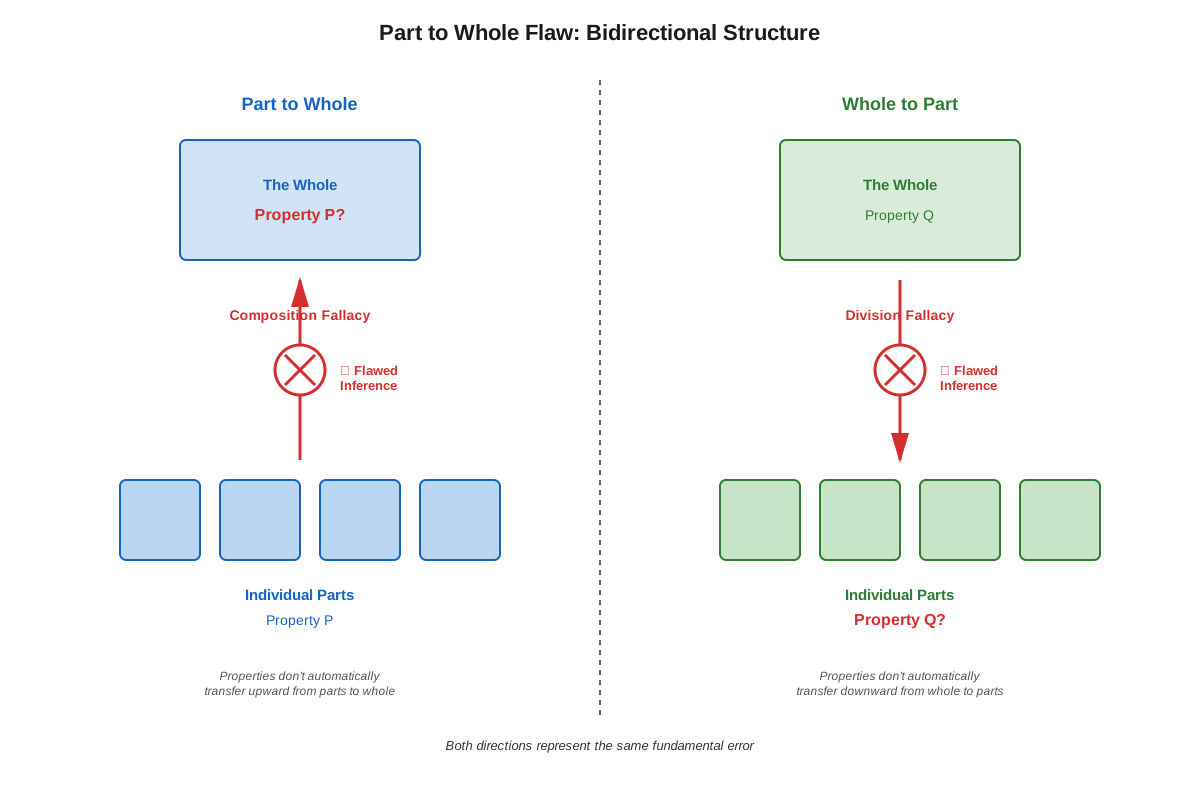
The part to whole flaw (also called the fallacy of composition when reasoning from part to whole, and the fallacy of division when reasoning from whole to part) involves an unjustified inference between individual components and the collective entity they comprise. This flaw manifests in two distinct directions, each representing a different type of invalid reasoning.
The part-to-whole direction occurs when an argument assumes that because individual parts possess a certain property, the whole composed of those parts must also possess that property. For example: "Each musician in the orchestra is highly talented; therefore, the orchestra as a whole must produce excellent music." This reasoning fails because collective performance depends on coordination, not just individual skill.
The whole-to-part direction occurs when an argument assumes that because a whole possesses a certain property, each individual part must possess that same property. For example: "The company is profitable; therefore, each department must be generating profit." This reasoning fails because some departments might lose money while others generate enough profit to make the company overall profitable.
Properties That Transfer vs. Properties That Don't
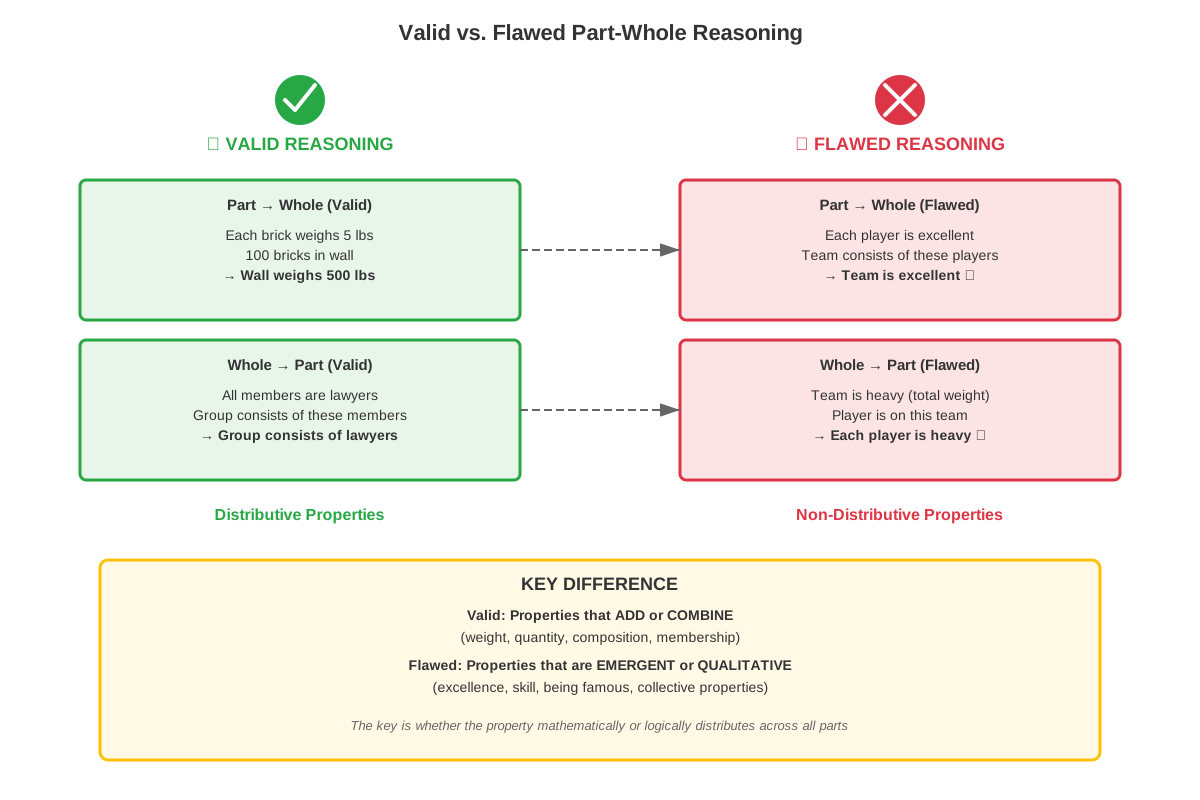
Understanding which properties legitimately transfer between parts and wholes is crucial for identifying when reasoning is flawed versus when it's valid. Distributive properties transfer between parts and wholes, while non-distributive properties do not.
| Property Type | Definition | Example | Transfers? |
|---|---|---|---|
| Distributive | Property that each part must have if the whole has it | Being made of wood | Yes |
| Non-distributive (Collective) | Property that emerges from the combination or relationship of parts | Being heavy, being expensive, being effective | No |
| Emergent | Property that exists only at the collective level | Being a team, having a majority opinion | No |
Distributive properties include: being made of a certain material, being located in a certain place (if all parts are there), and being subject to certain laws. If a table is made of wood, each part of the table is made of wood. This inference is valid.
Non-distributive properties include: weight (parts can be light while the whole is heavy), cost (individual components can be cheap while the whole is expensive), effectiveness (individual elements can be good while the combination is bad), and aesthetic qualities (parts can be beautiful while the whole is ugly, or vice versa).
Recognizing the Flaw in LSAT Arguments
LSAT part to whole flaw questions typically present arguments that make one of these invalid inferences while appearing superficially reasonable. The test writers craft these arguments to exploit intuitive but incorrect reasoning patterns. Key indicators include:
Shift in scope: The premises discuss individual members, components, or parts, while the conclusion addresses the group, collection, or whole (or vice versa). Watch for language shifts from "each," "every," or "individual" to "the group," "collectively," or "overall."
Missing justification: The argument provides no explanation for why the property in question should transfer from part to whole. Valid arguments would need to establish that the property is distributive or explain the mechanism by which individual properties combine to create collective properties.
Implicit assumption: The argument assumes without stating that what's true at one level must be true at another level. This hidden assumption is what makes the reasoning flawed.
Common Contexts for Part to Whole Flaws
The LSAT presents this flaw across various domains, but certain contexts appear repeatedly:
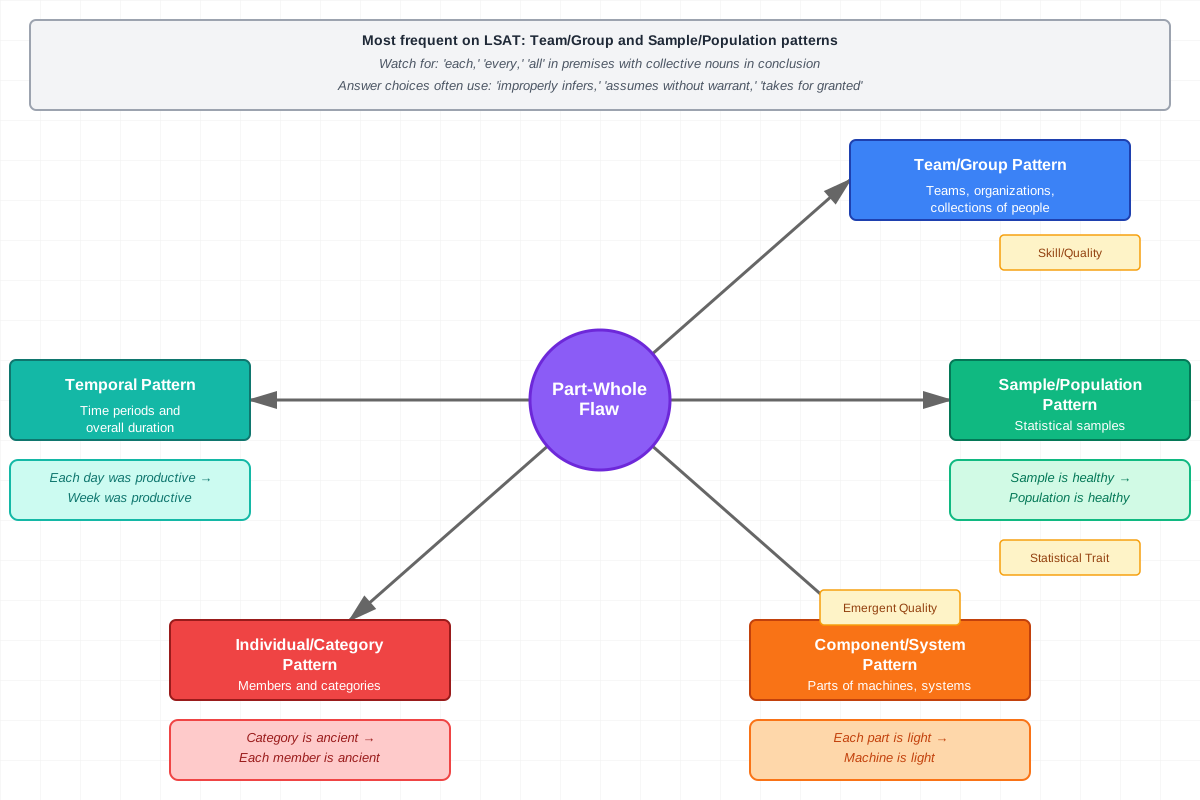
Statistical and sampling contexts: Arguments that generalize from a sample (part) to a population (whole) without justifying the sample's representativeness. Example: "Every person we surveyed in this neighborhood supports the policy; therefore, the entire city supports it."
Team and organizational contexts: Arguments about group performance based on individual capabilities or vice versa. Example: "Each player on the team is the best at their position; therefore, the team will win the championship."
Economic contexts: Arguments about collective economic outcomes based on individual economic behavior. Example: "If each person saves more money, the economy as a whole will have more money available for investment."
Compositional contexts: Arguments about the properties of compounds or mixtures based on their components. Example: "Each ingredient in this medicine is safe; therefore, the medicine as a whole must be safe."
The Reverse: Whole to Part Reasoning
While less common on the LSAT, whole-to-part reasoning errors deserve equal attention. These arguments assume that collective properties must be possessed by each individual member. Example: "The company increased its revenue by 20%; therefore, each department must have increased its revenue by 20%." This fails because some departments might have grown while others shrank.
Another example: "The average salary at this company is $80,000; therefore, most employees earn around $80,000." This commits the whole-to-part flaw because averages (collective properties) don't necessarily reflect individual cases—a few very high salaries could skew the average while most employees earn much less.
Distinguishing Valid Part-Whole Reasoning
Not all reasoning about parts and wholes is flawed. Valid arguments either: (1) involve distributive properties that legitimately transfer, (2) provide explicit justification for why the property transfers in this case, or (3) make qualified claims that acknowledge the inference isn't automatic.
Valid example: "Each component of this machine is made of steel; therefore, the entire machine is made of steel." This is valid because material composition is distributive.
Valid example with justification: "Each member of the team is highly skilled, and they have practiced together extensively with excellent coaching; therefore, the team will likely perform well." This avoids the flaw by providing the missing link—coordination and coaching—that explains how individual skill translates to collective performance.
Concept Relationships
The part to whole flaw connects to several other logical reasoning concepts, forming a network of related reasoning errors. Understanding these relationships deepens your ability to recognize and analyze flawed arguments.
Part to whole flaw → Hasty generalization: Both involve improper inferences from limited information to broader conclusions. A hasty generalization moves from a small sample to a general rule, while a part to whole flaw moves from individual components to collective properties. The key difference is that part to whole specifically involves the part-whole relationship, while hasty generalization can involve any insufficient evidence.
Part to whole flaw ← → Sampling errors: When the "part" in question is a sample and the "whole" is a population, part to whole flaws often manifest as sampling errors. The argument fails to establish that the sample is representative of the population.
Part to whole flaw → Composition/Division fallacies: These are the formal names for the two directions of part to whole reasoning. Composition (part to whole) and division (whole to part) are the technical philosophical terms for these specific fallacies.
Part to whole flaw ↔ Equivocation: Sometimes part to whole flaws involve subtle shifts in meaning. A term might mean one thing when applied to individuals and something different when applied to groups, creating an equivocation that enables the flawed inference.
Distributive properties ← determines → Valid part-whole reasoning: Whether a property is distributive determines whether reasoning about parts and wholes is valid. This is the crucial factor that separates good reasoning from flawed reasoning in this domain.
High-Yield Facts
⭐ The part to whole flaw assumes that properties of individual parts automatically transfer to the whole, or vice versa, without justification.
⭐ This flaw appears in approximately 5-8% of LSAT Logical Reasoning questions, making it one of the most frequently tested reasoning errors.
⭐ The flaw works in two directions: composition (part to whole) and division (whole to part), though composition is more common on the LSAT.
⭐ Key trigger words include shifts from "each," "every," or "individual" to "the group," "collectively," or "overall" (or the reverse).
⭐ Not all part-whole reasoning is flawed—distributive properties (like material composition) legitimately transfer between parts and wholes.
- The flaw often appears in arguments about teams, organizations, samples, populations, and economic behavior.
- Correct answer choices typically use language like "assumes that what is true of the parts is true of the whole" or "fails to consider that the whole may have properties not shared by its parts."
- The flaw is closely related to hasty generalization but specifically involves the part-whole relationship rather than just insufficient evidence.
- Arguments can avoid this flaw by providing explicit justification for why a property transfers in the specific case being discussed.
- Emergent properties—characteristics that exist only at the collective level—are particularly vulnerable to whole-to-part reasoning errors.
- Statistical averages and aggregates are common contexts for whole-to-part flaws because they represent collective properties that don't necessarily describe individuals.
- The flaw becomes harder to spot when the argument uses technical or unfamiliar subject matter, but the logical structure remains the same.
Quick check — test yourself on Part to whole flaw so far.
Try Flashcards →Common Misconceptions
Misconception: All reasoning from parts to wholes is automatically flawed. → Correction: Only reasoning about non-distributive properties is flawed. When properties are distributive (like material composition or location), reasoning from parts to wholes is valid. The key is whether the specific property in question legitimately transfers.
Misconception: If an argument mentions both individuals and groups, it must commit a part to whole flaw. → Correction: Arguments can discuss both parts and wholes without committing this flaw if they don't make unjustified inferences between them. The flaw requires an invalid inference, not merely discussion of both levels.
Misconception: Part to whole flaws only go in one direction (part to whole). → Correction: The flaw works in both directions. Whole-to-part reasoning (division) is equally flawed when it assumes collective properties must be possessed by each individual part.
Misconception: If the conclusion happens to be true, the reasoning isn't flawed. → Correction: A flaw is about the logical structure of the argument, not whether the conclusion is actually true. An argument can reach a true conclusion through flawed reasoning, and the LSAT tests your ability to identify the flaw regardless of the conclusion's truth.
Misconception: Part to whole flaws are the same as hasty generalizations. → Correction: While related, these are distinct flaws. Hasty generalization involves insufficient evidence for a general claim, while part to whole specifically involves improper inferences about the relationship between components and the collective entity they form.
Misconception: The flaw only appears in flaw questions. → Correction: While most common in flaw questions, this reasoning pattern also appears in assumption questions (where the answer supplies the missing justification), strengthen/weaken questions (where answers address the gap), and parallel reasoning questions (where you must match the flawed structure).
Misconception: Complex or technical subject matter makes the flaw different. → Correction: The logical structure of the flaw remains identical regardless of whether the argument discusses sports teams, chemical compounds, economic policies, or any other subject. The LSAT tests logical reasoning, not content knowledge.
Worked Examples
Example 1: Classic Part to Whole Flaw
Argument: "Each of the individual chapters in this textbook is clearly written and easy to understand. Therefore, students will find the textbook as a whole easy to understand."
Analysis:
Step 1: Identify the conclusion. The conclusion is that "students will find the textbook as a whole easy to understand."
Step 2: Identify the premises. The premise is that "each of the individual chapters is clearly written and easy to understand."
Step 3: Identify the scope shift. The premise discusses individual chapters (parts), while the conclusion discusses the textbook as a whole (whole).
Step 4: Determine if the property transfers. "Easy to understand" is a non-distributive property. Even if each chapter is individually clear, the textbook as a whole might be difficult to understand if the chapters don't connect well, if there's no coherent overall structure, if the progression is illogical, or if the book lacks adequate transitions between chapters.
Step 5: Identify the flaw. This is a classic part to whole flaw (composition). The argument assumes that because each part has a property (clarity), the whole must have that property, without justifying why individual clarity would necessarily produce collective clarity.
How an answer choice might describe this flaw: "The argument fails to consider that even though each individual chapter is easy to understand, the textbook as a whole may be difficult to understand due to poor organization or lack of coherent structure."
Connection to learning objectives: This example demonstrates how to identify the flaw (Objective 1), explains the reasoning pattern of assuming part properties transfer to the whole (Objective 2), and shows how to analyze an LSAT-style problem (Objective 3).
Example 2: Whole to Part Flaw
Argument: "The law firm's profits increased by 30% last year. Therefore, each attorney at the firm must have increased their billable hours significantly."
Analysis:
Step 1: Identify the conclusion. The conclusion is that "each attorney must have increased their billable hours significantly."
Step 2: Identify the premises. The premise is that "the firm's profits increased by 30%."
Step 3: Identify the scope shift. The premise discusses the firm as a whole (whole), while the conclusion discusses each individual attorney (parts).
Step 4: Determine if the property transfers. Profit increase is a collective property that doesn't necessarily distribute to each member. The firm's overall profit could increase for many reasons: some attorneys increased billable hours while others didn't, the firm raised rates, the firm reduced expenses, the firm added new profitable practice areas, or a few attorneys brought in major clients while others maintained steady performance.
Step 5: Identify the flaw. This is a whole to part flaw (division). The argument assumes that because the whole has a property (profit increase), each part must have contributed to that property in the same way (increased billable hours), without considering alternative explanations.
How an answer choice might describe this flaw: "The argument overlooks the possibility that the firm's increased profits resulted from factors other than increased billable hours by each attorney."
Connection to learning objectives: This example shows the reverse direction of the flaw (Objective 5), demonstrates the reasoning pattern in the whole-to-part direction (Objective 2), and provides practice applying the concept to solve problems (Objective 3).
Exam Strategy
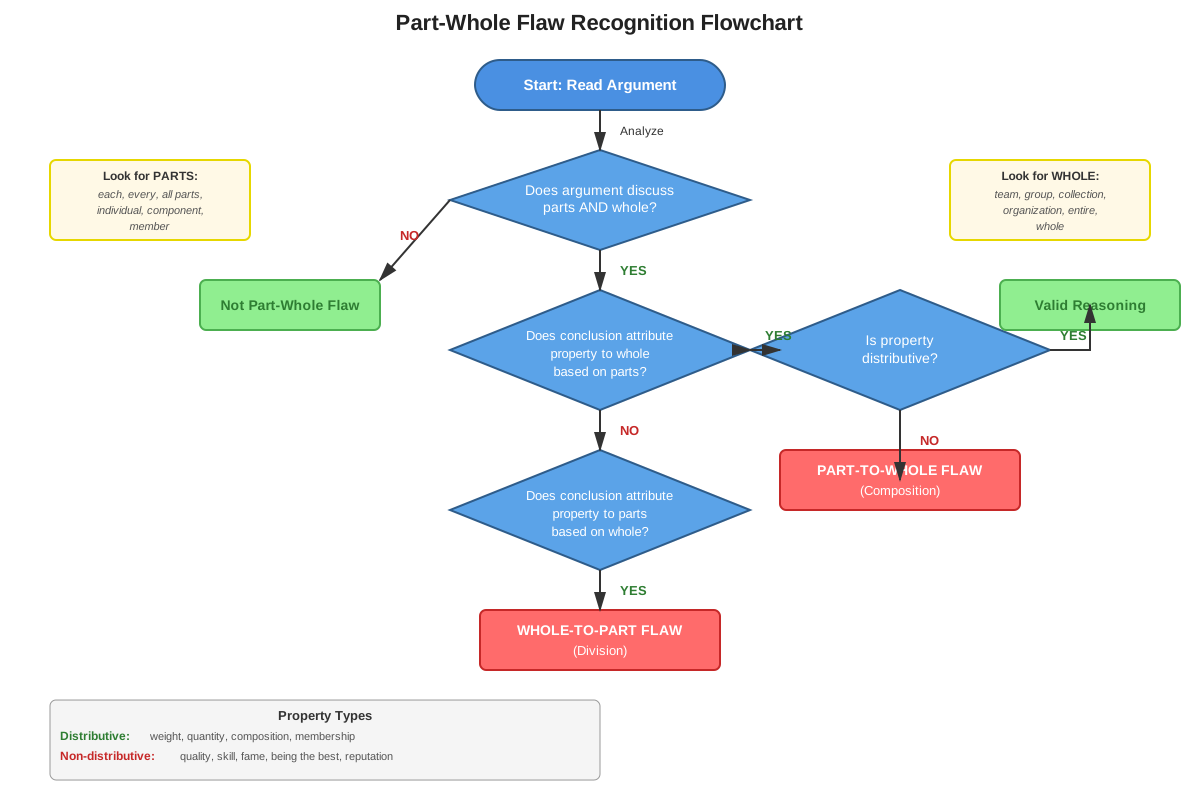
When approaching flaw questions that might involve part to whole reasoning, follow this systematic process:
Step 1: Read the argument carefully and identify scope shifts. Look for language that moves from individual/part/each/every to collective/whole/group/overall, or vice versa. These shifts are your primary trigger for suspecting a part to whole flaw.
Step 2: Ask yourself the critical question: "Does this property necessarily transfer?" Consider whether the property being discussed is distributive or non-distributive. If you're unsure, think of counterexamples—can you imagine a situation where the parts have the property but the whole doesn't (or vice versa)?
Step 3: Predict the answer before looking at choices. Formulate in your own words how the argument is flawed: "The argument assumes that because each part is X, the whole must be X, but this ignores that the whole might not be X even if all parts are."
Step 4: Scan answer choices for part-whole language. Correct answers typically include phrases like:
- "assumes that what is true of the parts is true of the whole"
- "fails to consider that the whole may have properties not shared by its parts"
- "overlooks the possibility that the group may not have the characteristics of its individual members"
- "takes for granted that characteristics of individual elements will be characteristics of the combination"
Step 5: Eliminate answers that describe different flaws. Common wrong answers describe other reasoning errors like causal flaws, conditional logic errors, or ad hominem attacks. Stay focused on whether the answer describes the specific part-whole relationship problem.
Trigger words and phrases to watch for:
- Part indicators: each, every, individual, member, component, element, person
- Whole indicators: group, team, organization, collection, overall, collectively, as a whole, in total
- Transition words: therefore, thus, so, consequently (connecting the part premise to whole conclusion)
Time allocation advice: Part to whole flaws are typically easier to identify than some other flaw types once you know what to look for. Spend 30-45 seconds on the argument analysis, 15-20 seconds predicting the answer, and 30-45 seconds evaluating choices. If you can quickly spot the scope shift, these questions should take 1:15-1:30 total.
Process of elimination tips: Wrong answers in part to whole flaw questions often describe the argument as making one of these other errors:
- Circular reasoning (but the argument doesn't assume its conclusion)
- Causal confusion (but the argument isn't about cause and effect)
- Appeal to authority (but the argument doesn't cite an expert)
- Ad hominem (but the argument doesn't attack a person)
If you've identified a part-whole scope shift but can't find an answer that explicitly describes it, look for answers that describe the argument as "generalizing inappropriately" or "failing to justify an inference"—these may be describing the part to whole flaw in more general terms.
Memory Techniques
Mnemonic for the two directions: "COPE with DIVISION"
- COmposition: Part to Entire (whole)
- DIVISION: Distribute Individual Values Incorrectly to Separate Items from Overall Numbers
Visualization strategy: Picture a brick wall. Each brick might be small and light (part property), but the wall as a whole is large and heavy (whole property). The properties don't transfer. When you see a part to whole flaw, visualize this brick wall to remind yourself that collective properties differ from individual properties.
The "Team Test": When you suspect a part to whole flaw, mentally substitute a sports team example. "Each player is excellent; therefore, the team is excellent" clearly shows the flaw because team success requires coordination, chemistry, and strategy beyond individual skill. This quick mental substitution helps confirm you've identified the right flaw.
Acronym for properties that DON'T transfer: WEAVE
- Weight (parts can be light, whole heavy)
- Effectiveness (parts can work individually but not together)
- Aesthetic qualities (parts can be beautiful, whole ugly, or vice versa)
- Value/cost (parts can be cheap, whole expensive)
- Emergent properties (exist only at collective level)
The "Distribution Question": Before concluding an argument commits this flaw, ask: "Would I distribute this property to everyone at a party?" If someone says "This party is fun," does that mean each individual person is fun? No—the party's fun-ness is a collective property. This quick mental check helps identify non-distributive properties.
Summary
The part to whole flaw represents a critical reasoning error tested frequently on the LSAT, appearing in approximately 5-8% of Logical Reasoning questions. This flaw occurs when arguments improperly assume that properties of individual parts transfer to the whole they comprise (composition), or that properties of a whole transfer to each individual part (division). The key to identifying this flaw lies in recognizing scope shifts between individual and collective language, then determining whether the property in question is distributive (legitimately transfers) or non-distributive (doesn't transfer). Most properties tested on the LSAT are non-distributive—effectiveness, cost, aesthetic qualities, and emergent properties don't automatically transfer between parts and wholes. Mastering this flaw requires understanding both its logical structure and its common manifestations in arguments about teams, samples, organizations, and compositions. Success on these questions depends on quickly spotting the scope shift, asking whether the property transfers, and predicting answer choices that describe the unjustified inference between parts and wholes.
Key Takeaways
- The part to whole flaw assumes properties transfer between parts and wholes without justification, appearing in two directions: composition (part to whole) and division (whole to part)
- Identify this flaw by spotting scope shifts from individual/part language to collective/whole language (or vice versa) combined with an unjustified inference
- Not all part-whole reasoning is flawed—distributive properties like material composition legitimately transfer, while non-distributive properties like effectiveness, cost, and emergent characteristics do not
- This flaw appears in 5-8% of LSAT Logical Reasoning questions across multiple question types, making it a high-yield topic for score improvement
- Correct answer choices typically use explicit part-whole language like "assumes what is true of parts is true of the whole" or describe the argument as failing to justify why the property transfers
- The flaw commonly appears in contexts involving teams, samples, populations, organizations, and compositions, but the logical structure remains identical regardless of subject matter
- Quick identification depends on recognizing trigger words (each/every vs. group/collectively) and asking the critical question: "Does this property necessarily transfer?"
Related Topics
Hasty Generalization: This flaw involves drawing broad conclusions from insufficient evidence and often overlaps with part to whole reasoning when the "part" is a sample. Mastering part to whole flaws provides a foundation for understanding when generalizations are justified versus when they're hasty.
Sampling Errors: When arguments generalize from samples to populations without establishing representativeness, they often commit both sampling errors and part to whole flaws. Understanding the part-whole relationship clarifies why unrepresentative samples lead to flawed conclusions.
Causal Reasoning: While distinct from part to whole flaws, causal arguments sometimes involve similar scope shifts—for example, assuming that because individuals behave a certain way, the aggregate outcome will follow predictably. Distinguishing these flaw types sharpens your analytical precision.
Necessary vs. Sufficient Assumptions: Part to whole arguments often have missing assumptions about why properties transfer. Understanding assumption questions helps you identify what would need to be true to make part-whole reasoning valid.
Strengthen and Weaken Questions: Once you can identify part to whole flaws, you can predict what would strengthen (evidence that the property does transfer) or weaken (evidence that it doesn't) arguments with this structure.
Practice CTA
Now that you've mastered the conceptual foundation of part to whole flaws, it's time to cement your understanding through active practice. Attempt the practice questions designed specifically for this topic, focusing on applying the systematic approach outlined in the exam strategy section. As you work through problems, pay special attention to identifying scope shifts and determining whether properties are distributive or non-distributive. Use the flashcards to reinforce your recognition of trigger words and common answer choice language. Remember: recognizing this single flaw type can help you correctly answer 2-4 questions on test day, potentially moving you up several percentile points. Your investment in mastering this concept will pay dividends when you encounter it under timed conditions on the actual LSAT. You've got this!
Sign up free to keep reading
Create a free AnvayaPrep account to finish this LSAT guide on Part to whole flaw — plus flashcards and practice questions.