Overview
The past to future flaw represents one of the most frequently tested reasoning errors on the LSAT Logical Reasoning section. This flaw occurs when an argument assumes that because something was true in the past, it will necessarily continue to be true in the future—without providing adequate justification for why past patterns should persist. Arguments committing this error fail to account for changing circumstances, evolving conditions, or the possibility that factors responsible for past outcomes may no longer be present or relevant.
Understanding this flaw is essential for LSAT success because it appears across multiple question types, including Flaw questions, Weaken questions, Assumption questions, and occasionally Strengthen questions. The LSAT tests this concept because it reflects a common reasoning error in everyday arguments, legal reasoning, and policy debates. Recognizing when an argument improperly extrapolates from historical data to future predictions is a critical analytical skill that law schools value highly.
Within the broader landscape of Logical Reasoning concepts, the past to future flaw connects to fundamental principles of inductive reasoning, causal reasoning, and the proper use of evidence. It shares conceptual territory with other temporal reasoning flaws and represents a specific instance of the broader category of unwarranted assumptions. Mastering this flaw type strengthens overall performance on flaw questions and enhances the ability to evaluate argument structure across all Logical Reasoning question types.
Learning Objectives
- [ ] Identify how Past to future flaw appears in LSAT questions
- [ ] Explain the reasoning pattern behind Past to future flaw
- [ ] Apply Past to future flaw to solve LSAT-style problems accurately
- [ ] Distinguish past to future flaw from other temporal reasoning errors
- [ ] Recognize the specific language patterns that signal this flaw in arguments
- [ ] Evaluate whether an argument provides sufficient justification for projecting past trends into the future
- [ ] Construct effective critiques of arguments that commit the past to future flaw
Prerequisites
- Basic argument structure: Understanding premises, conclusions, and how evidence supports claims is necessary to identify when past evidence is improperly used to support future predictions
- Inductive vs. deductive reasoning: Recognizing the difference between these reasoning types helps identify when an argument makes an inductive leap from past to future without adequate support
- Causal reasoning fundamentals: Many past to future flaws involve implicit causal assumptions about what made past patterns occur and whether those causes will persist
- General flaw question format: Familiarity with how the LSAT asks about flawed reasoning provides the framework for recognizing this specific flaw type
Why This Topic Matters
The lsat past to future flaw appears with remarkable frequency on the LSAT, making it one of the highest-yield topics for test preparation. Statistical analysis of released LSAT exams reveals that this flaw type appears in approximately 10-15% of all Flaw questions and surfaces regularly in Weaken and Assumption questions as well. Given that Logical Reasoning comprises half of the scored LSAT sections, mastering this single flaw type can directly impact multiple questions per test administration.
In real-world contexts, the past to future flaw underlies countless policy debates, business decisions, and legal arguments. Attorneys regularly encounter arguments that rely on historical precedent, past performance data, or previous outcomes to predict future results. The ability to identify when such projections are warranted versus when they represent flawed reasoning is fundamental to legal analysis. Courts must evaluate whether past patterns of behavior predict future conduct, whether historical discrimination suggests ongoing discrimination, and whether previous regulatory approaches will succeed in changed circumstances.
On the LSAT, this flaw appears in diverse contexts: arguments about business performance based on past profits, predictions about student success based on historical graduation rates, claims about policy effectiveness based on previous implementations, and forecasts about individual behavior based on past actions. The test writers favor this flaw because it tests sophisticated analytical thinking—the ability to recognize that temporal continuity requires justification, not mere assumption.
Core Concepts
The Basic Structure of Past to Future Flaw
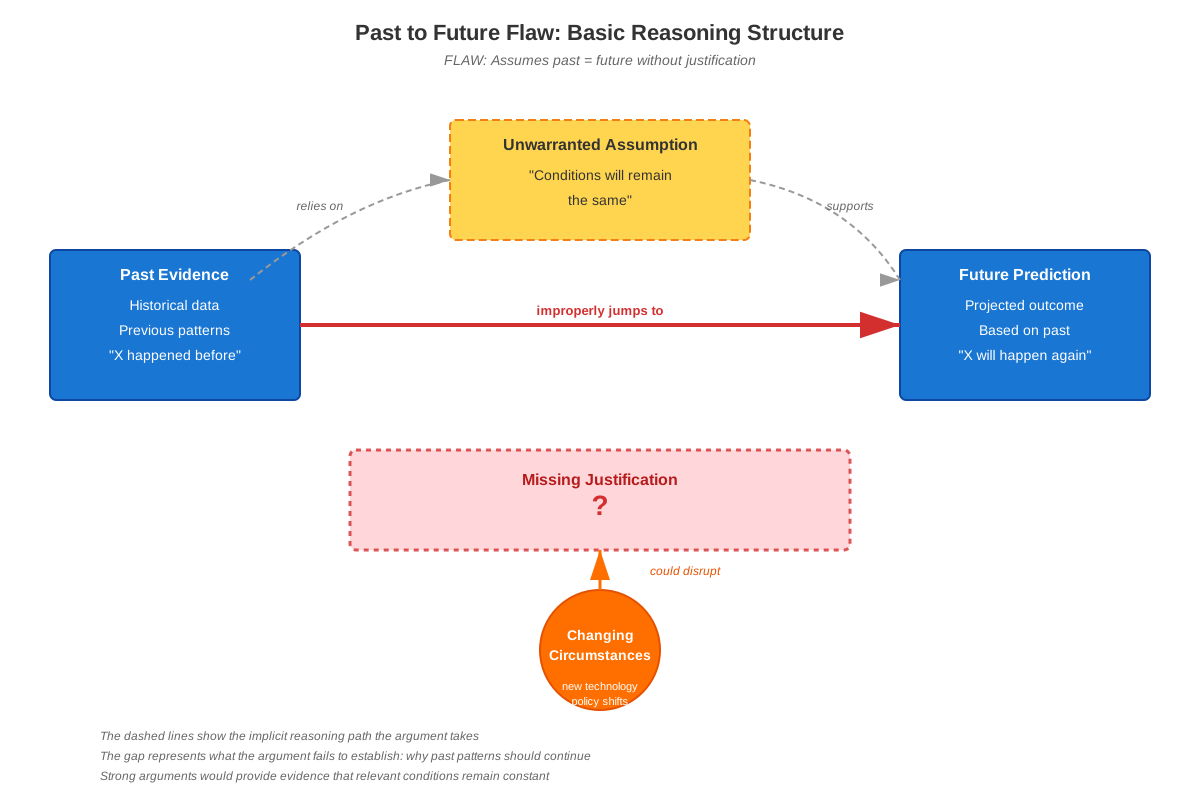
The past to future flaw follows a predictable pattern: an argument presents evidence about what happened in the past and concludes that the same thing will happen in the future, without adequately justifying why the past pattern should continue. The logical structure typically looks like this:
Premise: X was true in the past (or X occurred previously)
Conclusion: Therefore, X will be true in the future (or X will occur again)
Missing element: Justification for why past conditions will persist or why past causes remain operative
The flaw lies not in using past evidence—which can be perfectly legitimate—but in assuming automatic continuity without addressing whether relevant circumstances have changed or might change. Strong arguments that project from past to future explicitly address why the conditions that produced past outcomes remain in place or will remain in place.
What Makes the Reasoning Flawed
Several factors can make past-to-future reasoning fallacious:
- Changed circumstances: The conditions that produced past outcomes may no longer exist
- Intervening variables: New factors may emerge that disrupt historical patterns
- Sample size issues: Past data may be insufficient to support confident predictions
- Temporal limitations: The time period examined may be too short or unrepresentative
- Causal misunderstanding: The argument may misidentify what caused past outcomes
The critical insight is that temporal proximity does not guarantee causal or predictive continuity. Just because something happened yesterday does not mean it will happen tomorrow unless the underlying mechanisms remain constant.
Distinguishing Legitimate from Flawed Past-to-Future Reasoning
Not all arguments that move from past to future are flawed. The distinction lies in whether the argument provides adequate justification:
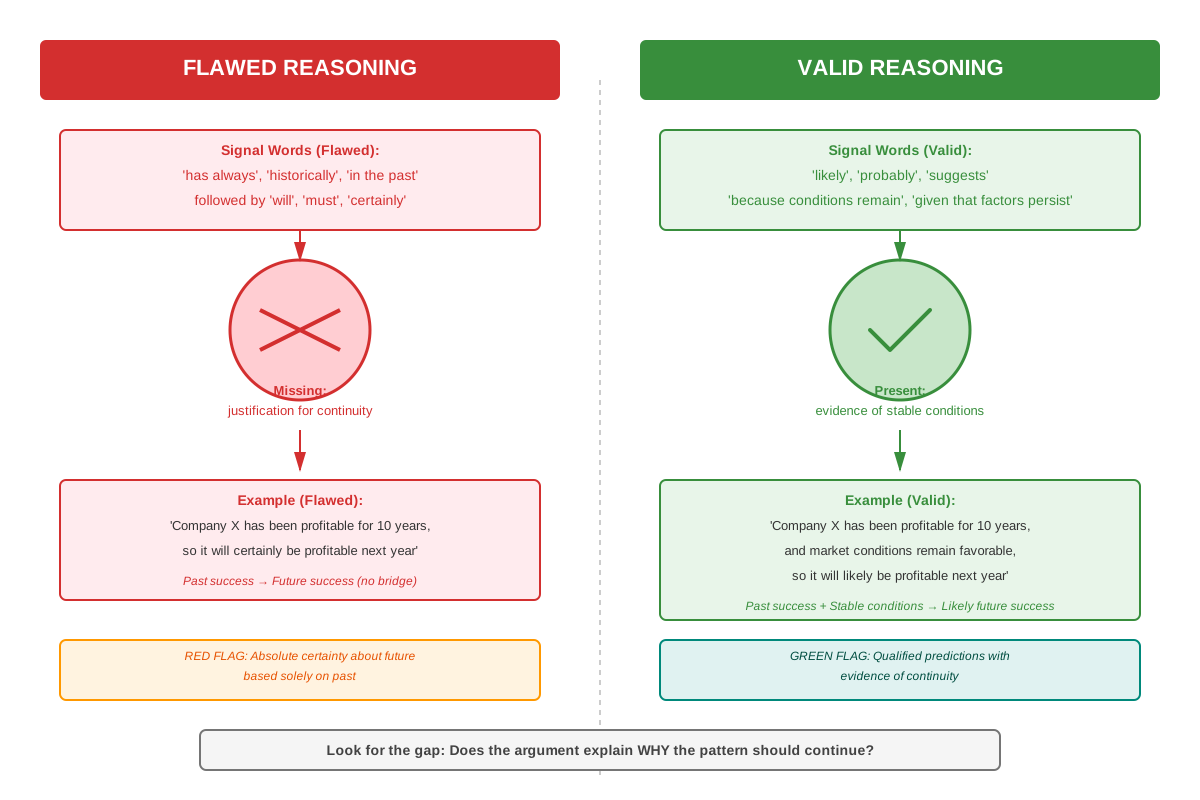
| Flawed Reasoning | Legitimate Reasoning |
|---|---|
| Assumes past patterns will continue without justification | Explains why conditions supporting past patterns persist |
| Ignores possibility of changed circumstances | Addresses potential changes and explains why they won't affect the pattern |
| Treats historical correlation as guaranteed future correlation | Identifies causal mechanisms that remain operative |
| Makes no attempt to rule out alternative explanations | Considers and eliminates competing explanations for past patterns |
Common Variations in LSAT Questions
The LSAT presents this flaw in multiple forms:
Personal behavior predictions: "Sarah has always arrived on time to meetings, so she will arrive on time to tomorrow's meeting." This assumes no circumstances will change (traffic, emergencies, schedule conflicts).
Business/economic projections: "The company's profits increased every year for the past decade, so profits will increase next year." This ignores market changes, competition, economic conditions, or internal factors.
Policy effectiveness claims: "This educational program raised test scores in the past, so implementing it again will raise test scores." This assumes the same conditions exist (student population, teacher quality, resources, external factors).
Trend extrapolation: "Temperatures have risen each year for five years, so temperatures will rise next year." This treats a limited pattern as an inevitable trajectory without addressing underlying causes or natural variation.
The Role of Implicit Assumptions
Arguments with past to future flaws rely on unstated assumptions that the LSAT exploits:
- Stability assumption: Relevant conditions will remain stable
- Causal continuity assumption: Whatever caused past outcomes will continue operating
- Representativeness assumption: The past period examined is representative of future periods
- Absence of interference assumption: No new factors will disrupt the pattern
Recognizing these implicit assumptions helps identify the flaw and predict what answer choices will say. Correct answers to Flaw questions often explicitly state that the argument "assumes without justification that past conditions will continue" or "fails to consider that circumstances may have changed."
Temporal Scope Considerations
The strength of past-to-future reasoning often depends on temporal factors:
- Longer time periods generally provide stronger evidence than shorter ones (but not always)
- More recent past may be more relevant than distant past for predicting near future
- Consistent patterns across varied conditions are more reliable than patterns under uniform conditions
- Stable domains (physical laws) support stronger inferences than volatile domains (stock markets, human behavior)
The LSAT tests whether students recognize that temporal scope affects argument strength and that past evidence alone, regardless of duration, cannot guarantee future outcomes without additional justification.
Concept Relationships
The past to future flaw connects to several other Logical Reasoning concepts in important ways:
Causal reasoning → Past to future flaw: Many past to future flaws involve implicit causal claims. The argument assumes that whatever caused past outcomes will continue causing similar outcomes, which requires understanding causal mechanisms.
Sampling and generalization → Past to future flaw: Using past data to predict the future is a form of generalization from a sample (past instances) to a broader population (future instances). The same principles about representative samples apply.
Necessary vs. sufficient assumptions → Past to future flaw: The assumption that conditions will remain stable is typically a necessary assumption for past-to-future arguments. Assumption questions often test whether students recognize this necessity.
Weaken/Strengthen strategies → Past to future flaw: Arguments with this flaw are weakened by evidence of changed circumstances and strengthened by evidence of stable conditions. Understanding the flaw predicts what will weaken or strengthen the argument.
Alternative explanations → Past to future flaw: The flaw often involves failing to consider that past outcomes might have resulted from temporary or unique circumstances that won't recur.
This web of relationships means that mastering the past to future flaw enhances performance across multiple question types and strengthens overall logical reasoning skills.
High-Yield Facts
⭐ The past to future flaw assumes that past patterns will continue without justifying why conditions remain stable or relevant
⭐ Correct answer choices often explicitly state the argument "fails to consider that circumstances may have changed" or uses similar language
⭐ This flaw appears in approximately 10-15% of Flaw questions and regularly in Weaken and Assumption questions
⭐ Not all past-to-future reasoning is flawed—only reasoning that lacks adequate justification for continuity
⭐ The flaw can be corrected by providing evidence that relevant conditions remain constant or that causal mechanisms persist
- Arguments committing this flaw often use temporal language like "has always," "previously," "in the past," "historically," or "traditionally"
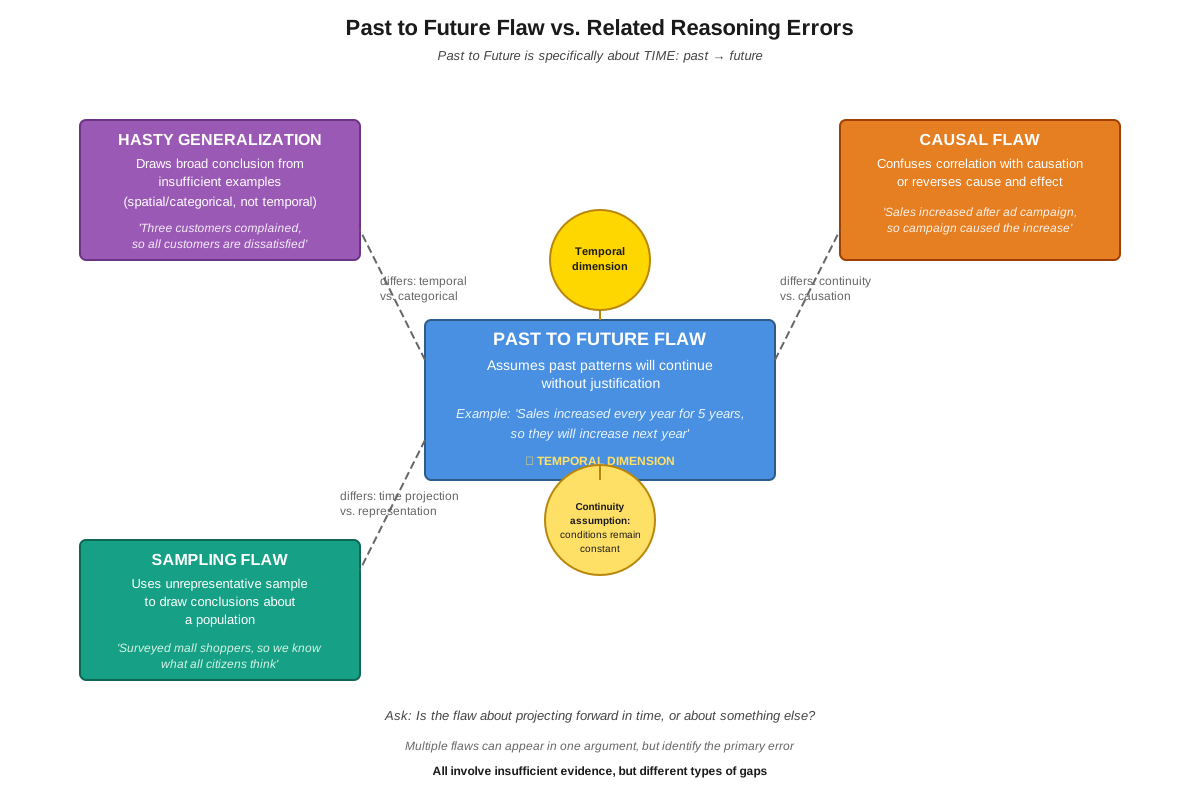
- The flaw is distinct from correlation/causation errors, though they can co-occur in the same argument
- Longer historical patterns do not automatically justify stronger future predictions without addressing why conditions remain relevant
- The LSAT often pairs this flaw with other reasoning errors in the same argument, requiring students to identify the primary flaw
- Answer choices describing this flaw may use various phrasings: "takes for granted," "presumes without warrant," "fails to establish," or "overlooks the possibility"
Quick check — test yourself on Past to future flaw so far.
Try Flashcards →Common Misconceptions
Misconception: Any argument that uses past evidence to support a conclusion about the future commits the past to future flaw.
Correction: The flaw only occurs when the argument fails to provide adequate justification for why past patterns should continue. Arguments that explain why conditions remain stable or why causal mechanisms persist are not flawed.
Misconception: The past to future flaw is the same as a correlation/causation error.
Correction: These are distinct flaws. The correlation/causation error involves mistaking correlation for causation, while the past to future flaw involves assuming temporal continuity without justification. An argument can commit one without committing the other, though both can appear together.
Misconception: Longer time periods automatically make past-to-future reasoning stronger and eliminate the flaw.
Correction: While longer patterns can provide more evidence, they don't automatically justify future predictions. Even century-long patterns can be disrupted by changed circumstances. The argument must still address why the pattern should continue, regardless of how long it has persisted.
Misconception: The past to future flaw only appears in Flaw questions.
Correction: This reasoning pattern appears across multiple question types, including Weaken questions (where you identify what would undermine the projection), Assumption questions (where you identify what the argument takes for granted about continuity), and occasionally Strengthen questions (where you support the projection).
Misconception: Pointing out that "things could change" is always sufficient to identify this flaw.
Correction: The flaw is more specific than mere possibility of change. The issue is that the argument provides no justification for continuity, not merely that change is possible. Correct answers typically indicate the argument "fails to establish" or "takes for granted" that conditions will remain relevant, not just that change is possible.
Misconception: If an argument acknowledges that past patterns existed, it has adequately justified future predictions.
Correction: Acknowledging past patterns is only the first step. The argument must also explain why those patterns should continue—what mechanisms will remain operative, why conditions won't change, or why the past is representative of the future.
Worked Examples
Example 1: Business Performance Argument
Argument: "TechCorp's stock price has increased every quarter for the past three years. Investors should therefore expect the stock price to increase next quarter as well."
Analysis:
Step 1 - Identify the conclusion: The conclusion is a prediction about the future: "the stock price [will] increase next quarter."
Step 2 - Identify the evidence: The evidence is entirely about the past: "stock price has increased every quarter for the past three years."
Step 3 - Examine the logical connection: The argument moves directly from past performance to future prediction without explaining why the past pattern should continue. It doesn't address:
- Whether market conditions remain favorable
- Whether the company's competitive position is stable
- Whether the factors driving past growth persist
- Whether the three-year period is representative or anomalous
Step 4 - Identify the flaw: This is a classic past to future flaw. The argument assumes that historical stock performance guarantees future performance without justifying why past conditions will persist.
Step 5 - Predict answer choices: Correct answers might say:
- "Assumes without justification that conditions affecting past stock performance will continue"
- "Fails to consider that factors contributing to past growth may no longer be operative"
- "Takes for granted that past trends are reliable indicators of future performance"
Connection to learning objectives: This example demonstrates how to identify the flaw (Objective 1), explains the reasoning pattern of moving from past evidence to future conclusion without justification (Objective 2), and shows the analytical process for solving such problems (Objective 3).
Example 2: Educational Policy Argument
Argument: "When Riverside School implemented the accelerated reading program five years ago, student reading scores improved by 15% that year. The school board should implement this program again, as it will certainly improve reading scores once more."
Analysis:
Step 1 - Identify the conclusion: "it will certainly improve reading scores once more" (future prediction)
Step 2 - Identify the evidence: "student reading scores improved by 15% that year" when the program was implemented five years ago (past outcome)
Step 3 - Examine the logical connection: The argument assumes that because the program worked in the past, it will work again. However, it fails to consider:
- Whether the current student population has different characteristics
- Whether teachers are equally trained or motivated
- Whether other factors (not the program itself) caused the past improvement
- Whether the educational context has changed in five years
- Whether the initial improvement was sustainable or temporary
Step 4 - Identify the flaw: This commits the past to future flaw by assuming past effectiveness guarantees future effectiveness without establishing that relevant conditions remain constant.
Step 5 - Additional considerations: This argument also potentially commits a causal reasoning error (assuming the program caused the improvement rather than correlation), showing how multiple flaws can appear together. However, the primary flaw is the unjustified projection from past to future.
Step 6 - Predict answer choices: Correct answers might say:
- "Overlooks the possibility that circumstances relevant to the program's effectiveness have changed"
- "Fails to establish that conditions that made the program successful previously still obtain"
- "Presumes without warrant that past results are indicative of future results"
Connection to learning objectives: This example shows how the flaw appears in policy contexts (Objective 1), demonstrates the reasoning pattern with additional complexity (Objective 2), illustrates how to distinguish the primary flaw when multiple issues exist (Objective 4), and applies the analytical framework to reach the correct answer (Objective 3).
Exam Strategy
Recognition Triggers
Watch for these linguistic patterns that frequently signal past to future flaws:
- Temporal markers: "has always," "historically," "traditionally," "in the past," "previously," "for years," "consistently"
- Trend language: "continued to," "repeatedly," "each time," "every year," "pattern of"
- Future predictions: "will," "should expect," "is likely to," "can anticipate," "therefore will"
- Certainty language: "certainly," "definitely," "undoubtedly," "surely" (when applied to future predictions based on past evidence)
Exam Tip: When you see an argument that describes a past pattern and then makes a future prediction, immediately ask yourself: "Does this argument explain WHY the pattern should continue, or does it just assume continuity?"
Systematic Approach
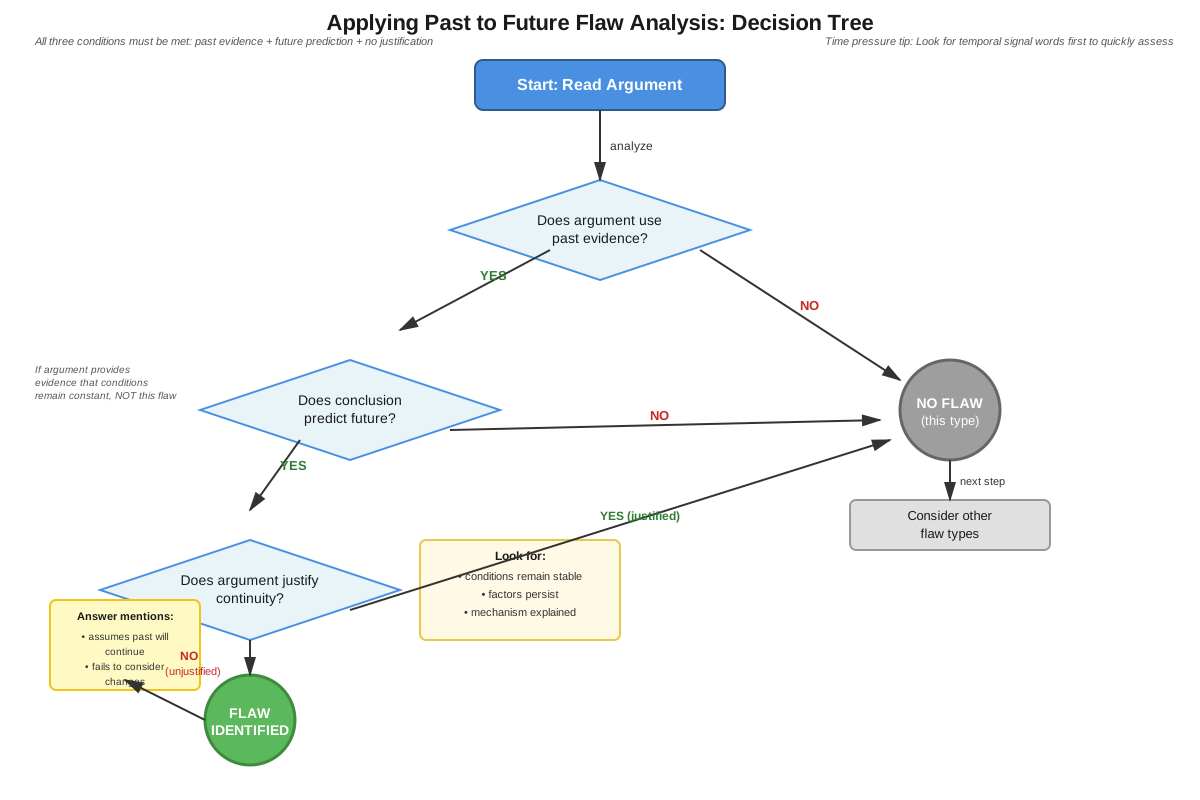
Use this four-step process for questions involving potential past to future flaws:
- Identify temporal elements: Mark what's about the past and what's about the future
- Locate the logical gap: What's missing between past evidence and future conclusion?
- Consider changed circumstances: What could be different now or in the future?
- Match to answer choices: Look for language about assumptions, failure to establish continuity, or overlooking changes
Answer Choice Patterns
Correct answers describing this flaw typically use these formulations:
- "takes for granted that [past conditions] will continue"
- "fails to establish that [relevant factors] remain constant"
- "presumes without providing justification that [past pattern] will persist"
- "overlooks the possibility that circumstances have changed"
- "assumes without warrant that past trends are indicative of future outcomes"
Incorrect answer choices often describe different flaws:
- Correlation/causation errors (when the argument doesn't make causal claims)
- Sampling errors (when the issue is temporal projection, not sample representativeness)
- Ad hominem attacks (when the argument doesn't attack anyone)
- Circular reasoning (when the argument doesn't assume its conclusion)
Time Management
For Flaw questions involving past to future reasoning:
- Spend 15-20 seconds identifying the argument structure and temporal elements
- Spend 10-15 seconds articulating the gap in your own words
- Spend 30-40 seconds evaluating answer choices
- Total time: Approximately 60-75 seconds per question
This flaw type is typically easier to identify than some others (like subtle necessary/sufficient condition errors), so don't overthink it. If you clearly see past evidence supporting a future conclusion without justification for continuity, trust your identification and move efficiently to answer choices.
Process of Elimination Strategy
When using POE on these questions:
- Eliminate answers describing flaws that aren't present (e.g., if there's no causal claim, eliminate causation errors)
- Eliminate answers that describe the argument's evidence rather than its reasoning flaw (e.g., "relies on past data" isn't a flaw; "assumes past data guarantees future outcomes" is)
- Keep answers that explicitly address the temporal gap between past and future
- Choose the answer that most precisely describes the unjustified assumption of continuity
Memory Techniques
Primary Mnemonic: "PAST"
Pattern identified (past evidence)
Assumption of continuity (unstated)
Stability not established (the flaw)
Temporal gap (between past and future)
This acronym helps remember the key elements: the argument identifies a past pattern, assumes it will continue, fails to establish that conditions remain stable, and contains a logical gap between past and future.
Visualization Strategy
Picture a bridge with a missing section. The past is on one side (solid ground with data and evidence), the future is on the other side (the conclusion), and the middle section (justification for continuity) is missing. The argument tries to cross from past to future without building the necessary bridge section.
Comparative Memory Aid
Think of the difference between:
- Weather forecasting (legitimate): Uses past data PLUS models of atmospheric conditions, current measurements, and causal understanding
- Simple extrapolation (flawed): "It rained yesterday, so it will rain tomorrow"
The first provides justification for the projection; the second merely assumes continuity.
Question Stem Recognition
Memorize that these question stems often accompany past to future flaws:
- "The reasoning in the argument is flawed in that it..."
- "The argument is vulnerable to criticism on the grounds that it..."
- "Which one of the following most accurately describes a flaw in the argument?"
When you see these stems and spot temporal language in the argument, immediately consider whether a past to future flaw is present.
Summary
The past to future flaw represents a critical reasoning error tested extensively on the LSAT Logical Reasoning section. This flaw occurs when arguments use past evidence to support future predictions without adequately justifying why historical patterns should continue. The core issue is not the use of past evidence itself—which can be perfectly legitimate—but rather the failure to establish that conditions, causes, or circumstances that produced past outcomes remain operative or relevant. Strong arguments that project from past to future explicitly address stability of conditions, persistence of causal mechanisms, or representativeness of historical data. The LSAT tests this concept across multiple question types, particularly Flaw, Weaken, and Assumption questions, making it one of the highest-yield topics for test preparation. Recognizing this flaw requires identifying temporal elements in arguments, locating logical gaps between past evidence and future conclusions, and understanding that temporal proximity does not guarantee predictive validity without additional justification.
Key Takeaways
- The past to future flaw assumes historical patterns will continue without justifying why conditions remain stable or relevant
- Not all past-to-future reasoning is flawed—only reasoning that lacks adequate justification for continuity commits this error
- This flaw appears in 10-15% of Flaw questions and regularly surfaces in Weaken and Assumption questions
- Correct answer choices typically state the argument "fails to establish," "takes for granted," or "overlooks the possibility" that circumstances have changed
- Recognition triggers include temporal markers ("has always," "historically"), trend language, and future predictions based solely on past patterns
- The flaw can be corrected by providing evidence that relevant conditions remain constant or that causal mechanisms persist
- Distinguishing legitimate from flawed past-to-future reasoning requires examining whether the argument addresses potential changes or explains why patterns should continue
Related Topics
Causal Reasoning Flaws: Understanding how arguments establish or fail to establish causal relationships deepens comprehension of past to future flaws, as many such flaws involve implicit causal assumptions about what produced past outcomes and whether those causes persist.
Sampling and Generalization: The principles governing when samples support generalizations apply to temporal reasoning, as using past instances to predict future instances involves treating the past as a sample of all time periods.
Necessary and Sufficient Assumptions: Many past to future arguments rely on necessary assumptions about stability of conditions. Mastering assumption identification strengthens the ability to recognize what these arguments take for granted.
Weaken and Strengthen Question Types: Since arguments with past to future flaws are vulnerable to evidence of changed circumstances, understanding this flaw enhances performance on questions asking what would weaken or strengthen such arguments.
Conditional Reasoning: Some past to future arguments involve conditional claims about what will happen if past patterns continue, requiring integration of conditional logic skills with temporal reasoning analysis.
Practice CTA
Now that you understand the past to future flaw—its structure, recognition triggers, and strategic approach—you're ready to apply this knowledge to actual LSAT questions. The practice questions and flashcards will reinforce these concepts and build the pattern recognition speed essential for test day success. Each practice question you complete strengthens your ability to spot this high-frequency flaw quickly and accurately. Remember: this single flaw type can appear multiple times per test, making your investment in mastering it one of the highest-yield uses of your study time. Approach the practice materials with confidence, knowing you now have the conceptual framework and analytical tools to excel on these questions.
Sign up free to keep reading
Create a free AnvayaPrep account to finish this LSAT guide on Past to future flaw — plus flashcards and practice questions.