Overview
The probability flaw is one of the most frequently tested reasoning errors in LSAT Logical Reasoning sections, appearing in approximately 10-15% of flaw questions. This error occurs when an argument confuses different types of probability statements or makes unjustified leaps from statistical information to conclusions about specific cases. Understanding this flaw is essential because it represents a fundamental misunderstanding of how probability and statistics apply to individual instances versus groups.
On the LSAT, probability flaws typically manifest when an argument takes information about what is likely or probable for a group and incorrectly applies it to guarantee or predict outcomes for individual members of that group. Alternatively, arguments may reverse this relationship, using information about a specific case to draw broad statistical conclusions. The test makers favor this flaw type because it mirrors real-world reasoning errors that appear in legal arguments, policy debates, and everyday decision-making—all contexts relevant to future law students.
Mastering the lsat probability flaw connects directly to broader Logical Reasoning skills, particularly understanding the relationship between evidence and conclusions, recognizing scope shifts, and identifying unwarranted assumptions. This flaw type often overlaps with other common reasoning errors such as hasty generalizations, sampling flaws, and conditional reasoning mistakes, making it a cornerstone concept for achieving a high score on the LSAT.
Learning Objectives
- [ ] Identify how Probability flaw appears in LSAT questions
- [ ] Explain the reasoning pattern behind Probability flaw
- [ ] Apply Probability flaw to solve LSAT-style problems accurately
- [ ] Distinguish probability flaws from related reasoning errors such as hasty generalizations
- [ ] Recognize the specific language patterns that signal probability flaws in argument stems
- [ ] Evaluate answer choices to identify correct descriptions of probability-based reasoning errors
- [ ] Construct valid probability-based arguments to understand what makes flawed versions incorrect
Prerequisites
- Basic understanding of argument structure: Recognizing premises and conclusions is essential because probability flaws involve the relationship between statistical evidence and specific claims.
- Familiarity with flaw question types: Knowing how to approach questions asking "which one of the following describes a flaw in the reasoning" provides the framework for identifying probability errors.
- Understanding of scope issues: Probability flaws often involve scope shifts between groups and individuals, requiring recognition of when conclusions exceed their evidence.
- Knowledge of conditional reasoning basics: Some probability flaws involve confusing likelihood with certainty, which relates to understanding necessary versus sufficient conditions.
Why This Topic Matters
In legal practice, attorneys constantly work with statistical evidence, expert testimony involving probabilities, and arguments about what outcomes are likely in specific cases. The ability to identify when probability-based reasoning goes wrong is fundamental to evaluating evidence, constructing sound arguments, and recognizing weak opposing claims. Law students must distinguish between what statistical data actually supports versus what advocates claim it supports.
On the LSAT, probability flaws appear in 3-5 questions per test on average, making them high-yield content for score improvement. These questions typically appear as flaw questions (asking what's wrong with the reasoning) but also surface in assumption questions, strengthen/weaken questions, and parallel reasoning questions. The LSAC consistently includes probability-based arguments because they test critical thinking skills essential for legal reasoning.
Common manifestations include arguments about medical treatments (confusing group success rates with individual predictions), consumer behavior (applying aggregate trends to specific purchases), risk assessment (treating probable outcomes as certain), and causal claims based on correlational statistics. The test makers particularly favor scenarios involving surveys, studies, expert predictions, and historical patterns being applied to future or specific cases.
Core Concepts
The Fundamental Probability Flaw Pattern
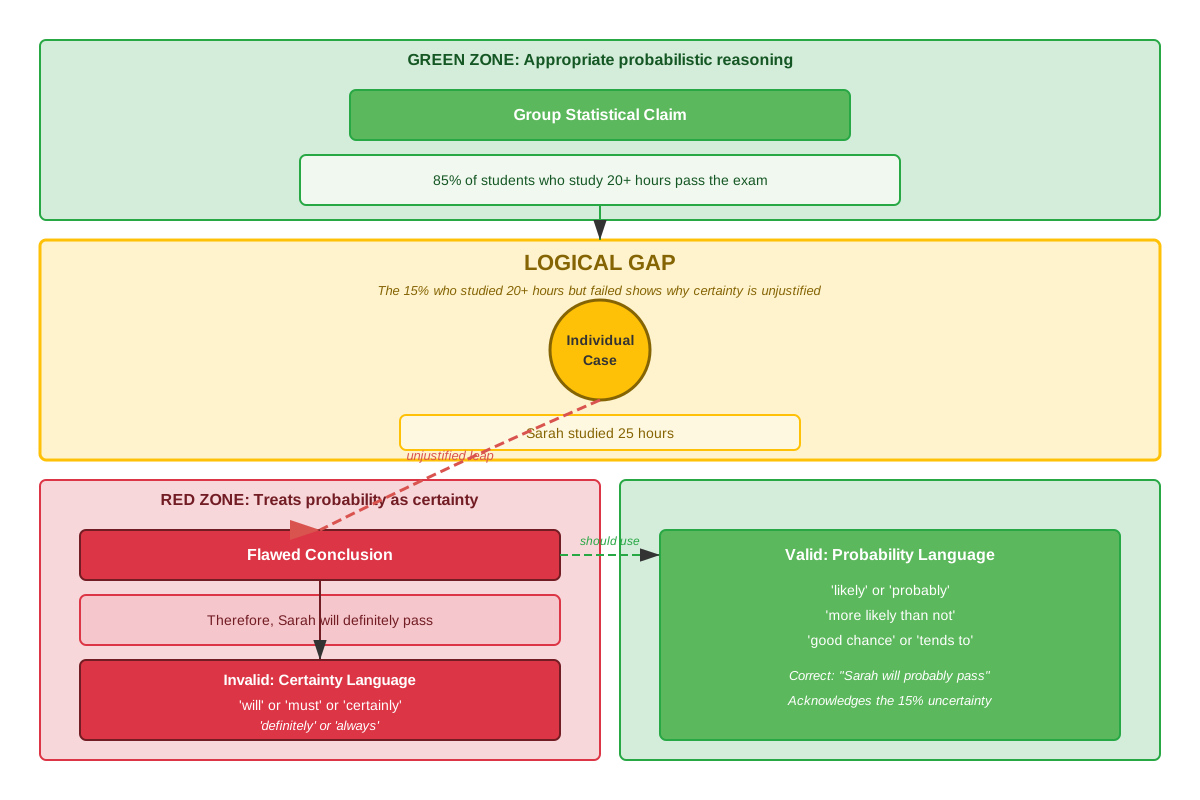
The probability flaw occurs when an argument treats probabilistic information as if it provides certainty about specific cases, or when it confuses the relationship between group statistics and individual instances. At its core, this flaw involves a mismatch between the strength of the evidence (probability, likelihood, tendency) and the strength of the conclusion (certainty, prediction, guarantee).
The basic structure follows this pattern:
- Premise: Statistical or probabilistic information about a group or general tendency
- Conclusion: Definitive claim about a specific case or individual
- Flaw: The gap between "likely" and "certain" or between "group tendency" and "individual outcome"
This reasoning error violates a fundamental principle of logic: probabilistic evidence can support probabilistic conclusions, but cannot justify absolute conclusions about specific instances. Even if 99% of cases follow a pattern, that statistical fact alone cannot prove that any particular case will follow that pattern.
Types of Probability Flaws
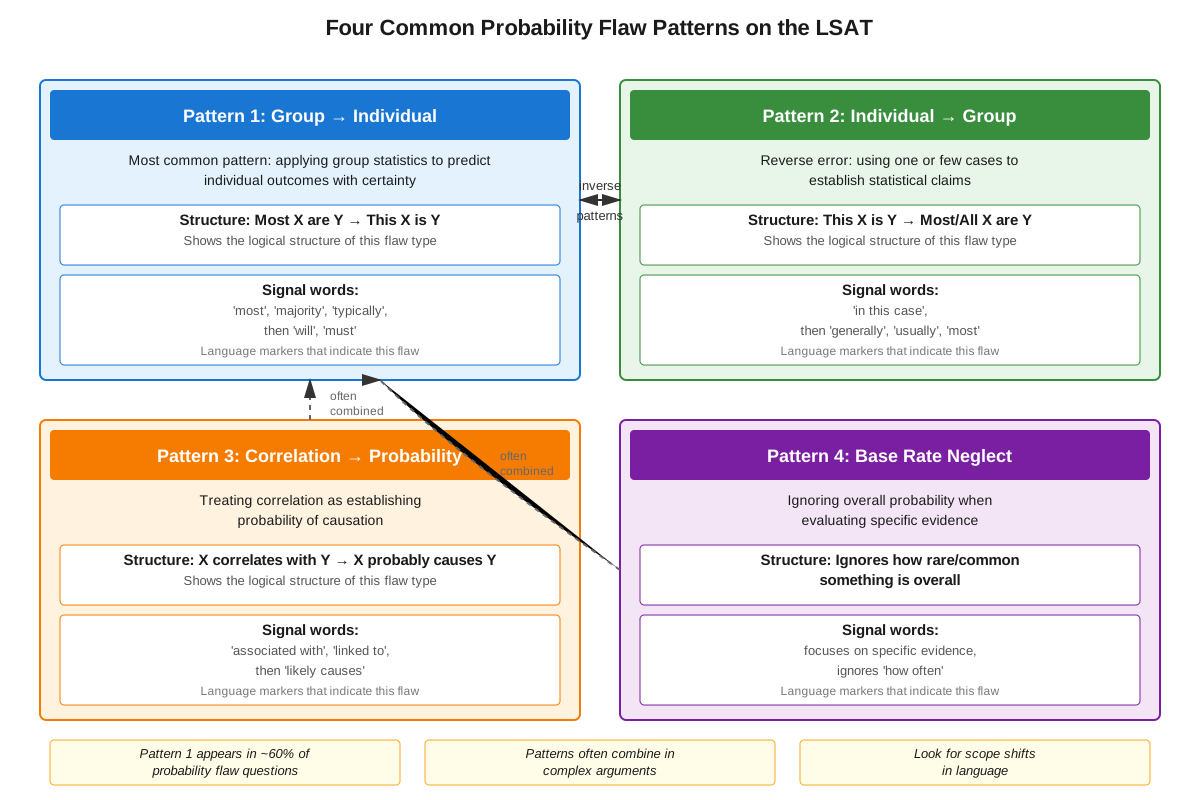
Group-to-Individual Application: This variant takes statistical information about a population and applies it to predict or guarantee outcomes for a specific member of that population. For example: "Most lawyers earn six-figure salaries. Therefore, Sarah, who just graduated from law school, will earn a six-figure salary." The flaw lies in treating the group statistic as determinative for the individual case, ignoring that Sarah might be in the minority.
Individual-to-Group Generalization: The reverse error takes information about one or a few specific cases and draws broad statistical conclusions. For example: "My neighbor's electric car broke down twice last year. Therefore, electric cars are generally unreliable." This confuses anecdotal evidence with statistical significance.
Probability-to-Certainty Confusion: Arguments commit this error when they treat probable outcomes as guaranteed outcomes. For example: "The weather forecast shows a 90% chance of rain tomorrow. Therefore, it will definitely rain tomorrow, so we should cancel the outdoor event." The 90% probability, while high, still leaves a 10% chance of no rain, making the definitive conclusion unjustified.
Correlation-to-Causation with Probability: While technically a separate flaw, this often combines with probability errors when arguments use statistical correlations to make causal predictions about specific cases. For example: "Studies show that people who drink coffee daily have lower rates of certain diseases. Therefore, if you start drinking coffee, you will reduce your risk of these diseases." This combines correlation-causation confusion with inappropriate individual application.
Key Distinguishing Features
| Feature | Valid Probability Reasoning | Flawed Probability Reasoning |
|---|---|---|
| Conclusion strength | Matches evidence (likely, probable, suggests) | Exceeds evidence (will, must, certainly) |
| Scope | Maintains group/individual distinction | Conflates group statistics with individual predictions |
| Acknowledgment of exceptions | Recognizes possibility of outliers | Ignores or dismisses exceptions |
| Language precision | Uses qualified terms (tends to, generally, often) | Uses absolute terms (always, never, definitely) |
Recognition Patterns in LSAT Arguments
Probability flaws typically appear with specific linguistic markers:
Evidence indicators: "Studies show," "statistics indicate," "most," "typically," "generally," "the majority," "X% of cases," "research demonstrates," "historically," "tends to," "usually," "often"
Conclusion indicators: "Therefore, this specific case will," "must," "certainly," "definitely," "cannot," "it is impossible that," "guarantees," "ensures," "proves that in this instance"
The gap between these qualified premises and definitive conclusions signals the probability flaw. LSAT arguments deliberately create this mismatch to test whether students recognize the logical leap.
The Logical Structure
Understanding the formal structure helps identify probability flaws systematically:
- Premise type: Statistical generalization or probability statement
- Scope shift: Movement from aggregate data to specific instance (or vice versa)
- Conclusion type: Claim that exceeds what probability allows
- Missing link: Acknowledgment that statistical tendencies don't determine individual outcomes
The flaw exists in the unstated assumption that group probabilities necessarily apply to specific cases with certainty. Valid reasoning would require either maintaining probabilistic language in the conclusion or providing additional evidence that the specific case matches the typical pattern.
Concept Relationships
The probability flaw connects to several other Logical Reasoning concepts in a hierarchical relationship. At the broadest level, it falls under scope errors, where conclusions exceed the scope of their evidence. More specifically, probability flaws represent a particular type of scope error involving the strength of claims—moving from probable to certain.
Relationship map:
- Scope Errors (parent concept) → Probability Flaws (specific type) → Group-to-Individual Application (variant)
- Probability Flaws ↔ Hasty Generalizations (related but distinct: hasty generalizations involve insufficient sample size, while probability flaws involve misapplying adequate statistics)
- Probability Flaws → Assumption Questions (probability flaws rest on the assumption that group statistics determine individual cases)
- Statistical Evidence → Probability Flaws → Causal Reasoning (probability flaws often appear in arguments attempting to establish causal relationships)
The probability flaw also connects to conditional reasoning because both involve understanding the relationship between evidence and conclusions. Just as conditional reasoning requires recognizing that sufficient conditions don't work in reverse, probability reasoning requires recognizing that group tendencies don't guarantee individual outcomes.
Understanding sampling flaws helps distinguish related errors: sampling flaws question whether the statistical evidence itself is reliable, while probability flaws accept the statistics but question their application to specific cases. Similarly, causal flaws often co-occur with probability flaws when arguments use correlational statistics to predict causal outcomes in individual instances.
High-Yield Facts
⭐ The probability flaw occurs when arguments treat statistical likelihood as certainty for specific cases—this is the single most important recognition pattern.
⭐ Group statistics cannot definitively predict individual outcomes—even 99% probability leaves room for the 1% exception.
⭐ Watch for scope shifts from "most," "generally," or "typically" in premises to "will," "must," or "certainly" in conclusions—this language mismatch signals the flaw.
⭐ Probability flaws appear in 3-5 questions per LSAT test, making them high-yield content for score improvement.
⭐ The correct answer choice will explicitly mention the gap between probability/tendency and certainty/specific application—look for phrases like "treats what is probable as certain" or "applies group statistics to individual cases."
- Probability flaws differ from hasty generalizations: hasty generalizations involve insufficient evidence, while probability flaws involve misapplying sufficient statistical evidence.
- Valid probability reasoning maintains qualified language throughout: if premises say "likely," conclusions should say "probably," not "definitely."
- The flaw exists even when the probability is very high (95%, 99%)—high probability still isn't certainty.
- Probability flaws can work in reverse: taking individual cases and drawing statistical conclusions about groups without adequate sample size.
- Answer choices describing probability flaws often use phrases like "overlooks the possibility that," "fails to consider that," or "presumes without justification that."
- Recognizing probability flaws requires distinguishing between what evidence suggests versus what it proves.
- The LSAT tests probability flaws because they mirror real legal reasoning about evidence, precedent, and prediction.
Quick check — test yourself on Probability flaw so far.
Try Flashcards →Common Misconceptions
Misconception: If something is very likely (90%+ probability), it's reasonable to treat it as certain in an argument.
Correction: Even extremely high probabilities don't justify absolute conclusions about specific cases. The logical gap exists regardless of how high the percentage is—99% still means 1 in 100 cases will be exceptions, and without additional evidence, we cannot know whether the specific case in question is typical or exceptional.
Misconception: Probability flaws and hasty generalizations are the same thing.
Correction: These are distinct errors. Hasty generalizations involve drawing conclusions from insufficient sample sizes (e.g., "My two friends liked the movie, so everyone will like it"). Probability flaws involve misapplying adequate statistical information (e.g., "85% of people liked the movie in a large study, so you will definitely like it"). The first questions the quality of evidence; the second questions how that evidence is applied.
Misconception: If an argument uses statistical evidence, it automatically commits a probability flaw.
Correction: Statistical evidence is perfectly valid when used appropriately. The flaw only occurs when arguments make unjustified leaps from statistical information to certainty about specific cases. An argument stating "Most lawyers earn six-figure salaries, so law school graduates probably have good earning potential" uses statistics validly because the conclusion maintains probabilistic language.
Misconception: Probability flaws only go from groups to individuals, not the other way.
Correction: While group-to-individual application is more common on the LSAT, the reverse also appears. Arguments that take one or a few individual cases and draw broad statistical conclusions without adequate sampling commit a related probability error. Both directions involve inappropriate relationships between statistical claims and specific instances.
Misconception: The correct answer choice will always use the exact phrase "probability flaw."
Correction: LSAT answer choices rarely use technical terminology like "probability flaw." Instead, they describe the error functionally: "treats what is likely as inevitable," "applies a general tendency to a specific case without justification," "overlooks the possibility that this case is an exception," or "confuses a statistical correlation with a certainty about individual outcomes." Learning to recognize these varied phrasings is essential.
Worked Examples
Example 1: Medical Treatment Argument
Argument: "A recent study of 10,000 patients showed that 85% of those who took the new medication experienced significant improvement in their symptoms within three months. Therefore, if Dr. Martinez prescribes this medication to her patient James, James will experience significant improvement within three months."
Analysis:
- Identify the premise: The study provides statistical information—85% of a large sample improved.
- Identify the conclusion: James will (definite future prediction) experience improvement.
- Spot the scope shift: The premise discusses a group tendency (85% of patients), while the conclusion makes a definitive prediction about a specific individual (James).
- Recognize the flaw: The argument treats the 85% probability as if it guarantees James's outcome, ignoring that he could be among the 15% who don't improve.
- Missing acknowledgment: The argument fails to recognize that group statistics, even from large studies, don't determine individual outcomes with certainty.
Why this is a probability flaw: The statistical evidence is strong and reliable (large sample size), so this isn't a sampling flaw or hasty generalization. The error lies specifically in applying the group statistic to predict with certainty what will happen to James. Valid reasoning would conclude that James is "likely" or "probably" going to improve, not that he "will" improve.
Correct answer choice would say something like: "The argument treats a statistical likelihood as a certainty about a specific case" or "The argument overlooks the possibility that James may be among the patients who do not experience improvement."
Example 2: Consumer Behavior Argument
Argument: "Market research indicates that consumers generally prefer products with environmentally friendly packaging. Last month, our company introduced a new product line with eco-friendly packaging, but sales have been disappointing. This proves that the market research was flawed and that consumers don't actually prefer environmentally friendly packaging."
Analysis:
- Identify the premise: General consumer preference (statistical/group tendency) and one specific case (this company's product).
- Identify the conclusion: The market research was wrong; consumers don't prefer eco-friendly packaging (broad statistical claim).
- Spot the scope shift: The argument moves from one specific instance (disappointing sales of one product line) to a general statistical conclusion (consumers don't prefer eco-friendly packaging).
- Recognize the flaw: This is the reverse probability flaw—using a specific case to overturn statistical evidence about general tendencies. The disappointing sales could result from numerous factors (price, product quality, marketing, distribution) unrelated to packaging preferences.
- Missing acknowledgment: The argument fails to recognize that individual cases can deviate from general patterns without invalidating those patterns, and that multiple factors influence specific outcomes.
Why this is a probability flaw: The argument inappropriately uses a single data point (one product's sales) to draw a broad statistical conclusion, ignoring that general tendencies allow for exceptions and that specific cases involve multiple variables. The market research could be entirely accurate about general preferences while this particular product fails for other reasons.
Correct answer choice would say something like: "The argument treats a single case as sufficient to overturn a general statistical finding" or "The argument fails to consider that factors other than packaging preferences might explain the disappointing sales."
Exam Strategy
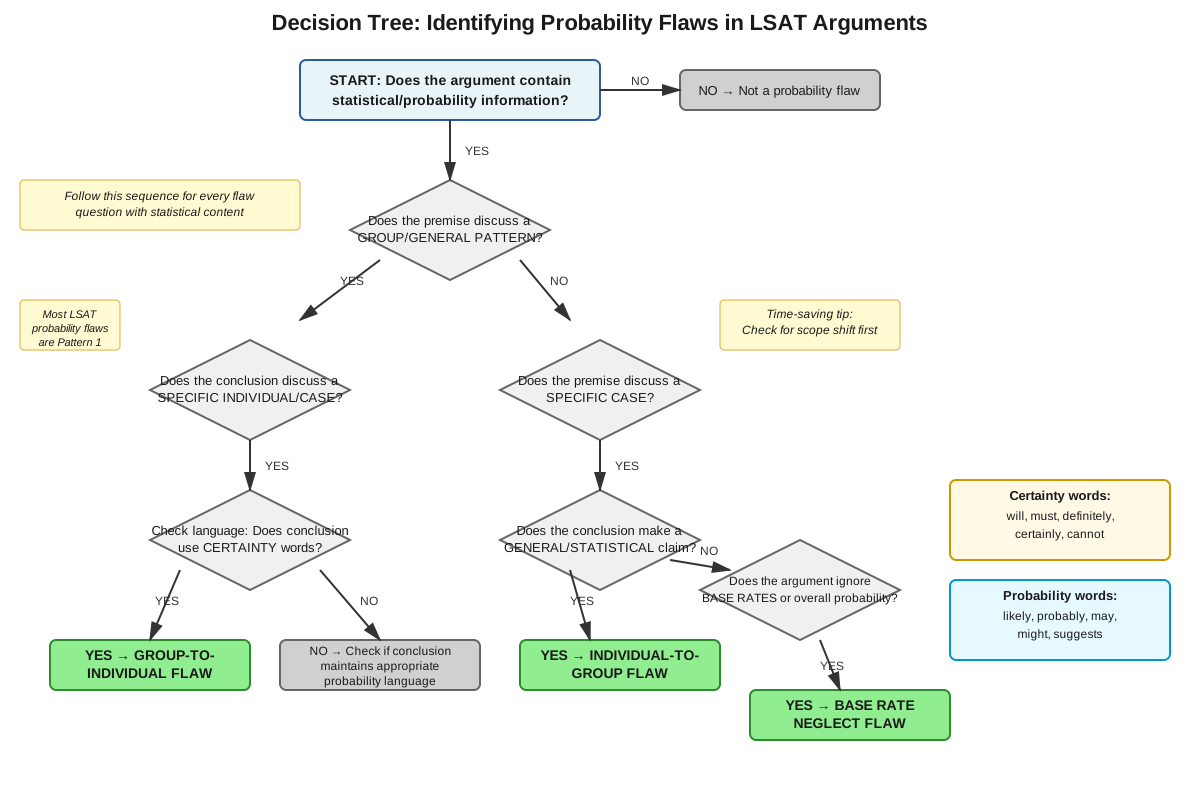
When approaching LSAT questions involving probability flaws, follow this systematic process:
Step 1: Identify statistical or probabilistic language in the premises. Look for words like "most," "generally," "typically," "studies show," "X% of," "tends to," "usually," "often," "the majority," or "research indicates." These signal that the evidence is probabilistic rather than absolute.
Step 2: Examine the conclusion for absolute or definitive language. Watch for "will," "must," "certainly," "definitely," "cannot," "proves," "ensures," or "guarantees." The contrast between qualified premises and absolute conclusions is your primary trigger.
Step 3: Check for scope shifts between groups and individuals. Ask yourself: Does the premise discuss a group, population, or general tendency? Does the conclusion make a claim about a specific case or individual? If yes to both, you've likely found a probability flaw.
Step 4: Eliminate answer choices systematically. Wrong answers often describe flaws that aren't present in the argument. Common distractors include:
- Circular reasoning (when the argument doesn't assume its conclusion)
- Ad hominem attacks (when the argument doesn't attack a person)
- False dichotomy (when the argument doesn't present only two options)
- Causal flaws (when the argument doesn't make causal claims, only predictive ones)
Step 5: Select the answer that explicitly addresses the probability gap. The correct answer will mention the relationship between statistical evidence and specific conclusions, using phrases like:
- "Treats what is probable as certain"
- "Applies a general tendency to a specific case"
- "Overlooks the possibility that this case is an exception"
- "Confuses a statistical correlation with a guarantee"
- "Fails to establish that the individual case conforms to the general pattern"
Exam Tip: Time allocation for probability flaw questions should be 1:15-1:30 minutes. These questions are typically medium difficulty, so don't get stuck. If you identify the probability flaw pattern quickly, you can eliminate wrong answers efficiently and move on.
Trigger phrases to watch for in answer choices:
- "Treats as inevitable what is merely probable"
- "Overlooks the possibility that"
- "Fails to consider that the case in question may be atypical"
- "Presumes without justification that group statistics apply to this individual"
- "Confuses a general tendency with a universal rule"
Common trap answers describe related but distinct flaws:
- Sampling flaws (questioning whether the statistical evidence is reliable)
- Hasty generalizations (claiming insufficient evidence)
- Causal reasoning errors (when the argument doesn't make causal claims)
Memory Techniques
Mnemonic: "GAPS" for identifying probability flaws:
- Group statistics in premises
- Absolute language in conclusion
- Probability treated as certainty
- Scope shift from general to specific
Visualization strategy: Picture a large crowd (representing the statistical group) with most people wearing blue shirts (the 85% or "most"). Now picture one person (the specific case in the conclusion) standing alone. The argument's flaw is assuming that lone person must be wearing blue just because most of the crowd does—but you can't see their shirt color yet. This visual reinforces that group tendencies don't determine individual cases.
Acronym: "SLIM" for valid probability reasoning:
- Statistical evidence
- Likelihood language (not certainty)
- Individual exceptions acknowledged
- Matching strength (evidence strength = conclusion strength)
Memory phrase: "Probable doesn't mean provable"—this captures the core distinction between statistical likelihood and logical certainty.
Pattern recognition shortcut: When you see "most/generally/typically" followed by "therefore, this specific case will," you've found a probability flaw. Train yourself to spot this pattern instantly by practicing with flashcards that pair qualified premises with absolute conclusions.
Summary
The probability flaw represents a fundamental error in logical reasoning where arguments inappropriately apply statistical or probabilistic information to specific cases, treating likelihood as certainty. This flaw appears frequently on the LSAT because it tests critical thinking skills essential for legal reasoning—the ability to distinguish between what evidence suggests versus what it proves. The core pattern involves premises containing qualified, statistical language about groups or general tendencies, followed by conclusions making definitive claims about specific instances. Recognizing this flaw requires attention to scope shifts (group to individual or vice versa) and language mismatches (probable to certain). Valid probability reasoning maintains consistency between evidence strength and conclusion strength, acknowledging that even strong statistical patterns allow for individual exceptions. Mastering this concept enables students to quickly identify probability flaws, eliminate incorrect answer choices, and select responses that accurately describe the gap between statistical evidence and specific predictions.
Key Takeaways
- The probability flaw occurs when arguments treat statistical likelihood as certainty for specific cases, ignoring that group tendencies don't guarantee individual outcomes
- Watch for scope shifts from qualified language ("most," "generally," "typically") in premises to absolute language ("will," "must," "certainly") in conclusions
- Probability flaws differ from hasty generalizations: the statistical evidence may be perfectly adequate, but it's being misapplied to specific cases
- Correct answer choices describe the flaw functionally rather than using the term "probability flaw," employing phrases like "treats what is probable as inevitable" or "overlooks the possibility of exceptions"
- Even extremely high probabilities (95%, 99%) don't justify absolute conclusions about specific instances—the logical gap exists regardless of percentage
- Probability flaws can work in both directions: applying group statistics to individuals or using individual cases to draw broad statistical conclusions
- This flaw type appears in 3-5 questions per LSAT test, making it high-yield content that significantly impacts scores when mastered
Related Topics
Sampling Flaws: Understanding how arguments can err in gathering or interpreting statistical data helps distinguish between questioning the quality of statistical evidence (sampling flaws) versus questioning its application (probability flaws). Mastering probability flaws provides the foundation for recognizing when arguments misuse otherwise valid statistics.
Causal Reasoning Errors: Many probability flaws appear in arguments attempting to establish causal relationships using correlational statistics. Understanding probability flaws enables recognition of when arguments inappropriately predict causal outcomes for specific cases based on group correlations.
Conditional Reasoning: The relationship between sufficient and necessary conditions parallels the relationship between probability and certainty. Both require understanding that certain logical relationships don't work in reverse or don't guarantee specific outcomes.
Scope Errors: Probability flaws represent a specific type of scope error. Mastering this concept builds skills for recognizing all types of scope shifts, including temporal scope, subject matter scope, and quantitative scope changes.
Strengthen and Weaken Questions: Understanding probability flaws enables students to identify what would strengthen or weaken probability-based arguments—typically evidence about whether the specific case matches or differs from the typical pattern.
Practice CTA
Now that you understand the probability flaw pattern, it's time to cement this knowledge through active practice. Attempt the practice questions to test your ability to identify probability flaws in various contexts and select correct answer choices that accurately describe these reasoning errors. Use the flashcards to reinforce recognition of key trigger phrases and common argument patterns. Remember: recognizing probability flaws quickly and accurately can improve your LSAT score by 2-3 points, as these questions appear consistently across tests. Each practice question you complete strengthens your pattern recognition and builds the confidence needed to tackle these questions efficiently on test day. You've got this!
Sign up free to keep reading
Create a free AnvayaPrep account to finish this LSAT guide on Probability flaw — plus flashcards and practice questions.