Overview
The sampling flaw represents one of the most frequently tested reasoning errors on the LSAT Logical Reasoning section. This flaw occurs when an argument draws a conclusion about a larger population based on evidence from a sample that is either too small, unrepresentative, or biased in some way. Understanding this flaw is critical because it appears in approximately 10-15% of all Flaw questions and also surfaces in Weaken, Strengthen, and Assumption questions.
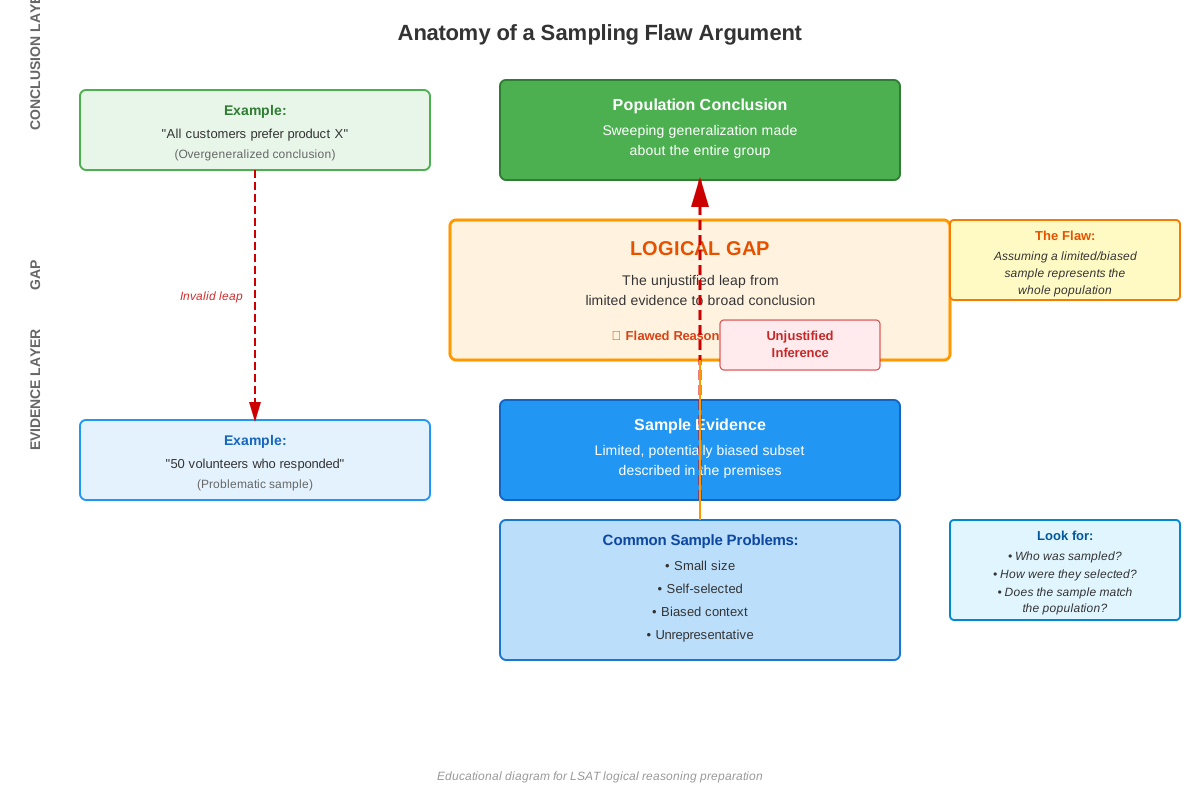
At its core, the sampling flaw exploits a fundamental principle of statistical reasoning: a sample must be representative of the population about which conclusions are drawn. When test-makers craft arguments with sampling flaws, they typically present evidence from a narrow, skewed, or insufficient subset of a population and then make sweeping generalizations. Recognizing these flawed patterns requires students to evaluate whether the evidence presented actually supports the breadth of the conclusion being drawn.
Within the broader landscape of logical reasoning, the lsat sampling flaw connects closely to other common reasoning errors such as hasty generalizations, unrepresentative evidence, and statistical reasoning flaws. Mastering this topic strengthens overall critical thinking skills and provides a framework for evaluating the quality of evidence in arguments—a skill that extends beyond the LSAT into law school and legal practice. The ability to identify when a sample fails to support a general conclusion is fundamental to evaluating the strength of inductive arguments, which form the backbone of many LSAT questions.
Learning Objectives
- [ ] Identify how Sampling flaw appears in LSAT questions
- [ ] Explain the reasoning pattern behind Sampling flaw
- [ ] Apply Sampling flaw to solve LSAT-style problems accurately
- [ ] Distinguish between representative and unrepresentative samples in argument contexts
- [ ] Recognize the various manifestations of sampling flaws (size, bias, self-selection)
- [ ] Predict how answer choices will describe sampling flaws in technical language
- [ ] Evaluate whether a given sample adequately supports a population-level conclusion
Prerequisites
- Basic understanding of inductive vs. deductive reasoning: Sampling flaws occur in inductive arguments where evidence is used to support probable (not certain) conclusions
- Familiarity with argument structure: Students must identify premises and conclusions to recognize when evidence (sample) fails to support the claim (population)
- General knowledge of Flaw question types: Understanding how to approach flaw questions generally provides the foundation for identifying specific flaw types
- Concept of generalization: Recognizing when an argument moves from specific instances to broader claims is essential for spotting sampling issues
Why This Topic Matters
In real-world contexts, sampling flaws appear constantly in media reports, political arguments, marketing claims, and policy debates. A company might claim "customers love our product" based on feedback from only satisfied customers who chose to respond to a survey. A politician might assert "voters support this policy" based on responses from a rally of supporters. Legal arguments frequently rely on precedent cases, expert testimony, or statistical evidence—all of which involve sampling considerations. The ability to evaluate whether evidence truly represents the population it claims to describe is fundamental to critical thinking in law and beyond.
On the LSAT, sampling flaws appear with remarkable frequency. Approximately 2-3 questions per test involve sampling issues, appearing most commonly in Flaw questions but also surfacing in Weaken, Strengthen, Assumption, and occasionally Parallel Reasoning questions. The LSAT tests this concept because it assesses a fundamental lawyering skill: evaluating whether evidence actually supports the claims being made. Law students and lawyers must constantly assess whether case precedents, witness testimony, or statistical evidence genuinely represents the broader situation at issue.
Common manifestations in LSAT passages include: surveys with self-selected respondents, conclusions about all members of a group based on a subset, generalizations from extreme or unusual cases, and arguments that ignore relevant differences between the sample and the target population. Test-makers particularly favor scenarios involving customer surveys, scientific studies, polling data, and expert opinions drawn from limited sources.
Core Concepts
Definition of Sampling Flaw
A sampling flaw occurs when an argument uses evidence from a sample to draw a conclusion about a larger population, but the sample is inadequate to support that conclusion. The inadequacy typically stems from three main issues: the sample is too small, the sample is biased or unrepresentative, or the sample is self-selected in a way that skews results. The fundamental error involves treating evidence from a subset as though it reliably indicates characteristics of the whole.
The logical structure follows this pattern:
- Evidence is presented about a specific group (the sample)
- A conclusion is drawn about a larger group (the population)
- The sample fails to adequately represent the population
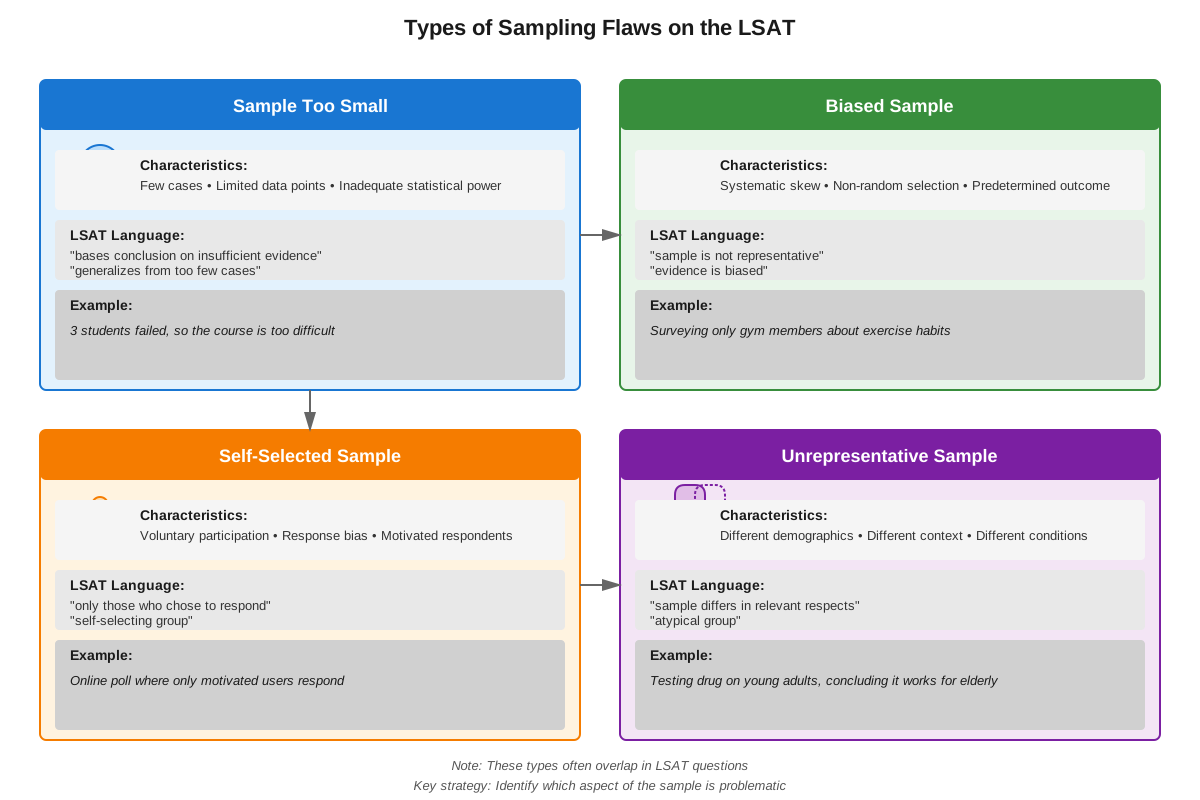
Types of Sampling Flaws
Unrepresentative Sample
The most common form involves a sample that systematically differs from the population in relevant ways. For example, surveying only urban residents about national transportation policy, or asking only successful entrepreneurs about business regulations. The sample may be large enough, but it captures a skewed subset that doesn't reflect the diversity of the whole population.
Key characteristics:
- The sample systematically excludes certain perspectives or groups
- The sample overrepresents certain characteristics
- Relevant differences exist between sample and population
Sample Size Too Small
Some arguments draw broad conclusions from just one or two instances. While a small sample isn't always problematic (sometimes one counterexample suffices), it becomes a flaw when the argument treats limited evidence as though it establishes a general pattern. The LSAT often presents arguments that observe a phenomenon in a few cases and conclude it applies universally.
Key characteristics:
- Very few instances examined (often 1-3)
- Conclusion claims a general pattern or universal truth
- No acknowledgment of the limited scope
Self-Selection Bias
This occurs when the sample consists only of individuals who chose to participate, and their choice to participate correlates with the characteristic being measured. Classic examples include customer satisfaction surveys where only very satisfied or very dissatisfied customers respond, or studies that rely on volunteers who have a particular interest in the topic.
Key characteristics:
- Participation is voluntary
- Those who participate differ systematically from non-participants
- The selection mechanism creates bias
Biased Sampling Method
The method of selecting the sample itself introduces bias. This might involve surveying people at a location that attracts a particular demographic, asking questions in a way that influences responses, or using a selection process that systematically excludes certain groups.
Key characteristics:
- The sampling methodology itself creates distortion
- The location, timing, or method of selection skews results
- Procedural aspects of data collection introduce bias
Comparison Table: Sample Types
| Sample Type | Characteristic | Example | Why It's Flawed |
|---|---|---|---|
| Unrepresentative | Systematically differs from population | Surveying only college students about retirement policy | College students lack relevant experience/perspective |
| Too Small | Insufficient number of instances | Concluding all restaurants in a city are expensive after visiting two | Two instances cannot establish a general pattern |
| Self-Selected | Only volunteers participate | Online poll about internet regulation | Those motivated to respond differ from general population |
| Biased Method | Selection process introduces distortion | Surveying gym members about exercise habits | Location attracts people already interested in fitness |
The Population-Sample Relationship
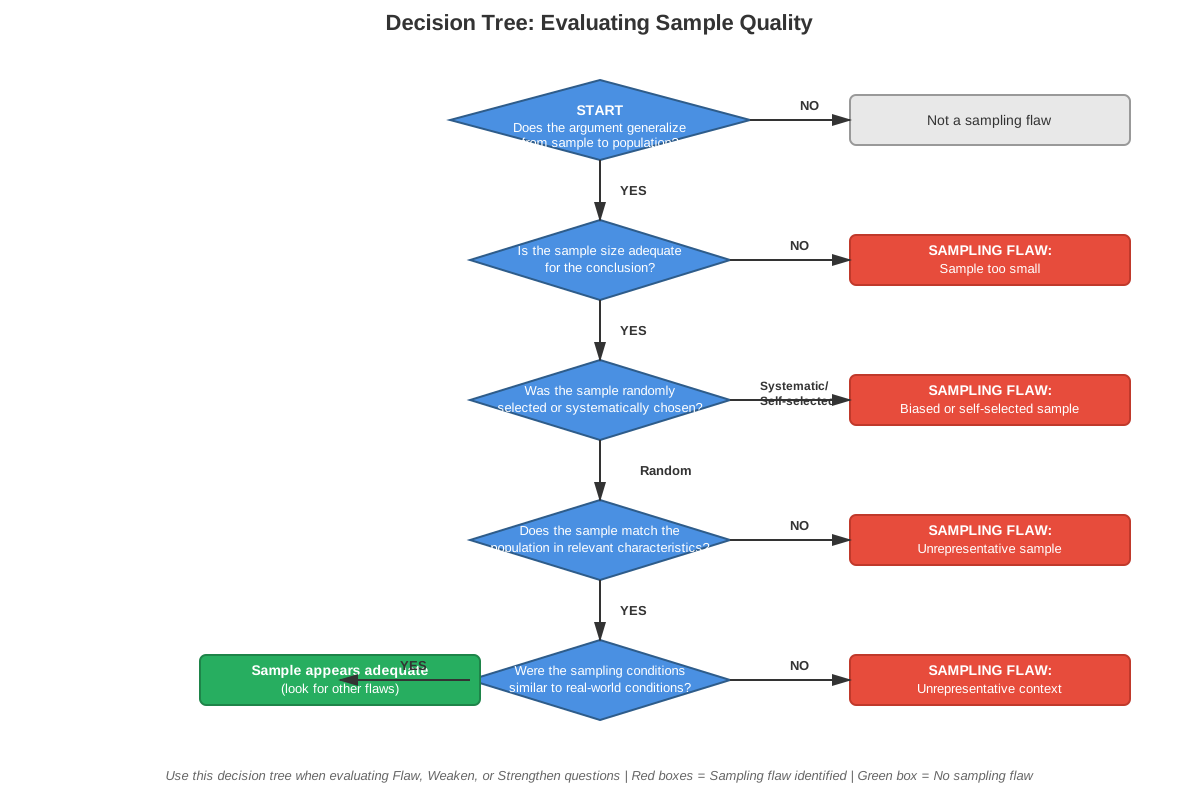
Understanding sampling flaws requires clarity about the relationship between sample and population. The population is the entire group about which a conclusion is drawn. The sample is the subset actually examined. For a sample to support a population-level conclusion, it must be:
- Sufficiently large: Enough instances to establish a pattern
- Representative: Reflects the diversity and characteristics of the population
- Randomly or appropriately selected: Selection method doesn't introduce bias
- Relevant: The sample members are actually part of or analogous to the target population
When any of these conditions fails, the argument commits a sampling flaw.
How LSAT Describes Sampling Flaws
The LSAT uses specific language patterns to describe sampling flaws in answer choices. Recognizing these patterns accelerates answer selection:
- "treats evidence about a subset as though it establishes a claim about the whole"
- "draws a conclusion about all members of a group based on evidence about an unrepresentative sample"
- "overlooks the possibility that the sample is biased"
- "fails to consider whether the sample is large enough"
- "ignores relevant differences between the sample and the population"
- "relies on a self-selected sample"
- "generalizes from atypical cases"
Concept Relationships
The sampling flaw connects to several other logical reasoning concepts in important ways. Most fundamentally, it represents a specific type of hasty generalization—the broader category of reasoning errors where insufficient evidence supports a general conclusion. While hasty generalizations can involve various types of inadequate evidence, sampling flaws specifically involve inadequate samples.
The relationship flows as follows: Inductive Reasoning → requires evidence to support probable conclusions → when evidence comes from samples → Sampling Flaw occurs if sample is inadequate → manifests as Hasty Generalization.
Sampling flaws also connect to causal reasoning errors. Many causal arguments rely on observational data or studies, and if the sample in such studies is flawed, both a sampling flaw and a causal reasoning error may be present. For example, an argument might conclude that a medication causes side effects based on reports from a self-selected group of patients—this involves both sampling issues and causal reasoning problems.
Additionally, sampling flaws relate to necessary vs. sufficient assumptions. Arguments with sampling flaws typically assume (often without justification) that their sample is representative. Identifying this assumption helps both in Flaw questions and in Assumption questions. The assumption that "the sample represents the population" is necessary for the argument's reasoning to work.
Within Flaw questions specifically, sampling flaws often appear alongside or in contrast to other common flaws like circular reasoning, false dichotomies, or equivocation. Understanding how sampling flaws differ from these other patterns helps eliminate wrong answers efficiently.
High-Yield Facts
⭐ A sampling flaw occurs when an argument draws a conclusion about a population based on an inadequate sample
⭐ The three main types of sampling inadequacy are: unrepresentative sample, sample too small, and self-selection bias
⭐ Self-selected samples are problematic because those who choose to participate often differ systematically from those who don't
⭐ An unrepresentative sample systematically differs from the population in ways relevant to the conclusion
⭐ LSAT answer choices describing sampling flaws often use phrases like "unrepresentative sample," "atypical cases," or "treats evidence about some as evidence about all"
- A sample can be large but still unrepresentative if it's biased in composition
- The location or method of sampling can itself introduce bias (e.g., surveying people at a specific venue)
- Not all small samples are flawed—sometimes a single counterexample suffices to disprove a universal claim
- Sampling flaws appear in approximately 10-15% of Flaw questions on the LSAT
- The flaw involves the relationship between evidence (sample) and conclusion (population), not the truth of either
- Recognizing sampling flaws requires identifying both what group the evidence describes and what group the conclusion claims to describe
- Arguments can have multiple flaws, and sampling flaws often appear alongside causal reasoning errors
- The LSAT rarely uses the exact phrase "sampling flaw" in answer choices, preferring more technical descriptions
Quick check — test yourself on Sampling flaw so far.
Try Flashcards →Common Misconceptions
Misconception: Any argument using a sample commits a sampling flaw → Correction: Sampling is a legitimate form of reasoning when done properly. The flaw only occurs when the sample is inadequate (too small, biased, or unrepresentative). Many strong arguments appropriately use sample evidence.
Misconception: A large sample automatically means no sampling flaw → Correction: Sample size alone doesn't guarantee representativeness. A sample of 10,000 people could still be unrepresentative if all participants share a characteristic that skews results (e.g., all from one geographic region, all volunteers with a particular interest).
Misconception: The sampling flaw only applies to statistical or survey-based arguments → Correction: Sampling flaws appear in many contexts beyond formal surveys. Any argument that draws a general conclusion from specific instances potentially involves sampling reasoning, including arguments about customer experiences, case studies, expert opinions, or observed patterns.
Misconception: If the argument doesn't explicitly mention a "sample" or "survey," it can't have a sampling flaw → Correction: The LSAT often presents sampling flaws without using statistical terminology. An argument might say "several customers complained" or "some studies show" or "in three cities we examined"—all of these involve samples even without explicit labeling.
Misconception: Pointing out that a sample is small is always sufficient to identify a sampling flaw → Correction: The flaw must be relevant to the argument's reasoning. If an argument only claims "some members of the group have this characteristic," a small sample might suffice. The flaw exists when the sample is inadequate for the specific conclusion being drawn.
Misconception: Sampling flaws and hasty generalizations are completely different concepts → Correction: Sampling flaws are a specific type of hasty generalization. All sampling flaws involve hasty generalization (drawing a broad conclusion from insufficient evidence), but not all hasty generalizations involve sampling issues specifically.
Worked Examples
Example 1: Customer Survey
Argument: "A restaurant owner wants to determine whether customers enjoy the new menu. She places comment cards on tables, and 90% of returned cards express satisfaction with the changes. The owner concludes that the new menu is popular with customers generally."
Analysis:
Step 1: Identify the conclusion
- Conclusion: The new menu is popular with customers generally
Step 2: Identify the evidence
- Evidence: 90% of returned comment cards expressed satisfaction
Step 3: Identify the sample and population
- Sample: Customers who chose to fill out and return comment cards
- Population: All customers (or customers generally)
Step 4: Evaluate whether the sample adequately represents the population
- The sample is self-selected (only customers motivated to respond participated)
- Customers with strong opinions (very satisfied or very dissatisfied) are more likely to respond
- The 90% satisfaction rate among respondents may not reflect the satisfaction rate among all customers
- Many neutral or mildly dissatisfied customers likely didn't return cards
Step 5: Identify the flaw
- This is a self-selection bias sampling flaw
- The argument treats evidence from customers who chose to respond as though it represents all customers
- The voluntary nature of participation creates bias
How this would appear in an answer choice: "overlooks the possibility that customers who returned comment cards are not representative of customers generally" or "fails to consider that those who chose to respond may differ from those who did not"
Connection to learning objectives: This example demonstrates how to identify sampling flaws (Objective 1), explains the reasoning pattern of self-selection bias (Objective 2), and shows how to analyze the sample-population relationship (Objective 4).
Example 2: Expert Opinion
Argument: "Three prominent economists at elite universities argue that the proposed tax policy will harm economic growth. Therefore, economists generally believe this policy is harmful to economic growth."
Analysis:
Step 1: Identify the conclusion
- Conclusion: Economists generally believe the policy is harmful
Step 2: Identify the evidence
- Evidence: Three prominent economists at elite universities hold this view
Step 3: Identify the sample and population
- Sample: Three economists from elite universities
- Population: Economists generally (all or most economists)
Step 4: Evaluate whether the sample adequately represents the population
- Sample size is very small (only three economists)
- Sample may be unrepresentative (economists at elite universities might have different perspectives than economists at other institutions, in government, or in private sector)
- No information about whether these three represent the range of views among economists
Step 5: Identify the flaw
- This combines sample too small and potentially unrepresentative sample
- Three economists cannot establish what "economists generally" believe
- Economists at elite universities may systematically differ in their views from the broader population of economists
How this would appear in an answer choice: "treats evidence about a few economists as though it establishes a claim about economists generally" or "draws a conclusion about all members of a profession based on the views of an unrepresentative sample"
Connection to learning objectives: This example shows how sampling flaws appear in non-survey contexts (Objective 1), demonstrates the reasoning pattern of inadequate sample size and unrepresentative samples (Objective 2), and illustrates how to distinguish between adequate and inadequate samples (Objective 4).
Exam Strategy
Trigger Words and Phrases
When reading LSAT arguments, certain words and phrases should immediately alert you to potential sampling issues:
In the stimulus:
- "survey," "poll," "study"
- "several," "some," "a few," "many"
- "customers who responded," "volunteers," "participants"
- "in three cities," "at five schools," "among those who..."
- "generally," "most," "typically," "usually" (in conclusions)
In answer choices:
- "unrepresentative sample"
- "atypical cases"
- "treats evidence about some as evidence about all"
- "overlooks the possibility that the sample is biased"
- "fails to establish that the sample is representative"
- "self-selected"
- "insufficient number of cases"
Systematic Approach
- Identify the scope shift: Look for a mismatch between the evidence (specific group) and conclusion (broader group)
- Ask three questions:
- Is the sample large enough?
- Is the sample representative?
- Is there self-selection or bias in how the sample was chosen?
- Predict the answer: Before looking at choices, articulate the flaw in your own words: "The argument treats evidence about [specific group] as though it proves something about [broader group], but [specific group] may not represent [broader group]"
- Eliminate wrong answers: Common wrong answer types include:
- Flaws that aren't present in the argument
- Descriptions of sampling flaws when no sampling flaw exists
- Overly specific descriptions that don't match the actual flaw
- Descriptions of other flaw types (circular reasoning, false dichotomy, etc.)
Time Management
Exam Tip: Sampling flaw questions are typically medium difficulty and should take 1:00-1:30 minutes. If you can quickly identify the sample-population mismatch, these questions become very efficient point-earners.
Spend most of your time on careful reading of the stimulus to identify the sample and population. Once you've identified the mismatch, answer selection is usually straightforward. Don't get bogged down in answer choices that describe flaws not present in the argument.
Common Trap Answers
Be wary of answer choices that:
- Describe sampling flaws when the argument doesn't actually generalize from a sample
- Confuse sampling flaws with other reasoning errors
- Are too extreme (e.g., claiming the argument "ignores all evidence" when it just uses inadequate evidence)
- Focus on irrelevant aspects of the sample rather than its representativeness
Memory Techniques
The "SURE" Acronym
To remember what makes a sample adequate, use SURE:
- Sufficient size
- Unbiased selection
- Representative of population
- Evidence matches conclusion scope
Visualization Strategy
Picture a funnel with a wide top (population) and narrow bottom (sample). For the argument to work, what comes out of the narrow bottom must accurately reflect what went in the wide top. If the funnel has a filter that blocks certain elements, or if the narrow part is too small to capture variety, the output won't represent the input.
The "Three Questions" Mantra
When you see evidence about a group, immediately ask:
- "How many?" (size)
- "Who exactly?" (representativeness)
- "How were they chosen?" (bias/self-selection)
Mnemonic for Self-Selection
"VOLUNTEERS VARY" - Remember that people who volunteer to participate (in surveys, studies, or providing feedback) systematically vary from those who don't volunteer.
Summary
The sampling flaw represents a critical reasoning error tested frequently on the LSAT Logical Reasoning section. This flaw occurs when arguments draw conclusions about populations based on inadequate samples—samples that are too small, unrepresentative, self-selected, or biased. Mastering this concept requires understanding the relationship between samples (the specific groups examined) and populations (the broader groups about which conclusions are drawn). The three main types of sampling inadequacy are insufficient sample size, unrepresentative samples that systematically differ from the population, and self-selection bias where voluntary participation skews results. On the LSAT, sampling flaws appear in various contexts beyond formal surveys, including arguments about customer experiences, expert opinions, case studies, and observed patterns. Success requires identifying scope shifts between evidence and conclusion, evaluating whether samples adequately represent populations, and recognizing the technical language LSAT answer choices use to describe these flaws. The ability to spot sampling flaws quickly and accurately provides a significant advantage on test day, as these questions appear regularly and, once the pattern is recognized, can be answered efficiently and confidently.
Key Takeaways
- Sampling flaws occur when conclusions about populations rest on inadequate samples—those that are too small, unrepresentative, or self-selected
- Always identify both the sample (specific group in evidence) and population (broader group in conclusion) to spot scope mismatches
- Self-selected samples are inherently problematic because volunteers differ systematically from non-volunteers
- Large samples can still be unrepresentative if they're biased in composition or selection method
- LSAT answer choices rarely use the phrase "sampling flaw" directly; instead, they describe the specific inadequacy using technical language
- Sampling flaws appear in 10-15% of Flaw questions and also surface in Weaken, Strengthen, and Assumption questions
- The "SURE" framework (Sufficient size, Unbiased selection, Representative, Evidence matches scope) helps evaluate sample adequacy quickly
Related Topics
Hasty Generalization: The broader category of reasoning errors involving insufficient evidence for general conclusions; sampling flaws represent a specific type of hasty generalization where the insufficiency involves sample inadequacy.
Causal Reasoning Flaws: Many causal arguments rely on studies or observations that involve sampling; understanding sampling flaws helps identify when causal conclusions rest on flawed evidence.
Necessary Assumptions: Arguments with sampling flaws typically assume their samples are representative; identifying this assumption helps with both Flaw and Assumption questions.
Strengthen/Weaken Questions: Understanding sampling flaws enables you to identify answer choices that strengthen arguments by showing samples are representative or weaken arguments by revealing sample bias.
Statistical Reasoning: Broader topic encompassing various ways arguments use numerical data and studies; sampling is one component of statistical reasoning on the LSAT.
Practice CTA
Now that you've mastered the core concepts of sampling flaws, it's time to put your knowledge into practice. Work through the practice questions to reinforce your ability to identify sampling flaws quickly and accurately. Use the flashcards to memorize key trigger phrases and answer choice patterns. Remember: sampling flaw questions are high-yield opportunities to earn points efficiently once you recognize the patterns. Each practice question you complete strengthens your pattern recognition and builds the confidence you need to excel on test day. You've built a strong foundation—now apply it!
Sign up free to keep reading
Create a free AnvayaPrep account to finish this LSAT guide on Sampling flaw — plus flashcards and practice questions.