Overview
The straw man flaw represents one of the most frequently tested reasoning errors on the LSAT Logical Reasoning section. This fallacy occurs when an arguer misrepresents, oversimplifies, or distorts an opponent's position to make it easier to attack, then proceeds to refute this weakened version rather than addressing the actual argument. The name derives from the metaphor of constructing a flimsy "straw man" that can be easily knocked down, rather than engaging with the stronger, genuine position.
Understanding the lsat straw man flaw is essential for success on the exam because it appears regularly in flaw questions, as well as in Method of Reasoning, Parallel Flaw, and Evaluate the Argument questions. The LSAT tests this concept because it reflects a critical thinking skill vital to legal reasoning: the ability to recognize when arguments fail to engage with opposing positions fairly and accurately. Legal professionals must identify when opposing counsel mischaracterizes arguments, and law students must demonstrate this analytical capability.
Within the broader landscape of logical reasoning, the straw man flaw connects to several other reasoning patterns. It shares characteristics with errors of relevance, as the arguer responds to something other than what was actually claimed. It also relates to scope shifts, where the conclusion addresses a different claim than the premises support. Mastering the straw man flaw enhances overall ability to identify when arguments fail to connect premises to conclusions appropriately, making it a foundational skill for LSAT success.
Learning Objectives
- [ ] Identify how Straw man flaw appears in LSAT questions
- [ ] Explain the reasoning pattern behind Straw man flaw
- [ ] Apply Straw man flaw to solve LSAT-style problems accurately
- [ ] Distinguish straw man flaws from other types of reasoning errors, particularly ad hominem attacks and appeals to authority
- [ ] Recognize the specific language patterns and structural markers that signal a straw man flaw in LSAT stimuli
- [ ] Evaluate answer choices to select descriptions that accurately characterize straw man reasoning
Prerequisites
- Basic argument structure: Understanding premises, conclusions, and how they relate is necessary to identify when an arguer responds to a different claim than what was presented
- Flaw question format: Familiarity with how the LSAT asks students to identify reasoning errors helps recognize the question stem patterns that commonly test straw man flaws
- Conditional reasoning fundamentals: Many straw man flaws involve misrepresenting conditional claims (e.g., treating "some" as "all"), so understanding logical quantifiers is essential
Why This Topic Matters
The straw man flaw appears in approximately 8-12% of all Logical Reasoning questions across typical LSAT administrations, making it one of the top ten most frequently tested reasoning errors. This high frequency means that mastering this concept can directly impact multiple questions per test, potentially adding several points to a scaled score. The flaw appears most commonly in Flaw questions (where test-takers must identify the reasoning error) but also surfaces in Parallel Flaw questions (requiring recognition of structurally similar flawed reasoning) and occasionally in Method of Reasoning questions.
Beyond exam performance, recognizing straw man reasoning develops essential skills for legal practice and everyday critical thinking. Attorneys must identify when opposing arguments mischaracterize their positions, judges must recognize when parties fail to address actual legal standards, and effective advocates must engage with the strongest versions of opposing viewpoints. The ability to spot this flaw protects against manipulation in political discourse, media analysis, and professional negotiations.
On the LSAT, straw man flaws typically appear in passages involving debates, responses to critics, or situations where one party characterizes another's position. Common contexts include scientific debates, policy discussions, business decisions, and philosophical arguments. The test-makers often embed this flaw in passages where the mischaracterization seems subtle, requiring careful attention to exactly what was claimed versus what was refuted.
Core Concepts
Definition and Structure of the Straw Man Flaw
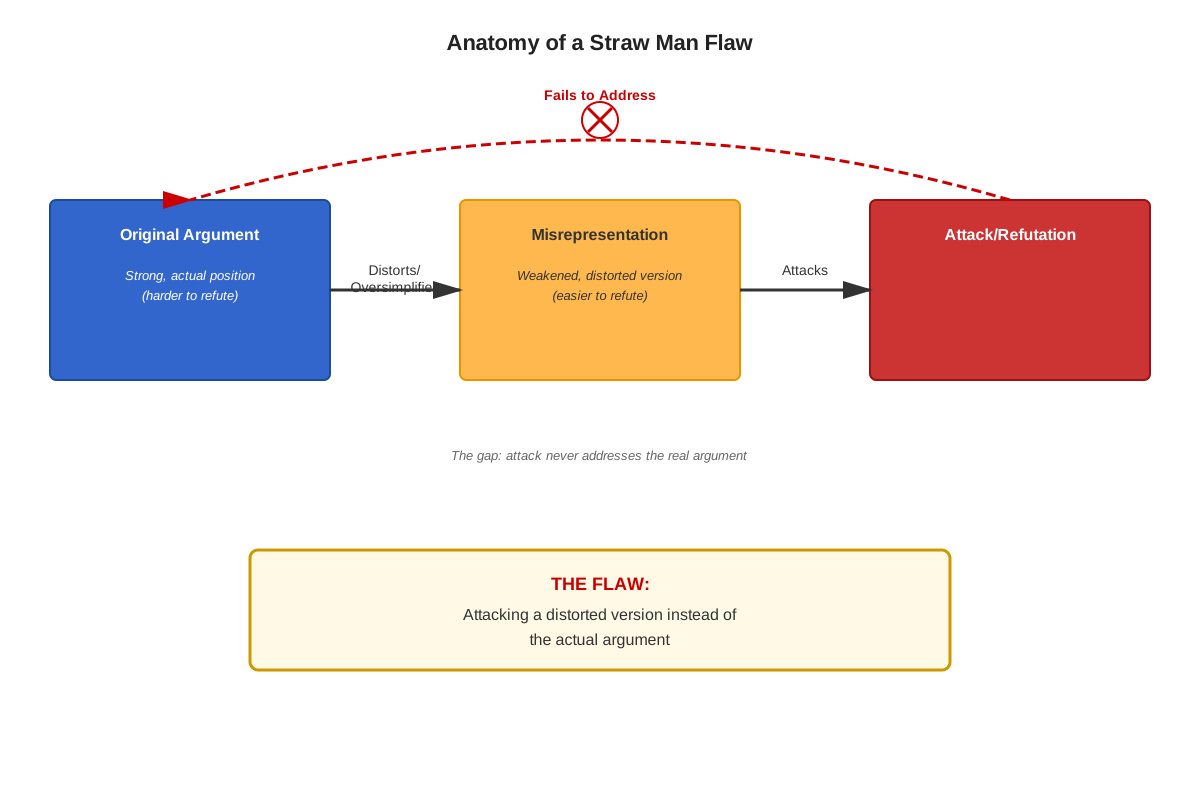
The straw man flaw occurs when an argument misrepresents an opponent's position—making it weaker, more extreme, or different than it actually is—and then attacks this distorted version rather than the genuine argument. The reasoning pattern follows this structure:
- Person A presents position X
- Person B misrepresents position X as position Y (where Y is easier to refute)
- Person B attacks position Y
- Person B concludes that position X has been refuted
The flaw lies in the disconnect between what was actually argued (position X) and what was attacked (position Y). Even if the attack on position Y succeeds completely, it provides no logical support for rejecting position X because X and Y are different claims.
Key Characteristics and Variations
The straw man flaw manifests in several distinct patterns on the LSAT:
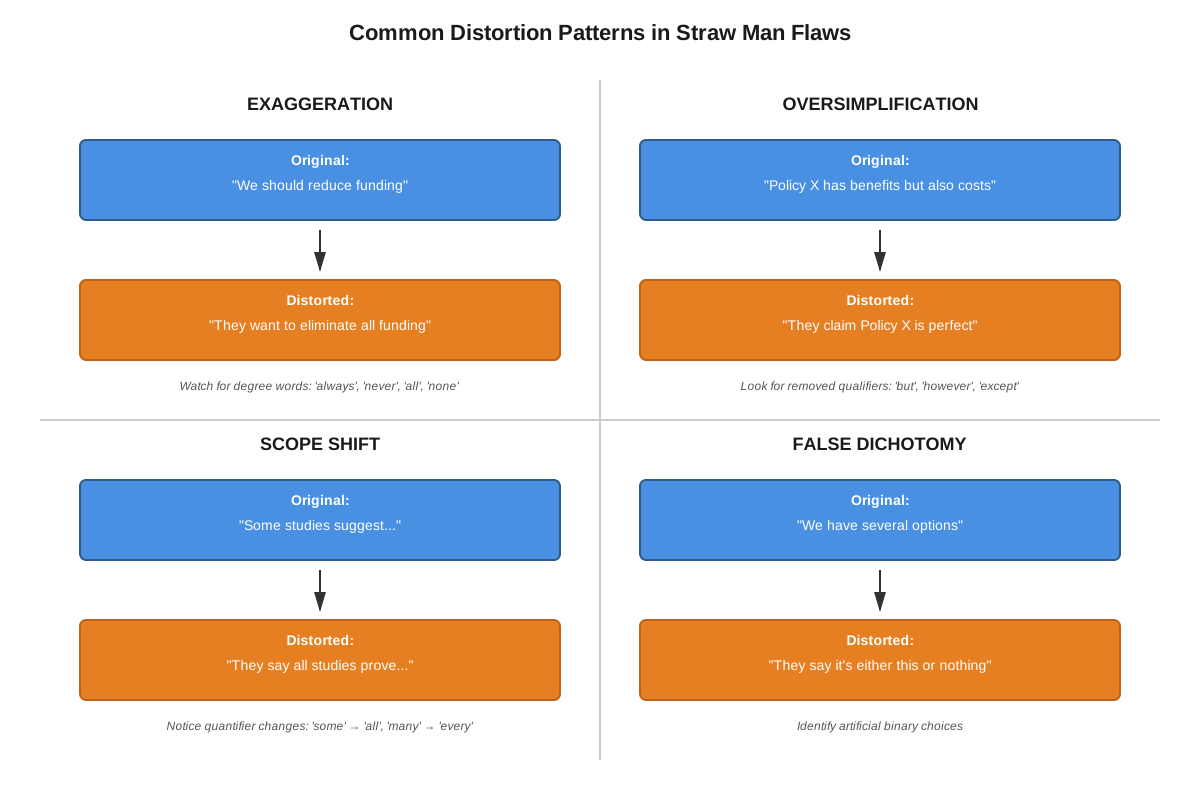
Exaggeration: The arguer takes a moderate claim and treats it as an extreme position. For example, if someone argues "we should reduce military spending in certain areas," the straw man response might attack the position "we should eliminate all military funding."
Oversimplification: A nuanced argument with multiple conditions or qualifications gets reduced to a simple, absolute claim. An argument stating "in most cases, with proper safeguards, this policy works" might be attacked as if it claimed "this policy always works perfectly."
Scope shift: The arguer changes the scope of the original claim, often by shifting between "some" and "all," or between "can" and "must." An opponent who says "some regulations are unnecessary" might be portrayed as claiming "all regulations are unnecessary."
Misattribution of implications: The arguer attacks implications or consequences that don't actually follow from the original position, treating them as if they were part of the opponent's argument.
Distinguishing Features from Similar Flaws
Understanding what the straw man flaw is NOT helps identify it accurately:
| Flaw Type | Key Difference from Straw Man |
|---|---|
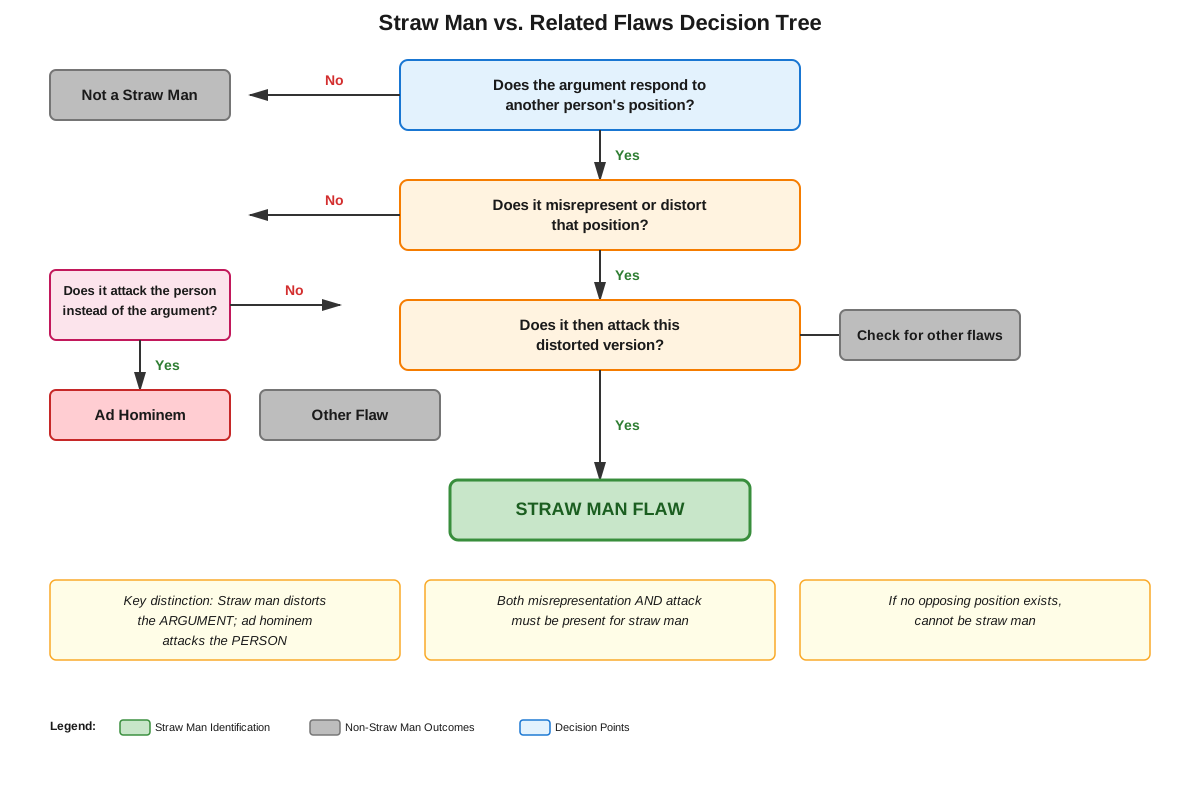
| Ad Hominem | Attacks the person rather than any version of their argument; straw man attacks a distorted argument |
| Red Herring | Introduces irrelevant information; straw man specifically misrepresents the opponent's position |
| False Dichotomy | Presents only two options when more exist; straw man distorts one specific position |
| Hasty Generalization | Draws broad conclusions from insufficient evidence; straw man mischaracterizes existing claims |
The critical distinguishing feature is that straw man flaws always involve misrepresentation of a specific position followed by refutation of that misrepresentation.
Recognition Patterns in LSAT Stimuli
LSAT passages containing straw man flaws typically follow predictable structural patterns:
Setup language: The passage introduces an initial position using phrases like "X argues that," "X claims," "X's position is," or "According to X." This establishes the genuine position.
Transition to misrepresentation: The arguer shifts to their response with phrases like "But X's argument assumes," "X is saying that," "X's position requires," or "X believes." These transitions often signal where the misrepresentation occurs.
Attack language: The arguer then refutes the misrepresented position using phrases like "This is clearly wrong because," "However," "But this fails to consider," or "This overlooks."
Conclusion: The arguer concludes that the original position has been refuted, often using language like "Therefore, X's argument fails," "So X is mistaken," or "X's position cannot be accepted."
Common Answer Choice Formulations
When the correct answer identifies a straw man flaw, the LSAT typically phrases it in one of these ways:
- "The argument misrepresents the position it seeks to undermine"
- "The argument attacks a distorted version of the opposing view"
- "The argument criticizes a view that is not actually held by the opponent"
- "The argument refutes a claim that was not made"
- "The argument attributes a position to the opponent that the opponent does not hold"
- "The argument responds to a stronger claim than was actually made"
Concept Relationships
The straw man flaw connects to multiple aspects of logical reasoning on the LSAT. At its foundation, it represents a failure of relevance—the premises (attacking the misrepresented position) don't actually support the conclusion (that the original position is wrong) because they address different claims. This connects straw man flaws to the broader category of relevance errors.
The flaw also involves scope problems, as the misrepresentation often changes the scope of the original claim. Understanding scope shifts (from "some" to "all," from "can" to "must," from "often" to "always") helps identify when a straw man has been constructed. This relationship means that mastering conditional reasoning and quantifier logic strengthens ability to spot straw man flaws.
Within flaw questions specifically, the straw man flaw relates to other common errors through a conceptual hierarchy:
Relevance Errors → includes → Straw Man Flaw (premises address wrong claim)
Relevance Errors → includes → Ad Hominem (premises address person, not argument)
Relevance Errors → includes → Appeal to Authority (premises cite authority rather than addressing argument)
The straw man flaw also connects forward to Parallel Flaw questions, where recognizing the abstract structure (misrepresent → attack misrepresentation → conclude original position refuted) enables matching to structurally similar arguments in different contexts.
High-Yield Facts
⭐ The straw man flaw always involves two distinct positions: the actual position stated and the distorted position attacked
⭐ The flaw occurs even if the attack on the misrepresented position is completely successful and logically sound
⭐ Common misrepresentation tactics include exaggeration, oversimplification, and scope shifts (especially "some" to "all")
⭐ Answer choices identifying straw man flaws typically use words like "misrepresents," "distorts," "attributes," or "responds to a claim not made"
⭐ The straw man flaw appears in approximately 8-12% of Logical Reasoning questions, making it one of the most frequently tested flaws
- Straw man flaws differ from ad hominem attacks because they attack an argument (albeit a distorted one) rather than the person
- The flaw can occur even when the arguer genuinely misunderstands the opponent's position (intent doesn't matter for LSAT purposes)
- Recognizing the transition point where misrepresentation occurs is crucial for identifying the flaw
- Straw man flaws often appear in passages involving debates, responses to critics, or policy discussions
- The LSAT may test whether students can distinguish between attacking a position and attacking a misrepresentation of that position
- Correct answers never excuse the flaw by suggesting the misrepresentation was "close enough" to the original position
Quick check — test yourself on Straw man flaw so far.
Try Flashcards →Common Misconceptions
Misconception: Any argument that attacks an opponent's position commits a straw man flaw.
Correction: The straw man flaw only occurs when the position attacked differs from the position actually stated. Attacking the genuine position, even aggressively, is not a straw man flaw.
Misconception: If the arguer's attack is logically valid against the misrepresented position, there is no flaw.
Correction: The flaw exists in the disconnect between what was attacked and what was originally claimed, regardless of how well the attack succeeds against the misrepresented version.
Misconception: Straw man flaws and ad hominem attacks are the same thing because both involve unfair argumentation.
Correction: Ad hominem attacks target the person making the argument, while straw man flaws target a distorted version of the argument itself. These are distinct reasoning errors.
Misconception: Small differences between the original position and the attacked position don't constitute a straw man flaw.
Correction: Even subtle misrepresentations create a straw man flaw if the attacked position differs meaningfully from what was actually claimed. The LSAT often tests ability to recognize these subtle distinctions.
Misconception: If the arguer genuinely misunderstood the opponent's position, it's not a straw man flaw.
Correction: The flaw exists based on the logical structure of the argument, not the arguer's intentions. Whether the misrepresentation was deliberate or accidental is irrelevant to identifying the reasoning error.
Misconception: Straw man flaws only occur when someone explicitly quotes an opponent.
Correction: The flaw can occur whenever an arguer characterizes, summarizes, or responds to another position, whether or not direct quotation is involved.
Worked Examples
Example 1: Policy Debate
Stimulus: "City Council Member Rodriguez argues that the city should implement a program to provide free bus passes to low-income residents. But Rodriguez's plan to give free transportation to everyone in the city would bankrupt our municipal budget within a year. We cannot afford such reckless spending, so Rodriguez's proposal should be rejected."
Analysis:
Step 1: Identify the original position. Rodriguez argues for "free bus passes to low-income residents"—a targeted program with specific eligibility criteria.
Step 2: Identify what position is attacked. The argument attacks "free transportation to everyone in the city"—a universal program with no income restrictions.
Step 3: Compare the positions. The original position (free passes for low-income residents) differs significantly from the attacked position (free transportation for everyone). The scope has been expanded from "low-income residents" to "everyone."
Step 4: Evaluate the reasoning. Even if the attack succeeds (universal free transportation would indeed bankrupt the budget), this provides no logical support for rejecting the actual proposal (targeted assistance to low-income residents), which would cost far less.
Step 5: Identify the flaw. This is a straw man flaw because the argument misrepresents Rodriguez's position by expanding its scope, then attacks this misrepresentation rather than the actual proposal.
Correct answer choice would likely read: "The argument misrepresents the proposal it seeks to reject by exaggerating its scope."
Example 2: Scientific Debate
Stimulus: "Dr. Chen claims that the new medication shows promise in treating certain types of chronic pain when used as part of a comprehensive treatment plan. However, Dr. Martinez responds that Dr. Chen's suggestion that this medication alone can cure all pain conditions is absurd. No single medication can address every type of pain, and many pain conditions require multiple interventions. Therefore, Dr. Chen's recommendation should be disregarded."
Analysis:
Step 1: Identify the original position. Dr. Chen's claim has three key components: (1) the medication shows promise, (2) for certain types of chronic pain, (3) when used as part of a comprehensive treatment plan. This is a qualified, moderate claim.
Step 2: Identify what position is attacked. Dr. Martinez attacks the claim that "this medication alone can cure all pain conditions"—an absolute claim about universal effectiveness as a sole treatment.
Step 3: Compare the positions. The original position is carefully qualified ("shows promise," "certain types," "part of a comprehensive plan"), while the attacked position is absolute ("alone," "cure," "all pain conditions"). Multiple misrepresentations have occurred: "shows promise" became "can cure," "certain types" became "all conditions," and "part of a comprehensive plan" became "alone."
Step 4: Evaluate the reasoning. Dr. Martinez's attack may be valid against the absolute claim, but this absolute claim was never made. The attack provides no logical basis for rejecting Dr. Chen's actual, qualified recommendation.
Step 5: Identify the flaw. This is a straw man flaw involving multiple misrepresentations: exaggeration (promise → cure), scope expansion (certain → all), and oversimplification (part of plan → alone).
Correct answer choice would likely read: "The argument responds to a stronger claim than was actually made by the opponent."
Exam Strategy
When approaching flaw questions that may involve straw man reasoning, follow this systematic process:
Step 1: Identify the structure. Look for passages where one person's position is characterized or summarized by another person. Key phrases include "X argues that," "X claims," "According to X," followed by "But X's position," "X is saying," or "However."
Step 2: Extract the original position precisely. Pay careful attention to qualifiers, scope words, and conditions in the initial claim. Note whether the claim uses "some" or "all," "can" or "must," "often" or "always." Write down or mentally note the exact scope and strength of the original claim.
Step 3: Extract the attacked position precisely. Identify exactly what the arguer refutes. Look for shifts in language, changes in scope, or additions of implications not present in the original.
Step 4: Compare the two positions. Ask: "Are these the same claim?" Look specifically for:
- Scope changes (some → all, certain → every)
- Strength changes (suggests → proves, might → must)
- Simplification (qualified claim → absolute claim)
- Addition of implications not stated
Step 5: Evaluate answer choices. Eliminate answers that:
- Describe flaws not present in the argument
- Accurately describe the reasoning (no flaw exists)
- Identify different flaws (ad hominem, circular reasoning, etc.)
Select answers that:
- Use language like "misrepresents," "distorts," "attributes a view not held"
- Accurately describe the specific type of misrepresentation that occurred
Exam Tip: If you identify a straw man flaw, the correct answer will NEVER suggest the argument is flawed because the attack itself is weak. The flaw is always that the wrong position was attacked, not that the attack failed.
Time allocation: Spend 15-20 seconds carefully reading the original position, 10-15 seconds identifying what's attacked, and 10 seconds comparing them. If they differ, you've found the flaw and can move quickly through answer choices (20-25 seconds).
Trigger words to watch for:
- "X's argument assumes/requires/depends on"
- "X is essentially saying"
- "X's position means/implies"
- "X believes/thinks"
- "According to X's logic"
These phrases often signal where misrepresentation occurs, as the arguer moves from what was stated to their interpretation.
Memory Techniques
Mnemonic for identifying straw man flaws: "SAME"
- Stated position: What was actually claimed?
- Attacked position: What was refuted?
- Match them: Are they identical?
- Error if different: If they don't match, it's a straw man flaw
Visualization strategy: Picture a debate stage with two podiums. At the first podium, the original speaker presents their actual position (visualize it as a solid, specific object). At the second podium, the responder creates a flimsy straw figure that looks different from the original position, then easily knocks it down. The original position remains standing at the first podium, untouched.
Acronym for common misrepresentation types: "ESOS"
- Exaggeration (moderate → extreme)
- Simplification (complex → simple)
- Overextension (some → all)
- Substitution (actual claim → different claim)
Memory phrase: "Don't attack the straw man—address the real plan." This reminds you that the flaw involves attacking something other than what was actually proposed.
Summary
The straw man flaw represents a critical reasoning error where an arguer misrepresents an opponent's position to make it easier to refute, then attacks this distorted version rather than engaging with the actual argument. This flaw appears frequently on the LSAT because it tests essential critical thinking skills: the ability to track exactly what claims are made, recognize when arguments shift to different claims, and identify when reasoning fails to address the actual issue at hand. Mastering this concept requires careful attention to the precise wording of both the original position and the attacked position, noting any changes in scope, strength, or content. The flaw exists regardless of whether the attack on the misrepresented position succeeds, because the logical disconnect lies in attacking the wrong target. Success on LSAT questions testing this concept depends on systematically comparing what was stated with what was refuted, recognizing common misrepresentation patterns (exaggeration, oversimplification, scope shifts), and selecting answer choices that accurately describe the misrepresentation without excusing or minimizing it.
Key Takeaways
- The straw man flaw always involves attacking a misrepresented version of an opponent's position rather than the actual position stated
- The flaw exists even when the attack on the misrepresented position is logically sound—the error lies in attacking the wrong target
- Common misrepresentation patterns include exaggeration (moderate → extreme), oversimplification (qualified → absolute), and scope shifts (some → all)
- Identifying straw man flaws requires precise comparison between the original position and the attacked position, noting any differences in scope, strength, or content
- Answer choices identifying this flaw typically use language like "misrepresents," "distorts," "attributes a view not held," or "responds to a claim not made"
- The straw man flaw differs from ad hominem attacks (which target the person) and red herrings (which introduce irrelevant information)
- This flaw appears in approximately 8-12% of Logical Reasoning questions, making it one of the highest-yield concepts to master for LSAT success
Related Topics
Ad Hominem Fallacy: Understanding how arguments attack people rather than positions helps distinguish this flaw from straw man reasoning, where a distorted argument is attacked. Both are relevance errors but target different things.
Appeal to Authority: This flaw involves citing authority rather than addressing arguments directly. Comparing it with straw man flaws clarifies the different ways arguments can fail to engage with actual reasoning.
Scope Errors: Many straw man flaws involve scope shifts. Deeper study of how arguments inappropriately expand or contract scope enhances ability to spot subtle misrepresentations.
Parallel Flaw Questions: After mastering straw man identification, applying this knowledge to match structurally similar flawed arguments develops advanced pattern recognition skills.
Strengthen and Weaken Questions: Understanding straw man flaws helps identify when answer choices in these question types address the actual argument versus addressing something different.
Practice CTA
Now that you understand the straw man flaw's structure, recognition patterns, and strategic approach, you're ready to apply this knowledge to practice questions. Work through the accompanying practice set, focusing on systematically comparing original positions with attacked positions. Each question you practice strengthens your ability to spot these flaws quickly and accurately on test day. Remember: mastering this single concept can directly impact multiple questions per LSAT administration, making your study time highly efficient. Challenge yourself with the flashcards to reinforce key distinctions and recognition patterns. Your ability to identify straw man flaws will not only boost your LSAT score but also sharpen critical thinking skills valuable throughout law school and legal practice.
Sign up free to keep reading
Create a free AnvayaPrep account to finish this LSAT guide on Straw man flaw — plus flashcards and practice questions.