Overview
The whole to part flaw represents one of the most frequently tested logical fallacies on the LSAT Logical Reasoning section. This reasoning error occurs when an argument incorrectly assumes that what is true of an entire group, collection, or entity must also be true of its individual parts or members. Understanding this flaw is crucial because it appears in multiple question types throughout the exam, including Flaw questions, Strengthen/Weaken questions, and Parallel Reasoning questions. The ability to recognize when an argument improperly transfers characteristics from a collective whole to its individual components is a fundamental skill that separates high-scoring test-takers from average performers.
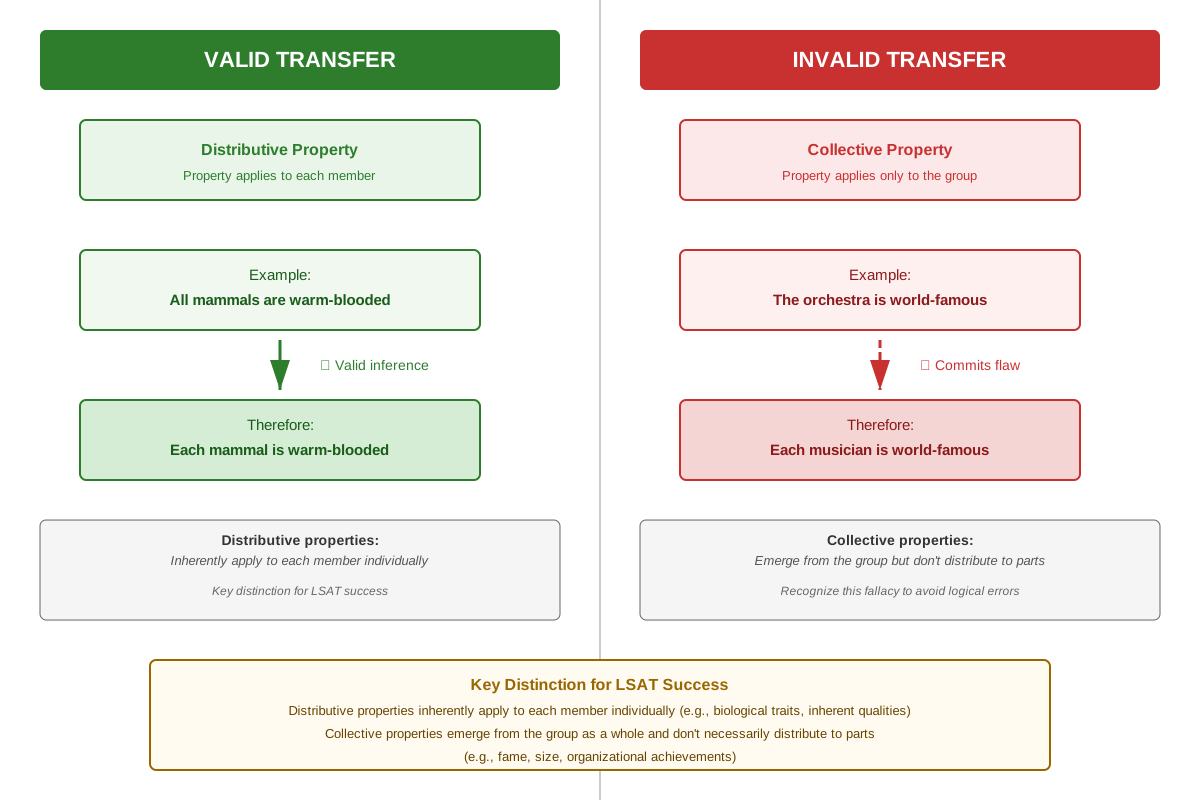
The lsat whole to part flaw challenges students to think critically about the relationship between groups and their members. Consider a simple example: "The orchestra is world-famous; therefore, each musician in the orchestra must be world-famous." This reasoning is flawed because the collective reputation of the orchestra does not necessarily transfer to each individual member. Some musicians might be relatively unknown despite being part of a celebrated ensemble. This type of fallacious reasoning appears throughout LSAT passages, often disguised in complex language or embedded within sophisticated arguments about economics, science, law, or social policy.
Within the broader landscape of logical reasoning and flaw questions, the whole to part flaw belongs to a family of composition and division fallacies. It connects closely to other reasoning errors involving improper generalizations, such as the part to whole flaw (its inverse), hasty generalizations, and unrepresentative sample errors. Mastering this particular flaw enhances overall analytical skills and provides a framework for understanding how properties, characteristics, and attributes can or cannot be legitimately transferred between different levels of analysis. This conceptual understanding proves invaluable not only for the LSAT but also for legal reasoning more broadly, where distinguishing between collective and individual properties frequently determines case outcomes.
Learning Objectives
- [ ] Identify how Whole to part flaw appears in LSAT questions
- [ ] Explain the reasoning pattern behind Whole to part flaw
- [ ] Apply Whole to part flaw to solve LSAT-style problems accurately
- [ ] Distinguish between legitimate and illegitimate transfers of properties from wholes to parts
- [ ] Recognize the inverse relationship between whole to part and part to whole flaws
- [ ] Evaluate answer choices that correctly describe this flaw using various phrasings
- [ ] Construct original examples demonstrating both flawed and valid reasoning about wholes and parts
Prerequisites
- Basic argument structure: Understanding premises and conclusions is essential because identifying the whole to part flaw requires recognizing what evidence is offered and what claim is being made.
- Concept of logical fallacies: Familiarity with the idea that arguments can be structurally invalid helps students understand that the whole to part flaw represents a specific type of reasoning error.
- Ability to identify argument components: Recognizing subjects, predicates, and the scope of claims enables students to determine whether an argument is discussing a collective entity or individual members.
- Understanding of necessary vs. sufficient conditions: This background helps distinguish when properties must transfer versus when they merely might transfer from wholes to parts.
Why This Topic Matters
The whole to part flaw appears with remarkable frequency on the LSAT, making it one of the highest-yield topics for test preparation. Statistical analysis of recent LSAT exams reveals that composition and division fallacies (including whole to part reasoning) appear in approximately 10-15% of all Logical Reasoning questions. This translates to roughly 5-8 questions per exam, making it one of the most commonly tested reasoning errors. Given that Logical Reasoning comprises half of the LSAT score, mastering this single flaw type can directly impact multiple points on the final score.
Beyond exam performance, understanding the whole to part flaw develops critical thinking skills essential for legal practice. Attorneys regularly encounter arguments about whether characteristics of organizations apply to individual members, whether properties of groups transfer to subgroups, and whether collective rights or responsibilities extend to individuals. For example, legal reasoning about corporate liability, class action lawsuits, and organizational accountability all involve careful analysis of when attributes of wholes do or do not apply to constituent parts.
On the LSAT specifically, the whole to part flaw appears most commonly in Flaw questions (where students must identify the reasoning error), Parallel Flaw questions (where students must match the flawed reasoning pattern), and occasionally in Strengthen/Weaken questions (where understanding the flaw helps identify which answer choices address the argument's vulnerability). The flaw typically appears embedded in arguments about organizations and their members, teams and individual players, collections and individual items, or aggregate statistics and individual cases. Recognizing the characteristic language patterns and structural features of this flaw enables rapid identification and accurate response selection under timed conditions.
Core Concepts
Definition of the Whole to Part Flaw
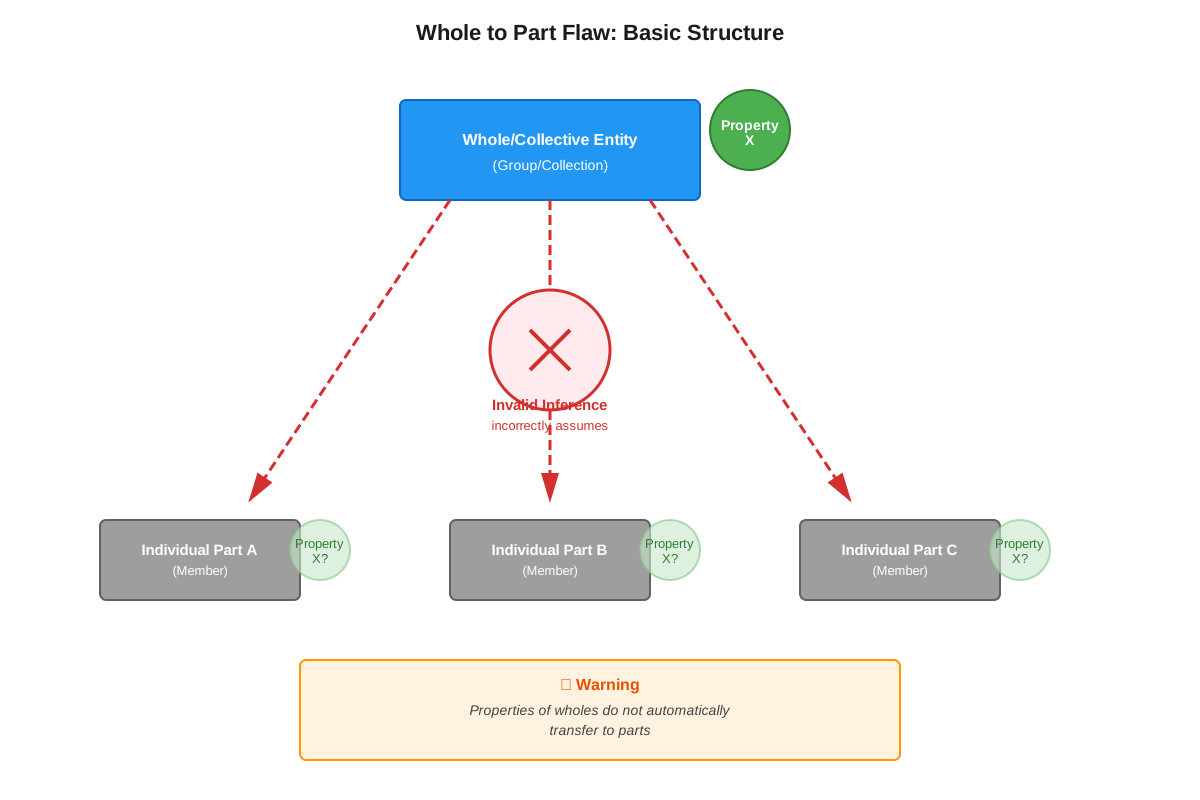
The whole to part flaw occurs when an argument assumes that a property, characteristic, or attribute that belongs to a collective entity, group, or whole necessarily applies to each individual part, member, or component of that entity. This reasoning error is also known as the "fallacy of division" in formal logic. The flaw lies in the unjustified assumption that characteristics are uniformly distributed or that collective properties automatically transfer to individuals.
The logical structure follows this pattern:
- Premise: The whole (group/collection/entity) has property X
- Conclusion: Therefore, each part (member/component/individual) has property X
- Flaw: The argument fails to establish that property X transfers from collective to individual level
Not all transfers from whole to part are fallacious. Some properties genuinely do transfer. For example, if a building is located in Chicago, then each room in that building is also located in Chicago. The flaw occurs specifically when the property in question does not logically or necessarily transfer from the collective to the individual level.
Types of Properties: Distributive vs. Collective
Understanding which properties transfer and which do not requires distinguishing between distributive properties and collective properties:
| Property Type | Definition | Example | Transfers to Parts? |
|---|---|---|---|
| Distributive | Properties that each member possesses individually | "Each student passed the exam" | Yes - already individual |
| Collective | Properties that belong only to the group as a whole | "The team won the championship" | No - only true of the group |
| Ambiguous | Properties that could be interpreted either way | "The class is intelligent" | Depends on interpretation |
Collective properties are characteristics that emerge from or apply to the group as a unified entity but do not necessarily describe individual members. Examples include: being numerous, being a majority, having an average, being well-known as a group, being profitable as a company, or being powerful as an organization.
Distributive properties describe each member individually. When we say "all students in the class are present," we mean each individual student is present. This is not a whole to part flaw because the property already applies at the individual level.
The whole to part flaw specifically involves treating collective properties as if they were distributive properties.
Common Contexts for the Flaw
The LSAT presents whole to part reasoning in several recurring contexts:
Organizations and Members: Arguments claiming that because an organization has certain characteristics (wealthy, influential, successful), each member must share those characteristics. Example: "The law firm is highly profitable; therefore, each attorney at the firm must earn a high income."
Statistical Aggregates and Individuals: Arguments moving from average, median, or total statistics to claims about individual cases. Example: "The average salary in this city is $75,000; therefore, most individuals in this city earn approximately $75,000."
Teams and Players: Arguments assuming that team achievements or characteristics apply to each team member. Example: "The basketball team has an excellent win record; therefore, each player on the team must be an excellent player."
Collections and Items: Arguments claiming that properties of a collection apply to individual items. Example: "This art collection is valuable; therefore, each painting in the collection must be valuable."
The Inverse: Part to Whole Flaw
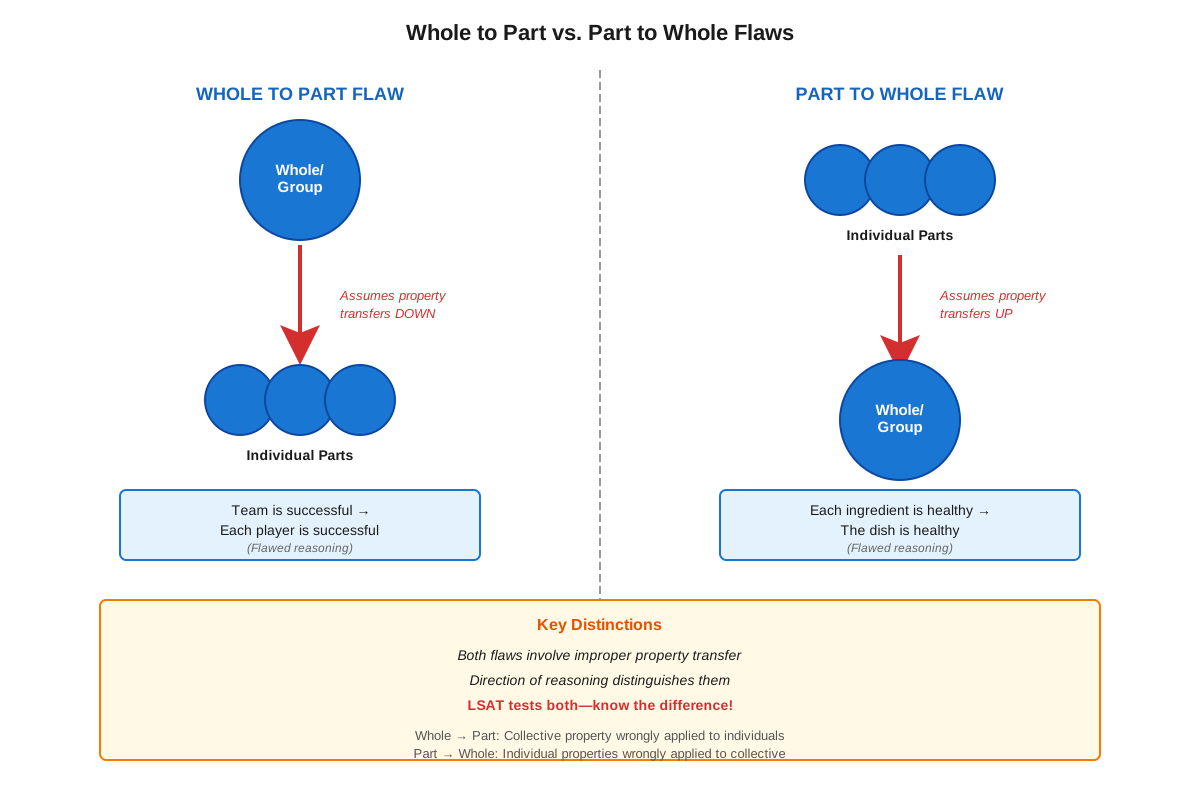
Understanding the whole to part flaw is enhanced by recognizing its inverse, the part to whole flaw (fallacy of composition). This occurs when an argument assumes that what is true of individual parts must be true of the whole. While related, these are distinct errors:
- Whole to Part: "The forest is ancient; therefore, each tree is ancient." (Flaw: some trees might be young)
- Part to Whole: "Each tree is small; therefore, the forest is small." (Flaw: many small trees can make a large forest)
The LSAT tests both flaws, and distinguishing between them requires careful attention to the direction of reasoning: from collective to individual (whole to part) or from individual to collective (part to whole).
Identifying the Flaw in Arguments
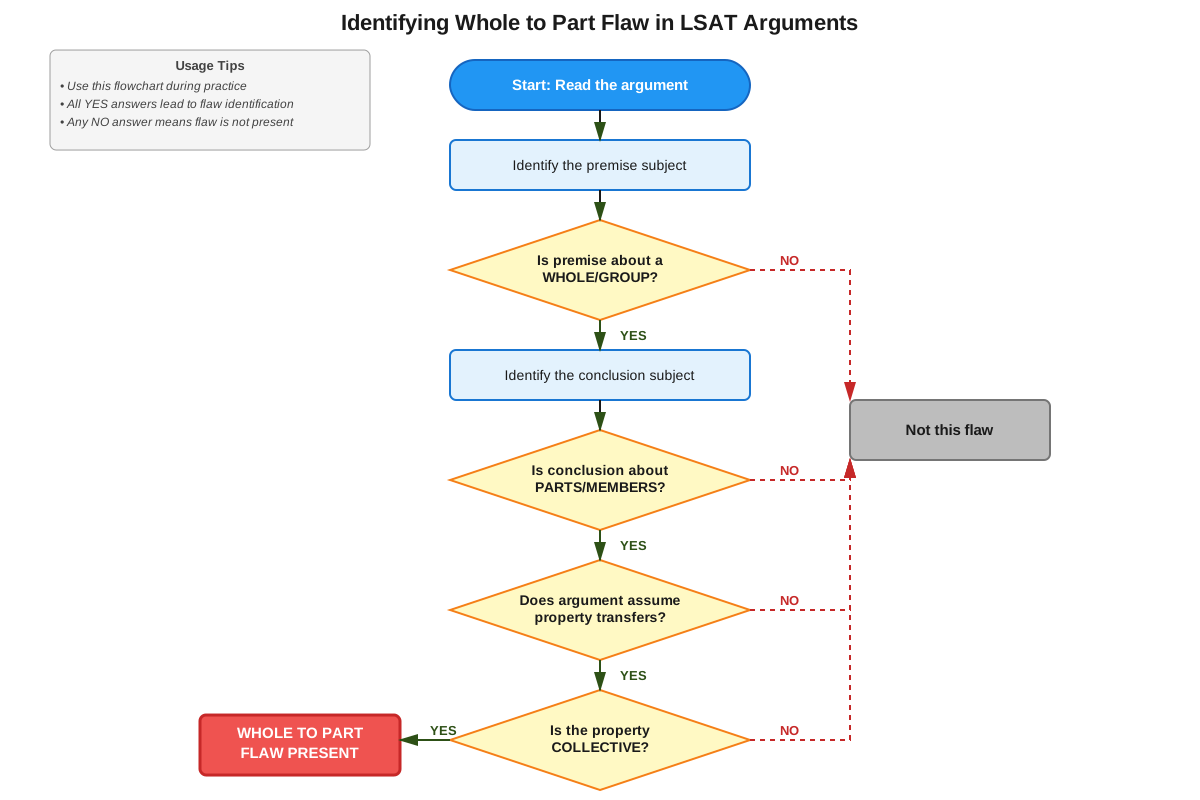
To identify a whole to part flaw, follow this systematic approach:
- Locate the conclusion: Determine what claim the argument is making
- Identify the subject of the conclusion: Is it about an individual, a part, or a member?
- Examine the premises: What evidence is provided?
- Identify the subject of the premises: Is it about a group, a whole, or a collective?
- Assess the property in question: Is this property collective or distributive?
- Evaluate the transfer: Does the argument justify why this property should transfer from whole to part?
If the argument moves from a collective property of a group to a claim about individuals without justification, the whole to part flaw is present.
Language Patterns and Trigger Words
Certain linguistic patterns frequently signal potential whole to part reasoning:
Premise indicators for wholes:
- "The organization/company/team/group..."
- "On average..."
- "Collectively..."
- "As a whole..."
- "The total/aggregate..."
Conclusion indicators for parts:
- "Therefore, each member..."
- "Thus, every individual..."
- "So, any particular..."
- "Hence, the typical..."
Property types that often don't transfer:
- Numerical aggregates (total, average, sum)
- Collective achievements (won, succeeded, accomplished)
- Reputational qualities (famous, well-known, prestigious)
- Emergent properties (powerful, influential, large)
Concept Relationships
The whole to part flaw connects to multiple concepts within logical reasoning. At the foundational level, it builds upon argument structure analysis → which enables identification of premises and conclusions → which allows recognition of scope shifts → which includes the specific case of whole to part transfers.
Within the family of reasoning flaws, the whole to part flaw relates closely to:
- Part to whole flaw: The inverse error, moving from individual properties to collective claims
- Hasty generalization: Both involve improper transfers, though hasty generalization typically involves sample-to-population reasoning rather than whole-to-part
- Equivocation: Sometimes the whole to part flaw involves shifting between collective and distributive meanings of the same term
- Unrepresentative sample: When the "whole" is actually a biased sample, both flaws may be present
The concept also connects to necessary and sufficient conditions because understanding when properties must transfer (necessary) versus when they might transfer (sufficient) helps evaluate the strength of whole to part reasoning.
In terms of question types, mastering the whole to part flaw enables success on:
- Flaw questions → where this error must be identified and described
- Parallel Flaw questions → where the same reasoning pattern must be matched
- Strengthen/Weaken questions → where understanding the flaw reveals the argument's vulnerability
- Assumption questions → where the unstated assumption often involves the legitimacy of the property transfer
Quick check — test yourself on Whole to part flaw so far.
Try Flashcards →High-Yield Facts
⭐ The whole to part flaw assumes that collective properties necessarily apply to individual members without justification.
⭐ Not all whole-to-part reasoning is flawed; distributive properties legitimately transfer, but collective properties do not.
⭐ Statistical averages, totals, and aggregates are collective properties that do not necessarily describe any particular individual.
⭐ Organizational achievements, reputations, or characteristics do not automatically apply to each member of the organization.
⭐ The LSAT frequently disguises this flaw using complex language about companies, teams, institutions, or collections.
- The inverse of the whole to part flaw is the part to whole flaw (fallacy of composition).
- Properties like location, time period, and jurisdiction typically do transfer from wholes to parts legitimately.
- The flaw appears in approximately 10-15% of Logical Reasoning questions across various question types.
- Answer choices describing this flaw may use phrases like "improperly infers," "fails to establish," or "assumes without warrant."
- Recognizing whether a property is collective or distributive is the key analytical skill for identifying this flaw.
- The flaw can occur in multi-step reasoning where the illegitimate transfer happens in one step of a longer argument.
- Some arguments commit both whole to part and part to whole flaws simultaneously in circular reasoning.
Common Misconceptions
Misconception: All reasoning from groups to individuals is flawed.
Correction: Only reasoning that improperly transfers collective properties to individuals is flawed. Distributive properties and certain other characteristics (like location or time period) legitimately transfer from wholes to parts. The key is whether the specific property in question logically applies at both levels.
Misconception: If most members of a group have a property, then the group has that property, so reasoning back to individuals is valid.
Correction: This confuses two different errors. Even if a group property is based on most members having that property, concluding that any particular individual must have it commits the whole to part flaw. The argument would need to establish which individuals have the property, not just that the group does.
Misconception: The whole to part flaw and hasty generalization are the same thing.
Correction: While both involve improper transfers, hasty generalization moves from a sample to a broader population (part to whole reasoning about the same type of entity), while the whole to part flaw moves from a collective property to individual members (different levels of analysis). The direction and nature of the transfer differ.
Misconception: Averages tell us about typical individuals, so reasoning from averages to individuals is not flawed.
Correction: Averages are collective properties that may not describe any actual individual. In a group where half earn $20,000 and half earn $80,000, the average is $50,000, but no individual earns that amount. Reasoning from an average to a claim about individuals without additional evidence commits the whole to part flaw.
Misconception: If an argument mentions both a group and individuals, it must contain a whole to part flaw.
Correction: The mere presence of both collective and individual references does not create a flaw. The flaw occurs only when the argument improperly transfers a collective property to individuals without justification. An argument might legitimately discuss both levels without committing this error.
Misconception: The whole to part flaw only appears in Flaw questions.
Correction: While most commonly tested in Flaw questions, this reasoning error also appears in Parallel Flaw questions, Strengthen/Weaken questions (where answer choices might address the flaw), and occasionally in Assumption questions (where the assumption involves the legitimacy of the transfer).
Worked Examples
Example 1: Classic Organizational Context
Argument: "TechCorp has been the most profitable technology company for the past five years, generating billions in revenue annually. Therefore, each software engineer employed by TechCorp must be earning an exceptionally high salary."
Analysis:
Step 1 - Identify the conclusion: "Each software engineer employed by TechCorp must be earning an exceptionally high salary."
Step 2 - Identify the premises: TechCorp is the most profitable technology company, generating billions in revenue.
Step 3 - Recognize the scope shift: The premise discusses the company as a whole (collective profitability), while the conclusion makes a claim about individual employees (each engineer's salary).
Step 4 - Evaluate the property transfer: Profitability is a collective property of the company. High company profits do not necessarily translate to high individual salaries. The company might achieve profitability through various means: large sales volume with modest margins, cost-cutting measures (including lower salaries), or concentration of profits among executives rather than engineers.
Step 5 - Identify the flaw: This is a whole to part flaw. The argument assumes that the collective property (company profitability) necessarily applies to individual members (each engineer's salary) without establishing that the profits are distributed to engineers in the form of high salaries.
Connection to learning objectives: This example demonstrates how to identify the flaw (Objective 1), explains the reasoning pattern of moving from collective to individual properties (Objective 2), and shows the analytical process for solving LSAT-style problems (Objective 3).
Example 2: Statistical Aggregate Context
Argument: "A recent study found that the average household in Riverside County owns 2.3 vehicles. The Martinez family lives in Riverside County. Therefore, the Martinez family probably owns either two or three vehicles."
Analysis:
Step 1 - Identify the conclusion: "The Martinez family probably owns either two or three vehicles."
Step 2 - Identify the premises: The average household in Riverside County owns 2.3 vehicles; the Martinez family lives in Riverside County.
Step 3 - Recognize the scope shift: The premise provides an average (a collective statistical property of all households in the county), while the conclusion makes a claim about one particular household.
Step 4 - Evaluate the property transfer: An average is a collective property that may not describe any individual case. The 2.3 average could result from many households owning zero or one vehicle and some households owning five or more vehicles. The distribution matters, and the average alone tells us nothing definitive about any particular household.
Step 5 - Identify the flaw: This commits the whole to part flaw by assuming that a statistical aggregate (average) applies to an individual case (the Martinez family). The argument treats the collective property (average ownership) as if it were a distributive property that describes each household.
Additional insight: This example is particularly instructive because it shows how the flaw can appear with statistical reasoning. Students often mistakenly believe that averages tell us about typical cases, but averages are collective properties that may not describe any actual individual. The LSAT frequently tests this specific manifestation of the whole to part flaw.
Connection to learning objectives: This example reinforces identification skills (Objective 1), demonstrates the reasoning pattern with statistical properties (Objective 2), and provides practice with a common LSAT context (Objective 3). It also helps students distinguish between legitimate and illegitimate property transfers (additional Objective 4).
Exam Strategy
When approaching LSAT questions involving potential whole to part flaws, employ this systematic strategy:
Recognition Phase (5-10 seconds):
- Scan for language indicating groups, organizations, teams, collections, or statistical aggregates in the premises
- Look for language indicating individuals, members, or particular cases in the conclusion
- Flag any argument that moves from collective to individual level
Analysis Phase (15-20 seconds):
- Identify the specific property being transferred (profitability, fame, size, average, etc.)
- Ask: "Is this property collective or distributive?"
- Determine whether the argument provides justification for the transfer
- Consider whether the property could fail to apply to individuals even if it applies to the whole
Answer Selection Phase (10-15 seconds):
- For Flaw questions, look for answer choices using phrases like:
- "presumes that what is true of a whole is true of its parts"
- "takes a characteristic of a group to apply to each member"
- "fails to establish that the property transfers to individuals"
- "improperly infers from aggregate data to individual cases"
- Eliminate answers describing other flaws (causal reasoning, sampling errors, etc.)
- Select the answer that most precisely describes the whole-to-part transfer
Exam Tip: The LSAT often includes trap answers that describe the inverse flaw (part to whole). Read carefully to ensure the answer matches the direction of reasoning in the argument.
Trigger Words to Watch For:
In premises (suggesting whole/collective):
- "The company/organization/team/group"
- "On average," "in total," "collectively"
- "The collection/set/class as a whole"
In conclusions (suggesting part/individual):
- "Each member," "every individual," "any particular"
- "Therefore, the typical," "thus, most individuals"
Time Allocation: Whole to part flaw questions should take approximately 45-60 seconds total. If you quickly recognize the flaw pattern, you can often eliminate wrong answers rapidly and select the correct answer with confidence. Do not overthink these questions once you've identified the flaw.
Process of Elimination Tips:
- Eliminate answers describing causal flaws if no causal relationship is present
- Eliminate answers about sampling if the argument doesn't involve samples
- Eliminate answers about necessary/sufficient conditions if no conditional reasoning appears
- Keep answers that mention groups/wholes and individuals/parts in the correct relationship
Memory Techniques
Mnemonic for Property Types: "DICE" helps remember which properties typically Don't transfer:
- Distributed statistics (averages, totals)
- Institutional reputation (fame, prestige)
- Collective achievements (won, succeeded)
- Emergent characteristics (powerful, numerous)
Visualization Strategy: Picture a trophy representing a team championship. The trophy belongs to the team as a whole. Now picture trying to break the trophy into pieces and give one to each player—it doesn't work. The championship is a collective property that cannot be divided among individuals. Use this mental image whenever you encounter potential whole to part reasoning.
Acronym for Analysis Steps: "SCOPE" guides your analysis:
- Subject of conclusion (individual or whole?)
- Collective or distributive property?
- Origin of the claim (what's the evidence?)
- Premise subject (individual or whole?)
- Evaluate the transfer (justified or not?)
Contrast Pair Memory Aid: Remember the phrase "Team wins, player plays" to distinguish legitimate from illegitimate transfers. If the team wins (collective achievement), we cannot conclude each player is a winner in the same sense. But if the team plays on Tuesday (distributive property of time), then each player plays on Tuesday. The contrast helps identify which properties transfer.
Direction Reminder: Use the phrase "Whole to part falls apart" to remember that reasoning from whole to part often falls apart (is flawed) when dealing with collective properties. This rhyme helps recall both the name of the flaw and its problematic nature.
Summary
The whole to part flaw represents a critical reasoning error that LSAT test-takers must master to achieve high scores. This flaw occurs when arguments improperly assume that collective properties of groups, organizations, or aggregates necessarily apply to individual members or parts. The key to identifying this flaw lies in distinguishing between distributive properties (which legitimately apply at both collective and individual levels) and collective properties (which belong only to the group as a whole). Statistical averages, organizational achievements, institutional reputations, and emergent characteristics are common examples of collective properties that do not automatically transfer to individuals. Successful LSAT performance requires recognizing the characteristic language patterns, understanding the logical structure of the flawed reasoning, and accurately matching this flaw to answer choices that may describe it in various ways. The whole to part flaw appears frequently across multiple question types, making it one of the highest-yield topics for focused study and practice.
Key Takeaways
- The whole to part flaw assumes collective properties necessarily apply to individual members without justification
- Distinguishing between collective and distributive properties is essential for identifying this flaw
- Statistical averages, organizational achievements, and institutional reputations are collective properties that typically do not transfer to individuals
- The flaw appears in approximately 10-15% of Logical Reasoning questions across various question types
- Systematic analysis of premise subjects, conclusion subjects, and property types enables rapid identification
- Answer choices may describe this flaw using various phrasings, including "presumes what is true of the whole is true of the parts"
- Understanding both the whole to part flaw and its inverse (part to whole) enhances overall analytical reasoning skills
Related Topics
Part to Whole Flaw (Fallacy of Composition): The inverse of the whole to part flaw, this reasoning error assumes that properties of individual parts necessarily apply to the collective whole. Mastering the whole to part flaw provides the foundation for understanding this related error, as both involve improper transfers between different levels of analysis.
Hasty Generalization: While distinct from the whole to part flaw, hasty generalization also involves improper transfers—specifically from samples to populations. Understanding the whole to part flaw helps students recognize different types of scope shifts and improper inferences.
Equivocation: Some arguments commit both equivocation and whole to part flaws by shifting between collective and distributive meanings of the same term. Recognizing the whole to part flaw enhances the ability to spot these compound errors.
Necessary and Sufficient Conditions: Understanding when properties must transfer versus when they might transfer connects to conditional reasoning. This relationship helps students evaluate the strength of whole to part reasoning in various contexts.
Strengthen and Weaken Questions: Once students master identifying the whole to part flaw, they can more effectively evaluate answer choices in Strengthen/Weaken questions that address this vulnerability in arguments.
Practice CTA
Now that you understand the whole to part flaw, it's time to reinforce your learning through active practice. Attempt the practice questions and flashcards associated with this topic to solidify your ability to identify this flaw quickly and accurately under timed conditions. Remember, recognizing this single flaw type can help you correctly answer multiple questions on test day, directly improving your LSAT score. The more you practice identifying the characteristic patterns and language of whole to part reasoning, the more automatic your recognition will become. You've built the foundation—now strengthen it through deliberate practice!
Sign up free to keep reading
Create a free AnvayaPrep account to finish this LSAT guide on Whole to part flaw — plus flashcards and practice questions.