Overview
Equivocation is one of the most frequently tested logical flaws on the LSAT Logical Reasoning section. This flaw occurs when an argument uses a key term in two or more different senses, creating the illusion of a valid logical connection when none actually exists. The argument appears to flow smoothly from premises to conclusion, but the shifting meaning of a critical word or phrase undermines the reasoning. Understanding equivocation is essential because it represents a fundamental breakdown in logical consistency—the argument's structure depends on treating different meanings as if they were the same.
On the LSAT, lsat equivocation questions appear regularly in Flaw questions, where test-takers must identify the reasoning error, and occasionally in other question types such as Parallel Flaw or Method of Reasoning questions. The ability to spot equivocation separates high-scoring test-takers from those who struggle with subtle logical distinctions. These questions test whether students can recognize when an argument exploits the ambiguity of language to create a false impression of logical validity.
Within the broader landscape of logical reasoning, equivocation belongs to a family of flaws involving ambiguity and imprecision in language. It connects closely to other reasoning errors such as circular reasoning (where terms might be used inconsistently to hide the circularity) and flawed analogies (where the comparison depends on treating non-equivalent things as equivalent). Mastering equivocation strengthens overall analytical skills because it trains students to scrutinize not just the structure of arguments but also the precise meaning of the terms used within them. This attention to semantic precision is crucial for success on flaw questions throughout the LSAT.
Learning Objectives
- [ ] Identify how Equivocation appears in LSAT questions
- [ ] Explain the reasoning pattern behind Equivocation
- [ ] Apply Equivocation to solve LSAT-style problems accurately
- [ ] Distinguish equivocation from other language-based flaws such as ambiguity and vagueness
- [ ] Recognize the specific words and phrases that commonly shift meaning in equivocation flaws
- [ ] Evaluate whether an argument's use of a term remains consistent throughout its reasoning
- [ ] Construct clear explanations of why a particular shift in meaning undermines an argument's validity
Prerequisites
- Basic argument structure: Understanding premises, conclusions, and how they relate is necessary because equivocation exploits the connections between these elements by shifting term meanings.
- Flaw question format: Familiarity with how the LSAT presents and asks about logical flaws enables students to recognize the question stem patterns that signal equivocation.
- Logical validity concepts: Knowing what makes an argument logically valid helps identify when shifting meanings break the logical chain between premises and conclusion.
- Common LSAT vocabulary: Recognition of terms like "assumes," "overlooks," and "takes for granted" aids in understanding answer choices that describe equivocation.
Why This Topic Matters
Equivocation appears in real-world reasoning constantly, making it both practically significant and a favorite target for LSAT test-makers. Politicians, advertisers, and debaters frequently exploit ambiguous terms to make weak arguments appear stronger. For example, someone might argue that "natural" products are healthier because they come from "nature," equivocating between "natural" as "not synthetic" and "natural" as "beneficial." Recognizing this flaw protects against manipulation and strengthens critical thinking in professional and personal contexts.
On the LSAT specifically, equivocation appears in approximately 3-5% of all Logical Reasoning questions, making it a high-yield topic that appears on virtually every test administration. The flaw most commonly surfaces in Flaw questions (where students must identify the reasoning error) but also appears in Parallel Flaw questions (where students must match the flawed reasoning pattern) and occasionally in Strengthen/Weaken questions (where understanding the equivocation helps identify what would fix or further damage the argument).
The LSAT tests equivocation through several recurring patterns: arguments about word definitions that shift between technical and colloquial meanings, arguments that move between different senses of abstract terms like "freedom" or "justice," and arguments that conflate related but distinct concepts like "popular" (widely liked) versus "popular" (widely known). Test-makers favor equivocation because it appears subtle—the argument reads smoothly on first pass, and only careful analysis reveals the semantic shift. This makes it an excellent discriminator between students who read carefully and those who skim for general meaning.
Core Concepts
Definition of Equivocation
Equivocation is a logical flaw in which an argument uses a word or phrase in two or more different senses, treating these different meanings as if they were the same. The argument's apparent validity depends on this semantic shift—if the term maintained a consistent meaning throughout, the logical connection between premises and conclusion would break down. The term comes from the Latin "aequivocus," meaning "of equal voice" or "ambiguous," reflecting how the same word "speaks" with different meanings.
For equivocation to occur, three conditions must be met: (1) a key term appears multiple times in the argument, (2) the term carries different meanings in different instances, and (3) the argument's logical force depends on treating these different meanings as equivalent. Without all three conditions, the flaw is something other than equivocation—perhaps simple ambiguity or a different logical error entirely.
The Mechanism of Equivocation
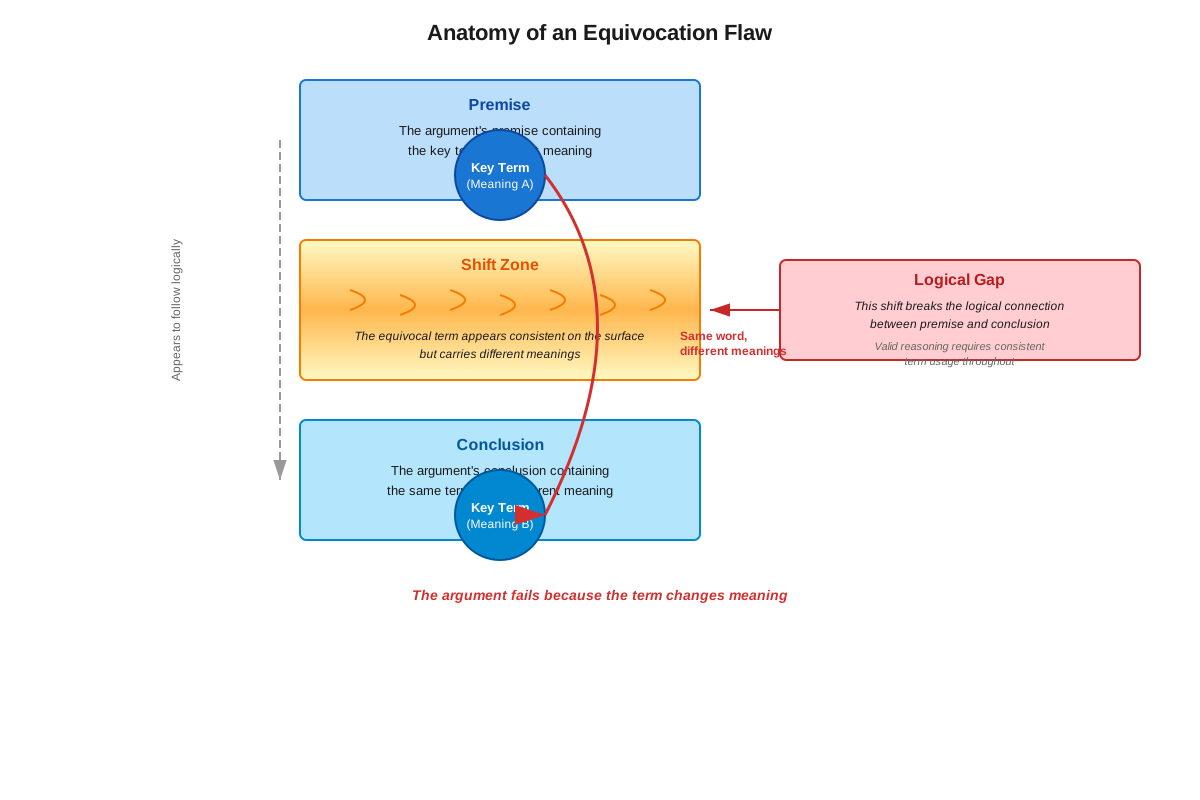
Equivocation works by exploiting the gap between surface grammar and underlying meaning. On the surface level, the argument appears to maintain consistent terminology, which creates an impression of logical coherence. The same word appears in premise and conclusion, suggesting a clear logical connection. However, at the semantic level, the meaning has shifted, breaking the actual logical chain.
Consider this structure:
- Premise: All X are Y (where X means X₁)
- Premise: Z is X (where X means X₂)
- Conclusion: Therefore, Z is Y
The argument appears to follow a valid categorical syllogism, but because X means something different in each premise, the reasoning fails. The conclusion doesn't actually follow from the premises—it only appears to follow because the same word is used.
Common Types of Equivocation on the LSAT
| Type | Description | Example Pattern |
|---|---|---|
| Technical vs. Colloquial | Shifts between specialized and everyday meanings | "Theory" as scientific theory vs. "theory" as guess |
| Broad vs. Narrow | Moves between general and specific senses | "Freedom" as political liberty vs. "freedom" as lack of obligations |
| Literal vs. Figurative | Conflates metaphorical and actual meanings | "Healthy" as medically sound vs. "healthy" as beneficial |
| Descriptive vs. Normative | Confuses factual and evaluative senses | "Natural" as occurring in nature vs. "natural" as morally good |
| Relative vs. Absolute | Treats context-dependent and universal meanings as same | "Large" for a mouse vs. "large" for an elephant |
Distinguishing Equivocation from Related Flaws
Equivocation differs from simple ambiguity in that ambiguity involves a single unclear usage, while equivocation requires multiple uses with different meanings. An ambiguous statement might be unclear, but equivocation actively exploits multiple meanings to create false logical connections.
Vagueness involves terms with unclear boundaries (like "tall" or "expensive"), but vague terms can be used consistently. Equivocation requires an actual shift in meaning, not just imprecision. An argument might use "expensive" consistently to mean "costs more than $100," which would be vague but not equivocal.
Circular reasoning sometimes involves subtle shifts in terminology to disguise that the conclusion merely restates the premise, but the core flaw is the circularity itself. Equivocation can occur in non-circular arguments and focuses specifically on the semantic shift rather than the logical structure.
Identifying Equivocation in Arguments
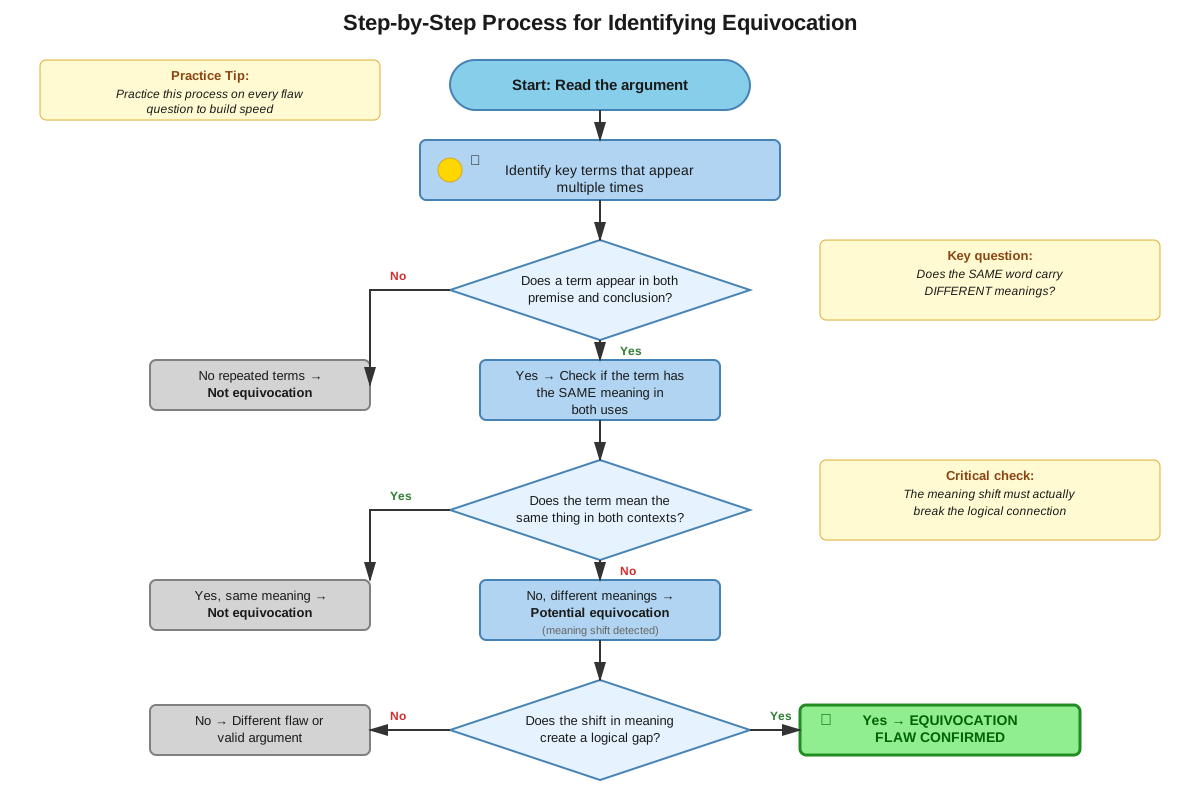
To identify equivocation systematically, follow this process:
- Locate repeated terms: Identify words or phrases that appear multiple times in the argument
- Define each instance: Determine what the term means in each specific context
- Compare meanings: Assess whether the meanings remain consistent or shift
- Evaluate logical impact: Determine whether the argument's validity depends on treating different meanings as the same
- Confirm the flaw: Verify that the semantic shift, not some other error, is the primary logical problem
The most commonly equivocated terms on the LSAT include abstract concepts (freedom, justice, rights), evaluative terms (good, successful, effective), relational terms (large, popular, significant), and technical terms that also have everyday meanings (theory, law, natural).
The Role of Context in Equivocation
Context determines meaning, and equivocation exploits how context can shift within an argument. A term might have one meaning when discussing scientific matters and another when discussing social issues. The argument commits equivocation when it moves between these contexts while treating the term as if its meaning remained stable.
For example, "discrimination" in a scientific context means "the ability to distinguish between different things" (a neutral or positive capability), while in a social context it means "unjust treatment based on group membership" (a negative practice). An argument that moves from "scientists must be good at discrimination" to "therefore, scientists engage in discrimination" equivocates by shifting contexts and thus meanings.
Concept Relationships
Equivocation connects to other logical reasoning concepts through multiple pathways. At the foundational level, it depends on understanding argument structure—premises and conclusions—because the flaw involves how terms function differently in these structural components. The semantic shift typically occurs between premise and conclusion or between multiple premises, breaking the logical chain that should connect them.
Within the family of language-based flaws, equivocation represents the most specific type. It relates to ambiguity (equivocation is a particular exploitation of ambiguity) and vagueness (both involve imprecision, but equivocation requires actual meaning shifts). The relationship flows: Ambiguity → creates possibility for → Equivocation → which is a specific type of → Logical Flaw.
Equivocation also connects to assumption-based reasoning. Many equivocation flaws can be described as the argument "assuming" that a term means the same thing in different contexts. This means equivocation questions sometimes overlap with Necessary Assumption questions—the argument assumes the meanings are equivalent when they're not.
The concept links forward to Parallel Flaw questions, where recognizing the abstract pattern of equivocation (using term X in sense A, then using term X in sense B, then concluding as if both meant the same thing) enables matching to structurally similar arguments. It also connects to Strengthen/Weaken questions, where establishing that a term does or doesn't maintain consistent meaning can strengthen or weaken an argument.
High-Yield Facts
⭐ Equivocation requires a term to appear at least twice with different meanings in the same argument—a single ambiguous use is not equivocation.
⭐ The most commonly equivocated terms on the LSAT are abstract concepts like "freedom," "natural," "rights," and "success" that have multiple legitimate meanings.
⭐ Equivocation answer choices often use phrases like "uses a key term in two different senses" or "equivocates with respect to a central concept."
⭐ The flaw undermines validity even if the premises and conclusion are all true—equivocation is a structural flaw, not a factual error.
⭐ Context shifts are the primary mechanism of equivocation—moving from technical to colloquial contexts, or from one domain to another, while keeping the same term.
- Equivocation appears in approximately 3-5% of Logical Reasoning questions, making it a regular but not overwhelming presence on each test.
- The flaw can occur with phrases and concepts, not just single words—"taking responsibility" might shift from "acknowledging causation" to "accepting blame."
- Recognizing equivocation requires careful attention to how terms are used, not just whether they appear—surface-level reading misses the semantic shift.
- Some arguments equivocate on implicit terms or concepts that aren't explicitly stated but are clearly implied by the reasoning.
- Equivocation differs from "shifting the burden of proof" or "attacking the person"—it's specifically about semantic shifts, not argumentative tactics.
Quick check — test yourself on Equivocation so far.
Try Flashcards →Common Misconceptions
Misconception: Any argument using an ambiguous term commits equivocation. → Correction: Equivocation requires the term to be used with different meanings in different parts of the argument. A single ambiguous use, or consistent use of an ambiguous term, is not equivocation.
Misconception: Equivocation only occurs with single words, not phrases or concepts. → Correction: Equivocation can involve multi-word phrases ("taking responsibility"), implicit concepts, or even the overall subject matter when the argument shifts what it's discussing while pretending continuity.
Misconception: If the reader can figure out what the argument means, there's no equivocation. → Correction: Equivocation is about whether the argument's logical validity depends on treating different meanings as the same, not about whether a charitable reader can interpret it correctly. The flaw exists even if the intended meaning is recoverable.
Misconception: Technical terms used in everyday contexts automatically create equivocation. → Correction: Using a technical term in a colloquial sense is only equivocation if the argument relies on shifting between the technical and colloquial meanings. Consistent use of either meaning, even if informal, is not equivocation.
Misconception: Equivocation is the same as being vague or imprecise. → Correction: Vagueness involves unclear boundaries or imprecision with a single meaning. Equivocation involves multiple distinct meanings. An argument can be vague without equivocating, and can equivocate while being quite precise in each individual usage.
Misconception: The term must have completely unrelated meanings to count as equivocation. → Correction: Equivocation often involves related but distinct meanings (like "healthy" meaning "medically sound" versus "conducive to health"). The meanings need only be different enough that the logical connection breaks down, not completely unrelated.
Worked Examples
Example 1: The Natural Foods Argument
Argument: "Natural foods are healthier than processed foods because natural foods come from nature, and whatever comes from nature is natural. Therefore, we should eat only natural foods to be healthy."
Analysis:
Step 1 - Identify the conclusion: "We should eat only natural foods to be healthy."
Step 2 - Identify the premises:
- Natural foods come from nature
- Whatever comes from nature is natural
- Natural foods are healthier than processed foods
Step 3 - Locate repeated terms: The term "natural" appears multiple times.
Step 4 - Define each instance:
- "Natural foods" in the first use means "unprocessed or minimally processed foods"
- "Come from nature" suggests "originating in the natural world"
- "Natural" in "whatever comes from nature is natural" means "occurring in nature without human intervention"
- The conclusion's "natural foods" returns to the "unprocessed" meaning
Step 5 - Identify the equivocation: The argument equivocates on "natural." It shifts between "natural" as "unprocessed/minimally processed" (a category of food products) and "natural" as "occurring in nature" (a much broader category that includes poisonous mushrooms, toxic plants, and harmful substances). The argument treats these as equivalent when they're not—many things that "come from nature" are deadly, and the fact that something is unprocessed doesn't automatically make it healthy.
Step 6 - Explain why this undermines the argument: The conclusion that we should eat natural foods (meaning unprocessed) doesn't follow from the premise that things from nature are natural (meaning occurring naturally), because these are different senses of "natural." The argument appears valid only because the same word is used, but the logical connection is broken by the semantic shift.
Connection to learning objectives: This example demonstrates how to identify equivocation (Objective 1), explains the reasoning pattern of shifting between different senses of a term (Objective 2), and shows the analytical process for solving such problems (Objective 3).
Example 2: The Freedom Argument
Argument: "Citizens in a democracy have freedom of speech, which means they are free to express their opinions. Since Maria is free to express her opinions, she must live in a democracy."
Analysis:
Step 1 - Identify the structure:
- Premise: Citizens in democracies have freedom of speech (meaning free to express opinions)
- Premise: Maria is free to express her opinions
- Conclusion: Maria lives in a democracy
Step 2 - Locate the potential equivocation: The term "free to express opinions" appears in both premises but may carry different meanings.
Step 3 - Define each instance:
- "Freedom of speech" in democracies typically means a legal/constitutional right protected from government interference
- "Free to express her opinions" regarding Maria might simply mean she has the practical ability or opportunity to speak, without legal barriers
Step 4 - Identify the equivocation: The argument equivocates on what it means to be "free" to express opinions. In the first premise, it refers to a specific legal right characteristic of democracies. In the second premise, it could mean merely that Maria has the practical ability to speak—perhaps she's in a private conversation, or she's not currently being prevented from speaking. The argument treats "having the legal right to free speech" as equivalent to "being able to express opinions in some context."
Step 5 - Explain the logical breakdown: Even if Maria can express her opinions in her current situation, this doesn't mean she has the constitutional protection of free speech that characterizes democracies. She might live in an authoritarian state but happen to be in a private setting where she can speak freely. The argument's logic fails because it treats different senses of "freedom" as equivalent.
Step 6 - Consider the formal structure: This also illustrates a common LSAT pattern—affirming the consequent combined with equivocation. The argument treats "freedom of speech" as if it uniquely identifies democracies, but it's equivocating on what "freedom" means.
Connection to learning objectives: This example shows how equivocation appears in conditional reasoning contexts (Objective 1), demonstrates the pattern of shifting between legal/formal and practical/informal meanings (Objective 2), and illustrates how to distinguish this from other flaws like affirming the consequent (Objective 4).
Exam Strategy
When approaching LSAT questions involving equivocation, implement a systematic strategy that maximizes accuracy while managing time effectively. Begin by reading the argument carefully, paying special attention to any terms that appear multiple times. The LSAT often signals potential equivocation through repetition of key terms, especially abstract or evaluative terms.
Trigger words and phrases to watch for include: "natural," "freedom," "rights," "fair," "equal," "theory," "law," "healthy," "successful," "significant," "popular," "discrimination," and "responsibility." These terms frequently carry multiple meanings that LSAT arguments exploit. When you see these words repeated, immediately ask yourself: "Is this term being used the same way each time?"
In the answer choices, equivocation is typically described with phrases such as:
- "uses a key term in two different senses"
- "equivocates with respect to a central concept"
- "relies on the ambiguity of a particular term"
- "takes a term to mean one thing in the premises and another in the conclusion"
- "confuses two different meanings of [term]"
Process of elimination strategy: Equivocation is often confused with other flaws, so eliminate answers that describe:
- Circular reasoning: The conclusion restates the premise (unless the circularity is hidden by equivocation)
- False dichotomy: The argument presents only two options when more exist
- Causal flaws: The argument confuses correlation with causation
- Sampling errors: The argument generalizes from an unrepresentative sample
If an answer choice mentions "ambiguity" but doesn't specify that the term is used in multiple different senses, be cautious—it might be describing simple ambiguity rather than equivocation.
Time allocation: Spend approximately 1:15-1:30 on equivocation questions. These require careful reading but shouldn't consume excessive time. If you're struggling to identify the semantic shift after one careful read, mark the question and return to it rather than spending three minutes trying to force the answer.
Exam Tip: When stuck between two answer choices, one describing equivocation and one describing another flaw, ask: "Does this argument's validity depend on treating different meanings as the same, or is there a different logical problem?" If the argument would still fail even with consistent term usage, the flaw probably isn't equivocation.
Verification technique: Before selecting an answer identifying equivocation, mentally rewrite the argument using different words for each sense of the term. If the argument now appears obviously invalid, you've correctly identified equivocation. For example, if an argument equivocates on "natural," rewrite it using "unprocessed" in one place and "occurring in nature" in another. If the argument now looks clearly flawed, equivocation was the problem.
Memory Techniques
Mnemonic for identifying equivocation - "SAME":
- Spot repeated terms
- Analyze each usage
- Match meanings (or identify mismatches)
- Evaluate logical impact
Visualization strategy: Picture equivocation as a "word bridge" that appears solid but is actually two separate bridges that don't connect. The same word appears on both sides, creating the illusion of connection, but the meanings are different, so there's a gap in the middle. When you read an argument, visualize whether the repeated terms form a solid bridge or have a hidden gap.
Acronym for common equivocation types - "TBLR":
- Technical vs. colloquial
- Broad vs. narrow
- Literal vs. figurative
- Relative vs. absolute
Memory palace technique: Associate equivocation with a specific location (like a courtroom) where you imagine a lawyer using the same word with different meanings to confuse the jury. Each time you encounter equivocation, mentally place it in this courtroom scene, reinforcing the pattern.
Rhyme for remembering the core concept: "Same word, different sense—breaks the logical fence." This captures both what equivocation is (same word, different meanings) and what it does (breaks logical validity).
Summary
Equivocation is a logical flaw in which an argument uses a key term in two or more different senses while treating these different meanings as equivalent. This semantic shift breaks the logical connection between premises and conclusion, even though the argument appears valid on the surface due to consistent terminology. The flaw is particularly common on the LSAT because it tests careful reading and semantic precision—skills essential for legal reasoning. To identify equivocation, students must locate repeated terms, analyze whether their meanings shift across different uses, and determine whether the argument's validity depends on treating these different meanings as the same. The most commonly equivocated terms are abstract concepts like "natural," "freedom," and "rights," as well as technical terms that also have everyday meanings. Mastering equivocation requires distinguishing it from related flaws like simple ambiguity or vagueness, and recognizing the specific answer choice language that describes semantic shifts. Success on equivocation questions depends on systematic analysis of term usage rather than general comprehension of the argument's topic.
Key Takeaways
- Equivocation requires a term to appear multiple times with different meanings, not just a single ambiguous usage
- The flaw breaks logical validity by treating different meanings as equivalent, creating only the illusion of valid reasoning
- Abstract and evaluative terms (natural, freedom, rights, successful) are the most frequently equivocated on the LSAT
- Answer choices describing equivocation typically use phrases like "uses a key term in two different senses" or "equivocates with respect to"
- Systematic analysis—spotting repeated terms, defining each usage, comparing meanings, and evaluating logical impact—is more reliable than intuitive reading
- Equivocation differs from simple ambiguity (single unclear use) and vagueness (imprecise boundaries with consistent meaning)
- Context shifts between technical and colloquial meanings, or between different domains, are the primary mechanism of equivocation
Related Topics
Ambiguity and Vagueness: Understanding the broader category of language-based reasoning flaws helps distinguish equivocation from other imprecision errors. Mastering equivocation provides the foundation for recognizing when arguments fail due to unclear language versus semantic shifts.
Necessary Assumptions: Many equivocation flaws can be reframed as the argument assuming that a term maintains consistent meaning. Studying assumption questions alongside equivocation strengthens the ability to identify what arguments take for granted.
Parallel Flaw Questions: Once equivocation is mastered, students can recognize the abstract pattern (using X in sense A, then sense B, then concluding as if both were the same) and match it to structurally similar arguments in parallel flaw questions.
Strengthen and Weaken Questions: Understanding equivocation enables students to recognize that establishing consistent or inconsistent term usage can strengthen or weaken arguments, particularly those involving definitions or abstract concepts.
Formal Logic and Conditional Reasoning: Equivocation often appears in arguments with conditional structures, where the same term appears in different conditional statements with different meanings, creating invalid chains of reasoning.
Practice CTA
Now that you understand the concept, mechanism, and identification strategies for equivocation, it's time to apply this knowledge to actual LSAT questions. Work through the practice questions and flashcards to reinforce your ability to spot semantic shifts quickly and accurately. Remember that equivocation appears regularly on the LSAT, making every practice question an investment in your score. Focus on the systematic analysis process—spot repeated terms, analyze each usage, match meanings, and evaluate logical impact. With deliberate practice, recognizing equivocation will become automatic, allowing you to identify this flaw confidently under timed conditions. Your ability to catch these subtle semantic shifts is what separates good LSAT performance from great performance!
Sign up free to keep reading
Create a free AnvayaPrep account to finish this LSAT guide on Equivocation — plus flashcards and practice questions.