Overview
Not all statements represent a critical category of quantified claims in formal logic and quantifiers that frequently appears throughout LSAT logical reasoning sections. These statements express partial negation—asserting that a universal claim does not hold for every member of a group, while leaving open the possibility that it holds for some, many, or even most members. Understanding how to properly interpret and manipulate not all statements is essential for success on the LSAT, as they appear in assumption questions, must be true questions, parallel reasoning questions, and formal logic chains that test conditional reasoning skills.
The logical structure of not all statements creates a unique challenge for test-takers because these statements are weaker than they initially appear. When the LSAT presents "not all lawyers are wealthy," students must recognize this means "at least one lawyer is not wealthy"—but it could mean that only one lawyer lacks wealth, or that most lawyers lack wealth, or anything in between. This flexibility makes not all statements particularly valuable for the test writers, who exploit common misinterpretations to create attractive wrong answer choices. The statement type also connects directly to the contrapositive relationships and sufficient-necessary condition reasoning that pervades LSAT logic games and logical reasoning questions.
Mastering lsat not all statements requires understanding their relationship to other quantifiers (all, some, most, none), their logical equivalences, and their role in argument structures. These statements often serve as premises that limit overly broad conclusions, or they appear as conclusions that must be supported by evidence of exceptions. The ability to quickly recognize not all statements, translate them into their logical equivalents, and apply them correctly distinguishes high-scoring test-takers from those who struggle with formal logic questions.
Learning Objectives
- [ ] Identify how Not all statements appears in LSAT questions
- [ ] Explain the reasoning pattern behind Not all statements
- [ ] Apply Not all statements to solve LSAT-style problems accurately
- [ ] Translate not all statements into logically equivalent forms (some not, at least one not)
- [ ] Distinguish between not all statements and other quantified statements (none, some, most)
- [ ] Recognize the contrapositive relationships involving not all statements
- [ ] Evaluate argument validity when not all statements serve as premises or conclusions
Prerequisites
- Basic propositional logic: Understanding truth values, negation, and logical operators is essential for manipulating not all statements within formal logic frameworks
- Quantifier fundamentals: Familiarity with universal (all) and existential (some) quantifiers provides the foundation for understanding how not all statements function as partial negations
- Conditional reasoning: Knowledge of if-then statements and their contrapositives enables recognition of how not all statements interact with conditional claims
- Set theory basics: Understanding groups, subsets, and membership relationships helps visualize what not all statements assert about category relationships
Why This Topic Matters
Not all statements appear with remarkable frequency on the LSAT, making them a high-yield study focus. Approximately 15-20% of logical reasoning questions involve quantified statements, and not all statements constitute a significant portion of these questions. They appear most commonly in Must Be True questions (where students must identify what logically follows from premises), Assumption questions (where not all statements often serve as necessary assumptions that prevent overgeneralization), and Flaw questions (where arguments incorrectly treat not all statements as stronger claims).
In real-world contexts, not all statements reflect the nuanced thinking required in legal reasoning. Attorneys must recognize exceptions to general rules, understand that precedents don't apply universally, and avoid overgeneralizing from limited evidence. The LSAT tests this skill because legal practice constantly requires distinguishing between universal principles and principles with exceptions. A lawyer who misinterprets "not all contracts require written signatures" as "no contracts require written signatures" would make catastrophic errors in practice.
The LSAT specifically tests not all statements through several recurring patterns: (1) presenting an argument that overgeneralizes and asking students to identify the flaw, (2) providing premises with not all statements and asking what must be true, (3) requiring students to identify assumptions that rule out universal claims, and (4) testing whether students can correctly form contrapositives involving partial negations. These patterns appear across all logical reasoning question types, making mastery of not all statements essential for consistent high performance.
Core Concepts
Logical Structure of Not All Statements
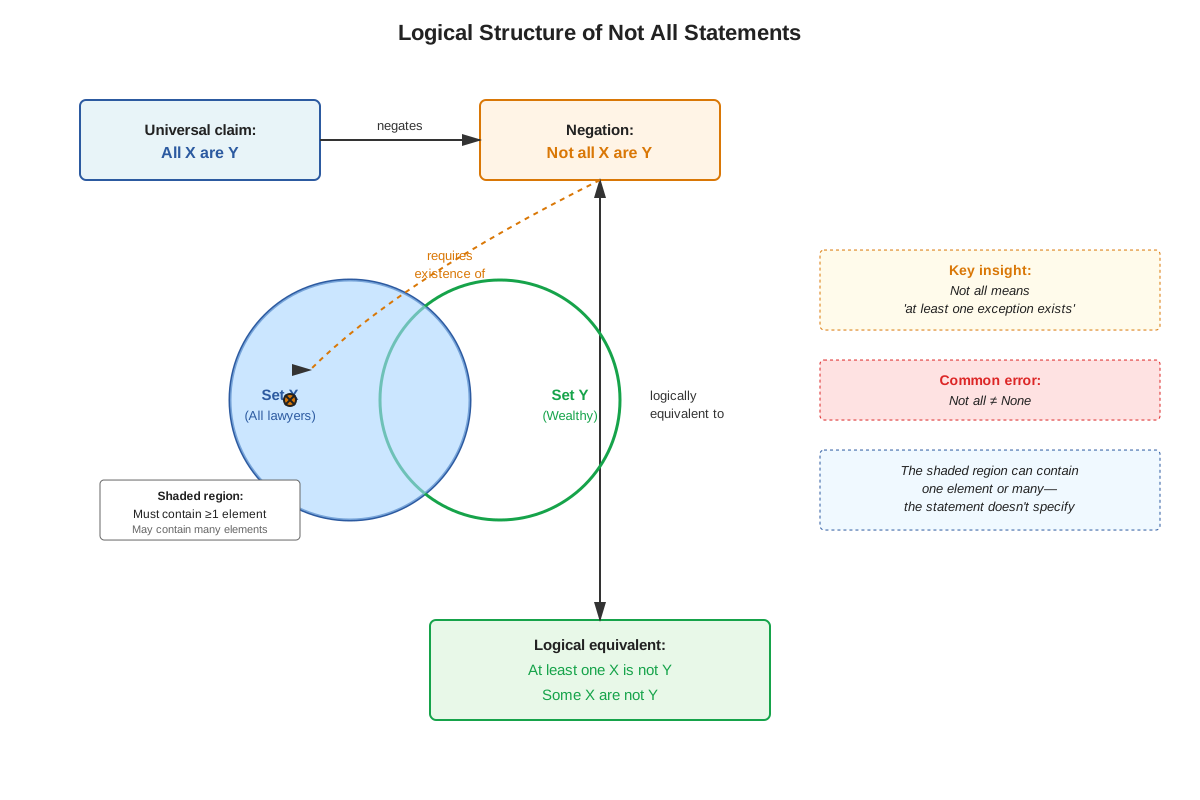
A not all statement takes the form "Not all X are Y" and asserts that the universal claim "All X are Y" is false. Critically, this means at least one X exists that is not Y. The logical structure can be represented as: ¬(∀x: X → Y), which is logically equivalent to ∃x: X ∧ ¬Y (there exists at least one X that is not Y). This equivalence is fundamental to understanding how not all statements function in LSAT arguments.
The key insight is that not all statements are existential claims about exceptions. They guarantee the existence of at least one counterexample to a universal generalization, but they provide no information about how many counterexamples exist. "Not all birds can fly" means at least one bird cannot fly (penguins, ostriches, etc.), but it's compatible with scenarios where only one bird species cannot fly or where most birds cannot fly.
Translation and Logical Equivalents
Not all statements can be translated into several equivalent forms, each useful for different LSAT question types:
| Original Statement | Logical Equivalent 1 | Logical Equivalent 2 | Logical Equivalent 3 |
|---|---|---|---|
| Not all X are Y | Some X are not Y | At least one X is not Y | It is false that all X are Y |
| Not all lawyers are wealthy | Some lawyers are not wealthy | At least one lawyer is not wealthy | It is false that all lawyers are wealthy |
| Not all valid arguments are sound | Some valid arguments are not sound | At least one valid argument is not sound | It is false that all valid arguments are sound |
These translations are logically interchangeable on the LSAT. When an answer choice states "some X are not Y," it means exactly the same thing as "not all X are Y." Recognizing these equivalences allows test-takers to match logically correct answers even when the wording differs from the stimulus.
Relationship to Other Quantifiers
Understanding how not all statements relate to other quantifiers is essential for LSAT success:
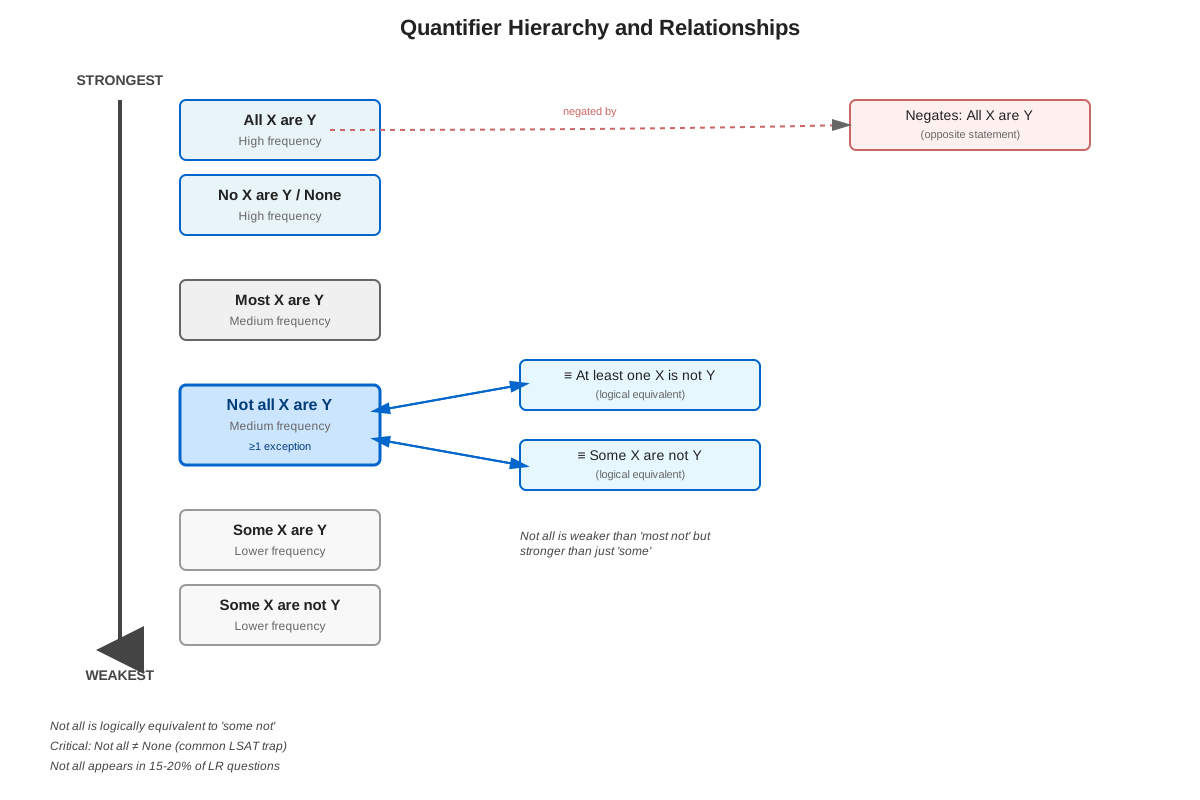
Not all vs. None: "Not all X are Y" is much weaker than "No X are Y." The former allows that some, many, or most X could be Y (just not all), while the latter prohibits any X from being Y. This distinction frequently appears in wrong answer choices that overstate what not all statements establish.
Not all vs. Some: "Not all X are Y" is logically equivalent to "Some X are not Y." However, "not all X are Y" does NOT mean "some X are Y"—that would be a separate claim requiring additional evidence. A not all statement only guarantees the existence of non-Y members within X; it says nothing about whether any Y members exist within X.
Not all vs. Most: "Not all X are Y" is compatible with "Most X are Y" (if 51-99% of X are Y, then not all X are Y). It's also compatible with "Most X are not Y" (if 51-99% of X are not Y, then not all X are Y). The not all statement is weaker than most statements and doesn't determine which direction the majority falls.
Negation Patterns
The negation of a not all statement returns to a universal claim. If "Not all X are Y" is false, then "All X are Y" must be true. This relationship is crucial for contrapositive reasoning and for evaluating answer choices in Must Be False questions.
The negation pattern follows this structure:
- Statement: Not all X are Y (Some X are not Y)
- Negation: All X are Y
- Contrapositive of negation: All not-Y are not-X
This pattern appears frequently when LSAT questions ask what would weaken or strengthen an argument, or what assumption is necessary for an argument to succeed.
Not All Statements in Argument Structures
Not all statements serve specific functions in LSAT arguments:
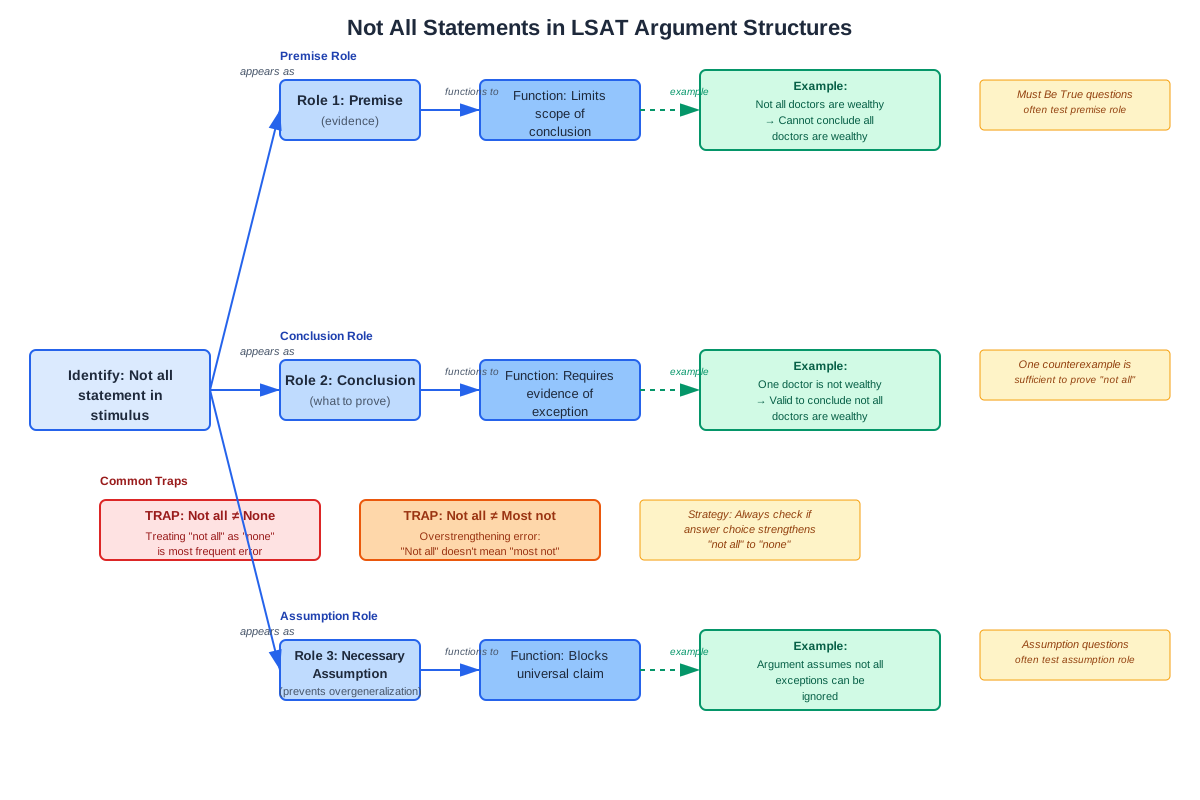
As Premises: When not all statements appear as premises, they typically establish exceptions that prevent overgeneralization. For example: "Not all effective medicines are expensive. Therefore, we should not assume that only expensive treatments work." The not all premise provides the evidence needed to reject a universal claim.
As Conclusions: When not all statements serve as conclusions, the argument must provide evidence of at least one counterexample. For example: "This effective medicine costs only $5. Therefore, not all effective medicines are expensive." A single counterexample is sufficient to establish a not all conclusion.
As Assumptions: Not all statements frequently appear as necessary assumptions in arguments that move from specific evidence to limited conclusions. If an argument concludes "Some politicians are honest" based on evidence about one honest politician, it assumes "Not all politicians are dishonest" (otherwise the evidence would be impossible).
Scope and Strength Considerations
Not all statements occupy a specific position on the spectrum of claim strength. They are stronger than "might" or "could" statements (which express mere possibility) but weaker than "some," "many," "most," and "all" statements. Understanding this hierarchy helps test-takers evaluate whether conclusions are properly supported:
Weakest to Strongest:
- Possible that some X are Y (mere possibility)
- Not all X are not-Y (equivalent to: at least one X is Y)
- Some X are Y (at least one, possibly more)
- Many X are Y (a significant number, but less than most)
- Most X are Y (more than half)
- All X are Y (every single one)
When an LSAT argument provides evidence supporting a not all statement but concludes with a stronger claim (like "most" or "all"), this represents a scope error—a common flaw tested on the exam.
Concept Relationships
The concepts within not all statements form an interconnected logical system. The logical structure (¬∀x → ∃x¬) provides the foundation for understanding translation equivalents (some not, at least one not), which in turn enable recognition of logical equivalences in answer choices. These translations connect directly to negation patterns, as understanding what makes a not all statement false (a universal affirmative) is essential for contrapositive reasoning.
The relationship between not all statements and other quantifiers creates a hierarchy of claim strength that determines scope considerations in arguments. This hierarchy flows into understanding argument structures, where not all statements serve specific roles as premises, conclusions, or assumptions based on their logical properties.
Connecting to prerequisite knowledge, not all statements build directly on conditional reasoning (if-then statements) because "All X are Y" can be expressed as "If X, then Y," making "Not all X are Y" equivalent to "It's not true that if X, then Y," which means "Some X are not Y." This connection to quantifier fundamentals shows how not all statements function as partial negations of universal quantifiers.
The progression flows: Basic Logic → Quantifiers → Not All Statements → Complex Argument Analysis → Advanced Formal Logic Chains. Mastering not all statements enables students to tackle more sophisticated LSAT questions involving multiple quantified premises, layered conditional reasoning, and subtle scope distinctions.
High-Yield Facts
⭐ Not all X are Y is logically equivalent to Some X are not Y and At least one X is not Y—these three forms are interchangeable on the LSAT
⭐ A not all statement guarantees the existence of at least one counterexample but provides no information about how many counterexamples exist
⭐ Not all X are Y does NOT mean Some X are Y—the statement only establishes that some X are not Y
⭐ The negation of "Not all X are Y" is "All X are Y"—these are logical opposites that cannot both be true
⭐ A single counterexample is sufficient evidence to establish a not all conclusion—you don't need multiple examples
- Not all statements are weaker than "most" statements but stronger than "possible" statements on the claim strength hierarchy
- "Not all X are Y" is compatible with "Most X are Y" (if 99% of X are Y, it's still true that not all X are Y)
- When an argument concludes with "all" based on evidence supporting only "not all," this represents a scope flaw
- Not all statements frequently appear as necessary assumptions that prevent overgeneralization in LSAT arguments
- The contrapositive of "All X are Y" is "All not-Y are not-X," but not all statements don't have standard contrapositives because they're not conditional statements
- In formal logic notation, ¬(∀x: P(x)) ≡ ∃x: ¬P(x) expresses the fundamental equivalence underlying not all statements
- Not all statements can be true simultaneously with "none" statements (if no X are Y, then it's false that not all X are Y—instead, all X are not Y)
Quick check — test yourself on Not all statements so far.
Try Flashcards →Common Misconceptions
Misconception: "Not all X are Y" means "Some X are Y" (the positive form)
Correction: Not all statements only establish that some X are NOT Y. They guarantee the existence of non-Y members within X but say nothing about whether any Y members exist within X. "Not all birds fly" means some birds don't fly, but it doesn't tell us whether any birds do fly (though we know from other knowledge that many do).
Misconception: "Not all X are Y" means "Most X are not Y"
Correction: Not all statements are much weaker than most statements. "Not all" only requires one counterexample, while "most" requires more than 50%. If 99 out of 100 lawyers are wealthy, it's still true that not all lawyers are wealthy (because of that one exception), but it would be false that most lawyers are not wealthy.
Misconception: "Not all X are Y" is the same as "No X are Y"
Correction: These statements are completely different in strength. "No X are Y" (none) is a universal negative that prohibits any overlap, while "Not all X are Y" is a partial negation that allows for significant overlap. "Not all politicians are dishonest" allows that many or most politicians could be dishonest, while "No politicians are dishonest" would mean every single politician is honest.
Misconception: You need multiple counterexamples to prove a not all statement
Correction: A single counterexample is sufficient to establish a not all conclusion. If you find one effective medicine that costs $5, you've proven "Not all effective medicines are expensive." The LSAT frequently tests whether students recognize that one example suffices for not all conclusions but not for "some," "many," or "most" conclusions.
Misconception: "Not all X are Y" and "All X are not Y" mean the same thing
Correction: These statements are dramatically different. "Not all X are Y" means some X are not Y (partial negation), while "All X are not Y" means no X are Y (universal negation). The placement of "not" completely changes the logical meaning. "Not all students passed" means at least one failed, while "All students did not pass" means every student failed.
Misconception: Not all statements can be strengthened to "most" statements with additional evidence
Correction: While you can add evidence to support a most claim, a not all statement itself doesn't provide a foundation for most. If you know "not all X are Y," you cannot determine whether most X are Y or most X are not Y without additional information. The not all statement is compatible with either scenario.
Worked Examples
Example 1: Must Be True Question
Stimulus: "Not all corporate executives have business degrees. Some corporate executives have law degrees instead. Every person with a law degree has passed a bar examination."
Question: Which of the following must be true based on the statements above?
Answer Choices:
(A) Most corporate executives do not have business degrees
(B) Some corporate executives have passed a bar examination
(C) No corporate executives have both business degrees and law degrees
(D) All corporate executives have either business degrees or law degrees
(E) Most corporate executives have law degrees
Solution Process:
Step 1: Translate the not all statement. "Not all corporate executives have business degrees" means "Some corporate executives do not have business degrees" or "At least one corporate executive does not have a business degree."
Step 2: Map the logical chain. We know:
- Some corporate executives have law degrees (given directly)
- All people with law degrees → passed bar examination (conditional)
- Therefore: Some corporate executives → law degrees → passed bar examination
Step 3: Evaluate each answer:
(A) Incorrect - "Most" is too strong. "Not all" only guarantees at least one exception, not a majority.
(B) Correct - Since some corporate executives have law degrees, and everyone with a law degree has passed a bar examination, we can conclude that some corporate executives have passed a bar examination. This follows necessarily from the conditional chain.
(C) Incorrect - Nothing in the stimulus rules out executives having both degrees. The statements are compatible with overlap.
(D) Incorrect - The stimulus doesn't establish that these are the only two options. Some executives might have neither degree, or might have different degrees entirely.
(E) Incorrect - "Most" is too strong. We only know "some" executives have law degrees, which could be as few as one.
Key Takeaway: This example demonstrates how not all statements (translated to "some not") combine with conditional statements to yield must-be-true conclusions. The correct answer required recognizing the logical chain and avoiding answers that overstate the strength of the conclusion.
Example 2: Necessary Assumption Question
Stimulus: "The new medication has been effective for three patients in our trial. Therefore, not all patients with this condition are untreatable."
Question: Which of the following is an assumption required by the argument?
Answer Choices:
(A) Most patients with this condition will respond to the new medication
(B) The three patients are representative of all patients with this condition
(C) The three patients actually have the condition in question
(D) No other medication has been effective for this condition
(E) The condition affects more than three patients total
Solution Process:
Step 1: Identify the argument structure. The argument moves from evidence (three patients improved) to a not all conclusion (not all patients with this condition are untreatable).
Step 2: Understand what the not all conclusion requires. To conclude "not all patients are untreatable," the argument needs at least one patient with the condition to be treatable. The three patients who improved serve as this evidence.
Step 3: Apply the negation test to find the necessary assumption. A necessary assumption, when negated, destroys the argument.
(A) Incorrect - The argument only needs to establish "not all" (at least one), not "most." This is too strong to be necessary.
(B) Incorrect - Representativeness isn't necessary for a not all conclusion. Even if these three patients are unusual, they still prove that not all patients are untreatable.
(C) Correct - If we negate this (the three patients don't actually have the condition), the argument falls apart. The evidence would no longer prove that patients with this condition can be treated. The argument assumes these three patients actually have the condition they're being used to make claims about.
(D) Incorrect - Other medications' effectiveness is irrelevant. Even if other medications work, this medication's success still proves not all patients are untreatable.
(E) Incorrect - The total number of patients doesn't matter for establishing that not all are untreatable. Three successful cases suffice regardless of the total population size.
Key Takeaway: This example shows how not all conclusions require minimal evidence (just one counterexample), but that evidence must be valid. The assumption connects the evidence to the category being discussed, ensuring the counterexample actually counts.
Exam Strategy
When approaching LSAT questions involving not all statements, follow this systematic process:
Recognition Phase: Watch for trigger phrases including "not all," "not every," "it is false that all," and "some...not." Also recognize implicit not all statements in arguments that present exceptions to general rules. When you see these triggers, immediately translate the statement into "at least one...not" to clarify its logical meaning.
Translation Phase: Convert not all statements into their "some not" equivalent before attempting to work with them. This translation makes logical relationships clearer and helps avoid the common error of treating not all statements as stronger than they are. Write "Some X are not Y" in your scratch work when you encounter "Not all X are Y."
Strength Assessment: Evaluate where the not all statement falls on the quantifier hierarchy. Ask yourself: Is the argument treating this not all statement as if it means "most not" or "none"? Is the conclusion stronger than what the not all premise supports? Many LSAT wrong answers exploit scope errors where not all evidence is used to support most or all conclusions.
Elimination Strategy: In Must Be True questions, eliminate answers that:
- Strengthen the not all statement to "most" or "all" without additional evidence
- Confuse "not all X are Y" with "some X are Y" (the positive form)
- Treat not all as equivalent to "none"
In Assumption questions, look for answers that:
- Prevent overgeneralization from limited evidence
- Ensure that counterexamples are valid members of the category
- Rule out universal claims that would contradict the conclusion
Time Management: Not all statement questions typically require 60-90 seconds. Spend 20 seconds translating and understanding the logical structure, 30 seconds evaluating answer choices, and 10-20 seconds confirming your selection. Don't rush the translation phase—errors here cascade into wrong answers.
Exam Tip: When you see "not all" in a stimulus, immediately ask: "What's the minimum this guarantees?" The answer is always "at least one counterexample." This mindset prevents overinterpretation.
Memory Techniques
The "At Least One" Anchor: Whenever you encounter "not all," mentally replace it with "at least one...not." This automatic translation prevents misinterpretation. Visualize a single red ball in a bag of blue balls—that one exception makes "not all balls are blue" true.
The Negation Flip: Remember that "not all" is the negation of "all." Visualize a light switch: "All" is fully on (100%), "Not all" means the switch isn't fully on (anything less than 100%, even 99%). This image reinforces that not all allows for high percentages while still being technically true.
SWAN Acronym: Some Were Absolutely Not = Not all statements guarantee that some members absolutely were not included in the universal claim. This reminds you that not all statements are about exclusion, not inclusion.
The Counterexample Rule: "One is enough for 'not all' stuff." This rhyme helps you remember that a single counterexample suffices to establish a not all conclusion, distinguishing it from "some," "many," or "most," which require more evidence.
The Hierarchy Ladder: Visualize a ladder with rungs labeled (bottom to top): Possible → Not all → Some → Many → Most → All. "Not all" is near the bottom, reminding you it's a weak claim that's easy to prove but doesn't support strong conclusions.
Summary
Not all statements represent partial negations of universal claims, asserting that at least one counterexample exists to an "all" statement. These statements are logically equivalent to "some...not" and "at least one...not," and they appear frequently throughout LSAT logical reasoning sections. The critical insight for LSAT success is recognizing that not all statements are weaker than they initially appear—they guarantee only one exception, not a majority of exceptions. This weakness makes them easy to prove (one counterexample suffices) but insufficient to support stronger conclusions without additional evidence. Not all statements occupy a specific position in the quantifier hierarchy, stronger than mere possibility but weaker than "some," "most," and "all." They function in arguments as premises that establish exceptions, conclusions that require minimal evidence, or assumptions that prevent overgeneralization. Mastering not all statements requires understanding their logical structure, recognizing their equivalents, distinguishing them from other quantifiers, and applying them correctly in formal logic chains and argument analysis.
Key Takeaways
- Not all X are Y means exactly the same as Some X are not Y and At least one X is not Y—these are interchangeable translations
- A single counterexample is sufficient to prove a not all statement, making these conclusions easy to establish but weak in argumentative force
- Not all statements do NOT establish the positive form (some X are Y)—they only guarantee the negative form (some X are not Y)
- The negation of "not all X are Y" is "all X are Y"—these are logical opposites
- Not all statements are compatible with most statements in either direction (most X are Y OR most X are not Y)
- Watch for scope errors where arguments treat not all evidence as supporting most or all conclusions
- In formal logic chains, not all statements combine with conditionals to yield must-be-true conclusions about exceptions
Related Topics
Universal Quantifiers (All Statements): Understanding all statements is essential because not all statements are defined as their negation. Mastering the relationship between these quantifiers enables sophisticated formal logic reasoning.
Existential Quantifiers (Some Statements): Some statements share the existential structure of not all statements (both guarantee at least one member exists with certain properties), making them natural companions in formal logic study.
Most Statements: Most statements represent a stronger quantifier than not all, and distinguishing between them is crucial for evaluating argument scope and strength on the LSAT.
Conditional Logic and Contrapositives: Not all statements interact with conditional statements in formal logic chains, and understanding these interactions is essential for Must Be True questions.
Argument Scope and Strength: Not all statements frequently appear in questions testing whether conclusions are properly supported by premises, connecting to broader skills in evaluating argument validity.
Practice CTA
Now that you've mastered the logical structure and application of not all statements, it's time to reinforce your understanding through active practice. Attempt the practice questions to test your ability to identify, translate, and apply not all statements in realistic LSAT scenarios. Use the flashcards to drill the key equivalences and distinctions until they become automatic. Remember: understanding the concept is the first step, but LSAT success requires the ability to apply this knowledge quickly and accurately under timed conditions. Your investment in mastering not all statements will pay dividends across multiple question types throughout the logical reasoning section. You've built a strong foundation—now strengthen it through deliberate practice!
Sign up free to keep reading
Create a free AnvayaPrep account to finish this LSAT guide on Not all statements — plus flashcards and practice questions.