Overview
Extreme answer traps represent one of the most pervasive and challenging obstacles students face when tackling inference questions on the LSAT Logical Reasoning section. These traps exploit a natural human tendency to overreach when drawing conclusions, presenting answer choices that go just slightly beyond what the stimulus actually supports. While the incorrect answer may feel intuitively correct or align with real-world knowledge, it contains language that makes claims stronger, broader, or more absolute than the evidence warrants.
Understanding extreme answer traps is essential for LSAT success because they appear across multiple question types—not just inference questions, but also Must Be True, Main Point, and even some Strengthen/Weaken questions. The LSAT tests your ability to distinguish between what must be true based on the stimulus versus what could be true or what seems likely to be true. Extreme answer traps deliberately blur this distinction by using intensifying language that transforms a supported claim into an unsupported one. Students who fail to recognize these traps often eliminate correct, carefully qualified answers in favor of more dramatic but ultimately flawed options.
The relationship between extreme answer traps and broader Logical Reasoning concepts is fundamental. This topic connects directly to conditional reasoning (where understanding necessary versus sufficient conditions prevents overstatement), formal logic (where quantifiers like "all," "some," and "most" carry precise meanings), and argument structure (where recognizing the scope and strength of premises determines what conclusions they can support). Mastering extreme answer traps builds the precision thinking required for the entire LSAT, training students to read with surgical accuracy and resist the temptation to fill gaps with assumptions.
Learning Objectives
- [ ] Identify how extreme answer traps appear in LSAT questions
- [ ] Explain the reasoning pattern behind extreme answer traps
- [ ] Apply extreme answer traps recognition to solve LSAT-style problems accurately
- [ ] Distinguish between appropriately qualified language and extreme language in answer choices
- [ ] Recognize the specific linguistic markers that signal extreme claims
- [ ] Evaluate answer choices by comparing their scope and strength to the stimulus
- [ ] Develop systematic strategies for eliminating extreme answers under time pressure
Prerequisites
- Basic argument structure: Understanding premises, conclusions, and how evidence supports claims is necessary because extreme answer traps involve claims that exceed the support provided by premises
- Inference question fundamentals: Familiarity with what inference questions ask (what must be true, what can be concluded) is required because extreme answers violate the "must be true" standard
- Reading comprehension skills: The ability to parse complex sentences and identify precise meanings is essential because extreme answer traps often hinge on subtle word choice differences
- Formal logic basics: Understanding quantifiers (all, some, most, none) helps recognize when answer choices make claims about quantity or frequency that exceed the stimulus
Why This Topic Matters
Extreme answer traps appear with remarkable frequency on the LSAT, making them one of the highest-yield topics for score improvement. Research on LSAT question patterns suggests that approximately 60-70% of inference questions include at least one extreme answer trap among the incorrect choices. These traps also appear in Must Be True questions (which are essentially inference questions), Parallel Reasoning questions, and even as incorrect answer choices in Assumption and Strengthen questions where the correct answer must be precisely calibrated to the argument's needs.
In real-world applications, the skill of avoiding extreme conclusions translates directly to legal reasoning. Attorneys must constantly distinguish between what evidence actually proves versus what it merely suggests. Overstating a claim in a legal brief, mischaracterizing precedent, or drawing conclusions beyond what facts support can undermine credibility and lose cases. The LSAT tests this precision because it's fundamental to legal practice.
On the exam, extreme answer traps typically manifest in several predictable patterns: answer choices that use absolute language ("always," "never," "only," "all") when the stimulus uses qualified language ("often," "sometimes," "many"); answers that expand the scope beyond what the stimulus discusses (moving from "some lawyers" to "all professionals"); and answers that intensify causal or correlational claims (transforming "associated with" into "causes" or "requires"). Recognition of these patterns allows students to eliminate wrong answers quickly and confidently, saving precious time for more challenging questions.
Core Concepts
Definition and Mechanism of Extreme Answer Traps
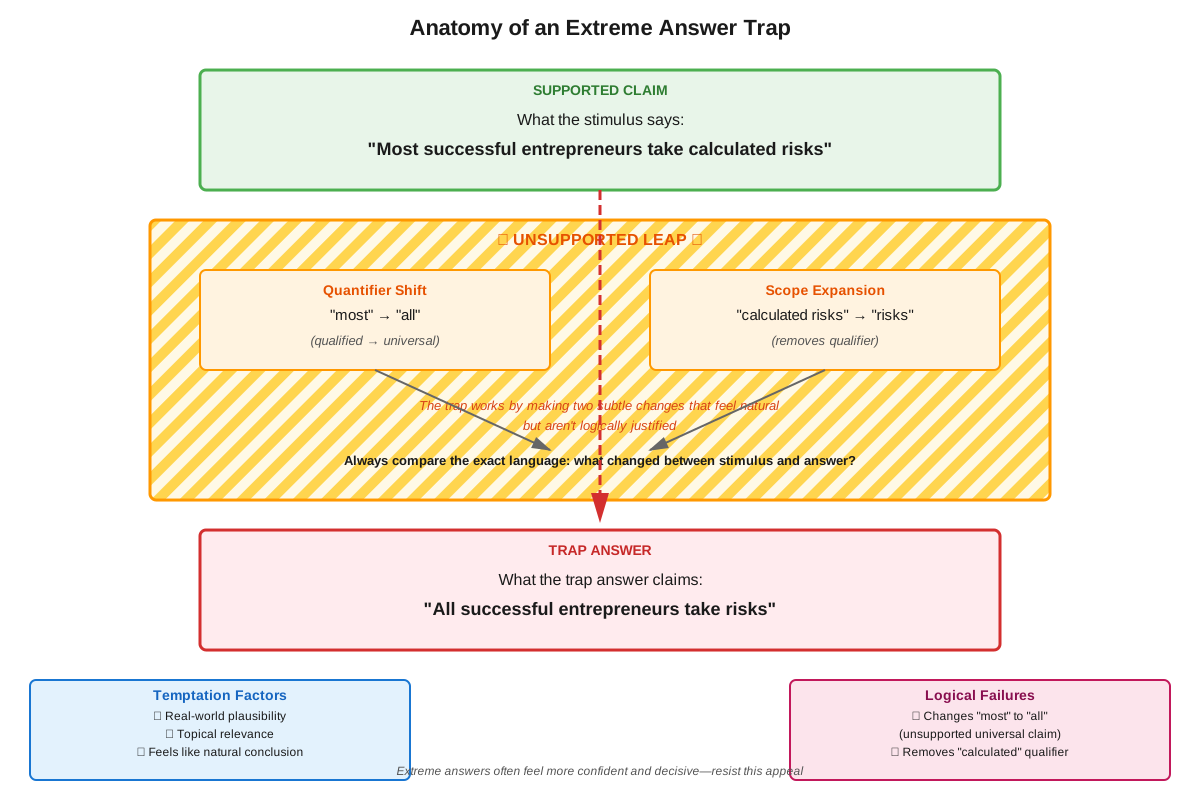
An extreme answer trap is an incorrect answer choice that makes a claim stronger, broader, or more absolute than what the stimulus supports. The mechanism behind these traps exploits cognitive biases: humans naturally seek patterns, make generalizations, and prefer confident, definitive statements over hedged, qualified ones. The LSAT deliberately crafts these answers to feel right while being technically wrong.
The trap works through subtle linguistic escalation. The stimulus might state: "Most successful entrepreneurs have experienced significant failures before achieving success." An extreme answer trap would say: "All entrepreneurs must fail before they can succeed." Notice how "most" became "all," "successful entrepreneurs" became "entrepreneurs" (broader scope), "have experienced" became "must" (necessity claim), and "significant failures" became simply "fail" (removing qualification). Each shift makes the claim stronger than warranted.
Linguistic Markers of Extreme Language
Certain words and phrases serve as red flags for extreme answer traps. These intensifiers and absolute terms include:
Absolute Quantifiers:
- All, every, each, any (universal claims)
- None, no, never (universal negations)
- Only, solely, exclusively (restrictive claims)
- Must, required, necessary (necessity claims)
Intensifying Modifiers:
- Always, invariably, without exception
- Completely, entirely, totally
- Impossible, cannot, unable to
- Guaranteed, certain, definitely
Scope Expanders:
- Everyone, everything, everywhere
- Throughout history, in all cases
- Universally, globally, absolutely
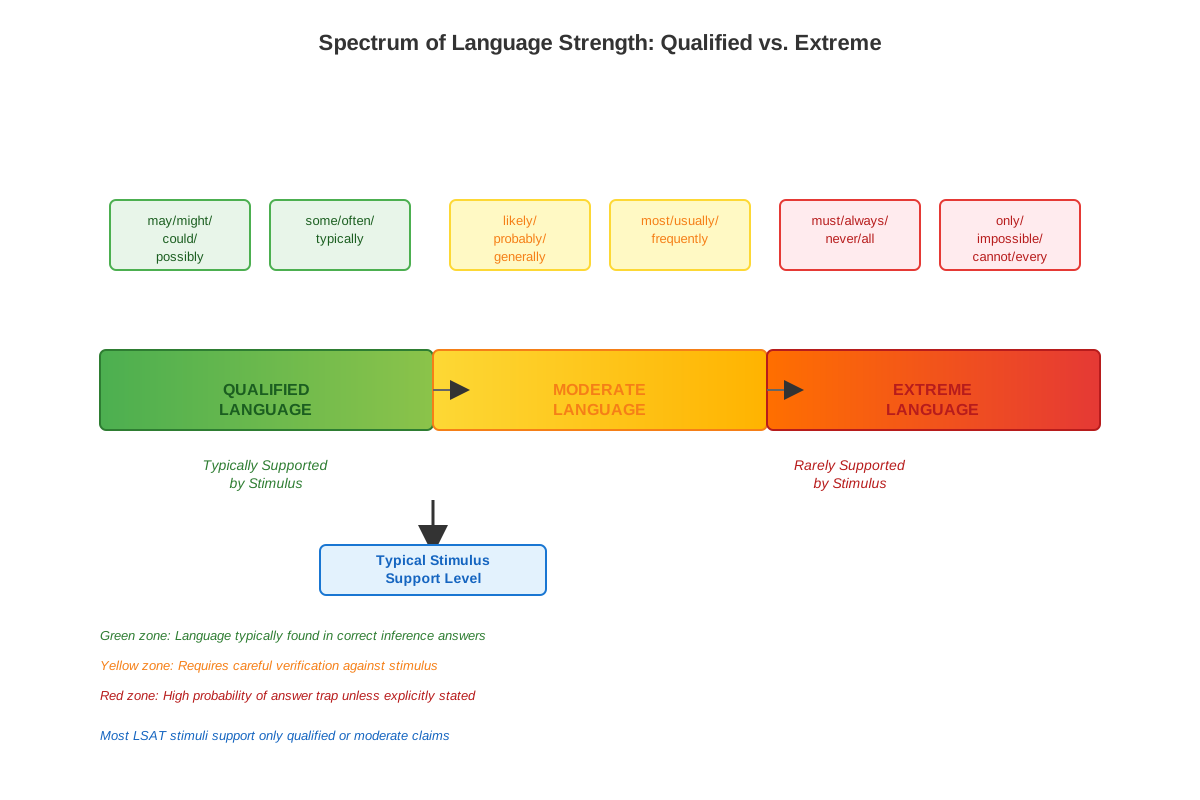
Conversely, qualified language that often appears in correct answers includes: some, many, most, often, typically, generally, can, may, might, usually, frequently, tends to, suggests, indicates, and likely.
The Spectrum of Claim Strength
Understanding extreme answer traps requires recognizing that claims exist on a spectrum from weak to strong:
| Strength Level | Example Language | Sample Claim |
|---|---|---|
| Weak | "might," "could," "possibly" | "This approach might improve outcomes" |
| Moderate | "often," "many," "typically" | "This approach often improves outcomes" |
| Strong | "usually," "most," "generally" | "This approach usually improves outcomes" |
| Very Strong | "always," "all," "must" | "This approach always improves outcomes" |
| Absolute | "only," "never," "impossible" | "Only this approach improves outcomes" |
The LSAT stimulus will support claims at a certain strength level. Extreme answer traps move up this spectrum, making claims stronger than the evidence warrants. A stimulus providing evidence at the "moderate" level cannot support a conclusion at the "absolute" level.
Scope Expansion Traps
Beyond intensifying language, extreme answer traps often expand the scope of claims. Scope refers to the breadth of what a statement covers—the categories, time periods, locations, or conditions it encompasses.
Common scope expansions include:
- Category expansion: "Some birds migrate" → "All animals migrate"
- Temporal expansion: "This occurred in 2020" → "This always occurs"
- Geographic expansion: "Common in coastal regions" → "Found everywhere"
- Conditional expansion: "When X occurs, Y follows" → "Y requires X" or "Y only occurs when X"
The key to recognizing scope expansion is comparing the specific terms and boundaries in the stimulus to those in the answer choice. If the answer discusses a broader category, longer timeframe, or removes limiting conditions, it's likely an extreme trap.
Causal and Correlational Overstatement
A particularly common form of extreme answer trap involves strengthening the relationship between two phenomena. The stimulus might establish correlation, association, or a contributing factor, while the trap answer claims causation, necessity, or sufficiency.
Relationship Strength Hierarchy:
- Correlation/Association: X and Y occur together
- Contributing Factor: X increases the likelihood of Y
- Causation: X causes Y (but other factors might also cause Y)
- Necessary Condition: Y cannot occur without X
- Sufficient Condition: X guarantees Y
- Necessary and Sufficient: X and only X causes Y
An extreme answer trap might take evidence at level 1 or 2 and present a conclusion at level 4, 5, or 6. For example, if the stimulus says "Studies show that regular exercise is associated with lower rates of heart disease," an extreme trap might say "Exercise is necessary to prevent heart disease" or "Exercise alone can prevent heart disease."
The Temptation Factor
Extreme answer traps succeed because they're often more interesting, dramatic, or memorable than correct answers. They make bold claims that feel satisfying to select. Additionally, they may align with real-world knowledge or common sense, even though the LSAT requires reasoning only from the stimulus provided.
The correct answer to an inference question often feels underwhelming—it's carefully qualified, limited in scope, and makes a modest claim that definitely follows from the stimulus. Students must resist the psychological pull toward more exciting but unsupported answers.
Concept Relationships
The concepts within extreme answer traps form an interconnected system. Linguistic markers serve as the diagnostic tools for identifying claim strength, which exists on a spectrum from weak to absolute. This spectrum applies both to the intensity of claims (how strongly something is asserted) and their scope (how broadly they apply). Both intensity and scope can be manipulated to create extreme traps.
Causal overstatement represents a specific application of the general principle of extreme answers, where the relationship between two things is strengthened beyond what evidence supports. This connects to conditional reasoning (a prerequisite topic) because necessary and sufficient conditions represent extreme forms of relationships that require strong evidence.
The relationship to broader Logical Reasoning concepts flows as follows:
Argument Structure → Evidence Evaluation → Claim Strength Assessment → Extreme Answer Recognition
Understanding what premises actually say (argument structure) enables evaluation of what they support (evidence evaluation), which requires assessing how strong a conclusion they warrant (claim strength), which allows identification of answers that exceed that strength (extreme answer recognition).
This topic also connects forward to Assumption questions (where extreme assumptions are often incorrect because they're not necessary) and Flaw questions (where overgeneralization is a common flaw type). The precision thinking developed through extreme answer trap recognition enhances performance across all Logical Reasoning question types.
High-Yield Facts
⭐ Extreme answer traps appear in 60-70% of inference and Must Be True questions as incorrect answer choices
⭐ Absolute language (all, never, only, must) in an answer choice requires absolute support from the stimulus—if the stimulus uses qualified language, the absolute answer is likely wrong
⭐ The correct answer to an inference question often feels "weak" or "obvious" compared to extreme traps because it makes only claims that definitely follow
⭐ Scope expansion—where an answer discusses a broader category, longer timeframe, or wider application than the stimulus—is as common as intensity escalation
⭐ Causal language (causes, requires, prevents, ensures) in an answer requires explicit causal evidence in the stimulus, not mere correlation or association
- Extreme answer traps exploit the human preference for confident, definitive statements over qualified, hedged ones
- Words like "some," "many," "often," and "can" in answer choices typically indicate appropriate qualification rather than extreme claims
- An answer that introduces new absolute conditions not mentioned in the stimulus is almost always an extreme trap
- Temporal absolutes ("always," "never," "throughout history") require evidence spanning all relevant time periods
- The phrase "the only way" or "the sole cause" represents an extreme claim requiring elimination of all alternatives, which stimuli rarely provide
Quick check — test yourself on Extreme answer traps so far.
Try Flashcards →Common Misconceptions
Misconception: If an answer choice is true in the real world, it's correct even if it's not fully supported by the stimulus.
Correction: LSAT inference questions require reasoning exclusively from the stimulus. Real-world knowledge is irrelevant; only what the stimulus states or necessarily implies can support the correct answer. An extreme answer might be factually true but still incorrect because it exceeds what the stimulus supports.
Misconception: Qualified language like "some" or "might" always indicates the correct answer, while absolute language always indicates a trap.
Correction: While extreme language often signals incorrect answers, context matters. If the stimulus itself makes an absolute claim with sufficient support ("All participants completed the study"), an answer using absolute language about those participants may be justified. The key is comparing the answer's strength to the stimulus's support, not automatically eliminating based on word choice alone.
Misconception: An extreme answer trap must be obviously wrong or dramatically overstated.
Correction: The most effective extreme answer traps are subtle, going just slightly beyond what the stimulus supports. The difference might be a single word change from "most" to "all" or adding "only" to a claim. These small escalations are easy to miss under time pressure but make the answer technically incorrect.
Misconception: If the stimulus discusses a specific example, the answer must also be specific and cannot make broader claims.
Correction: Inference questions can support generalizations from specific examples if the stimulus provides appropriate support. The issue isn't specificity versus generality per se, but whether the scope and strength of the generalization match what the evidence warrants. A stimulus about "three studies of coastal birds" might support "some coastal birds" but not "all birds."
Misconception: Extreme answer traps only appear in inference questions.
Correction: While most common in inference and Must Be True questions, extreme answer traps appear across question types. In Assumption questions, extreme assumptions are often incorrect because they're not necessary. In Strengthen questions, extreme answers may go beyond what's needed. In Flaw questions, recognizing overgeneralization requires the same skills as identifying extreme answer traps.
Worked Examples
Example 1: Identifying Scope and Intensity Escalation
Stimulus: "A recent survey of 500 software engineers in Silicon Valley found that 73% reported working more than 50 hours per week. Among those working these extended hours, 82% indicated they felt pressure from company culture rather than explicit requirements to maintain this schedule."
Question: Which of the following can be properly inferred from the information above?
Answer Choices:
A) Most software engineers in Silicon Valley work more than 50 hours per week due to company culture.
B) Company culture, rather than explicit requirements, causes all software engineers to work long hours.
C) The majority of software engineers surveyed who worked extended hours attributed this to company culture.
D) Software engineers throughout the technology industry face pressure to work more than 50 hours weekly.
E) It is impossible for software engineers to work reasonable hours in Silicon Valley.
Analysis:
Choice A: This commits scope expansion. The stimulus discusses 500 engineers surveyed, not "software engineers in Silicon Valley" generally. We cannot generalize from this sample to all Silicon Valley engineers. Additionally, while 73% worked long hours and 82% of those cited culture, the math (73% × 82% ≈ 60%) means "most" is technically supported for the surveyed group, but the geographic scope expansion makes this wrong. EXTREME TRAP - Scope Expansion
Choice B: This contains multiple extreme elements: "all" (universal quantifier), "causes" (causal claim when stimulus shows correlation/attribution), and removes the geographic limitation. The stimulus never establishes causation, only what engineers reported. EXTREME TRAP - Intensity and Scope
Choice C: This is carefully qualified. "Majority" matches the 82% figure, "surveyed" maintains the proper scope (not all engineers), "extended hours" matches "more than 50 hours," and "attributed" is weaker than "caused." This makes only claims the stimulus supports. CORRECT ANSWER
Choice D: Massive scope expansion from "Silicon Valley" to "throughout the technology industry." The stimulus provides no information about other locations or sectors. EXTREME TRAP - Scope Expansion
Choice E: Extreme absolute language ("impossible") and introduces a new concept ("reasonable hours" vs. "more than 50 hours"). The stimulus shows many work long hours but never suggests it's impossible to work less. EXTREME TRAP - Absolute Language
Key Takeaway: The correct answer (C) feels almost boringly obvious—it essentially restates part of the stimulus with appropriate qualification. The extreme traps (especially A and D) feel more interesting and substantial but exceed what the evidence supports.
Example 2: Causal Overstatement Recognition
Stimulus: "Researchers observed that children who participated in music education programs scored an average of 12% higher on spatial reasoning tests than children who did not participate in such programs. The study controlled for socioeconomic factors and prior academic achievement."
Question: The information above most strongly supports which of the following?
Answer Choices:
A) Music education causes improved spatial reasoning abilities in children.
B) Children who participate in music education programs perform better on spatial reasoning tests than those who do not.
C) Spatial reasoning skills require music education to develop properly.
D) The only way to improve children's spatial reasoning is through music education.
E) Music education is necessary for children to achieve high scores on spatial reasoning tests.
Analysis:
Choice A: This claims direct causation. While the study controlled for confounding variables (strengthening causal inference), the stimulus uses "observed" and presents correlation. The LSAT requires explicit causal language or elimination of alternative explanations for a causal conclusion. This is close but still overstates. EXTREME TRAP - Causal Overstatement
Choice B: This describes the observation without claiming causation. "Perform better" matches "scored higher," and the comparison is properly qualified. This is what the stimulus actually supports. CORRECT ANSWER
Choice C: "Require" and "necessary" are extreme necessity claims. The stimulus shows music education is associated with better performance, not that it's necessary for development. EXTREME TRAP - Necessity Claim
Choice D: "The only way" is an extreme exclusivity claim requiring elimination of all alternatives. The stimulus discusses one approach but never suggests it's the sole method. EXTREME TRAP - Absolute Exclusivity
Choice E: Another necessity claim ("necessary") combined with scope expansion ("high scores" vs. "higher scores"). The stimulus shows relative improvement, not that music education is required for high performance. EXTREME TRAP - Necessity and Scope
Key Takeaway: The distinction between correlation/observation (Choice B) and causation (Choice A) is subtle but critical. The LSAT rewards precision in recognizing what type of relationship the evidence actually establishes.
Exam Strategy
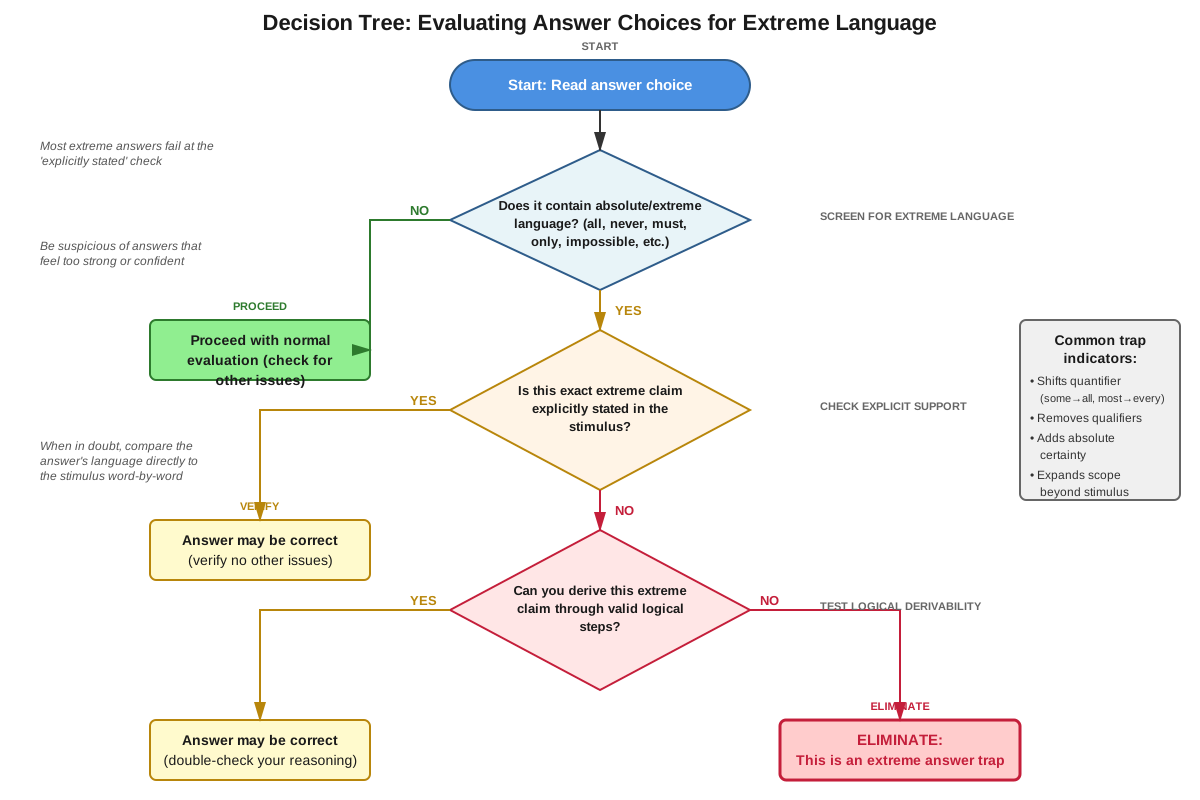
Systematic Approach to Avoiding Extreme Answer Traps
Step 1: Pre-phrase Before Reading Answers (15-20 seconds)
After reading the stimulus, formulate in your own words what can be concluded. Note the strength and scope of what you expect. This prevents extreme answers from seeming attractive.
Step 2: Identify Qualified vs. Absolute Language (5 seconds per answer)
As you read each answer, mentally flag absolute terms (all, never, only, must) and check whether the stimulus provides absolute support. If not, the answer is likely wrong.
Step 3: Compare Scope Explicitly (5 seconds per answer)
Ask: "Does this answer discuss the same category/timeframe/group as the stimulus, or has it expanded?" Draw mental boundaries around what the stimulus covers and check if the answer stays within them.
Step 4: Check Relationship Strength (5 seconds per answer)
If the answer involves causation, necessity, or sufficiency, verify the stimulus establishes that level of relationship, not merely correlation or association.
Trigger Words and Phrases
High-Alert Extreme Language (often signals wrong answers):
- "All," "every," "always," "never," "none"
- "Only," "solely," "exclusively," "alone"
- "Must," "required," "necessary," "essential"
- "Impossible," "cannot," "unable to"
- "Guarantees," "ensures," "proves"
- "The only way," "the sole cause"
Safe Qualified Language (often appears in correct answers):
- "Some," "many," "most," "several"
- "Often," "usually," "typically," "generally"
- "Can," "may," "might," "could"
- "Tends to," "likely," "probably"
- "Suggests," "indicates," "supports"
Process of Elimination Tips
Exam Tip: When down to two answers, the more qualified one is usually correct. If one answer says "all" and another says "most," and you're uncertain, choose "most."
- Eliminate absolute answers first unless the stimulus provides absolute support
- Eliminate scope-expanded answers by checking if they discuss broader categories than the stimulus
- Eliminate causal claims unless the stimulus explicitly establishes causation
- Keep carefully qualified answers even if they seem weak or obvious
- When uncertain, choose the answer that makes the smallest claim that still addresses the question
Time Allocation
For inference questions with extreme answer traps:
- Stimulus reading: 30-40 seconds (read carefully to note qualifications)
- Pre-phrasing: 15-20 seconds (establish expected strength/scope)
- Answer evaluation: 30-40 seconds (5-8 seconds per answer)
- Total: 75-100 seconds per question
If you identify extreme language quickly, you can eliminate 2-3 answers in 15 seconds, leaving more time for careful comparison of remaining choices.
Memory Techniques
The SCOPE Acronym
Use SCOPE to remember what to check in answer choices:
- Strength: Is the claim stronger than the stimulus supports?
- Category: Does it expand to broader categories?
- Only/All: Does it use absolute language without absolute support?
- Period: Does it expand the timeframe beyond what's discussed?
- Exclusive: Does it claim something is the only way/cause?
The Qualification Spectrum Visualization
Visualize a thermometer with "Absolute" at the top (boiling) and "Possible" at the bottom (freezing). The stimulus sets a temperature. Extreme answer traps are "too hot"—they've moved up the thermometer beyond where the evidence places them.
The "Must vs. Might" Mantra
Before selecting an answer, ask: "Does this must be true based on the stimulus, or does it merely might be true?" Inference questions require "must be true." If you're thinking "well, it could be true" or "that makes sense," you may be falling for an extreme trap.
The Boundary Box Technique
Mentally draw a box around the scope of the stimulus (e.g., "500 engineers in Silicon Valley in 2023"). Check if each answer stays inside the box or jumps outside it. Answers outside the box are scope-expanded extreme traps.
Summary
Extreme answer traps represent one of the most consistent patterns in LSAT Logical Reasoning, appearing predominantly in inference and Must Be True questions but also across other question types. These traps succeed by making claims that are slightly stronger, broader, or more absolute than what the stimulus supports, exploiting natural human tendencies toward confident generalizations. Recognition requires attention to linguistic markers (absolute quantifiers, intensifiers, causal language), scope boundaries (categories, timeframes, conditions), and relationship strength (correlation vs. causation, contribution vs. necessity). The correct answer to inference questions often feels underwhelming because it makes only modest, carefully qualified claims that definitely follow from the stimulus, while extreme traps offer more dramatic but ultimately unsupported conclusions. Systematic evaluation comparing answer choice strength and scope to stimulus support, combined with awareness of trigger words and the qualification spectrum, enables reliable identification and elimination of these traps. Mastering this skill improves performance across Logical Reasoning and builds the precision thinking essential for legal reasoning.
Key Takeaways
- Extreme answer traps make claims stronger or broader than the stimulus supports, using absolute language, scope expansion, or relationship intensification
- Absolute terms (all, never, only, must) require absolute support—if the stimulus uses qualified language, absolute answers are likely wrong
- The correct answer often feels "weak" or "obvious" because it makes only claims that definitely follow, while extreme traps are more dramatic
- Scope expansion is as common as intensity escalation—check whether answers discuss broader categories, longer timeframes, or wider applications than the stimulus
- Causal language requires causal evidence—correlation, association, or contributing factors in the stimulus cannot support "causes," "requires," or "prevents" in answers
- Pre-phrasing expected strength and scope before reading answers prevents extreme traps from seeming attractive
- When uncertain between two answers, choose the more qualified one—the LSAT rewards precision and appropriate hedging over bold claims
Related Topics
Conditional Reasoning and Sufficient/Necessary Conditions: Understanding the precise logic of conditional statements helps recognize when answer choices claim necessity or sufficiency without warrant, a specific form of extreme answer trap.
Quantifier Logic and Formal Logic: Mastery of how "all," "some," "most," and "none" function in logical relationships enables precise evaluation of whether answer choices match the quantification level the stimulus supports.
Assumption Questions and Necessary Assumptions: The skill of identifying extreme answer traps transfers directly to recognizing that extreme assumptions are rarely necessary—assumptions must be precisely calibrated to what the argument needs.
Flaw Questions and Overgeneralization: Many flawed arguments commit overgeneralization, which is essentially the same error as extreme answer traps—making claims stronger or broader than evidence warrants.
Strengthen and Weaken Questions: Recognizing appropriate claim strength helps identify answers that strengthen or weaken to the right degree rather than overshooting or undershooting what the question requires.
Practice CTA
Now that you understand the mechanics of extreme answer traps and how to systematically identify them, it's time to apply these skills to actual LSAT questions. Work through the practice questions for this topic, paying special attention to comparing the strength and scope of each answer choice to what the stimulus supports. Use the SCOPE acronym and boundary box technique as you evaluate answers. Remember: the correct answer may feel less exciting than the traps, but it will be the one that makes only claims the stimulus definitely supports. With practice, recognizing these patterns becomes automatic, significantly improving your accuracy and speed on inference questions. You've got this!
Sign up free to keep reading
Create a free AnvayaPrep account to finish this LSAT guide on Extreme answer traps — plus flashcards and practice questions.