Overview
Inference from facts represents one of the most fundamental and frequently tested question types on the LSAT Logical Reasoning section. These questions present a set of factual statements and ask test-takers to identify what must be true, could be true, or is most strongly supported based solely on the information provided. Unlike assumption or strengthen/weaken questions that require identifying missing logical links, inference questions demand careful reading comprehension and the ability to draw only those conclusions that are directly supported by the given facts.
The LSAT inference from facts questions test a critical skill for legal reasoning: the ability to distinguish between what is explicitly stated, what logically follows from stated facts, and what merely seems plausible but isn't necessarily supported. Law students and attorneys must constantly evaluate evidence, testimony, and statutory language to determine what conclusions can legitimately be drawn. These questions appear in approximately 15-20% of all Logical Reasoning questions, making them one of the highest-yield question types to master. Success requires disciplined thinking—resisting the temptation to bring in outside knowledge or make assumptions beyond what the stimulus explicitly supports.
Within the broader landscape of logical reasoning, inference questions occupy a unique position. While many LSAT question types ask you to critique, strengthen, or identify flaws in arguments, inference questions typically present neutral factual scenarios without argumentative structure. This distinction is crucial: you're not evaluating whether reasoning is sound, but rather determining what additional facts can be derived from the information given. Mastering this topic builds foundational skills that enhance performance across all Logical Reasoning question types, particularly Must Be True, Most Strongly Supported, and Main Point questions.
Learning Objectives
- [ ] Identify how Inference from facts appears in LSAT questions
- [ ] Explain the reasoning pattern behind Inference from facts
- [ ] Apply Inference from facts to solve LSAT-style problems accurately
- [ ] Distinguish between statements that must be true versus those that could be true based on given facts
- [ ] Recognize and avoid common traps in inference answer choices, including statements that are merely plausible but unsupported
- [ ] Evaluate the strength of support for various inferences, identifying which conclusions follow most directly from the stimulus
- [ ] Apply formal logical operations (contrapositive, combination of conditional statements) to derive valid inferences
Prerequisites
- Basic conditional logic: Understanding "if-then" statements is essential because many inference questions require combining or manipulating conditional relationships to reach valid conclusions.
- Formal logic notation: Familiarity with symbolic representation of logical statements helps track complex relationships and identify valid inferences efficiently.
- Reading comprehension fundamentals: The ability to parse dense text accurately is necessary because inference questions depend entirely on what the stimulus actually states, not what it implies or suggests.
- Distinction between facts and arguments: Recognizing when a passage presents factual claims versus argumentative reasoning helps identify inference questions and apply the appropriate analytical approach.
Why This Topic Matters
In legal practice, attorneys must constantly draw conclusions from statutes, case law, contracts, and evidence. The ability to determine what logically follows from a set of facts—without overstepping into speculation—is fundamental to legal analysis. Whether interpreting a contract clause, applying precedent to a new situation, or evaluating witness testimony, lawyers engage in inference from facts daily. The LSAT tests this skill because it predicts success in legal reasoning throughout law school and professional practice.
Inference questions appear with remarkable consistency on the LSAT, comprising roughly 15-20% of all Logical Reasoning questions. In a typical LSAT with two Logical Reasoning sections containing 25-26 questions each, students can expect to encounter 7-10 inference questions. These questions appear in several formats: "Which one of the following can be properly inferred," "If the statements above are true, which one of the following must also be true," "The statements above, if true, most strongly support which one of the following," and variations thereof. The distinction between "must be true" (requiring absolute logical necessity) and "most strongly supported" (allowing for high probability without absolute certainty) is critical for selecting correct answers.
Common manifestations in LSAT passages include: factual scenarios describing relationships between groups or categories; conditional statements that can be combined to yield new conclusions; quantitative information that can be mathematically manipulated; temporal sequences that establish what must have occurred when; and comparative statements that allow for relative inferences. The LSAT frequently tests whether students can resist attractive wrong answers that introduce new information, reverse conditional logic incorrectly, or make unwarranted assumptions.
Core Concepts
The Nature of Valid Inference
An inference from facts is a conclusion that follows logically and necessarily (or with strong support) from a set of given statements. The key principle is that valid inferences add no new information beyond what is logically contained in the premises. When a stimulus states "All lawyers are college graduates" and "Maria is a lawyer," the inference "Maria is a college graduate" is valid because it merely unpacks what is already logically present in the combination of those two facts.
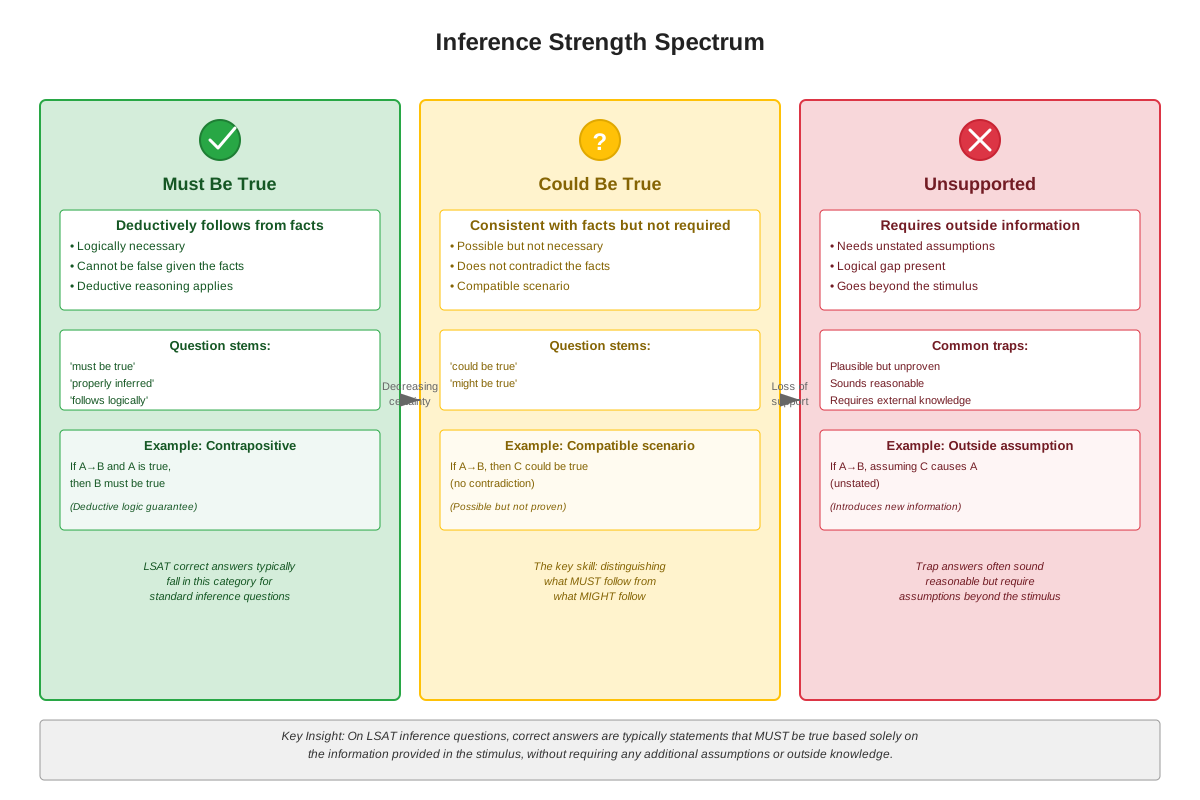
The LSAT distinguishes between different strengths of inference:
| Inference Type | Standard | Question Stem Language |
|---|---|---|
| Must Be True | Logical necessity; no possible scenario where premises are true and conclusion false | "must be true," "must also be true," "properly inferred" |
| Most Strongly Supported | High probability; conclusion follows with strong but not absolute certainty | "most strongly supported," "most reasonably concluded" |
| Could Be True | Logical possibility; not contradicted by the facts | "could be true," "consistent with" |
Understanding these distinctions prevents a common error: selecting answers that are merely possible or plausible when the question demands logical necessity.
Combining Factual Statements
Many inference questions require synthesizing multiple facts to reach a conclusion that isn't explicitly stated in any single sentence. This process involves identifying logical connections between statements and following chains of reasoning.
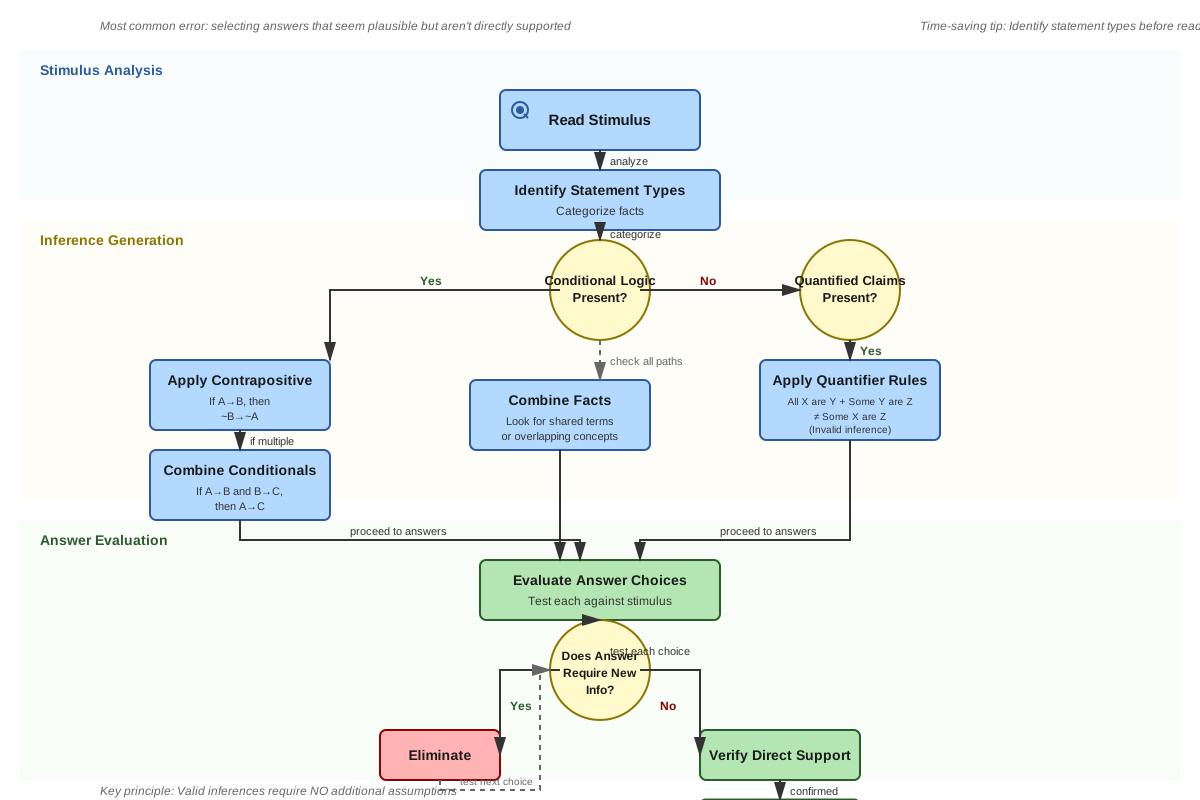
The combination process follows these steps:
- Identify all factual claims in the stimulus
- Look for overlapping terms or concepts that connect statements
- Apply logical rules (particularly conditional logic) to combine statements
- Derive the conclusion that follows from the combination
- Verify that the conclusion adds no assumptions beyond what's given
For example, if a stimulus states: "Every member of the committee voted for the proposal" and "Sarah is on the committee," these facts share the term "committee" and can be combined through categorical logic to conclude "Sarah voted for the proposal."
Conditional Logic in Inference Questions
Conditional statements form the backbone of many high-difficulty inference questions. A conditional statement establishes a sufficient condition (if X) and a necessary condition (then Y). Valid inferences from conditionals follow strict logical rules:
Valid operations:
- Modus Ponens: If X→Y and X is true, then Y must be true
- Modus Tollens (Contrapositive): If X→Y and Y is false, then X must be false
- Chain reasoning: If X→Y and Y→Z, then X→Z
Invalid operations that appear in wrong answers:
- Affirming the consequent: If X→Y and Y is true, concluding X is true (invalid)
- Denying the antecedent: If X→Y and X is false, concluding Y is false (invalid)
Consider this stimulus: "If the museum acquires the painting, it will need to expand its security system. The museum will not expand its security system." The valid inference is: "The museum will not acquire the painting" (contrapositive reasoning). An invalid inference would be: "If the museum expands its security system, it acquired the painting" (affirming the consequent).
Quantitative and Comparative Inferences
Some inference questions present numerical or comparative information that can be manipulated to yield valid conclusions. These require careful attention to the logical implications of quantitative relationships.
Quantitative inference principles:
- If more than half of Group A has property X, and more than half of Group A has property Y, then some members of Group A must have both X and Y
- If all of Group A is contained in Group B, and Group A has 100 members while Group B has 100 members, then Group A and Group B are identical
- If X is greater than Y, and Y is greater than Z, then X is greater than Z (transitivity)
Comparative inference principles:
- "More X than Y" does not establish absolute quantities, only relative ones
- "At least as many X as Y" allows for equality
- "Some" means "at least one" in formal logic, not "a few" or "many"
The Scope Limitation Principle
Perhaps the most critical concept for avoiding wrong answers is understanding that valid inferences cannot exceed the scope of the stimulus. Scope refers to the breadth of claims—the categories, time periods, and degree of certainty involved.
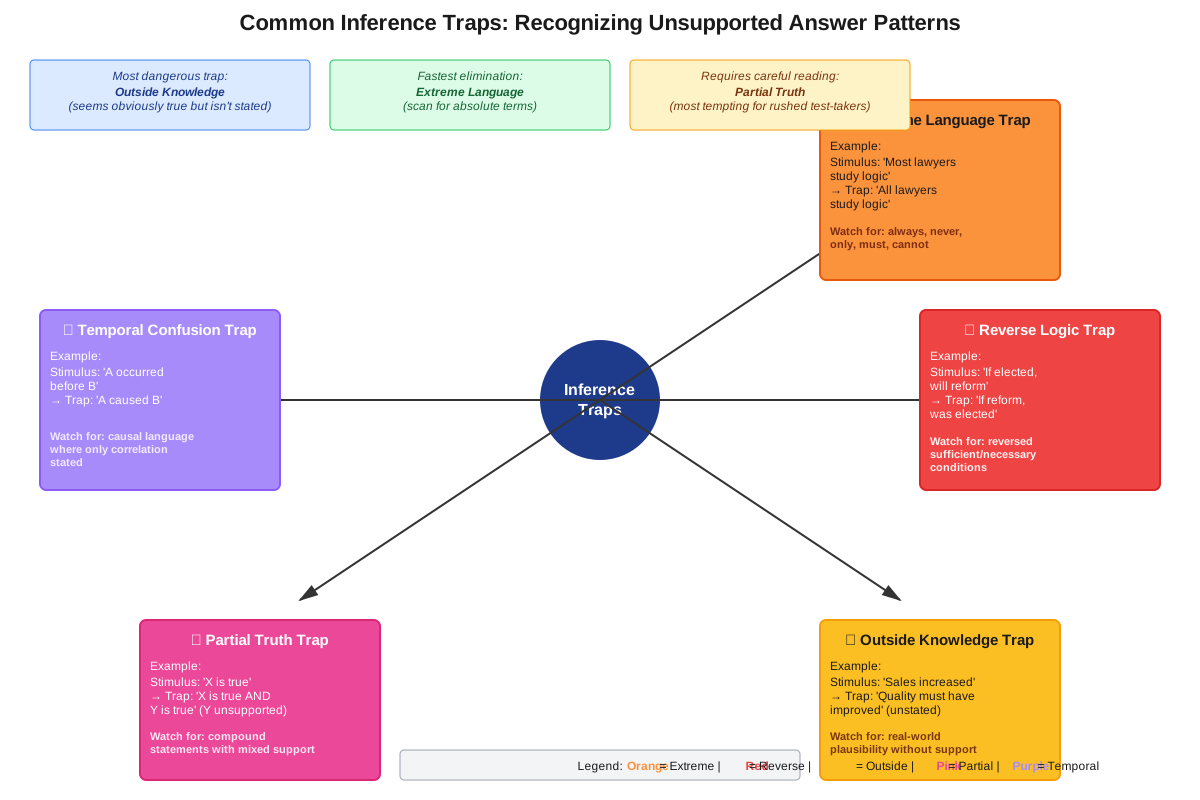
Common scope violations in wrong answers include:
- Temporal expansion: Stimulus discusses present facts; answer choice makes claims about the past or future
- Categorical expansion: Stimulus discusses a specific group; answer choice makes claims about a broader category
- Certainty inflation: Stimulus uses qualified language ("may," "some," "often"); answer choice uses absolute language ("must," "all," "never")
- Introducing new concepts: Answer choice mentions ideas not present in the stimulus
For instance, if a stimulus states "Most of the company's engineers prefer flexible work schedules," a scope violation would be concluding "The company should implement flexible work schedules" (introduces normative claim) or "Most of the company's employees prefer flexible work schedules" (expands from engineers to all employees).
The Prephrase Strategy
Effective inference question solving involves prephrasing—predicting what the answer should say before examining the choices. This strategy prevents wrong answers from appearing attractive and speeds up the elimination process.
The prephrasing process:
- After reading the stimulus, pause before looking at answers
- Ask: "What must be true given these facts?" or "What follows most directly?"
- Formulate a prediction in your own words
- Scan answer choices for a match to your prediction
- If no match exists, eliminate answers that violate logical rules or scope
Prephrasing is particularly effective when the stimulus contains conditional statements that can be combined or when quantitative relationships yield mathematical conclusions.
Concept Relationships
The concepts within inference from facts form an interconnected system. Valid inference serves as the foundational concept, defining what it means for a conclusion to follow from premises. This concept branches into different inference strengths (must be true vs. most strongly supported), which determine the standard of proof required.
Combining factual statements represents the primary method for generating inferences, and this process frequently employs conditional logic as its mechanism. Conditional logic, in turn, requires understanding both valid operations (modus ponens, contrapositive) and invalid operations to avoid. When statements involve quantities or comparisons, quantitative and comparative inference principles provide the specific rules for valid combination.
All of these inference-generation methods must operate within the scope limitation principle, which acts as a constraint preventing invalid conclusions. Finally, the prephrase strategy serves as the practical application method, integrating all other concepts into an efficient problem-solving approach.
The relationship to prerequisite topics: Basic conditional logic provides the formal rules that govern how conditional statements can be combined and manipulated. Reading comprehension ensures accurate identification of what the stimulus actually states, preventing the introduction of assumptions. The distinction between facts and arguments helps identify when inference reasoning (rather than argument evaluation) is appropriate.
Connection to related topics: Mastering inference from facts directly enhances performance on Must Be True questions, Main Point questions (which ask for the conclusion most supported by the passage), and Principle questions (which often require inferring how a general rule applies to specific facts). The logical discipline developed through inference questions also improves performance on Assumption questions by sharpening the ability to identify what is and isn't stated.
High-Yield Facts
⭐ Valid inferences add no new information beyond what is logically contained in the premises; they merely make explicit what is implicit in the combination of given facts.
⭐ "Must be true" requires logical necessity—there is no possible scenario where the premises are true and the conclusion is false.
⭐ The contrapositive of a conditional statement (If A→B, then Not B→Not A) is always logically equivalent to the original statement and represents a valid inference.
⭐ Wrong answers in inference questions frequently violate scope by introducing new concepts, expanding categories, or inflating the degree of certainty beyond what the stimulus supports.
⭐ When a stimulus states "some," it means "at least one" in formal logic, which allows for the possibility of "all" but does not require it.
- Combining two conditional statements with a shared term (If A→B and B→C) validly yields a chain inference (A→C).
- If more than 50% of a group has property X and more than 50% has property Y, then some members must have both properties (pigeonhole principle).
- Affirming the consequent (If A→B and B is true, concluding A is true) is an invalid inference pattern that frequently appears in wrong answers.
- Temporal qualifiers matter: "always," "never," "sometimes," and "often" establish different scopes that must be respected in valid inferences.
- Comparative statements establish relative relationships but not absolute quantities unless additional information is provided.
- The phrase "if and only if" establishes a biconditional relationship where both directions of implication are valid (A↔B means both A→B and B→A).
- Negative inferences are valid: if the stimulus establishes that something is not the case, conclusions based on that negation are legitimate.
- Quantitative inferences must respect mathematical constraints: if Group A has 10 members and Group B has 5 members, and all of B is in A, then A has at least 5 members who are not in B.
Quick check — test yourself on Inference from facts so far.
Try Flashcards →Common Misconceptions
Misconception: If a statement could be true based on the stimulus, it's a valid inference for a "must be true" question.
Correction: "Could be true" and "must be true" are entirely different standards. Must be true requires logical necessity—the conclusion cannot possibly be false if the premises are true. Many statements are consistent with the facts (could be true) without being logically required by them (must be true). Always match your answer to the specific standard the question stem demands.
Misconception: If the stimulus says "If A then B," and B is true, then A must be true.
Correction: This is the fallacy of affirming the consequent. The conditional "If A then B" tells us what happens when A is true, but it doesn't tell us that A is the only way to get B. B could be true for other reasons. The only valid inference from "If A then B" when B is true is that we cannot conclude anything definite about A.
Misconception: Inference questions require bringing in real-world knowledge to evaluate what's reasonable or likely.
Correction: Inference questions operate in a closed logical system. Only the information in the stimulus matters. Even if an answer choice states something that is true in the real world, it's wrong if it isn't supported by the stimulus. Conversely, even if an answer seems unrealistic, it's correct if it must be true given the facts presented.
Misconception: "Most strongly supported" means the same thing as "must be true."
Correction: These represent different inference standards. "Must be true" requires absolute logical necessity with no exceptions possible. "Most strongly supported" allows for conclusions that are highly probable or strongly indicated without being logically necessary. Most strongly supported answers can involve reasonable extrapolation, while must be true answers cannot.
Misconception: If the stimulus discusses a specific example, valid inferences can generalize to broader categories.
Correction: This violates the scope limitation principle. If the stimulus discusses "this company's engineers," valid inferences are limited to that specific group. Conclusions about "all engineers," "most companies," or even "this company's employees" exceed the scope unless the stimulus explicitly establishes those connections. Scope violations are among the most common wrong answer types.
Misconception: Longer, more detailed answer choices are more likely to be correct because they provide more information.
Correction: Length is irrelevant to validity. In fact, longer answer choices often introduce additional claims that aren't supported by the stimulus, making them wrong despite seeming comprehensive. The correct answer might be quite simple and direct. Evaluate each answer based solely on whether it follows logically from the stimulus, regardless of length or detail.
Misconception: If two facts are mentioned in the stimulus, they must be related in the correct answer.
Correction: Not all facts in a stimulus need to be combined. Sometimes the correct inference follows from just one of the statements, while other statements provide context or serve as distractors. Don't force connections between facts that aren't logically related. Focus on what actually follows from the information given.
Worked Examples
Example 1: Conditional Logic Chain
Stimulus: "All members of the board of directors have graduate degrees. Everyone with a graduate degree has completed at least four years of undergraduate education. No one who completed four years of undergraduate education started working full-time before age 21."
Question: If the statements above are true, which one of the following must also be true?
Analysis Process:
Step 1: Identify the conditional statements and translate them into logical notation:
- Board member → Graduate degree
- Graduate degree → 4+ years undergrad
- 4+ years undergrad → NOT (working full-time before 21)
Step 2: Look for chain reasoning opportunities. These three conditionals share overlapping terms, allowing us to create a chain:
- Board member → Graduate degree → 4+ years undergrad → NOT (working full-time before 21)
Step 3: Simplify the chain:
- Board member → NOT (working full-time before 21)
Step 4: Prephrase the answer: "No board member started working full-time before age 21" or equivalently "All board members started working full-time at age 21 or later."
Step 5: Evaluate answer choices:
(A) "Some people who started working full-time before age 21 are not members of the board of directors."
- This is the contrapositive partially stated, but "some" is too weak. Our inference tells us that NO board members started working before 21, which means ALL people who started working before 21 are not board members. This answer is true but weaker than what we can infer.
(B) "No member of the board of directors started working full-time before age 21."
- This matches our prephrase exactly. This must be true based on the chain of conditionals.
(C) "Everyone who has completed at least four years of undergraduate education is a member of the board of directors."
- This reverses the conditional logic (affirming the consequent). Just because board members have 4+ years of undergrad doesn't mean everyone with 4+ years is a board member. Invalid.
(D) "Everyone who started working full-time at age 21 or later has a graduate degree."
- This also reverses the logic. The stimulus tells us board members didn't start working before 21, but it doesn't tell us that everyone who started working at 21+ is a board member or has a graduate degree. Invalid.
(E) "Some people with graduate degrees started working full-time before age 21."
- This directly contradicts our chain. If you have a graduate degree, you completed 4+ years undergrad, which means you didn't start working full-time before 21. This must be FALSE, not true.
Answer: (B)
Connection to Learning Objectives: This example demonstrates identifying inference questions (Objective 1), applying the conditional logic reasoning pattern (Objective 2), and accurately solving the problem by combining conditional statements (Objective 3, 7).
Example 2: Quantitative Inference with Scope Limitations
Stimulus: "In last month's employee survey, 60% of respondents indicated they were satisfied with their compensation, and 70% indicated they were satisfied with their work-life balance. The survey was completed by 200 of the company's 500 employees."
Question: Which one of the following is most strongly supported by the information above?
Analysis Process:
Step 1: Extract the quantitative facts:
- 60% of 200 respondents satisfied with compensation = 120 people
- 70% of 200 respondents satisfied with work-life balance = 140 people
- 200 respondents out of 500 total employees
Step 2: Apply quantitative inference principles. Since 120 + 140 = 260, but there are only 200 respondents, the pigeonhole principle tells us that at least 60 people (260 - 200 = 60) must be satisfied with BOTH compensation and work-life balance.
Step 3: Note scope limitations:
- Conclusions can only be about the 200 respondents, not all 500 employees
- We can make claims about "some" or "at least" but not about "most" or "all" without additional information
- We cannot make claims about causation or future trends
Step 4: Prephrase: "At least some respondents (specifically at least 60) were satisfied with both compensation and work-life balance."
Step 5: Evaluate answer choices:
(A) "Most of the company's employees are satisfied with both their compensation and their work-life balance."
- Scope violation: We only have data on 200 of 500 employees. We cannot make claims about "most of the company's employees." Wrong.
(B) "At least some of the survey respondents were satisfied with both their compensation and their work-life balance."
- This matches our prephrase. The overlapping percentages guarantee that at least 60 respondents (30% of 200) were satisfied with both. Correct.
(C) "More employees are satisfied with their work-life balance than with their compensation."
- Scope violation: This makes a claim about all employees, but we only have data on respondents. Also, while more respondents were satisfied with work-life balance (140 vs. 120), we cannot extrapolate to all employees. Wrong.
(D) "If the remaining 300 employees had completed the survey, at least 60% would have indicated satisfaction with their compensation."
- This makes an unsupported prediction about non-respondents. We have no information about how the 300 non-respondents would have answered. Wrong.
(E) "Employees who are satisfied with their work-life balance are more likely to be satisfied with their compensation."
- This suggests a causal or correlational relationship that isn't established by the stimulus. The stimulus gives us overall percentages but doesn't tell us about the relationship between the two satisfaction measures. Wrong.
Answer: (B)
Connection to Learning Objectives: This example shows how to identify inference questions with quantitative data (Objective 1), apply quantitative reasoning patterns (Objective 2), avoid scope violations (Objective 5), and accurately solve the problem (Objective 3).
Exam Strategy
Approaching Inference Questions
Step 1: Identify the question type. Look for stems containing "must be true," "properly inferred," "most strongly supported," "if the statements above are true," or "the information above most strongly supports." These signal inference questions requiring you to find what follows from the facts.
Step 2: Read the stimulus carefully and actively. Since inference questions depend entirely on what's stated, read with precision. Note:
- Conditional statements (if-then relationships)
- Quantitative information (percentages, numbers, comparisons)
- Scope qualifiers (all, some, most, never, always)
- Temporal markers (past, present, future)
Step 3: Prephrase before examining answers. Ask yourself: "What must be true?" or "What follows most directly?" Formulate a prediction, even if rough. This prevents attractive wrong answers from misleading you.
Step 4: Apply aggressive elimination. Wrong answers in inference questions typically fall into predictable categories:
- Scope violations (too broad, too narrow, wrong time frame)
- Reversed logic (affirming consequent, denying antecedent)
- Unsupported new information
- Could be true but not must be true (for must be true questions)
- Contradicts the stimulus
Trigger Words and Phrases
In question stems:
- "Must be true" / "must also be true" → Requires logical necessity
- "Properly inferred" / "properly concluded" → Requires logical necessity
- "Most strongly supported" → Allows for high probability without absolute certainty
- "If the statements above are true" → Signals inference question
- "The information above provides the most support for" → Most strongly supported variant
In stimuli (indicating inference opportunities):
- "All," "every," "any" → Universal claims that can be combined with other statements
- "If...then" → Conditional logic that can be chained or contraposed
- "Some," "at least one" → Existential claims with specific logical properties
- "More than half," "most" → Quantitative claims that can be mathematically manipulated
- "Only," "unless" → Necessary conditions that can be converted to conditionals
In answer choices (red flags for wrong answers):
- "Probably," "likely" in must be true questions → Too weak
- "All," "never," "always" when stimulus uses "some," "sometimes" → Scope inflation
- New concepts not mentioned in stimulus → Unsupported information
- "Therefore," "thus," "because" → May indicate argument rather than fact
Process of Elimination Tips
Eliminate first: Answer choices that introduce concepts not present in the stimulus. If the stimulus discusses "engineers" and an answer mentions "scientists," it's almost certainly wrong unless the stimulus establishes a connection.
Eliminate second: Answer choices that reverse conditional logic. If the stimulus says "If A then B," eliminate answers claiming "If B then A" or "If not A then not B."
Eliminate third: Answer choices that violate scope by expanding categories, time frames, or certainty levels beyond what the stimulus supports.
Verify last: The remaining answer(s) by checking whether they follow necessarily (must be true) or with strong support (most strongly supported) from the stimulus.
Time Allocation
Inference questions typically require 1:15 to 1:30 minutes. Allocate time as follows:
- 20-30 seconds: Read and understand the stimulus
- 10-15 seconds: Prephrase the answer
- 30-45 seconds: Evaluate answer choices
- 10-15 seconds: Verify the selected answer
If a stimulus contains complex conditional logic or quantitative relationships, allow up to 2 minutes. However, if you cannot prephrase after 30 seconds, proceed to answer choices and use elimination rather than spending excessive time on the stimulus.
Memory Techniques
VALID - Mnemonic for checking inference answer choices:
- Verify it's in the stimulus scope
- Avoid new information
- Logic rules must be followed (no reversed conditionals)
- Inflation of certainty is wrong
- Direct support from facts required
The Conditional Chain Visualization: Picture conditional statements as links in a chain. Each "if-then" is a link. When terms overlap (the "then" of one statement matches the "if" of another), the links connect. You can trace from the first "if" to the final "then" to find valid inferences. Broken chains (where terms don't match) cannot yield inferences.
The Scope Box: Visualize the stimulus as creating a box. Everything inside the box is fair game for inferences. The walls of the box are defined by:
- Top wall: The broadest category mentioned
- Bottom wall: The most specific category mentioned
- Left wall: The earliest time period mentioned
- Right wall: The latest time period mentioned
- Depth: The degree of certainty used (all, most, some)
Valid inferences must stay inside this box. Answer choices that jump outside any wall are wrong.
Quantitative Overlap Formula: When dealing with percentages or proportions, remember:
- If X% have property A and Y% have property B, and X + Y > 100%, then at least (X + Y - 100)% must have both properties.
- Example: 60% + 70% = 130%, so 130% - 100% = 30% minimum overlap
The Contrapositive Flip: For any conditional "If A then B," flip both terms AND negate both to get the contrapositive "If not B then not A." Remember: Flip and Negate (both operations required).
Summary
Inference from facts questions test the ability to determine what must be true or is most strongly supported based solely on information provided in the stimulus. These questions require disciplined logical thinking: valid inferences add no new information beyond what is logically contained in the premises, and they must respect the scope of the original statements. Success depends on mastering several key skills: combining factual statements through conditional logic chains, applying quantitative reasoning principles to numerical information, recognizing and avoiding invalid logical operations like affirming the consequent, and eliminating answer choices that violate scope by introducing new concepts or expanding beyond what the stimulus supports. The distinction between "must be true" (requiring logical necessity) and "most strongly supported" (allowing strong probability) is critical for matching answers to question stems. Effective strategy involves careful reading of the stimulus, prephrasing answers before examining choices, and systematic elimination of wrong answers based on predictable error patterns. These questions appear frequently on the LSAT and test fundamental legal reasoning skills essential for law school and practice.
Key Takeaways
- Valid inferences must follow logically from the stimulus without adding assumptions or new information beyond what is explicitly stated or necessarily implied.
- "Must be true" requires absolute logical necessity, while "most strongly supported" allows for strong probability; always match your answer to the specific standard in the question stem.
- Conditional logic chains (combining "if-then" statements with overlapping terms) and quantitative reasoning (applying mathematical principles to percentages and numbers) are the primary mechanisms for generating valid inferences.
- Wrong answers typically violate scope by introducing new concepts, expanding categories, inflating certainty, or extending time frames beyond what the stimulus supports.
- The contrapositive (If A→B, then Not B→Not A) is always valid, while affirming the consequent and denying the antecedent are invalid operations that frequently appear in wrong answers.
- Prephrasing—predicting the answer before examining choices—prevents attractive wrong answers from misleading you and significantly improves accuracy and speed.
- Inference questions test closed-system logical reasoning; real-world knowledge is irrelevant and often leads to wrong answers that seem plausible but aren't supported by the stimulus.
Related Topics
Must Be True Questions: A specific type of inference question requiring absolute logical necessity. Mastering inference from facts provides the foundation for these questions, which demand the strictest standard of support.
Most Strongly Supported Questions: Another inference variant allowing for strong probability rather than necessity. Understanding the distinction between inference standards enables accurate performance on these questions.
Conditional Logic and Formal Logic: Deeper study of logical operations, including complex conditional chains, biconditionals, and formal logic notation. Mastering basic inference from facts prepares students for these more advanced logical reasoning topics.
Main Point Questions: These ask for the conclusion most supported by the passage, essentially requiring inference of the author's primary claim. The inference skills developed here transfer directly to identifying main points.
Principle Application Questions: These require inferring how a general principle applies to specific facts. The logical discipline developed through inference questions enhances performance on principle questions.
Practice CTA
Now that you understand the core concepts and strategies for inference from facts questions, it's time to apply this knowledge. Work through the practice questions to reinforce these principles and develop your pattern recognition skills. Each practice question provides an opportunity to apply the VALID mnemonic, practice prephrasing, and refine your elimination strategy. The flashcards will help you internalize key concepts like conditional logic rules and scope limitation principles. Consistent practice with these materials will transform inference questions from challenging puzzles into high-confidence points on test day. Remember: inference questions reward disciplined, systematic thinking—skills that improve rapidly with focused practice.
Sign up free to keep reading
Create a free AnvayaPrep account to finish this LSAT guide on Inference from facts — plus flashcards and practice questions.