Overview
Strongly supported conclusion questions represent one of the most frequently tested question types within the Logical Reasoning section of the LSAT. These inference questions require test-takers to identify which answer choice follows most logically from the information presented in the stimulus. Unlike assumption or strengthen/weaken questions that ask about argument structure, strongly supported conclusion questions test the ability to draw valid inferences from a set of facts or premises without adding outside information or making unwarranted logical leaps.
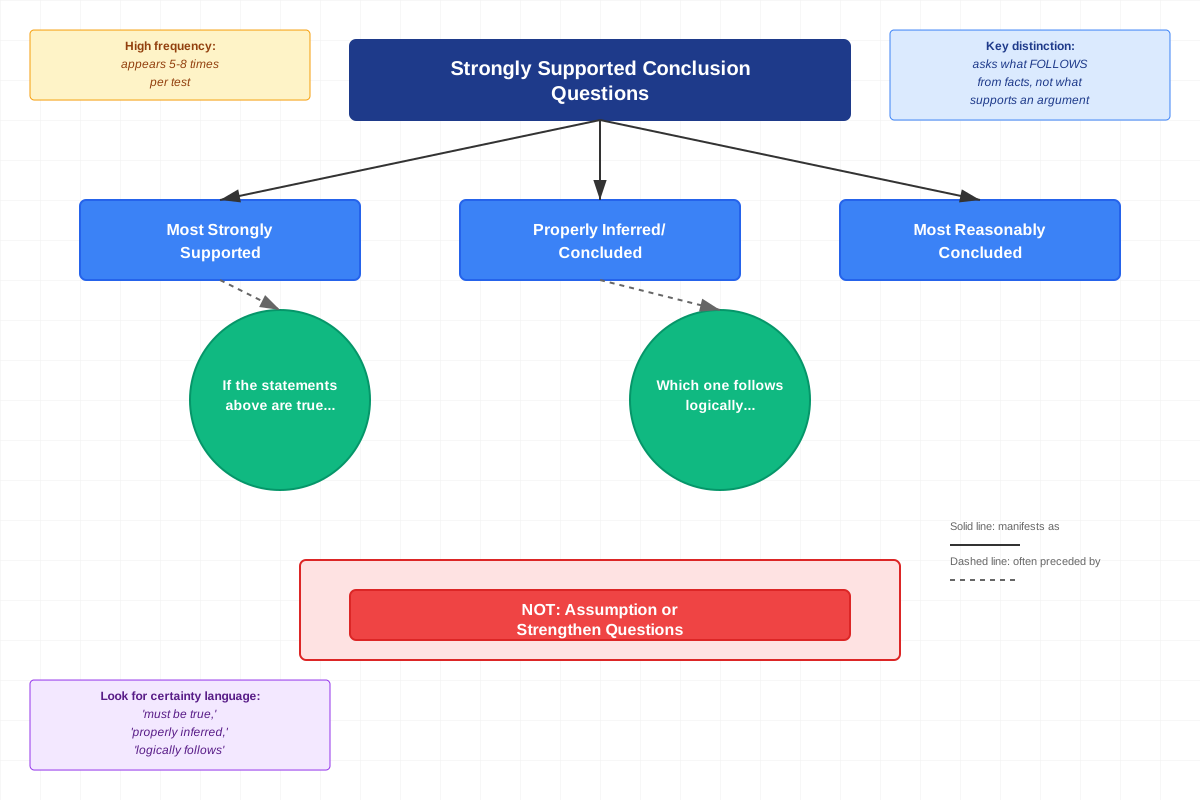
The LSAT tests strongly supported conclusions because legal reasoning fundamentally depends on the ability to extract what can be reliably concluded from available evidence. Attorneys must constantly evaluate testimony, documents, and facts to determine what logically follows—and what doesn't. This skill separates careful, precise reasoning from speculation or overreach. On the exam, these questions typically present a stimulus containing factual statements, research findings, or descriptive passages, then ask which conclusion is "most strongly supported," "properly inferred," or "most reasonably concluded" based solely on that information.
Mastering lsat strongly supported conclusion questions builds foundational skills that support success across all Logical Reasoning question types. The discipline of staying within the bounds of what's explicitly stated or necessarily implied strengthens performance on Must Be True questions, Parallel Reasoning questions, and even Reading Comprehension inference questions. This topic sits at the intersection of formal logic and practical reasoning, requiring both precision in language interpretation and restraint in drawing conclusions—two hallmarks of successful LSAT performance.
Learning Objectives
By the end of this study guide, students should be able to:
- [ ] Identify how Strongly supported conclusion appears in LSAT questions
- [ ] Explain the reasoning pattern behind Strongly supported conclusion
- [ ] Apply Strongly supported conclusion to solve LSAT-style problems accurately
- [ ] Distinguish between conclusions that are strongly supported versus those that require additional assumptions
- [ ] Recognize common trap answers that go beyond the scope of the stimulus
- [ ] Evaluate the strength of support for multiple potential conclusions
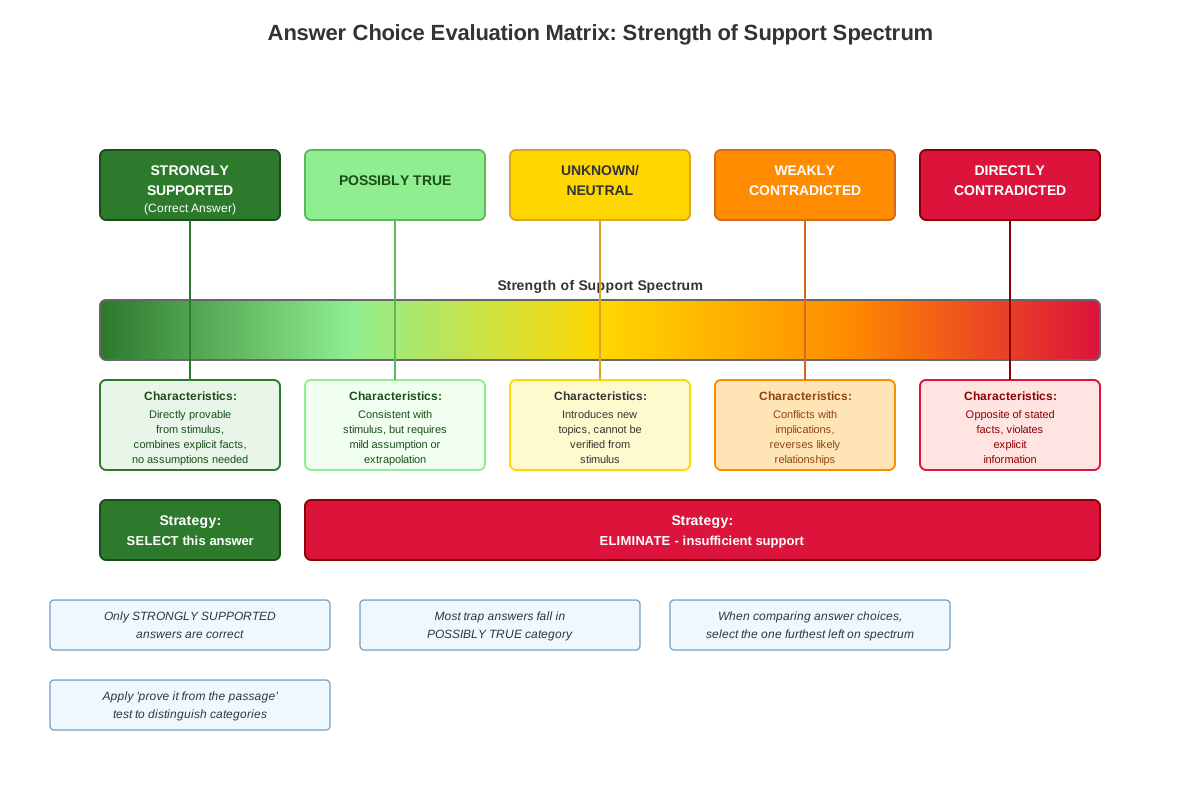
- [ ] Apply the "prove it from the passage" standard to eliminate incorrect answer choices
Prerequisites
Students should have foundational knowledge in the following areas:
- Basic formal logic: Understanding of conditional statements, necessary and sufficient conditions, and logical operators is essential because strongly supported conclusions often involve recognizing what must be true given certain conditions
- Argument structure identification: Ability to distinguish premises from conclusions helps students recognize when a stimulus is presenting facts versus making claims, which determines the appropriate reasoning approach
- Quantifier interpretation: Familiarity with terms like "some," "most," "all," and "none" is critical because the strength of a supported conclusion often depends on precise quantifier relationships
- Scope recognition: Understanding what information is and isn't addressed in a passage prevents students from selecting answers that introduce new topics or make unwarranted connections
Why This Topic Matters
Strongly supported conclusion questions appear with remarkable consistency on every LSAT administration, typically comprising 15-20% of all Logical Reasoning questions. This translates to approximately 5-8 questions per test, making this question type one of the highest-yield topics for focused study. The predictable nature of these questions—combined with their testable, rule-based approach—makes them an excellent opportunity for score improvement through deliberate practice.
In legal practice, the ability to draw only those conclusions warranted by available evidence prevents costly errors in case analysis, contract interpretation, and statutory construction. Attorneys who overreach in their conclusions face sanctions, lose credibility, or misadvise clients. The LSAT tests this skill because it directly predicts success in legal reasoning tasks that law students and practicing attorneys encounter daily.
These questions commonly appear in several formats: research study stimuli that present experimental findings and ask what can be concluded; descriptive passages about historical events, business practices, or social phenomena that require logical inference; and conditional logic chains that test whether students can recognize what necessarily follows from a series of if-then statements. The LSAT also frequently combines strongly supported conclusion questions with complex quantifier relationships, making them an integration point for multiple reasoning skills.
Core Concepts
The Standard of "Strong Support"
A strongly supported conclusion must be virtually certain given the information in the stimulus. This standard sits between absolute logical necessity (as in formal deductive logic) and mere possibility or plausibility. The correct answer doesn't need to be the only possible conclusion, but it must be the conclusion for which the stimulus provides the most direct, compelling evidence. Think of strong support as meaning the conclusion would be true in nearly all scenarios consistent with the stimulus facts.
The LSAT uses various phrasings to signal this question type: "Which one of the following is most strongly supported by the information above?", "If the statements above are true, which one of the following must also be true?", "The statements above, if true, most strongly support which one of the following?", and "Which one of the following can be properly inferred from the passage?" Despite slight variations in wording, all these formulations ask for the same thing: the answer choice that follows most reliably from the stimulus.
The "Prove It From the Passage" Principle
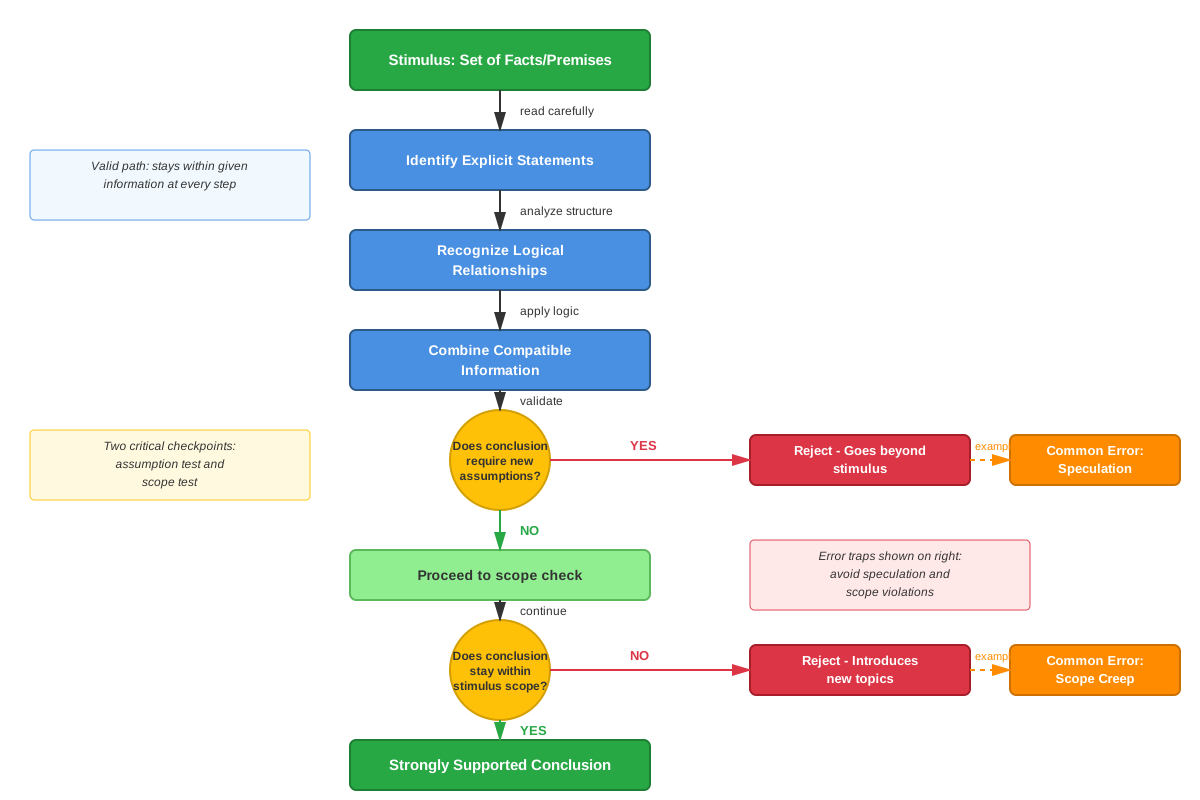
The cardinal rule for strongly supported conclusion questions is that every element of the correct answer must be provable directly from the stimulus. Students should approach these questions by asking: "Can I point to specific sentences or combinations of sentences in the stimulus that establish this answer choice?" If the answer requires assuming additional facts, making probabilistic guesses about what's likely, or importing real-world knowledge not stated in the passage, it's wrong—even if it seems reasonable or true in reality.
This principle distinguishes strongly supported conclusions from strengthen/weaken questions, where outside information can be relevant, and from assumption questions, where the correct answer provides unstated but necessary support. In strongly supported conclusion questions, the stimulus is complete and self-contained; the answer must emerge from what's already there.
Combining Information
Many strongly supported conclusion questions require synthesizing multiple pieces of information from the stimulus. The individual sentences might seem like disconnected facts, but the correct answer often emerges from recognizing how these facts interact. For example:
- Premise 1: All members of the committee are lawyers.
- Premise 2: Some lawyers in the firm specialize in tax law.
- Premise 3: No committee members specialize in tax law.
From these three statements, we can strongly conclude: Some lawyers in the firm are not committee members. This conclusion combines information from all three premises and represents a valid inference that must be true if the premises are true.
Quantifier Relationships
Understanding precise quantifier logic is essential for strongly supported conclusion questions. The LSAT exploits common misunderstandings about quantifiers to create trap answers. Key relationships include:
| Statement Type | What It Means | What It Doesn't Mean |
|---|---|---|
| All X are Y | Every single X is a Y | All Y are X |
| Some X are Y | At least one X is a Y | Most X are Y |
| Most X are Y | More than half of X are Y | All X are Y |
| No X are Y | Not a single X is a Y | No Y are X (though this is actually equivalent) |
A stimulus stating "Most doctors recommend this treatment" strongly supports "At least one doctor recommends this treatment" but does NOT strongly support "Most people who recommend this treatment are doctors" or "This treatment is effective." The first inference follows necessarily from the quantifier logic; the others introduce new information or reverse the relationship.
Scope Limitations
The scope of a strongly supported conclusion cannot exceed the scope of the stimulus. If the stimulus discusses "some European countries," the correct answer cannot make claims about "all countries" or even "all European countries." If the stimulus addresses economic factors, the correct answer typically cannot introduce political or social factors unless the stimulus explicitly connects them.
Scope violations represent the most common category of wrong answers in strongly supported conclusion questions. Test-makers craft attractive wrong answers that seem reasonable but subtly expand the topic, timeframe, or population beyond what the stimulus addresses. Vigilant scope-checking eliminates these traps efficiently.
Conditional Logic Chains
When a stimulus contains conditional statements, strongly supported conclusions often involve recognizing valid inferences through the contrapositive or through chaining conditionals. For example:
- If elected, the candidate will propose tax reform. (Elected → Tax Reform)
- The candidate will not propose tax reform. (¬Tax Reform)
- Therefore, the candidate was not elected. (¬Elected)
This represents a valid application of modus tollens (denying the consequent). However, students must avoid the common error of affirming the consequent or denying the antecedent, which do not produce strongly supported conclusions.
Degree and Certainty
Pay careful attention to the degree of certainty expressed in both the stimulus and answer choices. A stimulus using definitive language ("will," "always," "never") can support conclusions with similar certainty. A stimulus using qualified language ("may," "could," "sometimes") typically cannot support strong, definitive conclusions. The correct answer should match or be weaker than the strongest claim in the stimulus—never stronger.
Concept Relationships
The core concepts within strongly supported conclusion questions form an interconnected reasoning framework. The "prove it from the passage" principle serves as the foundational standard that governs all other concepts. This principle directly connects to scope limitations—staying within what can be proven requires staying within the scope of the stimulus. Both concepts work together to prevent the most common error: selecting answers that seem reasonable but aren't actually supported.
Quantifier relationships and conditional logic chains represent the technical tools for combining information from multiple premises. These formal logic elements provide the mechanisms through which separate facts in the stimulus yield new conclusions. Understanding quantifiers enables proper information combination, while conditional logic provides the rules for valid inference chains.
The standard of "strong support" sits atop this conceptual hierarchy, defining the threshold that separates correct from incorrect answers. This standard is operationalized through the other concepts: checking scope, verifying quantifier logic, confirming conditional reasoning, and ensuring every element is provable from the passage.
Relationship Map:
"Prove it from the passage" principle → governs → Scope limitations → prevents → Overreach errors
"Prove it from the passage" principle → requires → Combining information → uses → Quantifier relationships + Conditional logic chains
All concepts → must meet → Standard of "strong support" → determines → Correct answer selection
This topic connects to prerequisite knowledge of formal logic by applying those abstract rules to concrete LSAT stimuli. It also builds toward more complex question types: assumption questions (which ask what's needed but not stated) and strengthen/weaken questions (which evaluate argument quality) both require first understanding what IS supported before determining what's missing or what would help.
High-Yield Facts
⭐ The correct answer to a strongly supported conclusion question must be provable using only information explicitly stated or necessarily implied in the stimulus—no outside knowledge or assumptions allowed.
⭐ Scope violations are the most common type of wrong answer; always verify that the answer choice doesn't expand beyond the stimulus's topic, timeframe, or population.
⭐ When a stimulus contains "most," the correct answer can safely claim "some" (since most implies at least some), but not "all."
⭐ Conditional statements support their contrapositives as strongly supported conclusions, but do NOT support the converse or inverse.
⭐ If the stimulus presents only facts without an argument structure, the question is almost certainly asking for a strongly supported conclusion.
- The correct answer is often less exciting or dramatic than wrong answers; it may seem obvious or underwhelming because it stays conservatively within the stimulus bounds.
- Combining two or more pieces of information from the stimulus is frequently necessary to identify the correct answer.
- Extreme language in answer choices ("always," "never," "only," "all") requires extreme support in the stimulus; without such support, these answers are typically wrong.
- The phrase "if the statements above are true" signals that students should accept the stimulus as fact, even if it seems questionable or incomplete.
- Strongly supported conclusion questions never require identifying flaws in reasoning or evaluating argument strength—those are different question types.
- When two answer choices both seem supported, the correct answer is the one with stronger, more direct support requiring fewer inferential steps.
- Numerical or statistical information in the stimulus often supports conclusions about relative quantities but rarely supports conclusions about absolute numbers unless those are specified.
Quick check — test yourself on Strongly supported conclusion so far.
Try Flashcards →Common Misconceptions
Misconception: If an answer choice is true in the real world, it's the correct answer.
Correction: The correct answer must be supported by the stimulus specifically, regardless of real-world truth. The LSAT tests reasoning from given premises, not general knowledge. An answer that's factually accurate but not supported by the passage is wrong.
Misconception: "Most strongly supported" means the answer just needs to be more likely true than false.
Correction: Strong support requires near-certainty, not mere probability. The correct answer should be true in virtually all scenarios consistent with the stimulus facts. If an answer could easily be false even when the stimulus is true, it's not strongly supported.
Misconception: The correct answer will address the main point or most interesting aspect of the stimulus.
Correction: Strongly supported conclusions often focus on minor details or combinations of facts rather than the stimulus's apparent main topic. The LSAT frequently buries the provable inference in secondary information while making the primary topic seem important but unprovable.
Misconception: If the stimulus contains an argument, the correct answer will be the argument's conclusion.
Correction: The question asks what can be concluded from the stimulus, not what conclusion the stimulus itself draws. The correct answer is often something additional that follows from the premises, not merely a restatement of the author's conclusion.
Misconception: Conditional statements support their converses (if A→B, then B→A).
Correction: Conditional statements only support their contrapositives (if A→B, then ¬B→¬A). The converse is a logical fallacy. A stimulus stating "All elected officials must file disclosures" does NOT support "All who file disclosures are elected officials."
Misconception: "Some" means "a few" or "a small number."
Correction: In formal logic and on the LSAT, "some" means "at least one, possibly all." It's the weakest existential claim. If a stimulus says "some lawyers are judges," this is consistent with scenarios where only one lawyer is a judge or where every single lawyer is a judge.
Misconception: The correct answer will use the same vocabulary as the stimulus.
Correction: While the correct answer must address concepts from the stimulus, it often paraphrases or combines ideas using different terminology. Conversely, wrong answers sometimes use stimulus vocabulary to seem familiar while actually making unsupported claims.
Worked Examples
Example 1: Research Study Stimulus
Stimulus: "A recent study examined 200 patients with chronic back pain. Half received physical therapy, while half received no treatment. After six months, 60% of the physical therapy group reported reduced pain, while only 30% of the untreated group reported reduced pain. All participants were between ages 40 and 60, and none had previously received physical therapy for back pain."
Question: Which one of the following is most strongly supported by the information above?
Answer Choices:
(A) Physical therapy is the most effective treatment for chronic back pain.
(B) Some patients between ages 40 and 60 who received physical therapy for the first time experienced reduced pain after six months.
(C) Patients over 60 would experience similar benefits from physical therapy.
(D) Most patients with chronic back pain should receive physical therapy.
(E) Physical therapy is more effective than medication for treating back pain.
Analysis:
Let's apply the "prove it from the passage" principle to each answer:
(A) Claims physical therapy is "most effective" compared to all other treatments. The stimulus only compares physical therapy to no treatment, not to other treatments like medication, surgery, or alternative therapies. This exceeds the scope. Eliminate.
(B) States that "some patients between ages 40 and 60 who received physical therapy for the first time experienced reduced pain after six months." We can prove every element: The study included patients ages 40-60 (stated), none had previously received physical therapy (stated), they received physical therapy (stated), and 60% reported reduced pain after six months (stated). Since 60% is definitely "some," this is strongly supported. Keep.
(C) Makes a claim about patients over 60. The stimulus only addresses patients between 40 and 60. This introduces a new population not covered by the study. Eliminate.
(D) Makes a prescriptive recommendation about what patients "should" do. The stimulus presents descriptive research findings but doesn't establish that physical therapy is appropriate for most patients—we don't know about side effects, costs, or other relevant factors. Eliminate.
(E) Compares physical therapy to medication. The stimulus never mentions medication. This comparison cannot be supported. Eliminate.
Correct Answer: (B)
This example illustrates how the correct answer often seems underwhelming—it's a conservative statement that carefully stays within the bounds of what's provable. The wrong answers all make reasonable-sounding claims that go beyond the stimulus in various ways: comparing to unstated alternatives, extending to different populations, or making recommendations not supported by the data.
Example 2: Conditional Logic Stimulus
Stimulus: "Every member of the city council voted for the new zoning ordinance. Anyone who voted for the new zoning ordinance supports increased commercial development. No one who supports increased commercial development opposes the downtown renovation project."
Question: If the statements above are true, which one of the following must also be true?
Answer Choices:
(A) Everyone who supports the downtown renovation project is a city council member.
(B) Some people who support increased commercial development are city council members.
(C) No city council members oppose the downtown renovation project.
(D) Most city council members support the downtown renovation project.
(E) Anyone who opposes the downtown renovation project is not a city council member.
Analysis:
First, let's map the conditional logic:
- Premise 1: City Council Member → Voted for ordinance
- Premise 2: Voted for ordinance → Supports commercial development
- Premise 3: Supports commercial development → ¬Opposes renovation
Chaining these together: City Council Member → Voted for ordinance → Supports commercial development → ¬Opposes renovation
Therefore: City Council Member → ¬Opposes renovation (which is equivalent to: City Council Member → Supports or neutral on renovation)
Now evaluate each answer:
(A) This reverses the logic (converse fallacy). Just because all council members support renovation doesn't mean all renovation supporters are council members. Eliminate.
(B) We know all city council members support commercial development (from the chain). Since there's at least one council member (the stimulus says "every member" implying at least one exists), this is true. However, let's check if (C) or (E) are more directly supported. Hold.
(C) From our conditional chain, every city council member does not oppose the renovation project. This directly follows from the logic chain. Strong candidate.
(D) We can conclude that NO council members oppose renovation, which is stronger than "most support" it. However, "not opposing" doesn't necessarily mean "supporting"—they could be neutral. This answer is too strong. Eliminate.
(E) This is the contrapositive of our derived conclusion. If City Council Member → ¬Opposes renovation, then Opposes renovation → ¬City Council Member. This must be true. Strong candidate.
Comparing (C) and (E): Both are logically equivalent statements (one is the contrapositive of the other). Both must be true. However, (C) more directly states what we derived, while (E) requires recognizing the contrapositive. In practice, either could be correct, but (C) is more straightforward.
Correct Answer: (C) (though (E) would also be logically valid)
This example demonstrates how conditional logic chains create strongly supported conclusions through valid inference rules. The wrong answers include converse errors (A), statements that are true but not as strongly supported as others (B), and statements that are too strong given the premises (D).
Exam Strategy
When approaching strongly supported conclusion questions on the LSAT, follow this systematic process:
Step 1: Identify the question type by looking for key phrases: "most strongly supported," "properly inferred," "must also be true," or "if the statements above are true." These signals indicate you should not evaluate argument quality or identify assumptions—only determine what follows from the given information.
Step 2: Read the stimulus carefully and identify whether it contains an argument structure or merely presents facts. If it's purely factual (no conclusion being argued), you're almost certainly dealing with a strongly supported conclusion question. Note any conditional statements, quantifiers, or numerical data, as these often form the basis for the correct inference.
Step 3: Anticipate the answer before looking at choices, if possible. Ask yourself: "What must be true given these facts?" or "What can I combine from these premises?" Having even a rough prediction helps you recognize the correct answer and avoid attractive traps.
Step 4: Apply the "prove it" test to each answer choice. For each element of the answer, point to specific support in the stimulus. If you can't prove it directly, eliminate it. Be especially vigilant for:
- Scope shifts: Does the answer introduce new topics, timeframes, or populations?
- Degree mismatches: Does the answer claim more certainty than the stimulus supports?
- Reversed logic: Does the answer confuse sufficient and necessary conditions?
- Quantifier errors: Does the answer claim "all" when the stimulus says "most" or "some"?
Step 5: Choose the most conservative answer when multiple choices seem possible. The correct answer rarely makes dramatic or surprising claims. It typically states something that seems almost obvious once you see it, because it stays so close to the stimulus.
Exam Tip: If you're stuck between two answers, check which one requires fewer inferential steps. The correct answer usually follows more directly from the stimulus, while wrong answers often require you to make an additional assumption or logical leap.
Time allocation: Strongly supported conclusion questions should take approximately 1:15-1:30 on average. They're generally faster than assumption or flaw questions because you're not evaluating argument structure—just checking what's provable. If you find yourself spending over 2 minutes, you're likely overthinking. Return to the basics: What can I prove from the passage?
Trigger words to watch for in answer choices:
- "Must," "always," "never," "only," "all" → Require very strong support
- "Some," "may," "could," "sometimes" → Require minimal support
- "Most," "usually," "typically" → Require majority support
- "Likely," "probably" → Often wrong because they suggest uncertainty not present in the stimulus
Memory Techniques
The SCOPE Acronym for eliminating wrong answers:
- Scope: Does it stay within the stimulus boundaries?
- Conditionals: Are any conditional logic relationships correctly applied?
- Overly strong: Does it claim more than the stimulus supports?
- Provable: Can I point to specific sentences that establish this?
- Every element: Is each component of the answer supported?
The "Conservative Conclusion" Visualization: Picture the stimulus as a small island of facts. The correct answer is a point on that island or just offshore—close and clearly connected. Wrong answers are boats that have sailed away from the island into open water. The farther from shore (the stimulus), the less supported the conclusion.
Quantifier Hierarchy Memory Device: Remember "ALL > MOST > SOME" as a one-way street going downhill. You can always go down (if all, then most; if most, then some) but never up (if some, you can't conclude most or all). Think of it as water flowing downhill—it only goes one direction.
The Contrapositive Flip-and-Negate: For conditional statements, remember "flip the order, negate both parts." If A→B, then ¬B→¬A. Visualize physically flipping a card over and switching + to − signs.
The "Prove It" Mantra: Before selecting any answer, literally say to yourself: "Can I prove this from the passage?" This simple question, repeated consistently, prevents the majority of errors on these questions.
Summary
Strongly supported conclusion questions test the ability to identify what logically follows from a given set of premises without adding assumptions or outside information. These high-frequency LSAT questions require students to apply the "prove it from the passage" standard rigorously, ensuring every element of the correct answer can be directly established from the stimulus. Success depends on recognizing scope limitations, understanding quantifier relationships, correctly applying conditional logic, and avoiding common traps like converse errors and degree mismatches. The correct answer typically makes a conservative claim that stays close to the stimulus facts, while wrong answers introduce new information, expand the scope, or claim more certainty than the premises support. Mastering this question type builds foundational inference skills that enhance performance across all Logical Reasoning questions and develops the precise, evidence-based reasoning essential for legal analysis.
Key Takeaways
- Strongly supported conclusion questions ask what must be true or is most strongly supported given the stimulus—nothing more, nothing less
- The "prove it from the passage" principle is absolute: every element of the correct answer must be directly establishable from the stimulus
- Scope violations represent the most common wrong answer type; always verify the answer doesn't expand beyond the stimulus boundaries
- Quantifier logic matters: "all" supports "most" and "some," but "some" doesn't support "most" or "all"
- Conditional statements support their contrapositives but never their converses or inverses
- The correct answer is usually conservative and may seem obvious—dramatic or surprising answers typically go beyond what's supported
- Combining multiple pieces of information from the stimulus is often necessary to identify the correct inference
Related Topics
Must Be True Questions: These are essentially synonymous with strongly supported conclusion questions, using slightly different phrasing but testing the same inference skills. Mastering strongly supported conclusions directly translates to success on Must Be True questions.
Assumption Questions: After understanding what IS supported by premises, assumption questions ask what MUST BE ASSUMED for a conclusion to follow. This represents the logical complement to strongly supported conclusions.
Parallel Reasoning Questions: These require identifying arguments with the same logical structure. Understanding what conclusions are supported by different premise patterns helps recognize structural parallels.
Reading Comprehension Inference Questions: The same principles of staying within scope and proving answers from the passage apply to RC inference questions, making strongly supported conclusion skills transferable across sections.
Formal Logic and Conditional Reasoning: Deeper study of formal logic systems enhances the ability to recognize valid inference patterns and avoid logical fallacies in strongly supported conclusion questions.
Practice CTA
Now that you've mastered the core concepts of strongly supported conclusion questions, it's time to put your knowledge into practice. Work through the practice questions systematically, applying the SCOPE acronym and the "prove it from the passage" principle to each answer choice. Use the flashcards to reinforce quantifier relationships and conditional logic rules until they become automatic. Remember: these questions are highly learnable and represent one of the best opportunities for score improvement through deliberate practice. Every question you practice strengthens your inference skills and builds the disciplined reasoning that separates good LSAT scores from great ones. You've got this!
Sign up free to keep reading
Create a free AnvayaPrep account to finish this LSAT guide on Strongly supported conclusion — plus flashcards and practice questions.