Overview
Distinguishing role from main point is a critical skill in LSAT Logical Reasoning that tests a student's ability to analyze the structural function of statements within an argument. While many test-takers can identify what an argument concludes, fewer can accurately determine why a particular statement appears in the passage—whether it serves as the primary conclusion, supports that conclusion, provides background information, or plays another structural role. This distinction becomes especially important in method, role, and structure questions, where the LSAT explicitly asks students to identify the function of a specific claim rather than evaluate the argument's validity or identify assumptions.
The confusion between a statement's role and the main point represents one of the most common pitfalls in Logical Reasoning. A statement might seem important or persuasive, leading students to mistake it for the main conclusion when it actually serves as intermediate support or contextual information. Conversely, the actual main point might be stated subtly or appear early in the passage, causing students to overlook it in favor of more emphatic-sounding claims. Mastering this distinction requires understanding that the main point is what the author ultimately wants to prove, while a statement's role describes its structural function in building toward that conclusion.
This topic connects fundamentally to argument structure analysis, a cornerstone of LSAT success. Understanding how to distinguish role from main point enhances performance across multiple question types, including Main Point questions, Role of a Statement questions, Method of Reasoning questions, and even some Strengthen/Weaken questions where recognizing structural relationships clarifies which elements need support. The ability to map an argument's architecture—identifying premises, intermediate conclusions, main conclusions, and auxiliary elements—provides the foundation for virtually all Logical Reasoning success.
Learning Objectives
- [ ] Identify how distinguishing role from main point appears in LSAT questions
- [ ] Explain the reasoning pattern behind distinguishing role from main point
- [ ] Apply distinguishing role from main point to solve LSAT-style problems accurately
- [ ] Differentiate between main conclusions, intermediate conclusions, and premises within complex arguments
- [ ] Recognize structural indicators that signal a statement's function within an argument
- [ ] Evaluate answer choices that describe argumentative roles using precise logical terminology
- [ ] Construct mental maps of argument structure that clearly delineate each statement's purpose
Prerequisites
- Basic argument structure: Understanding the fundamental distinction between premises (supporting statements) and conclusions (supported statements) is essential because role identification builds upon recognizing these basic building blocks.
- Conclusion indicators and premise indicators: Familiarity with words like "therefore," "thus," "because," and "since" helps identify structural relationships, though distinguishing role from main point requires going beyond these surface markers.
- Reading comprehension fundamentals: The ability to parse complex sentences and identify the author's purpose enables accurate determination of whether a statement advances the main argument or serves an auxiliary function.
- Logical reasoning question types: Knowing the difference between Main Point, Role, and Method questions helps students recognize when they need to focus specifically on structural function rather than content evaluation.
Why This Topic Matters
In real-world contexts, distinguishing between a claim's role and the main point mirrors essential critical thinking skills used in legal reasoning, policy analysis, and academic discourse. Lawyers must identify which arguments serve as primary contentions versus supporting evidence. Policy analysts must distinguish between ultimate recommendations and the data supporting those recommendations. This skill prevents mischaracterization of others' arguments and strengthens one's own persuasive writing by maintaining clear structural hierarchy.
On the LSAT, distinguishing role from main point appears with remarkable frequency and in multiple question formats. Approximately 15-20% of Logical Reasoning questions directly test this skill through Role of a Statement questions ("The claim that X plays which one of the following roles in the argument?") and Main Point questions ("Which one of the following most accurately expresses the main conclusion?"). Additionally, Method of Reasoning questions often require understanding how different statements function together, and even Parallel Reasoning questions demand recognition of structural similarities rather than content similarities.
This topic appears in exam passages through several common patterns: arguments with multiple conclusions where students must identify which is primary; arguments where the main point appears early and is followed by extensive support; arguments containing concessions or opposing viewpoints that students might mistake for the author's position; and complex arguments with intermediate conclusions that serve as premises for the ultimate conclusion. The LSAT deliberately constructs passages to exploit common confusions, making this skill not just helpful but essential for competitive scoring.
Core Concepts
The Main Point Defined
The main point (also called the main conclusion or primary conclusion) represents the ultimate claim the argument seeks to establish—the statement that everything else in the passage works to support. Identifying the main point requires asking: "What is the author fundamentally trying to convince me of?" The main point is never used to support another claim within the argument; instead, all other substantive claims either directly or indirectly support it.
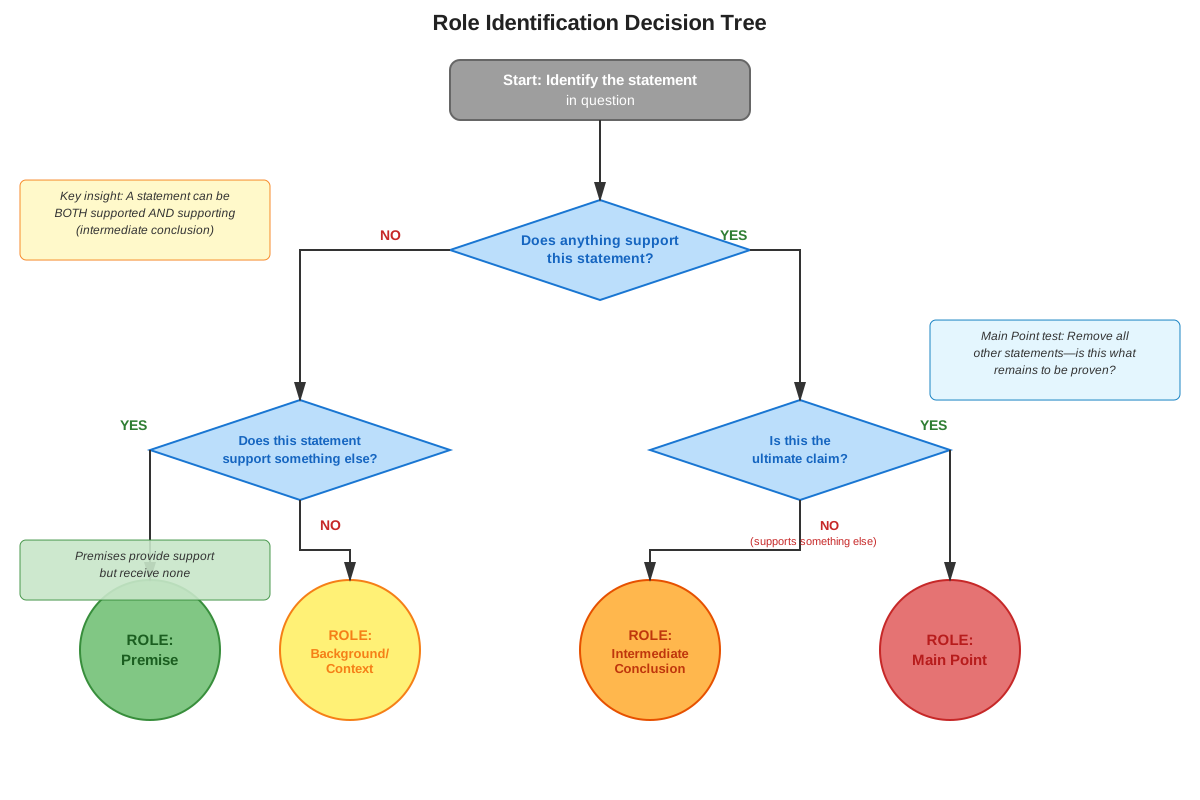
Main points can appear anywhere in an argument: at the beginning, middle, or end. While conclusion indicators like "therefore," "thus," and "consequently" often signal conclusions, their presence doesn't guarantee a statement is the main conclusion rather than an intermediate one. The structural test remains paramount: if other claims in the passage support this statement and it doesn't support anything else, it's the main point.
Roles vs. Main Point: The Critical Distinction
A statement's role describes its structural function within the argument—what job it performs in the logical architecture. Understanding roles requires recognizing that statements can serve many functions beyond being the main conclusion:
Common Statement Roles:
| Role Type | Function | Relationship to Main Point |
|---|---|---|
| Main Conclusion | The ultimate claim being argued | IS the main point |
| Intermediate Conclusion | A claim supported by some premises and used to support another conclusion | Supports the main point; supported by other premises |
| Premise | Evidence or reason offered in support | Directly or indirectly supports the main point |
| Background/Context | Information establishing the situation | Provides framework but doesn't support the conclusion |
| Opposing View | A position the author argues against | Contrasts with the main point |
| Concession | A point the author grants to the opposition | Acknowledged but doesn't undermine the main point |
| Illustration/Example | Specific instance demonstrating a general claim | Clarifies or exemplifies rather than proves |
The key insight is that the main point is one specific role a statement can play. When questions ask about a statement's role, they're asking about its structural function, which might or might not be serving as the main conclusion.
Intermediate Conclusions: The Common Confusion Point
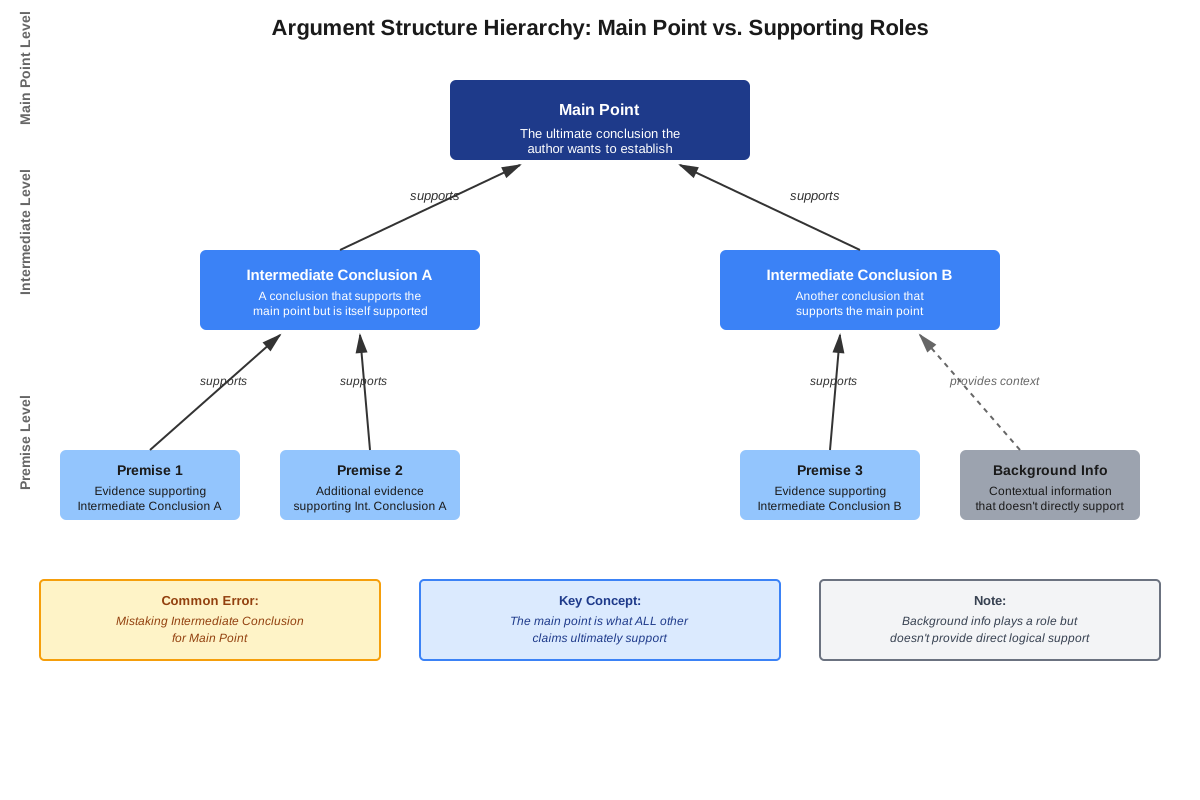
Intermediate conclusions (also called subsidiary conclusions or sub-conclusions) represent the most frequent source of confusion when distinguishing role from main point. These statements function as conclusions in one relationship (they're supported by premises) but as premises in another relationship (they support the main conclusion). This dual nature makes them appear conclusion-like, leading students to mistake them for the main point.
Consider this structure:
- Premise A
- Premise B
- Intermediate Conclusion C (supported by A and B)
- Premise D
- Main Conclusion E (supported by C and D)
Statement C looks like a conclusion because it follows from A and B, often with a conclusion indicator. However, C then serves as support for E, making E the main point. The structural test reveals the hierarchy: E is supported but supports nothing else, while C both receives support and provides support.
Structural Indicators and Their Limitations
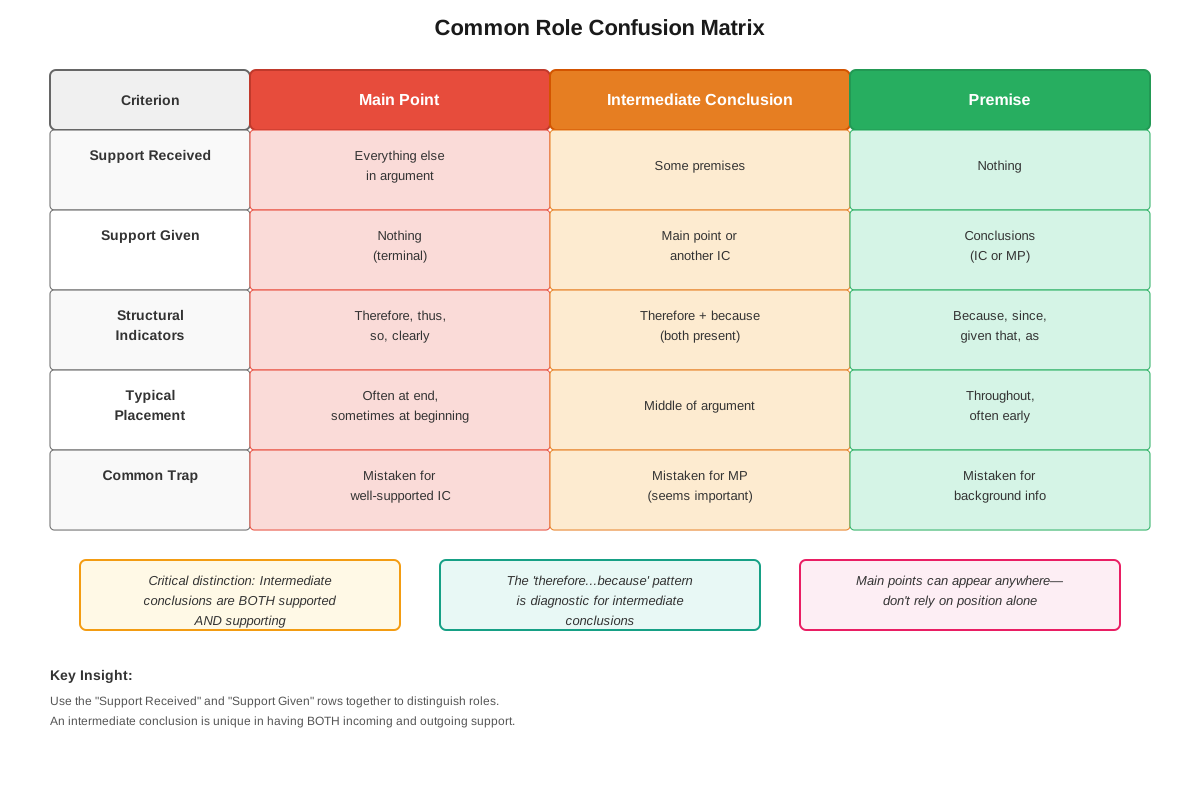
While certain words signal structural relationships, lsat distinguishing role from main point requires understanding that these indicators have limitations:
Conclusion Indicators: therefore, thus, hence, consequently, so, accordingly, it follows that, which shows that
Premise Indicators: because, since, for, given that, as, for the reason that, in light of
These indicators help identify that a support relationship exists, but they don't automatically identify the main point. An intermediate conclusion might follow "therefore," and the main conclusion might appear without any indicator at all. The definitive test remains structural: trace what supports what, and identify which claim sits at the top of the support hierarchy.
The "Why Test" for Main Point Identification
A reliable method for distinguishing the main point from other statements involves the "Why Test": For any statement you think might be the main point, ask "Why should I believe this?" If the passage provides reasons, those reasons are premises or intermediate conclusions. Then ask about those supporting statements: "Why are these in the passage?" If the answer is "to support the first statement," that first statement is likely the main point.
Conversely, if you can ask "So what?" or "What follows from this?" about a statement and the passage provides an answer, that statement probably isn't the main point—it's supporting something else.
Context and Background vs. Argumentative Roles
Not every statement in an LSAT argument plays a direct argumentative role. Background information and context set the stage but don't support the conclusion. For example: "The city council met last Tuesday to discuss the budget" might simply establish when something happened without providing evidence for any claim.
Distinguishing these contextual statements from premises requires asking whether the statement, if false, would weaken the argument. If removing a statement leaves the argument's logical force intact, it's likely background rather than a premise. This distinction matters for Role questions, where answer choices might describe a statement as "providing context" versus "offering evidence."
Concessions and Opposing Views
Arguments frequently include concessions (points granted to the opposition) and opposing views (positions the author argues against). These statements can be particularly tricky because they often appear emphatic and well-supported within the passage, yet they represent positions the author ultimately rejects or qualifies.
Identifying these requires attention to contrast indicators: "however," "but," "nevertheless," "although," "despite," "admittedly." When an argument presents a view then pivots with these words, the statement after the pivot typically aligns more closely with the author's main point. The conceded or opposing view plays the role of "a position the argument challenges" or "a consideration the argument acknowledges but ultimately rejects."
Concept Relationships
The concepts within distinguishing role from main point form a hierarchical and interconnected system. At the foundation lies basic argument structure (premises supporting conclusions), which enables recognition of the main point as the ultimate conclusion. This understanding then allows identification of intermediate conclusions, which bridge the gap between basic premises and the main point, creating multi-layered arguments.
The relationship flows as follows:
Basic Argument Structure → enables → Main Point Identification → which distinguishes from → Intermediate Conclusions → both of which are clarified by → Structural Indicators → but require → The Why Test → to definitively establish → Statement Roles
Parallel to this main chain, Context/Background Recognition and Concession/Opposition Identification branch off from basic argument structure, representing non-supporting elements that students must distinguish from argumentative components.
This topic connects to prerequisite knowledge of conclusion and premise indicators by building upon but transcending those surface markers. It relates to Method of Reasoning questions by providing the structural vocabulary needed to describe how arguments proceed. It connects to Main Point questions by providing the analytical framework for identifying primary conclusions. The skill ultimately supports Parallel Reasoning questions, where structural similarity matters more than content, and even Strengthen/Weaken questions, where understanding what supports what clarifies which elements need reinforcement or challenge.
High-Yield Facts
⭐ The main point is the one claim in an argument that is supported by other statements but does not itself support any other claim in the passage.
⭐ Intermediate conclusions are both supported by premises AND used to support the main conclusion, making them the most commonly confused element with the main point.
⭐ Conclusion indicators (therefore, thus, hence) can introduce intermediate conclusions, not just main conclusions, so their presence doesn't automatically identify the main point.
⭐ The main point can appear anywhere in the passage—beginning, middle, or end—and may lack any conclusion indicator.
⭐ Role questions ask about a statement's structural function; Main Point questions ask you to identify which statement serves the specific role of being the primary conclusion.
- Background information and context provide setting or circumstances but don't offer logical support for the conclusion.
- Concessions acknowledge opposing points without undermining the author's main argument; they typically appear before contrast words like "however" or "nevertheless."
- The "Why Test" (asking "Why should I believe this?") helps identify what supports what, revealing the support hierarchy.
- A statement can be important, true, or emphasized without being the main point; structural function, not prominence, determines role.
- In complex arguments, multiple layers of support may exist, with premises supporting intermediate conclusions that support further intermediate conclusions before reaching the main point.
Quick check — test yourself on Distinguishing role from main point so far.
Try Flashcards →Common Misconceptions
Misconception: The main point is always the last statement in the passage.
Correction: While conclusions often appear at the end, the main point can appear anywhere. LSAT passages frequently place the main conclusion early or in the middle, followed by extensive support, specifically to test whether students can identify structural function rather than relying on position.
Misconception: Any statement following "therefore" or "thus" must be the main point.
Correction: Conclusion indicators signal that a claim is being drawn from previous statements, but that claim might be an intermediate conclusion used to support a further conclusion. The structural test—whether the statement supports anything else—determines if it's the main point.
Misconception: The most strongly stated or emphatic claim is the main point.
Correction: Authors may state premises or intermediate conclusions emphatically while expressing the main point more tentatively. Emphasis and certainty don't determine structural role; the support relationships do.
Misconception: If a statement is true or important, it must be the main point.
Correction: Premises are typically true (or assumed true) and important, but they serve to support rather than constitute the main point. A statement's role depends on its function in the argument's structure, not its truth value or significance.
Misconception: Role questions and Main Point questions are essentially the same.
Correction: Main Point questions ask you to identify which statement serves as the primary conclusion. Role questions ask you to describe a specific statement's function, which might be serving as a premise, intermediate conclusion, background, concession, or one of many other roles—not necessarily the main conclusion.
Misconception: Every statement in an argument must be either a premise or a conclusion.
Correction: Arguments contain various elements including background information, context, concessions, opposing views, illustrations, and qualifications that don't fit neatly into premise/conclusion categories. Recognizing these auxiliary roles is essential for accurate role identification.
Worked Examples
Example 1: Identifying Main Point vs. Intermediate Conclusion
Passage: "Studies show that regular exercise reduces stress hormones in the bloodstream. Since reduced stress hormones correlate with better sleep quality, people who exercise regularly likely sleep better than those who don't. Therefore, doctors should recommend regular exercise to patients complaining of insomnia."
Question: The claim that reduced stress hormones correlate with better sleep quality plays which role in the argument?
Analysis:
Step 1: Identify all claims and their relationships.
- Claim 1: Studies show regular exercise reduces stress hormones (premise)
- Claim 2: Reduced stress hormones correlate with better sleep quality (intermediate conclusion/premise)
- Claim 3: People who exercise regularly likely sleep better (intermediate conclusion)
- Claim 4: Doctors should recommend exercise to insomnia patients (main conclusion)
Step 2: Apply the Why Test to Claim 4 (the apparent main conclusion).
- Why should doctors recommend exercise for insomnia? Because people who exercise likely sleep better (Claim 3).
- Why do people who exercise likely sleep better? Because exercise reduces stress hormones (Claim 1) and reduced stress hormones correlate with better sleep (Claim 2).
Step 3: Determine the role of the target claim (Claim 2).
- Is Claim 2 supported by anything? Yes, implicitly by studies (though not explicitly stated in this passage, it's presented as established fact).
- Does Claim 2 support anything? Yes, it combines with Claim 1 to support Claim 3.
- Is Claim 2 the main point? No, because it supports Claim 3, which supports Claim 4.
Answer: The claim plays the role of an intermediate conclusion (or premise, depending on how answer choices are worded) that links the evidence about exercise reducing stress hormones to the conclusion about sleep quality, ultimately supporting the main recommendation about doctors' advice.
Connection to Learning Objectives: This example demonstrates how to identify the reasoning pattern behind distinguishing role from main point by tracing support relationships and applying the Why Test to reveal argumentative structure.
Example 2: Distinguishing Main Point from Concession
Passage: "Admittedly, increasing the minimum wage could lead some businesses to reduce their workforce. However, the majority of economic studies indicate that modest minimum wage increases have negligible effects on employment levels. Moreover, the benefits to low-wage workers—including reduced poverty and increased consumer spending—far outweigh any minor employment disruptions. Thus, policymakers should support the proposed minimum wage increase."
Question: Which one of the following most accurately expresses the main conclusion of the argument?
Analysis:
Step 1: Identify the concession.
- "Admittedly, increasing the minimum wage could lead some businesses to reduce their workforce" is signaled by "admittedly" as a concession—a point granted to the opposition.
Step 2: Identify the contrast and what follows.
- "However" signals a pivot away from the concession.
- After the pivot: evidence that wage increases have negligible employment effects, and benefits outweigh disruptions.
Step 3: Locate conclusion indicators.
- "Thus" introduces "policymakers should support the proposed minimum wage increase."
Step 4: Apply the Why Test.
- Why should policymakers support the increase? Because benefits outweigh disruptions, and employment effects are negligible.
- Does anything in the passage tell us what follows from "policymakers should support the increase"? No—this is the terminal claim.
Step 5: Verify this is the main point, not the concession.
- The concession (potential workforce reduction) is acknowledged but then countered. It's not what the author wants to prove; it's what the author argues against or minimizes.
- The statement after "thus" represents what all the evidence supports.
Answer: "Policymakers should support the proposed minimum wage increase" is the main conclusion. The concession about potential workforce reduction plays the role of "a consideration the argument acknowledges but argues is outweighed by other factors."
Connection to Learning Objectives: This example shows how to apply distinguishing role from main point to solve LSAT-style problems by recognizing concessions and contrast structures, and by using structural indicators in context rather than in isolation.
Exam Strategy
Approaching Role Questions
When facing a Role of a Statement question, follow this systematic approach:
- Read the entire argument first before looking at the specific statement in question. Understanding the complete structure is essential for determining any individual part's function.
- Identify the main conclusion using the Why Test. Once you know what the argument ultimately tries to prove, you can determine how other statements relate to it.
- Locate the target statement and ask three questions:
- Is this statement supported by other claims in the passage?
- Does this statement support other claims in the passage?
- Does this statement do both, neither, or something else?
- Match the structural function to answer choices using precise logical vocabulary. Role question answers typically use terms like "intermediate conclusion," "provides context," "illustrates a principle," "states an opposing position," or "offers evidence."
Approaching Main Point Questions
For Main Point questions, use this process:
- Read actively for structure, not just content. As you read, mentally note what supports what.
- Look for conclusion indicators but don't rely on them exclusively. Note any "therefore," "thus," or "hence," but verify that what follows is actually the main point.
- Apply the Why Test to candidate statements. The main point should be supported by other statements but shouldn't support anything else.
- Eliminate answers that are:
- Premises or evidence (they support but aren't supported)
- Intermediate conclusions (they're supported but also support something else)
- Background information (they provide context but no support)
- Too broad or too narrow compared to what the argument actually establishes
Trigger Words and Phrases
Watch for these structural signals:
- Contrast indicators (however, but, nevertheless, yet, although, despite): Often signal that what follows is closer to the author's main point than what preceded
- Concession markers (admittedly, granted, to be sure, certainly): Indicate the author is acknowledging an opposing point
- Emphasis markers (importantly, significantly, crucially): May highlight key premises or the main point, but don't assume emphasis equals main conclusion
- Conclusion indicators (therefore, thus, hence, so, consequently): Signal a conclusion, but verify whether it's the main or an intermediate conclusion
Process of Elimination Tips
For Role questions, eliminate answers that:
- Describe a function the statement doesn't perform (e.g., calling something a "premise" when it's actually supported by other claims)
- Use extreme language inconsistent with the statement's actual function
- Confuse the statement's content with its structural role
For Main Point questions, eliminate answers that:
- Restate premises or evidence rather than the conclusion
- Go beyond what the argument actually concludes
- Describe intermediate steps rather than the ultimate conclusion
- Represent opposing views or concessions rather than the author's position
Time Allocation
Spend approximately 1:15-1:30 on Role and Main Point questions:
- 45-60 seconds reading and analyzing the argument structure
- 30-45 seconds evaluating answer choices
These questions reward careful structural analysis more than speed. Rushing through the argument often leads to confusing intermediate conclusions with the main point, costing more time in the long run when you must re-read.
Memory Techniques
The "WISE" Acronym for Main Point Identification
What is ultimately being argued?
Is it supported by other statements?
Supports nothing else in the passage
Everything else works toward proving it
The Support Chain Visualization
Visualize arguments as a pyramid or tree structure:
- Bottom level: Basic premises (evidence, facts, studies)
- Middle level(s): Intermediate conclusions (claims drawn from premises)
- Top: Main conclusion (the ultimate point)
Support flows upward. The main point sits at the apex, receiving support but providing none.
The "Therefore Test" Mnemonic
When you see "therefore," ask: "Therefore... what?"
- If the passage answers "what?" with another claim, the "therefore" introduced an intermediate conclusion
- If the passage doesn't go further, the "therefore" likely introduced the main conclusion
Role Categories: "PICO-B"
Remember common statement roles with PICO-B:
- Premise (evidence supporting the conclusion)
- Intermediate conclusion (supported by some claims, supports others)
- Conclusion (main point—supported but supports nothing)
- Opposition (view the author argues against)
- Background (context without argumentative force)
The "But Test" for Concessions
When you see "but," "however," or "nevertheless," remember: "The author's real point comes AFTER the contrast word, not before."
Summary
Distinguishing role from main point requires understanding that the main point represents one specific structural function—the ultimate conclusion that everything else supports—while statements can play numerous other roles including premises, intermediate conclusions, background, concessions, and opposing views. The key to mastery lies in analyzing support relationships rather than relying on surface indicators like conclusion words or emphatic language. The main point is identified by applying the Why Test: it's the claim that other statements support but that doesn't itself support any other claim in the passage. Intermediate conclusions create the most common confusion because they function as both conclusions (supported by premises) and premises (supporting the main point), appearing conclusion-like while not being the primary conclusion. Success on LSAT questions testing this skill requires careful structural analysis, recognition that conclusion indicators can introduce intermediate rather than main conclusions, and understanding that a statement's importance or truth value doesn't determine its structural role. Role questions ask about any statement's function, while Main Point questions specifically ask which statement serves as the primary conclusion—a crucial distinction that prevents treating these question types as interchangeable.
Key Takeaways
- The main point is the ultimate claim the argument establishes—supported by everything else but supporting nothing else in the passage
- Intermediate conclusions are both supported and supporting, making them the most commonly confused element with the main point
- Structural analysis (tracing what supports what) trumps surface indicators like conclusion words or statement position
- Role questions ask about any statement's function; Main Point questions ask which statement is the primary conclusion
- Concessions and opposing views often appear emphatic but represent positions the author argues against, not the main point
- The Why Test reliably identifies the main point by revealing the support hierarchy
- A statement can be true, important, or strongly stated without being the main point—structural function determines role
Related Topics
Argument Structure Mapping: Building on the ability to distinguish role from main point, this advanced skill involves diagramming complex multi-layered arguments with multiple intermediate conclusions, helping visualize support relationships in highly complex passages.
Method of Reasoning Questions: These questions ask how an argument proceeds or what argumentative technique it employs, requiring the same structural analysis skills used in distinguishing role from main point but applying them to describe overall argumentative strategy.
Parallel Reasoning Questions: Mastering role and main point distinction enables success on parallel reasoning questions, which require matching argument structures rather than content, demanding precise recognition of which statements play which roles.
Flaw Questions: Understanding argument structure helps identify logical flaws, as many flaws involve problematic relationships between premises and conclusions, such as treating an intermediate conclusion as if it were sufficiently supported.
Strengthen and Weaken Questions: Recognizing what supports what clarifies which elements of an argument need reinforcement or challenge, as strengthening typically involves supporting premises or the link between premises and conclusion.
Practice CTA
Now that you've mastered the conceptual framework for distinguishing role from main point, it's time to apply these skills to actual LSAT questions. The practice questions and flashcards will challenge you to identify main points in complex arguments, determine the roles of specific statements, and distinguish between intermediate and main conclusions under timed conditions. Remember: structural analysis becomes faster and more intuitive with practice. Each question you work through strengthens your ability to see argument architecture instantly, transforming what initially seems complex into clear, analyzable patterns. Approach the practice materials with confidence—you now have the analytical tools to excel at these high-yield question types.
Sign up free to keep reading
Create a free AnvayaPrep account to finish this LSAT guide on Distinguishing role from main point — plus flashcards and practice questions.