Overview
Generalization from examples is a fundamental reasoning pattern that appears frequently throughout the LSAT Logical Reasoning section, particularly in method, role, and structure questions. This pattern involves drawing a broad conclusion or universal principle from one or more specific instances or cases. When an argument moves from particular observations to a general rule, it employs generalization from examples. Understanding this reasoning structure is essential not only for identifying how arguments are constructed but also for evaluating their logical strength and recognizing potential weaknesses.
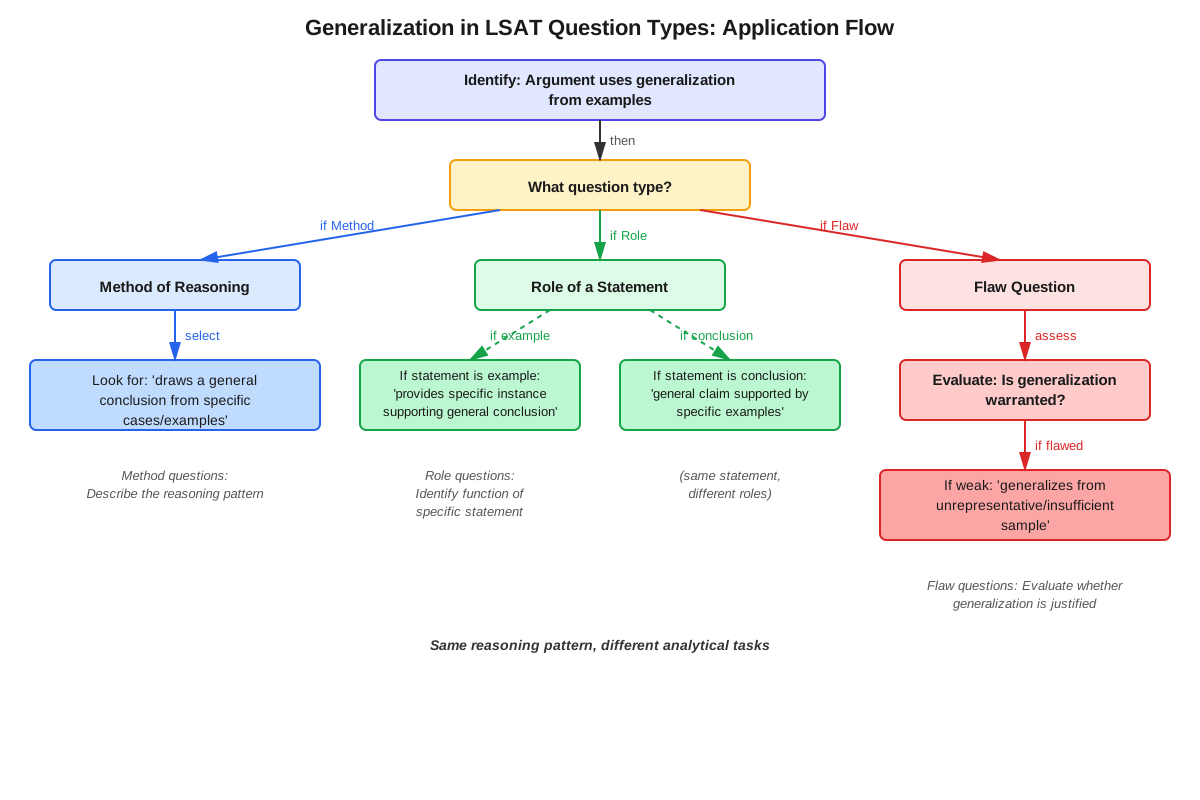
On the LSAT, test-makers expect students to recognize when an argument uses specific cases to support a broader claim, describe this reasoning pattern accurately, and evaluate whether the generalization is warranted by the evidence provided. This topic bridges multiple question types: Method of Reasoning questions ask you to identify that an argument proceeds by generalizing from examples; Role of a Statement questions may ask you to recognize that specific examples serve to support a general conclusion; and Flaw questions often test whether you can identify when a generalization is drawn too hastily or from insufficient evidence. Mastering this concept provides a foundation for understanding inductive reasoning more broadly.
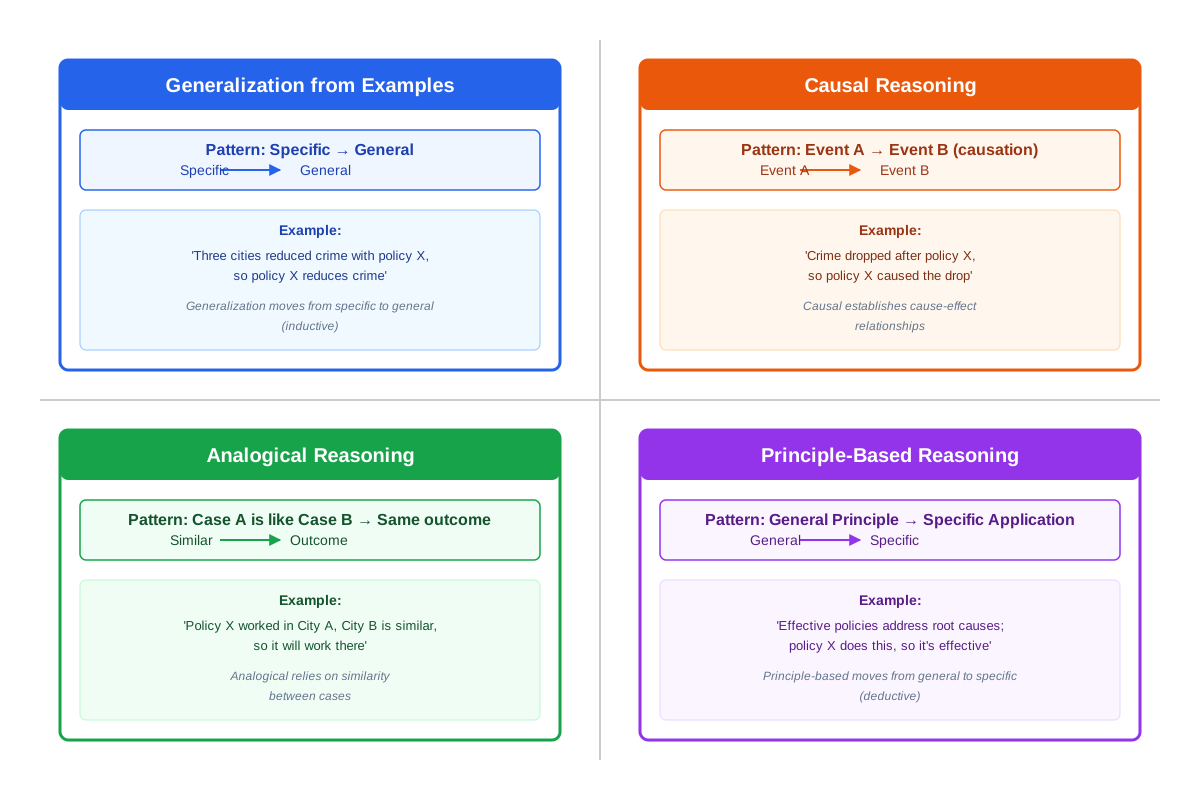
The relationship between generalization from examples and other logical reasoning concepts is crucial. While deductive arguments move from general principles to specific conclusions, generalization works in the opposite direction—from specific to general. This inductive reasoning pattern contrasts with causal reasoning, analogical reasoning, and principle-based arguments, yet it often appears alongside these patterns in complex LSAT arguments. Recognizing generalization from examples allows students to map argument structure accurately, anticipate correct answer choices, and eliminate trap answers that mischaracterize the reasoning employed.
Learning Objectives
- [ ] Identify how Generalization from examples appears in LSAT questions
- [ ] Explain the reasoning pattern behind Generalization from examples
- [ ] Apply Generalization from examples to solve LSAT-style problems accurately
- [ ] Distinguish generalization from examples from other reasoning patterns (causal, analogical, principle-based)
- [ ] Evaluate the strength of generalizations based on sample size, representativeness, and scope
- [ ] Recognize common answer choice formulations that correctly describe generalization reasoning
- [ ] Identify when a generalization constitutes a logical flaw versus legitimate inductive support
Prerequisites
- Basic argument structure: Understanding premises and conclusions is essential because generalization from examples describes the relationship between specific premise examples and general conclusions
- Inductive vs. deductive reasoning: Recognizing that generalizations are inductive (probabilistic) rather than deductive (certain) helps evaluate argument strength appropriately
- Conditional logic fundamentals: Understanding the difference between "all," "some," and "most" claims clarifies the scope of generalizations being made
- Question stem identification: Knowing whether you're answering a Method, Role, or Flaw question determines how you'll apply your understanding of generalization
Why This Topic Matters
Generalization from examples represents one of the most common reasoning patterns in everyday discourse, scientific inquiry, legal reasoning, and policy debates. When researchers conduct studies on sample populations to draw conclusions about larger groups, when courts use precedent cases to establish legal principles, or when policymakers cite specific instances to justify broad regulations, they employ generalization from examples. Understanding this pattern develops critical thinking skills applicable far beyond the LSAT, enabling students to evaluate the quality of evidence supporting claims they encounter in professional and personal contexts.
On the LSAT specifically, generalization from examples appears in approximately 15-20% of Logical Reasoning questions across various question types. Method of Reasoning questions frequently test whether students can identify this pattern, with correct answers often phrased as "draws a general conclusion from specific cases," "uses particular instances to support a universal claim," or "infers a broad principle from individual examples." Flaw questions commonly feature hasty generalizations—conclusions drawn from insufficient or unrepresentative examples. Role of a Statement questions may ask students to identify that specific examples function as evidence for a general claim. Even Strengthen and Weaken questions often hinge on whether additional examples support or undermine a generalization.
This topic appears in LSAT passages discussing scientific studies (generalizing from experimental results), social phenomena (drawing conclusions about human behavior from specific cases), legal reasoning (establishing principles from precedents), and policy arguments (supporting regulations with particular instances). The test-makers favor contexts where the generalization's legitimacy is debatable, requiring students to think critically about sample representativeness, sample size, and the scope of the conclusion relative to the evidence provided.
Core Concepts
The Basic Structure of Generalization from Examples
Generalization from examples follows a characteristic logical structure: the argument presents one or more specific instances, cases, or examples, then draws a broader conclusion that extends beyond those particular cases. The premises describe particular observations, while the conclusion makes a claim about a larger category, group, or universal principle. This movement from specific to general distinguishes generalization from other reasoning patterns.
The basic form appears as:
- Premise(s): Specific example(s) or instance(s) with particular characteristics
- Conclusion: General claim about a broader category or universal principle
For example: "The three restaurants I visited in Chicago all served excellent food. Therefore, Chicago restaurants generally serve excellent food." The premises cite three specific instances; the conclusion generalizes to a broader category (Chicago restaurants generally).
Identifying Generalization in LSAT Arguments
Recognition requires attention to linguistic markers and logical structure. LSAT generalization from examples typically features:
Premise indicators for specific examples:
- "In one case..."
- "For instance..."
- "Consider the example of..."
- "A study of [specific group] found..."
- Proper nouns or specific dates/locations
- Numerical data from particular samples
Conclusion indicators for generalizations:
- "Therefore, most..."
- "Thus, typically..."
- "This shows that generally..."
- "It follows that all..."
- "We can conclude that [broad category]..."
- Universal quantifiers (all, every, any) or frequency terms (usually, often, rarely)
The scope shift from specific to general is the defining characteristic. Even when conclusion indicators are absent, recognizing that the conclusion encompasses more cases than the premises explicitly mention signals generalization.
Types of Generalizations by Scope
Not all generalizations claim the same degree of universality. Understanding scope variations helps evaluate argument strength:
| Generalization Type | Scope | Example | Strength Required |
|---|---|---|---|
| Universal | All members of category | "All observed swans are white, so all swans are white" | Highest evidence threshold |
| Statistical Majority | Most/majority of category | "Most surveyed voters support the policy, so most voters support it" | Moderate evidence threshold |
| Typical/General | What is generally/usually true | "These cases show corruption is typical in the industry" | Lower evidence threshold |
| Existential | At least some members | "These examples prove some politicians are honest" | Lowest evidence threshold |
Universal generalizations are most vulnerable to counterexamples, while existential generalizations require only that the examples be genuine instances. The LSAT frequently tests whether students recognize when a conclusion's scope exceeds what the evidence can support.
Evaluating Generalization Strength
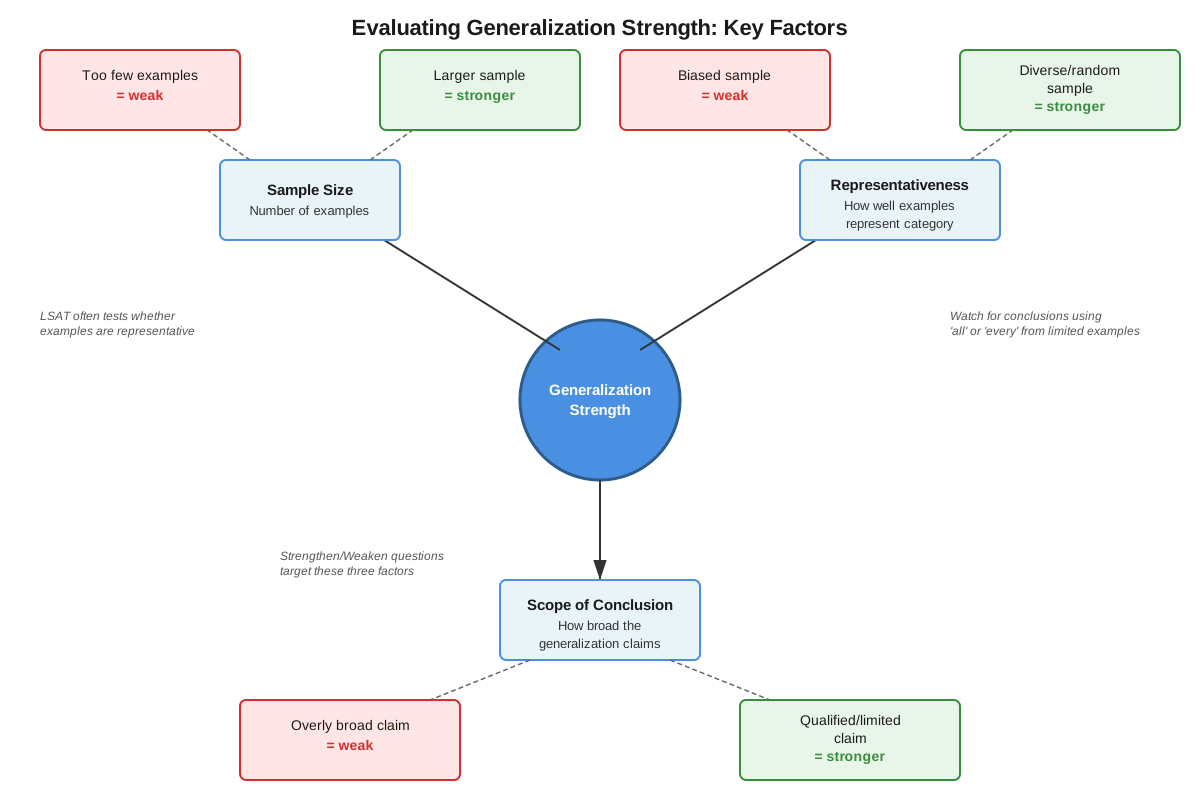
The logical strength of a generalization depends on several factors that LSAT questions frequently test:
Sample Size: Larger samples generally provide stronger support for generalizations. A conclusion about "all mammals" based on observing three mammals is weaker than one based on observing three hundred. However, sample size alone doesn't determine strength.
Sample Representativeness: The examples must be typical of the broader category. A generalization about "American voters" based solely on surveying residents of one neighborhood likely suffers from selection bias, regardless of sample size. The LSAT often presents arguments where examples come from atypical subgroups.
Scope of Conclusion: The broader the generalization, the more evidence required. Concluding that "some restaurants in Chicago serve excellent food" requires less evidence than "all Chicago restaurants serve excellent food" or "restaurants everywhere serve excellent food."
Relevant Similarities: The characteristics generalized about must be ones the examples actually share. If three Chicago restaurants serve excellent food but differ in cuisine type, location, and price range, generalizing about "Chicago restaurants" is more justified than if all three were Italian restaurants in the same neighborhood.
Generalization in Method of Reasoning Questions
Method, role, and structure questions ask students to describe how an argument proceeds or what role a statement plays. When the correct answer involves generalization from examples, it typically appears in these formulations:
- "draws a general conclusion from specific cases"
- "uses particular instances to support a broad claim"
- "infers a principle from examples"
- "generalizes from a limited sample"
- "extrapolates from observed cases to unobserved cases"
- "establishes a pattern based on individual occurrences"
Incorrect answers often mischaracterize the reasoning direction (claiming the argument moves from general to specific) or misidentify the reasoning type (describing causal, analogical, or deductive reasoning instead).
Generalization as a Flaw
When generalization appears in Flaw questions, the argument typically commits the hasty generalization fallacy—drawing a conclusion from insufficient or unrepresentative evidence. Common flaw formulations include:
- "generalizes from an unrepresentative sample"
- "draws a universal conclusion from a limited number of cases"
- "fails to establish that the examples are typical"
- "overlooks the possibility that the sample is biased"
- "treats evidence about some members of a group as evidence about all members"
The flaw isn't that the argument generalizes—generalization is legitimate inductive reasoning—but that it generalizes inappropriately given the evidence quality.
Concept Relationships
Generalization from examples connects to multiple logical reasoning concepts in a hierarchical and functional network. At the broadest level, generalization is a form of inductive reasoning, which contrasts with deductive reasoning. While deductive arguments guarantee their conclusions if premises are true, inductive arguments (including generalizations) provide probabilistic support. Understanding this distinction prevents students from applying deductive standards to inductive arguments.
Within inductive reasoning, generalization from examples relates closely to analogical reasoning. Both move from specific cases to conclusions about other cases, but analogical reasoning argues that because two things are similar in some respects, they're similar in another respect, while generalization argues that what's true of observed cases is true of the broader category. An argument might combine both: "These three cities implemented the policy successfully (examples), so our similar city (analogy) will likely succeed too."
Generalization also connects to causal reasoning. Arguments often generalize about causal relationships: "In these five studies, the drug reduced symptoms, so the drug generally causes symptom reduction." Here, generalization extends observed causal patterns to unobserved cases. Evaluating such arguments requires assessing both the causal claim and the generalization's legitimacy.
The relationship map flows as follows:
Inductive Reasoning → branches into → Generalization from Examples + Analogical Reasoning + Causal Reasoning
Generalization from Examples → requires evaluation of → Sample Size + Sample Representativeness + Conclusion Scope
Method Questions ← describe ← Generalization from Examples → when flawed → Hasty Generalization Flaw
Understanding these relationships enables students to recognize when arguments combine multiple reasoning patterns and to apply the appropriate evaluation criteria for each component.
High-Yield Facts
⭐ Generalization from examples moves from specific instances in the premises to a broader conclusion about a category or principle
⭐ Method of Reasoning correct answers describing generalization typically include phrases like "draws a general conclusion from specific cases" or "uses particular instances to support a broad claim"
⭐ The strength of a generalization depends on sample size, sample representativeness, and the scope of the conclusion relative to the evidence
⭐ Hasty generalization flaws occur when conclusions are drawn from insufficient, unrepresentative, or biased samples
⭐ Universal generalizations ("all," "every," "any") require stronger evidence than statistical generalizations ("most," "typically," "generally")
- Generalization is inductive reasoning, providing probabilistic rather than certain support for conclusions
- LSAT arguments often generalize from studies, surveys, experiments, or historical examples to broader populations or principles
- A single counterexample can refute a universal generalization but doesn't necessarily undermine statistical generalizations
- Representative samples matter more than large samples; a small random sample beats a large biased sample
- Scope creep—where the conclusion extends beyond what the examples can support—is a common generalization flaw tested on the LSAT
- Role of a Statement questions may ask students to identify that specific examples serve as evidence for a general conclusion
- Strengthen questions about generalizations often provide additional supporting examples or evidence that the sample is representative
- Weaken questions about generalizations often introduce counterexamples or evidence that the sample is unrepresentative
Quick check — test yourself on Generalization from examples so far.
Try Flashcards →Common Misconceptions
Misconception: All generalizations are logical fallacies and represent flawed reasoning.
Correction: Generalization from examples is legitimate inductive reasoning when based on sufficient, representative evidence. Only hasty or unwarranted generalizations constitute flaws. Scientists, researchers, and legal professionals regularly draw valid generalizations from appropriate samples.
Misconception: A generalization is only legitimate if it examines every single member of the category.
Correction: Examining every member would make generalization unnecessary—you'd have complete knowledge. Generalization's purpose is to draw conclusions about unobserved cases based on observed cases. The key is whether the observed cases are sufficiently numerous and representative, not whether they're exhaustive.
Misconception: Any argument that mentions specific examples is using generalization from examples.
Correction: Examples can serve multiple functions. An argument might use examples to illustrate a principle already established, to provide an analogy, or to demonstrate a causal mechanism. Generalization specifically involves deriving the general principle or conclusion from the examples, not merely illustrating a pre-established claim with examples.
Misconception: Larger samples always make generalizations stronger.
Correction: Sample representativeness matters more than size. A sample of 10,000 college students doesn't support strong generalizations about "all Americans" if college students differ systematically from the broader population. A smaller but more representative sample provides better support.
Misconception: If an argument generalizes, the correct Method of Reasoning answer will always use the word "generalization" or "generalizes."
Correction: Correct answers use varied phrasings: "draws a broad conclusion from specific cases," "uses particular instances to support a universal claim," "infers a principle from examples," "extrapolates from observed to unobserved cases." Students must recognize the concept regardless of specific wording.
Misconception: Statistical generalizations ("most," "typically") are immune to counterexamples.
Correction: While a single counterexample doesn't refute a statistical generalization the way it refutes a universal one, sufficient counterexamples can undermine statistical claims. If you claim "most restaurants in Chicago serve excellent food" based on three examples, discovering that 100 other Chicago restaurants serve poor food would seriously weaken your generalization.
Worked Examples
Example 1: Method of Reasoning Question
Argument: "A recent study examined three coastal cities that implemented strict building codes after experiencing hurricane damage. In each case, subsequent hurricanes caused significantly less property damage than previous storms of similar intensity. This demonstrates that strict building codes generally reduce hurricane damage to coastal properties."
Question: The argument proceeds by:
(A) applying a general principle to a specific case
(B) drawing a broad conclusion from a limited number of cases
(C) using an analogy between similar situations
(D) identifying a causal relationship through controlled experimentation
(E) refuting a hypothesis by providing counterexamples
Analysis:
Step 1: Identify the argument structure. The premises describe three specific cities (particular instances) where strict building codes were followed by reduced damage. The conclusion claims that strict building codes "generally" reduce damage—a broader claim extending beyond just these three cities.
Step 2: Recognize the reasoning pattern. The argument moves from specific cases (three cities) to a general principle (strict codes generally reduce damage). This is characteristic of generalization from examples.
Step 3: Evaluate answer choices:
(A) Incorrect - This describes deductive reasoning moving from general to specific, the opposite direction of this argument.
(B) Correct - This accurately describes generalization from examples. "Broad conclusion" captures the general claim about building codes generally, and "limited number of cases" acknowledges the three cities are specific instances. The phrase "limited number" doesn't necessarily indicate a flaw—it's a neutral description of the reasoning pattern.
(C) Incorrect - Analogical reasoning would compare these cities to another city and argue the other city will have similar results. This argument generalizes about coastal cities broadly, not about one specific analogous case.
(D) Incorrect - While the argument does suggest a causal relationship (codes cause reduced damage), it doesn't describe controlled experimentation. More importantly, the question asks about the method of reasoning, and the primary pattern is generalization, not causal analysis.
(E) Incorrect - The argument supports a hypothesis rather than refuting one, and provides supporting examples rather than counterexamples.
Connection to Learning Objectives: This example demonstrates how to identify generalization from examples in Method of Reasoning questions and distinguish it from other reasoning patterns.
Example 2: Flaw Question
Argument: "Every lawyer I've met at corporate law firms works more than 70 hours per week. Therefore, all lawyers work more than 70 hours per week."
Question: The reasoning is flawed because it:
(A) assumes that correlation implies causation
(B) generalizes from an unrepresentative sample
(C) confuses a necessary condition with a sufficient condition
(D) relies on the testimony of biased sources
(E) fails to define its terms precisely
Analysis:
Step 1: Identify the reasoning pattern. The argument presents specific examples (lawyers the speaker has met at corporate firms) and draws a general conclusion (all lawyers work 70+ hours).
Step 2: Evaluate the generalization's legitimacy. The conclusion's scope ("all lawyers") far exceeds the evidence scope (lawyers at corporate firms the speaker has met). Corporate law firm lawyers represent a specific subset of all lawyers—they're likely unrepresentative of public defenders, government lawyers, solo practitioners, part-time lawyers, etc.
Step 3: Identify the flaw type. This is a hasty generalization from an unrepresentative sample. The examples come from one specific context (corporate firms) that likely differs systematically from the broader category (all lawyers).
Step 4: Evaluate answer choices:
(A) Incorrect - The argument doesn't discuss correlation or causation. It generalizes from examples, not from correlated variables.
(B) Correct - This precisely identifies the flaw. Corporate law firm lawyers are an unrepresentative sample of all lawyers, yet the argument treats them as representative.
(C) Incorrect - The argument doesn't involve conditional logic or necessary/sufficient conditions. It involves generalization.
(D) Incorrect - There's no indication the sources are biased or that the argument relies on testimony rather than observation.
(E) Incorrect - While more precise definitions might help, the fundamental flaw is the unrepresentative sample, not definitional imprecision.
Connection to Learning Objectives: This example shows how to evaluate generalization strength by assessing sample representativeness and how to identify hasty generalization as a flaw.
Exam Strategy
Approaching Generalization Questions
When you encounter an LSAT Logical Reasoning question involving generalization from examples, follow this systematic approach:
Step 1: Identify the argument structure. Locate the conclusion and premises. Ask: Does the conclusion make a broader claim than the premises? Do the premises describe specific instances while the conclusion describes a category or principle?
Step 2: Confirm the reasoning pattern. Verify that the argument moves from specific to general. Watch for premise indicators like "in one study," "for example," "in these cases" paired with conclusion indicators like "therefore, generally," "thus, typically," "this shows that most."
Step 3: Assess the generalization's scope. Determine whether the conclusion claims universal truth ("all"), statistical majority ("most"), or typical patterns ("generally"). Higher scope claims require stronger evidence.
Step 4: Match to question type. For Method questions, look for answer choices describing movement from specific to general. For Flaw questions, evaluate whether the sample is sufficient and representative. For Strengthen/Weaken questions, consider what would make the sample more or less representative.
Trigger Words and Phrases
In premises (indicating specific examples):
- "A study of [specific group]"
- "In three cases"
- "Research on [particular sample]"
- "Observations of [specific instances]"
- Proper nouns, dates, specific locations
- "For instance," "for example," "consider"
In conclusions (indicating generalizations):
- "Therefore, all/most/typically"
- "This shows that generally"
- "It follows that [broad category]"
- "We can conclude that usually"
- "Thus, [universal or statistical claim]"
In answer choices (Method questions):
- "draws a general conclusion from specific cases"
- "uses particular instances to support a broad claim"
- "generalizes from a limited sample"
- "infers a principle from examples"
- "extrapolates from observed to unobserved cases"
In answer choices (Flaw questions):
- "generalizes from an unrepresentative sample"
- "draws a universal conclusion from limited cases"
- "fails to establish that the examples are typical"
- "overlooks the possibility that the sample is biased"
- "treats evidence about some as evidence about all"
Process of Elimination Tips
For Method of Reasoning questions:
- Eliminate answers describing opposite reasoning direction (general to specific)
- Eliminate answers describing different reasoning types (causal, analogical, conditional) unless the argument clearly combines patterns
- Eliminate answers that describe the conclusion's content rather than the reasoning process
- Keep answers that accurately describe movement from specific instances to broader claims
For Flaw questions:
- Eliminate answers describing flaws unrelated to generalization (causal fallacies, conditional logic errors) unless the argument has multiple flaws
- Eliminate answers that criticize the generalization for being inductive rather than deductive—inductive reasoning isn't inherently flawed
- Keep answers identifying problems with sample size, representativeness, or scope
- Watch for answers that accurately identify the flaw but use different terminology than you expected
Time Allocation
Generalization from examples questions typically require 60-90 seconds:
- 15-20 seconds: Read and understand the argument structure
- 10-15 seconds: Identify the reasoning pattern as generalization
- 10-15 seconds: Assess the generalization's strength (for Flaw questions) or prepare for answer choice matching (for Method questions)
- 25-40 seconds: Evaluate answer choices using process of elimination
If you quickly recognize the generalization pattern, you can often eliminate 3-4 answer choices rapidly, leaving more time for careful comparison of remaining choices.
Memory Techniques
The SCOPE Acronym
Remember factors affecting generalization strength with SCOPE:
- Sample size: Larger samples generally provide better support
- Conclusion breadth: Broader conclusions require more evidence
- Origin of examples: Where do the examples come from? Random or biased selection?
- Proportionality: Does the conclusion's scope match the evidence scope?
- Example representativeness: Are the examples typical of the broader category?
The Specific-to-General Visualization
Visualize generalization as a pyramid: specific examples form the narrow base, and the broad conclusion sits at the wide top. The argument builds upward from particular instances to general principles. If the base is too narrow (few examples) or unstable (unrepresentative examples), the top (conclusion) isn't well-supported.
The Direction Reminder
Remember: "Examples → Principle" not "Principle → Examples"
Generalization moves from examples to principle. If an argument moves from principle to examples, it's applying a principle, not generalizing from examples.
The Three-Question Test
When evaluating any generalization, ask:
- How many? (Sample size)
- How typical? (Representativeness)
- How broad? (Conclusion scope)
If the answers are "few," "atypical," and "very broad," the generalization is likely flawed.
Summary
Generalization from examples is a fundamental inductive reasoning pattern where arguments move from specific instances in the premises to broader conclusions about categories, groups, or principles. This pattern appears frequently on the LSAT in Method of Reasoning questions (where students must identify the reasoning pattern), Flaw questions (where hasty generalizations from insufficient or unrepresentative samples constitute logical errors), and Role of a Statement questions (where specific examples serve as evidence for general claims). The strength of any generalization depends on three key factors: sample size (more examples generally provide better support), sample representativeness (examples must be typical of the broader category), and conclusion scope (universal claims require stronger evidence than statistical claims). Students must distinguish generalization from other reasoning patterns—particularly the opposite movement from general principles to specific applications—and recognize that generalization itself isn't fallacious; only inadequately supported generalizations constitute flaws. Success requires identifying linguistic markers of specific examples in premises and general claims in conclusions, matching this pattern to correct answer choice formulations, and evaluating whether the evidence justifies the conclusion's breadth.
Key Takeaways
- Generalization from examples moves from specific instances (premises) to broader conclusions (general claims about categories or principles)
- Method of Reasoning answers correctly describing generalization include "draws a general conclusion from specific cases" and similar phrasings, not just the word "generalization"
- Evaluate generalization strength using SCOPE: Sample size, Conclusion breadth, Origin of examples, Proportionality, and Example representativeness
- Hasty generalization flaws occur when samples are too small, unrepresentative, or biased, or when conclusions are too broad for the evidence provided
- Universal generalizations ("all," "every") are more vulnerable to counterexamples and require stronger evidence than statistical generalizations ("most," "typically")
- Distinguish generalization from examples (specific to general) from applying principles (general to specific) and from analogical reasoning (specific to specific)
- Representative samples matter more than large samples—a small random sample beats a large biased sample for supporting generalizations
Related Topics
Analogical Reasoning: While generalization extends from observed cases to the broader category, analogical reasoning argues that because two specific things are similar in known respects, they're similar in another respect. Mastering generalization provides foundation for understanding analogical reasoning's different logical structure.
Causal Reasoning: Arguments often generalize about causal relationships, claiming that because X caused Y in observed cases, X generally causes Y. Understanding generalization helps evaluate whether causal patterns observed in specific instances extend to broader contexts.
Statistical Reasoning: Many generalizations involve statistical claims ("most," "typically," "rarely"). Deeper study of statistical reasoning builds on generalization concepts to address probability, sampling methodology, and statistical significance.
Flaw Question Types: Hasty generalization is one of several common LSAT flaws. Understanding this flaw thoroughly enables progression to studying other flaw types like causal fallacies, conditional logic errors, and circular reasoning.
Strengthen and Weaken Questions: These question types frequently test generalizations by asking what additional evidence would make a generalization more or less credible. Mastering generalization from examples enables sophisticated analysis of how new information affects argument strength.
Practice CTA
Now that you understand generalization from examples—how to identify it, evaluate it, and apply it to LSAT questions—it's time to cement your mastery through practice. Attempt the practice questions focusing on this reasoning pattern, paying special attention to distinguishing generalization from other reasoning types and evaluating whether samples adequately support conclusions. Use the flashcards to reinforce key concepts like the SCOPE factors and common answer choice formulations. Remember: recognizing generalization from examples quickly and accurately will save you valuable time on test day and improve your performance across multiple Logical Reasoning question types. Every practice question you complete strengthens your pattern recognition and builds the confidence you need to excel on the LSAT.
Sign up free to keep reading
Create a free AnvayaPrep account to finish this LSAT guide on Generalization from examples — plus flashcards and practice questions.