Overview
Role of a conclusion questions represent a critical category within LSAT Logical Reasoning sections, appearing consistently across multiple test administrations. These questions, part of the broader family of method, role, and structure questions, ask test-takers to identify the specific function that a particular statement plays within an argument's logical framework. Unlike questions that ask you to evaluate an argument's validity or identify assumptions, role questions focus purely on structural analysis—understanding how the pieces of an argument fit together mechanically.
Mastering role of a conclusion questions is essential for LSAT success because they test your ability to dissect arguments at a fundamental level. When you can accurately identify whether a statement serves as the main conclusion, an intermediate conclusion, a premise, background information, or another structural element, you demonstrate the analytical precision that law schools value. These questions typically present arguments with multiple claims and ask you to determine which role a specific highlighted statement plays. The complexity arises because LSAT arguments often contain subsidiary conclusions that support larger points, creating layered reasoning structures that require careful analysis.
The relationship between role of a conclusion questions and other Logical Reasoning concepts is foundational. Before you can evaluate whether an argument's reasoning is sound, identify its assumptions, or strengthen or weaken it, you must first understand its basic architecture. Role questions build directly on your ability to distinguish conclusions from premises—a skill that underlies virtually every other question type in Logical Reasoning. Furthermore, these questions prepare you for the more complex analytical tasks required in Reading Comprehension and even the Analytical Reasoning (Logic Games) section, where understanding structural relationships is paramount.
Learning Objectives
- [ ] Identify how Role of a conclusion appears in LSAT questions
- [ ] Explain the reasoning pattern behind Role of a conclusion
- [ ] Apply Role of a conclusion to solve LSAT-style problems accurately
- [ ] Distinguish between main conclusions, intermediate conclusions, and premises within complex arguments
- [ ] Recognize indicator words and structural patterns that signal different argumentative roles
- [ ] Evaluate multi-layered arguments where conclusions serve as premises for further reasoning
- [ ] Analyze arguments with implicit conclusions and determine the role of explicit statements
Prerequisites
- Basic argument structure: Understanding the fundamental distinction between premises (supporting statements) and conclusions (supported statements) is essential because role questions test your ability to identify these elements within complex contexts.
- Indicator words: Familiarity with conclusion indicators (therefore, thus, hence) and premise indicators (because, since, for) helps you quickly navigate argument structure and identify the function of specific statements.
- Reading comprehension skills: The ability to parse complex sentences and identify main ideas versus supporting details provides the foundation for distinguishing between different roles statements play in arguments.
- Logical relationships: Understanding how statements can support or follow from one another enables you to trace the flow of reasoning and determine which statements serve which functions.
Why This Topic Matters
Role of a conclusion questions appear with remarkable consistency on the LSAT, typically comprising 2-4 questions per Logical Reasoning section. Given that each LSAT contains two scored Logical Reasoning sections with approximately 25-26 questions each, you can expect to encounter 4-8 role questions on any given test administration. This frequency makes role questions a high-yield study area—mastering them directly translates to improved scores.
Beyond test performance, the analytical skills developed through role of a conclusion questions have profound real-world applications. Legal reasoning requires constant evaluation of how different claims relate to one another: which assertions serve as foundational premises, which represent intermediate steps in reasoning, and which constitute the ultimate conclusions being argued. Attorneys must construct persuasive arguments by carefully structuring their reasoning, and they must deconstruct opposing arguments by identifying weak links in the logical chain. The ability to perform structural analysis of arguments is not merely an academic exercise—it's a core competency for legal practice.
On the LSAT, role questions commonly appear in several formats. The most straightforward version presents an argument and asks about the role of a specific statement, often highlighted or referenced by line number. More challenging variants might ask you to identify which statement plays a particular role without explicitly highlighting it, requiring you to analyze the entire argument structure. Some questions combine role analysis with other tasks, such as identifying parallel reasoning or evaluating argument structure. The arguments themselves range from single-conclusion structures to complex, multi-layered reasoning chains where intermediate conclusions serve as premises for further inferences.
Core Concepts
Understanding Argument Structure
Every LSAT argument contains at least one conclusion—the main claim the author wants you to accept—and one or more premises that provide support for that conclusion. The role of a conclusion refers to the specific function a statement performs within this logical framework. A statement's role is determined not by its content but by its relationship to other statements in the argument.
The most fundamental distinction is between conclusions and premises. Premises provide reasons, evidence, or support; conclusions are the claims being supported. However, LSAT arguments frequently contain multiple layers of reasoning, creating more complex structural relationships. A statement might serve as a conclusion relative to some statements (those that support it) while simultaneously serving as a premise relative to others (those it supports).
Main Conclusions vs. Intermediate Conclusions
The main conclusion (also called the primary conclusion or ultimate conclusion) represents the argument's central claim—the final point the author wants to establish. Every argument has exactly one main conclusion, though it may not always be explicitly stated.
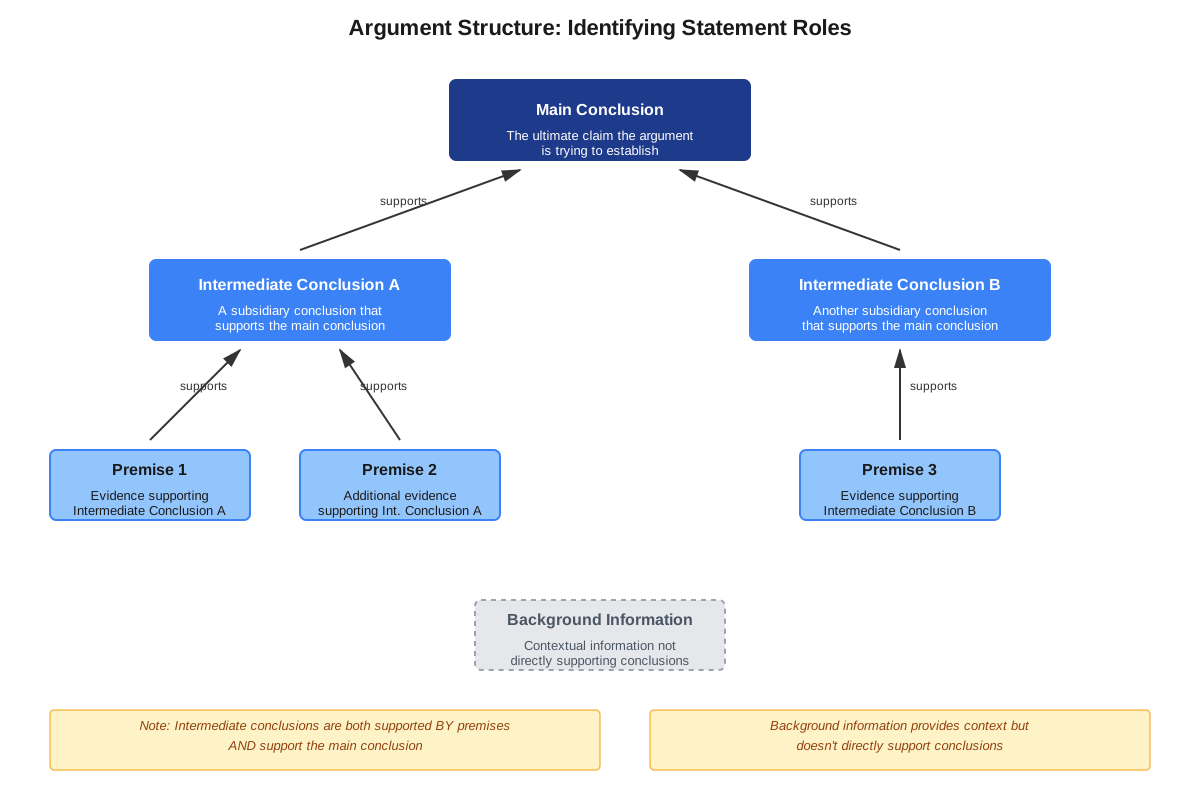
An intermediate conclusion (also called a subsidiary conclusion or sub-conclusion) is a statement that serves dual roles: it functions as a conclusion because it's supported by premises, but it also functions as a premise because it supports the main conclusion. Intermediate conclusions create logical stepping stones, allowing arguments to build complex reasoning chains.
Consider this structure:
Premise 1 + Premise 2 → Intermediate Conclusion → Main ConclusionThe intermediate conclusion is supported by Premises 1 and 2, making it a conclusion relative to them. However, it then supports the main conclusion, making it a premise relative to the main conclusion.
Identifying Conclusions Through Indicator Words
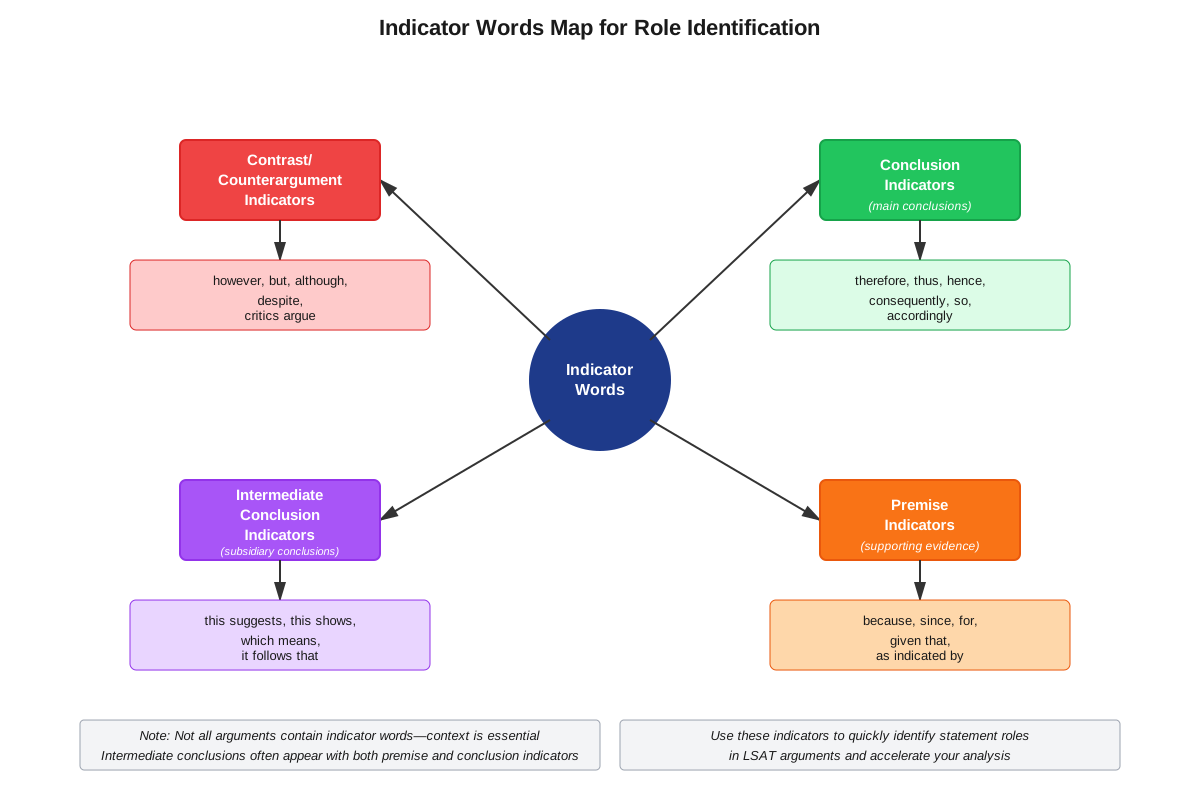
Conclusion indicators are words or phrases that signal a statement is being presented as a conclusion. Common indicators include:
- Therefore
- Thus
- Hence
- Consequently
- So
- It follows that
- We can conclude that
- This shows that
- This demonstrates that
Premise indicators signal supporting evidence:
- Because
- Since
- For
- Given that
- As indicated by
- The reason is that
- For the reason that
However, LSAT arguments deliberately vary their presentation to test your analytical skills. Not all conclusions are preceded by indicators, and some arguments present conclusions first, followed by supporting premises. The structural relationship, not the presence of indicator words, ultimately determines a statement's role.
The Support Relationship Test
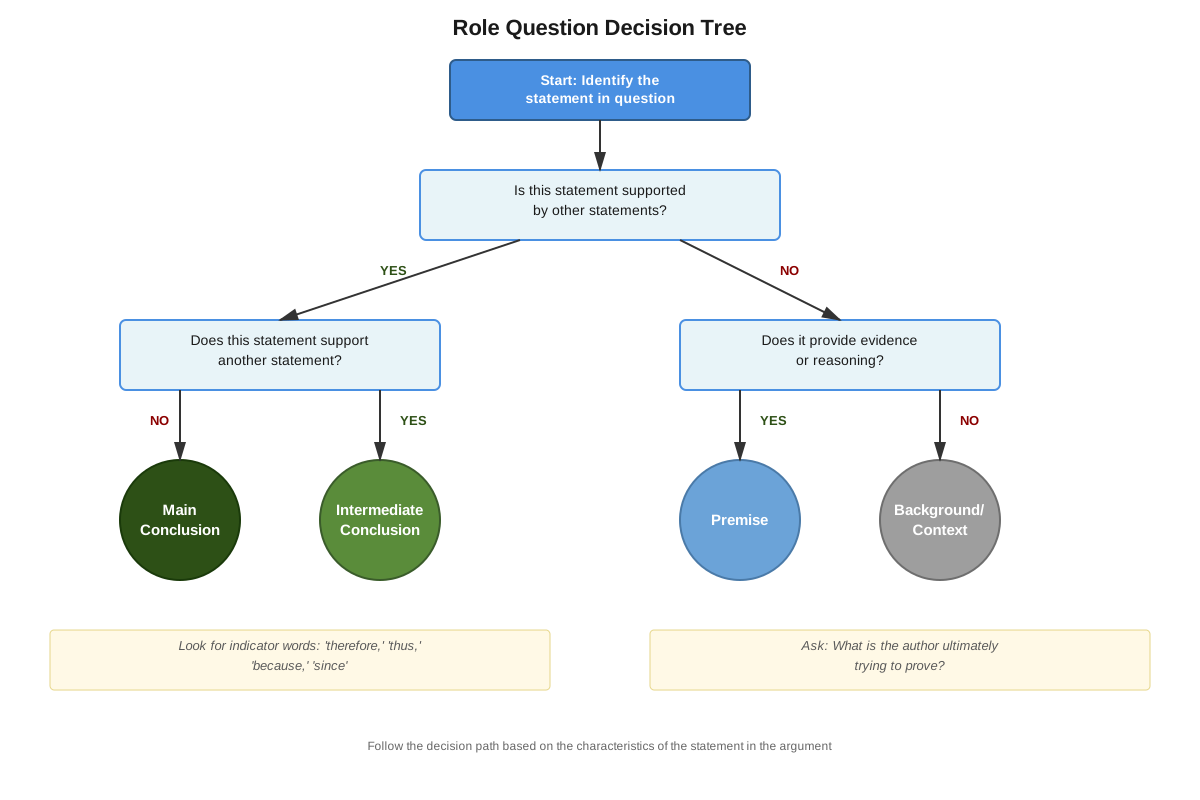
The most reliable method for determining whether a statement is a conclusion is the support relationship test. Ask two questions:
- Does this statement support another statement? If yes, it functions as a premise (at least partially).
- Is this statement supported by other statements? If yes, it functions as a conclusion (at least partially).
A statement that only supports others is a pure premise. A statement that is only supported by others is the main conclusion. A statement that both receives support and provides support is an intermediate conclusion.
Other Structural Roles
Beyond conclusions and premises, statements can play several other roles in LSAT arguments:
| Role | Function | Example Context |
|---|---|---|
| Background information | Provides context without directly supporting the conclusion | "The company was founded in 1995..." |
| Opposing viewpoint | Presents a position the argument will refute | "Some critics argue that..." |
| Concession | Acknowledges a point against the argument | "Although the policy has drawbacks..." |
| Clarification | Explains or defines terms | "By 'sustainable,' we mean..." |
| Illustration | Provides an example of a general claim | "For instance, in California..." |
| Prediction | States an expected outcome | "This will likely result in..." |
Implicit vs. Explicit Conclusions
Some LSAT arguments state their conclusions explicitly, while others leave them implicit. When a conclusion is implicit, the argument presents only premises, expecting readers to infer the conclusion. Role questions about arguments with implicit conclusions typically ask about the role of explicit statements (which will be premises or other supporting elements), but understanding that the main conclusion is unstated helps you correctly identify the roles of the stated elements.
Complex Argument Structures
Advanced LSAT arguments may contain multiple intermediate conclusions, creating branching or sequential reasoning chains:
Sequential structure:
Premise A → Intermediate Conclusion 1 → Intermediate Conclusion 2 → Main ConclusionBranching structure:
Premise A → Intermediate Conclusion 1 ↘
                                        → Main Conclusion
Premise B → Intermediate Conclusion 2 ↗
In branching structures, multiple lines of reasoning converge to support a single main conclusion. Identifying the role of any particular statement requires tracing its relationships both upstream (what supports it) and downstream (what it supports).
Concept Relationships
The concepts within role of a conclusion questions form a hierarchical and interconnected system. At the foundation lies the basic premise-conclusion distinction, which enables all further analysis. This fundamental relationship—that some statements support while others are supported—creates the logical structure of arguments.
Building on this foundation, the distinction between main conclusions and intermediate conclusions introduces layered reasoning. An intermediate conclusion depends on understanding the premise-conclusion relationship because it participates in that relationship twice: once as a conclusion (receiving support) and once as a premise (providing support). This dual nature makes intermediate conclusions the most challenging element in role questions.
Indicator words serve as surface-level clues pointing to underlying structural relationships. They connect to the premise-conclusion distinction by signaling which role a statement likely plays, but they're subordinate to the actual logical relationships. The support relationship test provides the definitive method for determining roles, superseding indicator words when they conflict.
The various other structural roles (background, opposing viewpoint, concession, etc.) relate to the core premise-conclusion framework by representing statements that participate in arguments without directly supporting or being supported. Understanding these roles requires recognizing what premises and conclusions are, then identifying statements that serve different functions.
Complex argument structures represent the synthesis of all these concepts. Analyzing a multi-layered argument requires: (1) identifying individual premise-conclusion relationships, (2) distinguishing main from intermediate conclusions, (3) using indicator words as initial guides, (4) applying the support relationship test to confirm roles, and (5) recognizing when statements play non-supporting roles.
This topic connects to prerequisite knowledge of basic argument structure by adding precision and complexity. While prerequisites establish that arguments contain premises and conclusions, role of a conclusion questions demand the ability to analyze arguments with multiple conclusions, implicit reasoning, and statements serving various functions. The skills developed here enable progression to assumption questions (which require identifying unstated premises supporting conclusions), strengthen/weaken questions (which require understanding what would affect the premise-conclusion relationship), and parallel reasoning questions (which require matching argument structures).
High-Yield Facts
⭐ The main conclusion is the statement that receives support but provides no support to any other statement in the argument.
⭐ An intermediate conclusion both receives support from premises and provides support to the main conclusion.
⭐ Conclusion indicator words (therefore, thus, hence) suggest but do not definitively establish that a statement is a conclusion—the logical relationship determines the role.
⭐ The support relationship test (asking what supports what) is the most reliable method for determining a statement's role.
⭐ Not all arguments explicitly state their main conclusion; some present only premises and expect readers to infer the conclusion.
- Background information provides context but does not directly support the conclusion through logical reasoning.
- A statement can serve as a premise in one argument and a conclusion in another—role is context-dependent.
- Opposing viewpoints are often introduced to be refuted, not to support the argument's conclusion.
- Concessions acknowledge points against the argument but are typically followed by stronger countervailing considerations.
- The main conclusion often appears at the beginning or end of an argument, but it can appear anywhere.
- Multiple premises can independently support a conclusion (independent support) or work together (joint support).
- Illustrations and examples typically support general claims, making them premises relative to those claims.
- Questions asking about "the role played by" a statement are explicitly testing your understanding of argument structure.
Quick check — test yourself on Role of a conclusion so far.
Try Flashcards →Common Misconceptions
Misconception: The conclusion always appears at the end of an argument.
Correction: While conclusions frequently appear at the end, they can appear anywhere in an argument—at the beginning, middle, or end. The conclusion's position is determined by rhetorical choice, not logical necessity. Always use the support relationship test rather than relying on position.
Misconception: Any statement preceded by "therefore" or "thus" must be the main conclusion.
Correction: Conclusion indicators signal that a statement is a conclusion, but they don't distinguish between main and intermediate conclusions. A statement preceded by "therefore" might be an intermediate conclusion that supports a further claim. Always trace the complete support structure.
Misconception: An argument can have multiple main conclusions.
Correction: By definition, an argument has exactly one main conclusion—the ultimate claim being established. What appears to be multiple main conclusions is typically either multiple intermediate conclusions supporting a single main conclusion, or multiple independent arguments presented together.
Misconception: If a statement is supported by evidence, it cannot also be a premise.
Correction: Intermediate conclusions are both supported by premises and serve as premises for further conclusions. A statement's role is determined by its relationships to all other statements in the argument, not just one relationship.
Misconception: Background information and premises are the same thing.
Correction: Premises provide logical support for conclusions through reasoning relationships. Background information provides context that helps readers understand the argument but doesn't directly support the conclusion through logical inference. For example, "The company was founded in 1995" provides context, while "The company has been profitable for 25 years" could serve as a premise supporting a conclusion about the company's financial stability.
Misconception: Longer or more complex statements are more likely to be conclusions.
Correction: A statement's role is independent of its length or complexity. Simple statements can be main conclusions, while complex statements can be premises. Focus on logical relationships, not surface features.
Misconception: Every statement in an argument must be either a premise or a conclusion.
Correction: Arguments can contain statements serving other roles: background information, opposing viewpoints, concessions, clarifications, illustrations, and predictions. Not every statement participates directly in the premise-conclusion support structure.
Worked Examples
Example 1: Identifying an Intermediate Conclusion
Argument: "Recent studies show that regular exercise reduces stress hormones in the bloodstream. Since reduced stress hormones lead to better sleep quality, and better sleep quality improves cognitive function, we can conclude that regular exercise enhances cognitive performance."
Question: What role does the statement "better sleep quality improves cognitive function" play in the argument?
Solution:
Step 1: Identify all claims in the argument
- Claim A: Regular exercise reduces stress hormones
- Claim B: Reduced stress hormones lead to better sleep quality
- Claim C: Better sleep quality improves cognitive function
- Claim D: Regular exercise enhances cognitive performance
Step 2: Map the support relationships
Let's trace what supports what:
- Claim A is presented as evidence (supported by "recent studies")
- Claim A supports Claim B (the connection between exercise and sleep quality)
- Claim B supports Claim C (the connection between sleep and cognition)
- Claims A, B, and C together support Claim D (the final conclusion about exercise and cognition)
Step 3: Apply the support relationship test to Claim C
Does Claim C support another statement? Yes—it supports Claim D (the main conclusion that exercise enhances cognitive performance).
Is Claim C supported by other statements? Yes—it's supported by the chain of reasoning from Claims A and B.
Step 4: Determine the role
Since Claim C both receives support and provides support, it functions as an intermediate conclusion. It's a conclusion relative to the earlier premises about exercise and stress hormones, but it serves as a premise supporting the main conclusion about cognitive performance.
Answer: The statement "better sleep quality improves cognitive function" serves as an intermediate conclusion. It's supported by the earlier claims about exercise reducing stress hormones and stress reduction improving sleep, and it in turn supports the main conclusion that exercise enhances cognitive performance.
Connection to learning objectives: This example demonstrates how to identify the role of a conclusion by tracing support relationships in a multi-layered argument, applying the reasoning pattern that intermediate conclusions both receive and provide support.
Example 2: Distinguishing Main Conclusion from Premises
Argument: "The city should invest in expanding public transportation. Traffic congestion has increased by 40% over the past five years, and this congestion costs the local economy approximately $200 million annually in lost productivity. Expanded public transportation would reduce the number of private vehicles on the road. Furthermore, cities with robust public transportation systems experience 25% less traffic congestion than comparable cities without such systems."
Question: Which statement represents the main conclusion of this argument?
Solution:
Step 1: Identify all claims
- Claim A: The city should invest in expanding public transportation
- Claim B: Traffic congestion has increased by 40% over the past five years
- Claim C: This congestion costs the local economy approximately $200 million annually
- Claim D: Expanded public transportation would reduce the number of private vehicles
- Claim E: Cities with robust public transportation systems experience 25% less traffic congestion
Step 2: Look for indicator words
The argument doesn't use explicit conclusion indicators like "therefore" or "thus," so we must rely on structural analysis.
Step 3: Apply the support relationship test to each claim
Claim A: Does it support other statements? No. Is it supported by other statements? Yes—all other claims provide reasons to invest in public transportation.
Claim B: Does it support other statements? Yes—it establishes the problem that needs solving. Is it supported by other statements? No—it's presented as factual evidence.
Claim C: Does it support other statements? Yes—it shows why congestion matters. Is it supported by other statements? Partially—it builds on Claim B.
Claim D: Does it support other statements? Yes—it explains how public transportation addresses the problem. Is it supported by other statements? No—it's presented as a logical consequence.
Claim E: Does it support other statements? Yes—it provides evidence that public transportation reduces congestion. Is it supported by other statements? No—it's presented as factual evidence.
Step 4: Identify the main conclusion
Claim A is the only statement that receives support without providing support to any other statement. All other claims work together to support the recommendation that the city should invest in public transportation.
Step 5: Verify by considering the argument's purpose
The argument's purpose is to persuade readers that the city should take a specific action. Claims B, C, D, and E all provide reasons supporting this recommendation. The argument would make no sense if Claim A were removed, but any individual supporting claim could be removed without destroying the argument's basic structure.
Answer: The main conclusion is "The city should invest in expanding public transportation." All other statements serve as premises providing evidence and reasoning to support this recommendation.
Connection to learning objectives: This example demonstrates how to identify the main conclusion in an argument without explicit indicator words, applying the support relationship test systematically and explaining the reasoning pattern that distinguishes conclusions from premises.
Exam Strategy
Approaching Role Questions Systematically
When you encounter a role of a conclusion question on the LSAT, follow this strategic process:
- Read the question stem first to identify which statement's role you need to determine. This focuses your reading and prevents wasting time analyzing irrelevant parts of the argument.
- Read the argument actively, marking conclusion indicators, premise indicators, and the statement in question. Use your scratch paper to create a quick structural map if the argument is complex.
- Apply the support relationship test to the statement in question: What supports it? What does it support? This two-question approach reliably determines the statement's role.
- Predict the answer before looking at the choices. Determine whether the statement is a main conclusion, intermediate conclusion, premise, or other role based on your analysis.
- Eliminate wrong answers systematically, using your structural understanding to rule out choices that mischaracterize the support relationships.
Trigger Words and Phrases
Question stems that indicate role questions:
- "The claim that [statement] plays which one of the following roles in the argument?"
- "The statement that [statement] serves which one of the following functions?"
- "Which one of the following most accurately describes the role played by [statement]?"
- "In the argument, the claim that [statement] is used to..."
- "The author's statement that [statement] figures in the argument in which one of the following ways?"
In answer choices, watch for these descriptive phrases:
- "It is the main conclusion of the argument" (main conclusion)
- "It is a conclusion for which the argument provides support, and which itself supports the argument's main conclusion" (intermediate conclusion)
- "It is a premise offered in support of the argument's conclusion" (premise)
- "It provides background information" (context, not direct support)
- "It is a position that the argument opposes" (opposing viewpoint)
- "It is a concession that the argument makes" (acknowledged counterpoint)
- "It is an illustration of a general principle" (example supporting a broader claim)
Process of Elimination Tips
Eliminate answers that:
- Reverse the support relationship: If the statement supports the conclusion, eliminate choices saying the conclusion supports it.
- Confuse main and intermediate conclusions: If the statement supports another claim in the argument, it cannot be the main conclusion—eliminate choices describing it as such.
- Claim the statement is unsupported when it receives support: If premises support the statement, eliminate choices describing it as a premise or assumption.
- Mischaracterize the statement's relationship to opposing viewpoints: If the statement represents the author's position, eliminate choices saying it's a view the argument opposes.
- Describe roles the statement doesn't play: If the statement provides direct logical support, eliminate choices describing it as mere background or illustration.
Time Allocation
Role questions typically require 60-90 seconds to complete—slightly less than the average 1:20 per question if you're efficient. The key to speed is:
- Quickly identifying the support structure rather than re-reading multiple times
- Using indicator words as initial guides to accelerate your analysis
- Trusting your structural analysis rather than second-guessing when you've correctly identified relationships
- Moving on if stuck after 90 seconds—you can return if time permits
Exam Tip: If an argument contains multiple layers of reasoning, draw a quick arrow diagram on your scratch paper showing what supports what. This visual representation makes complex structures immediately clear and prevents errors.
Memory Techniques
The SUPPORT Acronym
Use SUPPORT to remember the systematic approach to role questions:
- Scan the question stem first
- Underline the statement in question
- Premise indicators and conclusion indicators—mark them
- Predict what supports what
- Outline the structure (main conclusion, intermediate conclusions, premises)
- Review answer choices against your prediction
- Test remaining choices by elimination
The Conclusion Hierarchy Visualization
Visualize arguments as a pyramid:
                    [Main Conclusion]
                          ↑
              [Intermediate Conclusion(s)]
                          ↑
                    [Premises]
Support flows upward. Statements at the bottom (premises) support statements in the middle (intermediate conclusions), which support the statement at the top (main conclusion). When determining a statement's role, visualize where it sits in this pyramid.
The "Therefore Test"
To identify the main conclusion, try inserting "therefore" before each statement and asking whether the rest of the argument supports it. The statement that makes the most sense preceded by "therefore," with all other statements supporting it, is the main conclusion.
The Two-Question Mantra
Memorize and repeat: "What supports it? What does it support?" These two questions, applied consistently, will correctly identify any statement's role.
The IC Rule (Intermediate Conclusion)
Remember: IC = In the Chain. Intermediate Conclusions are "In the Chain" of reasoning—they're links between premises and the main conclusion, both receiving support and providing it.
Summary
Role of a conclusion questions test your ability to analyze argument structure by identifying the specific function statements play within logical frameworks. The fundamental skill is distinguishing between statements that provide support (premises), statements that receive support (conclusions), and statements that do both (intermediate conclusions). The main conclusion represents the argument's ultimate claim—the point everything else supports—while intermediate conclusions serve as logical stepping stones, being supported by premises and supporting the main conclusion. Determining a statement's role requires applying the support relationship test: asking what supports the statement and what the statement supports. While indicator words like "therefore" and "because" provide helpful clues, the actual logical relationships between statements definitively determine their roles. Beyond premises and conclusions, statements can serve other functions including providing background information, presenting opposing viewpoints, offering concessions, or illustrating general principles. Success on role questions requires systematic analysis: identifying all claims, mapping support relationships, applying the support relationship test, and matching your structural understanding to answer choices. These questions appear consistently on the LSAT and test foundational analytical skills essential for legal reasoning.
Key Takeaways
- The main conclusion is the ultimate claim being established—it receives support but provides none to other statements in the argument.
- Intermediate conclusions both receive support from premises and provide support to the main conclusion, serving as logical bridges in multi-layered arguments.
- The support relationship test (asking what supports what) is the most reliable method for determining any statement's role, superseding indicator words when they conflict.
- Conclusion indicators (therefore, thus, hence) and premise indicators (because, since, for) provide helpful clues but don't definitively establish roles—always verify through structural analysis.
- Not all statements in arguments are premises or conclusions; some provide background, present opposing views, offer concessions, or serve other structural functions.
- Role questions require systematic analysis: read the question stem first, identify the statement in question, map support relationships, predict the answer, and eliminate wrong choices based on structural mischaracterizations.
- Drawing quick structural diagrams showing what supports what accelerates analysis and prevents errors in complex, multi-layered arguments.
Related Topics
Assumption Questions: After mastering role of a conclusion, assumption questions become more accessible because they require identifying unstated premises that support conclusions. Understanding what role explicit statements play helps you recognize what unstated statements must be present for the reasoning to work.
Strengthen and Weaken Questions: These questions ask you to identify information that would make an argument more or less convincing. Recognizing the role of conclusions and premises enables you to target the specific premise-conclusion relationships that strengthen/weaken questions test.
Method of Reasoning Questions: These questions ask how an argument proceeds or what argumentative technique it employs. Role of a conclusion questions build the structural analysis skills that method of reasoning questions require at a more sophisticated level.
Parallel Reasoning Questions: These questions require matching the structure of one argument to another. Mastering role analysis enables you to identify structural patterns (main conclusion supported by intermediate conclusion supported by premises) that parallel reasoning questions test.
Flaw Questions: Identifying logical flaws requires understanding what role different statements play. You must recognize which statement is the conclusion and which statements are supposed to support it before you can identify why the support fails.
Practice CTA
Now that you've mastered the core concepts of role of a conclusion questions, it's time to apply your knowledge. Work through the practice questions to test your ability to identify main conclusions, intermediate conclusions, and premises in complex arguments. Use the flashcards to reinforce your understanding of key concepts and terminology. Remember: structural analysis is a skill that improves with deliberate practice. Each question you analyze strengthens your ability to quickly and accurately identify argument structure—a skill that will serve you throughout the LSAT and in legal reasoning beyond. Approach each practice question systematically, applying the support relationship test and trusting your analytical process. You've built a strong foundation; now reinforce it through application.
Sign up free to keep reading
Create a free AnvayaPrep account to finish this LSAT guide on Role of a conclusion — plus flashcards and practice questions.