Overview
The role of analogy is a critical concept within LSAT Logical Reasoning that appears frequently in method, role, and structure questions. These questions ask test-takers to identify the function that an analogy serves within an argument's structure. An analogy in LSAT arguments typically involves comparing two situations, objects, or scenarios to support a conclusion by suggesting that what is true in one case should be true in another similar case. Understanding how analogies function within arguments is essential because the LSAT regularly tests whether students can recognize when an author uses comparative reasoning to strengthen a point, illustrate a principle, or challenge an opposing view.
The LSAT role of analogy questions require more than simply identifying that an analogy exists—they demand precise understanding of what argumentative work the analogy performs. Does it provide support for the main conclusion? Does it illustrate an abstract principle with a concrete example? Does it undermine a counterargument? These distinctions are crucial for selecting correct answers and avoiding trap choices that describe what the analogy says rather than what it does within the argument's logical structure.
Mastering this topic connects directly to broader Logical Reasoning skills, including argument analysis, structural recognition, and the ability to distinguish between content and function. Students who excel at identifying the role of analogy demonstrate sophisticated reading comprehension and can parse complex argumentative structures—skills that translate across all Logical Reasoning question types and contribute significantly to overall LSAT performance.
Learning Objectives
- [ ] Identify how Role of analogy appears in LSAT questions
- [ ] Explain the reasoning pattern behind Role of analogy
- [ ] Apply Role of analogy to solve LSAT-style problems accurately
- [ ] Distinguish between the content of an analogy and its structural function within an argument
- [ ] Recognize the different purposes analogies serve (supporting conclusions, illustrating principles, refuting objections)
- [ ] Evaluate answer choices by matching them to the precise argumentative role the analogy plays
Prerequisites
- Basic argument structure: Understanding premises, conclusions, and how claims support one another is essential because role questions require identifying how specific elements function within the overall argument framework.
- Comparative reasoning: Familiarity with how similarities between cases can provide logical support enables recognition of when and why authors deploy analogical reasoning.
- Question stem recognition: Knowing how to identify method, role, and structure questions from their stems allows efficient application of appropriate strategies.
- Argument mapping: The ability to mentally or physically diagram argument flow helps visualize where analogies fit within the logical structure.
Why This Topic Matters
In legal reasoning—the foundation of LSAT design—analogies serve as fundamental tools for applying precedents, interpreting statutes, and constructing persuasive arguments. Lawyers constantly argue that Case A should be decided like Case B because of relevant similarities, making analogical reasoning central to legal practice. The LSAT tests this skill because it predicts success in law school and legal careers.
On the exam itself, role of analogy questions appear with significant frequency. Approximately 15-20% of Logical Reasoning questions involve method, role, and structure analysis, and analogies represent one of the most common argumentative techniques tested within this category. Students can expect to encounter 2-4 questions per test that either directly ask about the role of an analogy or require understanding analogical reasoning to answer correctly.
These questions typically appear in several formats: explicit "role" questions asking what function a specific statement serves, "method of reasoning" questions asking how the argument proceeds, and occasionally "parallel reasoning" questions where understanding analogical structure is crucial. The analogies themselves range from simple comparisons (comparing two consumer products) to complex multi-layered scenarios (comparing historical events to contemporary situations). Recognizing the pattern allows for systematic, efficient problem-solving rather than relying on intuition alone.
Core Concepts
What Is an Analogy in LSAT Arguments?
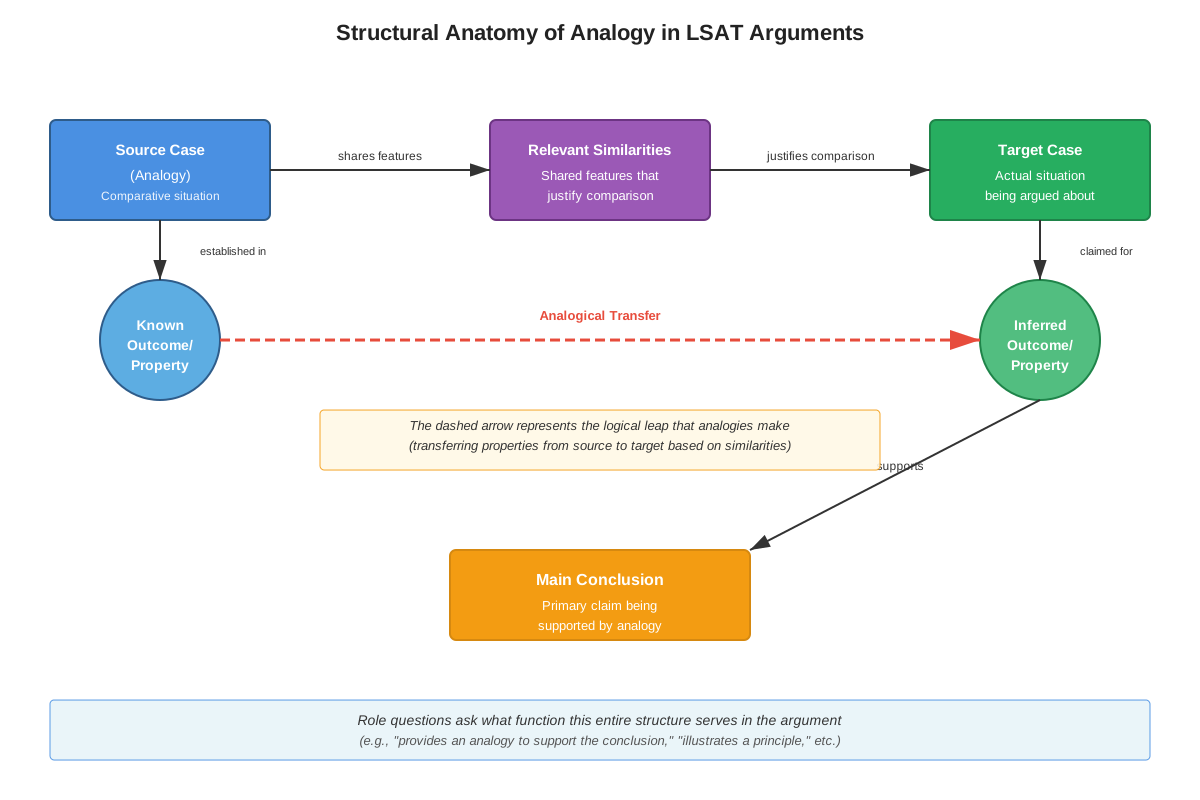
An analogy in Logical Reasoning is a comparison between two different situations, cases, or entities that highlights relevant similarities to support a conclusion. The fundamental structure involves:
- Source case/situation: The comparison point (often more familiar or already accepted)
- Target case/situation: The subject of the conclusion (what the argument is actually about)
- Relevant similarities: Shared features that justify treating the cases similarly
- Conclusion: A claim that what applies to the source should apply to the target
For example: "Just as we require licenses for driving cars because unlicensed drivers pose public safety risks, we should require licenses for owning firearms because unlicensed gun owners similarly pose public safety risks." Here, car licensing is the source, gun licensing is the target, public safety risk is the relevant similarity, and the licensing requirement is what transfers from source to target.
The Role vs. The Content Distinction
The most critical distinction for these questions is between what the analogy says (content) and what the analogy does (role/function). Many incorrect answer choices describe the content—the specific comparison being made—rather than the structural function the analogy serves.
Content: The specific details of the comparison (cars and guns, licensing requirements, safety risks)
Role/Function: The argumentative work performed (supporting the main conclusion, illustrating a principle, providing a counterexample)
LSAT questions about role of analogy always ask about function, not content. The correct answer will describe the structural relationship between the analogy and other parts of the argument.
Common Roles Analogies Play
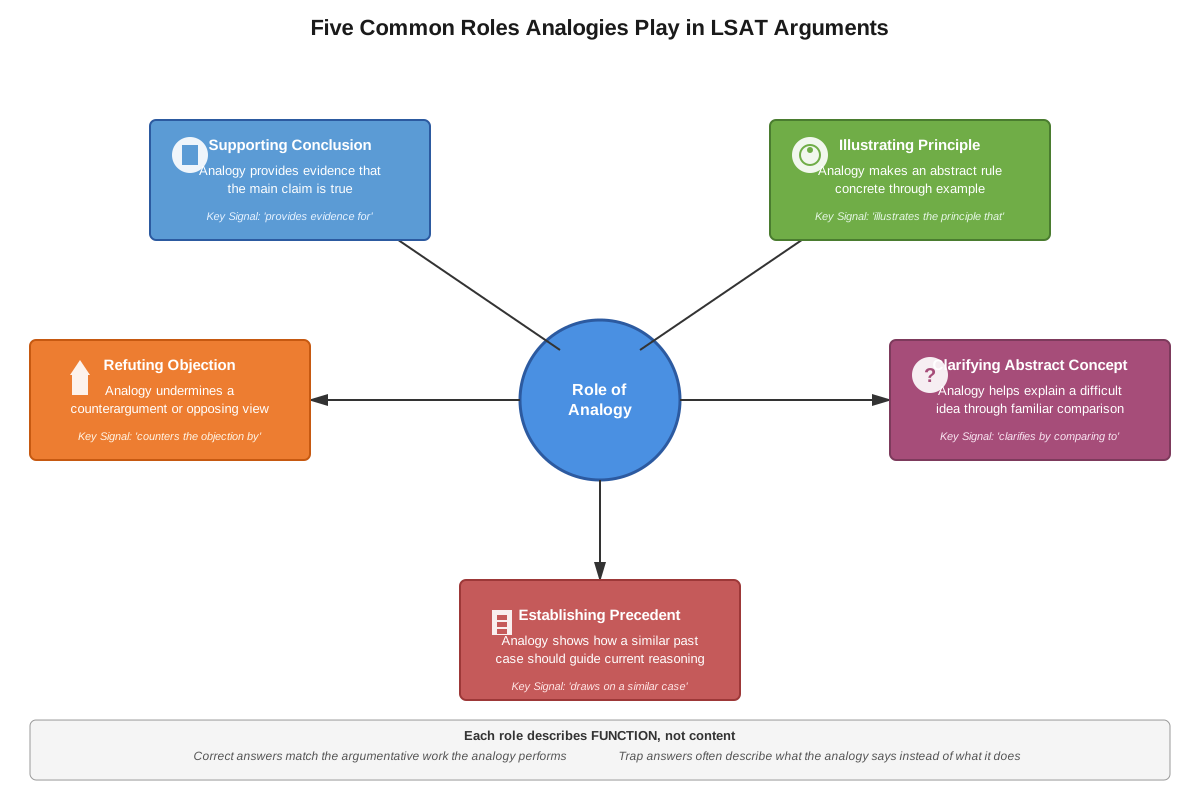
Analogies serve several distinct functions in LSAT arguments:
| Role | Description | Example Signal |
|---|---|---|
| Supporting the main conclusion | Provides evidence that the conclusion is likely true by showing a parallel case | "Similarly..." "Just as..." |
| Illustrating a principle | Makes an abstract rule concrete through a specific example | "For instance..." "Consider..." |
| Refuting an objection | Undermines a counterargument by showing it leads to absurd conclusions in analogous cases | "But that reasoning would also mean..." |
| Establishing a precedent | Shows that a similar case has already been decided a certain way | "We already accept that..." |
| Clarifying a concept | Explains a difficult idea through comparison to something more familiar | "Think of it like..." |
Structural Patterns in Analogy-Based Arguments
Arguments using analogies typically follow predictable patterns:
Pattern 1: Direct Support
- Premise about source case
- Analogy drawing parallel to target case
- Conclusion about target case
Pattern 2: Principle Illustration
- Abstract principle stated
- Analogy providing concrete example
- Application of principle to main case
Pattern 3: Objection Refutation
- Opposing view presented
- Analogy showing absurd consequence of that view
- Rejection of opposing view
Pattern 4: Precedent Application
- Established case/rule described
- Analogy showing current case is similar
- Conclusion that same rule should apply
Recognizing these patterns allows rapid identification of the analogy's function within the argument structure.
Evaluating Analogical Strength
While role questions focus on function rather than quality, understanding what makes analogies strong or weak helps identify their purpose. Strong analogies share relevant similarities—features that actually matter for the conclusion. Weak analogies rely on superficial or irrelevant similarities.
The LSAT often includes arguments with questionable analogies, and recognizing this helps distinguish between "the role the analogy is intended to play" (what the question asks) and "whether the analogy succeeds" (a separate evaluation question).
Signal Words and Phrases
Certain linguistic markers reliably indicate analogical reasoning:
- "Similarly" / "Likewise" / "By the same token"
- "Just as... so too..."
- "Analogously" / "Comparable to"
- "Consider the case of..."
- "This is like..."
- "We can see this by looking at..."
- "For example" / "For instance" (when followed by a comparison)
These signals help locate analogies quickly during timed test conditions and flag statements likely to be referenced in role questions.
Concept Relationships
The role of analogy concept connects to multiple aspects of Logical Reasoning:
Argument Structure → Role of Analogy: Understanding basic argument structure (premises supporting conclusions) is foundational because identifying an analogy's role requires first mapping the overall argument framework. The analogy's function only makes sense in relation to the conclusion it supports or the principle it illustrates.
Role of Analogy → Method of Reasoning: Role questions are a subset of method questions. While method questions ask broadly "how does the argument proceed," role questions ask specifically "what function does this element serve." Mastering role of analogy builds skills for all method questions.
Role of Analogy → Parallel Reasoning: Both question types require recognizing structural patterns. Parallel reasoning questions ask students to find arguments with matching structures, which often involves matching analogical patterns.
Role of Analogy → Strengthen/Weaken Questions: Understanding how analogies support conclusions helps predict what would strengthen (additional relevant similarities) or weaken (relevant differences) analogical arguments.
Textual Relationship Map:
Basic Argument Structure → Enables identification of → Role of Analogy → Applies to → Method Questions → Connects with → Parallel Reasoning → Informs → Strengthen/Weaken Analysis
High-Yield Facts
⭐ Role questions ask about function (what the analogy does), not content (what the analogy says).
⭐ The most common role for analogies is supporting the main conclusion by showing a parallel case.
⭐ Signal words like "similarly," "just as," and "likewise" reliably indicate analogical reasoning.
⭐ Analogies can illustrate abstract principles by providing concrete examples.
⭐ When an analogy appears after an opposing view, it typically functions to refute that objection.
- Analogies compare a source case (the comparison point) to a target case (the subject of the conclusion).
- Strong analogies rely on relevant similarities—features that actually matter for the conclusion.
- The same analogy might serve different roles in different arguments depending on context.
- Incorrect answer choices often describe the content of the analogy rather than its structural function.
- Recognizing argument patterns (direct support, principle illustration, objection refutation) speeds identification of analogical roles.
- Multiple analogies in one argument may serve different functions—read carefully to match the question to the correct analogy.
- The location of an analogy within the argument (before or after the conclusion) provides clues about its function.
Quick check — test yourself on Role of analogy so far.
Try Flashcards →Common Misconceptions
Misconception: An analogy's role is to prove the conclusion with certainty.
Correction: Analogies provide support or illustration but rarely constitute proof. They suggest that what's true in one case is likely true in another similar case, but this is probabilistic reasoning, not deductive proof. The role is to strengthen or clarify, not to definitively establish.
Misconception: If an analogy is weak or flawed, it doesn't have a role in the argument.
Correction: Even flawed analogies serve structural functions. Role questions ask what function the author intends the analogy to serve, not whether it succeeds. A weak analogy might still be intended to support the conclusion—it just does so poorly.
Misconception: The role of an analogy is always to support the main conclusion.
Correction: While supporting conclusions is common, analogies serve multiple functions: illustrating principles, refuting objections, clarifying concepts, or establishing precedents. Context determines the specific role.
Misconception: Longer, more detailed analogies are more important to the argument's structure.
Correction: Length doesn't determine importance or role. A brief one-sentence analogy might provide crucial support, while an extended comparison might merely illustrate a point already established. Function matters more than length.
Misconception: The analogy's role is whatever the answer choice says most accurately describes the comparison.
Correction: Accuracy of description doesn't equal correct identification of role. An answer might accurately describe what the analogy says but incorrectly identify what it does. Always focus on structural function within the argument.
Misconception: If the question asks about "the claim that X," and X is part of an analogy, the answer must mention analogies.
Correction: The correct answer describes the function, which might be "provides support for the conclusion" without explicitly mentioning that it does so through analogy. The method (analogy) and the role (support) are related but distinct.
Worked Examples
Example 1: Direct Support Role
Argument: "The city should not ban electric scooters from sidewalks. After all, we allow bicycles on sidewalks despite occasional accidents, and electric scooters pose similar safety risks to bicycles. Since we've determined that bicycles' benefits outweigh their risks, the same reasoning applies to electric scooters."
Question: The claim that bicycles are allowed on sidewalks despite occasional accidents plays which of the following roles in the argument?
Analysis:
Step 1: Identify the conclusion: "The city should not ban electric scooters from sidewalks."
Step 2: Map the argument structure:
- Premise 1: Bicycles are allowed on sidewalks despite accidents
- Premise 2: Electric scooters pose similar risks to bicycles
- Premise 3: Bicycles' benefits outweigh risks
- Conclusion: Same reasoning applies to scooters (don't ban them)
Step 3: Identify the analogy: The comparison between bicycles (source) and scooters (target).
Step 4: Determine the function: The bicycle claim establishes a precedent—a similar case already decided a certain way. This precedent, combined with the similarity claim, supports the conclusion that scooters should be treated the same way.
Correct Answer Type: "It describes a precedent that, together with a claim about relevant similarities, supports the argument's conclusion."
Why This Works: The answer identifies the structural function (supporting the conclusion through precedent) rather than merely describing the content (that bicycles are allowed). It captures how the bicycle claim works together with the similarity claim to build the argument.
Example 2: Principle Illustration Role
Argument: "Companies should not be required to disclose their proprietary algorithms to regulators. Requiring such disclosure would undermine innovation by removing competitive advantages. Consider that we don't require restaurants to disclose their secret recipes to health inspectors—inspectors verify safety through other means. The same approach should apply to algorithm regulation: verify outcomes without demanding disclosure of methods."
Question: The statement about restaurants and secret recipes serves which role in the argument?
Analysis:
Step 1: Identify the conclusion: "Companies should not be required to disclose proprietary algorithms to regulators."
Step 2: Map the argument structure:
- Main premise: Disclosure would undermine innovation
- Analogy: Restaurant recipe example
- Application: Same approach for algorithms
Step 3: Identify what the analogy does: The restaurant example doesn't directly support the conclusion. Instead, it illustrates the principle that regulation can verify safety without requiring disclosure of proprietary information. It makes the abstract principle concrete.
Step 4: Note the pattern: The analogy comes after the main reasoning and serves to clarify/illustrate rather than prove.
Correct Answer Type: "It provides an analogous case that illustrates how the principle underlying the argument's conclusion can be applied."
Why This Works: The restaurant example doesn't prove algorithms shouldn't be disclosed—it shows that the regulatory approach (verify outcomes without disclosure) already works in another domain. This is illustration of a principle, not direct evidential support for the conclusion.
Exam Strategy
Approaching Role of Analogy Questions
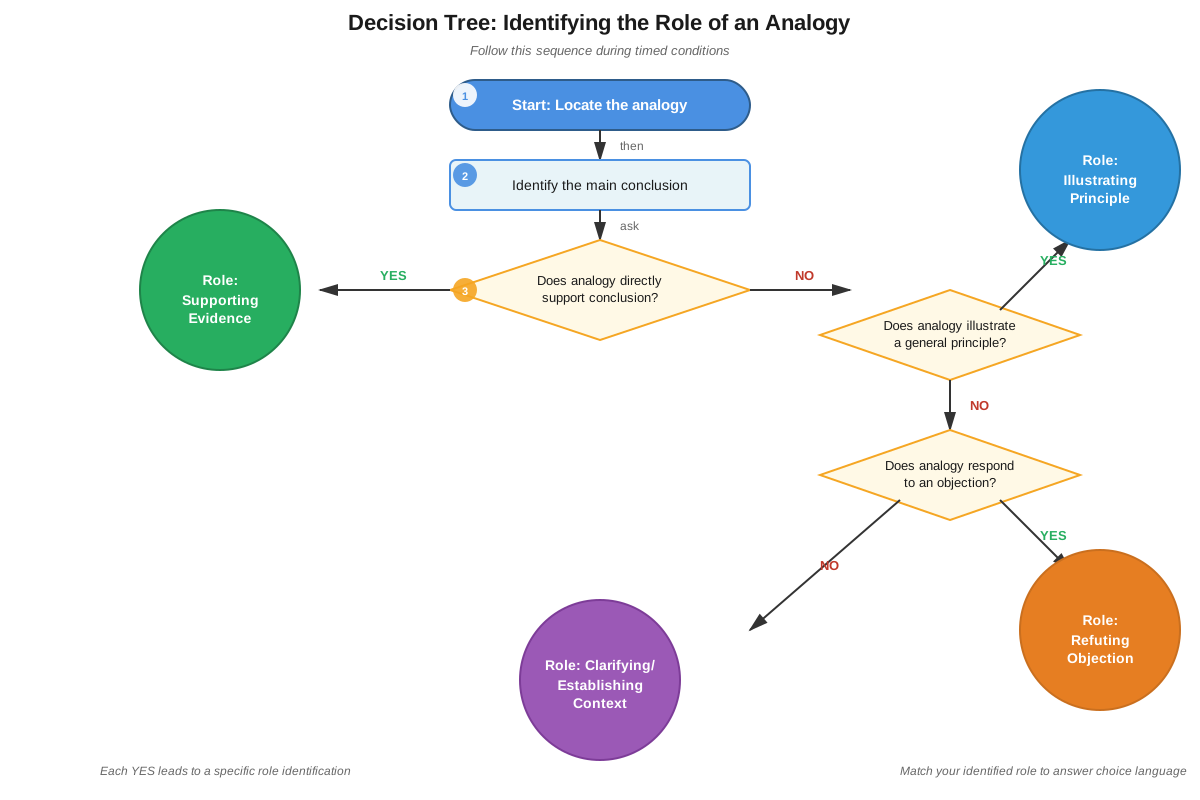
Step 1: Identify the Question Type
Look for stems like:
- "The claim that X plays which role..."
- "The statement about Y functions in the argument to..."
- "The author uses the example of Z in order to..."
Step 2: Locate and Bracket the Referenced Statement
Find the exact claim mentioned in the question stem and mark it clearly. Don't assume you remember it correctly—verify the precise wording.
Step 3: Map the Argument Structure
Before looking at answer choices, identify:
- The main conclusion
- The primary premises
- Where the analogy fits in the logical flow
Step 4: Determine the Function
Ask: "What would be missing if this analogy were removed?" The answer reveals its function:
- If the conclusion would lack support → supporting role
- If an abstract principle would remain unclear → illustrating role
- If an objection would stand unchallenged → refuting role
Step 5: Predict the Answer
Formulate your own description of the role before reading choices. This prevents answer choices from influencing your analysis.
Step 6: Eliminate Wrong Answer Types
Remove choices that:
- Describe content instead of function
- Reference parts of the argument the analogy doesn't relate to
- Misidentify the conclusion
- Claim the analogy does something it doesn't (e.g., "proves" when it only "supports")
Trigger Words to Watch For
In Question Stems:
- "plays which role"
- "functions to"
- "serves to"
- "in order to"
- "for the purpose of"
In Arguments (signaling analogies):
- "similarly" / "likewise"
- "just as... so too"
- "consider" / "for example" (when comparative)
- "we already accept that"
- "this is like"
In Answer Choices (function words):
- "supports" / "provides evidence for"
- "illustrates" / "exemplifies"
- "refutes" / "undermines"
- "establishes" / "demonstrates"
- "clarifies" / "explains"
Time Allocation
Role of analogy questions typically require 60-90 seconds:
- 15-20 seconds: Read and understand the argument
- 10-15 seconds: Locate the referenced statement
- 15-20 seconds: Determine its function
- 20-30 seconds: Evaluate answer choices
If you find yourself spending more than 90 seconds, you may be overthinking. Return to basics: What is the conclusion? How does this statement relate to that conclusion?
Process of Elimination Tips
Eliminate answers that:
- Describe what the analogy says rather than what it does
- Reference the wrong conclusion (some arguments have subsidiary conclusions)
- Claim the analogy "proves" or "establishes with certainty" (analogies rarely do this)
- Describe functions the analogy doesn't perform (e.g., "refutes an objection" when no objection appears)
- Use vague language that could apply to any premise ("provides information relevant to the conclusion")
Keep answers that:
- Precisely identify the structural relationship to the conclusion
- Use appropriate strength language ("supports," "suggests," "provides reason to believe")
- Match your pre-formulated prediction
- Account for all elements of the analogy's function
Memory Techniques
The SCRAP Mnemonic
Remember the five common roles analogies play with SCRAP:
- Supporting the conclusion (most common)
- Clarifying a concept
- Refuting an objection
- Applying a principle (illustration)
- Precedent establishing
When you identify an analogy, quickly run through SCRAP to determine which function it serves.
The Function-Not-Content Mantra
Memorize and repeat: "Function, not content. What it DOES, not what it SAYS."
This simple reminder prevents the most common error on role questions—selecting answers that accurately describe the analogy's content but misidentify its structural function.
The Removal Test Visualization
Visualize the argument as a physical structure (like a building). Mentally "remove" the analogy and observe what happens:
- Does the conclusion collapse? → Supporting role
- Does an abstract idea remain foggy? → Illustrating role
- Does an opposing beam push through? → Refuting role
This concrete visualization makes the abstract concept of "role" more tangible and memorable.
Location-Function Association
Create mental associations between where analogies appear and their likely functions:
- Early in argument (before conclusion): Usually supporting or establishing precedent
- After conclusion: Usually illustrating or clarifying
- After "some might object": Usually refuting
While not absolute rules, these patterns provide quick initial hypotheses during timed conditions.
Summary
The role of analogy in LSAT Logical Reasoning questions requires students to identify the structural function that comparative reasoning serves within an argument, rather than simply recognizing that a comparison exists. Analogies appear frequently in method, role, and structure questions, serving various purposes: supporting conclusions by showing parallel cases, illustrating abstract principles with concrete examples, refuting objections by revealing absurd implications, establishing precedents, or clarifying difficult concepts. Success on these questions depends on distinguishing between an analogy's content (what it says) and its role (what it does), mapping argument structure to determine how the analogy relates to the conclusion, and selecting answers that precisely describe the structural function rather than merely summarizing the comparison. Signal words like "similarly," "just as," and "likewise" help locate analogies quickly, while systematic analysis of the argument's logical flow reveals the specific work each analogy performs. Mastering this topic requires practice identifying patterns, avoiding the common trap of content-focused answers, and developing the ability to see arguments as structural frameworks where each element serves a specific purpose.
Key Takeaways
- Role questions ask what an analogy DOES (function), not what it SAYS (content)—this distinction is the foundation of all correct answers.
- The five common roles (SCRAP: Supporting, Clarifying, Refuting, Applying/illustrating, Precedent) cover most analogies you'll encounter on the LSAT.
- Map the argument structure first: Identify the conclusion, then determine how the analogy relates to it before evaluating answer choices.
- Signal words like "similarly," "just as," and "likewise" reliably indicate analogical reasoning and help you locate relevant statements quickly.
- The removal test (asking what would be missing if the analogy were deleted) reveals the analogy's function within the argument.
- Predict the answer before reading choices to avoid being misled by attractive but incorrect descriptions of the analogy's content.
- Location provides clues: Analogies before the conclusion typically support it; analogies after the conclusion often illustrate principles or clarify concepts.
Related Topics
Parallel Reasoning Questions: These questions require identifying arguments with matching structures, often involving analogical patterns. Mastering role of analogy builds the structural recognition skills essential for parallel reasoning success.
Method of Reasoning Questions: Role questions are a specific type of method question. Understanding analogical roles provides a framework for analyzing other argumentative techniques like conditional reasoning, causal claims, and evidence citation.
Strengthen and Weaken Questions: Knowing how analogies support conclusions helps predict what would strengthen (additional relevant similarities) or weaken (relevant differences) analogical arguments, making these question types more approachable.
Flaw Questions: Many flawed arguments rely on weak analogies—comparisons based on superficial or irrelevant similarities. Understanding the role analogies should play helps identify when they fail to fulfill that role.
Principle Questions: Analogies often illustrate principles, and principle questions ask about the general rules underlying specific cases. The connection between these topics strengthens overall Logical Reasoning performance.
Practice CTA
Now that you understand how analogies function within LSAT arguments, it's time to apply this knowledge to actual test questions. Work through the practice questions associated with this topic, paying special attention to distinguishing between content and function in each answer choice. Use the SCRAP mnemonic to quickly categorize each analogy's role, and practice the removal test to verify your analysis. Remember: every practice question you complete builds the pattern recognition and structural analysis skills that translate directly to test-day success. The more you practice identifying roles, the more automatic and efficient this skill becomes—turning a challenging question type into a reliable source of points on your LSAT.
Sign up free to keep reading
Create a free AnvayaPrep account to finish this LSAT guide on Role of analogy — plus flashcards and practice questions.