Overview
The role of causal claim is a critical concept within LSAT Logical Reasoning that tests a student's ability to identify and analyze how causal statements function within an argument's structure. When the LSAT asks about the role a causal claim plays, it is assessing whether test-takers can distinguish between premises, conclusions, intermediate conclusions, background information, and objections—specifically when these elements involve cause-and-effect relationships. This topic appears frequently in method, role, and structure questions, which ask students to describe what function a particular statement serves rather than to evaluate whether the argument is sound.
Understanding the role of causal claim is essential because causal reasoning pervades LSAT arguments. Authors frequently use causal relationships to build their cases, whether arguing that one phenomenon causes another, that a correlation suggests causation, or that an intervention will produce a specific effect. The LSAT tests whether students can step back from the content of these claims and analyze their structural function. For instance, a causal claim might serve as the main conclusion the argument seeks to establish, or it might function as evidence supporting a different conclusion entirely. Misidentifying these roles leads to incorrect answers on questions worth valuable points.
Within the broader landscape of logical reasoning, role questions—including those focused on causal claims—bridge the gap between understanding argument structure and evaluating argument quality. While strengthen/weaken questions ask students to assess an argument's validity, and assumption questions probe what's unstated, role questions demand precise structural analysis. Mastering this topic builds the foundation for tackling more complex question types and develops the analytical precision necessary for achieving elite LSAT scores.
Learning Objectives
- [ ] Identify how role of causal claim appears in LSAT questions
- [ ] Explain the reasoning pattern behind role of causal claim
- [ ] Apply role of causal claim to solve LSAT-style problems accurately
- [ ] Distinguish between causal claims functioning as conclusions versus premises
- [ ] Recognize when causal claims serve as intermediate conclusions or subsidiary points
- [ ] Analyze how causal claims interact with other structural elements in complex arguments
- [ ] Evaluate answer choices that describe the role of causal statements with precision
Prerequisites
- Basic argument structure: Understanding premises, conclusions, and how they connect is essential because role questions ask students to identify which structural component a causal claim represents.
- Causal reasoning fundamentals: Familiarity with cause-and-effect relationships, including the difference between correlation and causation, provides the content knowledge necessary to recognize causal claims.
- Indicator words: Knowledge of conclusion indicators (therefore, thus, hence) and premise indicators (because, since, for) helps students trace the logical flow and determine structural roles.
- Question stem recognition: Ability to identify role questions by their characteristic phrasing ensures students apply the appropriate analytical approach.
Why This Topic Matters
The role of causal claim appears with remarkable frequency on the LSAT, making it a high-yield topic for focused study. Role questions constitute approximately 10-15% of all Logical Reasoning questions, and a substantial portion of these involve causal claims given how commonly LSAT arguments employ causal reasoning. These questions appear in both Logical Reasoning sections, meaning students encounter them multiple times per test. Missing these questions significantly impacts scaled scores, particularly since they're considered medium difficulty—questions that strong test-takers should answer correctly.
In real-world applications, the ability to identify how causal claims function within arguments is fundamental to legal reasoning, policy analysis, and scientific discourse. Lawyers must distinguish between causal claims used as evidence versus those serving as the ultimate point to be proven. Policy makers need to recognize whether a proposed causal mechanism is being offered as established fact or as a hypothesis requiring support. This skill translates directly to law school case analysis, where students must parse complex judicial opinions and identify which causal assertions are holdings versus dicta.
On the LSAT specifically, role of causal claim questions typically appear with stems like: "The claim that X causes Y plays which one of the following roles in the argument?" or "The statement that increased regulation led to decreased innovation functions in the argument as..." These questions test pure structural analysis—students must set aside whether they agree with the causal claim and focus solely on its argumentative function. Common passage contexts include scientific studies, policy debates, historical explanations, and business analyses, all domains where causal reasoning predominates.
Core Concepts
Understanding Causal Claims
A causal claim is any statement asserting that one phenomenon brings about, produces, or is responsible for another phenomenon. These claims take various forms: "X causes Y," "X leads to Y," "X results in Y," "X is responsible for Y," or "Y occurs because of X." On the LSAT, causal claims may be explicit ("The new policy caused crime rates to drop") or implicit ("Crime rates dropped after the new policy was implemented," suggesting causation through temporal sequence). Recognizing these claims is the first step in analyzing their role.
Causal claims differ from mere correlations or associations. While "X and Y occur together" describes a correlation, "X causes Y" makes a stronger assertion about the relationship's nature. The LSAT frequently exploits this distinction, presenting arguments where authors move from correlation to causation or where causal claims require additional support. Understanding this difference helps students recognize when a causal claim needs justification versus when it serves as established evidence.
Structural Roles Causal Claims Can Play
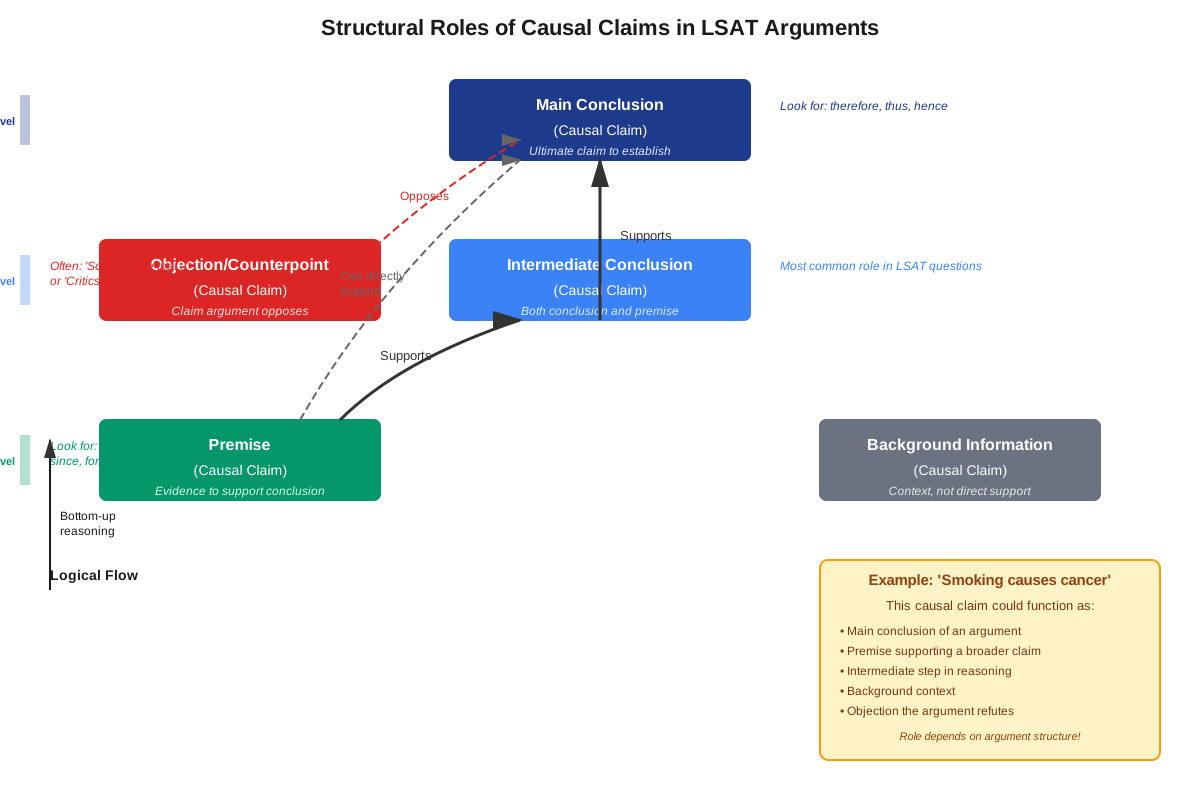
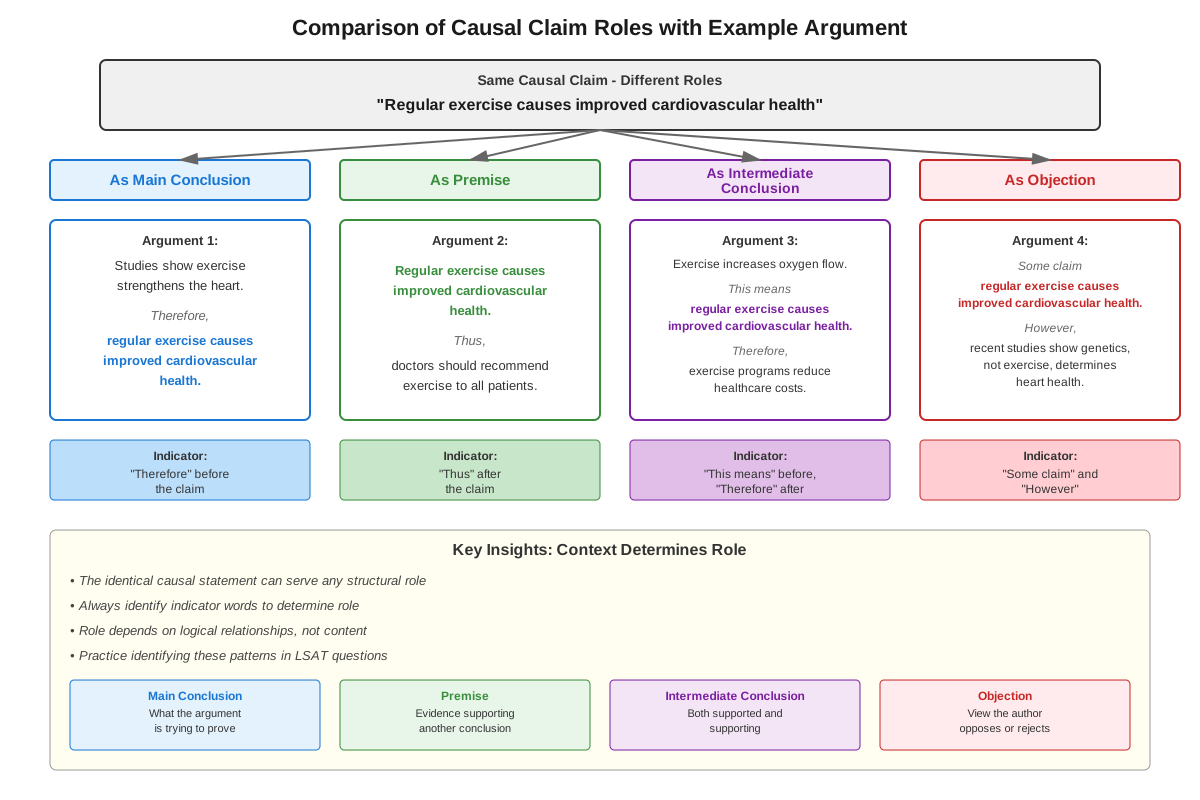
Causal claims can occupy any structural position within an argument. As main conclusions, they represent the ultimate point the argument seeks to establish. For example: "The evidence shows that excessive screen time causes attention problems in children" might be the conclusion supported by various studies and statistics. When a causal claim serves as the main conclusion, all other statements in the argument provide reasons to accept this causal relationship.
As premises, causal claims function as evidence supporting a different conclusion. Consider: "Because smoking causes lung cancer (causal premise), we should ban cigarette advertising (conclusion)." Here, the causal relationship is treated as established fact used to justify a policy recommendation. The argument doesn't seek to prove the causal link; it uses that link to support a separate claim.
Causal claims frequently serve as intermediate conclusions or subsidiary points—claims that are both supported by some evidence and used to support further conclusions. For instance: "Studies show correlation between variables A and B (evidence). Therefore, A likely causes B (intermediate conclusion). Thus, we should implement policy C (main conclusion)." The causal claim receives support from correlation data while simultaneously supporting the policy recommendation.
Less commonly, causal claims can function as background information or context, providing necessary information without serving as evidence. They might also represent opposing positions that the argument seeks to refute, or concessions the author acknowledges before presenting counterarguments.
Analyzing Argument Structure
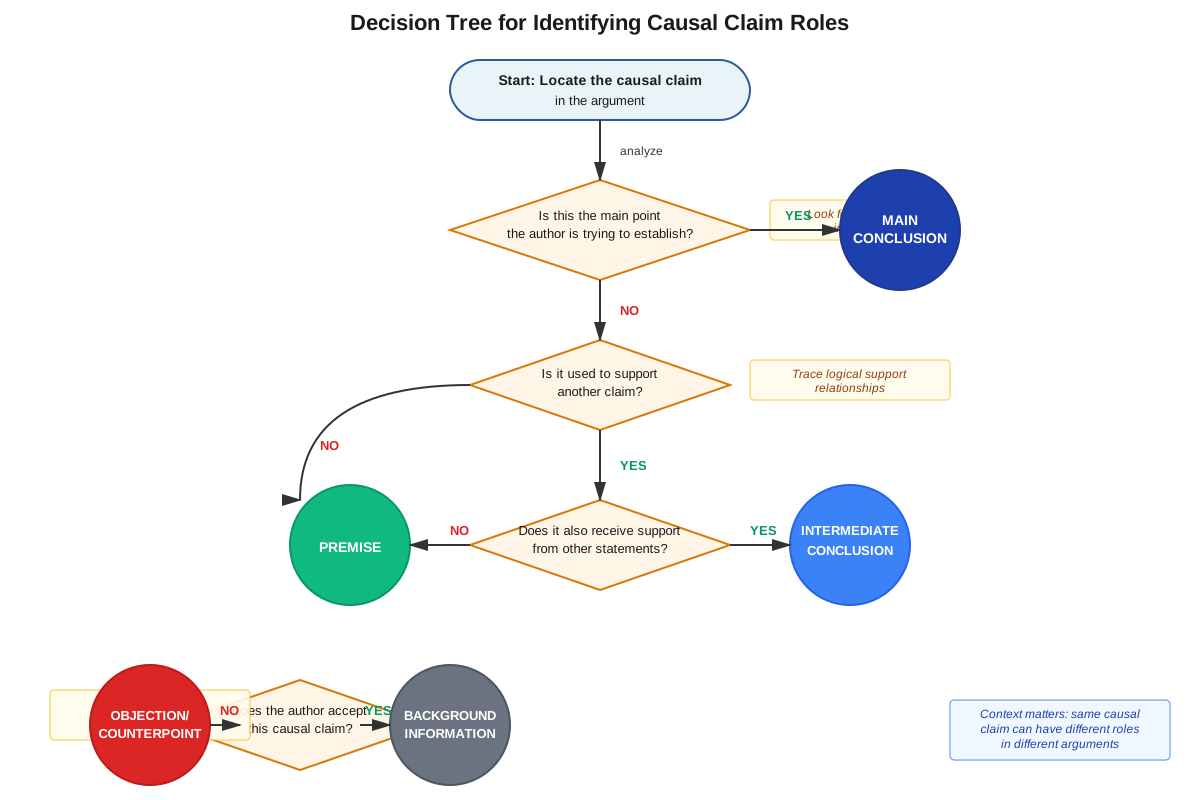
To determine a causal claim's role, students must map the entire argument structure. This process involves several steps:
- Identify the main conclusion: Look for the author's ultimate point—what they most want to convince the reader to accept
- Locate all premises: Find statements offered as reasons, evidence, or support
- Identify the causal claim in question: Determine which specific statement the question asks about
- Trace logical connections: Determine whether other statements support the causal claim, whether the causal claim supports other statements, or both
- Match to answer choices: Select the description that accurately captures these relationships
The key insight is that role questions test function, not truth. Whether the causal claim is actually correct is irrelevant; what matters is how it operates within the argument's logical structure. A false causal claim can still serve as a premise if the author treats it as established, and a well-supported causal claim might still be the conclusion if that's what the argument aims to prove.
Common Patterns in LSAT Arguments
Certain argumentative patterns involving causal claims appear repeatedly on the LSAT:
Pattern 1: Causal Claim as Conclusion
- Evidence → Evidence → Evidence → Therefore, X causes Y
- The entire argument builds toward establishing the causal relationship
Pattern 2: Causal Claim as Premise
- X causes Y (given) → Therefore, we should do Z
- The causal relationship is assumed or treated as established
Pattern 3: Causal Chain
- A causes B → B causes C → Therefore, A causes C
- Multiple causal claims link together, with some serving as intermediate conclusions
Pattern 4: Causal Explanation
- Phenomenon Y occurred → X caused Y (explanation) → Therefore, conclusion about X or Y
- The causal claim explains an observed phenomenon and supports further inference
Distinguishing Role from Evaluation
A critical distinction exists between role questions and evaluation questions (strengthen, weaken, assumption, flaw). Role questions ask "What does this claim do?" while evaluation questions ask "Is this claim justified?" or "How could we assess this claim?" Students must recognize role question stems and avoid bringing in evaluative thinking. The answer to a role question describes structural function using neutral language: "serves as the main conclusion," "provides evidence for," "is a hypothesis that the argument seeks to support." Answers never say "proves," "demonstrates conclusively," or make claims about the argument's quality.
Concept Relationships
The role of causal claim concept integrates multiple foundational logical reasoning skills. At its base, it requires understanding argument structure—the ability to distinguish premises from conclusions. This prerequisite knowledge enables students to then identify where causal claims fit within that structure. The relationship flows: Basic Structure Knowledge → Causal Reasoning Recognition → Role Identification.
Within the topic itself, concepts connect hierarchically. Students must first recognize causal claims (identifying cause-effect language) before they can analyze structural position (determining whether the claim is a premise, conclusion, or intermediate point). This analysis then enables answer choice evaluation (matching the claim's function to the correct description). The progression is: Recognition → Analysis → Application.
The role of causal claim connects forward to more advanced topics in method, role, and structure questions. Mastering causal claim roles provides a template for analyzing the role of any statement type—analogies, generalizations, counterexamples, or definitions. The analytical process remains consistent: identify the statement, trace its logical connections, determine its function. Additionally, understanding causal claim roles enhances performance on assumption questions (recognizing when a causal conclusion requires assumptions about alternative causes) and strengthen/weaken questions (knowing whether to support or undermine a causal premise versus conclusion).
The relationship map: Argument Structure Fundamentals → Causal Reasoning Basics → Role of Causal Claim → Advanced Role Questions → Integration with Assumption/Strengthen/Weaken Questions → Comprehensive Logical Reasoning Mastery.
High-Yield Facts
⭐ Role questions ask about function, not truth: The correctness of a causal claim is irrelevant to determining its structural role in the argument.
⭐ Causal claims can serve as premises, conclusions, or intermediate conclusions: The same type of statement can occupy different structural positions depending on the argument.
⭐ Main conclusions are supported by other statements but don't support anything else: If other claims in the argument support the causal claim and it doesn't support further conclusions, it's the main conclusion.
⭐ Premises support other claims but receive no support themselves within the argument: If the causal claim is treated as given and used to justify another statement, it's functioning as a premise.
⭐ Intermediate conclusions both receive and provide support: If evidence supports the causal claim AND the causal claim supports a further conclusion, it's an intermediate conclusion.
⭐ Indicator words help but aren't definitive: "Therefore" often precedes conclusions and "because" often precedes premises, but context determines actual function.
- Causal language varies widely: "Causes," "leads to," "results in," "produces," "brings about," "is responsible for," "explains," and "accounts for" all signal causal claims.
- Temporal sequence doesn't prove causation: "After X, Y occurred" suggests but doesn't establish that X caused Y; arguments often treat this as requiring further support.
- Role questions typically quote or paraphrase a specific claim: The question stem identifies which statement's role students must determine.
- Wrong answers often describe the role of different statements: Incorrect options may accurately describe other parts of the argument but not the specific causal claim in question.
- Background information provides context without serving as evidence: Some causal claims simply set the stage rather than supporting or being supported.
- Opposing views are positions the argument rejects: A causal claim might represent a view the author argues against rather than endorses.
- Concessions acknowledge points before countering them: Authors sometimes accept causal claims before arguing they're outweighed by other factors.
- Multiple causal claims can appear in a single argument: Students must carefully identify which specific claim the question asks about.
- Answer choices use precise structural language: "Serves as," "functions as," "plays the role of," and "is used to" are common phrasings that describe argumentative function.
Quick check — test yourself on Role of causal claim so far.
Try Flashcards →Common Misconceptions
Misconception: A causal claim that appears early in the argument must be a premise.
Correction: Position within the passage doesn't determine structural role. Conclusions can appear first, with supporting premises following. Students must trace logical relationships, not rely on physical location.
Misconception: If a causal claim is well-supported by evidence, it must be the conclusion.
Correction: A causal claim can receive substantial support yet still function as a premise supporting a further conclusion. Intermediate conclusions are both supported and supporting. The main conclusion is whatever the argument ultimately aims to establish.
Misconception: Role questions require evaluating whether the causal claim is justified.
Correction: Role questions are purely structural. Students should not assess argument quality, identify flaws, or consider whether the causal claim is actually true. The question asks only what function the claim serves.
Misconception: Causal claims always use explicit causal language like "causes" or "leads to."
Correction: Causal relationships can be implied through temporal language ("after the policy, crime decreased"), explanatory language ("this accounts for the phenomenon"), or conditional structures ("if X, then Y" can suggest causation). Students must recognize implicit causal claims.
Misconception: The longest or most complex statement in the argument is the conclusion.
Correction: Conclusions can be brief and simple while premises are detailed and complex. Structural role depends on logical function, not statement length or complexity. A simple causal claim like "X causes Y" can be the main conclusion supported by extensive evidence.
Misconception: If the author provides evidence for a causal claim, that claim cannot also be a premise.
Correction: Intermediate conclusions receive support from some statements while supporting others. A causal claim can be both proven by evidence and used to justify a further conclusion. Students must trace all logical connections, not assume each claim has only one relationship.
Misconception: Background information and premises are the same thing.
Correction: Premises actively support conclusions, while background information provides context without serving as evidence. A causal claim offered as general context ("Historically, X has caused Y") differs from one used as a reason to accept the conclusion.
Worked Examples
Example 1: Causal Claim as Main Conclusion
Argument: "Recent studies have found a strong correlation between daily meditation practice and reduced anxiety levels. Participants who meditated showed decreased cortisol production, a hormone associated with stress. Additionally, brain scans revealed increased activity in regions associated with emotional regulation among meditators. These findings indicate that meditation causes reduced anxiety."
Question: The claim that meditation causes reduced anxiety plays which role in the argument?
Analysis:
- Identify the causal claim: "Meditation causes reduced anxiety" (final sentence)
- Locate the main conclusion: The argument builds toward establishing this causal relationship—it's what the author wants to prove
- Identify premises: The correlation study, cortisol findings, and brain scan results all serve as evidence
- Trace logical connections: All other statements support the causal claim; the causal claim doesn't support any further conclusion
- Determine role: The causal claim is the main conclusion
Answer: The claim serves as the main conclusion, supported by evidence from correlation studies, physiological measurements, and neurological findings.
Connection to Learning Objectives: This example demonstrates how to identify a causal claim functioning as the ultimate point the argument seeks to establish, distinguishing it from the supporting evidence. The reasoning pattern shows evidence → evidence → evidence → causal conclusion.
Example 2: Causal Claim as Premise
Argument: "Excessive sugar consumption causes insulin resistance, which can lead to type 2 diabetes. Given this established relationship, public health officials should implement taxes on sugary beverages to reduce consumption and protect public health."
Question: The claim that excessive sugar consumption causes insulin resistance plays which role in the argument?
Analysis:
- Identify the causal claim: "Excessive sugar consumption causes insulin resistance"
- Locate the main conclusion: "Public health officials should implement taxes on sugary beverages"—this is the ultimate recommendation
- Identify premises: The causal claim about sugar and insulin resistance is treated as established fact
- Trace logical connections: The causal claim supports the policy recommendation; no evidence in the argument supports the causal claim itself
- Determine role: The causal claim is a premise
Answer: The claim functions as a premise—an established causal relationship used to justify the policy recommendation that serves as the argument's main conclusion.
Connection to Learning Objectives: This example illustrates how causal claims can serve as evidence rather than conclusions, even when they involve important cause-effect relationships. The reasoning pattern shows causal premise → policy conclusion, demonstrating that not all causal claims are what the argument aims to prove.
Example 3: Causal Claim as Intermediate Conclusion
Argument: "City traffic congestion has worsened significantly since 2015, while public transportation ridership has declined by 30% during the same period. This correlation suggests that reduced public transit use has caused increased traffic congestion. Therefore, the city should invest heavily in improving public transportation infrastructure to alleviate traffic problems."
Question: The claim that reduced public transit use has caused increased traffic congestion plays which role in the argument?
Analysis:
- Identify the causal claim: "Reduced public transit use has caused increased traffic congestion"
- Locate the main conclusion: "The city should invest heavily in improving public transportation infrastructure"
- Identify what supports the causal claim: The correlation between declining ridership and worsening congestion
- Identify what the causal claim supports: The investment recommendation
- Trace logical connections: Evidence → causal claim → policy conclusion
- Determine role: The causal claim is an intermediate conclusion
Answer: The claim serves as an intermediate conclusion, supported by correlation data and used to justify the infrastructure investment recommendation.
Connection to Learning Objectives: This example demonstrates the more complex scenario where a causal claim both receives support and provides support, functioning as a bridge between evidence and the ultimate conclusion. This pattern appears frequently on the LSAT and requires careful structural analysis.
Exam Strategy
When approaching LSAT role of causal claim questions, begin by reading the question stem carefully to identify which specific claim's role you must determine. The stem typically quotes or paraphrases the causal statement. Before looking at answer choices, analyze the argument structure independently:
Step 1: Bracket the causal claim in the passage so you can track it visually.
Step 2: Identify the main conclusion by asking "What is the author's ultimate point?" Look for conclusion indicators (therefore, thus, hence, consequently) but verify by checking what receives support versus what provides support.
Step 3: Map logical relationships by drawing arrows: evidence → claim → further conclusion. Determine whether statements support the causal claim, whether the causal claim supports other statements, or both.
Step 4: Predict the answer before reading choices. Decide: "This causal claim is the main conclusion / a premise / an intermediate conclusion / background information."
Step 5: Eliminate wrong answers by checking whether each choice accurately describes the relationships you mapped. Common wrong answer types include:
- Descriptions of different statements in the argument
- Evaluative language (proving, demonstrating) rather than structural language
- Reversed relationships (claiming the causal statement supports X when X actually supports it)
- Overly specific or overly general descriptions
Exam Tip: Watch for trigger phrases in question stems: "plays which role," "functions in the argument as," "serves as," "is used to." These signal role questions requiring structural analysis, not evaluation.
Time allocation: Spend 15-20 seconds mapping the argument structure before reading answer choices. This upfront investment prevents confusion and reduces the need to re-read. Role questions should take 60-75 seconds total—they're typically faster than assumption or strengthen/weaken questions once you've mastered the structural analysis approach.
Process of elimination strategy: First eliminate answers describing the wrong statement. Then eliminate answers using evaluative rather than structural language. Finally, choose between remaining options by checking which accurately captures both what supports the causal claim and what it supports.
Common trap answers:
- "Provides conclusive proof" (too strong; role questions describe function, not quality)
- Descriptions that reverse the logical flow
- Answers describing the role of the main conclusion when the causal claim is actually a premise
- Answers that accurately describe a different causal claim in the argument
Memory Techniques
Mnemonic for determining role: "SWIM"
- Supported by what? (What evidence backs this claim?)
- What does it support? (What further conclusions does it justify?)
- Identify the main point (What's the ultimate conclusion?)
- Match to function (Premise, conclusion, or intermediate?)
Visualization strategy: Picture arguments as buildings. The main conclusion is the roof—everything supports it, but it supports nothing above. Premises are the foundation—they support everything but rest on nothing within the argument. Intermediate conclusions are middle floors—they rest on lower levels and support upper levels. When you see a causal claim, visualize where it sits in this structure.
Acronym for causal language: "CLEAR"
- Causes
- Leads to
- Explains
- Accounts for
- Results in
Recognizing these terms helps quickly identify causal claims in passages.
Memory aid for role question approach: "Find the claim, trace the chain, name the game." First find the specific causal claim mentioned in the question. Then trace the logical chain (what supports it, what it supports). Finally, name its role (premise, conclusion, intermediate).
Summary
The role of causal claim is a high-yield LSAT topic testing students' ability to analyze how cause-effect statements function within argument structures. Unlike evaluation questions that assess argument quality, role questions demand pure structural analysis: identifying whether a causal claim serves as the main conclusion (the ultimate point to be proven), a premise (evidence supporting another conclusion), an intermediate conclusion (both supported and supporting), or another structural element. Success requires recognizing causal language in its various forms, mapping logical relationships by determining what supports the claim and what it supports, and matching this analysis to answer choices using precise structural terminology. The key insight is that role depends entirely on function within the argument's logical structure, not on the claim's truth, complexity, or position in the passage. Students must trace logical connections systematically, predict answers before reading choices, and eliminate options that describe wrong statements or use evaluative rather than structural language. Mastering this topic builds foundational skills for all method, role, and structure questions while enhancing performance on assumption and strengthen/weaken questions by clarifying what arguments aim to establish versus what they take as given.
Key Takeaways
- Role questions test structural function, not argument quality or truth: Focus exclusively on what the causal claim does within the argument's logical framework
- Causal claims can occupy any structural position: The same type of statement might be a premise in one argument and a conclusion in another
- Main conclusions receive support but provide none; premises provide support but receive none; intermediate conclusions do both: Use this distinction to determine role
- Map logical relationships before reading answer choices: Identify what supports the causal claim and what it supports to predict the correct answer
- Indicator words help but aren't definitive: "Therefore" and "because" provide clues, but always verify by tracing actual logical connections
- Eliminate answers describing different statements or using evaluative language: Wrong answers often accurately describe other parts of the argument or assess quality rather than function
- Causal language varies widely: Recognize implicit causal claims through temporal, explanatory, and conditional structures, not just explicit "causes" language
Related Topics
Assumption Questions with Causal Reasoning: Building on role identification, assumption questions ask what unstated premises causal arguments require. Understanding whether a causal claim is a conclusion or premise determines what assumptions to seek—conclusions require assumptions about alternative causes, while premises may require assumptions about the causal mechanism's validity.
Strengthen and Weaken Questions: Once students can identify a causal claim's role, they can more effectively strengthen or weaken arguments. Strengthening a causal conclusion requires different evidence than strengthening a premise, and recognizing this distinction improves answer selection accuracy.
Flaw Questions Involving Causal Reasoning: Many LSAT flaw questions target causal reasoning errors—confusing correlation with causation, ignoring alternative causes, or reversing cause and effect. Understanding causal claim roles helps identify which causal relationship the argument improperly establishes.
Method of Reasoning Questions: These questions ask how arguments proceed or what techniques they employ. Recognizing that an argument establishes a causal claim through correlation, eliminates alternative explanations, or uses a causal premise to justify a recommendation describes argumentative method.
Parallel Reasoning with Causal Structures: Advanced parallel reasoning questions require matching not just logical form but also the role of corresponding elements. Identifying that a causal claim serves as an intermediate conclusion helps find parallel arguments with the same structure.
Practice CTA
Now that you've mastered the core concepts of role of causal claim, it's time to apply this knowledge to actual LSAT questions. Work through the practice questions systematically, using the SWIM mnemonic and structural mapping techniques covered in this guide. Pay special attention to tracing logical relationships before reading answer choices—this disciplined approach will become automatic with practice. Review the flashcards to reinforce high-yield facts and common patterns. Remember, role questions are among the most teachable question types on the LSAT; consistent practice with proper technique yields rapid score improvements. You're building essential skills that will serve you throughout the Logical Reasoning sections and beyond. Stay focused on function over truth, structure over content, and you'll master this high-yield topic.
Sign up free to keep reading
Create a free AnvayaPrep account to finish this LSAT guide on Role of causal claim — plus flashcards and practice questions.