Overview
Role of definition questions represent a sophisticated category within LSAT Logical Reasoning that tests a student's ability to identify how a specific statement—particularly a definition—functions within an argument's logical structure. These questions fall under the broader umbrella of method, role, and structure questions, which collectively assess understanding of argumentative architecture rather than content evaluation. When encountering a role of definition question, test-takers must recognize that the LSAT is asking them to step back from evaluating whether an argument is sound and instead analyze the mechanical function that a particular definitional statement serves in advancing the author's reasoning.
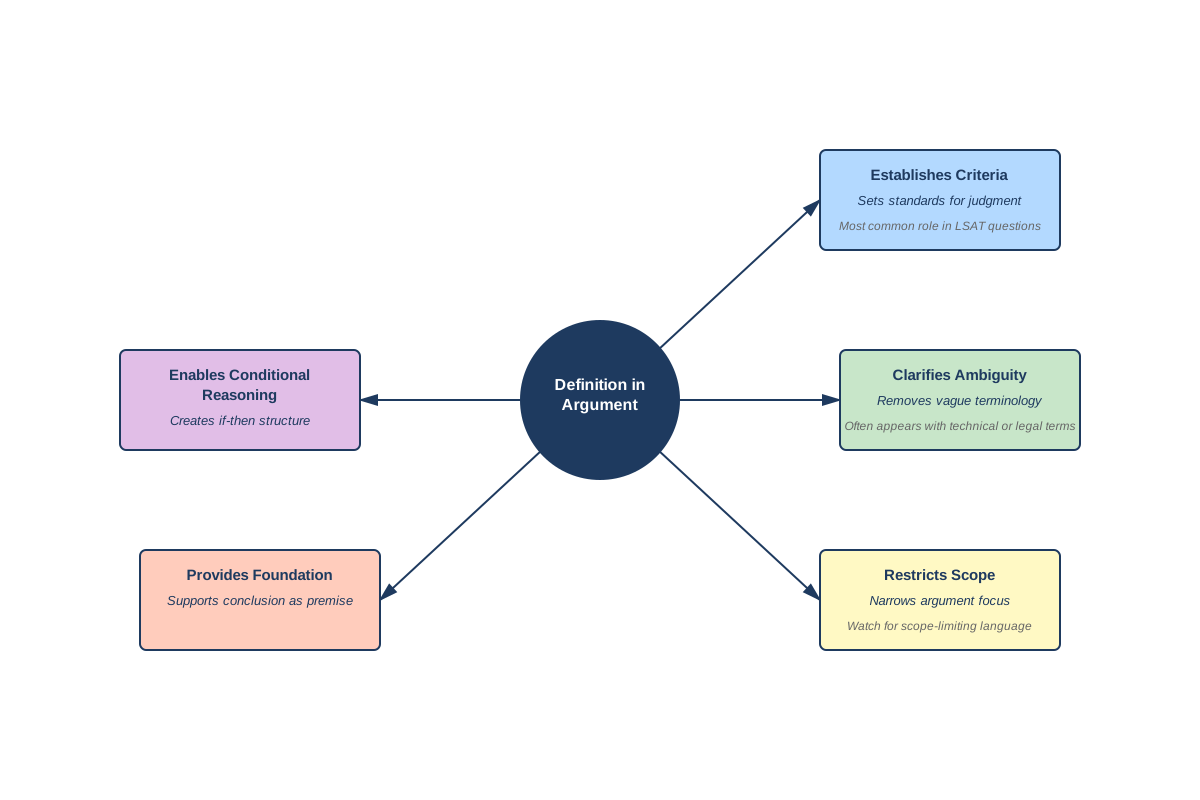
The LSAT role of definition questions typically present an argument containing a definition or clarification of terms, then ask students to identify what purpose that definition serves. Unlike assumption or strengthen/weaken questions that focus on logical gaps or support, role questions demand meta-cognitive awareness of argumentative construction. A definition might serve to establish criteria for a subsequent judgment, clarify ambiguous terminology that could otherwise undermine the argument, restrict the scope of a claim, or provide the foundation upon which a conclusion rests. Understanding these functional possibilities is essential for achieving competitive LSAT scores, as misidentifying the role of a statement—even when understanding the argument's content—leads directly to incorrect answers.
This topic connects intimately with other Logical Reasoning skills, particularly argument structure analysis, premise-conclusion identification, and understanding of conditional reasoning. Mastery of role of definition questions enhances overall performance on the Logical Reasoning section because it develops the analytical distance necessary for evaluating arguments objectively. Students who excel at identifying definitional roles demonstrate sophisticated reading comprehension and can distinguish between what an argument says and how it constructs its reasoning—a distinction that separates top-scoring test-takers from those who struggle to break through score plateaus.
Learning Objectives
- [ ] Identify how Role of definition appears in LSAT questions
- [ ] Explain the reasoning pattern behind Role of definition
- [ ] Apply Role of definition to solve LSAT-style problems accurately
- [ ] Distinguish between different functional roles that definitions can serve within arguments
- [ ] Recognize trigger language in question stems that signals role of definition questions
- [ ] Evaluate answer choices by matching them to the precise function of the definitional statement
- [ ] Analyze complex arguments to isolate definitional components from other argumentative elements
Prerequisites
- Basic argument structure identification: Understanding premises, conclusions, and intermediate conclusions is essential because role questions require locating where a definition fits within the argumentative framework.
- Familiarity with conditional reasoning: Many definitions establish conditional relationships or criteria, so recognizing "if-then" structures helps identify how definitions constrain or enable subsequent reasoning.
- Understanding of logical indicators: Words like "therefore," "because," "since," and "thus" signal argumentative relationships that help determine whether a definition serves as support, background, or conclusion.
- Experience with standard Logical Reasoning question types: Recognizing how role questions differ from strengthen, weaken, or assumption questions prevents confusion about what the question is actually asking.
Why This Topic Matters
In legal reasoning—the domain the LSAT is designed to assess—precise definitions form the foundation of argumentation. Attorneys must constantly work with statutory definitions, contractual terms, and legal precedents that hinge on how specific words are defined. The ability to recognize how a definition functions within an argument directly translates to legal practice, where understanding whether a definition establishes a standard, provides an exception, or clarifies ambiguity can determine case outcomes. This practical relevance makes role of definition questions particularly valuable for law school preparation beyond mere test performance.
On the LSAT itself, role questions (including role of definition specifically) appear with moderate frequency, typically constituting 2-4 questions per Logical Reasoning section. While not as common as assumption or strengthen/weaken questions, they appear consistently enough that mastery significantly impacts overall scores. These questions often appear at medium to medium-high difficulty levels, making them ideal opportunities for score improvement—they're challenging enough to separate strong performers from average ones, but learnable enough that dedicated study yields measurable results.
Role of definition questions most commonly appear in arguments involving technical terminology, legal or scientific contexts, or situations where ambiguous language could undermine reasoning. The LSAT frequently presents arguments where an author defines a term in a specific way to support a particular conclusion, and the correct answer requires identifying that the definition "establishes criteria for" or "provides a basis for" the subsequent judgment. Recognizing these patterns allows efficient question processing and confident answer selection.
Core Concepts
What Constitutes a Definition in LSAT Arguments
A definition in LSAT Logical Reasoning extends beyond dictionary-style explanations. Any statement that clarifies, specifies, or delimits the meaning of a term, concept, or category functions definitionally. This includes explicit definitions ("By 'success,' I mean achieving one's stated goals"), implicit clarifications ("True art must evoke emotional response"), stipulative definitions that establish how a term will be used in that specific argument, and operational definitions that specify measurable criteria. The LSAT tests whether students recognize these various forms and understand their argumentative function rather than their semantic content.
Definitions in LSAT arguments serve structural purposes. They are not merely informative but functional—they do work within the argument. This functional perspective is crucial: the same definitional statement could serve different roles depending on its position and relationship to other statements. A definition appearing early in an argument typically establishes framework or criteria, while one appearing after evidence might synthesize or categorize information. Understanding this positional sensitivity helps predict likely roles before examining answer choices.
Common Functional Roles of Definitions
Definitions serve several distinct functions within LSAT arguments, and recognizing these categories dramatically improves accuracy:
Establishing Criteria or Standards: The most common role involves definitions that set up the conditions or requirements something must meet. For example: "A policy is economically efficient only if it maximizes overall welfare. The proposed policy reduces overall welfare. Therefore, it is not economically efficient." Here, the definition establishes the standard against which the policy is judged.
Clarifying Ambiguous Terms: Definitions often resolve potential confusion that could otherwise undermine the argument. When an argument uses a term that might be interpreted multiple ways, providing a specific definition prevents misunderstanding and strengthens the reasoning by eliminating alternative interpretations.
Restricting Scope: Some definitions function to narrow the domain of discussion, explicitly excluding certain cases or interpretations. This restriction allows the argument to make claims that would be too broad without the definitional limitation.
Providing Foundational Premises: Definitions can serve as fundamental assumptions upon which the entire argument rests. These definitional premises are typically undefended within the argument—they're presented as given starting points.
Supporting Intermediate Conclusions: Occasionally, a definition appears mid-argument to support a subsidiary point that then contributes to the main conclusion. Recognizing this layered structure prevents confusing the definition's immediate function with its ultimate contribution.
Identifying Role of Definition Questions
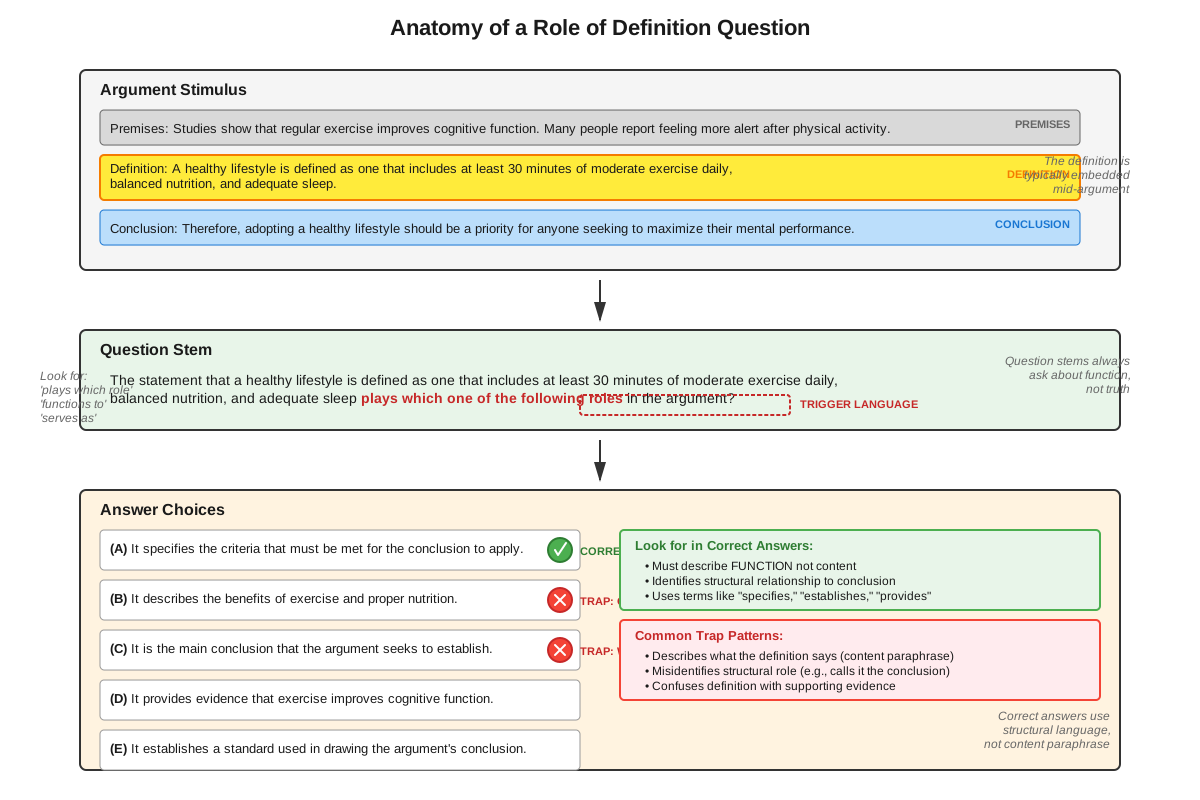
LSAT role of definition questions use characteristic language in their question stems. Recognizing these triggers allows immediate strategic adjustment:
- "The claim that [definition] plays which one of the following roles in the argument?"
- "The author's definition of [term] functions in the argument to..."
- "The statement that [definition] serves which purpose in the argument?"
- "In the argument, the author uses the characterization of [term] as [definition] in order to..."
These stems share common features: they reference a specific statement (often quoted or paraphrased), use functional language ("plays a role," "functions," "serves"), and ask about purpose rather than truth or support. Distinguishing these from other question types prevents applying inappropriate strategies—for instance, evaluating whether the definition is true (irrelevant) or whether it strengthens the conclusion (wrong question type).
Analyzing Definitional Relationships Within Arguments
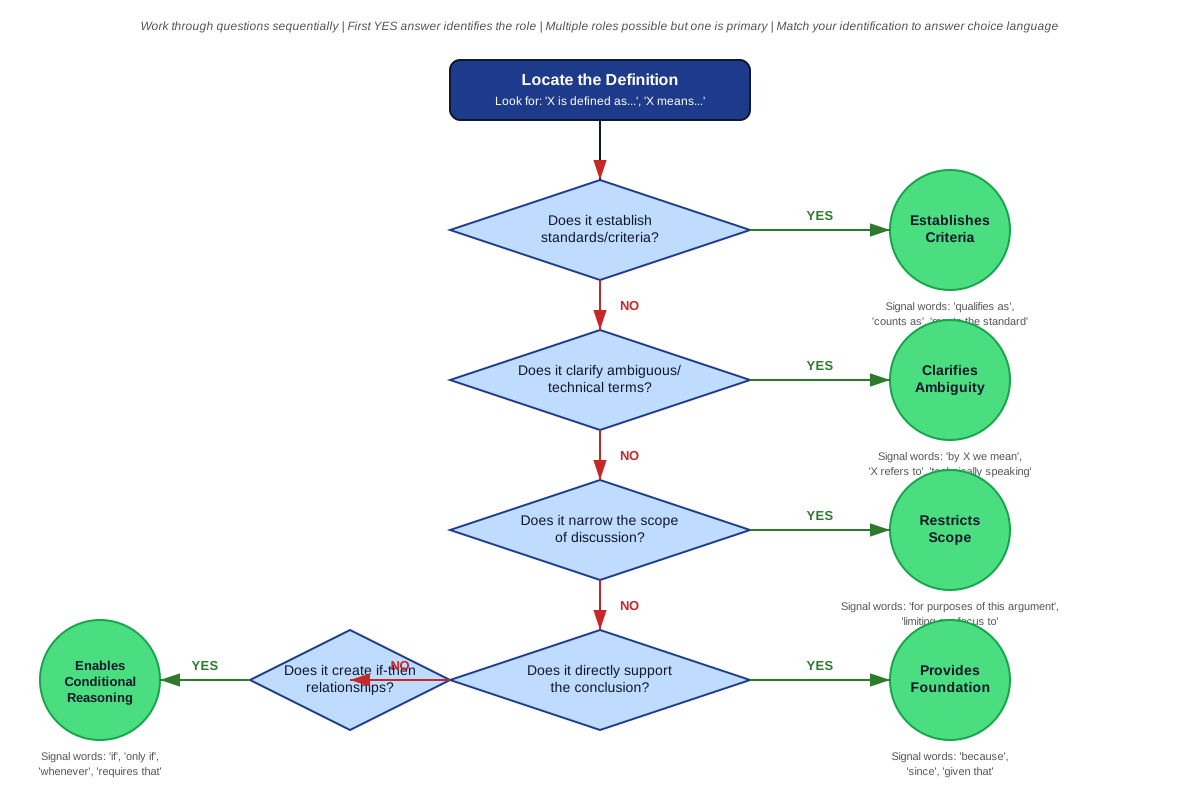
To accurately identify a definition's role, students must map the argument's structure systematically:
- Locate the conclusion: Identify what the argument is ultimately trying to prove
- Identify the definition: Find the statement that clarifies, specifies, or delimits meaning
- Trace logical connections: Determine what the definition directly supports or enables
- Assess necessity: Consider whether the argument could function without the definition
- Match to functional category: Classify the role using the common functions described above
This systematic approach prevents the most common error: selecting an answer that describes what the definition says rather than what it does. The content of a definition and its functional role are distinct—a definition might state "X means Y" while its role is "establishing criteria for evaluating Z."
Answer Choice Patterns
Correct answers to role of definition questions typically use precise functional language:
- "provides a criterion for determining..."
- "establishes a standard by which..."
- "clarifies a term that might otherwise..."
- "restricts the scope of the conclusion to..."
- "serves as a premise supporting the claim that..."
Incorrect answers often describe plausible-sounding functions that don't match the actual argument structure. Common wrong answer patterns include:
- Overstating importance: Claiming the definition is the main conclusion when it's actually a premise
- Misstating direction: Suggesting the definition supports something it doesn't actually connect to
- Confusing content with function: Describing what the definition means rather than what it does
- Attributing unsupported roles: Claiming the definition "refutes" or "challenges" something when the argument contains no such opposition
Concept Relationships
The concepts within role of definition questions form an interconnected system. Definitions themselves connect to argument structure because their function depends entirely on their position and relationship to other statements. A definition's role as criteria-establishing directly relates to conditional reasoning because criteria often take the form "if something meets these conditions, then it qualifies as X." This connection means that students strong in conditional logic often excel at role of definition questions, while those struggling with conditionals may find these questions particularly challenging.
The relationship between definitional roles and premise-conclusion structure is fundamental: definitions typically function as premises (supporting statements) rather than conclusions, but their specific type of support varies. A definition that clarifies ambiguous terms prevents potential objections, functioning similarly to how blocking objections works in assumption questions. A definition that establishes criteria provides the standard against which evidence is measured, creating a two-step reasoning process: (1) here's the standard, (2) the case meets/fails the standard.
Understanding role of definition enhances performance on related question types. Method of reasoning questions often involve definitional moves, and recognizing "the argument proceeds by defining a key term" as a methodological step improves accuracy. Parallel reasoning questions may hinge on matching definitional structures—if the original argument defines X then applies that definition, the parallel must do the same. This interconnection means that time invested in mastering role of definition yields returns across multiple question types.
The progression from identifying definitions → understanding their functional roles → applying this understanding to eliminate wrong answers represents the learning pathway for this topic. Each step builds on the previous: students must first recognize what counts as a definition (broader than dictionary definitions), then categorize its function (criteria, clarification, scope restriction, etc.), and finally match that function to answer choice language while avoiding traps.
High-Yield Facts
⭐ Role of definition questions ask about function, not content—what the definition does in the argument, not what it means or whether it's true.
⭐ Definitions most commonly establish criteria or standards that the argument then applies to reach its conclusion.
⭐ The correct answer must match both the definition's immediate connection and its ultimate contribution to the argument's conclusion.
⭐ Question stems use functional language like "plays a role," "functions to," "serves the purpose of," or "is used in order to."
⭐ Definitions typically appear as premises, not conclusions, though they may support intermediate conclusions.
- Definitions can be explicit ("X is defined as Y") or implicit ("True X must have property Y").
- The same definitional statement could serve different roles in different arguments depending on context and structure.
- Wrong answers often describe what the definition says rather than what it does, or misstate what the definition actually supports.
- Clarifying definitions prevent potential objections by eliminating ambiguity that could undermine the argument.
- Scope-restricting definitions allow arguments to make claims that would be too broad without the limitation.
- Recognizing conditional structures within definitions ("only if," "requires," "must") helps identify criteria-establishing roles.
- The position of a definition within an argument (early vs. late) often signals its likely function.
- Multiple definitions may appear in a single argument, each serving distinct roles.
- Some definitions function as unstated assumptions made explicit—recognizing this connection helps on assumption questions too.
- Practice mapping argument structure before examining answer choices dramatically improves accuracy on role questions.
Quick check — test yourself on Role of definition so far.
Try Flashcards →Common Misconceptions
Misconception: Role of definition questions are asking whether the definition is accurate or true.
Correction: These questions assess functional role within the argument's structure, not the definition's accuracy. Even if a definition seems questionable, the correct answer describes what role it plays, assuming the argument accepts it as given.
Misconception: The definition must be the most important part of the argument.
Correction: Definitions typically serve supporting roles as premises. The conclusion remains the most important claim the argument makes; the definition enables or supports reaching that conclusion but is rarely the conclusion itself.
Misconception: If a definition appears early in the argument, it must be background information.
Correction: Position alone doesn't determine function. Early definitions often establish criteria that become crucial for the argument's reasoning. "Background information" is typically descriptive context that could be removed without affecting the logical structure, while functional definitions are integral to the reasoning.
Misconception: The correct answer should restate what the definition says.
Correction: Correct answers describe what the definition does—its functional role. An answer that merely paraphrases the definition's content without identifying its purpose is almost always wrong.
Misconception: All definitions serve the same role in arguments.
Correction: Definitions serve varied functions: establishing criteria, clarifying ambiguity, restricting scope, providing foundational premises, or supporting intermediate conclusions. Identifying which specific function applies to a particular argument is the core skill being tested.
Misconception: If the definition seems obvious or uncontroversial, it can't be important to the argument.
Correction: Even seemingly obvious definitions serve crucial structural roles. The LSAT tests recognition of argumentative architecture, not just controversial claims. A straightforward definition might establish the essential criteria upon which the entire argument depends.
Misconception: Role questions are just asking for the definition's relationship to the conclusion.
Correction: While the ultimate contribution to the conclusion matters, definitions often have immediate relationships to other premises or intermediate conclusions. The correct answer must capture the definition's direct function, which may be one step removed from the main conclusion.
Worked Examples
Example 1: Criteria-Establishing Definition
Argument: "A scientific theory is genuinely explanatory only if it makes testable predictions that could potentially be falsified. String theory, despite its mathematical elegance, makes no testable predictions that could be falsified by current experimental methods. Therefore, string theory is not genuinely explanatory."
Question: The claim that a scientific theory is genuinely explanatory only if it makes testable predictions plays which role in the argument?
Analysis:
- Identify the conclusion: "String theory is not genuinely explanatory"
- Locate the definition: "A scientific theory is genuinely explanatory only if it makes testable predictions that could potentially be falsified"
- Trace the logical structure:
- Definition establishes criterion for "genuinely explanatory"
- Evidence shows string theory fails to meet this criterion
- Conclusion applies the criterion to reach judgment
- Determine the function: The definition establishes the standard/criterion by which string theory is evaluated
Correct Answer: "It provides a criterion that the argument uses to evaluate whether string theory is genuinely explanatory."
Why other answers fail:
- "It states the main conclusion" – Wrong; the conclusion is about string theory specifically
- "It describes a property that string theory possesses" – Wrong; string theory lacks this property
- "It provides background information about scientific theories" – Wrong; it's not mere context but an essential premise
- "It challenges a commonly held view" – Wrong; no opposing view is presented
Connection to Learning Objectives: This example demonstrates identifying how role of definition appears (through the "only if" conditional structure), explaining the reasoning pattern (criterion establishment followed by application), and applying this understanding to select the correct answer.
Example 2: Clarifying Definition
Argument: "Critics claim that the new urban development will harm the neighborhood's character. However, by 'character' these critics seem to mean merely the visual appearance of buildings, not the social fabric or community relationships. The development will actually strengthen community relationships by providing shared public spaces. Therefore, the development will not harm what truly constitutes the neighborhood's character."
Question: The author's clarification of what critics mean by "character" serves which purpose in the argument?
Analysis:
- Identify the conclusion: "The development will not harm what truly constitutes the neighborhood's character"
- Locate the definition: The clarification that critics mean "visual appearance" not "social fabric or community relationships"
- Trace the logical structure:
- Critics' objection is presented
- Author clarifies/restricts what critics mean by "character"
- Author shows development benefits the aspect of character that matters
- Conclusion: development doesn't harm true character
- Determine the function: The definition clarifies an ambiguous term in a way that allows the author to distinguish between two interpretations and argue that the relevant interpretation supports the conclusion
Correct Answer: "It clarifies an ambiguous term in order to show that the critics' objection does not apply to what the author considers the relevant aspect of neighborhood character."
Why other answers fail:
- "It concedes that the critics' concern is valid" – Wrong; it actually undermines their concern
- "It provides evidence that the development will benefit the neighborhood" – Wrong; the evidence is the claim about public spaces
- "It establishes the only acceptable definition of character" – Wrong; it describes what critics mean, not what's objectively correct
- "It states an assumption underlying the critics' argument" – Wrong; it's the author's interpretation, not the critics' assumption
Connection to Learning Objectives: This example shows a more complex role where the definition serves to reinterpret an objection, demonstrating the reasoning pattern of clarification-then-rebuttal and requiring careful application to distinguish from superficially similar wrong answers.
Exam Strategy
When approaching role of definition questions on the LSAT, implement this systematic process:
Step 1: Recognize the question type immediately. Trigger phrases include "plays which role," "functions in the argument to," "serves which purpose," and "is used in order to." Once identified, shift into structure-analysis mode rather than content-evaluation mode.
Step 2: Locate and bracket the referenced statement. The question stem will identify which statement's role you need to determine. Physically mark this in the passage to maintain focus on the correct sentence.
Step 3: Map the argument structure before looking at answers. Identify the conclusion, then trace how the definition connects to it. Ask: "What does this definition enable the argument to do?" and "Could the argument reach its conclusion without this definition?"
Step 4: Predict the role category. Before examining answer choices, mentally categorize the definition's function: Does it establish criteria? Clarify ambiguity? Restrict scope? Provide a foundational premise? This prediction serves as an anchor when evaluating answers.
Step 5: Eliminate answers that describe content rather than function. Any answer that merely restates what the definition says without identifying what it does is wrong. Look for functional verbs: "establishes," "provides," "clarifies," "restricts," "supports."
Step 6: Verify the logical connection. The correct answer must accurately describe both what the definition directly connects to and how it contributes to the conclusion. Trace the chain: definition → immediate connection → ultimate contribution to conclusion.
Time allocation: Role of definition questions typically require 60-90 seconds. They demand careful structural analysis but don't involve complex logical operations like formal logic questions. If spending more than 90 seconds, make your best prediction and move on—these questions reward structural insight more than extended deliberation.
Process of elimination tips specific to this topic:
- Eliminate answers using "refutes," "challenges," or "objects to" unless the argument explicitly presents opposing views
- Eliminate answers claiming the definition is the conclusion unless it's clearly the final claim
- Eliminate answers that misstate what the definition connects to—verify each connection claimed
- Eliminate answers using vague language like "provides support" when more specific functional language appears in other choices
Exam Tip: If stuck between two answers, check whether each accurately describes the definition's immediate function (what it directly does) versus its ultimate contribution (how it helps reach the conclusion). The correct answer must capture both accurately.
Memory Techniques
CREST Mnemonic for common definitional roles:
- Criteria-establishing (sets standards for judgment)
- Restricting scope (narrows the domain)
- Enabling reasoning (provides necessary foundation)
- Supporting intermediate conclusions (builds toward main point)
- Term clarification (resolves ambiguity)
Visualization Strategy: Picture the argument as a building. The conclusion is the roof. Definitions are typically foundation stones or support beams—they're structural elements that enable the building to stand, not decorative elements. When you see a definition, visualize where in the structure it fits: Is it a foundation stone (criteria-establishing)? A support beam (enabling reasoning)? A clarifying label (term clarification)?
The "What Does It DO?" Mantra: Train yourself to automatically ask "What does this definition DO?" rather than "What does this definition SAY?" every time you encounter a definitional statement. This mental habit prevents the most common error of focusing on content rather than function.
Acronym for Question Stem Recognition - FRPS:
- Function ("functions in the argument to")
- Role ("plays which role")
- Purpose ("serves which purpose")
- Serves ("is used in order to")
When you see any of these words in a question stem, immediately think "role question—analyze structure, not content."
The Connection Chain: Visualize arrows connecting argument elements. For any definition, draw mental arrows: Definition → [what it directly connects to] → [how that connects to conclusion]. This visual chain helps verify that answer choices accurately describe the path from definition to conclusion.
Summary
Role of definition questions assess the ability to identify how definitional statements function within LSAT arguments rather than evaluating their content or truth. These questions, part of the broader category of method, role, and structure questions, require students to analyze argumentative architecture by recognizing that definitions serve specific structural purposes: establishing criteria or standards, clarifying ambiguous terms, restricting scope, providing foundational premises, or supporting intermediate conclusions. Success demands distinguishing between what a definition says (its content) and what it does (its function), then matching that function to answer choices using precise functional language. The systematic approach involves recognizing question type through trigger phrases, locating the referenced definition, mapping argument structure to trace logical connections, predicting the role category, and eliminating answers that describe content rather than function or misstate logical relationships. Mastery of this topic enhances overall Logical Reasoning performance because it develops the meta-cognitive awareness necessary for objective argument evaluation—a skill that transfers to multiple question types and reflects the analytical thinking essential for legal reasoning.
Key Takeaways
- Role of definition questions test functional analysis—what a definition does in an argument—not whether it's true or what it means
- Definitions most commonly establish criteria or standards that arguments then apply to reach conclusions
- Question stems use characteristic functional language: "plays a role," "functions to," "serves the purpose of"
- Correct answers must accurately describe both the definition's immediate connection and its ultimate contribution to the conclusion
- The systematic approach—recognize question type, locate definition, map structure, predict role, eliminate wrong answers—dramatically improves accuracy
- Common wrong answers describe content rather than function, overstate importance, or misstate logical connections
- Mastering role of definition enhances performance on related question types including method of reasoning and parallel reasoning
Related Topics
Method of Reasoning Questions: These questions ask how an argument proceeds or what technique it employs. Understanding role of definition helps because "defining a key term" is a common method. Mastering definitional roles enables recognizing when this method appears and how it contributes to overall argumentative strategy.
Argument Structure Questions: Broader questions about how arguments are constructed benefit from role of definition skills. Recognizing definitional functions is part of the larger skill of mapping premise-conclusion relationships and identifying how different statement types interact.
Assumption Questions: Definitions sometimes make explicit what would otherwise be unstated assumptions. Understanding how definitions function helps identify when an argument depends on a particular way of defining terms, which can be the key to finding necessary assumptions.
Parallel Reasoning Questions: These require matching argumentative structures. When the original argument uses a definition in a specific way (e.g., establishing criteria then applying them), the parallel must do the same. Role of definition mastery helps identify these structural parallels.
Conditional Reasoning: Many definitions establish conditional relationships ("X only if Y" or "X requires Y"). Strengthening conditional reasoning skills enhances ability to recognize criteria-establishing definitions and trace their logical implications.
Practice CTA
Now that you've mastered the core concepts of role of definition, it's time to apply this knowledge to actual LSAT questions. The practice questions and flashcards designed for this topic will reinforce your ability to quickly identify definitional roles, distinguish function from content, and confidently select correct answers. Remember: these questions reward systematic structural analysis, and each practice attempt strengthens the mental pathways that lead to automatic, accurate performance on test day. Approach each practice question by implementing the strategies you've learned—recognize the question type, map the structure, predict the role, and eliminate systematically. Your investment in deliberate practice now will translate directly to points on the LSAT. You've built the foundation; now construct mastery through application.
Sign up free to keep reading
Create a free AnvayaPrep account to finish this LSAT guide on Role of definition — plus flashcards and practice questions.