Overview
Structural paraphrase is a critical skill tested throughout the LSAT's Logical Reasoning sections, particularly in method, role, and structure questions. These questions require test-takers to abstract away from the specific content of an argument and instead focus on its underlying logical architecture. Rather than evaluating whether an argument is sound or identifying its flaws, structural paraphrase questions ask students to recognize and describe the formal pattern of reasoning—the skeleton that remains when all the particular subject matter is stripped away. This skill demands a sophisticated understanding of how arguments are constructed, how premises relate to conclusions, and how different reasoning techniques function across diverse contexts.
The ability to perform lsat structural paraphrase is essential because it appears in multiple question types beyond those explicitly labeled as "structure" questions. Method of reasoning questions ask how an argument proceeds, role of a statement questions require identifying what function a particular claim serves within the argument's structure, and parallel reasoning questions demand recognition of identical logical patterns in different contexts. Together, these question types constitute approximately 15-20% of all logical reasoning questions on any given LSAT, making structural paraphrase one of the highest-yield skills a test-taker can develop.
Mastering structural paraphrase fundamentally strengthens overall LSAT performance because it develops the meta-cognitive ability to see arguments as formal systems rather than collections of claims about specific topics. This abstraction skill enhances performance on assumption questions, strengthen/weaken questions, and even reading comprehension passages, where recognizing argumentative structure helps predict where an author's reasoning will lead. Students who excel at structural paraphrase can quickly identify what an argument is doing, even when the subject matter is unfamiliar or complex, giving them a decisive advantage under timed conditions.
Learning Objectives
- [ ] Identify how Structural paraphrase appears in LSAT questions
- [ ] Explain the reasoning pattern behind Structural paraphrase
- [ ] Apply Structural paraphrase to solve LSAT-style problems accurately
- [ ] Distinguish between content-based and structure-based answer choices in method questions
- [ ] Translate concrete arguments into abstract structural descriptions
- [ ] Recognize common structural patterns that recur across different LSAT arguments
- [ ] Evaluate answer choices by matching structural elements rather than topical similarity
Prerequisites
- Basic argument structure: Understanding of premises, conclusions, and how they connect is essential because structural paraphrase requires identifying these elements before abstracting them
- Indicator words: Familiarity with conclusion indicators (therefore, thus, hence) and premise indicators (because, since, for) enables quick identification of argumentative components
- Conditional reasoning fundamentals: Knowledge of if-then relationships helps recognize one of the most common structural patterns in LSAT arguments
- Causal reasoning basics: Understanding cause-and-effect claims is necessary because many arguments have causal structures that must be paraphrased accurately
Why This Topic Matters
Structural paraphrase represents a fundamental shift in how students must approach LSAT arguments. In everyday reasoning, people focus on whether they agree with a claim's content; on the LSAT, success requires analyzing how arguments function regardless of their subject matter. This skill mirrors the analytical thinking required in legal practice, where attorneys must recognize patterns of reasoning across diverse cases and precedents. A lawyer arguing a contract dispute uses the same logical structures as one arguing a constitutional question—only the content differs.
On the LSAT, structural paraphrase appears in several high-frequency question types. Method of reasoning questions (appearing 2-4 times per section) explicitly ask test-takers to describe how an argument proceeds. Role of a statement questions (appearing 1-2 times per section) require identifying what function a specific claim serves in the argument's structure. Parallel reasoning questions (appearing 1-2 times per section) demand recognition of identical structures in different contexts. Additionally, structural thinking aids in parallel flaw questions and even some strengthen/weaken questions where understanding the argument's architecture reveals its vulnerabilities.
Common manifestations in exam passages include: arguments that use analogies to support conclusions (requiring recognition of analogical reasoning structure), arguments that eliminate alternative explanations (requiring recognition of elimination structure), arguments that apply general principles to specific cases (requiring recognition of deductive application structure), and arguments that generalize from samples to populations (requiring recognition of inductive generalization structure). The LSAT consistently tests whether students can see past surface-level content to identify these underlying patterns.
Core Concepts
What Is Structural Paraphrase?
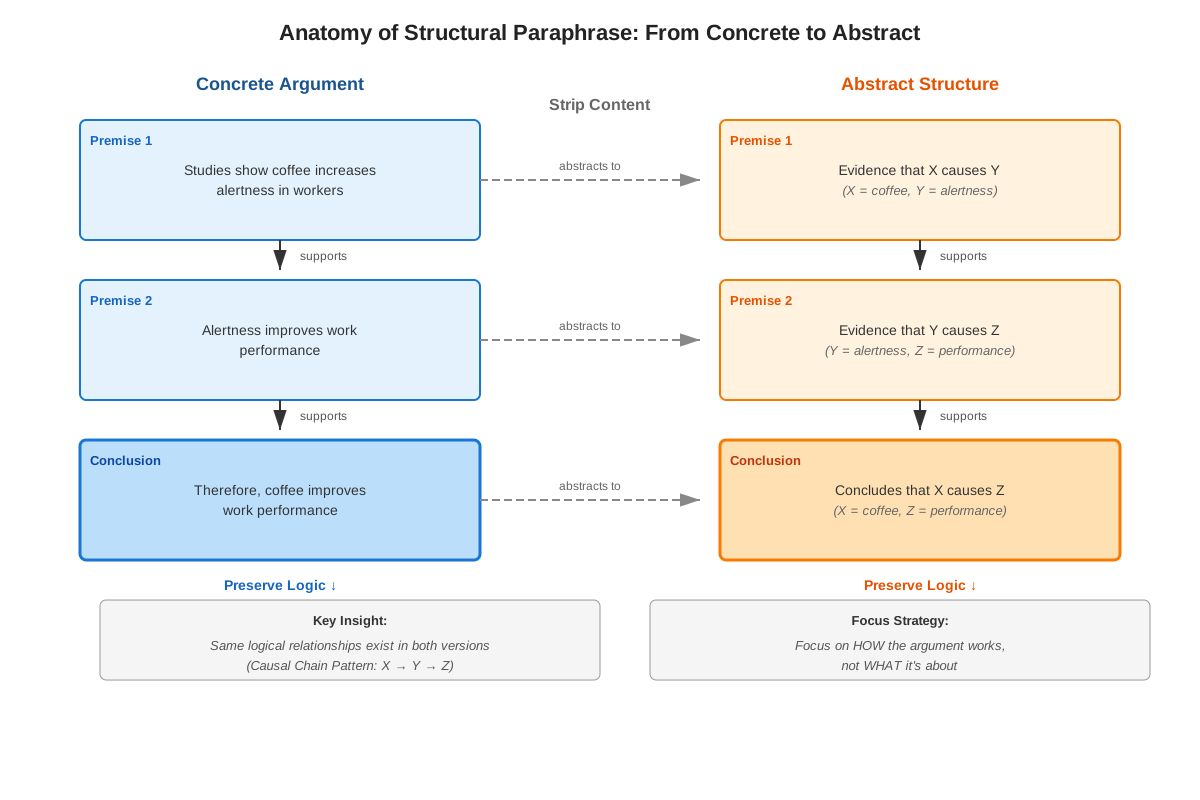
Structural paraphrase is the process of describing an argument's logical form or reasoning pattern without reference to its specific content. When performing structural paraphrase, the test-taker translates concrete claims about particular subjects into abstract descriptions of logical relationships. For example, an argument about "companies that invest in employee training see higher productivity" has the same structure as "cities that invest in public transportation see reduced traffic congestion"—both follow the pattern: "entities that implement strategy X experience outcome Y."
The key distinction is between content (what the argument is about) and structure (how the argument works). Content includes the specific topics, examples, and subject matter; structure includes the logical moves, the relationship between premises and conclusion, and the type of reasoning employed. LSAT questions testing structural paraphrase deliberately use abstract language in correct answer choices to ensure students are evaluating structure rather than matching familiar words.
Types of Structural Paraphrase Questions
Method of Reasoning Questions
These questions ask "how" an argument proceeds or what technique it employs. Question stems include phrases like:
- "The argument proceeds by..."
- "Which one of the following describes the technique of reasoning used?"
- "The argument employs which one of the following argumentative strategies?"
The correct answer will describe the argument's logical architecture using abstract terms. For instance, if an argument presents a counterexample to refute a universal claim, the correct answer might state: "challenges a generalization by providing a case that contradicts it."
Role of a Statement Questions
These questions identify a specific sentence or claim in the argument and ask what function it serves. Question stems include:
- "The claim that [statement] plays which one of the following roles?"
- "The statement that [claim] figures in the argument in which one of the following ways?"
Correct answers describe structural functions such as: "provides evidence for an intermediate conclusion that supports the main conclusion," "states a position that the argument seeks to refute," or "illustrates a general principle that the argument applies."
Parallel Reasoning Questions
While technically a separate question type, parallel reasoning questions are fundamentally exercises in structural paraphrase. They require identifying an argument with an identical logical structure to the stimulus argument, demanding precise structural analysis of both the original and each answer choice.
Common Structural Patterns on the LSAT
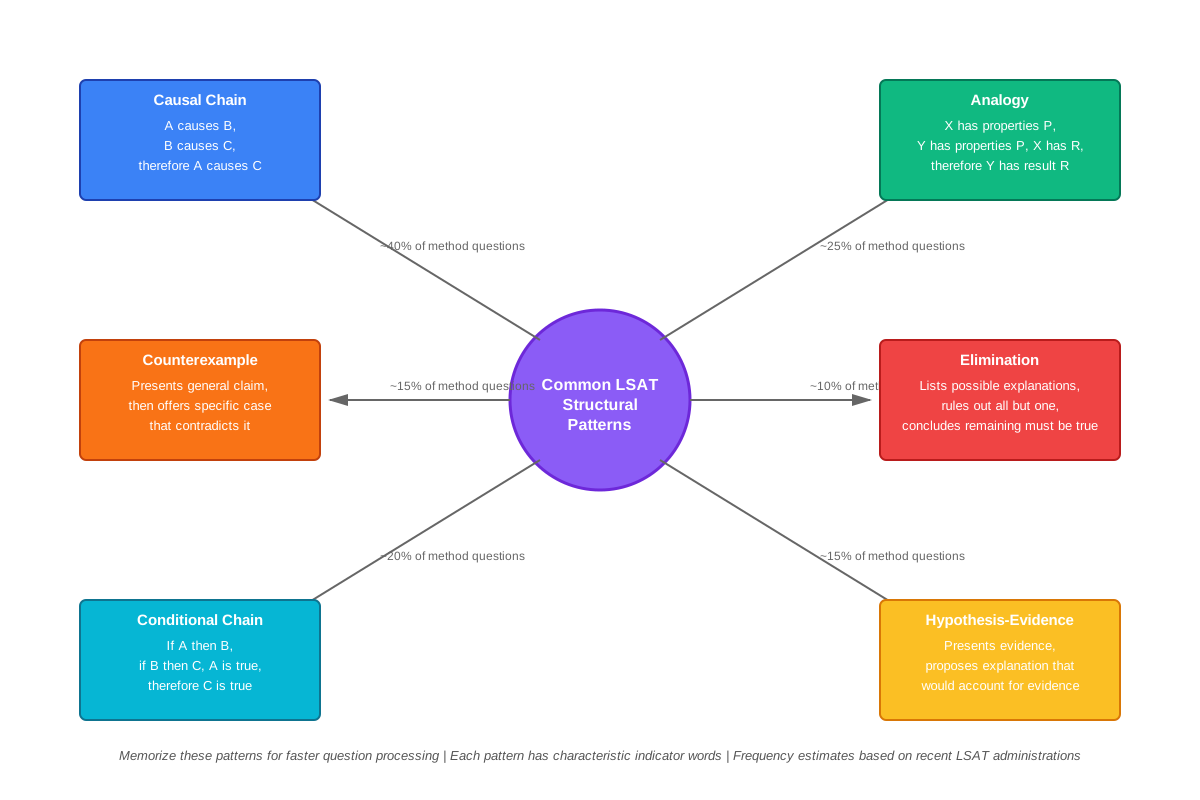
Understanding recurring patterns accelerates structural paraphrase. The LSAT repeatedly uses these architectures:
| Structural Pattern | Description | Example Structure |
|---|---|---|
| Analogical Reasoning | Compares two situations and infers similarity in one respect based on similarity in others | A and B share features X, Y, Z; A has feature W; therefore B probably has feature W |
| Elimination of Alternatives | Rules out competing explanations to support one remaining explanation | Phenomenon P could be caused by A, B, or C; evidence rules out A and B; therefore C caused P |
| Counterexample | Refutes a universal claim by providing a single contradictory instance | Claim: All X are Y; Counterexample: Here's an X that isn't Y; Conclusion: The claim is false |
| Causal Reasoning | Establishes or challenges a cause-effect relationship | X and Y correlate; alternative explanations are unlikely; therefore X causes Y |
| Principle Application | Applies a general rule to a specific case | General rule: All X should do Y; This is an X; Therefore this should do Y |
| Generalization | Draws a broad conclusion from specific instances or samples | Sample S has property P; Therefore population containing S probably has property P |
| Reductio ad Absurdum | Shows a claim leads to absurd consequences, therefore the claim is false | Assume claim C is true; C implies absurd result R; Therefore C must be false |
The Abstraction Process
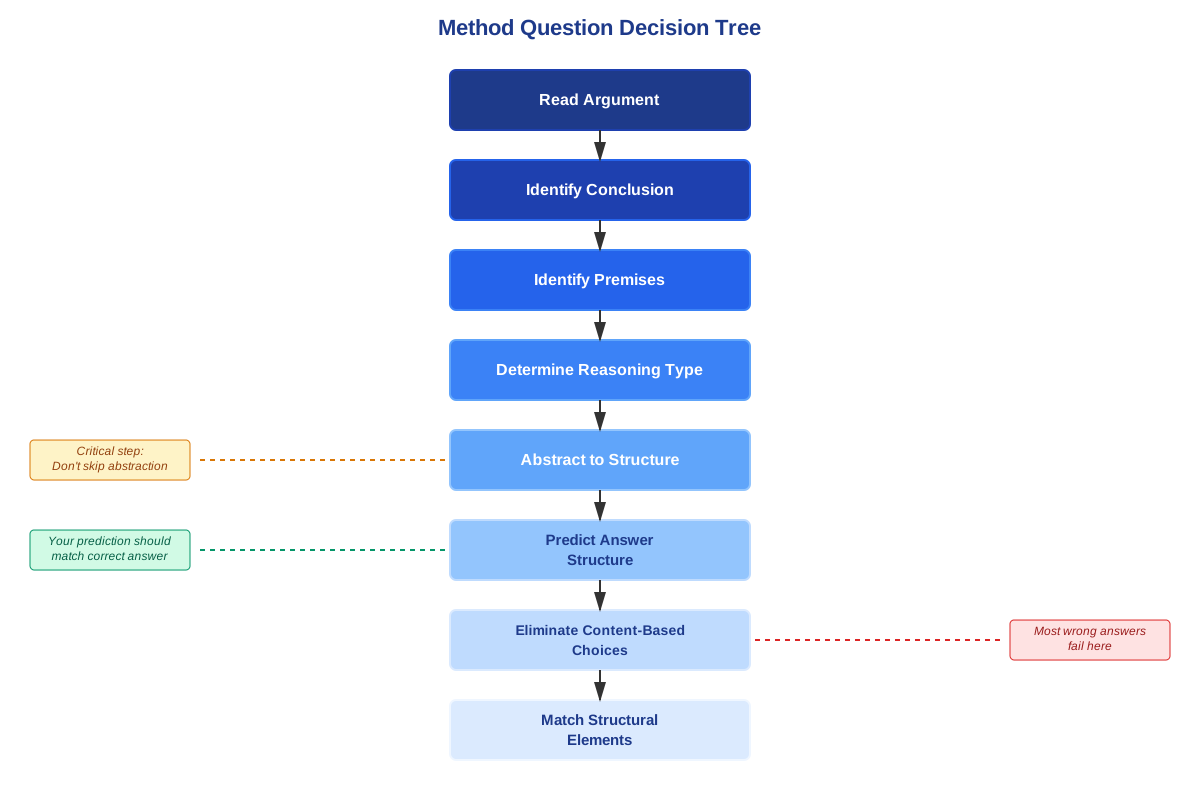
Performing structural paraphrase requires systematic abstraction:
- Identify the conclusion: Determine what the argument is ultimately trying to prove
- Identify the premises: Locate all evidence and reasons offered in support
- Map the logical relationships: Determine how premises connect to the conclusion and to each other
- Abstract the content: Replace specific subjects with variables or generic terms (e.g., "the proposed policy" becomes "the claim under discussion")
- Describe the logical moves: Characterize what reasoning technique connects premises to conclusion
- Match to answer choices: Find the answer that captures this structure using appropriately abstract language
For example, consider this argument:
"Most successful entrepreneurs failed multiple times before succeeding. Therefore, experiencing failure is likely necessary for entrepreneurial success."
The abstraction process yields:
- Conclusion: Property Y is necessary for outcome Z
- Premise: Most entities with outcome Z also have property Y
- Structure: Infers necessity from correlation/co-occurrence
- Paraphrase: "Concludes that a characteristic is required for an outcome based on evidence that the characteristic is commonly present when the outcome occurs"
Distinguishing Structure from Content
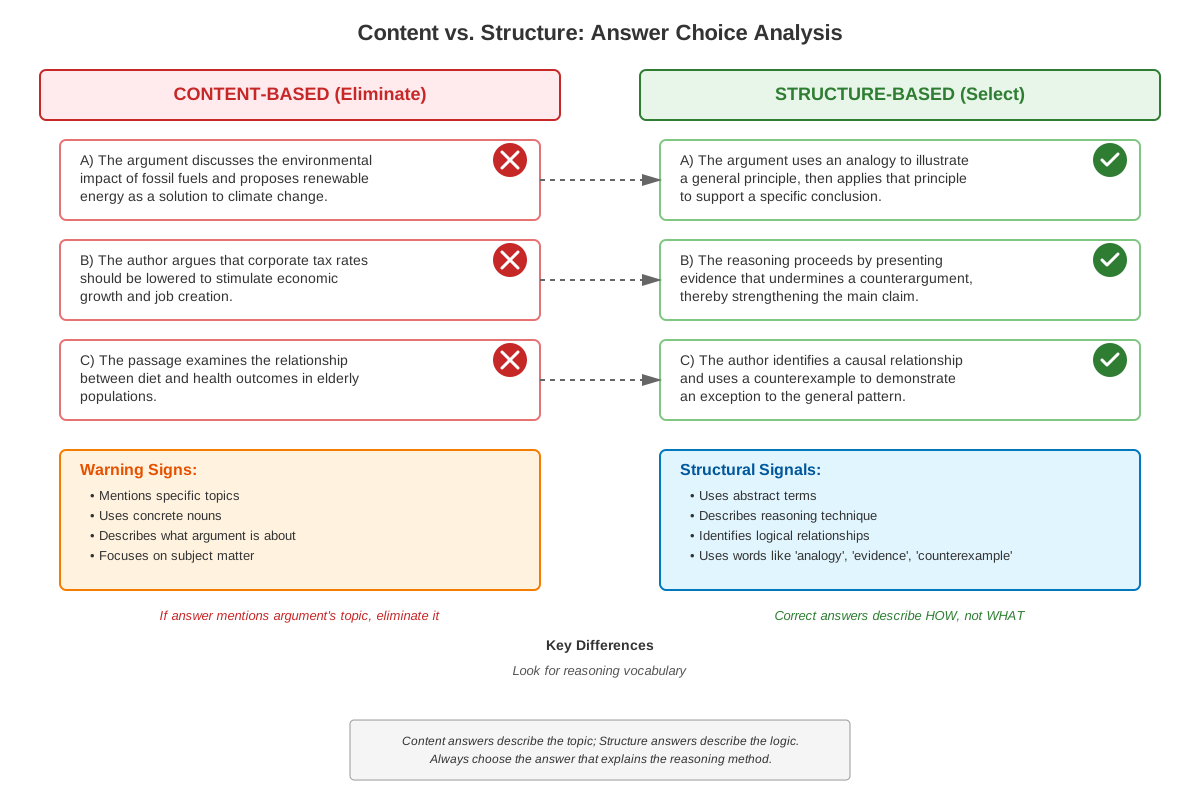
The most challenging aspect of structural paraphrase is ignoring content similarity when it doesn't reflect structural similarity. Wrong answer choices often use topically related language to trap students who match content rather than structure. Consider:
Stimulus: "All the company's most profitable products were developed by small teams. Therefore, the company should assign future product development to small teams."
Wrong answer (content match): "Concludes that a business strategy will be effective based on past success"
Right answer (structure match): "Recommends a course of action based on a correlation between a feature and a desired outcome"
The wrong answer uses business-related language ("business strategy," "effective," "past success") that feels topically appropriate but doesn't accurately capture the logical structure. The right answer abstracts away from business entirely, focusing on the pattern: correlation observed → action recommended.
Concept Relationships
Structural paraphrase serves as a foundational skill that connects to virtually every other aspect of LSAT Logical Reasoning. The ability to see argument structure enables more sophisticated analysis across all question types.
Within Method, Role, and Structure Questions: Structural paraphrase → enables Method of Reasoning identification → which supports Role of Statement analysis → which develops Parallel Reasoning recognition. These three question types form a progression of structural thinking, with each building on the abstraction skills of the previous.
Connection to Assumption Questions: Understanding argument structure reveals gaps between premises and conclusions, which is precisely what assumption questions test. Structural paraphrase → identifies logical gaps → reveals necessary assumptions.
Connection to Strengthen/Weaken Questions: Recognizing an argument's structure shows where it's vulnerable. Structural paraphrase → identifies reasoning pattern → reveals potential weaknesses → guides selection of strengthening or weakening information.
Connection to Flaw Questions: Many flaws are structural (e.g., confusing correlation with causation, generalizing from unrepresentative samples). Structural paraphrase → recognizes reasoning pattern → identifies structural flaws.
Connection to Parallel Flaw Questions: These combine structural paraphrase with flaw identification. Structural paraphrase → identifies flawed reasoning pattern → matches identical flawed structure in answer choices.
The prerequisite knowledge of basic argument structure provides the foundation: understanding premises and conclusions → enables identification of logical relationships → which allows abstraction into structural patterns → which permits structural paraphrase.
High-Yield Facts
⭐ Correct answers to method questions use abstract, formal language rather than content-specific terms—if an answer choice mentions the specific subject matter of the argument, it's likely wrong.
⭐ The most common structural patterns on the LSAT are analogical reasoning, elimination of alternatives, counterexample, and causal reasoning—recognizing these immediately saves time.
⭐ Role of statement questions require identifying both what a claim says and how it functions in the argument's logical architecture—the same claim can serve different roles in different arguments.
⭐ Structural paraphrase questions test logical form, not content evaluation—never select an answer because you agree with the argument or find it persuasive.
⭐ Wrong answers often describe what the argument discusses rather than how it reasons—description of topics is content, not structure.
- Method questions appear 2-4 times per Logical Reasoning section, making them high-frequency question types worth mastering.
- The phrase "proceeds by" in a question stem always signals a method of reasoning question requiring structural paraphrase.
- Intermediate conclusions (sub-conclusions) often confuse students in role questions—they function as both conclusions (supported by some premises) and premises (supporting the main conclusion).
- Parallel reasoning questions are essentially double structural paraphrase exercises—you must abstract both the stimulus and each answer choice.
- Arguments using technical or unfamiliar subject matter deliberately test whether students can abstract structure despite not understanding content deeply.
- The LSAT rarely uses the same structural pattern twice in the same section, so identifying one pattern helps eliminate it from consideration for subsequent questions.
- Conditional reasoning structures (if-then patterns) appear in approximately 30% of structural paraphrase questions.
- Arguments that "respond to" or "counter" another position typically have a two-part structure: present opposing view, then refute it.
Quick check — test yourself on Structural paraphrase so far.
Try Flashcards →Common Misconceptions
Misconception: Structural paraphrase means summarizing the argument in different words.
Correction: Structural paraphrase requires abstracting the logical form, not restating the content. A summary preserves the specific subject matter; a structural paraphrase replaces it with formal descriptions of logical relationships.
Misconception: The correct answer to a method question will use similar vocabulary to the stimulus.
Correction: Correct answers deliberately use abstract, formal language that differs from the stimulus vocabulary. Content-matching language typically appears in wrong answers designed to trap students who aren't truly abstracting structure.
Misconception: If an argument discusses causation, the correct structural paraphrase must mention "cause" or "causal."
Correction: While causal arguments often have "causal" in the correct answer, the LSAT may use synonymous abstract language like "explains a phenomenon by identifying a factor responsible for it" or "attributes an outcome to a particular condition."
Misconception: Role of statement questions ask what the statement means or whether it's true.
Correction: These questions ask what function the statement serves in the argument's logical architecture—whether it's a premise, conclusion, intermediate conclusion, opposing view, illustration, principle, or another structural element. Truth and meaning are irrelevant.
Misconception: Longer, more complex answer choices are more likely to be correct in structural paraphrase questions.
Correction: The LSAT includes both concise and elaborate correct answers. Length doesn't correlate with correctness. Focus on structural accuracy, not sophistication of language.
Misconception: Background information or context in an argument must be mentioned in the structural paraphrase.
Correction: Structural paraphrase focuses on the logical moves from premises to conclusion. Background information that doesn't function as a premise or conclusion typically doesn't appear in correct structural descriptions.
Misconception: If two arguments reach similar conclusions, they have similar structures.
Correction: Structure concerns how an argument reaches its conclusion, not what conclusion it reaches. Two arguments can reach identical conclusions through completely different reasoning patterns (one by analogy, another by elimination, etc.).
Worked Examples
Example 1: Method of Reasoning Question
Stimulus:
"Archaeologist: The pottery shards found at the site date to 500 BCE, as confirmed by radiocarbon dating. However, the site also contains bronze tools. Since bronze working wasn't introduced to this region until 300 BCE, the site must have been occupied during multiple distinct periods."
Question: The archaeologist's argument proceeds by:
Answer Choices:
(A) Accepting one dating method as reliable while rejecting another as unreliable
(B) Inferring that a location was used at different times based on the presence of artifacts from different eras
(C) Challenging the accuracy of radiocarbon dating by presenting contradictory physical evidence
(D) Concluding that bronze working was introduced earlier than previously believed
(E) Demonstrating that pottery and bronze tools were used simultaneously
Solution Process:
Step 1—Identify the conclusion: "The site must have been occupied during multiple distinct periods."
Step 2—Identify the premises:
- Pottery shards date to 500 BCE (confirmed by radiocarbon dating)
- Site contains bronze tools
- Bronze working wasn't introduced until 300 BCE
Step 3—Map the logical relationship: The argument notes that artifacts from two different time periods (500 BCE pottery, post-300 BCE bronze) exist at the same site, then concludes the site was occupied at both times.
Step 4—Abstract the structure: Evidence of items from different eras at one location → conclusion of multiple periods of use
Step 5—Evaluate answer choices:
(A) Wrong—content mismatch: The argument doesn't reject any dating method; it accepts both the radiocarbon dating and the historical evidence about bronze working.
(B) Correct—structure match: This perfectly captures the logical form: different-era artifacts → different-time occupation. The abstract language ("location," "different times," "artifacts from different eras") matches the structure without mimicking the specific content.
(C) Wrong—content mismatch: The argument doesn't challenge radiocarbon dating; it accepts those results and explains the apparent contradiction.
(D) Wrong—content mismatch: The argument explicitly accepts the 300 BCE date for bronze introduction; it doesn't challenge this.
(E) Wrong—content mismatch: The argument concludes the opposite—that they were used at different times (multiple periods of occupation).
Key Lesson: The correct answer (B) uses completely different vocabulary from the stimulus ("location" instead of "site," "artifacts" instead of "pottery and bronze") but captures the logical structure perfectly. Wrong answers often preserve content words while misrepresenting structure.
Example 2: Role of Statement Question
Stimulus:
"Consumer advocate: The new privacy regulations will harm small businesses more than large corporations. Large corporations already have compliance departments that can adapt to new regulations with minimal additional cost. Small businesses, however, will need to hire consultants or new staff, creating significant financial burden. Therefore, the regulations should be modified to exempt businesses with fewer than 50 employees."
Question: The statement that large corporations already have compliance departments plays which one of the following roles in the consumer advocate's argument?
Answer Choices:
(A) It is the main conclusion of the argument
(B) It provides evidence for an intermediate conclusion that supports the main conclusion
(C) It states an objection that the argument attempts to refute
(D) It describes a consequence that the argument seeks to avoid
(E) It illustrates a general principle that the argument applies to a specific case
Solution Process:
Step 1—Identify the main conclusion: "The regulations should be modified to exempt businesses with fewer than 50 employees."
Step 2—Identify the intermediate conclusion: "The new privacy regulations will harm small businesses more than large corporations."
Step 3—Map the argument structure:
- Premise 1: Large corporations have compliance departments (minimal additional cost)
- Premise 2: Small businesses lack such departments (significant financial burden)
- Intermediate conclusion: Regulations harm small businesses more
- Main conclusion: Regulations should exempt small businesses
Step 4—Determine the target statement's function: The statement about large corporations having compliance departments serves as evidence for why large corporations won't be harmed much, which contrasts with small businesses being harmed significantly, which supports the intermediate conclusion that small businesses are harmed more, which ultimately supports the main conclusion about exemptions.
Step 5—Evaluate answer choices:
(A) Wrong: The main conclusion is about modifying regulations, not about what large corporations have.
(B) Correct: The statement provides evidence (large corporations have compliance departments) for an intermediate conclusion (regulations harm small businesses more than large corporations), which in turn supports the main conclusion (regulations should exempt small businesses).
(C) Wrong: The argument doesn't present this as an objection to refute; it uses it as supporting evidence.
(D) Wrong: The statement describes an existing situation, not a consequence to avoid.
(E) Wrong: The statement isn't a general principle; it's a specific factual claim about large corporations.
Key Lesson: Role questions require understanding the argument's hierarchical structure. The same statement can be a conclusion relative to some claims (those that support it) and a premise relative to others (those it supports). Mapping the full logical architecture is essential.
Exam Strategy
Approaching Structural Paraphrase Questions
Step 1—Identify the question type immediately: Look for trigger phrases like "proceeds by," "technique of reasoning," "role in the argument," or "method of argumentation." Recognizing the question type before reading the stimulus primes your brain to focus on structure rather than content.
Step 2—Read for structure, not content: As you read the stimulus, actively translate concrete claims into abstract patterns. Instead of thinking "this argument is about environmental policy," think "this argument uses an analogy between two situations."
Step 3—Physically map the argument: On scratch paper or in your mind, create a simple diagram showing premises → intermediate conclusions → main conclusion. This visual representation makes structure explicit.
Step 4—Predict the answer in abstract terms: Before looking at answer choices, articulate the structure in your own words: "The argument refutes a claim by showing it leads to a contradiction" or "The argument supports a recommendation by citing a correlation."
Step 5—Eliminate content-heavy answer choices first: Any answer choice that mentions the specific subject matter of the argument (unless it's a role question asking about a specific statement) is likely wrong. This often eliminates 2-3 choices immediately.
Trigger Words and Phrases
In question stems:
- "proceeds by" → method question
- "technique of reasoning" → method question
- "argumentative strategy" → method question
- "role in the argument" → role question
- "figures in the argument" → role question
- "does which one of the following" → method question
In correct answer choices:
- "challenges/refutes/counters a claim by..."
- "supports a conclusion by..."
- "draws an inference from..."
- "establishes that..."
- "provides evidence for..."
- "illustrates a principle..."
- "eliminates alternative explanations..."
- "applies a general rule to..."
In wrong answer choices (red flags):
- Specific content words from the stimulus
- Evaluative language about whether the argument is good/bad
- Claims about what the argument "proves" or "demonstrates" (unless that's actually the structure)
- Descriptions of topics discussed rather than logical moves made
Process of Elimination Strategy
- First pass—eliminate content matches: Cross out any answer that uses specific subject matter from the stimulus inappropriately
- Second pass—eliminate structural mismatches: For each remaining answer, check whether the described structure actually appears in the argument
- Third pass—verify the survivor: Confirm the remaining answer accurately captures the complete structure
Time Allocation
Structural paraphrase questions typically require 60-90 seconds—slightly longer than average because they demand careful abstraction. However, investing this time pays dividends because:
- These questions have objectively correct answers (less ambiguity than some strengthen/weaken questions)
- The abstraction skill developed transfers to other questions
- Rushing leads to content-matching errors that are easily avoided with systematic approach
If a structural paraphrase question is taking more than 90 seconds, you're likely over-thinking. Make your best prediction, eliminate obvious wrong answers, and move on. These questions reward systematic process more than prolonged deliberation.
Memory Techniques
The MAPS Acronym for Structural Paraphrase Process
Map the argument structure (identify premises, conclusions, relationships)
Abstract the content (replace specific subjects with generic terms)
Predict the structure in your own words
Select the answer matching your prediction
Visualization Strategy: The Argument Skeleton
Imagine the argument as a body: the conclusion is the head (where everything points), major premises are the torso (providing main support), and minor premises or evidence are the limbs (extending from the torso). When you perform structural paraphrase, you're describing the skeleton—the underlying framework—not the flesh (specific content).
Common Structure Mnemonics
PACE for the four most common structural patterns:
- Principle application
- Analogy
- Counterexample
- Elimination of alternatives
Role Function Categories: EPIC
When identifying the role of a statement, remember EPIC:
- Evidence (premise supporting a conclusion)
- Position (conclusion being argued for)
- Illustration (example demonstrating a principle)
- Challenge (opposing view being refuted)
The "Content-Free Test"
When evaluating an answer choice, mentally replace all content words with variables: "X does Y, therefore Z." If the structure still makes sense and matches the argument, it's likely correct. If removing content words makes the answer meaningless, it was a content match, not a structure match.
Summary
Structural paraphrase is the essential LSAT skill of describing an argument's logical form without reference to its specific content. This skill appears directly in method of reasoning questions, role of statement questions, and parallel reasoning questions, collectively comprising 15-20% of Logical Reasoning questions. Success requires systematic abstraction: identifying the argument's components (premises, conclusions, logical relationships), translating concrete claims into formal patterns, and matching these patterns to answer choices that use appropriately abstract language. The most common structural patterns include analogical reasoning, elimination of alternatives, counterexample refutation, causal inference, principle application, and generalization from samples. Wrong answers typically trap students through content matching—using subject-matter vocabulary from the stimulus while misrepresenting the logical structure. Correct answers deliberately employ formal, abstract language that captures how the argument works rather than what it discusses. Mastering structural paraphrase requires practice shifting focus from content evaluation (whether claims are true or persuasive) to structural analysis (how premises connect to conclusions), a fundamental skill that enhances performance across all Logical Reasoning question types.
Key Takeaways
- Structural paraphrase focuses on how arguments work, not what they're about—abstract the logical form by replacing specific content with generic descriptions of relationships
- Correct answers use formal, abstract language; wrong answers often match content vocabulary—if an answer mentions the stimulus's specific subject matter inappropriately, eliminate it
- The most testable structural patterns are analogy, elimination, counterexample, causation, and principle application—recognizing these immediately accelerates analysis
- Method questions ask "how does the argument proceed"; role questions ask "what function does this statement serve"—both require mapping the argument's logical architecture
- Systematic process beats intuition: map structure, abstract content, predict answer, eliminate mismatches—rushing to answer choices before abstracting structure leads to content-matching errors
- Structural paraphrase skill transfers across question types—understanding argument architecture helps with assumptions, flaws, strengthen/weaken, and parallel reasoning questions
- Practice translating arguments into structure-only descriptions—develop the habit of seeing logical skeletons beneath content flesh
Related Topics
Parallel Reasoning Questions: These questions require identifying arguments with identical logical structures to the stimulus, demanding precise structural paraphrase of multiple arguments simultaneously. Mastering structural paraphrase is prerequisite to efficiently solving parallel reasoning questions.
Parallel Flaw Questions: Combining structural paraphrase with flaw identification, these questions ask students to find arguments with the same flawed reasoning pattern. Understanding structural paraphrase enables recognition of flawed structures across different content domains.
Argument Structure Fundamentals: Deeper study of how complex arguments build through chains of reasoning, with intermediate conclusions serving as both conclusions and premises, enhances structural paraphrase ability.
Formal Logic and Conditional Reasoning: Many structural patterns involve conditional relationships (if-then structures), so advanced study of formal logic strengthens recognition of these common patterns.
Causal Reasoning Patterns: Since causal arguments represent one of the most frequent structural patterns, dedicated study of how the LSAT constructs and tests causal reasoning enhances structural paraphrase skills.
Practice CTA
Now that you understand the principles of structural paraphrase, the next crucial step is application. Attempt the practice questions associated with this topic, focusing on implementing the systematic MAPS process: Map the argument, Abstract the content, Predict the structure, and Select the matching answer. As you work through problems, resist the temptation to match content vocabulary—train yourself to see the logical skeleton beneath the surface. Review the flashcards to reinforce recognition of common structural patterns and trigger phrases. Remember: structural paraphrase is a skill that improves dramatically with deliberate practice. Each question you analyze strengthens your ability to abstract logical form, making subsequent questions faster and more accurate. You're developing the analytical thinking that distinguishes top LSAT performers—stay committed to the process, and the results will follow.
Sign up free to keep reading
Create a free AnvayaPrep account to finish this LSAT guide on Structural paraphrase — plus flashcards and practice questions.