Overview
Using analogy as support is a fundamental reasoning technique that appears frequently throughout the LSAT, particularly in Logical Reasoning sections. An analogy draws a comparison between two situations, arguing that because they share certain relevant similarities, they likely share other characteristics as well. On the LSAT, test-makers use analogical reasoning both as a method of argumentation within stimulus passages and as the subject of questions themselves. Understanding how analogies function as support is critical for identifying argument structures, evaluating reasoning quality, and selecting correct answers in method, role, and structure questions.
The LSAT tests analogical reasoning in multiple ways: you may need to identify when an author uses an analogy to support a conclusion, evaluate whether an analogy is strong or weak, recognize parallel reasoning patterns, or determine the role an analogical comparison plays within an argument's structure. This reasoning pattern appears across various question types, including Method of Reasoning questions (which ask "how" an argument proceeds), Role questions (which ask what function a particular statement serves), and Parallel Reasoning questions (which require identifying structurally similar arguments). Mastery of analogical support enables students to quickly parse complex arguments and eliminate incorrect answer choices that mischaracterize the reasoning employed.
Within the broader landscape of LSAT using analogy as support concepts, this topic connects intimately with argument structure analysis, premise-conclusion relationships, and the evaluation of evidence quality. Analogies represent one of several evidence types (alongside statistical data, expert testimony, causal claims, and general principles) that LSAT arguments deploy to support conclusions. Recognizing analogical support as distinct from other reasoning patterns—such as causal reasoning, conditional logic, or appeals to authority—allows test-takers to accurately describe argument methodology and predict which answer choices will correctly characterize the reasoning structure.
Learning Objectives
- [ ] Identify how using analogy as support appears in LSAT questions
- [ ] Explain the reasoning pattern behind using analogy as support
- [ ] Apply using analogy as support to solve LSAT-style problems accurately
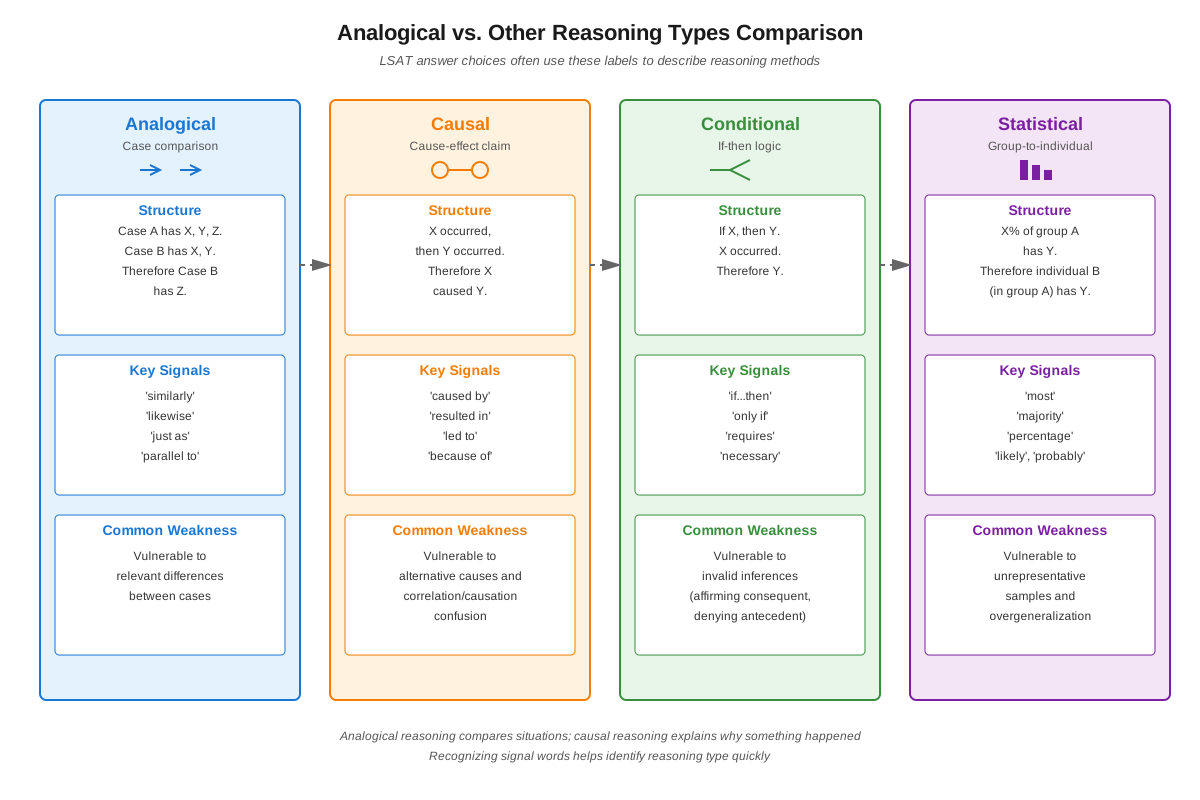
- [ ] Distinguish analogical reasoning from other forms of support (causal, conditional, statistical)
- [ ] Evaluate the strength of analogical arguments by assessing relevant similarities and differences
- [ ] Recognize common answer choice language that describes analogical reasoning
- [ ] Predict when analogical support will be the credited response in method and role questions
Prerequisites
- Basic argument structure: Understanding premises and conclusions is essential because analogies function as premises supporting conclusions
- Conditional reasoning fundamentals: Analogies sometimes involve conditional relationships that must be tracked across compared situations
- Argument evaluation skills: Assessing whether an analogy provides strong or weak support requires general argument analysis abilities
- Question type familiarity: Knowing the basic structure of Method, Role, and Parallel Reasoning questions helps contextualize how analogical reasoning appears
Why This Topic Matters
Analogical reasoning pervades legal thinking, making it a natural focus for the LSAT. Lawyers regularly argue by precedent—claiming that because a previous case shares relevant features with a current case, the same legal principle should apply. This real-world application explains why the LSAT frequently tests the ability to recognize, analyze, and evaluate arguments that rely on analogical support. Beyond legal practice, analogies appear in policy debates, scientific reasoning, ethical arguments, and everyday decision-making, making this a broadly applicable critical thinking skill.
On the LSAT, analogical reasoning appears in approximately 15-20% of Logical Reasoning questions across various question types. Method of Reasoning questions explicitly ask test-takers to identify that an argument "draws an analogy" or "argues by comparing similar situations." Role questions may ask about the function of a statement that introduces an analogical comparison. Parallel Reasoning questions—which constitute roughly 2-3 questions per test—fundamentally test the ability to recognize analogous argument structures. Even in Strengthen, Weaken, and Flaw questions, understanding that an argument relies on analogical support helps predict which answer choices will be relevant (those addressing similarities or differences between compared situations).
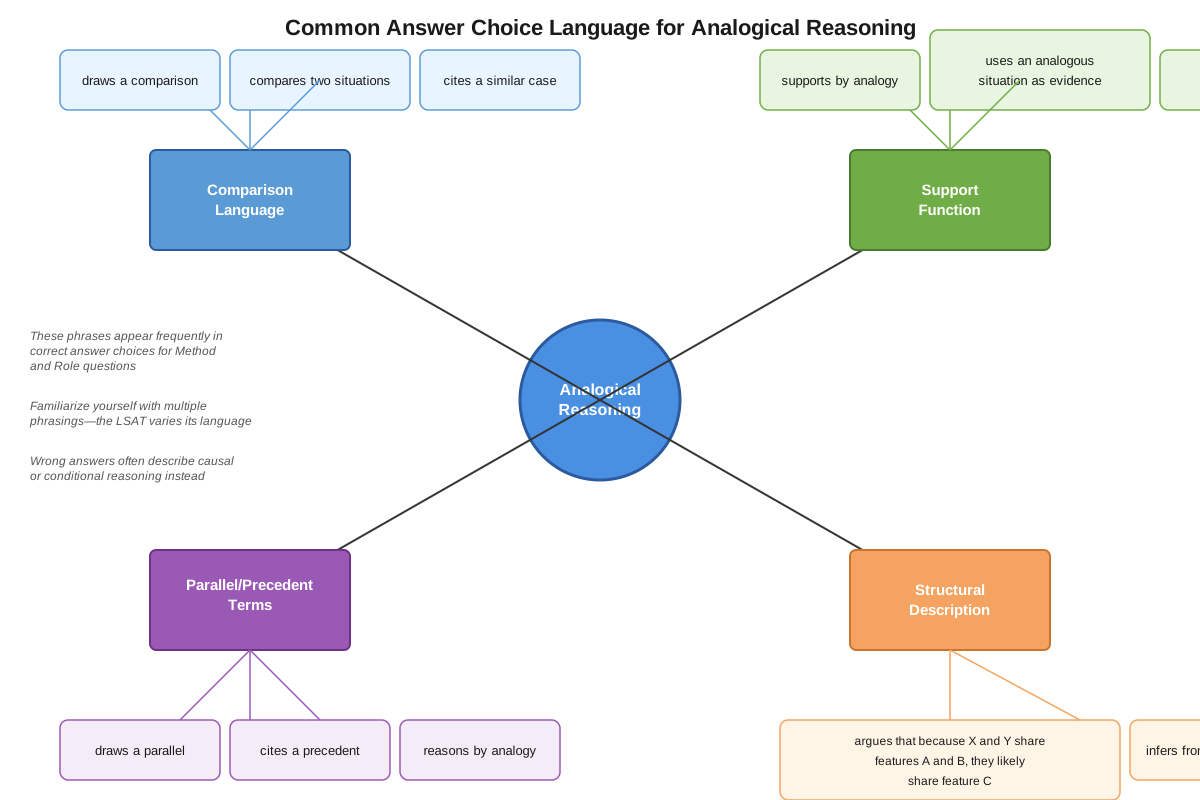
Common manifestations include: arguments comparing historical situations to current circumstances, comparisons between different industries or markets, analogies between human behavior and animal behavior, parallels between different policy implementations, and comparisons between different legal or ethical cases. The LSAT also tests this concept through answer choices that describe reasoning methods, using phrases like "draws a comparison," "cites a parallel case," "argues by analogy," or "supports the conclusion by comparing similar situations."
Core Concepts
The Structure of Analogical Arguments
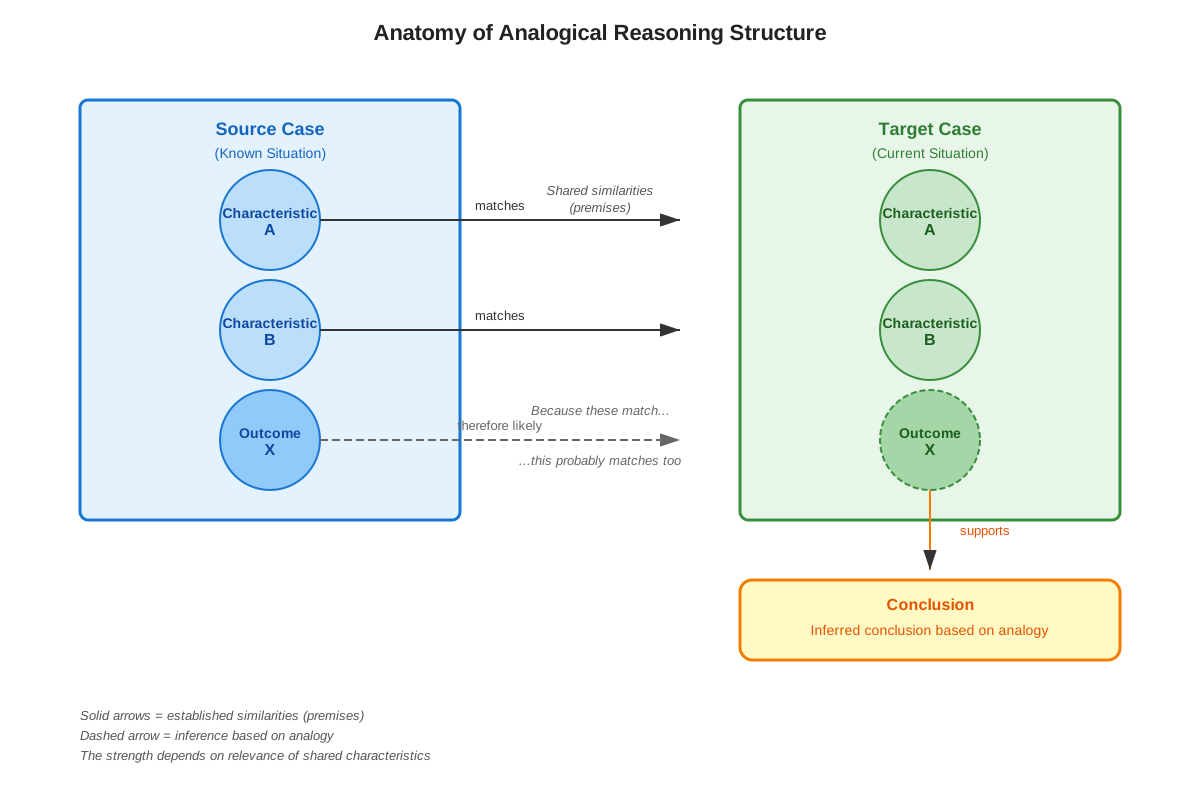
An analogical argument follows a predictable structure: it identifies two situations (A and B), notes that they share certain relevant characteristics, and concludes that they likely share additional characteristics as well. The basic form is:
- Situation A has characteristics X, Y, and Z
- Situation B has characteristics X and Y
- Therefore, Situation B probably has characteristic Z as well
The premise establishes the comparison between situations, while the conclusion extends properties from the known situation to the target situation. For example: "City X implemented a congestion tax and saw traffic decrease by 30%. City Y has similar population density and traffic patterns to City X. Therefore, City Y would likely see similar traffic reductions if it implemented a congestion tax."
Key Components of Analogical Support
When an argument uses analogy as support, several elements must be present:
| Component | Description | Example |
|---|---|---|
| Base case | The situation with known properties | The historical policy implementation |
| Target case | The situation being argued about | The proposed new policy |
| Shared features | Characteristics both situations possess | Similar economic conditions, demographics |
| Inferred feature | The characteristic being extended | Expected outcome or result |
| Implicit claim | That shared features are relevant | That the similarities matter for the outcome |
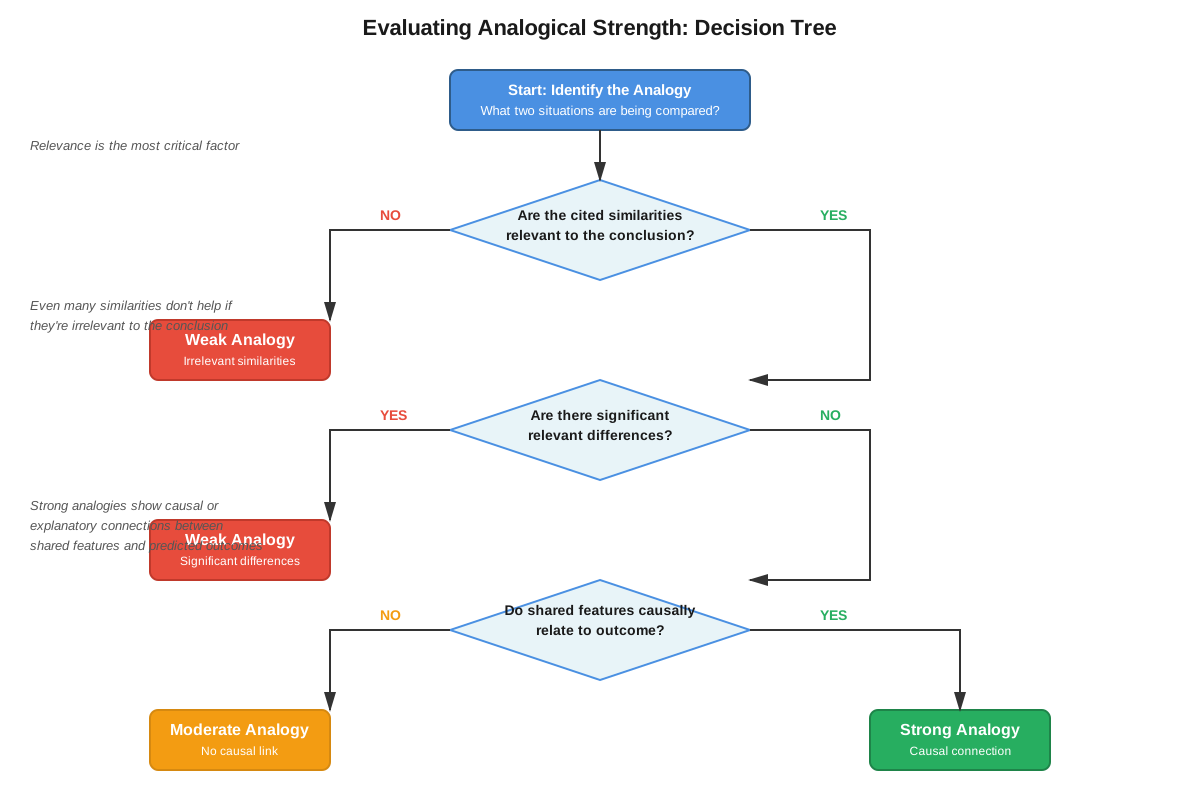
The strength of analogical support depends critically on whether the shared features are relevant to the inferred feature. Two situations might share many characteristics, but if those characteristics don't causally or logically relate to the property being inferred, the analogy provides weak support.
Recognizing Analogical Language
The LSAT uses specific linguistic markers to signal analogical reasoning. Watch for phrases such as:
- "Similarly..."
- "Just as... so too..."
- "Like the situation in..."
- "By analogy to..."
- "Comparable to..."
- "Parallels the case of..."
- "In the same way that..."
- "Analogous to..."
These trigger phrases indicate that the author is drawing a comparison to support their conclusion. However, not all comparisons constitute analogical support—the comparison must serve as evidence for a conclusion rather than merely illustrating a point already established.
Distinguishing Analogies from Other Reasoning Patterns
Understanding what analogical reasoning is NOT helps identify it correctly:
Analogical reasoning vs. Causal reasoning: Analogies compare situations; causal arguments claim one thing causes another. "City X's tax reduced traffic" (causal) differs from "City X's tax reduced traffic, so City Y's similar tax will too" (analogical).
Analogical reasoning vs. Conditional reasoning: Conditional logic establishes if-then relationships; analogies argue from similarity. "If a city implements a congestion tax, traffic decreases" (conditional) differs from the analogical version above.
Analogical reasoning vs. Generalization: Generalizations move from specific instances to broad rules; analogies move from one specific case to another specific case. "Three cities with congestion taxes saw traffic decrease, so congestion taxes generally reduce traffic" (generalization) differs from comparing two specific cities.
The Role of Analogies in Argument Structure
In method, role, and structure questions, analogies can serve several functions:
- Primary support: The analogy is the main evidence for the conclusion
- Supplementary support: The analogy reinforces other evidence
- Counterexample: The analogy challenges an opposing view
- Illustration: The analogy clarifies a point without serving as evidence
- Intermediate conclusion: The analogy itself is argued for, then used to support a further conclusion
Distinguishing these roles is crucial for Role questions, which might ask: "The claim that City X reduced traffic serves which function in the argument?" The correct answer depends on whether this claim is used to support a conclusion about City Y (analogical support) or serves some other purpose.
Evaluating Analogical Strength
Strong analogies share features relevant to the conclusion; weak analogies rely on superficial similarities. Consider:
Strong analogy: "Medical School A's curriculum change improved board scores. Medical School B has similar student profiles, resources, and teaching methods. Therefore, Medical School B's adoption of the same curriculum change will likely improve scores."
Weak analogy: "Medical School A's curriculum change improved board scores. Medical School B also has a red brick building like School A. Therefore, Medical School B's adoption of the same curriculum change will likely improve scores."
The building color is irrelevant to educational outcomes, making this a weak analogy despite the shared characteristic.
Concept Relationships
The concepts within analogical reasoning form an interconnected system. The structure of analogical arguments (base case, target case, shared features, inferred feature) provides the foundation for recognizing analogical language in LSAT passages. Once identified through trigger phrases, the analogy's role in argument structure can be determined—whether it serves as primary support, supplementary evidence, or another function. This role determination directly impacts how to answer Method and Role questions.
Evaluating analogical strength connects back to the key components: strong analogies have shared features that are relevant to the inferred feature, while weak analogies rely on irrelevant similarities. This evaluation skill is essential for Strengthen, Weaken, and Flaw questions involving analogical reasoning.
The ability to distinguish analogies from other reasoning patterns enables accurate identification in Method questions and prevents confusion with causal, conditional, or statistical reasoning. This distinction skill builds on prerequisite knowledge of basic argument structure and conditional reasoning.
Relationship map:
Argument Structure → Analogical Structure (base/target/shared/inferred) → Recognition via Language Markers → Role Determination → Strength Evaluation → Application to Question Types → Distinguishing from Other Patterns → Accurate Answer Selection
Connections to prerequisite topics: Basic argument structure provides the premise-conclusion framework within which analogies operate. Conditional reasoning knowledge prevents confusion when analogies involve conditional relationships. Argument evaluation skills enable assessment of analogical strength.
High-Yield Facts
⭐ Analogical arguments claim that because two situations share certain features, they likely share additional features as well
⭐ The strength of an analogy depends on whether shared features are relevant to the inferred feature, not merely on how many features are shared
⭐ Common trigger phrases include "similarly," "just as," "like," "analogous to," and "parallels the case of"
⭐ In Method questions, correct answers describing analogical reasoning often use phrases like "draws a comparison," "cites a parallel case," or "argues by analogy"
⭐ Analogies differ from generalizations: analogies move from one specific case to another specific case, while generalizations move from specific instances to broad rules
- Analogical reasoning appears in approximately 15-20% of Logical Reasoning questions across various question types
- An analogy can serve as primary support, supplementary support, counterexample, illustration, or intermediate conclusion within an argument
- Parallel Reasoning questions fundamentally test the ability to recognize analogous argument structures
- Weak analogies rely on superficial or irrelevant similarities between compared situations
- Not all comparisons constitute analogical support—the comparison must serve as evidence for a conclusion
- Analogies differ from causal reasoning: analogies compare situations while causal arguments claim one thing causes another
- Legal reasoning frequently employs analogical thinking through precedent, making it a natural LSAT focus
Quick check — test yourself on Using analogy as support so far.
Try Flashcards →Common Misconceptions
Misconception: Any comparison in an argument constitutes analogical reasoning.
Correction: A comparison only functions as analogical support when it serves as evidence for a conclusion. Comparisons used merely to illustrate a point already established, or to clarify terminology, are not analogical arguments. The analogy must be doing argumentative work—supporting an inference about the target case based on the base case.
Misconception: The more similarities two situations share, the stronger the analogy.
Correction: Analogical strength depends on the relevance of shared features, not their quantity. Two situations might share dozens of superficial characteristics while differing in the one feature that actually matters for the conclusion. Conversely, sharing just a few highly relevant features can make an analogy quite strong.
Misconception: Analogical reasoning and parallel reasoning are the same thing.
Correction: Analogical reasoning is a method of argumentation within a single argument (comparing two situations to support a conclusion). Parallel reasoning questions ask you to identify a different argument with the same logical structure. While parallel reasoning questions test your ability to recognize analogous structures, the term "analogical reasoning" specifically refers to arguments that support conclusions by comparing similar situations.
Misconception: If an argument mentions a historical example, it must be using analogical reasoning.
Correction: Historical examples can serve various functions. An argument might cite history as statistical evidence ("This policy failed in 15 historical cases"), as a counterexample to a general claim, or as an illustration. Only when the historical case is compared to a current situation to infer that the current situation will have similar outcomes does it constitute analogical support.
Misconception: Analogies are always weak arguments that can be easily attacked.
Correction: While analogies can be weakened by pointing out relevant differences, strong analogies with highly relevant shared features provide robust support. In legal reasoning, arguments from precedent (a form of analogy) are often considered compelling. The LSAT includes both strong and weak analogical arguments, and recognizing the difference is part of what's being tested.
Misconception: The base case in an analogy must be explicitly stated before the target case.
Correction: LSAT arguments can present analogical comparisons in various orders. The target case (what's being argued about) might appear first, with the base case (the comparison) introduced later. The logical structure remains the same regardless of presentation order.
Worked Examples
Example 1: Method of Reasoning Question
Stimulus: "The city of Riverside implemented a bike-sharing program five years ago, and since then has seen a 15% reduction in downtown traffic congestion. Riverside's population density, public transportation infrastructure, and climate are remarkably similar to those of Lakewood. Therefore, Lakewood should expect similar reductions in traffic congestion if it implements a comparable bike-sharing program."
Question: The argument proceeds by
Answer Choices:
(A) generalizing from a single instance to establish a universal principle
(B) drawing an analogy between two situations to support a prediction
(C) establishing a causal relationship and applying it to a new case
(D) citing expert testimony to support a policy recommendation
(E) using statistical evidence to demonstrate the effectiveness of a program
Analysis:
Step 1: Identify the conclusion. The conclusion is that Lakewood should expect similar traffic reductions (a prediction about Lakewood based on Riverside's experience).
Step 2: Identify the premises. The premises are: (1) Riverside implemented a program and saw results, and (2) Riverside and Lakewood share relevant characteristics.
Step 3: Determine the reasoning pattern. The argument compares two cities, notes their similarities, and infers that what happened in one will happen in the other. This is classic analogical reasoning.
Step 4: Eliminate incorrect answers:
- (A) is wrong because the argument doesn't establish a universal principle; it makes a specific prediction about Lakewood
- (C) is tempting but incorrect; while the argument might assume a causal relationship between the program and traffic reduction, the method of reasoning is comparison, not causal analysis
- (D) is wrong because no expert is cited
- (E) is wrong because while statistics are mentioned, the method is comparison, not statistical analysis
Step 5: Confirm the correct answer. (B) accurately describes the reasoning: the argument draws an analogy (comparison) between Riverside and Lakewood to support a prediction about Lakewood.
Connection to learning objectives: This example demonstrates how to identify analogical support in LSAT questions and apply that recognition to select the correct answer in a Method of Reasoning question.
Example 2: Role Question
Stimulus: "Some argue that implementing strict emissions standards will harm economic growth. However, this concern is unfounded. When Sweden implemented strict emissions standards in the 1990s, its economy continued to grow robustly. Sweden's economic structure and level of development at that time were comparable to our country's current situation. The claim that emissions standards will harm growth is therefore not supported by historical evidence."
Question: The statement that Sweden's economy continued to grow robustly serves which function in the argument?
Answer Choices:
(A) It is the main conclusion of the argument
(B) It is a premise offered in support of an intermediate conclusion
(C) It provides evidence for the conclusion by citing a comparable case
(D) It states an assumption upon which the argument depends
(E) It presents a view that the argument seeks to refute
Analysis:
Step 1: Identify the main conclusion. The conclusion is that the claim about emissions standards harming growth is not supported (stated in the final sentence).
Step 2: Locate the statement in question. "Sweden's economy continued to grow robustly" appears in the middle of the argument.
Step 3: Determine its function. This statement is part of a comparison between Sweden and the current country. The argument notes Sweden implemented standards, continued growing, and is comparable to the current situation—this is analogical support for the conclusion that emissions standards won't harm growth.
Step 4: Eliminate incorrect answers:
- (A) is wrong because the main conclusion is about the claim being unsupported
- (B) is partially correct but incomplete; there's no clear intermediate conclusion
- (D) is wrong because this is stated explicitly, not assumed
- (E) is wrong because this supports the argument's position, not a view being refuted
Step 5: Confirm the correct answer. (C) accurately describes the role: the statement provides evidence by citing a comparable case (Sweden) to support the conclusion that emissions standards won't harm growth.
Connection to learning objectives: This example shows how analogical support functions within argument structure and how to identify that role when answering Role questions.
Exam Strategy
Approaching Questions Involving Analogical Reasoning
Step 1: Identify the argument structure first. Before determining whether analogical reasoning is present, locate the conclusion and premises. This prevents confusion between the analogy itself and the conclusion it supports.
Step 2: Look for comparison language. Scan for trigger words like "similarly," "just as," "like," "comparable," or "analogous." These signal potential analogical reasoning.
Step 3: Verify the comparison serves as support. Confirm that the comparison isn't merely illustrative but actually functions as evidence for the conclusion. Ask: "Is the author inferring something about the target case based on the base case?"
Step 4: For Method questions, match the reasoning pattern to answer choice language. Correct answers describing analogical reasoning typically use phrases like:
- "draws a comparison between similar situations"
- "argues by analogy"
- "cites a parallel case"
- "supports the conclusion by comparing"
- "draws on a similar situation"
Step 5: For Role questions, determine whether the analogical statement is:
- The base case being compared
- The target case being argued about
- A statement of similarity between cases
- The conclusion drawn from the comparison
Process of Elimination Tips
Eliminate answers that describe other reasoning patterns:
- If the answer says "generalizes from specific instances," but the argument compares two specific cases, eliminate it
- If the answer says "establishes a causal relationship," but the argument compares situations rather than claiming causation, eliminate it
- If the answer says "applies a general principle," but the argument reasons from one case to another, eliminate it
Watch for scope mismatches: If an answer choice describes the argument as establishing a universal rule or broad principle, but the argument only makes a claim about one specific situation based on another, eliminate it.
Verify the direction of reasoning: Analogical arguments move from base case to target case. If an answer choice reverses this direction or suggests a different logical flow, eliminate it.
Time Allocation
For Method and Role questions involving analogical reasoning, allocate approximately 1:15-1:30. These questions typically require:
- 20-30 seconds to read and understand the stimulus
- 10-15 seconds to identify the reasoning pattern
- 30-45 seconds to evaluate answer choices
If you quickly recognize analogical reasoning through trigger phrases, you can move through answer choices efficiently by eliminating those describing other reasoning patterns first.
Memory Techniques
Mnemonic for Analogical Structure: "BASE-T"
Base case (the known situation)
Analogous features (shared characteristics)
Similarity claim (that the features are relevant)
Extended feature (what's being inferred)
Target case (the situation being argued about)
Visualization Strategy
Picture analogical reasoning as a bridge: the base case is one shore (solid ground with known properties), the shared features are the bridge structure connecting the two shores, and the target case is the opposite shore where you're inferring properties. The bridge is only strong if its materials (shared features) are appropriate for the span (relevant to the conclusion).
Acronym for Trigger Phrases: "SLAP-J"
Similarly
Like
Analogous to
Parallels
Just as
When you see SLAP-J words, think: "This might be analogical reasoning."
Memory Aid for Distinguishing Reasoning Types
Analogy: One specific case → Another specific case ("City X did Y, City Z is like X, so Z will do Y")
Generalization: Multiple specific cases → General rule ("Cities X, Y, and Z did this, so all cities will")
Causal: Cause → Effect ("X causes Y")
Conditional: If-then relationship ("If X, then Y")
Remember: "Analogies are one-to-one comparisons, not one-to-many or cause-to-effect."
Summary
Using analogy as support is a fundamental reasoning pattern on the LSAT in which an argument compares two situations, identifies relevant similarities, and infers that what is true of one situation will be true of the other. This reasoning method appears frequently in Logical Reasoning questions, particularly in Method of Reasoning, Role, and Parallel Reasoning questions. The structure of analogical arguments includes a base case (known situation), target case (situation being argued about), shared features, and an inferred feature. Strong analogies rely on relevant similarities, while weak analogies depend on superficial or irrelevant shared characteristics. Recognizing analogical reasoning requires identifying comparison language ("similarly," "just as," "analogous to") and verifying that the comparison serves as evidence for a conclusion rather than mere illustration. Distinguishing analogies from other reasoning patterns—particularly causal reasoning, generalizations, and conditional logic—is essential for accurate answer selection. Success with these questions depends on understanding argument structure, recognizing the role analogical statements play within that structure, and matching the reasoning pattern to answer choice language that describes drawing comparisons or citing parallel cases.
Key Takeaways
- Analogical arguments support conclusions by comparing similar situations and inferring that shared features extend to additional properties
- Analogical strength depends on the relevance of shared features, not merely their quantity
- Trigger phrases like "similarly," "just as," and "analogous to" signal potential analogical reasoning
- In Method questions, correct answers describing analogies use language like "draws a comparison" or "argues by analogy"
- Analogies differ from generalizations (one-to-one vs. many-to-all) and causal reasoning (comparison vs. cause-effect)
- Not all comparisons are analogical arguments—the comparison must serve as evidence for a conclusion
- Recognizing analogical reasoning enables efficient elimination of answer choices describing other reasoning patterns
Related Topics
Parallel Reasoning Questions: These questions require identifying arguments with analogous structures, building directly on the ability to recognize analogical patterns. Mastering analogical support provides the foundation for quickly matching argument structures.
Strengthen and Weaken Questions with Analogies: Understanding that arguments rely on analogical support helps predict which answer choices will be relevant—those addressing similarities or differences between compared situations.
Flaw Questions Involving False Analogies: Recognizing when analogies rely on irrelevant similarities enables identification of flawed reasoning, a common question type that builds on analogical reasoning concepts.
Causal Reasoning: Distinguishing analogical from causal reasoning prevents confusion and enables accurate identification of reasoning methods, as these patterns often appear in similar contexts.
Argument Structure and Role Questions: Deeper understanding of how analogies function within overall argument structure enhances performance on Role questions that ask about the function of specific statements.
Practice CTA
Now that you understand how analogical reasoning functions on the LSAT, it's time to apply this knowledge. Work through the practice questions to reinforce your ability to identify, analyze, and evaluate arguments that use analogy as support. Pay special attention to recognizing trigger phrases and distinguishing analogical reasoning from other patterns. Use the flashcards to memorize key concepts and test your recall of high-yield facts. Remember: recognizing analogical reasoning quickly and accurately will save you valuable time on test day and significantly improve your performance on Method, Role, and Parallel Reasoning questions. You've built a strong foundation—now strengthen it through deliberate practice!
Sign up free to keep reading
Create a free AnvayaPrep account to finish this LSAT guide on Using analogy as support — plus flashcards and practice questions.