Overview
Analogy parallel flaw questions represent one of the most challenging and high-value question types within LSAT Logical Reasoning. These questions require test-takers to identify an argument that contains the same logical error as the stimulus argument, but expressed through entirely different subject matter. Unlike standard parallel reasoning questions that ask students to match valid argument structures, parallel flaw questions specifically target the ability to recognize and replicate flawed reasoning patterns. This distinction is crucial: students must not only understand what makes an argument invalid but also recognize that same invalidity when disguised in completely different contexts.
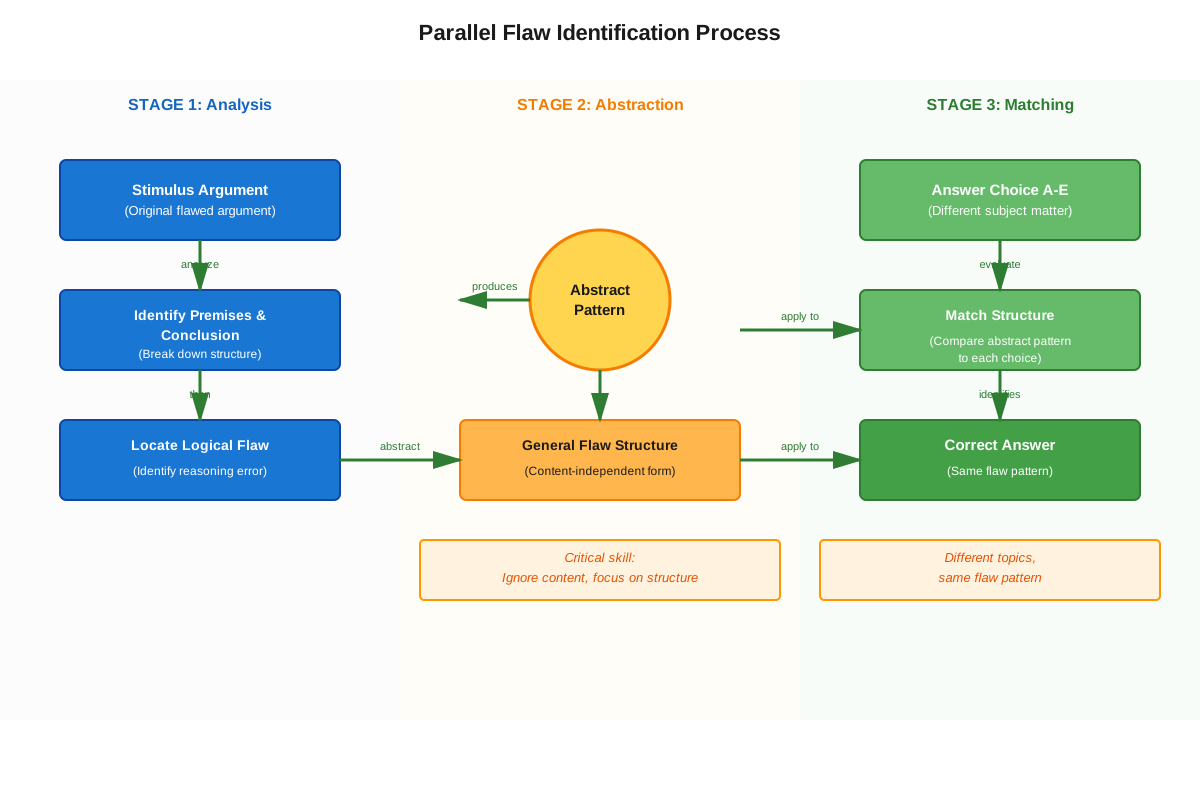
The cognitive demand of these questions is substantial. Test-takers must first analyze the stimulus argument to identify its specific logical flaw, then abstract that flaw into a general pattern independent of content, and finally match that pattern to one of five answer choices that discuss entirely unrelated topics. This process requires exceptional analytical flexibility and pattern recognition skills. The LSAT deliberately uses disparate subject matter between stimulus and answer choices to ensure that students are truly identifying structural flaws rather than relying on superficial content similarities.
Within the broader landscape of LSAT Logical Reasoning, parallel flaw questions connect intimately to several other question types. They build upon foundational skills in flaw identification, assumption analysis, and formal logic. Mastering parallel flaw questions simultaneously strengthens performance on standard flaw questions, parallel reasoning questions, and even strengthen/weaken questions, as all require precise understanding of argument structure. The ability to see past content to underlying logical form—the core skill tested by parallel flaw questions—represents one of the highest-level reasoning abilities the LSAT assesses.
Learning Objectives
- [ ] Identify how Analogy parallel flaw appears in LSAT questions
- [ ] Explain the reasoning pattern behind Analogy parallel flaw
- [ ] Apply Analogy parallel flaw to solve LSAT-style problems accurately
- [ ] Distinguish between different types of logical flaws that commonly appear in parallel flaw questions
- [ ] Abstract logical structures from specific content to recognize patterns across different contexts
- [ ] Evaluate answer choices efficiently by eliminating structural mismatches before analyzing complete arguments
Prerequisites
- Basic argument structure: Understanding premises, conclusions, and how they relate is essential because parallel flaw questions require identifying these components in both stimulus and answer choices
- Common logical fallacies: Familiarity with standard reasoning errors (ad hominem, false dichotomy, circular reasoning, etc.) provides the vocabulary and conceptual framework for recognizing flaws
- Conditional logic fundamentals: Many parallel flaw questions involve conditional reasoning errors, making comfort with if-then statements and their valid/invalid forms necessary
- Standard flaw question experience: Having practiced identifying flaws in isolation prepares students for the additional step of matching those flaws across different arguments
Why This Topic Matters
Parallel flaw questions appear with remarkable consistency on the LSAT, typically comprising 2-4 questions per Logical Reasoning section. Given that each Logical Reasoning section contains approximately 25-26 questions, and most LSAT administrations include two scored Logical Reasoning sections, students can expect to encounter 4-8 parallel flaw questions on test day. At roughly 4 points per question, mastering this question type can directly impact scores by 16-32 points—a difference that can move a student from the 75th percentile to the 90th percentile or higher.
Beyond raw frequency, parallel flaw questions serve as excellent diagnostic tools for overall logical reasoning ability. Students who struggle with these questions often have gaps in fundamental argument analysis skills that affect performance across multiple question types. Conversely, students who excel at parallel flaw questions typically demonstrate strong performance throughout Logical Reasoning sections because they've developed the ability to see arguments as abstract structures rather than getting lost in content details.
In real-world applications, the skills developed through parallel flaw practice translate directly to legal reasoning. Attorneys constantly draw analogies between cases, identifying when precedents apply based on structural similarities despite factual differences. The ability to recognize that "this case is like that case in the relevant logical respects" mirrors exactly what parallel flaw questions demand. Law school case analysis, legal writing, and oral advocacy all require this same capacity to abstract principles from specific instances and apply them across contexts—making parallel flaw questions among the most legally relevant on the entire LSAT.
Core Concepts
Understanding Parallel Flaw Question Structure
Parallel flaw questions present an argument containing a logical error in the stimulus, then ask which answer choice exhibits the same flawed reasoning pattern. The question stem typically includes language such as "The flawed reasoning in which one of the following is most similar to that in the argument above?" or "Which one of the following arguments is most similar in its pattern of reasoning to the argument above?" The inclusion of "flawed" or contextual indicators that the reasoning is problematic distinguishes these from standard parallel reasoning questions.
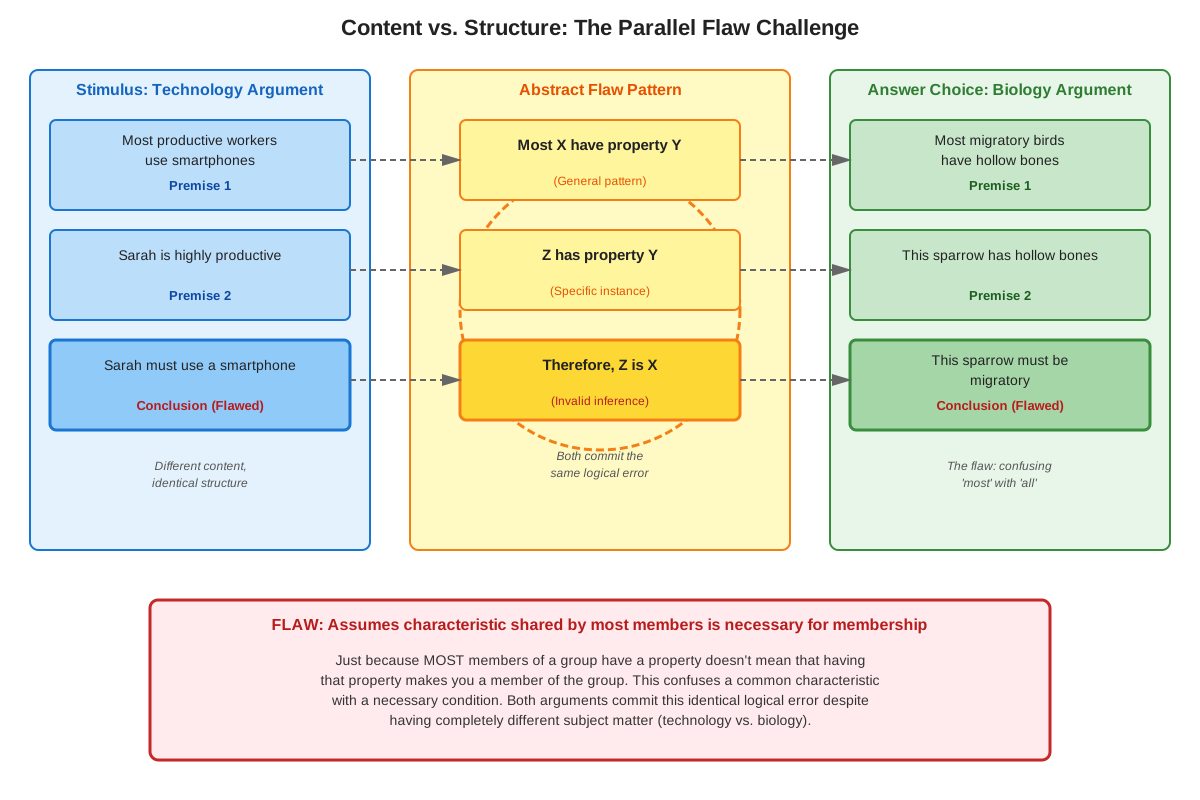
The fundamental challenge lies in the abstraction requirement. Consider an argument that reasons: "All dogs are mammals. Fluffy is a mammal. Therefore, Fluffy is a dog." This commits the fallacy of affirming the consequent in conditional logic terms, or more generally, the error of assuming that being a member of a larger category (mammals) guarantees membership in a smaller category (dogs). A parallel flaw might state: "All roses are flowers. This plant is a flower. Therefore, this plant is a rose." Despite completely different subject matter, the logical structure—and the specific error—remains identical.
Common Flaw Types in Parallel Flaw Questions
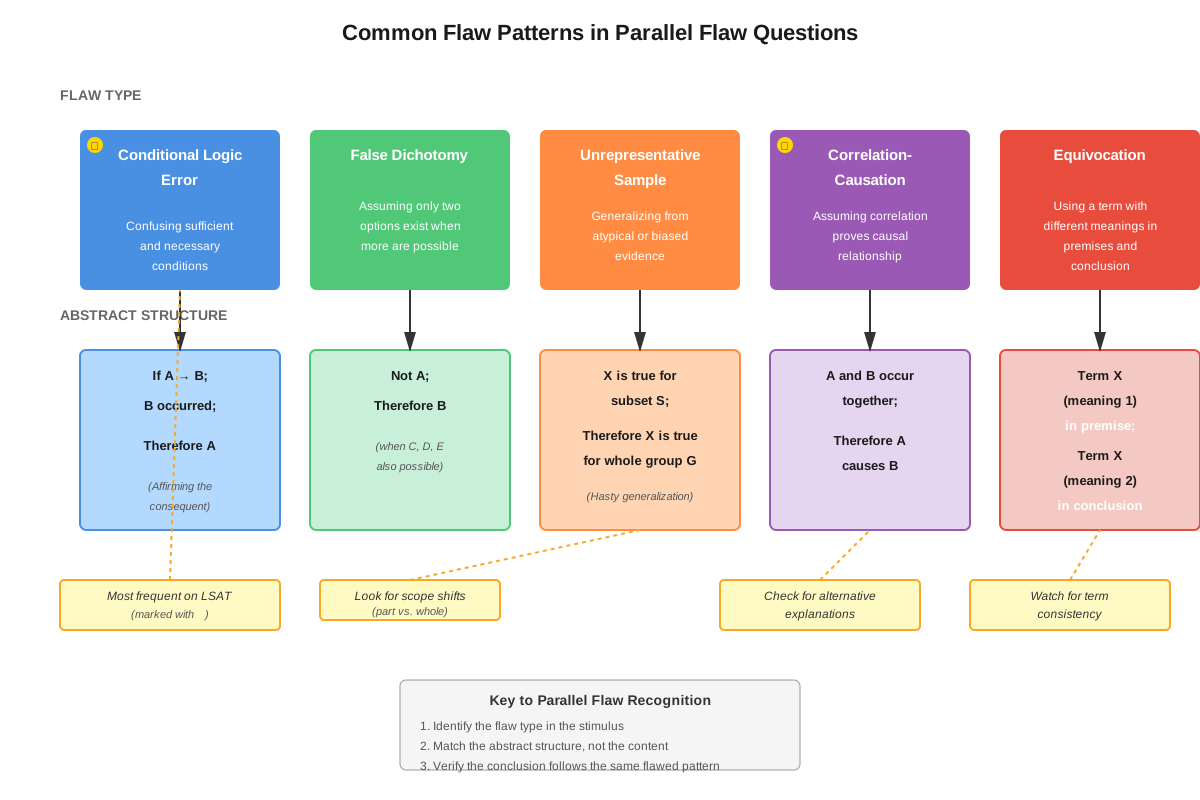
Several categories of logical errors appear repeatedly in LSAT analogy parallel flaw questions:
Conditional Logic Errors: These include affirming the consequent (if A then B; B, therefore A), denying the antecedent (if A then B; not A, therefore not B), and confusing necessity with sufficiency. These errors are particularly common because they're easy to disguise across different content areas while maintaining structural identity.
Part-to-Whole Fallacies: Arguments that incorrectly assume what's true of parts must be true of the whole, or vice versa. For example: "Each player on the team is excellent, so the team must be excellent" commits a composition fallacy, while "The orchestra is world-class, so each musician must be world-class" commits a division fallacy.
Sampling and Generalization Errors: Arguments that draw conclusions about entire populations based on unrepresentative samples, or that assume a sample's characteristics apply universally. The flaw lies in the mismatch between evidence scope and conclusion scope.
Causal Reasoning Flaws: These include confusing correlation with causation, reversing cause and effect, or ignoring alternative explanations. A parallel flaw must match not just that causation is assumed, but the specific way the causal error manifests.
Circular Reasoning: Arguments where the conclusion merely restates a premise, often in disguised language. The parallel must exhibit the same degree and type of circularity.
The Abstraction Process
Successfully solving parallel flaw questions requires a systematic abstraction process:
- Identify the conclusion: Determine exactly what the argument is trying to prove
- Map the premises: Note what evidence is offered and how it's structured
- Diagnose the flaw: Pinpoint the specific logical gap or error
- Abstract the pattern: Translate the argument into general logical form, removing all specific content
- Match structurally: Compare this abstract pattern to answer choices, eliminating mismatches
For example, abstracting "All successful entrepreneurs take risks. Maria takes risks. Therefore, Maria is a successful entrepreneur" yields: "All A are B. X is B. Therefore, X is A." This abstraction reveals the affirming-the-consequent structure that must appear in the correct answer.
Structural Elements to Match
When evaluating whether an answer choice parallels the stimulus flaw, several structural elements must align:
| Structural Element | What to Match | Example |
|---|---|---|
| Number of premises | Same quantity of supporting statements | Two premises must match two premises |
| Quantifier type | Universal (all/no) vs. particular (some/most) | "All X are Y" requires "All A are B" |
| Conclusion strength | Absolute vs. qualified claims | "Must be" requires "must be," not "probably is" |
| Logical operators | And/or/if-then structure | Conditional in stimulus requires conditional in answer |
| Negation placement | Where "not" appears in the structure | "Not all X" differs from "All non-X" |
Content Independence Principle
A critical concept in parallel reasoning questions is content independence: the subject matter is deliberately varied to test pure structural recognition. An argument about biology might parallel one about economics, architecture, or sports. Students must train themselves to ignore content appeal or familiarity and focus exclusively on logical form. This requires conscious effort, as human cognition naturally gravitates toward content and meaning rather than abstract structure.
Concept Relationships
The concepts within parallel flaw questions form a hierarchical relationship. At the foundation lies argument structure recognition—the ability to identify premises and conclusions. This enables flaw identification, which requires understanding both what the argument claims and where its reasoning breaks down. Flaw identification then supports pattern abstraction, the process of converting specific arguments into general logical forms. Finally, pattern abstraction enables structural matching, where abstract patterns are compared across different content domains.
These internal relationships connect to broader Logical Reasoning skills. Parallel flaw questions draw heavily on standard flaw questions, essentially adding a matching component to basic flaw identification. They also connect to parallel reasoning questions (non-flawed versions), with the key difference being that students must match invalid rather than valid structures. The conditional logic errors common in parallel flaw questions link directly to formal logic concepts, particularly sufficient and necessary conditions. Additionally, the abstraction skills developed through parallel flaw practice enhance performance on method of reasoning questions, which also require seeing past content to underlying structure.
The relationship map flows as follows: Conditional Logic Fundamentals → Flaw Identification → Pattern Recognition → Abstraction Ability → Structural Matching → Parallel Flaw Mastery. Each stage builds on the previous, and weakness at any point in the chain compromises overall performance.
High-Yield Facts
- ⭐ Parallel flaw questions require matching both the logical structure AND the specific type of flaw, not just general invalidity
- ⭐ The correct answer will have the same number of premises as the stimulus argument in most cases
- ⭐ Quantifier strength must match: "all" in the stimulus requires "all" (or equivalent) in the answer, not "most" or "some"
- ⭐ Conditional logic errors (affirming consequent, denying antecedent) are the most frequently tested flaw types in parallel questions
- ⭐ Content similarity between stimulus and answer choice is often a trap—correct answers typically discuss completely different topics
- Circular reasoning parallels must exhibit the same degree of obviousness or disguise in their circularity
- Part-to-whole fallacies must match direction: composition (parts→whole) doesn't parallel division (whole→parts)
- The conclusion's certainty level must match: "definitely" requires "definitely," not "probably"
- Causal flaw parallels must match the specific causal error type, not just assume causation generally
- Answer choices that commit different flaws than the stimulus can be eliminated immediately, even if they're invalid arguments
- Parallel flaw questions typically take 90-120 seconds to complete accurately, longer than average Logical Reasoning questions
Quick check — test yourself on Analogy parallel flaw so far.
Try Flashcards →Common Misconceptions
Misconception: Any invalid argument that seems similar to the stimulus is correct → Correction: The specific type of flaw must match exactly; an argument that commits a different logical error, even if also flawed, is incorrect. For example, if the stimulus commits a sampling error, an answer choice with circular reasoning is wrong despite being flawed.
Misconception: Content similarity indicates a correct answer → Correction: The LSAT deliberately uses different subject matter to test structural recognition. An answer about the same topic as the stimulus is often a trap, while the correct answer typically discusses something completely unrelated.
Misconception: Matching the conclusion is sufficient → Correction: The entire argument structure must parallel, including how premises relate to the conclusion and where specifically the logical gap occurs. Two arguments can reach similar conclusions through entirely different (and differently flawed) reasoning.
Misconception: "Close enough" structural similarity is acceptable → Correction: Parallel flaw questions demand precise structural matching. An argument with two premises cannot correctly parallel one with three premises; "all" cannot match "most"; conditional structures cannot match categorical ones.
Misconception: Understanding that both arguments are flawed is the main task → Correction: Recognizing that an argument is flawed is only the first step. The critical skill is identifying the specific flaw type and matching that exact error pattern across different content, which requires much deeper analysis than simply spotting that something is wrong.
Worked Examples
Example 1: Conditional Logic Error
Stimulus: "If a restaurant receives a prestigious award, it must serve excellent food. The Downtown Bistro serves excellent food. Therefore, the Downtown Bistro must have received a prestigious award."
Analysis:
- Identify the structure: This is a conditional argument: If A (award) → B (excellent food)
- Map the reasoning: Premise 1 establishes the conditional. Premise 2 affirms the consequent (B). Conclusion claims the antecedent (A).
- Diagnose the flaw: This commits the fallacy of affirming the consequent—assuming that because the consequent is true, the antecedent must be true. The argument ignores that excellent food might exist without the award.
- Abstract the pattern: If A → B; B; therefore A
- Predict the answer: Must have the same conditional structure with the same error
Correct Answer: "If a student studies diligently, that student will pass the exam. Jordan passed the exam. Therefore, Jordan must have studied diligently."
Why it's correct: This perfectly matches the structure: If A (study diligently) → B (pass exam); B (Jordan passed); therefore A (Jordan studied diligently). The flaw is identical—assuming the sufficient condition occurred just because the necessary condition was met, ignoring other possible ways to pass the exam.
Wrong Answer to Avoid: "If a plant receives adequate water, it will grow. This plant did not receive adequate water. Therefore, it will not grow."
Why it's wrong: This commits denying the antecedent (If A → B; not A; therefore not B), which is a different conditional error than affirming the consequent. Despite both being conditional logic flaws, the specific error type doesn't match.
Example 2: Part-to-Whole Fallacy
Stimulus: "Every chapter in this book is short and easy to read. Therefore, the entire book must be short and easy to read."
Analysis:
- Identify the structure: This moves from properties of parts (chapters) to properties of the whole (book)
- Map the reasoning: Premise establishes that each component has certain properties. Conclusion claims the aggregate has those same properties.
- Diagnose the flaw: This commits the composition fallacy—assuming what's true of parts must be true of the whole. Many short chapters can create a long book; many easy chapters can create a challenging overall reading experience.
- Abstract the pattern: Each part has property X; therefore, the whole has property X
- Predict the answer: Must move from parts to whole with the same type of property that doesn't necessarily transfer
Correct Answer: "Each individual task in this project is simple and quick to complete. Therefore, the entire project must be simple and quick to complete."
Why it's correct: This exhibits identical composition reasoning: parts (tasks) have properties (simple, quick) that are assumed to transfer to the whole (project), when in reality many simple tasks can create a complex, time-consuming project. The logical structure and specific flaw type match perfectly.
Wrong Answer to Avoid: "This orchestra is world-renowned. Therefore, each musician in the orchestra must be world-renowned."
Why it's wrong: This commits the division fallacy (whole to parts) rather than composition (parts to whole). While both are part-whole errors, the direction is opposite, making the logical structure different. The stimulus moves from parts to whole; this answer moves from whole to parts.
Exam Strategy
When approaching parallel flaw questions on the LSAT, employ this systematic strategy:
Step 1: Identify the question type (5-10 seconds). Look for trigger phrases: "most similar in its flawed reasoning," "exhibits a flawed pattern of reasoning most like," or "reasoning is most parallel to." These indicate a parallel flaw question rather than standard parallel reasoning.
Step 2: Analyze the stimulus argument (20-30 seconds). Read actively to identify: (a) the conclusion, (b) each premise, (c) the specific logical flaw. Don't just recognize that it's flawed—diagnose the exact error type. Ask yourself: "What specific mistake in reasoning makes this argument invalid?"
Step 3: Abstract the structure (10-15 seconds). Mentally convert the argument to variables or general terms. For example, translate "All successful CEOs are risk-takers. John is a risk-taker. Therefore, John is a successful CEO" into "All A are B. X is B. Therefore, X is A." This abstraction is your matching template.
Step 4: Predict structural requirements (5-10 seconds). Before reading answer choices, note what must match: number of premises, quantifier types (all/some/most), conditional vs. categorical structure, and the specific flaw type.
Step 5: Eliminate aggressively (30-40 seconds). Read answer choices looking for structural mismatches that allow immediate elimination:
- Wrong number of premises
- Different quantifiers (all vs. some)
- Different logical operators (conditional vs. categorical)
- Different flaw type (even if also flawed)
Exam Tip: Eliminate answer choices as soon as you spot a structural mismatch. Don't finish reading an answer choice that has already revealed a disqualifying difference from the stimulus.
Step 6: Verify the remaining choice (10-20 seconds). Once you've eliminated four answers, verify that the remaining choice truly parallels both structure and flaw. Map it explicitly to your abstraction to confirm.
Time allocation: Budget 90-120 seconds for parallel flaw questions. They require more time than average Logical Reasoning questions due to the complexity of analyzing multiple arguments. If you're exceeding two minutes, make your best guess and move on—spending three minutes on one question sacrifices time needed elsewhere.
Trigger words to watch for: "Similar pattern," "parallel," "flawed reasoning," "most like," "same error," "analogous reasoning." These phrases signal that you must match structure, not evaluate the argument's validity independently.
Memory Techniques
MATCH acronym for parallel flaw analysis:
- Map the structure (identify premises and conclusion)
- Abstract to variables (remove specific content)
- Type the flaw (diagnose the specific error)
- Count elements (verify number of premises, quantifiers)
- Hunt for mismatches (eliminate structural differences)
Visualization strategy: Picture the stimulus argument as a physical structure—perhaps a building with a specific architectural flaw (a cracked foundation, missing support beam, etc.). The correct answer is a different building with the exact same architectural flaw in the same location, even though the buildings look completely different otherwise. This metaphor reinforces that surface differences (content) don't matter, but structural similarities (logical form) do.
The "Content Blindfold" technique: When reading answer choices, consciously try to "not see" the specific subject matter. Focus on logical words (all, some, if, then, therefore, must, probably) and structural elements while letting content blur. This trains your brain to prioritize structure over content.
Flaw Family Grouping: Memorize common flaw families that appear in parallel questions:
- Conditional Cousins: Affirming consequent, denying antecedent, confusing necessity/sufficiency
- Part-Whole Pair: Composition (parts→whole), Division (whole→parts)
- Causal Clan: Correlation→causation, reversed causation, ignored alternatives
- Scope Siblings: Overgeneralization, unrepresentative sample, shift in scope
Grouping flaws into families helps you quickly categorize the stimulus flaw and predict what the answer must match.
Summary
Analogy parallel flaw questions test the sophisticated ability to recognize identical logical errors across completely different content domains. These questions require students to analyze the stimulus argument to identify its specific flaw, abstract that flaw into a general structural pattern independent of subject matter, and match that pattern to one of five answer choices discussing unrelated topics. Success demands mastery of common logical fallacies (particularly conditional logic errors, part-whole fallacies, and causal reasoning flaws), the ability to distinguish between different flaw types, and the discipline to focus on logical structure rather than content. The key insight is that parallel flaw questions test pattern recognition at the highest level: students must see past surface differences to identify deep structural similarities. With 2-4 questions per Logical Reasoning section, mastering this question type significantly impacts overall LSAT performance. The systematic approach involves identifying the flaw type, abstracting the logical structure, and aggressively eliminating answer choices that exhibit structural mismatches, even if they're also flawed arguments. Content similarity is typically a trap, while structural precision is essential—quantifiers, logical operators, number of premises, and the specific error type must all align between stimulus and correct answer.
Key Takeaways
- Parallel flaw questions require matching both the logical structure AND the specific type of flaw, not just general invalidity
- Abstract the stimulus argument into variables or general logical form before evaluating answer choices
- Eliminate answer choices immediately upon identifying structural mismatches (wrong quantifiers, different number of premises, different flaw type)
- Content similarity between stimulus and answer is often a trap—correct answers typically discuss completely different topics
- Conditional logic errors (affirming consequent, denying antecedent) are the most frequently tested flaw types
- The entire argument structure must parallel, including how premises relate to conclusions and where the logical gap occurs
- Budget 90-120 seconds per parallel flaw question, as they require more analysis time than average Logical Reasoning questions
Related Topics
Standard Flaw Questions: These questions ask students to identify the logical error in an argument without the matching component. Mastering parallel flaw questions strengthens flaw identification skills, while strong flaw recognition makes parallel flaw questions more manageable.
Parallel Reasoning (Valid Arguments): These questions ask students to match valid argument structures rather than flawed ones. The abstraction and structural matching skills are identical, but students must recognize sound reasoning patterns instead of errors.
Formal Logic and Conditional Reasoning: Many parallel flaw questions involve conditional logic errors, making deep understanding of sufficient and necessary conditions, contrapositives, and valid/invalid conditional inferences essential for advanced performance.
Method of Reasoning Questions: These questions ask students to describe how an argument proceeds, requiring similar abstraction skills to see past content to underlying structure. Success with parallel flaw questions enhances method of reasoning performance.
Practice CTA
Now that you've mastered the conceptual framework for analogy parallel flaw questions, it's time to apply these skills to actual LSAT-style problems. The practice questions and flashcards will reinforce your ability to abstract logical structures, identify specific flaw types, and match patterns across different content domains. Remember: parallel flaw questions reward systematic analysis and structural precision. Each practice question you complete strengthens your pattern recognition abilities and builds the confidence needed to tackle these high-value questions efficiently on test day. Approach practice deliberately, using the MATCH acronym and elimination strategies you've learned. Your investment in mastering this challenging question type will pay dividends throughout the Logical Reasoning sections and beyond.
Sign up free to keep reading
Create a free AnvayaPrep account to finish this LSAT guide on Analogy parallel flaw — plus flashcards and practice questions.