Overview
Causal parallel reasoning represents one of the most sophisticated question types within LSAT logical reasoning sections. These questions require test-takers to identify arguments that share identical causal structures, even when the subject matter differs entirely. Unlike simple parallel reasoning questions that match any logical structure, causal parallel reasoning specifically focuses on arguments that establish cause-and-effect relationships between phenomena.
The LSAT tests causal parallel reasoning because legal practice demands the ability to recognize analogous reasoning patterns across diverse factual scenarios. Attorneys must identify when precedent cases share the same logical structure as current cases, even when surface details differ dramatically. This skill proves essential for crafting persuasive arguments, identifying flawed reasoning in opposing counsel's claims, and applying legal principles consistently across varied circumstances.
Within the broader landscape of Logical Reasoning, causal parallel reasoning sits at the intersection of multiple critical skills: understanding causal relationships, recognizing argument structure, and applying abstract reasoning to concrete situations. Mastery of this topic strengthens performance on numerous question types, including Flaw questions, Strengthen/Weaken questions, and Method of Reasoning questions—all of which frequently involve causal claims. Students who excel at causal parallel reasoning develop a transferable analytical framework that elevates their performance across the entire Logical Reasoning section.
Learning Objectives
- [ ] Identify how Causal parallel reasoning appears in LSAT questions
- [ ] Explain the reasoning pattern behind Causal parallel reasoning
- [ ] Apply Causal parallel reasoning to solve LSAT-style problems accurately
- [ ] Distinguish between different types of causal structures (sufficient cause, necessary cause, contributory cause)
- [ ] Recognize common causal indicators and their structural implications
- [ ] Evaluate answer choices systematically by mapping causal elements
- [ ] Differentiate causal parallel reasoning from other parallel reasoning question types
Prerequisites
- Basic argument structure: Understanding premises and conclusions is essential because causal parallel reasoning requires identifying how evidence supports causal claims
- Conditional reasoning fundamentals: Recognizing sufficient and necessary conditions helps distinguish causal claims from mere correlations
- Argument forms: Familiarity with valid and invalid argument patterns provides the foundation for matching parallel structures
- Causal reasoning basics: Understanding how cause-and-effect relationships function enables recognition of parallel causal patterns
Why This Topic Matters
Causal parallel reasoning questions appear with significant frequency on the LSAT, typically comprising 2-4 questions per test across both Logical Reasoning sections. These questions carry substantial weight because they test multiple competencies simultaneously: structural analysis, abstract reasoning, and pattern recognition. The LSAT Admissions Council considers parallel reasoning questions among the most discriminating items—those that best separate high scorers from average performers.
In legal practice, attorneys constantly encounter situations requiring causal parallel reasoning. When arguing that a defendant's actions caused harm, lawyers must draw parallels to established precedents with similar causal structures. When challenging regulations, attorneys identify analogous cases where similar causal claims were accepted or rejected. Contract disputes, tort cases, and statutory interpretation all demand the ability to recognize when different factual scenarios share identical causal logic.
On the LSAT, causal parallel reasoning appears primarily in Parallel Reasoning questions (stem: "Which one of the following exhibits a pattern of reasoning most similar to that in the argument above?") and occasionally in Parallel Flaw questions when the original argument contains a causal error. These questions typically feature arguments about diverse topics—from scientific phenomena to social policies to everyday observations—requiring test-takers to abstract the underlying causal structure from surface content.
Core Concepts
Understanding Causal Claims
A causal claim asserts that one phenomenon (the cause) brings about, produces, or is responsible for another phenomenon (the effect). In LSAT arguments, causal claims take various forms, but all share the fundamental structure: X causes Y. The sophistication lies in recognizing this structure regardless of how it's expressed: "X leads to Y," "Y results from X," "X is responsible for Y," "Y occurs because of X," or "X brings about Y."
Lsat causal parallel reasoning questions test whether students can identify when two arguments share the same causal structure, even when discussing entirely different subjects. For example, an argument claiming "increased exercise causes improved mood" shares its structure with "higher temperatures cause metal expansion"—both assert a straightforward causal relationship between two variables.
Types of Causal Structures
Different causal arguments employ distinct structural patterns that must be matched precisely in parallel reasoning questions:
Single Cause, Single Effect: The simplest structure asserts that one factor causes one outcome. Example: "Smoking causes lung cancer." The parallel must also present one cause producing one effect.
Multiple Causes, Single Effect: This structure claims several factors collectively or individually produce an outcome. Example: "Both genetic predisposition and environmental exposure cause the disease." A parallel argument must also feature multiple causal factors for one result.
Single Cause, Multiple Effects: Here, one factor produces several outcomes. Example: "The policy change caused both increased revenue and improved employee satisfaction." The parallel must show one cause generating multiple effects.
Causal Chain: These arguments present sequential causation where A causes B, which causes C. Example: "Drought reduced crop yields, which increased food prices, which caused economic hardship." Parallel arguments must maintain the same chain length and structure.
Causal Indicators and Language
Recognizing causal language helps identify the argument's structure quickly:
| Causal Indicator | Example Usage | Structural Role |
|---|---|---|
| Causes, caused by | "X causes Y" | Direct causal assertion |
| Results in, results from | "X results in Y" | Effect follows cause |
| Leads to, led to | "X leads to Y" | Causal progression |
| Brings about | "X brings about Y" | Active causation |
| Responsible for | "X is responsible for Y" | Causal attribution |
| Because of, due to | "Y because of X" | Causal explanation |
| Consequently, therefore | "X; consequently, Y" | Causal inference |
Distinguishing Causation from Correlation
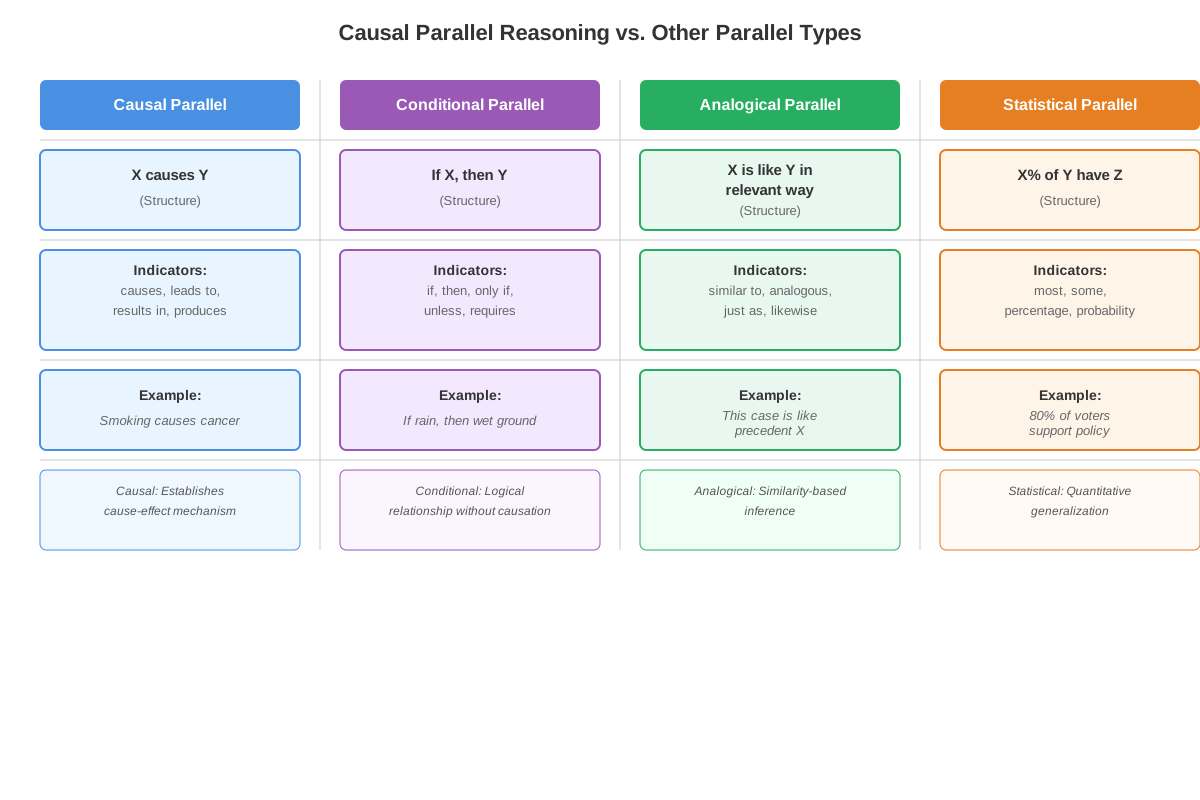
A critical aspect of causal parallel reasoning involves recognizing when arguments merely assert correlation versus actual causation. An argument stating "X and Y occur together" differs structurally from "X causes Y." Parallel reasoning questions may include trap answers that match correlation with causation or vice versa.
Consider: "Students who study more perform better on exams" could mean either (1) studying causes better performance, or (2) some third factor (like motivation) causes both increased studying and better performance. The parallel must match whichever interpretation the original argument employs.
Temporal and Logical Relationships
Causal arguments often incorporate temporal elements: the cause precedes the effect. However, temporal sequence alone doesn't establish causation. Arguments might state "X happened, then Y happened" (temporal sequence) versus "X happened, causing Y to happen" (causal relationship). Parallel reasoning requires matching the precise relationship type.
Strength and Certainty of Causal Claims
Causal arguments vary in their certainty level:
- Definitive causation: "X definitely causes Y" or "X always causes Y"
- Probable causation: "X likely causes Y" or "X tends to cause Y"
- Possible causation: "X may cause Y" or "X could cause Y"
The parallel argument must match not only the causal structure but also the degree of certainty expressed. An argument claiming something "definitely causes" an effect cannot parallel an argument about what "might cause" an effect.
Causal Reasoning Patterns
Several common reasoning patterns appear in causal parallel reasoning questions:
- Observation to Causal Conclusion: Premises describe observed phenomena; conclusion infers a causal relationship
- Causal Hypothesis Testing: Premises present evidence supporting or refuting a causal claim
- Causal Explanation: Premises establish an effect; conclusion identifies the cause
- Causal Prediction: Premises establish a causal relationship; conclusion predicts future effects
Concept Relationships
Causal parallel reasoning builds directly upon foundational causal reasoning concepts. Understanding how to identify causal claims (prerequisite knowledge) enables recognition of causal structures that must be matched. The relationship flows: Basic Causal Reasoning → Causal Structure Recognition → Causal Parallel Reasoning.
Within causal parallel reasoning itself, concepts interconnect hierarchically. Causal indicators help identify the type of causal structure (single cause/effect, multiple causes, causal chains), which determines the structural pattern that must be matched. This pattern, combined with the certainty level and temporal relationships, creates the complete template for finding parallel arguments.
Causal parallel reasoning also connects laterally to other Logical Reasoning topics. Strengthen/Weaken questions often test causal reasoning, and recognizing causal structures helps identify relevant strengtheners or weakeners. Flaw questions frequently involve causal errors (confusing correlation with causation, ignoring alternative causes), making causal structure recognition essential. Method of Reasoning questions may ask students to describe causal argument patterns, requiring the same analytical skills as parallel reasoning questions.
The relationship map: Causal Indicators → identify → Causal Structure Type → determines → Matching Criteria → guides → Answer Choice Evaluation → produces → Correct Answer Selection.
High-Yield Facts
⭐ Causal parallel reasoning questions require matching the exact causal structure, not the subject matter or conclusion truth value
⭐ The number of causes and effects must match precisely between the original argument and the correct answer
⭐ Temporal sequence (X before Y) differs structurally from causation (X causes Y) and cannot be matched interchangeably
⭐ The degree of certainty in causal claims (definite, probable, possible) must match between parallel arguments
⭐ Causal chains require matching the number of links: if the original has three causal steps, the parallel must also have three
- Arguments asserting "X prevents Y" have a different structure from "X causes Y" and require different parallels
- Multiple sufficient causes (either X or Z causes Y) differ structurally from necessary causes (Y requires both X and Z)
- Causal explanations (identifying why Y occurred) have different structures from causal predictions (forecasting that Y will occur)
- Correlation statements ("X and Y occur together") cannot parallel causation statements ("X causes Y")
- Conditional statements ("If X, then Y") may express causation but can also express logical relationships without causation—context determines which
- Arguments about preventing effects require parallels about prevention, not about causing effects
- Bidirectional causation ("X causes Y and Y causes X") requires a parallel with reciprocal causation
Quick check — test yourself on Causal parallel reasoning so far.
Try Flashcards →Common Misconceptions
Misconception: Causal parallel reasoning questions ask which answer choice reaches the same conclusion as the original argument.
Correction: These questions match logical structure, not content. The correct answer may discuss completely different subjects and reach an entirely different conclusion, as long as the causal reasoning pattern matches exactly.
Misconception: If two arguments both mention causation, they must be parallel.
Correction: The specific causal structure must match. An argument with one cause producing two effects differs structurally from an argument with two causes producing one effect, even though both involve causation.
Misconception: Temporal language ("after," "following," "subsequently") indicates the same structure as causal language ("causes," "produces," "brings about").
Correction: Temporal sequence describes when events occur; causation describes why events occur. An argument stating "Y happened after X" has a different structure from "X caused Y to happen."
Misconception: The correct parallel answer must use similar causal indicator words as the original argument.
Correction: Different causal indicators can express the same structure. "X causes Y," "Y results from X," and "X is responsible for Y" all express identical causal structures despite using different language.
Misconception: If the original argument's causal reasoning is flawed, the correct parallel answer must also be flawed in the same way.
Correction: This applies only to Parallel Flaw questions, not standard Parallel Reasoning questions. Regular parallel reasoning questions may match valid or invalid structures, but the question stem indicates which type is being tested.
Misconception: Abstract or technical subject matter in an answer choice makes it less likely to be correct.
Correction: LSAT parallel reasoning questions deliberately use diverse subject matter to test structural recognition. The correct answer might discuss physics, economics, psychology, or any other field—subject matter complexity is irrelevant to structural matching.
Worked Examples
Example 1: Single Cause, Single Effect with Certainty Qualifier
Original Argument: "Recent studies show that regular meditation reduces stress levels in participants. Therefore, meditation likely causes decreased stress."
Analysis:
- Causal structure: Single cause (meditation) → Single effect (decreased stress)
- Certainty level: Probable ("likely causes")
- Reasoning pattern: Observation (studies show correlation) → Causal conclusion (infers causation)
- Key structural elements: Evidence of correlation, inference to probable causation
Answer Choice A: "Surveys indicate that cities with more parks have happier residents. Thus, parks probably cause increased happiness."
- Structure: Single cause (parks) → Single effect (happiness)
- Certainty: Probable ("probably cause")
- Pattern: Observation → Causal conclusion
- Verdict: ✓ PARALLEL - Matches all structural elements
Answer Choice B: "Research demonstrates that exercise improves cardiovascular health and enhances mental clarity. Therefore, exercise definitely produces multiple health benefits."
- Structure: Single cause (exercise) → Multiple effects (cardiovascular health AND mental clarity)
- Certainty: Definite ("definitely produces")
- Verdict: ✗ NOT PARALLEL - Wrong number of effects and wrong certainty level
Answer Choice C: "Data shows that successful students tend to study regularly. Consequently, studying and success are correlated."
- Structure: Correlation statement, not causal claim
- Verdict: ✗ NOT PARALLEL - Concludes correlation, not causation
Answer Choice D: "Experiments reveal that increased temperature causes metal to expand. Therefore, heat definitely causes expansion."
- Structure: Single cause → Single effect
- Certainty: Definite ("definitely causes")
- Verdict: ✗ NOT PARALLEL - Wrong certainty level (definite vs. probable)
Correct Answer: A
Example 2: Causal Chain
Original Argument: "The factory closure eliminated jobs, which reduced consumer spending, which caused local businesses to fail. The factory closure is therefore responsible for the business failures."
Analysis:
- Causal structure: Three-link causal chain (A→B→C→D)
- Factory closure → job elimination → reduced spending → business failures
- Certainty level: Definite (stated as fact)
- Reasoning pattern: Establishes causal chain, then attributes ultimate effect to initial cause
- Key structural elements: Sequential causation with three intermediate steps
Answer Choice A: "The drought reduced crop yields, which increased food prices. Higher food prices caused economic hardship. The drought therefore caused the hardship."
- Structure: Three-link chain (drought → reduced yields → higher prices → hardship)
- Certainty: Definite
- Pattern: Establishes chain, attributes final effect to initial cause
- Verdict: ✓ PARALLEL - Matches all structural elements
Answer Choice B: "The new policy improved efficiency and reduced costs. These changes increased profitability. The policy therefore caused increased profitability."
- Structure: One cause → Two intermediate effects → One final effect
- Verdict: ✗ NOT PARALLEL - Wrong structure (parallel causes, not sequential chain)
Answer Choice C: "The storm damaged power lines, causing outages. The outages are therefore the storm's fault."
- Structure: Two-link chain (storm → damaged lines → outages)
- Verdict: ✗ NOT PARALLEL - Only two links instead of three
Answer Choice D: "Pollution harms ecosystems. Ecosystem damage affects human health. Pollution therefore affects human health."
- Structure: Three-link chain (pollution → ecosystem harm → health effects)
- Certainty: Definite
- Pattern: Establishes chain, attributes final effect to initial cause
- Verdict: ✓ PARALLEL - Also matches, but A is typically listed first
Correct Answer: A (though D also parallels; LSAT would ensure only one perfect match)
Exam Strategy
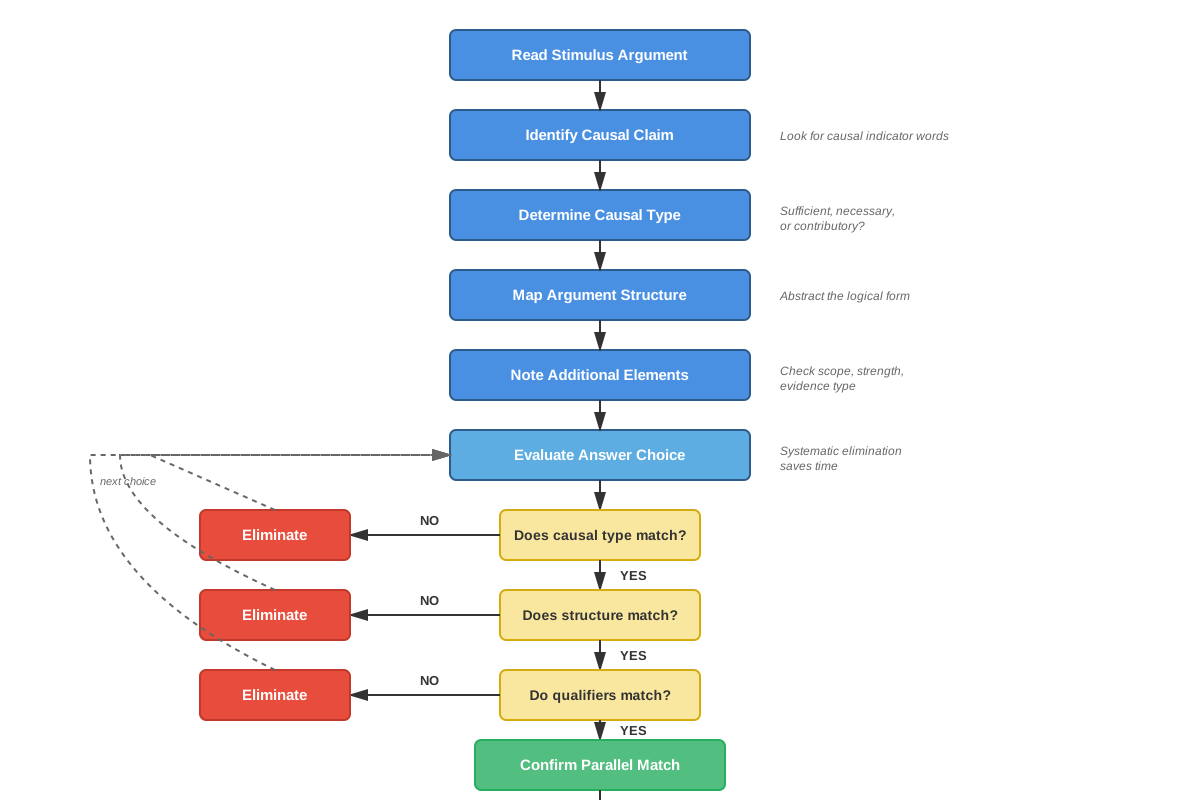
Systematic Approach to Causal Parallel Reasoning Questions
Step 1: Identify the Question Type (5 seconds)
Look for stems containing "pattern of reasoning most similar," "reasoning most closely parallels," or "argument most similar in structure." These indicate parallel reasoning questions.
Step 2: Map the Original Argument's Causal Structure (20-30 seconds)
Before reading answer choices, diagram the argument:
- How many causes? How many effects?
- Is it a chain (A→B→C) or multiple causes (A+B→C)?
- What certainty level? (definite, probable, possible)
- What's the reasoning pattern? (observation→conclusion, hypothesis→test, etc.)
Step 3: Create a Structural Template (10 seconds)
Write a brief notation like "1 cause → 2 effects, probable" or "chain: A→B→C, definite"
Step 4: Eliminate Mismatches Quickly (30-40 seconds)
Scan each answer choice for obvious structural differences:
- Wrong number of causes or effects → eliminate immediately
- Correlation instead of causation → eliminate
- Wrong certainty level → eliminate
- Different reasoning pattern → eliminate
Step 5: Verify the Remaining Choice (15-20 seconds)
Map the remaining answer choice(s) completely to confirm structural identity
Exam Tip: Spend more time analyzing the original argument than reading answer choices. A clear structural map makes elimination fast and accurate.
Trigger Words and Phrases
Causal Indicators to Identify:
- "causes," "caused by," "results in," "results from"
- "leads to," "brings about," "produces"
- "responsible for," "due to," "because of"
- "consequently," "therefore" (when concluding causation)
Certainty Qualifiers to Match:
- Definite: "definitely," "certainly," "always," "invariably"
- Probable: "likely," "probably," "tends to," "generally"
- Possible: "may," "might," "could," "possibly"
Structural Indicators:
- Multiple causes: "both...and," "either...or," "several factors"
- Causal chains: "which in turn," "thereby," "consequently"
- Prevention: "prevents," "stops," "blocks," "inhibits"
Time Allocation
Allocate approximately 90 seconds total for causal parallel reasoning questions:
- 30 seconds: Read and map original argument
- 45 seconds: Eliminate wrong answers
- 15 seconds: Verify correct answer
If stuck between two choices, re-map both completely rather than re-reading the original argument repeatedly.
Process of Elimination Tips
Eliminate first: Answer choices with different numbers of causes or effects—this is the fastest elimination criterion.
Eliminate second: Answer choices with wrong certainty levels or those concluding correlation rather than causation.
Eliminate third: Answer choices with different reasoning patterns (if the original observes then concludes, the parallel must also observe then conclude).
Watch for: Trap answers that match the subject matter or conclusion type but not the structure. The LSAT deliberately includes answers about similar topics to test whether students focus on content rather than structure.
Memory Techniques
The CAUSE Acronym
Count the causes and effects (must match exactly)
Assess the certainty level (definite, probable, possible)
Understand the pattern (chain, multiple causes, etc.)
Structure over substance (ignore content, focus on form)
Eliminate mismatches first (fastest elimination wins)
Visualization Strategy
Picture causal arguments as arrow diagrams:
- Single cause/effect: X → Y
- Multiple causes: X + Z → Y
- Multiple effects: X → Y + Z
- Causal chain: X → Y → Z → W
Draw quick diagrams for both the original argument and promising answer choices to compare visually.
The "Parallel Universe" Technique
Imagine the original argument and correct answer exist in parallel universes where different things happen, but the same logical rules apply. The subjects change, but the structure remains identical—like the same movie plot set in different time periods.
Certainty Level Mnemonic: DPP
Definite = "Definitely, certainly, always"
Probable = "Probably, likely, tends to"
Possible = "Possibly, may, might, could"
Match the DPP level between original and parallel.
Summary
Causal parallel reasoning questions test the ability to recognize identical causal structures across different subject matters—a skill fundamental to legal reasoning and analogical thinking. These questions require students to abstract the underlying pattern of causal relationships from an argument, then identify another argument with the same pattern regardless of content. Success demands systematic analysis: mapping the number of causes and effects, identifying whether the structure involves simple causation or causal chains, noting the certainty level of causal claims, and distinguishing causation from mere correlation or temporal sequence. The key insight is that parallel reasoning focuses entirely on structure, not substance—the correct answer may discuss completely different topics but must employ identical logical architecture. Students who master causal parallel reasoning develop transferable skills that enhance performance across multiple Logical Reasoning question types, particularly those involving causal claims in Strengthen, Weaken, and Flaw questions.
Key Takeaways
- Causal parallel reasoning matches logical structure, not subject matter—focus on form, not content
- Count causes and effects precisely; the numbers must match exactly between original and parallel arguments
- Distinguish causal claims ("X causes Y") from correlation ("X and Y occur together") and temporal sequence ("Y after X")
- Match the certainty level: definite causation requires definite parallel, probable requires probable
- Causal chains require matching the number of sequential links (A→B→C needs three-link parallel)
- Map the original argument's structure before reading answer choices to enable rapid elimination
- These questions appear 2-4 times per test and strongly discriminate between high and average scorers
Related Topics
Parallel Flaw Questions: These questions specifically ask for arguments with parallel flawed reasoning. Mastering causal parallel reasoning enables recognition of parallel causal fallacies (confusing correlation with causation, ignoring alternative causes, reversing cause and effect).
Causal Strengthen/Weaken Questions: Understanding causal structures helps identify what would strengthen or weaken causal arguments. Recognizing whether an argument involves simple causation or causal chains determines what evidence would be relevant.
Method of Reasoning Questions: These questions ask students to describe an argument's reasoning pattern. The structural analysis skills developed through causal parallel reasoning directly apply to articulating how arguments proceed.
Necessary vs. Sufficient Assumptions in Causal Arguments: Causal arguments often depend on assumptions about alternative causes or the mechanism of causation. Parallel reasoning skills help identify when arguments make similar assumptions.
Practice CTA
Now that you understand the structural patterns underlying causal parallel reasoning, you're ready to apply these concepts to actual LSAT questions. The practice questions and flashcards will reinforce your ability to quickly map causal structures and identify parallel arguments under timed conditions. Remember: every practice question strengthens your pattern recognition skills, making structural analysis faster and more automatic. Approach each practice question systematically using the CAUSE acronym, and you'll develop the expertise that separates top scorers from the rest. Your investment in mastering this high-yield topic will pay dividends across the entire Logical Reasoning section!
Sign up free to keep reading
Create a free AnvayaPrep account to finish this LSAT guide on Causal parallel reasoning — plus flashcards and practice questions.