Overview
Parallel reasoning questions are among the most challenging question types on the LSAT Logical Reasoning section, requiring test-takers to identify arguments that share identical logical structures despite having completely different content. While the task seems straightforward—match the reasoning pattern in the stimulus to one of five answer choices—the test makers deliberately design common parallel reasoning traps that exploit predictable cognitive shortcuts and reasoning errors. These traps cause even well-prepared students to select answer choices that superficially resemble the stimulus but fail to match its underlying logical structure.
Understanding common parallel reasoning traps is essential for LSAT success because these questions appear with high frequency (typically 2-4 questions per test) and carry significant time costs. Students who fall for these traps often spend 2-3 minutes on a single question, only to select an incorrect answer. The traps work by presenting answer choices that match certain surface features of the stimulus—such as similar subject matter, comparable sentence length, or matching conclusion indicators—while diverging in critical structural elements like the relationship between premises and conclusion, the type of reasoning employed, or the logical force of the argument.
Mastering parallel reasoning traps connects directly to broader logical reasoning skills tested throughout the LSAT. The ability to abstract logical structure from content, recognize argument patterns, and distinguish form from substance applies equally to assumption questions, strengthen/weaken questions, and flaw questions. Students who develop expertise in avoiding parallel reasoning traps simultaneously strengthen their capacity to analyze arguments across all Logical Reasoning question types, making this topic a high-leverage investment of study time.
Learning Objectives
- [ ] Identify how common parallel reasoning traps appear in LSAT questions
- [ ] Explain the reasoning pattern behind common parallel reasoning traps
- [ ] Apply common parallel reasoning traps to solve LSAT-style problems accurately
- [ ] Distinguish between surface-level content similarity and structural parallelism in arguments
- [ ] Systematically eliminate answer choices by identifying specific structural mismatches
- [ ] Recognize the five most common trap types and their distinguishing features
- [ ] Execute a time-efficient process for parallel reasoning questions that minimizes trap vulnerability
Prerequisites
- Argument structure identification: Understanding premises, conclusions, and intermediate conclusions is essential because parallel reasoning requires matching these structural components across different arguments
- Conditional reasoning: Recognizing sufficient and necessary conditions matters because many parallel reasoning questions involve conditional statements that must match precisely in logical form
- Quantifier logic: Familiarity with "all," "some," "most," and "none" is relevant because quantifier mismatches represent a major category of parallel reasoning traps
- Argument types: Knowledge of deductive versus inductive reasoning helps because parallel arguments must match not only in structure but also in the type of reasoning employed
- Formal logic notation: Basic ability to symbolize arguments aids in abstracting structure from content, which is the core skill tested in parallel reasoning questions
Why This Topic Matters
Parallel reasoning questions test a fundamental legal skill: the ability to apply precedent by recognizing when two situations share the same logical structure despite different factual circumstances. Lawyers constantly engage in analogical reasoning, arguing that a previous case's logic should apply to a new situation because the underlying reasoning pattern is identical. This skill extends beyond law to any field requiring principled decision-making, policy application, or precedent-based reasoning.
On the LSAT, parallel reasoning questions typically appear 2-4 times per test, representing approximately 8-16% of all Logical Reasoning questions. These questions consistently rank among the most time-consuming and most frequently missed question types, with average completion times of 2-3 minutes compared to 1-1.5 minutes for standard Logical Reasoning questions. The difficulty stems not from the concept itself but from the sophisticated traps embedded in wrong answer choices.
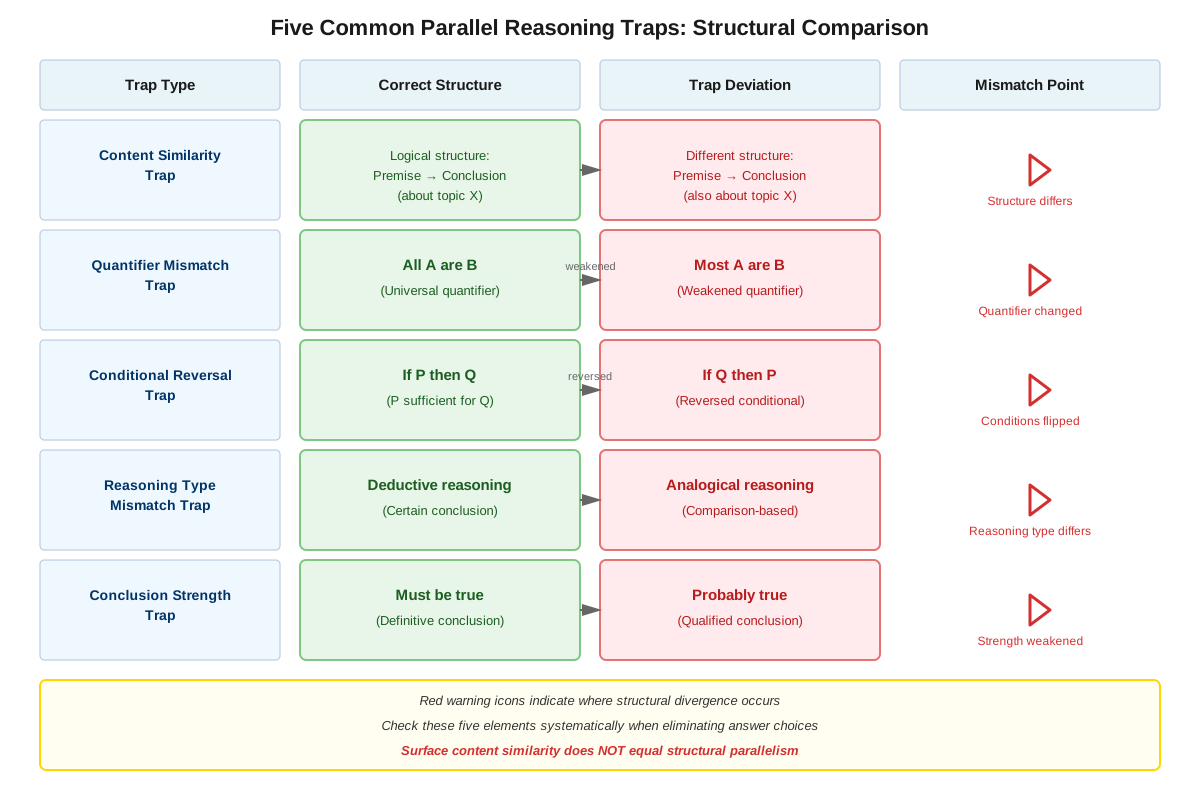
Common parallel reasoning traps appear in several predictable ways on the exam. The most frequent presentation involves answer choices that match the stimulus in subject matter or thematic content while diverging in logical structure. For example, if the stimulus argues about environmental policy, trap answers might also discuss environmental topics but employ different reasoning patterns. Another common presentation involves answer choices that match the stimulus in superficial grammatical features—such as beginning with "All X are Y" or ending with "Therefore, Z"—while failing to preserve the logical relationships between these statements. The test makers also frequently include answer choices that match most but not all structural elements, requiring careful attention to every component of the argument.
Core Concepts
The Nature of Parallel Reasoning
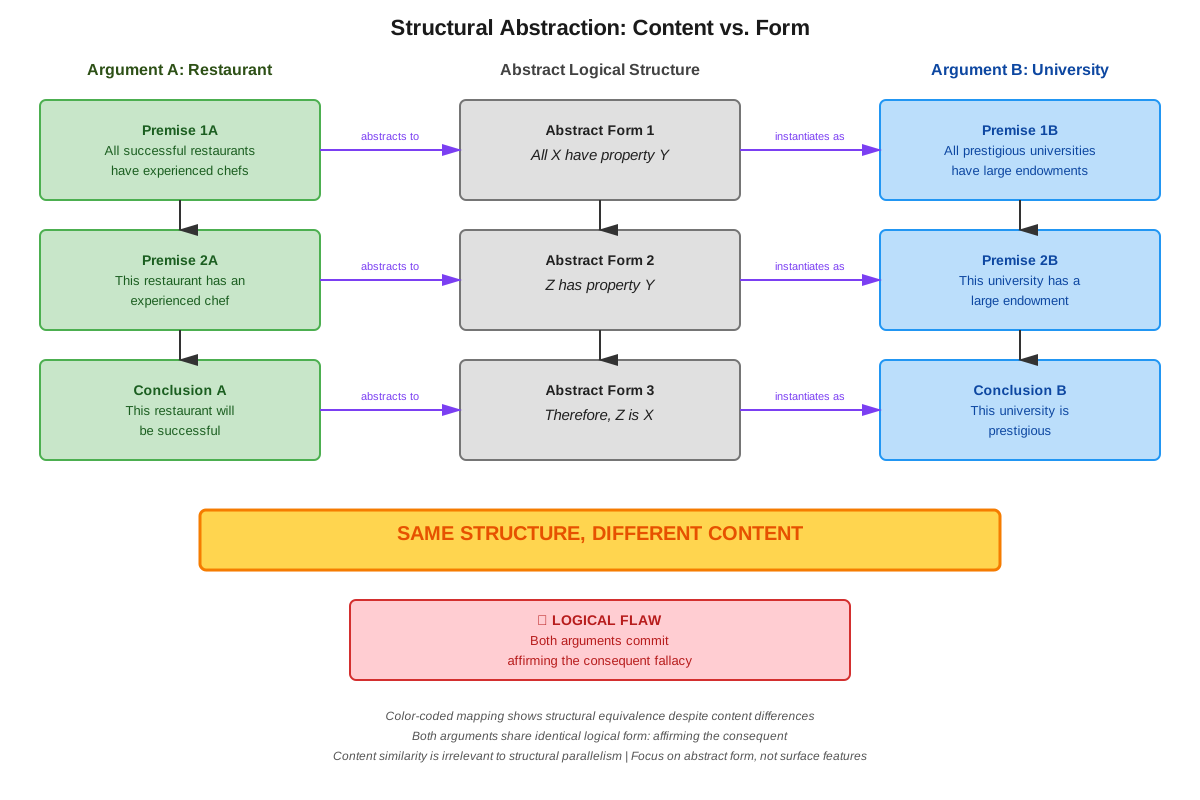
Parallel reasoning questions ask test-takers to identify an argument whose logical structure matches that of a stimulus argument, regardless of content differences. The key insight is that logical structure exists independently of subject matter. An argument about economics can have the same structure as an argument about biology if the relationships between premises and conclusion follow identical patterns. The LSAT tests whether students can abstract this structure—essentially creating a logical "skeleton" of the argument—and then recognize the same skeleton in a completely different context.
The challenge arises because human cognition naturally focuses on content rather than form. When reading an argument about taxation policy, the mind automatically engages with the substance of the claims rather than the abstract relationships between them. LSAT common parallel reasoning traps exploit this cognitive tendency by presenting answer choices that feel similar in content, tone, or complexity while differing in the precise logical structure.
Trap Type 1: Content Similarity
The most pervasive trap involves answer choices that discuss similar subject matter or use comparable vocabulary to the stimulus. If the stimulus argues about corporate responsibility using business terminology, a trap answer might also discuss corporate behavior while employing a fundamentally different argument structure. This trap succeeds because content similarity creates a false sense of parallelism.
For example, if the stimulus argues: "All profitable companies invest in research. TechCorp invests in research. Therefore, TechCorp is profitable," a content-similarity trap might state: "All successful businesses prioritize innovation. StartupCo prioritizes innovation. Therefore, StartupCo is successful." Both arguments discuss business success and use similar vocabulary, but the stimulus commits the formal fallacy of affirming the consequent (invalid reasoning), and the trap answer must match this invalid structure precisely.
Trap Type 2: Conclusion Indicator Matching
Many students rely heavily on conclusion indicators like "therefore," "thus," "consequently," or "it follows that" to identify argument structure. Common parallel reasoning traps exploit this by including answer choices that use the same conclusion indicators as the stimulus while presenting different logical relationships. The presence of "therefore" in both arguments does not guarantee structural parallelism if what comes before and after differs in logical form.
Consider a stimulus that uses causal reasoning: "Increased rainfall causes crop growth. Crop growth occurred. Therefore, increased rainfall must have occurred." A trap answer might use "therefore" while employing correlation rather than causation: "Exercise correlates with health. Health improved. Therefore, exercise occurred." Despite identical conclusion indicators, these arguments differ structurally—one claims causation while the other merely notes correlation.
Trap Type 3: Quantifier Mismatches
Arguments frequently involve quantifiers like "all," "some," "most," "many," "few," or "none." Parallel reasoning requires exact quantifier matching because changing a quantifier fundamentally alters logical structure. A trap answer might match the stimulus in every respect except substituting "most" for "all" or "some" for "none," creating a structurally different argument.
| Stimulus Quantifier | Trap Quantifier | Structural Impact |
|---|---|---|
| All X are Y | Most X are Y | Changes from universal to probabilistic claim |
| Some X are Y | No X are Y | Changes from existential to universal negative |
| Most X are Y | Many X are Y | Changes from majority claim to indefinite quantity |
| If X, then Y | If Y, then X | Reverses conditional relationship |
Trap Type 4: Reasoning Type Substitution
Arguments employ different types of reasoning: deductive, inductive, analogical, causal, or statistical. Parallel reasoning requires matching not just the structure but also the reasoning type. A common trap presents an answer choice that matches structural elements but substitutes one reasoning type for another.
For instance, if the stimulus uses analogical reasoning—"Situation A has features 1, 2, and 3. Situation B has features 1, 2, and 3. Situation A had outcome X. Therefore, Situation B will have outcome X"—a trap might use causal reasoning with similar structure: "Event A preceded Event B. Event B preceded Event C. Event A caused Event B. Therefore, Event A caused Event C." Both arguments have multiple premises leading to a conclusion, but the reasoning types differ fundamentally.
Trap Type 5: Intermediate Conclusion Confusion
Complex arguments often contain intermediate conclusions—statements that serve as both the conclusion of one sub-argument and a premise for another. Parallel reasoning questions involving intermediate conclusions are particularly susceptible to traps because answer choices might match the overall conclusion structure while misplacing or omitting the intermediate conclusion.
A stimulus might argue: "All mammals are warm-blooded [Premise 1]. Whales are mammals [Premise 2]. Therefore, whales are warm-blooded [Intermediate Conclusion]. Warm-blooded animals regulate body temperature [Premise 3]. Therefore, whales regulate body temperature [Final Conclusion]." A trap answer might present the same number of statements but make the third statement a premise rather than an intermediate conclusion, fundamentally altering the argument's logical architecture.
Trap Type 6: Conditional Logic Reversals and Negations
Arguments involving conditional statements (if-then relationships) are especially prone to traps involving reversed or negated conditionals. The logical relationships "if A then B," "if B then A," "if not A then not B," and "if not B then not A" are all distinct structures, yet trap answers frequently substitute one for another while maintaining surface similarity.
If the stimulus argues using modus ponens—"If it rains, the ground is wet. It rained. Therefore, the ground is wet"—a trap might use the converse—"If it rains, the ground is wet. The ground is wet. Therefore, it rained." Both arguments involve the same conditional statement and reach conclusions about the same variables, but the logical operations differ critically.
Trap Type 7: Scope and Degree Shifts
Arguments make claims with specific scope (what the argument is about) and degree (how strong the claim is). Trap answers often shift scope by discussing a broader or narrower category, or shift degree by making a stronger or weaker claim. These shifts can be subtle but render the arguments structurally non-parallel.
For example, if the stimulus concludes "This policy will likely improve outcomes," a trap might conclude "This policy will definitely improve outcomes" (degree shift) or "This policy will likely improve all outcomes" (scope shift). The structural difference lies in the logical force and breadth of the conclusion, even if the premise structure matches.
Concept Relationships
The various common parallel reasoning traps interconnect through their shared exploitation of cognitive shortcuts. Content similarity traps and conclusion indicator matching both leverage the human tendency toward surface-level processing rather than deep structural analysis. When students fall for content similarity, they often simultaneously fall for conclusion indicator matching because both traps create a false sense of familiarity.
Quantifier mismatches and conditional logic reversals represent more technical trap types that build on formal logic knowledge. Students who struggle with conditional reasoning in other question types will predictably struggle with conditional-based parallel reasoning traps. Similarly, reasoning type substitution connects to the broader LSAT skill of identifying whether an argument is deductive or inductive, a distinction that matters across multiple question types.
The relationship map flows as follows: Surface-level features (content, indicators) → create false sense of parallelism → leading to premature answer selection → while structural elements (quantifiers, conditionals, reasoning type) → require systematic analysis → enabling accurate matching. Intermediate conclusion confusion and scope/degree shifts represent advanced traps that combine multiple elements, typically appearing in harder parallel reasoning questions.
Understanding these relationships helps students develop a hierarchical approach: first eliminate answers with obvious structural differences (quantifier mismatches, wrong reasoning type), then scrutinize remaining answers for subtle shifts (scope, degree, conditional reversals), and finally verify that no content similarity is creating false confidence in an answer that fails structural parallelism.
High-Yield Facts
- ⭐ Parallel reasoning questions require matching logical structure, not content: Arguments about completely different topics can be structurally parallel
- ⭐ Quantifiers must match exactly: Substituting "most" for "all" or "some" for "none" creates a structurally different argument
- ⭐ Conditional statements must preserve direction: "If A then B" is not parallel to "If B then A" or "If not A then not B"
- ⭐ Reasoning type must match: Deductive arguments parallel only deductive arguments; inductive arguments parallel only inductive arguments
- ⭐ Intermediate conclusions must appear in the same structural position: An argument with an intermediate conclusion is not parallel to one without, even if the final conclusion matches
- Content similarity is the most common trap and should trigger heightened scrutiny rather than confidence
- Conclusion indicators like "therefore" or "thus" do not guarantee structural parallelism
- The number of premises must match between stimulus and correct answer
- Scope shifts (broader or narrower categories) destroy parallelism even when other elements match
- Degree shifts (stronger or weaker claims) create structural differences that eliminate answer choices
- Causal arguments parallel only causal arguments; correlation does not equal causation in parallel reasoning
- Arguments with formal fallacies must be matched with arguments containing the same fallacy
- The order of premises can vary while maintaining parallelism, but the logical relationships must remain identical
- Parallel reasoning questions typically take 2-3 minutes; spending more suggests falling into trap analysis rather than structural analysis
Quick check — test yourself on Common parallel reasoning traps so far.
Try Flashcards →Common Misconceptions
Misconception: If an answer choice discusses the same topic as the stimulus, it's more likely to be correct.
Correction: Content similarity is actually a red flag indicating a potential trap. The correct answer often discusses a completely unrelated topic because parallel reasoning tests structural matching, not thematic similarity.
Misconception: Matching the conclusion indicator ("therefore," "thus," etc.) means the arguments are structurally parallel.
Correction: Conclusion indicators mark where the conclusion appears but say nothing about the logical relationships between premises and conclusion. Two arguments can both use "therefore" while employing completely different reasoning patterns.
Misconception: If most elements of an argument match, close enough is good enough.
Correction: Parallel reasoning requires exact structural matching. An answer choice that matches four out of five structural elements is still wrong. Even a single quantifier mismatch or conditional reversal eliminates an answer choice.
Misconception: Complex arguments with more premises are automatically parallel to other complex arguments.
Correction: Complexity alone doesn't determine parallelism. A three-premise argument is only parallel to another three-premise argument if the logical relationships between all premises and the conclusion match exactly, not merely because both have three premises.
Misconception: Valid arguments parallel only valid arguments, and flawed arguments parallel only flawed arguments.
Correction: While this is generally true, the specific type of validity or flaw must match. A valid modus ponens argument doesn't parallel a valid modus tollens argument, and an argument with a sufficiency/necessity confusion doesn't parallel an argument with a false dichotomy.
Misconception: The correct answer will feel similar to the stimulus when reading it.
Correction: The correct answer often feels strange or unfamiliar precisely because it discusses different content. Students should feel suspicious if an answer choice feels too comfortable or familiar, as this often indicates content-based rather than structure-based matching.
Worked Examples
Example 1: Identifying Quantifier Mismatch Trap
Stimulus: "All professional athletes train daily. Maria trains daily. Therefore, Maria is a professional athlete."
Analysis: This argument commits the formal fallacy of affirming the consequent. The structure is: All A are B. X is B. Therefore, X is A. This is invalid reasoning because being B doesn't guarantee being A (many non-athletes also train daily).
Answer Choice A: "All successful students study regularly. James studies regularly. Therefore, James is a successful student."
Initial Assessment: This looks very parallel—same quantifier ("all"), same structure of two premises leading to a conclusion, similar content about a category and its characteristics.
Detailed Analysis: This answer choice commits the same fallacy as the stimulus. Structure: All A are B. X is B. Therefore, X is A. The quantifiers match exactly ("all" in both), the logical relationships are identical (affirming the consequent), and the reasoning type matches (invalid deductive reasoning). This is the correct answer.
Answer Choice B: "Most professional athletes train daily. Maria trains daily. Therefore, Maria is probably a professional athlete."
Trap Identification: This is a quantifier mismatch trap. The stimulus uses "all" (universal quantifier) while this answer uses "most" (majority quantifier). This changes the logical structure fundamentally. Additionally, the conclusion says "probably," introducing probabilistic reasoning not present in the stimulus. Even though the content is nearly identical to the stimulus, the structural differences eliminate this answer.
Answer Choice C: "All professional athletes train daily. Maria is a professional athlete. Therefore, Maria trains daily."
Trap Identification: This is a conditional logic reversal trap. While it uses the same quantifier ("all") and discusses the same topic, the logical structure differs. This argument is: All A are B. X is A. Therefore, X is B. This is valid modus ponens reasoning, whereas the stimulus commits the fallacy of affirming the consequent. The direction of reasoning is reversed, making this structurally non-parallel despite surface similarity.
Key Takeaway: The correct answer (A) matches the stimulus in quantifiers, number of premises, logical relationships, and reasoning type (including the specific fallacy). Answer B fails due to quantifier mismatch, and Answer C fails due to conditional reversal, despite both discussing similar or identical content.
Example 2: Recognizing Reasoning Type Substitution
Stimulus: "In the past, when interest rates decreased, housing sales increased. Interest rates have decreased. Therefore, housing sales will increase."
Analysis: This argument uses inductive reasoning based on past correlation to predict future outcomes. The structure is: Past pattern observed (A correlated with B). A has occurred. Therefore, B will occur. This is inductive, not deductive—the conclusion is probable but not certain based on the premises.
Answer Choice A: "Historically, when unemployment rises, consumer spending falls. Unemployment has risen. Therefore, consumer spending will fall."
Initial Assessment: This appears strongly parallel—same temporal reasoning ("historically" vs. "in the past"), same pattern of correlation, same predictive conclusion.
Detailed Analysis: This matches the stimulus in reasoning type (inductive), structure (past correlation → current condition → predicted outcome), and logical force (probable rather than certain conclusion). The content differs (unemployment/spending vs. interest rates/housing), but the structure matches exactly. This is the correct answer.
Answer Choice B: "Whenever it rains, the streets get wet. It is raining. Therefore, the streets are getting wet."
Trap Identification: This is a reasoning type substitution trap. While the structure superficially resembles the stimulus (condition → occurrence → conclusion), this argument uses deductive rather than inductive reasoning. "Whenever" establishes a universal conditional relationship, making the conclusion certain rather than probable. The stimulus makes a prediction based on past patterns (inductive), while this answer states a logical necessity (deductive). Despite similar grammatical structure, the reasoning types differ fundamentally.
Answer Choice C: "Every time the company launched a new product, profits increased. The company is launching a new product. Therefore, profits have always increased when launching products."
Trap Identification: This is a conclusion scope shift trap. The premises match the stimulus structure (past pattern → current occurrence), but the conclusion shifts from a prediction about the future ("will increase") to a claim about the past ("have always increased"). This changes the logical structure because the conclusion no longer follows from the premises in the same way—it's a generalization about all past instances rather than a prediction about the current instance.
Key Takeaway: Parallel reasoning requires matching not just the grammatical structure but the type of reasoning employed. Inductive arguments parallel only inductive arguments, and the logical force of the conclusion (certain vs. probable) must match.
Exam Strategy
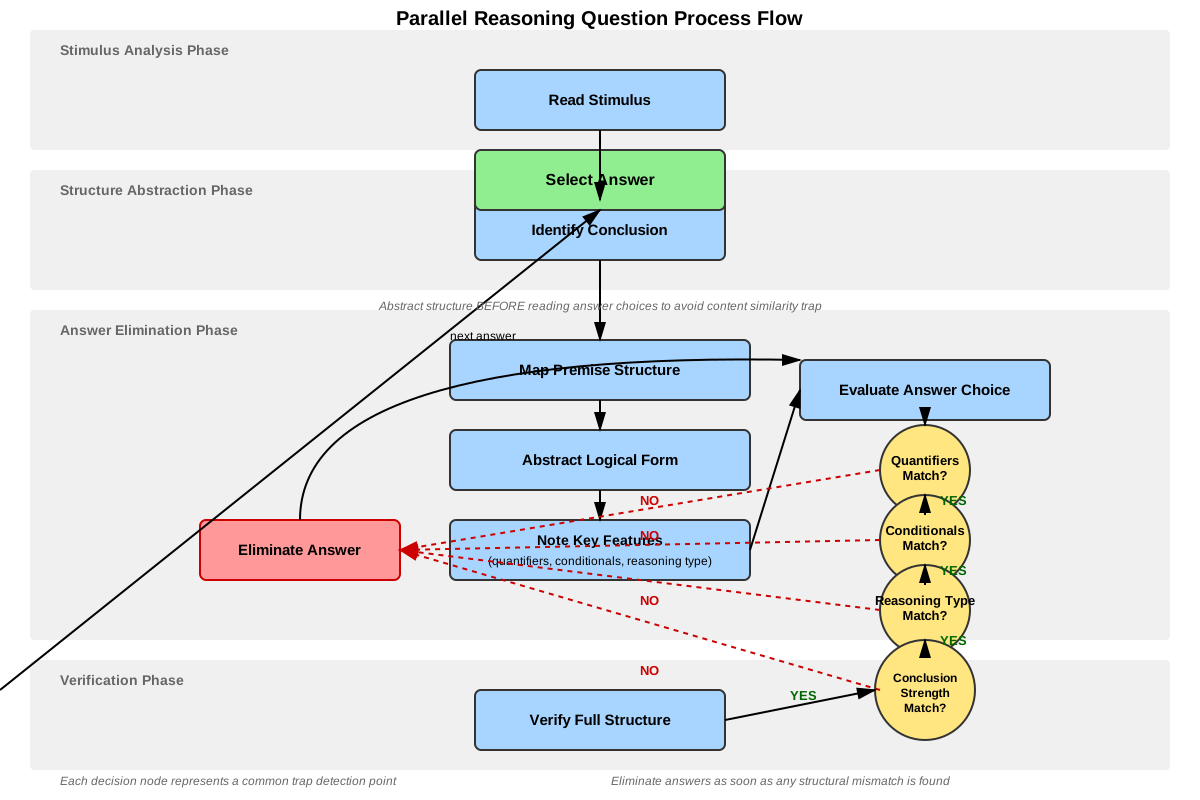
When approaching parallel reasoning questions on the LSAT, implement a systematic process that minimizes vulnerability to traps:
Step 1: Abstract the stimulus structure before reading answer choices. Create a mental or written outline using variables: "All A are B. C is B. Therefore, C is A." This abstraction prevents content-based thinking from influencing answer evaluation. Spend 30-45 seconds on this step—it saves time by enabling rapid answer choice elimination.
Step 2: Identify the reasoning type. Determine whether the stimulus uses deductive, inductive, causal, analogical, or statistical reasoning. Note whether the argument is valid or contains a flaw, and if flawed, identify the specific flaw type. This immediately eliminates answer choices with different reasoning types.
Step 3: Note all quantifiers and conditional indicators. Circle or mentally flag words like "all," "some," "most," "if," "only if," "unless," and "whenever." These must match exactly in the correct answer. Create a checklist: "Uses 'all' in first premise, 'some' in second premise, 'therefore' before conclusion."
Step 4: Eliminate answer choices systematically. Read each answer choice looking for disqualifying features rather than confirming features. Ask: "What's wrong with this answer?" rather than "Does this feel right?" Common disqualifiers include:
- Wrong quantifier (eliminate immediately)
- Wrong number of premises (eliminate immediately)
- Wrong reasoning type (eliminate immediately)
- Conditional reversal or negation (eliminate immediately)
- Different conclusion scope or degree (eliminate immediately)
Step 5: Verify the remaining answer. Once four answers are eliminated, verify that the remaining answer matches every structural element. Don't assume it's correct just because others are wrong—confirm positive matching.
Trigger words and phrases to watch for:
- Quantifiers: "all," "every," "any," "some," "most," "many," "few," "none," "no"
- Conditional indicators: "if," "only if," "unless," "whenever," "provided that," "assuming that"
- Conclusion indicators: "therefore," "thus," "hence," "consequently," "it follows that," "so"
- Causal language: "causes," "leads to," "results in," "produces," "brings about"
- Temporal markers: "always," "never," "sometimes," "usually," "typically," "in the past"
Process-of-elimination tips specific to parallel reasoning:
- Eliminate answers with different quantifiers first (fastest elimination)
- Eliminate answers with different numbers of premises second
- Eliminate answers with different reasoning types third
- Scrutinize remaining answers for subtle conditional reversals or scope shifts
- Be especially suspicious of answers that discuss similar content to the stimulus
Time allocation advice:
- Spend 30-45 seconds abstracting the stimulus structure
- Spend 15-20 seconds per answer choice (75-100 seconds total for five choices)
- Total time target: 2-2.5 minutes
- If exceeding 3 minutes, make your best guess and move on—parallel reasoning questions have diminishing returns on additional time investment
Exam Tip: If you find yourself re-reading the stimulus multiple times while evaluating answer choices, you haven't adequately abstracted the structure. Return to Step 1 and create a clearer structural outline before continuing.
Memory Techniques
MATCH Acronym for parallel reasoning verification:
- Match the reasoning type (deductive, inductive, etc.)
- Align all quantifiers exactly
- Track conditional directions (if A then B vs. if B then A)
- Count premises and intermediate conclusions
- Heed scope and degree of conclusion
The "Skeleton Strategy": Visualize stripping all content from the argument, leaving only the logical skeleton. Imagine the stimulus as a stick figure drawing—the correct answer is the same stick figure in different clothes. Wrong answers are different stick figures, even if wearing similar clothes.
Quantifier Hierarchy Visualization: Picture quantifiers on a spectrum from strongest to weakest:
ALL ——— MOST ——— MANY ——— SOME ——— FEW ——— NONE
(universal) (majority) (indefinite) (existential) (minority) (universal negative)
Any movement along this spectrum destroys parallelism.
Conditional Direction Arrows: When encountering conditionals, draw mental arrows:
- "If A then B" = A → B
- "If B then A" = B → A (reversed, not parallel)
- "If not A then not B" = ~A → ~B (contrapositive of B → A, not parallel to A → B)
- "If not B then not A" = ~B → ~A (contrapositive of A → B, parallel!)
The "Content Trap" Reminder: Create a mental image of a trap with cheese (content similarity) as bait. When you notice content similarity, visualize the trap and become more cautious rather than more confident.
Summary
Common parallel reasoning traps represent systematic patterns in wrong answer choices designed to exploit predictable cognitive shortcuts that test-takers employ when matching argument structures. The seven major trap types—content similarity, conclusion indicator matching, quantifier mismatches, reasoning type substitution, intermediate conclusion confusion, conditional logic reversals, and scope/degree shifts—account for the vast majority of incorrect answer selections on parallel reasoning questions. Success requires developing the ability to abstract logical structure from content, creating a mental representation of the argument's skeleton that can be matched against answer choices without being distracted by thematic similarity or surface-level features. The key insight is that parallel reasoning tests formal logic structure, not content, and the correct answer will often discuss completely unrelated subject matter while preserving exact structural correspondence in quantifiers, conditional relationships, reasoning type, number and function of premises, and scope and degree of conclusion. Students must resist the natural cognitive tendency to favor familiar-feeling answers and instead implement systematic elimination based on structural mismatches, treating content similarity as a warning sign rather than a confirmation signal.
Key Takeaways
- Parallel reasoning requires exact structural matching; content similarity is typically a trap rather than a helpful signal
- Quantifiers must match precisely—substituting "most" for "all" or "some" for "none" creates a structurally different argument that cannot be correct
- Conditional statements must preserve direction; "if A then B" is not parallel to "if B then A" even when discussing identical content
- The reasoning type (deductive, inductive, causal, analogical) must match between stimulus and correct answer
- Abstract the stimulus structure using variables before reading answer choices to prevent content-based thinking from influencing evaluation
- Eliminate answer choices based on structural disqualifiers (wrong quantifier, wrong number of premises, wrong reasoning type) rather than searching for confirming features
- Intermediate conclusions must appear in the same structural position; their presence or absence fundamentally alters argument architecture
Related Topics
Formal Logic and Conditional Reasoning: Mastering parallel reasoning traps builds directly on conditional logic skills, as many parallel reasoning questions involve matching conditional structures. Advanced study of sufficient and necessary conditions, contrapositives, and conditional chains enhances parallel reasoning performance.
Argument Structure and Diagramming: The ability to diagram arguments—identifying premises, intermediate conclusions, and final conclusions—is foundational for parallel reasoning. Further study of complex argument structures with multiple sub-arguments prepares students for the most difficult parallel reasoning questions.
Flawed Reasoning Patterns: Many parallel reasoning questions involve matching flawed arguments, requiring recognition of specific fallacy types like affirming the consequent, denying the antecedent, false dichotomies, and circular reasoning. Studying common LSAT flaws enhances the ability to match flawed parallel reasoning.
Parallel Flaw Questions: These questions combine parallel reasoning with flaw identification, asking students to find an answer choice with the same flawed reasoning pattern. Mastering parallel reasoning traps provides the foundation for this advanced question type.
Method of Reasoning Questions: These questions ask students to describe the argumentative technique used in a stimulus. The analytical skills developed for parallel reasoning—abstracting structure from content—apply directly to method of reasoning questions.
Practice CTA
Now that you understand the seven major types of common parallel reasoning traps and have learned systematic strategies for avoiding them, it's time to apply this knowledge to actual LSAT questions. The practice questions and flashcards for this topic will challenge you to identify trap answers, abstract argument structures, and select structurally parallel answer choices under timed conditions. Remember that parallel reasoning is a skill that improves dramatically with deliberate practice—each question you analyze strengthens your ability to see through content-based distractions and focus on logical structure. Approach the practice materials with the MATCH acronym in mind, and don't be discouraged if you initially find these questions challenging. The investment you make in mastering parallel reasoning traps will pay dividends not only on these specific question types but across all Logical Reasoning questions that require structural analysis. You've built the foundation—now it's time to reinforce it through targeted practice.
Sign up free to keep reading
Create a free AnvayaPrep account to finish this LSAT guide on Common parallel reasoning traps — plus flashcards and practice questions.