Overview
Comparison parallel reasoning represents a sophisticated question type within LSAT Logical Reasoning that challenges test-takers to identify structural similarities between arguments. Unlike standard parallel reasoning questions that ask students to match the logical structure of an entire argument, comparison parallel reasoning questions specifically focus on matching the pattern of comparative relationships and analogical structures between two or more entities, concepts, or situations.
These questions appear regularly on the LSAT and demand that students look beyond surface-level content to identify the underlying logical architecture of comparisons. When an argument states "Just as X relates to Y in manner Z, so too does A relate to B in manner Z," the test-taker must recognize this comparative pattern and find an answer choice that replicates the same relational structure—even when the subject matter differs entirely. This skill proves essential because the LSAT frequently tests the ability to distinguish between form and content, rewarding those who can abstract logical patterns from their contextual wrapping.
Within the broader landscape of logical reasoning, comparison parallel reasoning sits at the intersection of multiple critical skills: pattern recognition, structural analysis, and analogical thinking. Mastery of this topic strengthens performance not only on explicit parallel reasoning questions but also on flaw questions, method of reasoning questions, and strengthen/weaken questions that employ comparative structures. The ability to deconstruct and match comparative reasoning patterns represents a high-yield skill that separates top scorers from average performers.
Learning Objectives
- [ ] Identify how Comparison parallel reasoning appears in LSAT questions
- [ ] Explain the reasoning pattern behind Comparison parallel reasoning
- [ ] Apply Comparison parallel reasoning to solve LSAT-style problems accurately
- [ ] Distinguish between surface-level similarity and structural parallelism in comparative arguments
- [ ] Analyze the components of comparative reasoning (subjects being compared, basis of comparison, conclusion drawn)
- [ ] Evaluate answer choices systematically by mapping structural elements rather than content
Prerequisites
- Basic argument structure identification: Understanding premises, conclusions, and how they connect is essential because comparison parallel reasoning requires mapping these elements across different arguments
- Standard parallel reasoning concepts: Familiarity with matching logical structures provides the foundation for the more specialized skill of matching comparative structures
- Conditional reasoning fundamentals: Many comparative arguments contain conditional elements ("if X is like Y, then..."), requiring comfort with conditional logic
- Analogical reasoning basics: Recognizing how analogies function helps identify when two situations are being compared based on shared characteristics
Why This Topic Matters
Comparison parallel reasoning questions appear with notable frequency on the LSAT, typically comprising 1-3 questions per Logical Reasoning section. Given that each Logical Reasoning section contains approximately 25-26 questions, and two such sections appear on each test, mastering this question type can directly impact 4-6 points on the exam—a significant margin in a test where every point matters for competitive law school admissions.
In real-world legal practice, attorneys constantly employ comparative reasoning: arguing that one case should be decided like another based on similar facts, distinguishing precedents by identifying relevant differences, and constructing analogies to persuade judges and juries. The LSAT tests this skill because it reflects authentic legal reasoning that law students and lawyers use daily. Understanding how comparisons function logically—and how they can be flawed—prepares students for both law school case analysis and professional legal argumentation.
On the exam, comparison parallel reasoning appears most commonly in three formats: (1) explicit "parallel reasoning" questions asking which answer choice most closely parallels the reasoning in the stimulus, (2) "method of reasoning" questions that describe comparative argument structures, and (3) embedded within strengthen/weaken questions where the correct answer employs a parallel comparison. The questions often feature trigger phrases like "most similar in reasoning to," "employs a pattern of reasoning most like," or "uses a method of argument that is most parallel to."
Core Concepts
The Structure of Comparative Arguments
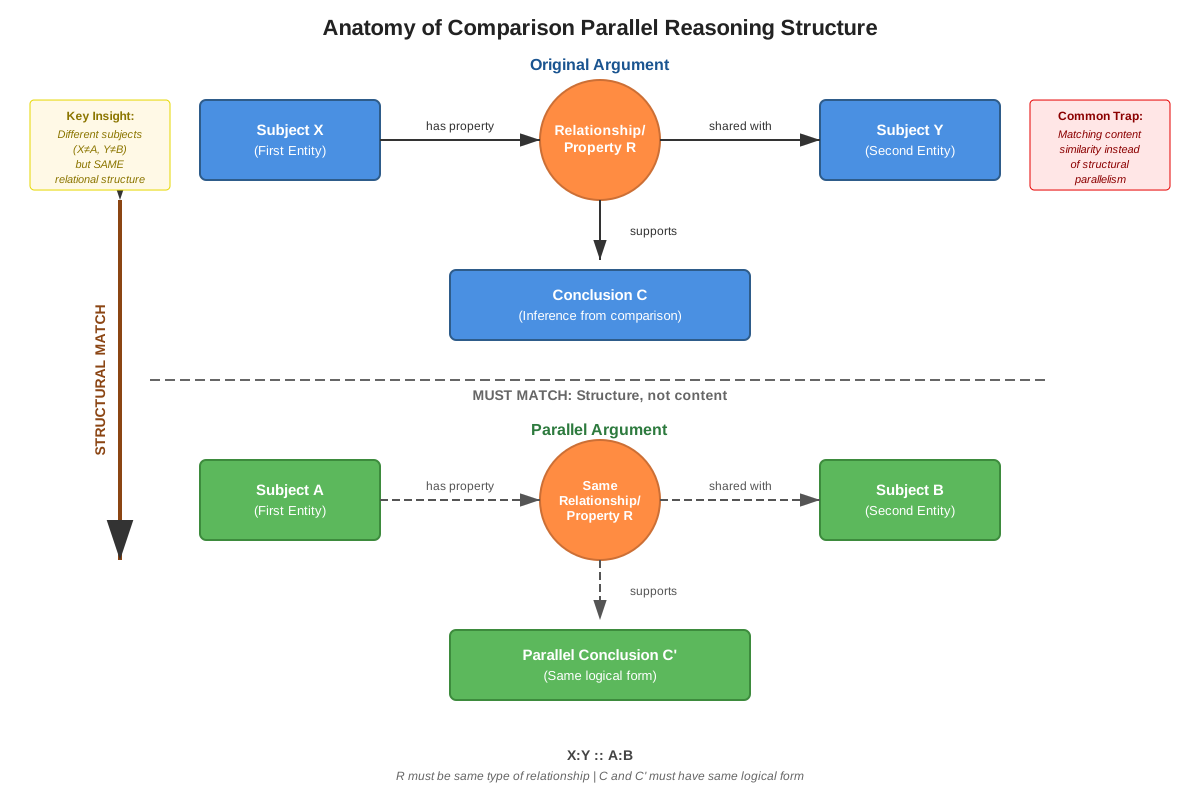
Comparison parallel reasoning involves arguments that establish a relationship between two or more entities and then draw conclusions based on that comparative relationship. The fundamental structure contains three essential components:
- Subject A with certain characteristics or in a certain situation
- Subject B with characteristics or in a situation being compared to A
- A conclusion drawn based on the comparison between A and B
The logical force of these arguments depends on the basis of comparison—the specific attribute, relationship, or characteristic that links the two subjects. For example: "Classical music requires years of training to appreciate fully. Similarly, fine wine requires extensive experience to evaluate properly. Therefore, just as we don't expect children to judge classical music, we shouldn't expect novices to rate wines."
Types of Comparative Reasoning Patterns
Parallel reasoning questions involving comparisons typically employ several recurring patterns:
Analogical Comparison: Argues that because two things are alike in certain respects, they will be alike in another respect. Structure: "X has properties 1, 2, 3. Y has properties 1, 2, 3. X also has property 4. Therefore, Y probably has property 4."
Degree Comparison: Establishes a relationship based on relative magnitude or intensity. Structure: "If X (lesser case) produces result R, then Y (greater case) will certainly produce result R." Example: "If a small tax increase reduces consumption, a large tax increase will definitely reduce consumption."
Inverse Comparison: Argues that opposite causes produce opposite effects or that the absence of a cause produces the absence of an effect. Structure: "When X increases, Y decreases. When A increases, B decreases. Therefore, the X-Y relationship parallels the A-B relationship."
Proportional Comparison: Establishes that relationships maintain consistent ratios or proportions. Structure: "X relates to Y as A relates to B" (the classic analogical proportion).
Identifying Structural Elements vs. Content
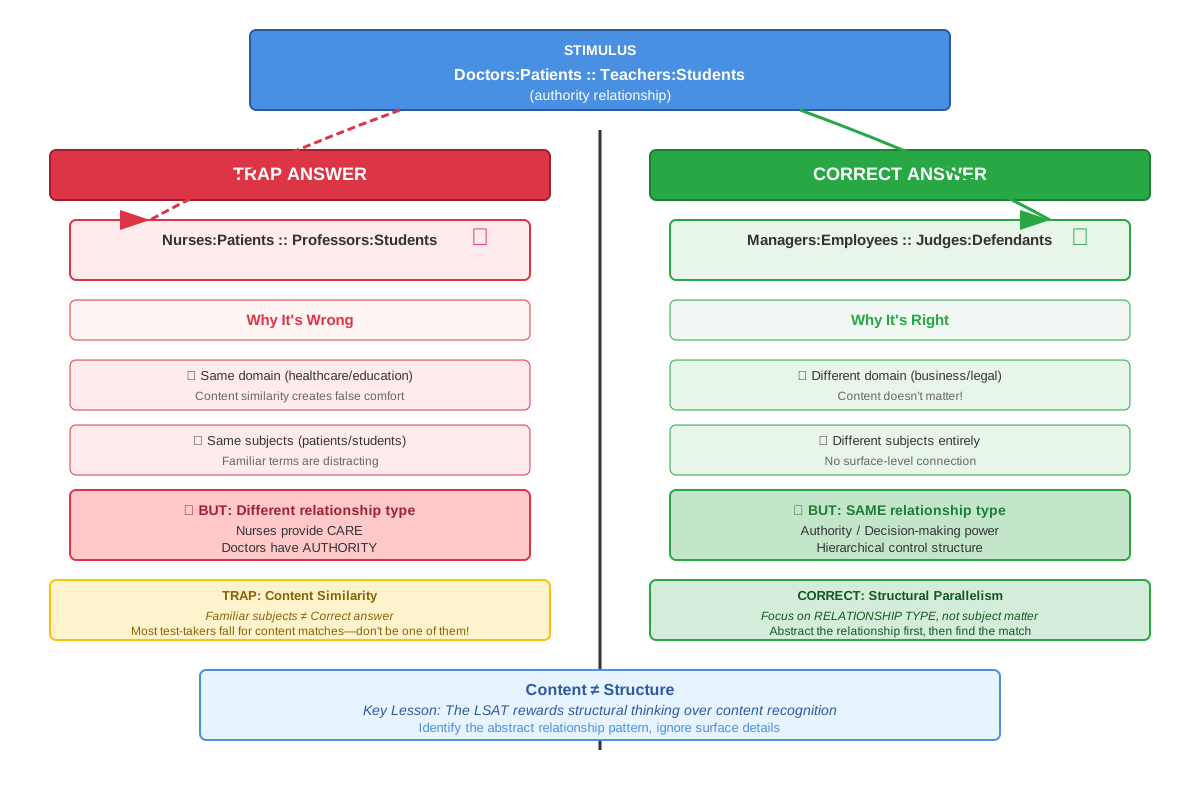
The critical skill in lsat comparison parallel reasoning questions involves distinguishing between the logical structure (the form of the reasoning) and the content (the specific subject matter). Two arguments can discuss completely different topics yet share identical logical structures.
Consider this structure: "Just as [professional role A] requires [skill X] to perform [task Y], [professional role B] requires [skill X] to perform [task Z]."
This structure remains constant whether discussing "doctors requiring empathy to treat patients" and "teachers requiring empathy to educate students," or "pilots requiring spatial awareness to navigate" and "surgeons requiring spatial awareness to operate." The LSAT tests whether students can recognize this structural identity despite content differences.
Mapping Comparative Elements
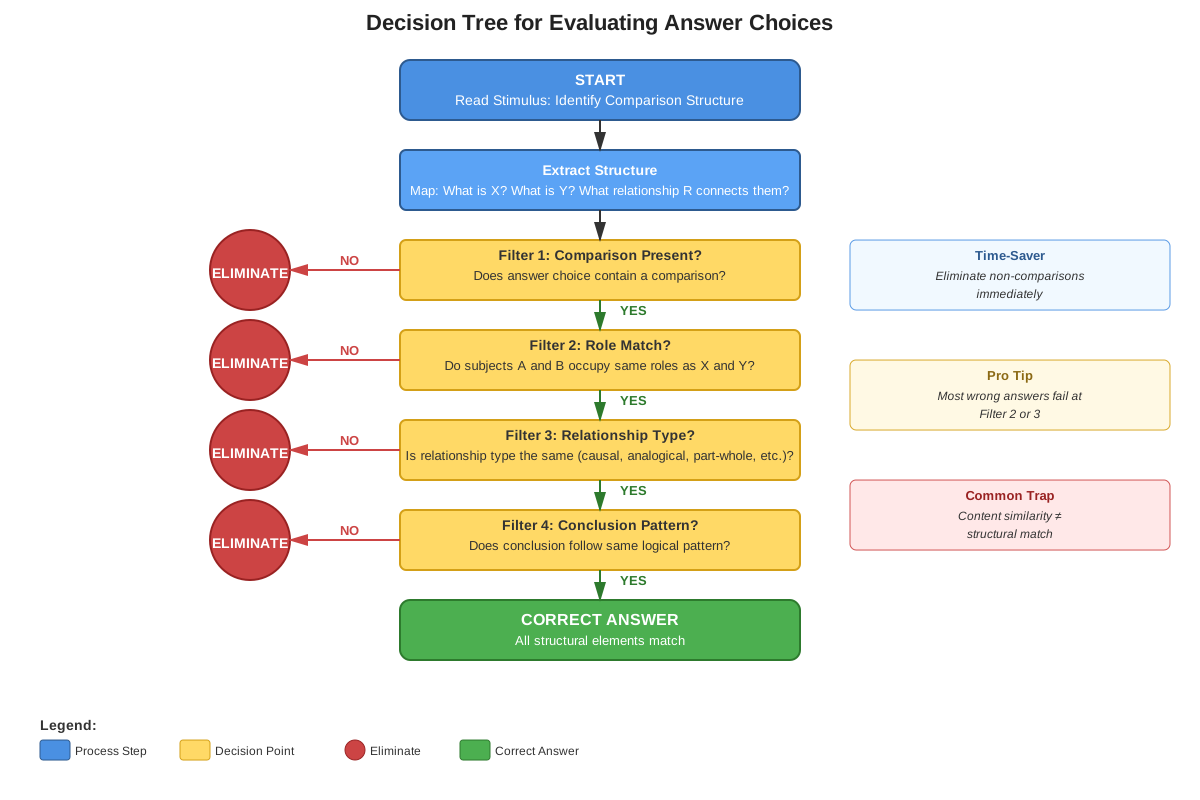
To solve comparison parallel reasoning questions systematically, students must map each element of the original argument to corresponding elements in the answer choices:
| Original Argument Element | Must Match In Answer Choice |
|---|---|
| First subject of comparison | First subject of comparison |
| Second subject of comparison | Second subject of comparison |
| Basis/ground of comparison | Basis/ground of comparison |
| Type of relationship (similar/different/greater/lesser) | Type of relationship |
| Conclusion type (prediction/recommendation/explanation) | Conclusion type |
| Strength of conclusion (definite/probable/possible) | Strength of conclusion |
Common Structural Variations
LSAT comparison parallel reasoning questions often include subtle variations that test careful analysis:
Positive vs. Negative Comparisons: "X is like Y" has a different structure than "X is unlike Y." The parallel answer must maintain the same positive or negative relationship.
Sufficient vs. Necessary Conditions in Comparisons: "If something has property X (like A does), it will have property Y" differs structurally from "Only things with property X (like A) will have property Y."
Single vs. Multiple Comparisons: Some arguments compare two items; others compare three or more. The parallel must match the number of comparative relationships.
Explicit vs. Implicit Conclusions: Some comparative arguments state their conclusions directly; others leave them implied. The parallel should match this feature.
Concept Relationships
Comparison parallel reasoning builds directly upon foundational parallel reasoning skills by adding an additional layer of complexity: the comparative relationship itself must be parallel, not just the overall argument structure. This creates a hierarchical relationship: Standard Parallel Reasoning → Comparison Parallel Reasoning → Complex Multi-Step Comparative Reasoning.
The connection to analogical reasoning is bidirectional: understanding how analogies function helps identify comparative structures, while mastering comparison parallel reasoning strengthens the ability to evaluate analogical arguments for validity. This relationship can be expressed as: Analogical Reasoning ↔ Comparison Parallel Reasoning → Enhanced Argument Evaluation.
Within the topic itself, concepts connect sequentially: Identifying Comparative Structure → Mapping Structural Elements → Distinguishing Form from Content → Systematically Eliminating Non-Parallel Answers → Selecting the Best Match. Each step depends on the previous one, creating a procedural chain that students must follow consistently.
The relationship to conditional reasoning emerges when comparative arguments contain conditional elements: "If X is true of A, then Y is true of A. If X is true of B, then Y is true of B." Recognizing these conditional structures within comparisons requires integrating both skill sets: Conditional Reasoning + Comparison Parallel Reasoning = Complex Structural Analysis.
High-Yield Facts
⭐ Comparison parallel reasoning questions require matching the logical structure of comparative relationships, not the content or subject matter
⭐ The basis of comparison (the specific attribute or relationship being compared) must be structurally parallel in the correct answer
⭐ Positive and negative comparisons have different structures; "X is like Y" is not parallel to "X is unlike Y"
⭐ The strength of the conclusion (certain, probable, possible) must match between the original argument and the parallel answer
⭐ The number of entities being compared must match (two-way comparison vs. three-way comparison vs. multiple comparisons)
- Comparative arguments often contain implicit premises about what makes the comparison valid or relevant
- Degree comparisons ("if less X produces Y, then more X produces more Y") follow a specific logical pattern that must be matched exactly
- Inverse relationships ("as X increases, Y decreases") require parallel inverse relationships in the answer, not direct relationships
- The conclusion type (prediction, recommendation, explanation, evaluation) must match structurally between stimulus and answer
- Surface-level similarity in subject matter often appears in wrong answers to distract from structural differences
Quick check — test yourself on Comparison parallel reasoning so far.
Try Flashcards →Common Misconceptions
Misconception: Comparison parallel reasoning means finding an answer choice about a similar topic or subject matter.
Correction: Comparison parallel reasoning requires matching the logical structure of the comparative relationship, regardless of topic. An argument comparing doctors and teachers can be parallel to an argument comparing engineers and architects if the structural relationship is identical, even though the subject matter differs completely.
Misconception: If two things are being compared in both the stimulus and an answer choice, the reasoning is parallel.
Correction: The mere presence of a comparison is insufficient; the type of comparison, the basis of comparison, the direction of the comparison, and the conclusion drawn must all match structurally. An argument stating "X is more effective than Y" is not parallel to one stating "X is similar to Y in effectiveness."
Misconception: The correct answer will use similar language or phrasing to the original argument.
Correction: The LSAT deliberately varies language to test whether students recognize structural identity beneath different wording. "Just as A requires B" might be parallel to "Without X, Y cannot occur" if the structural relationship is the same, despite completely different phrasing.
Misconception: Comparison parallel reasoning questions always have one clearly correct answer that matches perfectly.
Correction: These questions ask for the answer that "most closely parallels" the reasoning, meaning the best available option. Sometimes the correct answer may have minor structural differences but still represents the closest match among the five choices.
Misconception: Evaluating the validity or soundness of the argument helps identify the parallel answer.
Correction: Parallel reasoning questions test structural matching, not argument quality. A flawed argument in the stimulus requires finding an answer with the same flaw structure, not a better argument. Both valid and invalid comparative reasoning patterns can be paralleled.
Misconception: Longer, more complex answer choices are more likely to be correct because they match the complexity of the stimulus.
Correction: Length and complexity are irrelevant to structural parallelism. A concise answer choice can perfectly parallel a complex stimulus if it captures the essential comparative structure. The LSAT often includes verbose wrong answers as distractors.
Worked Examples
Example 1: Analogical Comparison
Stimulus: "Learning to play chess well requires studying classic games played by masters. Similarly, learning to write well requires reading classic literature written by great authors. Therefore, just as chess students benefit from analyzing master games, writing students benefit from analyzing great literature."
Analysis Process:
Step 1: Identify the comparative structure
- Subject A: Learning chess well
- Requirement for A: Studying classic master games
- Subject B: Learning to write well
- Requirement for B: Reading classic literature
- Conclusion: Parallel benefit (chess students analyzing games ≈ writing students analyzing literature)
Step 2: Map the structural pattern
- Pattern: "X requires studying exemplary instances of X. Y requires studying exemplary instances of Y. Therefore, students of X benefit from analysis just as students of Y benefit from analysis."
- This is a proportional comparison with parallel requirements leading to parallel benefits.
Step 3: Evaluate answer choices (hypothetical)
Choice A: "Becoming a skilled surgeon requires practicing procedures. Becoming a skilled musician requires practicing techniques. Therefore, surgeons and musicians both need practice."
- Analysis: This matches the parallel requirements but loses the specific element about studying exemplary instances and the analytical benefit. The conclusion is too general. Not the best match.
Choice B: "Understanding physics requires studying fundamental principles. Understanding chemistry requires studying fundamental principles. Therefore, physics students benefit from principle analysis just as chemistry students do."
- Analysis: This preserves the parallel requirements (studying fundamental principles), maintains the same subjects (students of each field), and draws a parallel conclusion about analytical benefit. Strong candidate.
Choice C: "Chess masters study games to improve. Writing masters read literature to improve. Therefore, mastery in any field requires study."
- Analysis: This reverses the subjects (masters instead of students) and draws an overly general conclusion about "any field" rather than maintaining the specific parallel. Structural mismatch.
Correct Answer: Choice B most closely parallels the reasoning because it maintains the structure of parallel requirements leading to parallel analytical benefits for students in each field.
Example 2: Degree Comparison
Stimulus: "If a minor software bug can frustrate users and reduce satisfaction, then a major software bug will certainly frustrate users and reduce satisfaction even more significantly."
Analysis Process:
Step 1: Identify the comparative structure
- Lesser case: Minor software bug
- Effect of lesser case: Frustrates users, reduces satisfaction
- Greater case: Major software bug
- Conclusion: Certainly produces the same effect, but more significantly
- Pattern type: Degree comparison (if lesser X produces Y, greater X produces more Y)
Step 2: Map the logical structure
- Structure: "If [lesser degree of X] produces [effect Y], then [greater degree of X] will certainly produce [effect Y] to a greater extent."
- Key elements: Degree relationship (minor → major), certainty of conclusion ("will certainly"), amplification of effect ("even more significantly")
Step 3: Evaluate answer choices (hypothetical)
Choice A: "If a small earthquake can damage buildings, then a large earthquake might damage buildings more severely."
- Analysis: Matches the degree relationship (small → large) and the effect amplification, but uses "might" instead of "will certainly," weakening the conclusion strength. Partial match, but conclusion strength differs.
Choice B: "If a brief exposure to cold can lower body temperature, then a prolonged exposure to cold will definitely lower body temperature more substantially."
- Analysis: Preserves the degree relationship (brief → prolonged), maintains certainty ("will definitely"), and includes effect amplification ("more substantially"). Excellent structural match.
Choice C: "Small investments sometimes yield returns, so large investments will yield larger returns."
- Analysis: Changes from certainty to possibility ("sometimes"), and the conclusion lacks the definitive certainty of the original. Structural mismatch in conclusion strength.
Correct Answer: Choice B most closely parallels the reasoning because it maintains the degree comparison structure with a certain conclusion and amplified effect.
Exam Strategy
Systematic Approach to Comparison Parallel Reasoning Questions
Step 1: Identify the Question Type
Watch for trigger phrases: "most similar in reasoning to," "employs a pattern of reasoning most like," "reasoning most closely parallels," or "uses a method of argument that is most parallel to." These signal comparison parallel reasoning questions.
Step 2: Deconstruct the Stimulus
Before looking at answer choices, map the comparative structure:
- What entities/concepts are being compared?
- What is the basis of the comparison?
- What type of comparison is it (analogical, degree, inverse, proportional)?
- What conclusion is drawn?
- How strong is the conclusion (certain, probable, possible)?
Step 3: Create a Structural Template
Mentally formulate an abstract version: "If A has property X and produces result Y, and B has property X, then B produces result Y." This template becomes your matching criterion.
Step 4: Eliminate Systematically
Process answer choices by checking each structural element:
- First elimination pass: Remove choices with wrong comparison type
- Second elimination pass: Remove choices with mismatched conclusion strength
- Third elimination pass: Remove choices with wrong number of comparative elements
- Final selection: Choose the answer with the closest overall structural match
Exam Tip: Don't be distracted by answer choices that discuss similar subject matter but have different logical structures. The LSAT deliberately includes these as trap answers.
Time Management
Allocate approximately 90 seconds for comparison parallel reasoning questions:
- 20 seconds: Read and understand the stimulus
- 15 seconds: Map the comparative structure
- 45 seconds: Evaluate answer choices systematically
- 10 seconds: Verify your selection
If a question exceeds 2 minutes, mark it and move on. These questions can be time-consuming, but spending excessive time on one question jeopardizes performance on others.
Trigger Words and Phrases
In the stimulus, watch for:
- "Just as... so too..."
- "Similarly..."
- "Likewise..."
- "In the same way..."
- "Analogously..."
- "If [lesser case]... then [greater case]..."
- "X is to Y as A is to B"
In answer choices, be wary of:
- Content similarity without structural parallelism
- Reversed relationships (cause/effect flipped)
- Different conclusion types (prediction vs. recommendation)
- Altered conclusion strength (certain vs. probable)
Process of Elimination Tips
Eliminate answer choices that:
- Compare a different number of entities (two-way vs. three-way comparison)
- Use a different type of comparison (similarity vs. difference)
- Draw a different type of conclusion (explanation vs. prediction)
- Have different conclusion strength (definite vs. possible)
- Reverse the direction of the comparison (greater to lesser vs. lesser to greater)
Keep answer choices that:
- Match the abstract structure even with different content
- Preserve the relationship type between compared elements
- Maintain the same logical moves in the same order
- Draw conclusions with equivalent strength and type
Memory Techniques
The COMPARE Acronym
Count the entities being compared (must match)
Observe the type of comparison (analogical, degree, inverse, proportional)
Map each structural element systematically
Pay attention to conclusion strength (certain, probable, possible)
Abstract the structure from the content
Reject content similarity without structural parallelism
Evaluate answer choices against your structural template
Visualization Strategy
Picture the comparative argument as a bridge connecting two islands (the entities being compared). The bridge's architecture (the logical structure) must match in the parallel answer, even if the islands themselves (the content) are completely different. A suspension bridge connecting two islands remains a suspension bridge whether those islands are tropical or arctic—the structure is what matters.
The "Mad Libs" Technique
Convert the stimulus into a fill-in-the-blank template with variables: "Just as [X] requires [Y] to achieve [Z], [A] requires [Y] to achieve [Z]." The correct answer should fit this same template structure, even with completely different X, Y, Z, and A values.
Structural Matching Checklist
Create a mental checklist for each question:
- ✓ Same number of comparisons?
- ✓ Same type of relationship?
- ✓ Same basis of comparison?
- ✓ Same conclusion type?
- ✓ Same conclusion strength?
If all five checks pass, you've found your answer.
Summary
Comparison parallel reasoning questions test the ability to identify and match the logical structure of comparative arguments while ignoring surface-level content differences. These questions require students to deconstruct arguments into their essential components—the entities being compared, the basis of comparison, the type of comparative relationship, and the conclusion drawn—and then find answer choices that replicate this structure with different subject matter. Success depends on distinguishing between form and content, recognizing that arguments about entirely different topics can share identical logical architectures. The key skills involve mapping structural elements systematically, understanding various comparison types (analogical, degree, inverse, proportional), and maintaining focus on how the comparison functions logically rather than what is being compared. Students must also match conclusion strength and type, ensuring that certain conclusions parallel certain conclusions and probable conclusions parallel probable conclusions. Mastering this question type requires practice in abstraction, pattern recognition, and systematic elimination of structurally non-parallel answers.
Key Takeaways
- Comparison parallel reasoning requires matching logical structure, not content or subject matter
- Map each structural element of the comparative argument before evaluating answer choices
- The basis of comparison, type of relationship, and conclusion strength must all match structurally
- Eliminate answers systematically by checking each structural component against the stimulus
- Use the COMPARE acronym to ensure comprehensive analysis of each question
- Allocate approximately 90 seconds per question and move on if exceeding 2 minutes
- Practice abstracting comparative structures into templates that can be applied across different content areas
Related Topics
Standard Parallel Reasoning: Mastering comparison parallel reasoning builds upon and enhances skills in standard parallel reasoning questions, where the entire argument structure (not just the comparative element) must be matched. Understanding comparison patterns provides a specialized tool within the broader parallel reasoning toolkit.
Method of Reasoning Questions: These questions often describe comparative argument structures, requiring students to identify how comparisons function within arguments. The analytical skills developed through comparison parallel reasoning directly transfer to method of reasoning questions.
Analogical Reasoning and Flaw Questions: Many flaw questions involve faulty analogies or inappropriate comparisons. Understanding how valid comparative reasoning works enables students to identify when comparisons break down or when the basis of comparison is inadequate.
Strengthen and Weaken Questions with Comparative Elements: Arguments involving comparisons can be strengthened by showing the comparison is apt or weakened by showing relevant differences. Mastery of comparison parallel reasoning enhances the ability to evaluate these arguments effectively.
Practice CTA
Now that you understand the structure and strategy behind comparison parallel reasoning, it's time to apply these concepts to actual LSAT questions. Work through the practice questions systematically, using the COMPARE acronym and structural mapping techniques covered in this guide. Pay special attention to distinguishing between surface-level content similarity and true structural parallelism—this distinction separates correct answers from tempting distractors. Review the flashcards to reinforce the key patterns and structural elements you'll encounter on test day. Remember: every practice question you analyze strengthens your pattern recognition skills and builds the mental templates that enable quick, accurate responses under timed conditions. Your investment in mastering this high-yield question type will pay dividends across multiple Logical Reasoning questions on test day.
Sign up free to keep reading
Create a free AnvayaPrep account to finish this LSAT guide on Comparison parallel reasoning — plus flashcards and practice questions.