Overview
Conclusion type in parallel questions represents a critical analytical skill tested on the LSAT Logical Reasoning section. These questions require test-takers to identify arguments that share the same logical structure, with particular emphasis on matching the type of conclusion drawn in the original argument. Unlike standard parallel reasoning questions that focus solely on structural similarity, conclusion type questions demand precise attention to whether the conclusion is categorical, conditional, comparative, probabilistic, or prescriptive in nature. Mastering this distinction separates high-scoring candidates from those who struggle with nuanced logical analysis.
The LSAT tests parallel reasoning skills because legal practice demands the ability to recognize analogous case structures, apply precedents correctly, and distinguish between superficially similar but structurally different arguments. When evaluating conclusion type in parallel questions, students must look beyond surface-level content similarities and identify the fundamental logical relationship between premises and conclusion. This skill directly translates to legal reasoning, where attorneys must determine whether a precedent truly applies to a new case based on structural parallels rather than topical overlap.
Within the broader logical reasoning framework, conclusion type analysis sits at the intersection of argument structure recognition and formal logic application. It builds upon foundational skills in identifying conclusions, understanding premise-conclusion relationships, and recognizing logical patterns. Success with these questions requires synthesizing multiple competencies: structural mapping, categorical thinking, and precise logical classification. This topic connects directly to assumption questions, strengthen/weaken questions, and flaw identification, as all require understanding how conclusions relate to their supporting evidence.
Learning Objectives
- [ ] Identify how conclusion type in parallel questions appears in LSAT questions
- [ ] Explain the reasoning pattern behind conclusion type in parallel questions
- [ ] Apply conclusion type in parallel questions to solve LSAT-style problems accurately
- [ ] Distinguish between different conclusion types (categorical, conditional, comparative, probabilistic, prescriptive)
- [ ] Evaluate answer choices by systematically eliminating structural mismatches
- [ ] Recognize common distractor patterns that mimic surface content but differ in logical structure
- [ ] Construct mental templates for the five primary conclusion types to accelerate pattern recognition
Prerequisites
- Basic argument structure identification: Understanding premises, conclusions, and their relationships is essential because parallel reasoning requires mapping these components across arguments
- Conditional logic fundamentals: Recognizing if-then relationships enables distinguishing conditional conclusions from categorical ones
- Formal logic notation: Familiarity with symbolic representation helps visualize structural parallels more efficiently
- Standard argument forms: Knowledge of common patterns (modus ponens, modus tollens, disjunctive syllogism) provides templates for matching
- Conclusion identification skills: The ability to quickly locate and characterize conclusions is foundational to comparing them across arguments
Why This Topic Matters
Parallel reasoning questions, particularly those emphasizing conclusion type, appear with remarkable consistency on the LSAT. Approximately 2-4 parallel reasoning questions appear on each Logical Reasoning section, representing roughly 8-15% of all Logical Reasoning questions. Among these, conclusion type matching serves as the primary differentiator between correct answers and attractive distractors. Test-makers deliberately construct wrong answers that match premise structure but diverge in conclusion type, making this skill a high-yield discriminator for top scores.
In legal practice, recognizing parallel case structures determines whether precedents apply. An attorney arguing before an appellate court must demonstrate that a prior ruling's logical structure matches the current case—not merely that both involve similar subject matter. A precedent concluding "X must be true" (categorical) cannot support an argument concluding "X is probably true" (probabilistic), even if both cases involve identical facts. This precise structural matching mirrors the analytical demands of lsat conclusion type in parallel questions.
These questions commonly appear in several formats: standard parallel reasoning questions asking "Which one of the following exhibits a pattern of reasoning most similar to that in the argument above?"; parallel flaw questions requiring matching both structure and logical error; and parallel principle questions demanding application of the same abstract rule. The conclusion type serves as the final checkpoint—after matching premise structure, the conclusion must exhibit the same logical force, scope, and relationship to the evidence presented.
Core Concepts
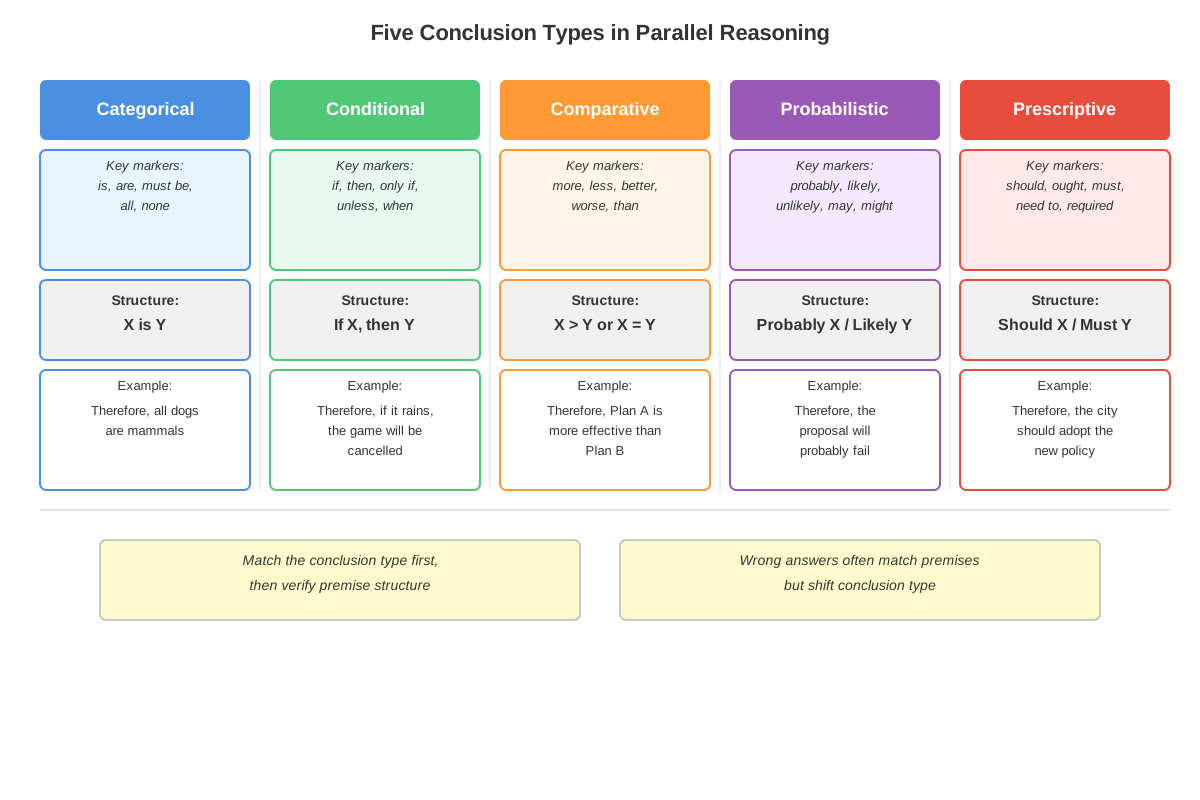
The Five Primary Conclusion Types
Categorical conclusions assert that something definitively is or is not the case. These conclusions make absolute claims without hedging or qualification. Example: "Therefore, the defendant is liable" or "Thus, the policy will fail." The logical force is binary—the conclusion claims certainty based on the premises. When matching parallel arguments, categorical conclusions must pair with categorical conclusions; mixing categorical with probabilistic conclusions represents a structural mismatch even if all other elements align.
Conditional conclusions establish if-then relationships, asserting that one condition leads to or requires another. Example: "Therefore, if the company expands, it will need additional capital" or "Thus, anyone who meets these criteria must be admitted." These conclusions don't claim that the antecedent condition actually obtains, only that a relationship exists between conditions. The parallel must preserve this conditional structure—a conclusion stating "X will happen" (categorical) cannot match "If Y, then X will happen" (conditional).
Comparative conclusions rank, contrast, or establish relative relationships between two or more entities. Example: "Therefore, Option A is superior to Option B" or "Thus, this approach is more effective than the alternative." The logical structure requires at least two elements being compared along some dimension. Parallel arguments must maintain this comparative framework—a conclusion about a single entity cannot match a conclusion comparing multiple entities.
Probabilistic conclusions express likelihood, possibility, or probability rather than certainty. Example: "Therefore, the hypothesis is probably correct" or "Thus, it is likely that the trend will continue." These conclusions acknowledge uncertainty and make claims about probability rather than definitive truth. Key markers include "probably," "likely," "possibly," "suggests," and "indicates." A probabilistic conclusion cannot parallel a categorical one because the logical force differs fundamentally.
Prescriptive conclusions recommend actions, establish obligations, or state what should or ought to occur. Example: "Therefore, the government should implement this policy" or "Thus, the company must revise its procedures." These normative conclusions move from descriptive premises to action-oriented recommendations. The parallel must preserve this prescriptive element—a conclusion describing what will happen cannot match a conclusion prescribing what should happen.
Structural Mapping Process
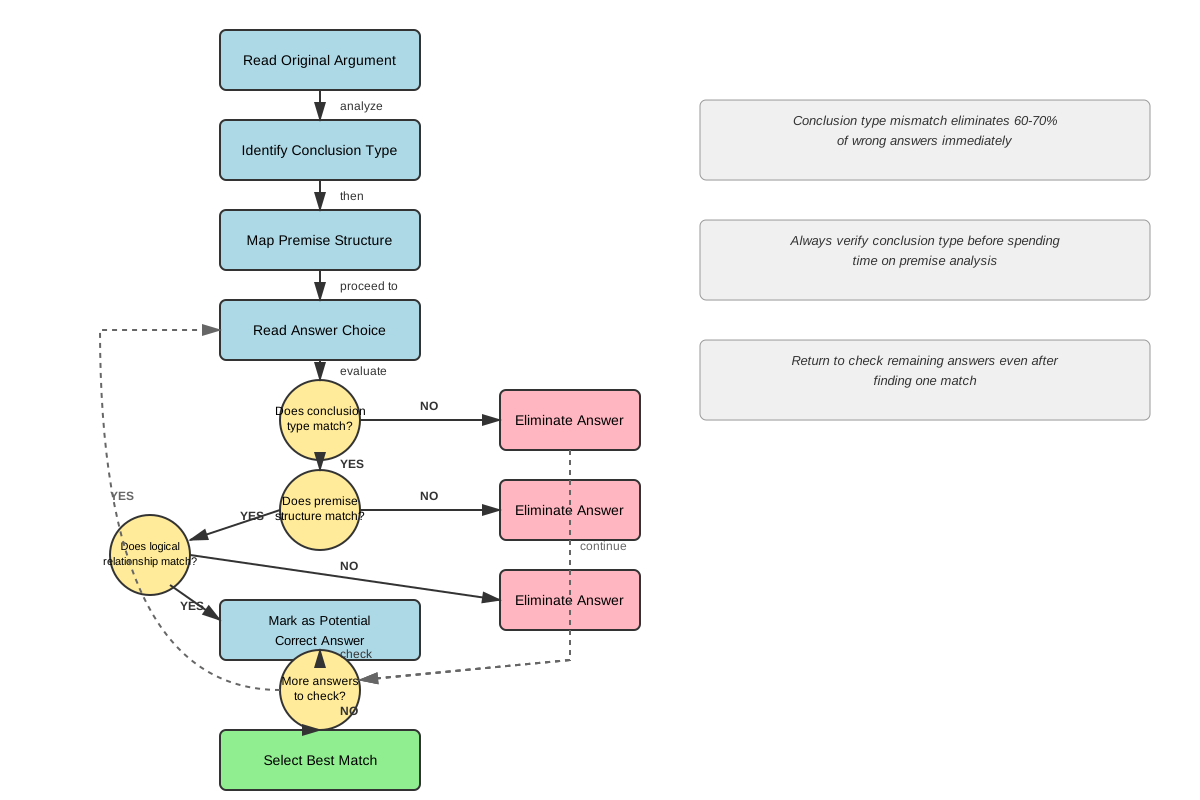
The systematic approach to conclusion type in parallel questions follows a four-stage process:
- Identify the original argument's conclusion type: Before examining answer choices, precisely categorize the stimulus argument's conclusion using the five-type framework
- Map the premise structure: Note the number of premises, their relationships (supporting, contrasting, conditional), and how they connect to the conclusion
- Eliminate mismatched conclusion types: Scan answer choices for conclusion type first, immediately eliminating any that differ from the original
- Verify complete structural parallel: Among remaining choices with matching conclusion types, confirm that premise relationships and logical progression mirror the original
This process prioritizes efficiency. Since conclusion type serves as a necessary condition for correct answers, eliminating mismatches early saves time and cognitive resources. Many test-takers waste valuable seconds analyzing premise structures in answer choices whose conclusions already disqualify them.
Logical Force and Scope Matching
Beyond conclusion type classification, parallel reasoning demands matching logical force (the strength of the claim) and scope (the breadth of application). A conclusion stating "All X are Y" differs structurally from "Some X are Y" even though both are categorical. Similarly, "This specific policy will fail" differs from "All such policies will fail" in scope despite sharing categorical force.
| Dimension | Original | Parallel Match Required | Non-Parallel Example |
|---|---|---|---|
| Force | Definite ("will") | Definite ("must") | Probable ("might") |
| Scope | Universal ("all") | Universal ("every") | Particular ("some") |
| Modality | Necessary ("must") | Necessary ("required") | Possible ("could") |
| Direction | Positive ("is") | Positive ("are") | Negative ("is not") |
Content Abstraction
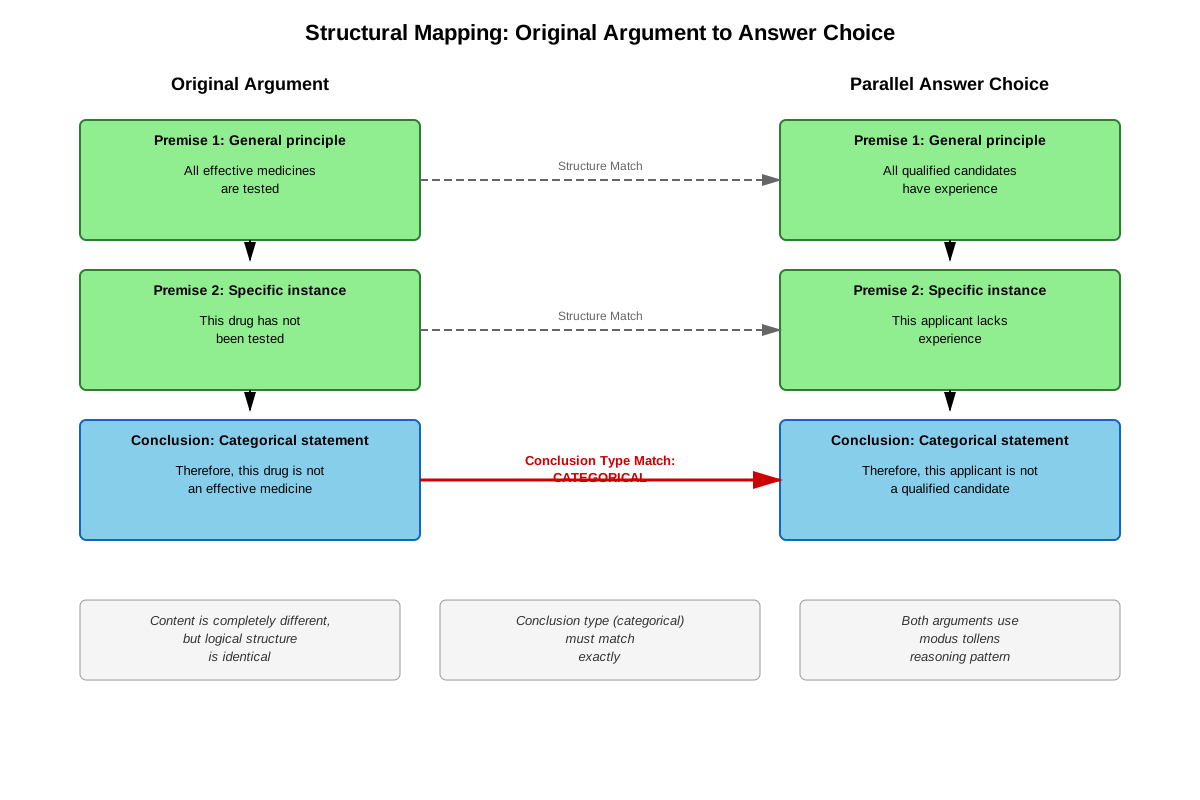
A critical skill in parallel reasoning involves abstracting away from specific content to identify underlying logical structure. The original argument might discuss corporate taxation while the correct answer discusses environmental regulation—the content differs entirely, but the logical skeleton remains identical. Test-takers must mentally replace specific terms with variables: "If [condition A], then [result B]. [Condition A] obtains. Therefore, [result B] follows."
This abstraction prevents the common error of selecting answers that discuss similar topics but employ different logical structures. An argument about dogs and an argument about cats might share subject matter (animals) but exhibit completely different reasoning patterns. Conversely, arguments about quantum physics and medieval literature might share identical logical structures despite having no topical overlap.
Common Structural Patterns
Certain argument structures appear repeatedly in parallel reasoning questions:
Modus Ponens Pattern: If A, then B. A is true. Therefore, B is true. (Categorical conclusion)
Modus Tollens Pattern: If A, then B. B is false. Therefore, A is false. (Categorical conclusion)
Disjunctive Syllogism: Either A or B. Not A. Therefore, B. (Categorical conclusion)
Analogical Reasoning: X has properties 1, 2, 3 and result R. Y has properties 1, 2, 3. Therefore, Y probably has result R. (Probabilistic conclusion)
Comparative Reasoning: X achieves goal G better than Y on criteria C1 and C2. Therefore, X is superior to Y for achieving G. (Comparative conclusion)
Prescriptive Reasoning: Goal G is desirable. Action A achieves G. Therefore, we should do A. (Prescriptive conclusion)
Recognizing these templates accelerates pattern matching and reduces cognitive load during timed testing conditions.
Concept Relationships
The hierarchy of skills in parallel reasoning flows from foundational to advanced: Argument structure identification → Conclusion type classification → Premise relationship mapping → Complete structural parallel verification. Each level builds upon the previous, with conclusion type serving as the critical middle checkpoint that eliminates the majority of incorrect answers.
Conclusion type analysis connects bidirectionally with conditional logic. Conditional conclusions require applying conditional logic rules, while categorical conclusions often result from resolving conditional chains. Understanding sufficient and necessary conditions enables distinguishing "If A, then B" (conditional conclusion) from "A, therefore B" (categorical conclusion following from conditional premise).
The relationship to assumption questions manifests in how conclusions relate to premises. Parallel arguments must share not only explicit structural elements but also the same types of logical gaps. An argument requiring a causal assumption cannot parallel an argument requiring a representativeness assumption, even if both have categorical conclusions. This deeper structural similarity extends beyond surface-level conclusion matching.
Flaw identification skills directly enhance parallel reasoning performance. Recognizing that an argument commits a particular flaw (e.g., confusing correlation with causation) helps identify parallel arguments committing the same flaw. Parallel flaw questions explicitly test this connection, requiring both structural matching and flaw matching—with conclusion type serving as a primary indicator of whether the flaw structure truly parallels.
The progression to advanced topics follows this path: Master conclusion type identification → Apply to standard parallel reasoning → Extend to parallel flaw questions → Synthesize with parallel principle questions → Integrate with complex multi-layered arguments. Each stage requires increasingly sophisticated application of the same fundamental skill: recognizing and matching logical structure independent of content.
High-Yield Facts
⭐ Conclusion type must match exactly between the original argument and correct answer—this is a necessary condition for correctness
⭐ Categorical conclusions (definite claims) cannot parallel probabilistic conclusions (likelihood claims), even if all other structural elements match
⭐ Conditional conclusions establish relationships between conditions; they differ structurally from categorical conclusions even when discussing the same subject matter
⭐ The correct answer in parallel reasoning questions typically discusses completely different content from the original argument—topical similarity often indicates a distractor
⭐ Prescriptive conclusions (what should happen) require prescriptive parallels—descriptive conclusions (what will happen) represent structural mismatches
- Comparative conclusions require at least two entities being ranked or contrasted; single-entity conclusions cannot parallel them
- The number of premises must match between original and parallel arguments, though the order may vary
- Logical force (strength of claim) and scope (breadth of application) must align even within the same conclusion type category
- Parallel reasoning questions reward systematic elimination: check conclusion type first, then premise structure, then complete logical flow
- Abstract reasoning (replacing specific content with variables) prevents content-based distraction and reveals underlying structure
- Intermediate conclusions in multi-step arguments must also parallel—not just the final conclusion
- Negative conclusions (claiming something is not the case) must parallel with negative conclusions, not positive ones
- The relationship between premises (supporting, contrasting, conditional) must mirror the original argument's premise relationships
- Time investment in thoroughly analyzing the original argument's structure pays dividends by enabling rapid answer choice elimination
- Common wrong answer patterns include: matching content but not structure, matching premise structure but not conclusion type, and matching conclusion type but reversing logical direction
Quick check — test yourself on Conclusion type in parallel questions so far.
Try Flashcards →Common Misconceptions
Misconception: If an answer choice discusses the same topic as the original argument, it's more likely to be correct.
Correction: Parallel reasoning questions specifically test the ability to recognize identical logical structures across different content domains. Correct answers typically discuss completely unrelated topics to ensure test-takers focus on structure rather than content. Topical similarity often signals a distractor designed to trap those focusing on surface features.
Misconception: A conclusion stating "X will probably happen" can parallel a conclusion stating "X will definitely happen" because both predict X.
Correction: These represent fundamentally different conclusion types—probabilistic versus categorical. The logical force differs: one claims certainty while the other acknowledges uncertainty. This structural difference disqualifies the parallel regardless of other similarities. The conclusion type must match exactly in both category and strength.
Misconception: As long as the conclusion type matches, the answer is correct.
Correction: Conclusion type matching is necessary but not sufficient. The premise structure, number of premises, relationships between premises, and overall logical progression must all parallel the original. An answer with a matching conclusion type but different premise structure remains incorrect. Conclusion type serves as an efficient elimination tool, not a complete solution.
Misconception: Conditional conclusions and categorical conclusions are interchangeable if they discuss the same outcome.
Correction: "If A, then B" (conditional) structurally differs from "Therefore, B" (categorical) even when B represents the same outcome. Conditional conclusions assert relationships between conditions without claiming the conditions obtain; categorical conclusions make definite claims. This distinction reflects different logical structures that cannot parallel each other.
Misconception: The premises and conclusion must appear in the same order in the parallel argument.
Correction: While the logical relationships must match, the physical order of presentation can vary. An argument presenting premises P1, P2, then conclusion C can parallel an argument presenting P2, P1, then C, provided the logical relationships remain identical. Structure refers to logical connections, not physical arrangement.
Misconception: Parallel reasoning questions test reading comprehension and vocabulary more than logical analysis.
Correction: These questions specifically assess the ability to abstract logical structure from content. Success requires recognizing formal patterns independent of subject matter expertise or vocabulary. A test-taker can correctly answer parallel reasoning questions about unfamiliar topics by focusing purely on logical structure—in fact, unfamiliarity sometimes helps by preventing content-based distraction.
Misconception: Longer answer choices are more likely to be correct because they provide more complete parallels.
Correction: Length correlates neither with correctness nor structural completeness. Test-makers deliberately vary answer choice length to prevent length-based guessing strategies. A concise answer choice can provide a complete structural parallel, while a lengthy one might include irrelevant elaboration that obscures a structural mismatch.
Worked Examples
Example 1: Categorical Conclusion Parallel
Original Argument:
"Every successful technology company invests heavily in research and development. TechCorp invests heavily in research and development. Therefore, TechCorp is a successful technology company."
Analysis:
- Conclusion type: Categorical (definite claim: "TechCorp is a successful technology company")
- Premise structure: Universal premise (Every X has property Y) + Particular premise (Z has property Y)
- Logical pattern: Affirming the consequent (a formal fallacy)
- Key structural elements: Two premises, one universal and one particular, leading to categorical conclusion
Answer Choice A:
"All effective leaders communicate clearly. Mayor Johnson communicates clearly. Therefore, Mayor Johnson is probably an effective leader."
Evaluation: INCORRECT. While the premise structure matches (universal + particular), the conclusion type differs. The original has a categorical conclusion ("is a successful company") while this has a probabilistic conclusion ("probably an effective leader"). This mismatch in conclusion type disqualifies this answer immediately.
Answer Choice B:
"Every nutritious meal includes vegetables. This meal includes vegetables. Therefore, this meal is nutritious."
Evaluation: CORRECT. The conclusion type matches (categorical: "this meal is nutritious"). The premise structure parallels exactly: universal statement about category membership + particular instance possessing the property + categorical conclusion about category membership. Both arguments commit the same logical flaw (affirming the consequent), and the structural parallel is complete. The content differs entirely (technology companies vs. meals), confirming this tests structure, not content.
Example 2: Conditional Conclusion Parallel
Original Argument:
"Historical records show that whenever inflation exceeds 5% annually, the central bank raises interest rates. Economic forecasts predict inflation will exceed 5% next year. If these forecasts prove accurate, the central bank will raise interest rates."
Analysis:
- Conclusion type: Conditional (if-then structure: "If forecasts prove accurate, then central bank will raise interest rates")
- Premise structure: Historical pattern establishing conditional relationship + Prediction about antecedent condition
- Logical pattern: Conditional reasoning with hypothetical application
- Key structural elements: Establishes general conditional rule, notes potential triggering condition, concludes with conditional prediction
Answer Choice A:
"Studies demonstrate that when children read daily, their vocabulary expands significantly. Recent surveys indicate that children in this district read daily. Therefore, children in this district will experience significant vocabulary expansion."
Evaluation: INCORRECT. The conclusion is categorical ("will experience significant vocabulary expansion"), not conditional. This argument applies the conditional rule directly to reach a definite conclusion, whereas the original maintains the conditional structure in its conclusion. The logical force differs fundamentally.
Answer Choice B:
"Research indicates that whenever a species loses its primary habitat, population decline follows. Scientists predict this species will lose its primary habitat due to development. If this prediction is correct, population decline will follow."
Evaluation: CORRECT. The conclusion type matches perfectly—both maintain conditional structure ("If this prediction is correct, then..."). The premise structure parallels: established conditional relationship + prediction about triggering condition + conditional conclusion maintaining the if-then framework. Both arguments preserve uncertainty about whether the antecedent will obtain while asserting what follows if it does. The structural parallel is complete despite entirely different content domains (economics vs. ecology).
Exam Strategy
Systematic Approach Protocol
When encountering conclusion type in parallel questions, implement this time-efficient protocol:
Step 1 (15-20 seconds): Thoroughly analyze the original argument. Identify the conclusion and classify its type using the five-category framework. Note whether it's categorical, conditional, comparative, probabilistic, or prescriptive. Mark the conclusion type in your scratch work.
Step 2 (5-10 seconds per choice): Scan each answer choice's conclusion first, before reading the entire argument. Immediately eliminate any choice whose conclusion type differs from the original. This rapid elimination typically removes 2-3 answer choices instantly.
Step 3 (15-20 seconds per remaining choice): For answer choices with matching conclusion types, analyze premise structure. Count premises, identify their relationships, and verify the logical progression mirrors the original.
Step 4 (10 seconds): Verify the complete parallel by mentally abstracting both arguments to pure logical form, confirming the structural skeleton matches exactly.
Trigger Words and Phrases
Categorical conclusion indicators: "therefore," "thus," "consequently," "it follows that," "must be," "is," "will be," "are"
Conditional conclusion indicators: "if...then," "provided that," "assuming," "in the event that," "should...then," "would"
Comparative conclusion indicators: "more than," "less than," "superior to," "preferable to," "better than," "worse than," "exceeds"
Probabilistic conclusion indicators: "probably," "likely," "suggests," "indicates," "appears," "seems," "possibly," "may," "might"
Prescriptive conclusion indicators: "should," "ought to," "must" (in normative sense), "needs to," "is required to," "is obligated to"
Exam Tip: When the question stem asks for "parallel reasoning" or "similar pattern of reasoning," conclusion type matching is non-negotiable. When it asks for "parallel flaw," both the conclusion type AND the logical error must match.
Process of Elimination Strategies
Content similarity elimination: If an answer choice discusses the same or closely related subject matter as the original, flag it as a likely distractor. Correct parallels typically involve completely different domains.
Conclusion type mismatch elimination: This should remove 40-60% of answer choices immediately. Any difference in conclusion type—categorical vs. probabilistic, conditional vs. categorical, etc.—disqualifies the choice.
Premise count elimination: If the original has two premises and an answer choice has three, eliminate it. The number of logical steps must match.
Logical direction elimination: If the original concludes positively ("X is true") and an answer concludes negatively ("Y is not true"), the parallel fails even if other elements match.
Time Allocation
Parallel reasoning questions warrant slightly more time investment than average Logical Reasoning questions due to their complexity. Allocate approximately 90-120 seconds per question:
- 20 seconds: Analyze original argument structure
- 40-60 seconds: Eliminate mismatched answer choices
- 20-30 seconds: Verify the remaining choice(s)
- 10 seconds: Final confirmation
This investment pays dividends because systematic analysis prevents the common error of selecting superficially attractive but structurally mismatched answers. Rushing through parallel reasoning questions significantly increases error rates.
Memory Techniques
The "CCPPP" Mnemonic
Remember the five conclusion types with CCPPP:
- Categorical (definite claims)
- Conditional (if-then relationships)
- Probabilistic (likelihood statements)
- Prescriptive (should/ought recommendations)
- Parallel (comparative rankings)
Note: The last "P" stands for "Parallel" as a reminder that comparative conclusions involve parallel comparisons between entities.
The Structure-First Visualization
Visualize arguments as skeletal frameworks, like building blueprints. The conclusion type represents the roof shape—flat (categorical), peaked (conditional), sloped (comparative), domed (probabilistic), or stepped (prescriptive). The premises represent support columns. A parallel argument must have the same roof shape and same number/arrangement of columns, even if the building materials (content) differ completely.
The "MAPS" Process Acronym
Match conclusion type first
Abstract content to structure
Premise relationships must parallel
Scan for structural skeleton, not surface similarity
This acronym provides a memorable sequence for approaching every parallel reasoning question systematically.
The Force-Scope-Type Triangle
Visualize three points of a triangle labeled Force (strength of claim), Scope (breadth of application), and Type (conclusion category). All three points must align between original and parallel arguments. If any point misaligns, the triangle collapses—the parallel fails.
Summary
Conclusion type in parallel questions represents a high-yield LSAT skill requiring precise identification of logical structure independent of content. Success demands mastering the five primary conclusion types—categorical, conditional, comparative, probabilistic, and prescriptive—and recognizing that exact matching is necessary for correct answers. The systematic approach prioritizes conclusion type verification before analyzing premise structure, enabling efficient elimination of 40-60% of answer choices within seconds. Test-takers must abstract away from specific content to identify underlying logical skeletons, recognizing that correct parallels typically discuss entirely different subject matter while maintaining identical structural relationships. The key insight is that parallel reasoning tests formal logic pattern recognition, not reading comprehension or subject matter knowledge. By implementing the structure-first protocol, using conclusion type as the primary elimination criterion, and verifying complete structural parallels only among remaining candidates, students can achieve consistent accuracy on these challenging questions. Mastery requires practice in rapid conclusion type classification, systematic premise mapping, and disciplined resistance to content-based distraction—skills that directly translate to legal reasoning and case analysis in professional practice.
Key Takeaways
- Conclusion type matching is a necessary but not sufficient condition—it eliminates wrong answers efficiently but requires premise structure verification for final selection
- The five conclusion types (categorical, conditional, comparative, probabilistic, prescriptive) must be instantly recognizable through trigger words and logical force indicators
- Content similarity between original and answer choice typically signals a distractor—correct parallels usually involve completely different subject matter
- Systematic elimination based on conclusion type first, then premise structure, maximizes efficiency and prevents time-wasting analysis of structurally disqualified choices
- Abstract reasoning—replacing specific content with logical variables—reveals underlying structure and prevents content-based distraction
- Both logical force (strength) and scope (breadth) must match within conclusion types—"all" vs. "some" or "will" vs. "might" represent structural differences
- Parallel reasoning questions reward methodical analysis over speed—investing 90-120 seconds per question with systematic approach yields higher accuracy than rushing
Related Topics
Parallel Flaw Questions: Building directly on conclusion type matching, these questions require identifying arguments that share both logical structure and the same reasoning error. Mastering conclusion type analysis provides the foundation for recognizing when flawed reasoning patterns parallel each other.
Sufficient Assumption Questions: Understanding conclusion types enhances sufficient assumption identification because the assumption must bridge premises to a conclusion of specific type and force. Recognizing whether a conclusion is categorical versus probabilistic determines what strength of assumption suffices.
Principle Application Questions: These questions require applying abstract rules to concrete situations—essentially a form of parallel reasoning where the principle provides the structural template. Conclusion type matching helps verify whether the application truly instantiates the principle.
Method of Reasoning Questions: Analyzing how arguments reach their conclusions requires the same structural abstraction skills as parallel reasoning. Recognizing conclusion types helps categorize reasoning methods accurately.
Argument Structure Mapping: Advanced parallel reasoning extends to complex multi-layered arguments with intermediate conclusions. Mastering basic conclusion type matching enables progression to these sophisticated structural analyses.
Practice CTA
Now that you've mastered the conceptual framework for conclusion type in parallel questions, it's time to cement your understanding through active practice. The practice questions and flashcards accompanying this guide provide targeted opportunities to apply the systematic approach, test your conclusion type classification speed, and refine your structural abstraction skills. Remember: parallel reasoning mastery comes not from passive reading but from deliberate practice with immediate feedback. Each practice question you work through strengthens your pattern recognition and builds the automaticity needed for timed test conditions. Approach the practice materials with the same systematic protocol outlined in this guide—identify conclusion type first, eliminate mismatches, verify structural parallels—and track your accuracy improvement over time. You've built the foundation; now construct expertise through application. Your investment in mastering this high-yield topic will pay dividends across multiple questions on test day!
Sign up free to keep reading
Create a free AnvayaPrep account to finish this LSAT guide on Conclusion type in parallel questions — plus flashcards and practice questions.