Overview
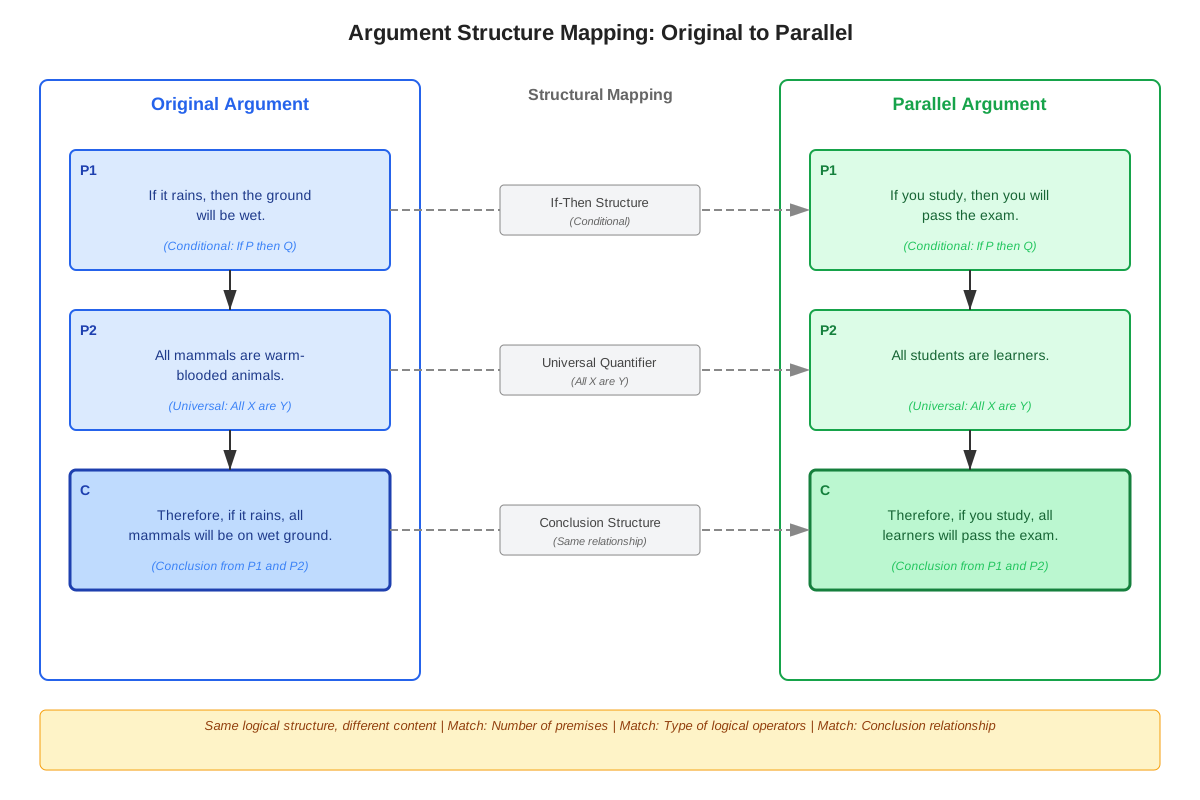
Descriptive parallel arguments represent a critical question type within the LSAT's Logical Reasoning sections, appearing with consistent frequency on every administration of the exam. These questions require test-takers to identify arguments that share the same logical structure or reasoning pattern as a given stimulus, even when the content differs entirely. Unlike parallel flaw questions that focus on matching errors in reasoning, descriptive parallel arguments ask students to match the form of valid or neutral reasoning patterns across different contexts.
Mastering this topic is essential for LSAT success because parallel reasoning questions typically appear 2-4 times per test, accounting for approximately 5-8% of all Logical Reasoning questions. These questions test a fundamental skill that underlies all logical analysis: the ability to abstract the structure of an argument from its content. This skill directly supports performance on other question types, including Must Be True, Sufficient Assumption, and Method of Reasoning questions, as all require recognizing how premises relate to conclusions.
Within the broader landscape of logical reasoning, parallel reasoning questions occupy a unique position. They assess not just whether students can evaluate arguments, but whether they can deconstruct arguments into their component logical relationships and reconstruct those relationships in entirely different contexts. This metacognitive skill—thinking about the structure of thinking itself—represents one of the highest-order reasoning abilities tested on the LSAT and correlates strongly with success in legal education, where analogical reasoning forms the foundation of case law analysis.
Learning Objectives
- [ ] Identify how Descriptive parallel arguments appears in LSAT questions
- [ ] Explain the reasoning pattern behind Descriptive parallel arguments
- [ ] Apply Descriptive parallel arguments to solve LSAT-style problems accurately
- [ ] Deconstruct complex arguments into their structural components (premises, conclusion, logical operators)
- [ ] Distinguish between content-based similarities and structural parallels in arguments
- [ ] Evaluate answer choices systematically using structural matching techniques
- [ ] Recognize common argument structures that frequently appear in parallel reasoning questions
Prerequisites
- Basic argument structure: Understanding the distinction between premises and conclusions is fundamental, as parallel reasoning requires mapping these components across different arguments
- Conditional reasoning: Familiarity with if-then statements and their logical relationships enables recognition of conditional structures that must be matched in parallel questions
- Quantifiers and scope: Knowledge of terms like "all," "some," "most," and "none" is necessary because parallel arguments must match not just logical relationships but also the scope and strength of claims
- Logical indicators: Recognition of conclusion indicators (therefore, thus, hence) and premise indicators (because, since, given that) allows rapid identification of argument structure
Why This Topic Matters
Descriptive parallel arguments questions appear on every LSAT administration, making them one of the most reliable question types students will encounter. Recent LSAT administrations feature 2-4 parallel reasoning questions per test, distributed across the two scored Logical Reasoning sections. These questions carry the same weight as any other Logical Reasoning question, typically representing 4-6 raw points on the exam—enough to shift a score by 2-3 scaled points when answered correctly or incorrectly.
Beyond their direct point value, parallel reasoning questions develop transferable analytical skills crucial for legal practice. Attorneys constantly engage in analogical reasoning, arguing that a precedent case with similar structure should govern a current dispute. The ability to recognize when two situations share the same logical structure despite different surface details is precisely what these questions train. Law school examinations, particularly in first-year courses, heavily emphasize this skill through issue-spotting and case comparison exercises.
On the LSAT, lsat descriptive parallel arguments typically appear as standalone questions following a single argument stimulus. The question stem explicitly asks test-takers to identify which answer choice "most closely parallels the reasoning" or exhibits "reasoning most similar to" the original argument. Unlike parallel flaw questions, which specifically state they're looking for flawed reasoning, descriptive parallel questions may present valid arguments, invalid arguments, or arguments with neutral logical structures. The key challenge lies in abstracting the logical form while ignoring compelling but irrelevant content similarities.
Core Concepts
Understanding Argument Structure
The foundation of solving descriptive parallel arguments lies in the ability to reduce any argument to its skeletal logical structure. Every argument consists of premises (supporting statements) and a conclusion (the claim being supported). However, the structural analysis goes deeper, requiring identification of:
- Logical operators: Words like "if," "unless," "only if," "all," "some," "most," and "none" that determine the logical relationships between concepts
- Quantifier scope: Whether claims apply universally, to most instances, to some instances, or to no instances
- Conditional relationships: Whether premises establish sufficient conditions, necessary conditions, or both
- Causal claims: Whether the argument asserts that one thing causes another
- Comparative structures: Whether the argument ranks or compares items
Consider this simple argument: "All lawyers are professionals. Maria is a lawyer. Therefore, Maria is a professional." The structure is: All A are B. X is A. Therefore, X is B. This represents a valid categorical syllogism. A parallel argument might state: "All roses are flowers. This plant is a rose. Therefore, this plant is a flower." Despite completely different content, the logical structure remains identical.
Abstracting Content from Form
The most challenging aspect of parallel reasoning questions involves ignoring content while focusing exclusively on form. Test-takers naturally gravitate toward answer choices that discuss similar topics to the stimulus, but parallel reasoning questions deliberately include wrong answers with topical similarity but structural differences.
The abstraction process follows these steps:
- Identify the conclusion: Determine what the argument is trying to prove
- Map the premises: List each supporting statement
- Symbolize relationships: Replace specific content with variables (A, B, X, Y)
- Note logical connectors: Preserve all quantifiers, conditionals, and operators
- Capture argument flow: Determine whether reasoning moves from general to specific, specific to general, or through analogy
For example, an argument stating "Most scientists support the theory. Dr. Johnson is a scientist. Therefore, Dr. Johnson probably supports the theory" has the structure: Most A are B. X is A. Therefore, X is probably B. Note that "probably" in the conclusion matches "most" in the premise—this probabilistic relationship must appear in the correct parallel answer.
Common Argument Structures in Parallel Questions
Certain logical structures appear repeatedly in LSAT parallel reasoning questions. Recognizing these patterns accelerates the matching process:
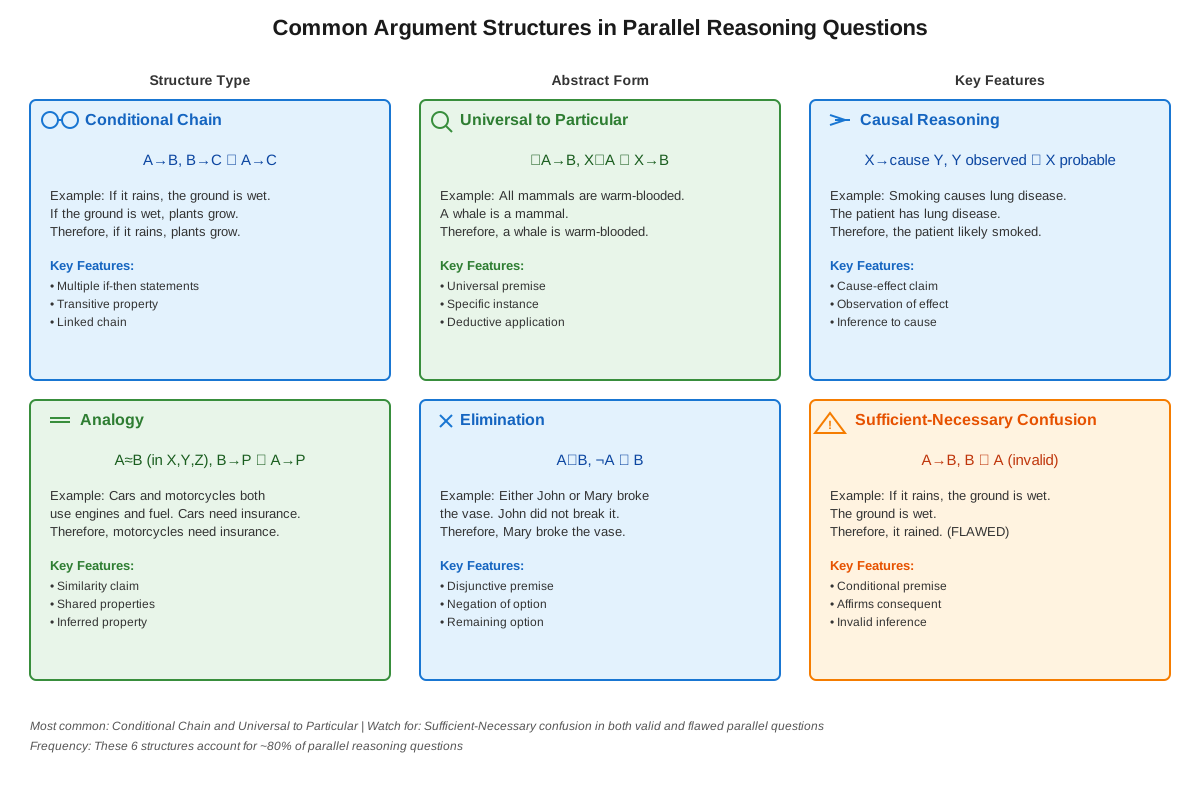
| Structure Type | Pattern | Example |
|---|---|---|
| Categorical Syllogism | All A are B; All B are C; Therefore, all A are C | All dogs are mammals; All mammals are animals; Therefore, all dogs are animals |
| Conditional Chain | If A then B; If B then C; Therefore, if A then C | If it rains, the ground is wet; If the ground is wet, plants grow; Therefore, if it rains, plants grow |
| Contrapositive | If A then B; Not B; Therefore, not A | If qualified, then hired; Not hired; Therefore, not qualified |
| Probabilistic | Most A are B; X is A; Therefore, X is probably B | Most athletes are healthy; John is an athlete; Therefore, John is probably healthy |
| Analogical | A and B share properties X, Y, Z; A has property W; Therefore, B probably has property W | Cats and dogs are both mammals, have four legs, and are domesticated; Cats are independent; Therefore, dogs are probably independent |
| Causal | A occurred, then B occurred; Therefore, A caused B | The medication was taken, then symptoms improved; Therefore, the medication caused improvement |
Matching Logical Strength and Certainty
A crucial but often overlooked element of parallel reasoning involves matching the strength of the conclusion to the strength of the premises. Arguments with universal premises ("all," "every," "none") that yield universal conclusions must be matched with arguments exhibiting the same certainty level. Arguments with qualified premises ("most," "many," "some") that yield probabilistic conclusions ("probably," "likely") require parallel qualification.
Consider these two arguments:
Argument 1: "All members attended. Sarah is a member. Therefore, Sarah attended."
Argument 2: "Most members attended. Sarah is a member. Therefore, Sarah probably attended."
These arguments are NOT parallel despite similar content. The first moves from universal premises to a certain conclusion; the second moves from a qualified premise to a probabilistic conclusion. The correct parallel to Argument 1 might be: "All participants received certificates. Tom is a participant. Therefore, Tom received a certificate."
Negative and Positive Structures
Arguments can be constructed with positive or negative claims, and this polarity must be preserved in parallel structures. An argument stating "No A are B" differs structurally from "All A are B," even though both are universal claims. Similarly, "If A then B" differs from "If A then not B."
Example of negative structure: "No reptiles are mammals. Snakes are reptiles. Therefore, snakes are not mammals." (Structure: No A are B. X is A. Therefore, X is not B.)
A parallel must maintain this negative relationship: "No vegetables are proteins. Carrots are vegetables. Therefore, carrots are not proteins."
Complex Multi-Premise Arguments
Advanced parallel reasoning questions may present arguments with multiple independent premises, conditional chains, or embedded sub-arguments. These require careful mapping of each logical relationship.
For a complex argument like: "If the law passes, taxes increase. If taxes increase, spending decreases. The law passed. Therefore, spending will decrease," the structure involves:
- Two conditional premises forming a chain
- An affirmation of the sufficient condition of the first conditional
- A conclusion affirming the necessary condition of the second conditional
The parallel must replicate all three elements: conditional chain structure, affirmation of the initial sufficient condition, and conclusion following the chain to the final necessary condition.
Concept Relationships
The concepts within descriptive parallel arguments build hierarchically. Understanding argument structure forms the foundation, as students cannot abstract form from content without first identifying premises and conclusions. This foundational skill leads to the ability to abstract content from form, which involves replacing specific terms with variables while preserving logical relationships.
Once abstraction is mastered, students can recognize common argument structures, which serves as a pattern library that accelerates matching. This pattern recognition enables quick identification of logical strength and certainty levels, as students learn that certain structures inherently produce certain or probabilistic conclusions.
The ability to distinguish negative and positive structures operates in parallel with strength matching, as both involve preserving the polarity and force of claims. These skills collectively support analysis of complex multi-premise arguments, which simply combine multiple instances of simpler structures.
This topic connects to prerequisite knowledge through direct application: conditional reasoning provides the tools for analyzing if-then structures in parallel questions; quantifiers and scope determine whether universal or particular claims are being made; logical indicators enable rapid identification of premises and conclusions during the abstraction process.
Descriptive parallel arguments also connect forward to other LSAT topics. The structural analysis skills developed here directly transfer to Method of Reasoning questions, which ask students to describe how an argument proceeds. The abstraction ability supports Sufficient Assumption questions, where students must identify what logical connection would complete an argument. Even Strengthen and Weaken questions benefit from structural understanding, as students must recognize what type of evidence would affect different argument structures.
High-Yield Facts
⭐ Parallel reasoning questions ask for structural matches, not content matches—arguments about completely different topics can be perfectly parallel if they share the same logical form.
⭐ The correct answer must match the conclusion type exactly—if the stimulus concludes with certainty, the parallel must conclude with certainty; if the stimulus concludes probabilistically, the parallel must conclude probabilistically.
⭐ Quantifiers must match precisely—"all" must parallel "all," "most" must parallel "most," "some" must parallel "some," and "none" must parallel "none."
⭐ Conditional structures must preserve direction—if the stimulus uses "if A then B," the parallel must use "if X then Y," not "if Y then X."
⭐ The number of premises must match—an argument with two premises requires a parallel with two premises, not one or three.
- Negative claims in the stimulus require negative claims in the parallel—"no A are B" must parallel "no X are Y."
- Causal arguments must be paralleled with causal arguments, not merely correlational or conditional arguments.
- Analogical reasoning in the stimulus requires analogical reasoning in the parallel, preserving the structure of comparison.
- The order of logical steps matters—if the stimulus establishes A, then uses A to prove B, then uses B to prove C, the parallel must follow the same sequence.
- Embedded conditionals or complex logical structures must be replicated exactly, not simplified in the parallel answer.
- Comparative structures ("more than," "less than," "better than") must be matched with comparative structures, not absolute claims.
- Arguments that explicitly acknowledge counterarguments or limitations must be paralleled with answers that include similar acknowledgments.
Quick check — test yourself on Descriptive parallel arguments so far.
Try Flashcards →Common Misconceptions
Misconception: Parallel arguments must discuss similar topics or use similar vocabulary to the stimulus.
Correction: Parallel reasoning questions test structural similarity, not content similarity. The correct answer often discusses a completely unrelated topic but follows the identical logical pattern. Test-makers deliberately include wrong answers with topical similarity but structural differences to trap students who focus on content.
Misconception: If an argument in the stimulus is flawed, the parallel must contain the same flaw.
Correction: This is only true for "parallel flaw" questions, which explicitly state they're looking for flawed reasoning. Descriptive parallel arguments questions (which don't mention flaws) simply require structural matching, whether the reasoning is valid, invalid, or neutral. The parallel must match the structure, not necessarily replicate an error.
Misconception: Close enough is good enough—an answer that's mostly similar in structure is correct.
Correction: Parallel reasoning questions demand exact structural matches. An answer that matches four out of five structural elements is wrong. Every logical component—quantifiers, conditionals, number of premises, conclusion strength, and logical operators—must align perfectly.
Misconception: The parallel argument must reach a similar type of conclusion (e.g., both about what should happen, or both about what is true).
Correction: While the logical strength must match, the type of claim (normative vs. descriptive, predictive vs. explanatory) need not match. An argument concluding "X will happen" can parallel an argument concluding "Y is true" if the logical structure connecting premises to conclusion is identical.
Misconception: Longer answer choices are more likely to be correct because they provide more detail.
Correction: Length is irrelevant to correctness in parallel reasoning questions. Test-makers often create longer wrong answers with additional irrelevant details to appear more sophisticated. The correct answer may be the shortest option if it efficiently captures the exact logical structure.
Misconception: If the stimulus uses formal logical language, the parallel must also use formal language.
Correction: The level of formality or sophistication in language is a content feature, not a structural feature. An argument using technical terminology can be paralleled by an argument using everyday language, as long as the logical relationships are identical.
Worked Examples
Example 1: Categorical Syllogism with Universal Quantifiers
Stimulus: "All effective managers are good communicators. Chen is an effective manager. Therefore, Chen is a good communicator."
Analysis Process:
Step 1 - Identify the conclusion: "Chen is a good communicator"
Step 2 - Identify the premises:
- Premise 1: "All effective managers are good communicators"
- Premise 2: "Chen is an effective manager"
Step 3 - Abstract the structure:
- Premise 1: All A are B
- Premise 2: X is A
- Conclusion: Therefore, X is B
Step 4 - Note key structural features:
- Universal quantifier ("all") in first premise
- Categorical membership claim in second premise
- Certain conclusion (no hedging with "probably" or "might")
- Two premises leading to one conclusion
- Valid deductive structure (affirming membership in category A, which is entirely contained in category B)
Evaluating Answer Choices:
Choice A: "Most successful athletes train daily. Jordan is a successful athlete. Therefore, Jordan probably trains daily."
Structural analysis: Most A are B. X is A. Therefore, X probably B.
Verdict: INCORRECT. Changes "all" to "most" and adds "probably" to conclusion, altering logical strength.
Choice B: "All novels are books. This item is a novel. Therefore, this item is a book."
Structural analysis: All A are B. X is A. Therefore, X is B.
Verdict: CORRECT. Perfect structural match with universal quantifier, categorical membership, and certain conclusion.
Choice C: "All effective managers are good communicators. Good communicators are valuable employees. Therefore, effective managers are valuable employees."
Structural analysis: All A are B. All B are C. Therefore, all A are C.
Verdict: INCORRECT. Contains three categorical claims forming a chain, not two premises about category membership and individual membership.
Choice D: "If someone is an effective manager, they are a good communicator. Chen is a good communicator. Therefore, Chen is an effective manager."
Structural analysis: If A then B. B. Therefore, A.
Verdict: INCORRECT. Uses conditional structure and commits the fallacy of affirming the consequent, whereas the stimulus uses categorical structure with valid reasoning.
Example 2: Probabilistic Reasoning with Qualified Premises
Stimulus: "Most restaurants that receive positive reviews experience increased business. The Riverside Café received positive reviews. Therefore, the Riverside Café will probably experience increased business."
Analysis Process:
Step 1 - Identify the conclusion: "The Riverside Café will probably experience increased business"
Step 2 - Identify the premises:
- Premise 1: "Most restaurants that receive positive reviews experience increased business"
- Premise 2: "The Riverside Café received positive reviews"
Step 3 - Abstract the structure:
- Premise 1: Most A that are B are also C
- Premise 2: X is A and is B
- Conclusion: Therefore, X will probably be C
Step 4 - Note key structural features:
- Qualified quantifier ("most," not "all")
- Compound condition in first premise (A that are B)
- Probabilistic conclusion ("probably")
- The conclusion strength matches the premise strength (most → probably)
Evaluating Answer Choices:
Choice A: "Most students who study regularly earn high grades. Marcus studies regularly. Therefore, Marcus will earn high grades."
Structural analysis: Most A that are B are C. X is A and B. Therefore, X will be C.
Verdict: INCORRECT. Conclusion lacks "probably" or similar hedge, claiming certainty from a "most" premise.
Choice B: "Most companies that invest in research develop innovative products. TechCorp invests in research. Therefore, TechCorp will probably develop innovative products."
Structural analysis: Most A that are B are C. X is A and B. Therefore, X will probably be C.
Verdict: CORRECT. Perfect match with qualified premise, compound condition, and appropriately hedged conclusion.
Choice C: "All restaurants that receive positive reviews experience increased business. The Riverside Café received positive reviews. Therefore, the Riverside Café will experience increased business."
Structural analysis: All A that are B are C. X is A and B. Therefore, X will be C.
Verdict: INCORRECT. Changes "most" to "all" and removes "probably," fundamentally altering the logical strength.
Choice D: "Some restaurants that receive positive reviews experience increased business. The Riverside Café received positive reviews. Therefore, the Riverside Café might experience increased business."
Structural analysis: Some A that are B are C. X is A and B. Therefore, X might be C.
Verdict: INCORRECT. "Some" is weaker than "most," and "might" is weaker than "probably," changing the strength relationship.
Exam Strategy
When approaching lsat descriptive parallel arguments questions, employ a systematic process that prioritizes efficiency without sacrificing accuracy:
Initial Assessment (15-20 seconds):
- Read the question stem first to confirm it's asking for parallel reasoning, not parallel flaw
- Quickly scan the stimulus to gauge complexity (number of premises, presence of conditionals, quantifiers used)
- Decide whether to diagram the argument or work from mental abstraction based on complexity
Stimulus Analysis (30-45 seconds):
- Identify and bracket the conclusion
- Number each premise
- Circle all quantifiers (all, most, some, none) and logical operators (if, unless, only if)
- Create a simple structural notation: "All A→B, X is A, ∴ X is B"
- Note the conclusion's strength (certain, probable, possible)
Answer Choice Evaluation (60-90 seconds total):
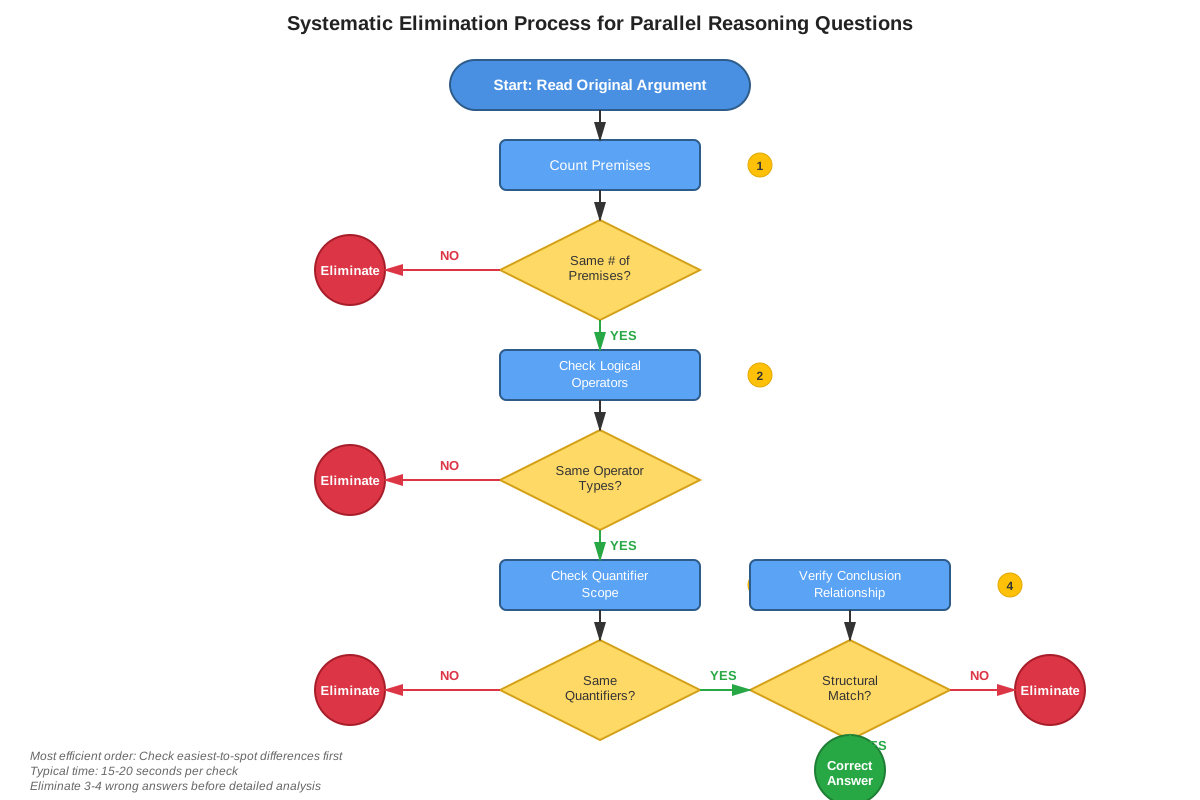
- Eliminate answers with wrong number of premises immediately
- Check conclusion strength next—eliminate any mismatch
- For remaining choices, verify quantifier matching
- Finally, confirm the logical flow matches exactly
Trigger Words to Watch:
- Question stems: "most closely parallels," "reasoning most similar to," "same pattern of reasoning"
- Quantifiers in stimulus: all, most, many, some, few, none, every, any
- Conditional indicators: if, then, only if, unless, whenever, provided that
- Conclusion hedges: probably, likely, might, possibly, must, certainly, definitely
Process of Elimination Tips:
- The Quantifier Test: If the stimulus says "all," eliminate any answer using "most," "some," or "none"
- The Premise Count Test: Count premises in stimulus; eliminate answers with different counts
- The Certainty Test: If the stimulus concludes with certainty, eliminate answers concluding with "probably" or "might"
- The Conditional Direction Test: If stimulus uses "if A then B," eliminate answers using "if B then A"
- The Negative Polarity Test: If stimulus includes "no" or "not," eliminate answers without corresponding negation
Time Allocation:
- Parallel reasoning questions typically require 90-120 seconds
- If approaching 2 minutes without a clear answer, make your best guess and flag for review
- These questions reward accuracy over speed—taking an extra 30 seconds is worthwhile if it ensures correctness
- Practice abstracting common structures until recognition becomes automatic, reducing analysis time
Common Trap Patterns:
- Content similarity trap: Answer discusses the same topic but has different structure
- Partial match trap: Answer matches 80% of the structure but fails on one critical element
- Complexity trap: Answer adds unnecessary complexity not present in stimulus
- Reversed logic trap: Answer flips the direction of a conditional or causal relationship
Memory Techniques
The MATCH Acronym for systematic parallel reasoning analysis:
- Match the number of premises
- Abstract the content to variables
- Track quantifiers and their strength
- Check conclusion certainty level
- Hold the logical flow constant
The Quantifier Hierarchy Visualization:
Imagine a pyramid of certainty:
        ALL/NONE (apex - strongest)
           MOST/FEW
         MANY/SEVERAL
           SOME/ANY (base - weakest)
Parallel arguments must stay at the same level—you cannot move up or down the pyramid.
The Conditional Direction Mnemonic: "Sufficient Starts, Necessary Needs"
- The sufficient condition starts the arrow (if A...)
- The necessary condition needs the sufficient (then B)
- In parallels, keep the arrow pointing the same direction
The Structural Blueprint Method:
Visualize arguments as buildings. The conclusion is the roof, premises are supporting pillars. A parallel argument must have:
- Same number of pillars (premises)
- Same strength pillars (quantifier strength)
- Same roof type (conclusion certainty)
- Same architectural style (logical structure)
The Variable Substitution Chant:
When abstracting, mentally chant: "A is to B as X is to Y"
This reinforces that specific content (A, B) maps to different content (X, Y) while preserving relationships.
Color Coding for Complex Arguments (mental or on scratch paper):
- Premises = blue
- Conclusion = red
- Conditionals = circle
- Quantifiers = box
- Negations = underline
Parallel answers must have the same color pattern and marking pattern.
Summary
Descriptive parallel arguments questions test the ability to recognize identical logical structures across different content domains, a fundamental skill for legal reasoning and a high-value question type on the LSAT. Success requires systematic deconstruction of arguments into their structural components—premises, conclusions, quantifiers, conditionals, and logical operators—while completely ignoring the specific subject matter. The key insight is that arguments about entirely unrelated topics can be perfectly parallel if they follow the same logical pattern, while arguments about similar topics may have completely different structures. Students must match every structural element exactly: the number of premises, the type and strength of quantifiers, the certainty level of the conclusion, the direction of any conditional relationships, and the overall logical flow from premises to conclusion. Common errors include focusing on content similarity rather than structural identity, accepting "close enough" matches that fail on one critical element, and mismatching the strength of conclusions to premises. Mastery comes through deliberate practice in abstracting arguments to symbolic form, building a mental library of common argument structures, and applying systematic elimination strategies that check each structural component sequentially.
Key Takeaways
- Parallel reasoning questions test structure, not content—the correct answer may discuss a completely different topic but must follow the identical logical pattern
- Every structural element must match exactly—quantifiers, number of premises, conditional directions, and conclusion strength must all align perfectly
- Systematic abstraction is essential—replace specific terms with variables (A, B, X, Y) to see the underlying logical skeleton
- Conclusion strength must match premise strength—universal premises yield certain conclusions; qualified premises yield probabilistic conclusions
- Common argument structures appear repeatedly—categorical syllogisms, conditional chains, and probabilistic reasoning patterns form the core of most parallel questions
- Efficient elimination strategies save time—check premise count first, then quantifiers, then conclusion strength, then detailed logical flow
- Practice transforms pattern recognition into automatic skill—regular exposure to parallel reasoning questions builds mental templates that accelerate matching
Related Topics
Parallel Flaw Questions: While descriptive parallel arguments match any logical structure, parallel flaw questions specifically match flawed reasoning patterns. Mastering descriptive parallels provides the foundation for identifying parallel flaws, as the same structural analysis applies but with added focus on logical errors.
Method of Reasoning Questions: These questions ask students to describe how an argument proceeds, requiring the same structural analysis skills developed through parallel reasoning practice. The ability to abstract and articulate logical structure transfers directly.
Sufficient Assumption Questions: Identifying what would make an argument valid requires understanding the argument's current structure and recognizing what logical connection is missing—skills honed through parallel reasoning analysis.
Formal Logic and Conditional Reasoning: Advanced parallel questions often involve complex conditional chains, making deeper study of formal logic valuable for handling the most difficult parallel reasoning questions.
Argument Diagramming Techniques: Systematic visual representation of argument structure supports parallel reasoning analysis, particularly for complex multi-premise arguments.
Practice CTA
Now that you've mastered the conceptual framework for descriptive parallel arguments, it's time to cement your understanding through active practice. Attempt the practice questions associated with this topic, focusing on applying the systematic analysis process outlined in the exam strategy section. As you work through problems, consciously practice abstracting arguments to their structural form before evaluating answer choices. Use the flashcards to drill recognition of common argument structures until pattern identification becomes automatic. Remember: parallel reasoning is a skill that improves dramatically with deliberate practice. Each question you analyze strengthens your ability to see through content to structure, building the analytical foundation that will serve you throughout the LSAT and in legal education. You've got this—now prove it through practice!
Sign up free to keep reading
Create a free AnvayaPrep account to finish this LSAT guide on Descriptive parallel arguments — plus flashcards and practice questions.