Overview
Flawed versus valid structure is a critical distinction that appears throughout LSAT Logical Reasoning sections, particularly in parallel reasoning questions. These questions require test-takers to identify whether an argument's logical structure is sound or contains a reasoning error, then match that structure to another argument with the same pattern. Understanding this distinction is essential because approximately 10-15% of Logical Reasoning questions directly test the ability to recognize and replicate argument structures, whether those structures are logically valid or contain specific flaws.
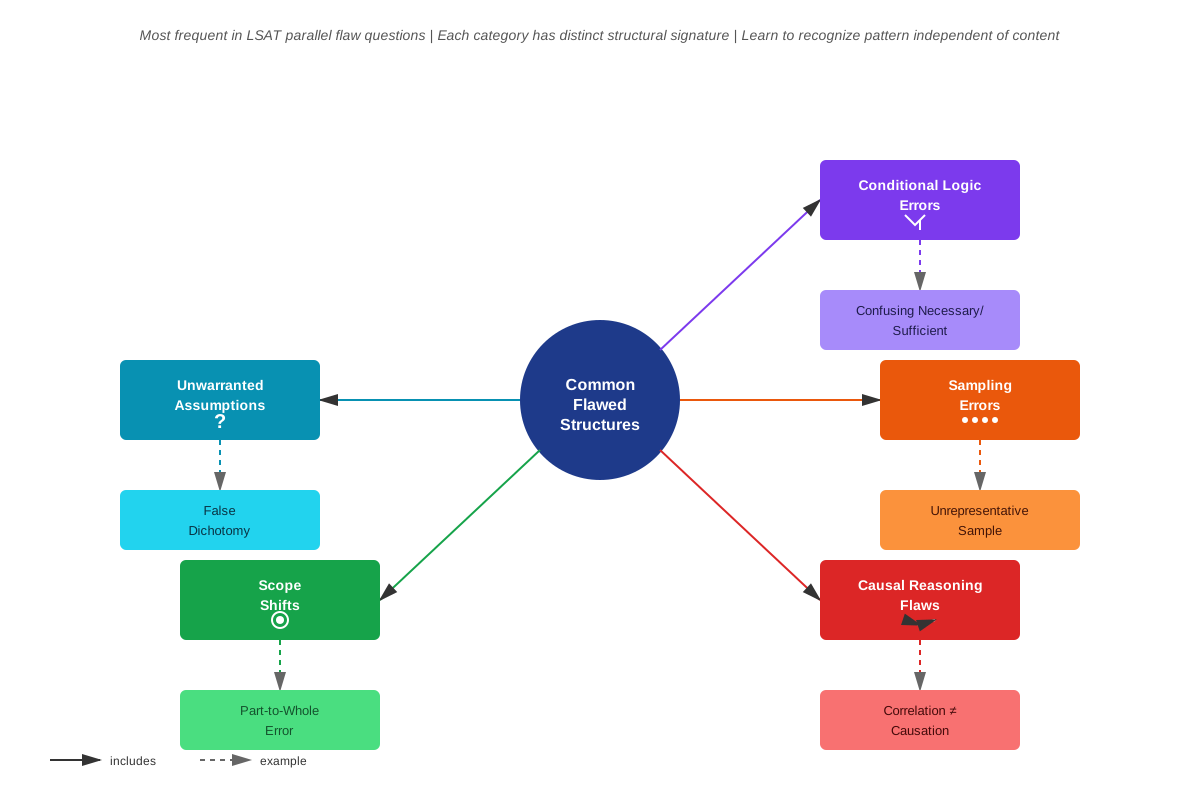
The core challenge in these questions lies in abstracting away from content and focusing purely on form. A logical reasoning pattern might appear convincing when discussing familiar topics, but when stripped down to its structural components, the same pattern reveals itself as either valid or flawed. For instance, an argument might confuse necessary and sufficient conditions, make an unwarranted assumption, or commit a sampling error—and the test-taker must identify another argument that commits the exact same structural error, regardless of subject matter.
This topic serves as a bridge between understanding individual argument flaws and applying that knowledge to complex matching tasks. Mastery of flawed versus valid structure enhances performance not only on explicit parallel reasoning questions but also on flaw identification questions, strengthen/weaken questions, and assumption questions. The ability to see through surface content to underlying logical architecture is perhaps the single most valuable skill for achieving a top LSAT score, as it enables rapid, accurate analysis across multiple question types.
Learning Objectives
- [ ] Identify how flawed versus valid structure appears in LSAT questions
- [ ] Explain the reasoning pattern behind flawed versus valid structure
- [ ] Apply flawed versus valid structure to solve LSAT-style problems accurately
- [ ] Distinguish between superficial content similarities and genuine structural parallels
- [ ] Categorize common flaw types and their corresponding valid reasoning patterns
- [ ] Evaluate answer choices by systematically mapping structural elements
- [ ] Construct abstract representations of arguments to facilitate pattern matching
Prerequisites
- Basic argument structure: Understanding premises, conclusions, and how they relate is essential because parallel reasoning requires mapping these components across different arguments
- Common logical fallacies: Familiarity with standard reasoning errors (ad hominem, false dichotomy, hasty generalization, etc.) provides the vocabulary for identifying flawed structures
- Conditional reasoning: Knowledge of if-then statements, necessary and sufficient conditions, and contrapositive forms is crucial since many parallel reasoning questions involve conditional logic
- Argument diagramming: The ability to visually represent argument flow helps in abstracting structure from content
Why This Topic Matters
In real-world contexts, the ability to recognize flawed versus valid reasoning structures protects against manipulation, enables critical evaluation of persuasive communications, and strengthens analytical decision-making. Legal professionals—the target audience for the LSAT—must constantly evaluate whether precedents genuinely parallel current cases or merely appear similar on the surface. This same skill applies to policy analysis, contract interpretation, and courtroom argumentation.
On the LSAT, parallel reasoning questions appear in both "parallel reasoning" and "parallel flaw" variants, collectively accounting for 2-4 questions per Logical Reasoning section. Given that most LSAT administrations include two Logical Reasoning sections, test-takers can expect 4-8 questions directly testing this skill. Additionally, the underlying competency—structural analysis—enhances performance on at least 50% of all other Logical Reasoning questions, making this a high-leverage topic for score improvement.
These questions typically appear in the following formats:
- "Which one of the following arguments is most similar in its reasoning to the argument above?"
- "The flawed pattern of reasoning in the argument above is most similar to that in which one of the following?"
- "Which one of the following exhibits a flawed pattern of reasoning most similar to that exhibited by the argument above?"
The difficulty level ranges from medium to challenging, with harder questions featuring subtle structural differences or complex nested reasoning. Time pressure makes these questions particularly challenging, as thorough structural analysis competes with the need to move efficiently through the section.
Core Concepts
Understanding Logical Structure
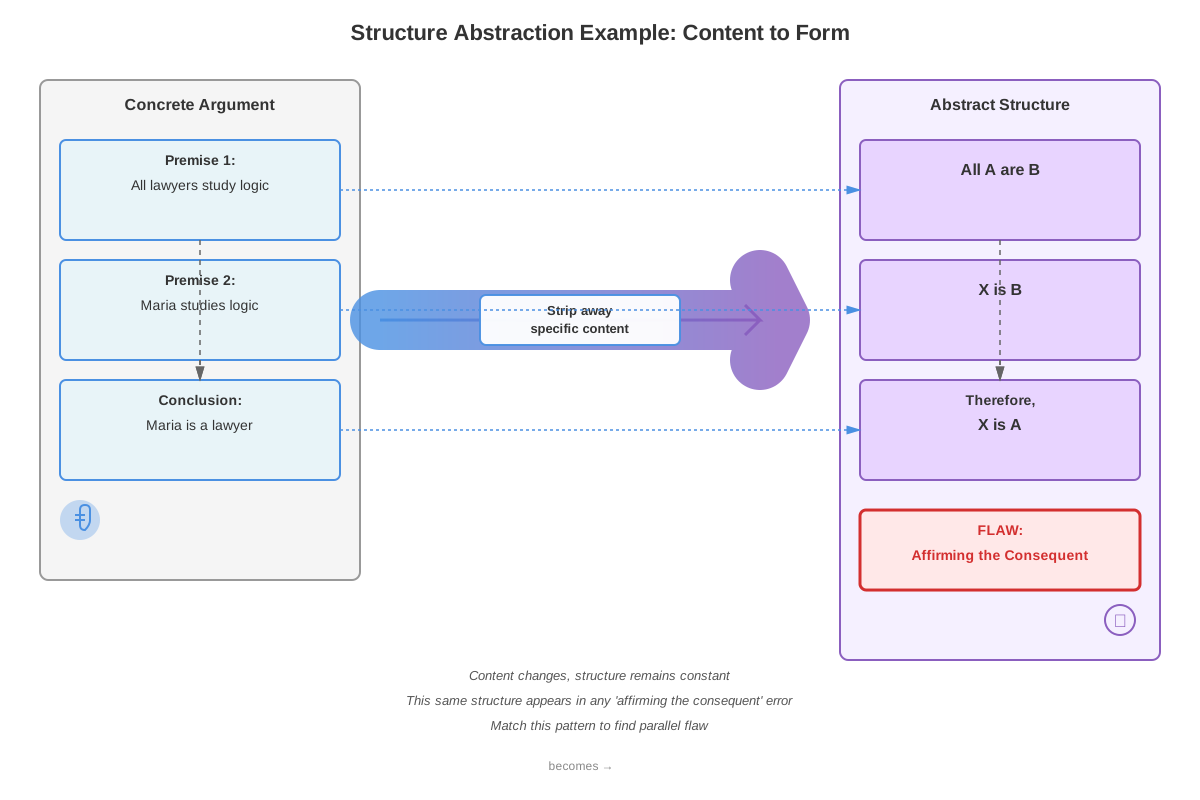
Logical structure refers to the formal relationship between premises and conclusions, independent of specific content. When analyzing structure, the focus shifts from what an argument says to how it reasons. Consider two arguments: "All dogs are mammals; Fido is a dog; therefore, Fido is a mammal" and "All roses are flowers; this plant is a rose; therefore, this plant is a flower." Despite different content, both share identical valid structure: categorical syllogism with universal premise, particular premise, and validly derived conclusion.
The key to structural analysis involves abstraction—replacing specific terms with variables or generic placeholders. The dog argument becomes: "All X are Y; Z is X; therefore, Z is Y." This abstraction reveals the underlying logical form and enables comparison with arguments about entirely different subjects.
Valid Reasoning Structures
Valid structures guarantee that if the premises are true, the conclusion must be true. Common valid patterns include:
Modus Ponens: If A, then B; A; therefore, B
Modus Tollens: If A, then B; not B; therefore, not A
Categorical Syllogism: All X are Y; Z is X; therefore, Z is Y
Disjunctive Syllogism: A or B; not A; therefore, B
Valid structures maintain logical necessity. The conclusion follows inevitably from the premises, regardless of whether the premises are actually true in reality. The LSAT tests whether test-takers can recognize when two arguments share this valid structure, even when discussing unrelated topics.
Flawed Reasoning Structures
Flawed structures contain reasoning errors that break the logical connection between premises and conclusion. The conclusion might still be true, but it doesn't follow necessarily from the premises. Understanding common flaw types is essential for parallel flaw questions:
| Flaw Type | Structure | Example |
|---|---|---|
| Affirming the Consequent | If A, then B; B; therefore, A | If it rains, the ground is wet; the ground is wet; therefore, it rained |
| Denying the Antecedent | If A, then B; not A; therefore, not B | If you study, you'll pass; you didn't study; therefore, you won't pass |
| Confusing Necessity and Sufficiency | Treats a necessary condition as sufficient or vice versa | Having a license is necessary to drive legally; I have a license; therefore, I can drive legally |
| Unrepresentative Sample | Generalizes from biased or insufficient sample | I surveyed three people at a gym; all exercise daily; therefore, most people exercise daily |
| False Dichotomy | Presents two options as exhaustive when others exist | Either we ban all cars or accept pollution; we can't ban all cars; therefore, we must accept pollution |
| Circular Reasoning | Conclusion restates premise without independent support | This law is just because it's the right thing to do, and we know it's right because it's just |
Structural Mapping Technique
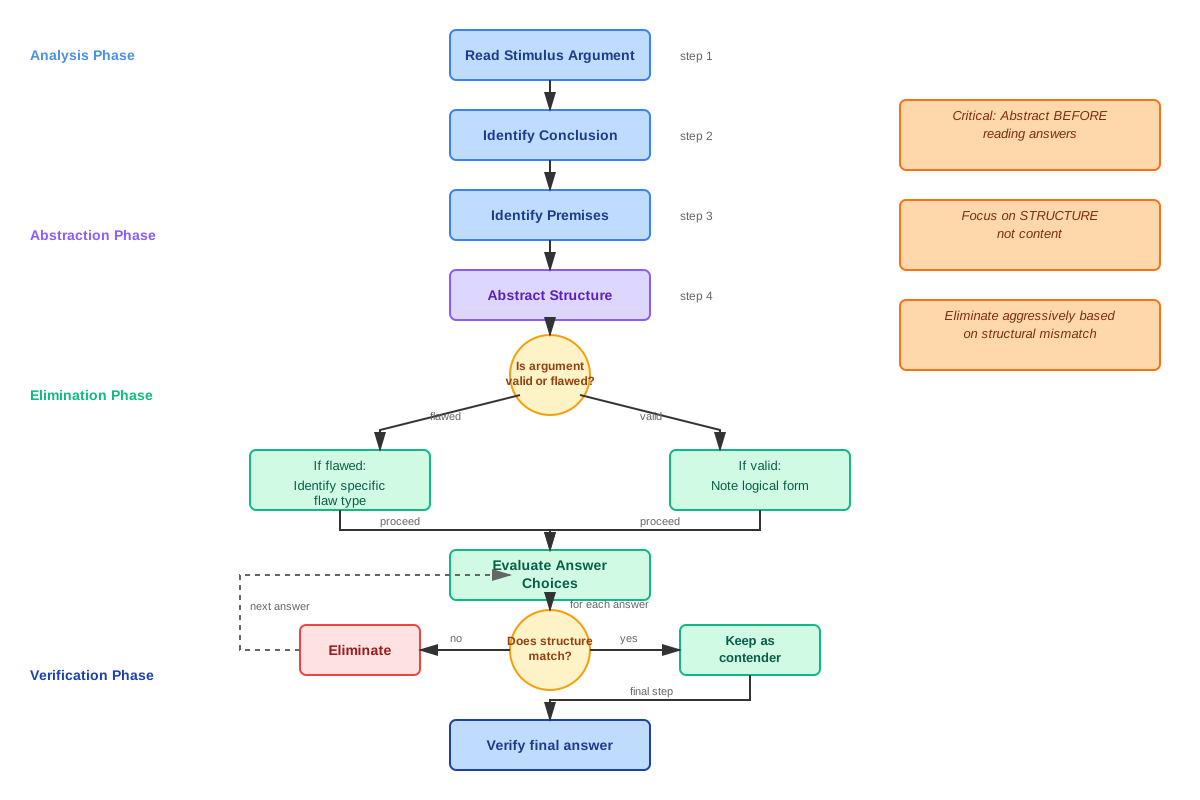
To match structures effectively, follow this systematic approach:
- Identify the conclusion in the stimulus argument
- Locate the premises supporting that conclusion
- Determine the logical relationship (valid or flawed, and if flawed, which type)
- Abstract the structure using generic terms or variables
- Apply the same abstraction process to each answer choice
- Match the structure that preserves all logical relationships
For example, if the stimulus argues: "Most successful entrepreneurs take risks; Maria takes risks; therefore, Maria is probably a successful entrepreneur," the structure is: "Most X are Y; Z is Y; therefore, Z is probably X." This commits the flaw of affirming the consequent in probabilistic form. The correct answer must have the same structure: concluding that something belongs to a category because it has a characteristic that most category members share.
Content Versus Structure Distinction
The LSAT deliberately creates content traps—answer choices that discuss similar topics but have different logical structures. A stimulus about business might have answer choices about business, but the correct answer might be about gardening. Conversely, an answer choice about the same topic as the stimulus might have entirely different structure.
Test-takers must train themselves to ignore content similarities and focus exclusively on structural parallels. This requires conscious effort, as the human brain naturally gravitates toward content connections. Successful test-takers develop the habit of immediately abstracting arguments into structural form before evaluating answer choices.
Degree and Strength Matching
Beyond basic structure, parallel reasoning questions require matching quantifiers and strength of conclusion. An argument concluding "definitely X" differs structurally from one concluding "probably X" or "might be X." Similarly, "all," "most," "some," and "none" create different logical relationships.
Consider: "All politicians make promises; John is a politician; therefore, John makes promises" versus "Most politicians make promises; John is a politician; therefore, John probably makes promises." The first is deductively valid; the second is inductively strong but not deductively valid. These represent different structures despite surface similarity.
Complex and Nested Structures
Advanced parallel reasoning questions feature nested reasoning—arguments within arguments, or multiple inferential steps. For example: "If A, then B; if B, then C; A; therefore, C" involves chaining conditional statements. The parallel must preserve not just the conditional structure but also the chaining pattern.
Some arguments contain subsidiary conclusions—intermediate conclusions that serve as premises for the main conclusion. Structural matching requires preserving these multi-layered relationships, not just the final inferential step.
Concept Relationships
The concepts within flawed versus valid structure form a hierarchical relationship. At the foundation lies logical structure itself—the abstract pattern of reasoning. This concept branches into two categories: valid structures (where conclusions follow necessarily) and flawed structures (where reasoning errors occur).
Understanding common flaw types depends on first grasping what makes a structure valid, as flaws represent specific deviations from valid patterns. For instance, understanding modus ponens (valid) enables recognition of affirming the consequent (flawed) as an invalid reversal of that pattern.
The structural mapping technique integrates all other concepts, applying them systematically to match arguments. This technique requires both abstraction skills (removing content to reveal structure) and degree matching (preserving quantifiers and conclusion strength). Finally, complex structures build upon simple structures, combining multiple valid or flawed patterns into nested arguments.
The relationship to prerequisite topics flows as follows: Basic argument structure → Logical structure → Valid/Flawed distinction → Structural mapping → Parallel reasoning mastery. Each level builds upon and requires the previous level.
Connections to related topics include: Flaw identification questions (which test recognition of flawed structures in isolation), strengthen/weaken questions (which often require understanding what would make a flawed structure valid), and assumption questions (which identify missing premises needed to make structures valid).
High-Yield Facts
⭐ Parallel reasoning questions require matching structure, not content—the correct answer may discuss entirely different subject matter from the stimulus
⭐ Valid structures guarantee that true premises produce true conclusions; flawed structures break this guarantee even if the conclusion happens to be true
⭐ Affirming the consequent (If A then B; B; therefore A) is one of the most frequently tested flawed structures on the LSAT
⭐ Quantifier matching is essential—"all," "most," "some," and "none" create different logical structures that must be preserved in parallel answers
⭐ Conclusion strength must match—"definitely," "probably," "possibly," and "might" represent different degrees of certainty that must parallel exactly
- Denying the antecedent (If A then B; not A; therefore not B) appears frequently in parallel flaw questions
- Confusing necessary and sufficient conditions creates a distinct flaw type that requires precise matching
- The correct answer in parallel reasoning questions preserves every structural element, including intermediate steps in multi-step arguments
- Content similarity between stimulus and answer choice often indicates a wrong answer designed to trap test-takers
- Abstract representation using variables (X, Y, Z) or generic terms (Category 1, Category 2) facilitates accurate structural comparison
Quick check — test yourself on Flawed versus valid structure so far.
Try Flashcards →Common Misconceptions
Misconception: If an answer choice discusses the same topic as the stimulus, it's more likely to be correct → Correction: The LSAT deliberately uses content similarity as a distractor. Correct answers match structure regardless of topic, and content similarity often signals a trap answer that has different structure but superficially related subject matter.
Misconception: Valid arguments must have true premises and true conclusions → Correction: Validity concerns only whether the conclusion follows logically from the premises, not whether premises or conclusions are actually true. An argument can be valid with false premises ("All birds are purple; penguins are birds; therefore, penguins are purple" is valid but unsound).
Misconception: Parallel flaw questions require finding any argument with a flaw → Correction: The flaw must be structurally identical, not just any reasoning error. An argument that commits a false dichotomy doesn't parallel an argument that commits a sampling error, even though both are flawed.
Misconception: Longer answer choices are more likely to match complex stimulus arguments → Correction: Length doesn't determine structural match. A concise answer choice might perfectly parallel a lengthy stimulus if the underlying structure is the same. Conversely, a long answer choice might add irrelevant details that don't affect structure.
Misconception: If the conclusion seems reasonable, the reasoning must be valid → Correction: Flawed reasoning can lead to true conclusions. The LSAT tests logical structure, not real-world truth. An argument might reach a correct conclusion through faulty reasoning, and recognizing this distinction is essential for parallel flaw questions.
Misconception: Parallel reasoning questions are primarily vocabulary tests → Correction: While understanding logical terminology helps, these questions fundamentally test the ability to abstract structure from content and recognize patterns. A test-taker with perfect vocabulary but poor structural analysis skills will struggle more than one with strong pattern recognition abilities.
Worked Examples
Example 1: Parallel Flaw Question
Stimulus: "Every time the company has launched a successful product, it invested heavily in marketing. The company is investing heavily in marketing for its new product. Therefore, the new product will be successful."
Analysis:
- Identify conclusion: "The new product will be successful"
- Identify premises: "Every successful product had heavy marketing investment" and "The new product has heavy marketing investment"
- Determine structure: This commits the flaw of affirming the consequent. The structure is: "If successful, then heavy marketing; heavy marketing; therefore, successful." This reverses the conditional relationship.
- Abstract structure: "If X, then Y; Y; therefore, X"
Answer Choice A: "Whenever it rains, the streets are wet. The streets are wet today. Therefore, it rained today."
- Structure: "If rain, then wet streets; wet streets; therefore, rain"
- This matches! Same flaw: affirming the consequent
Answer Choice B: "Most award-winning films have large budgets. This film has a large budget. Therefore, this film will probably win an award."
- Structure: "Most X are Y; Z is Y; therefore, Z is probably X"
- This is different—it's a probabilistic reversal with "most" rather than a conditional with "every/if"
Answer Choice C: "If a restaurant is popular, it serves good food. This restaurant serves good food. Therefore, it is popular."
- Structure: "If X, then Y; Y; therefore, X"
- This matches the structure! Both commit affirming the consequent with conditional reasoning.
Correct Answer: Both A and C match structurally. In an actual LSAT question, subtle differences would distinguish them, but both demonstrate the target flaw. The key learning point: focus on the conditional structure and the reversal pattern, not the content about products, rain, or restaurants.
Example 2: Parallel Valid Reasoning
Stimulus: "All members of the committee voted for the proposal. Chen is a member of the committee. Therefore, Chen voted for the proposal."
Analysis:
- Identify conclusion: "Chen voted for the proposal"
- Identify premises: "All committee members voted for the proposal" and "Chen is a committee member"
- Determine structure: This is valid categorical syllogism: "All X are Y; Z is X; therefore, Z is Y"
- Abstract structure: Universal premise about category membership leading to particular conclusion
Answer Choice A: "Most students who study regularly pass the exam. Sarah studies regularly. Therefore, Sarah will probably pass the exam."
- Structure: "Most X are Y; Z is X; therefore, Z is probably Y"
- This is inductively strong but not the same structure—uses "most" instead of "all" and "probably" instead of definite conclusion
Answer Choice B: "Every employee who works overtime receives a bonus. Martinez works overtime. Therefore, Martinez receives a bonus."
- Structure: "All X are Y; Z is X; therefore, Z is Y"
- Perfect match! Valid categorical syllogism with universal premise and definite conclusion
Answer Choice C: "If someone exercises daily, they improve their health. Kim exercises daily. Therefore, Kim improves her health."
- Structure: "If X, then Y; X; therefore, Y"
- This is valid (modus ponens) but structurally different—conditional rather than categorical
Correct Answer: B matches the structure exactly. Both use universal quantification ("all"/"every"), establish category membership, and draw a definite conclusion. Answer C, while valid, uses conditional rather than categorical structure, making it structurally distinct despite both being valid arguments.
Exam Strategy
When approaching parallel reasoning questions, implement this systematic process:
Step 1: Identify the question type by reading the question stem first. Look for phrases like "most similar in reasoning," "parallel flaw," or "exhibits the same pattern." This determines whether you're matching valid or flawed structure.
Step 2: Analyze the stimulus argument by breaking it into components:
- Circle or mentally note the conclusion
- Underline or identify each premise
- Determine if the reasoning is valid or flawed
- If flawed, identify the specific flaw type
Step 3: Abstract the structure before looking at answer choices. Create a mental or written template using variables or generic terms. This prevents content-based distraction.
Step 4: Predict structural features the correct answer must have:
- Same quantifiers (all, most, some, none)
- Same conclusion strength (definite, probable, possible)
- Same number of premises
- Same type of reasoning (conditional, categorical, causal, etc.)
Step 5: Eliminate answer choices systematically:
- First pass: eliminate choices with wrong quantifiers or conclusion strength
- Second pass: eliminate choices with different numbers of premises or reasoning types
- Third pass: carefully compare remaining choices to your abstracted structure
Exam Tip: Trigger words that signal structure include "all," "most," "some," "if," "only if," "unless," "every," "never," "always," "probably," "definitely," "might," and "could." Pay special attention to these when abstracting structure.
Time allocation: Parallel reasoning questions typically require 90-120 seconds. If you're spending more than two minutes, you're likely getting caught in content rather than focusing on structure. Practice abstracting quickly to build speed.
Process of elimination specific to this topic:
- Eliminate answer choices discussing the same topic as the stimulus—these are usually traps
- Eliminate choices with different quantifiers immediately
- Eliminate choices with different conclusion certainty levels
- If two choices seem structurally similar, map them element-by-element against the stimulus
Common trap patterns:
- Answer choices that reach the same conclusion as the stimulus but through different reasoning
- Answer choices that use similar vocabulary but different logical structure
- Answer choices that are valid when the stimulus is flawed (or vice versa)
- Answer choices that commit a different flaw than the stimulus in parallel flaw questions
Memory Techniques
Mnemonic for common valid structures - "MMCD":
- Modus Ponens (If A then B; A; therefore B)
- Modus Tollens (If A then B; not B; therefore not A)
- Categorical Syllogism (All X are Y; Z is X; therefore Z is Y)
- Disjunctive Syllogism (A or B; not A; therefore B)
Mnemonic for common flaws - "ADUCFS":
- Affirming the Consequent
- Denying the Antecedent
- Unrepresentative Sample
- Confusing Necessity/Sufficiency
- False Dichotomy
- Source Confusion (ad hominem, appeal to authority)
Visualization strategy: Picture arguments as flowcharts with boxes (premises) and arrows (logical connections) leading to a conclusion box. Valid structures have solid arrows; flawed structures have broken or misdirected arrows. When comparing arguments, visualize whether the arrow patterns match.
The "Content Blindfold" technique: When reading answer choices, mentally replace all specific nouns with generic placeholders (Thing 1, Thing 2, Category A, Category B). This forces focus on structure rather than content.
The "Quantifier Checklist": Before selecting an answer, verify:
- Quantifiers match (all/most/some)
- Universal or particular scope matches
- Absolute or qualified conclusion matches
- Logical connectors match (if/then, and/or)
Summary
Flawed versus valid structure represents a fundamental LSAT skill that requires distinguishing between arguments based on their logical form rather than content. Valid structures guarantee that true premises produce true conclusions through patterns like modus ponens, modus tollens, and categorical syllogism. Flawed structures break this logical necessity through errors such as affirming the consequent, denying the antecedent, or confusing necessary and sufficient conditions. Success on parallel reasoning questions demands systematic abstraction—replacing specific content with variables to reveal underlying structure—followed by precise matching of quantifiers, conclusion strength, and logical relationships. The LSAT deliberately uses content similarity as a distractor, making the ability to see through surface features to structural patterns essential. Test-takers must train themselves to ignore what arguments discuss and focus exclusively on how they reason, matching every structural element from premises through intermediate steps to final conclusions. This skill enhances performance across multiple question types and represents high-leverage preparation for achieving top LSAT scores.
Key Takeaways
- Parallel reasoning questions test structural matching, not content similarity—correct answers may discuss entirely different topics from the stimulus
- Valid structures guarantee logical necessity; flawed structures contain reasoning errors that break the premise-conclusion connection
- Systematic abstraction using variables or generic terms is essential for accurate structural comparison
- Quantifiers (all/most/some) and conclusion strength (definite/probable/possible) must match exactly in parallel answers
- Common flawed structures include affirming the consequent, denying the antecedent, and confusing necessary and sufficient conditions
- Content similarity between stimulus and answer choice often signals a trap designed to distract from structural differences
- Mastering structural analysis enhances performance on flaw, assumption, strengthen, and weaken questions beyond just parallel reasoning
Related Topics
Formal Logic and Conditional Reasoning: Deepens understanding of if-then structures, contrapositives, and necessary/sufficient conditions that frequently appear in parallel reasoning questions. Mastering flawed versus valid structure provides the foundation for advanced conditional logic manipulation.
Argument Flaw Identification: Focuses on recognizing specific reasoning errors in isolation. The structural analysis skills developed through parallel reasoning directly transfer to quickly identifying and categorizing flaws in standard flaw questions.
Sufficient Assumption Questions: Requires identifying what premise would make an argument valid. Understanding valid structures enables test-takers to recognize what's missing from flawed arguments and predict correct sufficient assumptions.
Method of Reasoning Questions: Tests the ability to describe how an argument proceeds. The abstraction skills developed for parallel reasoning translate directly to accurately characterizing argumentative techniques and strategies.
Strengthen and Weaken Questions: Often involve understanding what would fix a flawed structure (strengthen) or exploit a structural weakness (weaken). Recognizing argument structure enables more precise prediction and evaluation of answer choices.
Practice CTA
Now that you've mastered the core concepts of flawed versus valid structure, it's time to apply this knowledge to actual LSAT questions. The practice questions and flashcards will reinforce your ability to abstract arguments, recognize patterns, and match structures accurately. Remember: every parallel reasoning question you practice strengthens your structural analysis skills across all Logical Reasoning question types. Consistent practice with immediate feedback is the key to transforming theoretical understanding into test-day performance. Challenge yourself to abstract each argument before looking at answer choices, and track which flaw types you recognize most quickly. Your investment in mastering this high-yield topic will pay dividends throughout the Logical Reasoning section!
Sign up free to keep reading
Create a free AnvayaPrep account to finish this LSAT guide on Flawed versus valid structure — plus flashcards and practice questions.