Overview
Matching analogy structure is a critical skill within the LSAT's Logical Reasoning section, specifically appearing in questions that test parallel reasoning. These questions require test-takers to identify arguments that share the same logical structure as a given stimulus, even when the content differs entirely. Rather than evaluating whether an argument is valid or sound, matching analogy structure questions assess the ability to recognize abstract patterns of reasoning—a fundamental skill that distinguishes high-scoring candidates from average performers.
On the LSAT, lsat matching analogy structure questions typically present an argument in the stimulus and ask which answer choice employs the same method of reasoning or exhibits the most similar logical pattern. These questions demand that students look beyond surface-level content about specific topics (politics, science, business) and instead focus on the underlying architecture of the argument: how premises relate to conclusions, what logical moves the argument makes, and what structural features define its reasoning. This abstraction skill is essential because the LSAT tests analytical thinking rather than subject-matter expertise.
Within the broader landscape of logical reasoning, matching analogy structure connects to numerous other question types and skills. It reinforces understanding of argument structure (premise-conclusion relationships), strengthens recognition of common reasoning patterns (conditional logic, causal reasoning, analogical reasoning), and develops the mental flexibility needed for assumption, strengthen/weaken, and flaw questions. Mastering this topic builds a foundation for recognizing how arguments work at their most fundamental level, making it one of the highest-yield areas of study for comprehensive LSAT preparation.
Learning Objectives
- [ ] Identify how Matching analogy structure appears in LSAT questions
- [ ] Explain the reasoning pattern behind Matching analogy structure
- [ ] Apply Matching analogy structure to solve LSAT-style problems accurately
- [ ] Distinguish between structural similarity and content similarity in arguments
- [ ] Systematically abstract arguments into their logical components
- [ ] Recognize common structural patterns that frequently appear in parallel reasoning questions
- [ ] Eliminate answer choices efficiently by identifying structural mismatches
Prerequisites
- Basic argument structure: Understanding premises, conclusions, and how to identify them is essential because matching analogy structure requires recognizing these components in both the stimulus and answer choices.
- Conditional logic fundamentals: Familiarity with "if-then" statements and their contrapositives helps identify structural patterns involving necessary and sufficient conditions.
- Common reasoning patterns: Knowledge of causal reasoning, analogical reasoning, and categorical statements provides the vocabulary for describing structural similarities.
- Logical indicators: Recognition of conclusion indicators (therefore, thus, so) and premise indicators (because, since, given that) enables quick identification of argument components.
Why This Topic Matters
Matching analogy structure questions appear consistently on every LSAT administration, typically comprising 2-4 questions per test across both Logical Reasoning sections. While this represents approximately 8-15% of Logical Reasoning questions, their importance extends beyond raw frequency. These questions serve as a diagnostic tool for overall logical reasoning ability—students who excel at parallel reasoning typically perform well across all question types because they've developed the fundamental skill of seeing arguments structurally rather than merely reading them for content.
In real-world applications, the ability to recognize parallel reasoning structures is invaluable for legal practice. Attorneys constantly apply precedent by identifying cases with analogous structures, even when factual details differ. A contract dispute about software licensing may share the same legal structure as a century-old case about horse trading. Law schools and the legal profession value this pattern-recognition ability because it underlies case analysis, statutory interpretation, and persuasive argumentation.
On the LSAT, matching analogy structure appears in several question formats. The most common stem asks: "Which one of the following arguments is most similar in its reasoning to the argument above?" Variations include "The pattern of reasoning in which one of the following is most similar to that in the argument above?" or "Which one of the following employs a method of reasoning most similar to that employed in the argument above?" These questions consistently appear in medium-to-difficult positions within Logical Reasoning sections, making them crucial for achieving competitive scores.
Core Concepts
Understanding Structural vs. Content Similarity
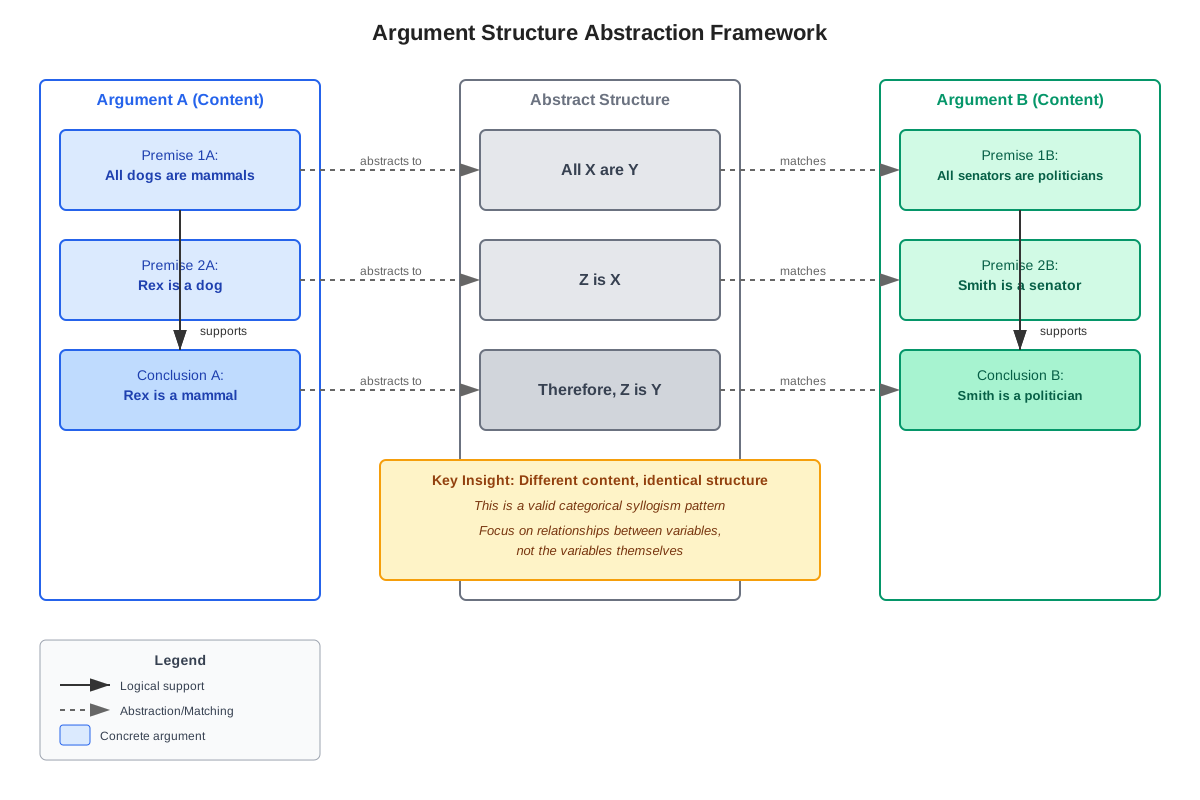
The foundational distinction in parallel reasoning is between an argument's structure and its content. Content refers to the specific subject matter—whether an argument discusses economics, biology, or sports. Structure refers to the logical relationships between components—how premises support a conclusion, what logical moves the argument makes, and what form the reasoning takes.
Consider two arguments:
- "All dogs are mammals. Rover is a dog. Therefore, Rover is a mammal."
- "All senators are politicians. Smith is a senator. Therefore, Smith is a politician."
These arguments have identical structures (categorical syllogism with universal premise, particular premise, and particular conclusion) despite completely different content. Matching analogy structure questions exploit this distinction by presenting answer choices with similar content but different structures, or different content but similar structures. The correct answer always matches structure, not content.
Components of Argument Structure
To match structures effectively, students must identify and abstract several key components:
Premise types: Are the premises universal statements ("all X are Y"), particular statements ("some X are Y"), conditional statements ("if X, then Y"), or causal claims ("X causes Y")? The correct answer must match these premise types.
Conclusion type: Is the conclusion definitive ("X is definitely true"), probable ("X is likely true"), prescriptive ("X should be done"), or predictive ("X will happen")? The strength and nature of the conclusion must align.
Logical moves: What reasoning technique does the argument employ? Common moves include:
- Applying a general principle to a specific case
- Drawing an analogy between two situations
- Identifying a causal relationship
- Eliminating alternatives
- Reasoning from absence of evidence
- Using conditional logic (modus ponens, modus tollens)
Quantifiers and scope: Does the argument use "all," "some," "most," "none," or "many"? These quantifiers define the scope of claims and must match between stimulus and answer.
Common Structural Patterns
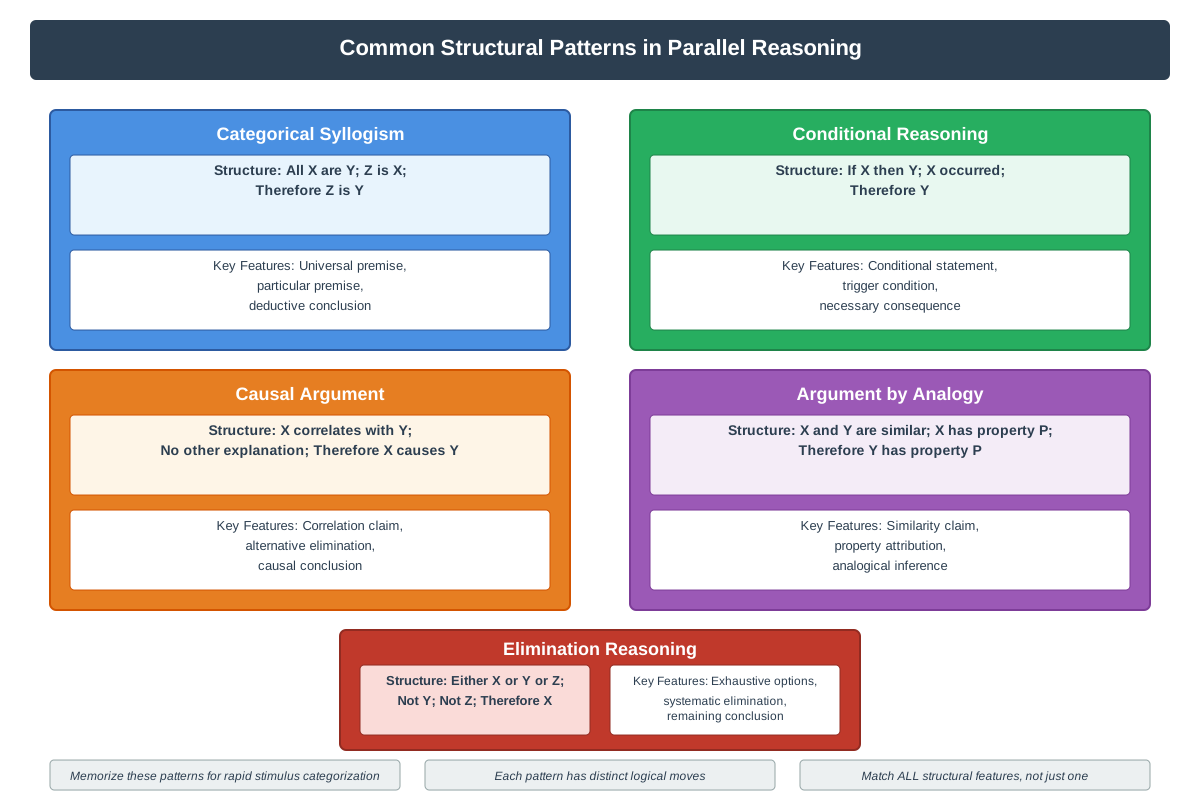
Certain argument structures appear repeatedly on the LSAT. Recognizing these patterns accelerates the matching process:
| Pattern Type | Structure | Example |
|---|---|---|
| Categorical Syllogism | All A are B; X is A; therefore X is B | All lawyers study logic; Maria is a lawyer; therefore Maria studies logic |
| Conditional Application | If A then B; A; therefore B | If it rains, the game is cancelled; it's raining; therefore the game is cancelled |
| Conditional Contrapositive | If A then B; not B; therefore not A | If qualified, then hired; not hired; therefore not qualified |
| Causal Reasoning | A correlates with B; no other explanation; therefore A causes B | Sales increased after the ad campaign; no other changes occurred; therefore the campaign caused increased sales |
| Argument by Analogy | X and Y are similar in respects 1, 2, 3; X has property Z; therefore Y has property Z | Dolphins and humans both have complex brains and social structures; humans use language; therefore dolphins likely use language |
| Elimination | Either A or B; not A; therefore B | The problem is hardware or software; it's not hardware; therefore it's software |
The Abstraction Process
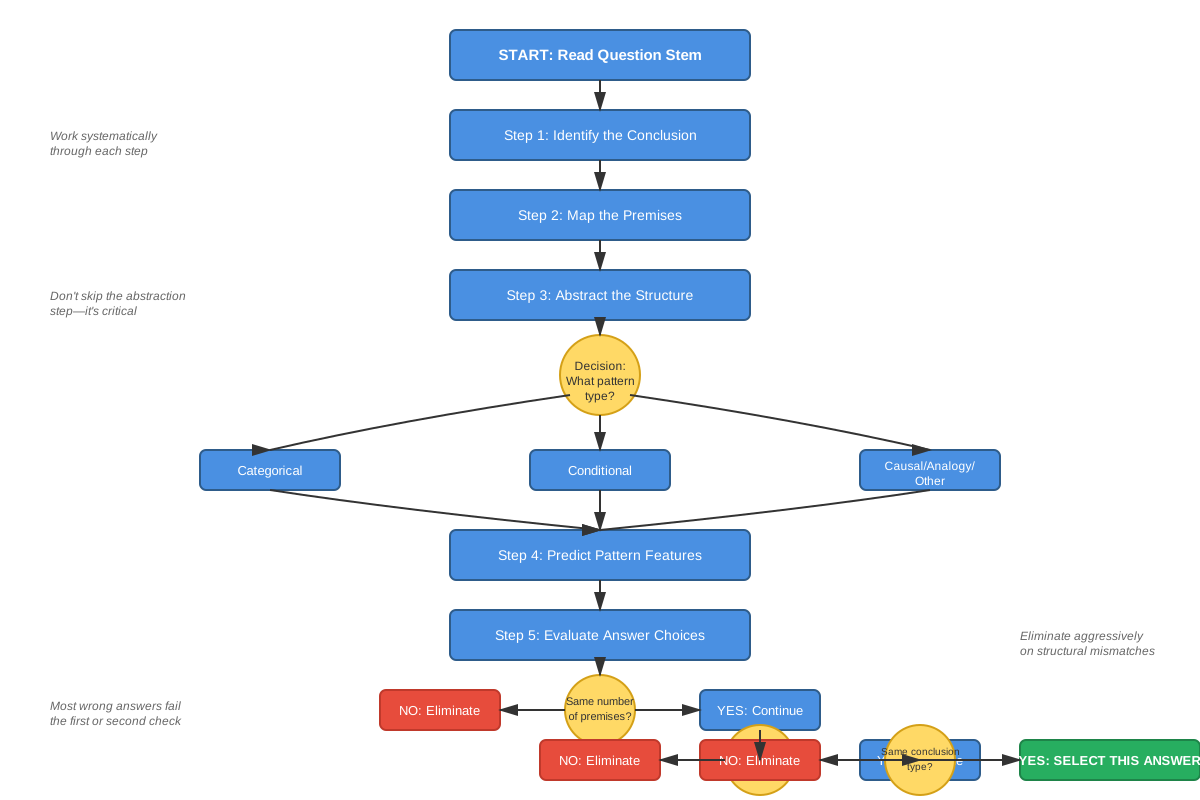
Successful matching requires systematic abstraction—translating specific content into general logical form. This process involves four steps:
- Identify the conclusion: Locate what the argument is trying to prove. Mark it clearly.
- Map the premises: Identify each piece of evidence or reasoning that supports the conclusion. Number them if helpful.
- Determine the logical relationship: How do the premises connect to the conclusion? What reasoning technique bridges them?
- Create a structural template: Express the argument in abstract terms using variables (A, B, C) or generic placeholders (Group 1, Group 2, Property X).
For example, given: "Most successful entrepreneurs take calculated risks. Chen is a successful entrepreneur. Therefore, Chen probably takes calculated risks."
Abstract to: "Most members of Group X have Property Y. Individual Z is a member of Group X. Therefore, Individual Z probably has Property Y."
This template can then be matched against answer choices, regardless of their specific content.
Structural Flaws and Their Parallels
Some parallel reasoning questions involve flawed arguments, requiring identification of an answer choice with the same flaw. Common flawed structures include:
Affirming the consequent: If A then B; B; therefore A (invalid)
Denying the antecedent: If A then B; not A; therefore not B (invalid)
Improper generalization: X is true in one case; therefore X is true in all cases
False dichotomy: Either A or B (when other options exist); not A; therefore B
Confusing correlation with causation: A and B occur together; therefore A causes B
When matching flawed reasoning, the correct answer must contain the same logical error, not merely any flaw.
Degree and Strength Matching
Arguments vary in the strength of their claims and the degree of certainty they express. These elements are structural features that must match:
Certainty levels: "definitely," "certainly," "must be" vs. "probably," "likely," "suggests"
Scope modifiers: "all," "every," "always" vs. "most," "many," "usually" vs. "some," "a few," "sometimes"
Temporal elements: "will always," "has never," "sometimes occurs"
An argument concluding "X is definitely true" cannot parallel an argument concluding "X is probably true," even if other structural elements align.
Concept Relationships
The concepts within matching analogy structure form an interconnected system. Structural vs. content similarity serves as the foundational principle that enables all other concepts. This distinction leads directly to the abstraction process, which provides the methodology for converting specific arguments into general templates. The abstraction process requires identifying components of argument structure (premise types, conclusion types, logical moves), which in turn draws upon knowledge of common structural patterns. These patterns include both valid reasoning forms and structural flaws, both of which may need to be matched depending on the question.
Degree and strength matching operates as a refinement layer applied after basic structural matching, ensuring that quantifiers and certainty levels align between stimulus and answer choice. All these concepts work together in a hierarchical relationship: recognize the structure/content distinction → abstract the argument → identify its pattern → check for degree/strength alignment → select the matching answer.
This topic connects to prerequisite knowledge of basic argument structure by building upon premise-conclusion identification and extending it to pattern recognition. It relates to conditional logic by incorporating "if-then" structures as one type of pattern to match. Looking forward, mastery of matching analogy structure enhances performance on assumption questions (by clarifying what logical moves arguments make), flaw questions (by recognizing structural errors), and strengthen/weaken questions (by understanding how arguments are constructed).
The relationship map: Argument Structure Basics → Abstraction Skills → Pattern Recognition → Parallel Reasoning Mastery → Enhanced Performance Across All LR Question Types
High-Yield Facts
⭐ Matching analogy structure questions require matching logical structure, never content similarity—arguments about completely different topics can have identical structures.
⭐ The correct answer must match the conclusion type (definitive vs. probable, prescriptive vs. descriptive) and strength (certain vs. likely).
⭐ Quantifiers must align precisely—"all" in the stimulus requires "all" in the answer, not "most" or "some."
⭐ The number of premises should generally match between stimulus and correct answer, though occasionally an answer may combine premises.
⭐ Conditional logic structures must match exactly—modus ponens (if A then B; A; therefore B) cannot parallel modus tollens (if A then B; not B; therefore not A).
- Parallel reasoning questions typically appear 2-4 times per LSAT, making them high-yield for score improvement.
- Arguments with flaws require answer choices with the same flaw, not just any flawed reasoning.
- The abstraction process should be performed on the stimulus before reading answer choices to avoid content bias.
- Causal arguments must match in their causal direction—"A causes B" differs structurally from "B causes A."
- Analogical reasoning structures require matching the number of similarities cited and the property being inferred.
- Elimination reasoning (either/or structures) must match in the number of alternatives presented and eliminated.
- Temporal elements (past, present, future; always, sometimes, never) are structural features that must align.
- Arguments applying general principles to specific cases must match in the direction of reasoning (general to specific).
- The presence or absence of counterexamples or exceptions is a structural feature that must match.
- Process of elimination is particularly effective on parallel reasoning questions because structural mismatches are often obvious.
Quick check — test yourself on Matching analogy structure so far.
Try Flashcards →Common Misconceptions
Misconception: If two arguments discuss similar topics, they likely have similar structures.
Correction: Content similarity is irrelevant and often deliberately misleading. Two arguments about economics can have completely different structures, while arguments about economics and biology can share identical structures. Always focus on logical relationships, not subject matter.
Misconception: The correct answer will use similar vocabulary or phrasing to the stimulus.
Correction: The LSAT deliberately uses different vocabulary in correct answers to test true structural understanding. Words like "all," "some," and "most" matter because they're quantifiers, but topical vocabulary is irrelevant.
Misconception: If an answer choice reaches the same conclusion as the stimulus, it's probably correct.
Correction: Parallel reasoning matches the path of reasoning, not the destination. An argument concluding "X is good" can parallel an argument concluding "Y is bad" if they use the same logical structure to reach their respective conclusions.
Misconception: Longer answer choices are more likely to match complex stimulus arguments.
Correction: Length doesn't indicate structural similarity. A concise answer choice can perfectly match a lengthy stimulus if the logical structure aligns. Conversely, verbose answer choices often add irrelevant details that don't affect structure.
Misconception: If the stimulus contains a flaw, any answer choice with a flaw will work.
Correction: Flawed parallel reasoning questions require the same specific flaw. An argument that affirms the consequent must be matched with another argument that affirms the consequent, not one that commits a different error like false dichotomy.
Misconception: Matching analogy structure questions are primarily about reading comprehension.
Correction: These questions test logical analysis and pattern recognition, not reading comprehension. Students with excellent reading skills but weak logical abstraction abilities often struggle with parallel reasoning questions.
Misconception: The correct answer must use the same type of examples (people, objects, events) as the stimulus.
Correction: The type of entity discussed is content, not structure. An argument about people can perfectly parallel an argument about objects, companies, or abstract concepts if the logical relationships match.
Worked Examples
Example 1: Valid Categorical Reasoning
Stimulus: "All members of the city council voted for the budget proposal. Rodriguez is a member of the city council. Therefore, Rodriguez voted for the budget proposal."
Analysis Process:
Step 1 - Identify the conclusion: "Rodriguez voted for the budget proposal"
Step 2 - Map the premises:
- Premise 1: All members of the city council voted for the budget proposal (universal statement about a group)
- Premise 2: Rodriguez is a member of the city council (particular statement placing an individual in that group)
Step 3 - Determine logical relationship: This is a categorical syllogism applying a universal statement to a particular case. The structure is: All X are Y; Z is X; therefore Z is Y.
Step 4 - Create abstract template: All members of Group A have Property B; Individual C is a member of Group A; therefore Individual C has Property B.
Evaluating Answer Choices:
(A) "Most students in the class passed the exam. Jennifer is a student in the class. Therefore, Jennifer probably passed the exam."
- Structure: Most X are Y; Z is X; therefore Z is probably Y
- Mismatch: Uses "most" instead of "all," and conclusion is probable rather than definitive
- Eliminate
(B) "All employees received a bonus. The company had a profitable year. Therefore, the company rewarded its employees."
- Structure: Statement about employees; statement about company; conclusion about company's action
- Mismatch: Doesn't follow the pattern of applying a group characteristic to an individual member
- Eliminate
(C) "All participants in the study were given the medication. Thompson was a participant in the study. Therefore, Thompson was given the medication."
- Structure: All X are Y; Z is X; therefore Z is Y
- Match: Universal statement about group, particular statement about individual, definitive conclusion applying group characteristic to individual
- Correct answer
(D) "Every building on the street was inspected. This building is on the street. Therefore, this building probably was inspected."
- Structure: All X are Y; Z is X; therefore Z is probably Y
- Mismatch: Conclusion is probable rather than definitive
- Eliminate
Key Takeaway: The correct answer (C) matches all structural elements: universal quantifier ("all"), categorical membership, and definitive conclusion. Content about medication and studies is completely different from city council and voting, but the logical structure is identical.
Example 2: Flawed Conditional Reasoning
Stimulus: "If the company implements the new policy, employee satisfaction will increase. Employee satisfaction has increased. Therefore, the company must have implemented the new policy."
Analysis Process:
Step 1 - Identify the conclusion: "The company must have implemented the new policy"
Step 2 - Map the premises:
- Premise 1: If new policy → increased satisfaction (conditional statement)
- Premise 2: Increased satisfaction (affirming the consequent)
Step 3 - Determine logical relationship: This commits the fallacy of affirming the consequent. The structure is: If A then B; B; therefore A (invalid reasoning).
Step 4 - Create abstract template: If Action X occurs, then Result Y occurs; Result Y has occurred; therefore Action X must have occurred. This is flawed because other factors could cause Result Y.
Evaluating Answer Choices:
(A) "If it rains, the ground will be wet. The ground is wet. Therefore, it must have rained."
- Structure: If A then B; B; therefore A
- Match: This commits the same fallacy—affirming the consequent. The ground could be wet for other reasons (sprinklers, flooding, etc.)
- Correct answer
(B) "If the alarm sounds, there is a fire. The alarm sounded. Therefore, there is a fire."
- Structure: If A then B; A; therefore B
- Mismatch: This is valid reasoning (modus ponens), not the flawed pattern in the stimulus
- Eliminate
(C) "If the store is closed, the lights are off. The lights are off. Therefore, the store might be closed."
- Structure: If A then B; B; therefore A is possible
- Mismatch: The conclusion is tentative ("might be") rather than definitive ("must have"), changing the structural flaw
- Eliminate
(D) "If the medication works, symptoms will decrease. Symptoms have not decreased. Therefore, the medication did not work."
- Structure: If A then B; not B; therefore not A
- Mismatch: This is valid reasoning (modus tollens/contrapositive), not the flawed pattern
- Eliminate
Key Takeaway: When matching flawed reasoning, the correct answer must contain the same logical error. Answer (A) commits affirming the consequent just like the stimulus, even though the content (rain/wet ground vs. policy/satisfaction) differs completely.
Exam Strategy
Pre-Reading Strategy: Before reading answer choices, invest 30-45 seconds abstracting the stimulus argument. Write down a brief structural template using variables or generic terms. This prevents content bias and makes structural mismatches immediately obvious when evaluating answers.
Trigger Words to Watch For: Question stems containing "similar in its reasoning," "employs a method of reasoning most similar," "pattern of reasoning," or "most closely parallels" indicate matching analogy structure questions. These phrases signal that structure, not content or conclusion, is being tested.
Systematic Elimination Approach:
- Check quantifiers first: Eliminate any answer choice that uses different quantifiers (all vs. most vs. some) than the stimulus. This often eliminates 2-3 answers immediately.
- Verify conclusion strength: Eliminate answers with definitive conclusions when the stimulus is probable, or vice versa.
- Count logical moves: If the stimulus makes two distinct logical moves (e.g., establishes a correlation, then infers causation), eliminate answers that make only one move or three moves.
- Match conditional structures exactly: If the stimulus uses modus ponens, eliminate answers using modus tollens or other conditional patterns.
- Check for flaw matching: If the stimulus is flawed, eliminate any valid reasoning patterns and any answers with different flaws.
Time Allocation: Parallel reasoning questions typically require 90-120 seconds—slightly more than average Logical Reasoning questions. The additional time spent abstracting the stimulus pays dividends in faster, more accurate answer choice evaluation. Don't rush the abstraction phase.
Content Trap Avoidance: The LSAT deliberately includes wrong answers with similar content to the stimulus. Train yourself to feel suspicious when an answer choice discusses the same topic or uses similar examples. Content similarity often signals a trap answer.
Process of Elimination Power: Parallel reasoning questions are particularly amenable to POE because structural mismatches are often definitive. Unlike assumption or strengthen questions where answers may seem partially correct, structural mismatches are binary—the structure either matches or it doesn't.
Exam Tip: If stuck between two answers, re-abstract both the stimulus and the remaining answer choices using identical variable names (A, B, C). Write them side-by-side. Structural differences become visually obvious when expressed in the same notation.
Memory Techniques
MATCH Acronym for systematic evaluation:
- Move count: Same number of logical steps
- Abstract first: Convert to variables before reading answers
- Type alignment: Premises and conclusion types must match
- Certainty level: Definitive vs. probable must align
- How it reasons: Same logical technique (analogy, causation, etc.)
The Variable Visualization: When reading the stimulus, mentally replace specific content with colored shapes. "All dogs are mammals" becomes "All blue circles are red squares." This forces structural thinking and prevents content fixation. Practice this visualization until it becomes automatic.
Quantifier Hierarchy Mnemonic: Remember "All > Most > Some > None" as a spectrum. Arguments using different points on this spectrum have different structures. Visualize this as a number line to quickly spot quantifier mismatches.
Flaw Family Grouping: Memorize flawed conditional reasoning as a family:
- Affirming the Consequent: "If A→B; B; ∴A" (the "backward error")
- Denying the Antecedent: "If A→B; ¬A; ∴¬B" (the "forward error")
Group these together mentally so when you spot one, you're primed to distinguish it from the other.
The Content Blindfold Technique: Practice reading arguments while mentally "blurring" the specific nouns and focusing only on logical connectors (all, some, if, then, therefore, because). This trains the brain to prioritize structure over content.
Summary
Matching analogy structure is a high-yield LSAT skill that tests the ability to recognize identical logical patterns across arguments with different content. Success requires distinguishing structure from content, systematically abstracting arguments into logical templates, and matching components precisely: premise types, conclusion types, quantifiers, logical moves, and certainty levels must all align. Common structural patterns include categorical syllogisms, conditional reasoning (both valid and flawed), causal arguments, analogical reasoning, and elimination structures. The key to mastery is developing a systematic abstraction process—converting specific arguments into general forms before evaluating answer choices—which prevents content bias and makes structural mismatches obvious. These questions appear 2-4 times per LSAT and serve as a diagnostic for overall logical reasoning ability, making them essential for competitive scores.
Key Takeaways
- Structure, never content, determines correct answers—arguments about completely different topics can have identical logical structures
- Systematic abstraction before reading answers prevents content bias and accelerates accurate answer selection
- All structural elements must match: quantifiers (all/most/some), conclusion strength (definite/probable), logical moves, and premise types
- Flawed parallel reasoning requires matching the specific flaw, not just any flawed reasoning pattern
- Quantifier mismatches and conclusion strength mismatches are the fastest elimination criteria, often removing 60-80% of wrong answers immediately
- Process of elimination is particularly powerful for parallel reasoning because structural mismatches are definitive, not matters of degree
- Practice translating arguments into abstract templates using variables (A, B, C) or generic placeholders to build structural recognition skills
Related Topics
Formal Logic and Conditional Reasoning: Mastering matching analogy structure provides a foundation for advanced conditional logic, including complex conditional chains, contrapositive reasoning, and formal logic games. The pattern-recognition skills developed here transfer directly to Logic Games.
Argument Structure and Conclusion Identification: Parallel reasoning deepens understanding of how arguments are constructed, which enhances performance on Main Point, Role of Statement, and Argument Part questions throughout Logical Reasoning.
Flaw Question Types: Recognizing structural patterns in parallel reasoning questions builds the foundation for identifying logical flaws in dedicated Flaw questions, as many flaws are defined by their structure (affirming the consequent, false dichotomy, etc.).
Method of Reasoning Questions: These questions ask how an argument proceeds, which is essentially asking about its structure. Mastery of parallel reasoning provides the vocabulary and analytical framework for Method of Reasoning questions.
Strengthen and Weaken Questions: Understanding argument structure through parallel reasoning enhances the ability to identify what would strengthen or weaken an argument, as these questions require recognizing structural gaps and vulnerabilities.
Practice CTA
Now that you've mastered the conceptual foundation of matching analogy structure, it's time to apply these skills to authentic LSAT questions. The practice questions and flashcards that follow are specifically designed to reinforce the abstraction process, pattern recognition, and systematic elimination strategies covered in this guide. Approach each practice question by first abstracting the stimulus before reading answer choices—this disciplined approach will build the habits that lead to consistent high performance on test day. Remember: parallel reasoning questions reward systematic thinking and structural analysis. Every practice question you complete strengthens these essential skills and moves you closer to your target score.
Sign up free to keep reading
Create a free AnvayaPrep account to finish this LSAT guide on Matching analogy structure — plus flashcards and practice questions.